

|
시장보고서
상품코드
2107333
농업용 생물제제 시장 : 제품 유형별, 원료별, 시용 방법별, 대상 작물별, 지역별, 주요 기업별 - 동향 및 예측(-2035년)Agricultural Biologicals Market by Type of Product, Source of Product, Mode of Application, Type of Crop Treated, Geographical Regions and Leading Players - Trends and Forecast Till 2035 |
||||||

농업용 생물제제 시장 : 개요
세계의 농업용 생물제제 시장 규모는 올해 182억 7,000만 달러에서 2035년까지 435억 3,000만 달러로 확대되어, 예측 기간 전체에 걸쳐 CAGR 10.1%를 기록할 것으로 추정됩니다.
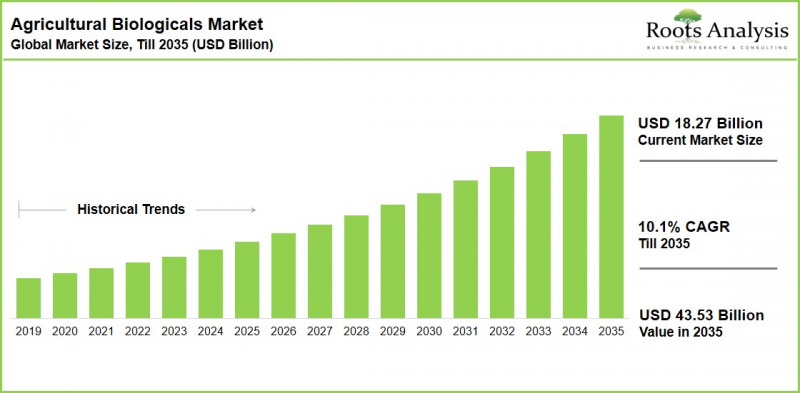
농업용 생물제제 시장 : 성장 및 동향
생물농약, 바이오 비료, 바이오자극제 등의 농업용 생물제제는 천연 유래의 작물 보호 및 영양 제품으로, 생물학적 메커니즘을 통해 작물의 수확량과 토양의 건전성을 향상시킵니다. 지난 10년 동안 기후 변화, 토양 황폐화, 화학 잔류물에 대한 규제 강화 등을 배경으로 농업용 생물 제제는 틈새 솔루션에서 통합 작물 관리의 주류 구성요소로 진화해 왔습니다.
또한, 전 세계 식량 수요 증가, 물 부족, 해충의 내성 강화, 그리고 합성 농약에 대한 규제 강화로 인해 생산성을 높이는 동시에 규제 준수를 지원하는 생물 유래 대체제의 도입이 가속화되고 있습니다. 유엔 식량농업기구(FAO), 미국 환경보호청(EPA), 유럽식품안전청(EFSA), 인도농업연구위원회(ICAR) 등의 기관은 각국의 식량 안보 및 토양 건강화 전략에서 생물 유래 작물 투입 자재의 역할을 강조하고 있으며, 이는 상업적 도입을 위한 유리한 조건을 조성하고 있습니다.
다국적 농약 제조사와 생물 유래 제품 전문 개발 기업들은 생물 유래 제품 포트폴리오를 확대하고 있습니다. 예를 들어, BASF는 AgBiTech 인수를 완료하여 생물 유래 해충 방제 제품 공급 체계를 강화했습니다. 한편, IPL Biologicals사는 구자라트주에 세 번째 제조 공장을 건설하여 생산능력을 연간 7,000 KL로 확대했습니다. 또한 신젠타사는 천연 화합물 및 미생물 균주에 대한 역량 확충을 지속하고 있습니다. 이러한 동향은 생물 유래 제품이 단순한 실험적 부수적 분야가 아니라, 구조적이고 장기적인 카테고리로 다루어지고 있음을 보여줍니다. 이러한 노력들은 유통 파트너, 제제 물류 및 판매 채널의 경제성에 직접적인 영향을 미치는 변화를 시사합니다.
성장의 원동력 : 시장 확대를 뒷받침하는 요인
농업용 생물제제 시장의 성장은 친환경적이고 지속가능한 농업을 촉진하기 위한 합성 농약에 대한 규제 강화에 의해 주도되고 있으며, 이는 생물 유래 작물 보호 제품의 채택을 가속화하고 있습니다. 또한, 잔류물이 없는 농산물에 대한 수요 증가 역시 농가의 관심을 농업용 생물제제로 더욱 돌리고 있습니다. 또한, FAO(유엔 식량농업기구)의 추산에 따르면 인위적인 토지 황폐화의 영향을 받는 지역에 약 17억 명이 거주하고 있는 것으로 알려져 있으며, 이러한 추산과 맞물려 지속가능하고 재생 가능한 농업으로의 전환 움직임이 바이오 비료 및 바이오 자극제의 잠재적 시장 규모를 확대시키고 있습니다. 미생물 균주의 발견, 발효 기술, 제제의 안정성 측면에서 지속적인 진전이 이루어짐에 따라, 오랫동안 농가의 신뢰를 저해해 온 장벽이었던 밭에서의 균일성이 향상되고 있습니다.
시장의 과제 : 진전을 저해하는 중대한 장벽
농업용 생물 제제는 대규모로 채택되고 있지만, 시장에는 여전히 해결해야 할 몇 가지 과제가 존재합니다. 생물 유래 제품의 밭에서의 성능은 기후 조건, 토양 종류, 작물 품종에 따라 변동될 가능성이 있습니다. 이러한 요인들로 인해 표준화된 합성 화학제품과 비교했을 때, 농가의 신뢰가 제한될 우려가 있습니다. 규제상의 취급도 일관성이 부족합니다. 생물 농약은 명확한 농약 등록 절차를 거치는 반면, 생물 자극제는 미국에서는 주로 EPA(환경보호청)의 공식 등록 대상에서 제외되어 있으며, 다른 지역에서도 규제가 제각각이기 때문에 효능이 검증되지 않은 제품이 시장에 유입되어 규정을 준수하는 개발자들에게 불공정한 경쟁 환경이 조성되고 있습니다.
농업용 생물제제 시장 : 주요 인사이트
본 보고서는 농업용 생물제제 시장의 현황을 상세히 분석하고, 유통 파트너, 판매 채널 중개업체, 농업 자재 소매업체를 위한 잠재적 성장 기회를 파악하고 있습니다. 주요 조사 결과는 다음과 같습니다:
- 제품의 원산지별, 보존 및 제제의 안정성에는 큰 차이가 있습니다. 식물 추출 유래 생물제제는 일반적으로 미생물 제제에 비해 보존 및 생존율에 관한 제약이 적기 때문에 유통업체는 단일 콜드체인 기준이 아닌 취급 제품별로 상이한 취급 절차를 유지해야 합니다.
- 가장 빠르게 성장하는 적용 형태로 종자 처리가 부상할 것으로 예상됨에 따라, 이는 명확한 판매 채널 기회를 열어주고 있습니다. 종자 제조사나 통합형 작물 솔루션 제공업체와 파트너십을 맺은 기업 및 유통업체는 광범위한 엽면 살포나 토양 살포 시장으로 확산되기 전에, 도입 초기 단계의 수요를 선점할 수 있는 위치에 있습니다.
- 바이오 자극제에 대한 규제가 파편화되어 있어, 미국에서는 주로 EPA(환경보호청)의 공식 농약 등록 대상에서 제외되고, 다른 지역에서도 일관성 없는 규제 체계를 마주하고 있기 때문에 효능이 검증되지 않은 제품이 시장에 유입되는 원인이 되고 있습니다. 제제의 품질을 검증하고 그 품질을 보증할 수 있는 판매업체는, 가격만을 경쟁 수단으로 삼는 경쟁사들에 비해 명확한 차별화 수단을 갖게 됩니다.
- IPL Biologicals의 구자라트주 제조 공장 확장에 대표되는 아시아태평양의 생산능력 확충에 따라, 현지 규제 절차를 원활하게 진행하고 세분화된 소규모 농가 시장에 대한 라스트 마일 배송을 가능하게 하는 지역 유통·물류 파트너에 대한 수요가 높아지고 있습니다.
- BASF의 AgBiTech 인수 등 대형 농약 제조사 간의 통합이 진행됨에 따라 소규모 지역 개발 기업의 시장 진입 장벽은 높아지고 있는 반면, 대규모 범용 유통 사업자가 쉽게 재현할 수 없는 특정 작물이나 지역에 특화된 전문 지식을 갖춘 틈새 유통업체에게는 새로운 비즈니스 기회가 생겨나고 있습니다.
- 과일이나 견과류 등 고부가가치 원예 분야에서는 생산자들이 제품 공급에 더해 농장 내 시험이나 수출 인증 지원과 같은 부가가치 서비스를 점점 더 기대하게 되고 있으며, 이 분야의 유통업체들은 물류 비용뿐만 아니라 기술 지원 측면에서도 경쟁을 펼치고 있는 것으로 나타났습니다.
- 인도 ICAR-CRIDA가 주관하는 ' 'Save the Field Campaign'과 같은 정부 주도의 토양 건전화 프로그램은 농가의 수요를 바이오 비료나 생물 유래 자재로 직접 유도하고 있으며, 공공 부문의 보급 프로그램과 연계하는 판매업자에게는 곡물 및 콩류 분야에서 정책에 뒷받침된 지속가능한 수요 기반이 마련되고 있습니다.
투자자들의 열기를 보여주는 최근 거래 동향
- 생산능력 확대 : IPL Biologicals가 구자라트주 바도다라에 신설한 제조 공장을 통해 연간 생산량이 7,000 KL/년으로 확대되었습니다. 이는 아시아태평양 공급 기반에서 수년에 걸친 지속적인 판매량 성장을 직접적으로 보여주는 지표입니다.
- M&A 동향 : BASF Agricultural Solutions가 AgBiTech를 인수한 것은 해당 기업의 생물 유래 해충 방제 제품 포트폴리오를 확대하는 것이며, 주요 제조사 간의 통합이 지속되고 있음을 시사합니다.
- 규제 측면의 진전 : BioPrime AgriSolutions가 인도 농업부로부터 20종의 생장촉진제 제제에 대한 승인을 획득한 것은 주요 신흥 시장에서 규제 명확화가 가속화되고 있음을 보여줍니다.
- 연구 개발 심화 : 신젠타(Syngenta)가 노바티스(Novartis)로부터 천연 화합물 및 유전자주 저장소를 인수한 것은 독자적인 미생물 및 식물 유래 물질 발견 플랫폼에 대한 지속적인 투자를 반영합니다.
농업용 생물제제 시장 세분화
시장 규모 및 기회 분석은 다음 매개변수를 기반으로 세분화됩니다:
제품 유형별
- 바이오 농약/생물학적 방제
- 바이오 비료
- 바이오 자극제
원료별
- 미생물
- 식물 추출물
- 기타
시용 방법별
- 엽면 살포
- 종자 처리
- 토양 처리
- 기타 시용 방법
대상 작물별
- 곡류 및 콩류
- 과일 및 견과류
- 유지작물
- 사료작물, 채소, 괴경류
- 산업용 작물, 섬유작물 및 기타
지역별
- 북미
- 미국
- 캐나다
- 유럽
- 독일
- 영국
- 프랑스
- 이탈리아
- 스페인
- 기타 유럽 국가
- 아시아태평양
- 중국
- 일본
- 인도
- 한국
- 호주
- 기타 아시아태평양
- 중동 및 북아프리카
- 사우디아라비아
- 아랍에미리트
- 라틴아메리카
- 브라질
- 아르헨티나
- 기타 라틴아메리카
기타 혜택
- 무료 PPT 인사이트 팩
- 보고서 내 모든 분석 모듈에 대응하는 무료 엑셀 데이터 팩
- 콘텐츠 맞춤 설정을 15% 무료로 제공해 드립니다.
- 조사팀별 상세한 보고서 해설 세션
- 보고서 발행 후 6-12개월 이상 경과한 경우, 무료로 최신 버전으로 업데이트해 드립니다.
목차
제1장 서문
제2장 조사 방법
제3장 시장 역학
제4장 거시경제 지표
제5장 주요 요약
제6장 소개
제7장 시장 구도
제8장 기업 경쟁력 분석
제9장 기업 개요
제10장 파트너십과 협력 관계
제11장 특허 분석
제12장 Porter's Five Forces 분석
제13장 시장 영향 분석 : 촉진요인, 저해요인, 기회, 과제
제14장 세계의 농업용 생물제제 시장
제15장 농업용 생물제제 시장(제품 유형별)
제16장 농업용 생물제제 시장(원료별)
제17장 농업용 생물제제 시장(적용 방법별)
제18장 농업용 생물제제 시장(대상 작물별)
제19장 농업용 생물제제 시장(지역별)
제20장 결론
제21장 경영진 인사이트
제22장 부록 1 : 표형식 데이터
KSM 26.08.13AGRICULTURAL BIOLOGICALS MARKET: OVERVIEW
As per Roots Analysis, the global agricultural biologicals market is estimated to grow from USD 18.27 billion in the current year to USD 43.53 billion by 2035, registering a CAGR of 10.1% across the forecast period.
Agricultural Biologicals Market: Growth and Trends
Agricultural biologicals, such as biopesticides, biofertilizers, and biostimulants are naturally derived crop protection and nutrition products that enhance crop yield and soil health through biological mechanisms. Over the past decade, agricultural biologicals have evolved from a niche solution to a mainstream component of integrated crop management, driven by climate variability, soil degradation, and stricter chemical residue regulations
Additionally, rising global food demand, water scarcity, increasing pest resistance, and stricter regulations on synthetic agrochemicals are driving the adoption of biological alternatives that improve productivity while supporting regulatory compliance. Agencies such as the Food and Agriculture Organization (FAO), the US Environmental Protection Agency (EPA), the European Food Safety Authority (EFSA) and the Indian Council of Agricultural Research (ICAR) have reinforced the role of biological crop inputs in national food-security and soil-health strategies, creating favorable conditions for commercial adoption.
Multinational agrochemical manufacturers and specialized biological product developers are expanding their biological portfolios. For instance, BASF's completed acquisition of AgBiTech to strengthen its biological insect-control offering. Meanwhile, IPL Biologicals' third manufacturing plant in Gujarat increased production capacity to 7,000 KL per year, and Syngenta's continued build-out of natural-compound and microbial-strain capabilities. These developments signal that biologicals are being treated as a structural, long-term category rather than an experimental sideline. These initiatives indicate a shift with direct implications for distribution partners, formulation logistics and channel economics.
Growth Drivers: Factors Fueling Market Expansion
Agricultural biologicals market growth is being driven by increasing regulatory restrictions on synthetic agrochemicals to promote environmentally friendly and sustainable farming, which is accelerating adoption of biological crop protection. Additionally, growing demand for residue-free produce has further shifted farmers' focus toward agricultural biologicals. Further, the push toward sustainable and regenerative agriculture, reinforced by FAO estimates that roughly 1.7 billion people live in regions affected by human-induced land degradation, is widening the addressable base for biofertilizers and biostimulants. Continued advances in microbial strain discovery, fermentation technology and formulation stability are improving field consistency, a long-standing barrier to grower confidence.
Market Challenges: Critical Barriers Hindering Progress
Although agricultural biologicals are being adopted on a large scale, the market still witnesses several challenges that need to be addressed. Field performance for biological products can vary with climatic conditions, soil type, and crop variety. These factors may limit farmer confidence relative to standardized synthetic chemistries. Regulatory treatment is also inconsistent: while biopesticides go through defined pesticide-registration pathways, biostimulants largely fall outside formal EPA registration in the US and face fragmented rules across other geographies, allowing products with unverified efficacy claims to enter the market and creating uneven competitive conditions for compliant developers.
Agricultural Biologicals Market: Key Insights
The report delves into the current state of the agricultural biologicals market and identifies potential growth opportunities for distribution partners, channel intermediaries, and agri-input retailers. Some key findings include:
- Storage and formulation stability differ meaningfully by source of product: plant-extract biologicals generally face fewer storage and viability constraints than microbial formulations, which require distributors to maintain differentiated handling protocols across their portfolio rather than a single cold-chain standard.
- The forecast shift toward seed treatments as the fastest-growing application mode is opening a distinct channel opportunity: companies and distributors that establish partnerships with seed manufacturers and integrated crop-solution providers are positioned to capture early-stage adoption before it reaches broad-acre foliar and soil channels.
- Regulatory fragmentation for biostimulants, which largely fall outside formal EPA pesticide registration in the US and face inconsistent frameworks elsewhere, is allowing products with unverified efficacy claims into the market; distributors that can validate and stand behind formulation quality have a clear differentiation lever over price-only competitors.
- Capacity build-out in Asia-Pacific, exemplified by IPL Biologicals' expanded manufacturing plant in Gujarat, is increasing the need for regional distribution and logistics partners capable of navigating local regulatory pathways and last-mile delivery into fragmented smallholder markets.
- Consolidation among large agrochemical majors, such as BASF's acquisition of AgBiTech, is raising barriers to entry for smaller regional developers while simultaneously creating openings for niche distributors with crop-specific or geography-specific expertise that larger, generalist channel players cannot easily replicate.
- In high-value horticultural segments such as fruits and nuts, growers increasingly expect value-added services, including on-farm trials and export-certification assistance, alongside product supply, indicating that distributors in this space are competing on technical support rather than logistics cost alone.
- Government-backed soil-health programs, such as ICAR-CRIDA's Save the Field Campaign in India, are directly channelling farmer demand toward biofertilizers and biological inputs, giving distributors aligned with public-sector extension programs a durable, policy-supported demand base in cereals and pulses.
Recent Deal Activity Signalling Investor Momentum
- Capacity Expansion: IPL Biologicals' new manufacturing plant in Vadodara, Gujarat lifts annual output to 7,000 KL / year, a direct proxy for sustained multi-year volume growth in the Asia-Pacific supply base.
- M&A Activity: BASF Agricultural Solutions' completed acquisition of AgBiTech extends its biological insect-control portfolio, signaling continued consolidation among originator-scale players.
- Regulatory Momentum: BioPrime AgriSolutions' approval for 20 biostimulant formulations from India's Ministry of Agriculture illustrates accelerating regulatory clarity in key emerging markets.
- R&D Deepening: Syngenta's acquisition of a natural-compound and genetic-strain repository from Novartis reflects sustained investment in proprietary microbial and botanical discovery platforms.
Agricultural Biologicals Market Segments
The market sizing and opportunity analysis has been segmented across the following parameters:
By Type of Product
- Biopesticides / Biocontrol
- Biofertilizers
- Biostimulants
By Source of Product
- Microbes
- Plant Extracts
- Other Sources
By Mode of Application
- Foliar Sprays
- Seed Treatments
- Soil Treatments
- Other Application Methods
By Type of Crop Treated
- Cereals and Pulses
- Fruits and Nuts
- Oilseeds
- Green Fodder, Vegetables and Tubers
- Industrial Crops, Textile Crops and Others
By Geographical Regions
- North America
- US
- Canada
- Europe
- Germany
- UK
- France
- Italy
- Spain
- Rest of Europe
- Asia-Pacific
- China
- Japan
- India
- South Korea
- Australia
- Rest of Asia-Pacific
- Middle East and North Africa
- Saudi Arabia
- UAE
- Latin America
- Brazil
- Argentina
- Rest of Latin America
Agricultural Biologicals Market: Key Segments
Biopesticides and Biocontrol Leads the Market
Biopesticides and biocontrol solutions currently account for the largest share of overall market share. This highest share is supported by the high economic value of crop protection and yield preservation. Further, the tightening residue regulations that favor biological alternatives to synthetic pesticides has further driving this segment growth.
In the coming years, Biofertilizers are projected to register the higher CAGR during the forecast period. This lucrative growth is largely because growers are increasingly prioritizing long-term soil health and nutrient-use efficiency, which is likely to increase the demand for biofertilizers. Further, the rising fertilizer costs and government-backed regenerative agriculture programs have supported the growth of biofertilizers segment.
Microbial Products Dominate the Market
Based on Roots Analysis market report, microbial products capture the highest market share. This highest share reflects their broad applicability across protection, fertilization and biostimulation, and their established track record on efficacy and scalability.
In the long run, plant extracts are expected to grow at a comparatively higher CAGR during the forecast period. This growth is aided by favorable storage stability and regulatory profiles relative to microbial formulations.
Foliar Sprays Hold the Highest Share of the Market
Based on the proprietary market report, Foliar sprays hold highest application share, owing to rapid, targeted delivery that integrates easily into existing spray programs. This targeted approach allows growers to rapidly correct acute nutrient deficiencies or address sudden pest and disease outbreaks in real-time, preventing severe yield drag.
On the other hand, seed treatments segment is likely to grow at a higher CAGR during the forecast period. This growth is driven by a shift toward preventive and input-efficient crop establishment strategies. Rather than relying on reactive, broad-acre foliar applications, modern agricultural systems are prioritizing localized, seed-applied solutions. This targeted approach ensures maximum early-stage protection against soil-borne pathogens and pests while drastically reducing chemical runoff, aligning operational efficiency with tightening environmental ESG standards.
Cereals and Pulses Dominate the Crop Treating Segment
Based on the Roots Analysis market report, cereals and pulses account for the highest overall market share. This highest share is driven by the sheer scale of global cultivation area and government-backed soil-health initiatives such as ICAR-CRIDA's Save the Field Campaign (Khet Bachao Abhiyan), launched in June.
On the other hand, fruits and nuts are projected to grow at the fastest CAGR during the forecast period. This rapid growth is propelled by escalating export-compliance demands and the lucrative per-acre margins in high-value horticulture, which make growers far more receptive to investing in premium biological solutions.
North America Dominates the Market and Registers Higher CAGR
North America anchors the global market, driven by a mature organic-farming infrastructure, high biological adoption rates, and robust commercial distribution channels. This dominance is further stabilized by the EPA's structured regulatory frameworks, which provide clear, predictable registration pathways for novel crop inputs.
Meanwhile, the Asia-Pacific region is projected to register the fastest CAGR during the forecast period till 2035. This highest growth is propelled by aggressive government-backed soil restoration mandates and a massive domestic push to scale manufacturing capacity in agricultural giant countries like India and China, paving the way for rapid localized production of advanced crop solutions.
Example Players in Agricultural Biologicals Market
- AMVAC
- Andermatt
- BASF
- Bayer
- BioSafe Systems
- Brandt
- Certis Biologicals
- Corteva Agriscience
- FBSciences
- Grow Indigo
- Koppert Biological Systems
- Lallemand
- Nutri-Tech Solutions
- Novonesis
- PI Industries
- ProFarm
- SQM
- Stoller
- Syngenta AG
- UPL
- Vegalab
- Valent Biosciences
- Verdisian Life Sciences
Expert Interview and Industry Insights
The opinions and insights presented in this study were shaped by discussions with multiple stakeholders across the value chain. The research report features detailed transcripts of interviews held with the following industry participants:
- President, Mid-sized Company, Switzerland
- Global Director, Mid-sized Company, Canada
- Sales Representative, Mid-sized Company, China
In addition, the market report includes transcripts of the following other third-party discussions:
- Chairman of the Board, Mid-sized Company, US
- Head of Biologics, Very Large Company, Germany
- Agribusiness Strategist, Small Company, Brazil
- Director of Market Innovation, Mid-sized Company, US
- Chief Executive Officer and Co-founder, Mid-sized Company, Belgium
- Director of Technical Marketing and Communication, Mid-sized Company, US
- Head of Crop Protection Product Team Biologicals, Very Large Company, Germany
- Founder and Former Chief Executive Officer, Mid-sized Company, US
- Chief Executive Officer and President, Mid-sized Company, Spain
- Co-founder and Chief Executive Officer, Mid-sized Company, Chile
AGRICULTURAL BIOLOGICALS MARKET: RESEARCH COVERAGE
- Market Sizing and Opportunity Analysis: An in-depth analysis of the agricultural biologicals market, focusing on key segments, including type of product, source of product, mode of application, type of crop treated, and geographical regions.
- Distributor and Channel Landscape: A dedicated view of how application method (foliar, seed, soil) and crop-cycle seasonality shape inventory, cold-chain and last-mile distribution requirements, directly relevant to distributors and agri-input retailers.
- Developer Landscape: A detailed assessment of companies developing agricultural biologicals, based on parameters such as year of establishment, company size, location of headquarters, and product portfolio breadth.
- Company Profiles: In-depth profiles of prominent players engaged in the development and commercialization of agricultural biologicals, featuring information on year of establishment, headquarters, product portfolio, and key initiatives.
- Partnerships and Collaborations Analysis: A comprehensive assessment of partnership activity among agricultural biologicals developers, evaluated by year, partnership type, focus area, and geography, highlighting the most active companies and regional deal patterns.
- Patent Analysis: A comprehensive analysis of patents related to agricultural biologicals, based on several relevant parameters, including publication year, application year, patent type, jurisdiction, CPC symbols, and type of applicant. The chapter further presents an assessment of the leading industry players, non-industry players, and individual assignees based on patent activity.
- Porter's Five Forces Analysis: A qualitative assessment of the competitive dynamics within the market using Porter's Five Forces framework. The chapter evaluates the impact of five key forces, namely, the threat of new entrants, bargaining power of end-users, bargaining power of product developers, threat of substitute products, and rivalry among existing competitors, providing insights into the overall attractiveness, competitive intensity, and long-term growth potential of the market.
- Market Impact Analysis: The report analyzes drivers, restraints, opportunities, and challenges affecting market growth, including the impact of regulatory fragmentation on biostimulant commercialization.
Key Questions Answered in this Report
- How large is the agricultural biologicals market today, and how large will it be by 2035?
- Which product types, sources and application modes are gaining or losing share?
- Which companies are best positioned across each segment, and how deep is their product pipeline?
- How will the shift toward biofertilizers and seed treatments reshape distribution and channel economics?
- Which crop segments and geographies offer the strongest near-term revenue and long-term growth combination?
- What is the realistic impact of regulatory fragmentation on biostimulant commercialization timelines?
Reasons to Buy this Report
Market players evaluating the agricultural biologicals opportunity need more than a headline market size. This report is built to support commercial decision-making, not just awareness, and differentiates itself on the following counts:
- Top-Down and Bottom-Up Triangulated Forecasting: Revenue projections for each segment are cross-validated using both macro-level agronomic demand data and company-level sales figures, reducing forecast risk for investors and channel partners.
- Primary Research with Senior Commercial and Technical Leadership: Insights are grounded in interviews with presidents, global directors, and heads of biologics across large, mid-sized, and specialty organizations, not desk research alone.
- Distribution and Channel-Specific Lens: Unlike generic agri-input market reports, this study maps how the mix shift across foliar, seed, and soil application methods will change storage stability requirements, seasonal inventory planning, and retail agri-input accessibility, insights directly relevant to distributors and input retailers.
- Regulatory-Readiness Analysis: A dedicated view of EPA and EFSA treatment of biopesticides versus the fragmented, evolving oversight of biostimulants helps distributors time market-entry and portfolio decisions around regulatory clarity.
- Investor-Grade Financial Context: Company profiles include revenue trends, recent capital deployment (such as IPL Biologicals' expanded manufacturing capacity and BASF's AgBiTech acquisition), and funding activity, positioned for use in diligence and business case development.
Additional Benefits
- Complementary PPT Insights Pack
- Complementary Excel Data Packs for all Analytical Modules in the Report
- 15% Free Content Customization
- Detailed Report Walkthrough Session with Research Team
- Free Updated report if the report is 6-12 months old or older
TABLE OF CONTENTS
1. PREFACE
- 1.1. Introduction
- 1.2. Market Share Insights
- 1.3. Key Market Insights
- 1.4. Report Coverage
- 1.5. Key Questions Answered
- 1.6. Chapter Outlines
2. RESEARCH METHODOLOGY
- 2.1. Chapter Overview
- 2.2. Research Assumptions
- 2.2.1. Market Landscape and Market Trends
- 2.2.2. Market Forecast and Opportunity Analysis
- 2.2.3. Comparative Analysis
- 2.3. Database Building
- 2.3.1. Data Collection
- 2.3.2. Data Validation
- 2.3.3. Data Analysis
- 2.4. Project Methodology
- 2.4.1. Secondary Research
- 2.4.1.1. Annual Reports
- 2.4.1.2. Academic Research Papers
- 2.4.1.3. Company Websites
- 2.4.1.4. Investor Presentations
- 2.4.1.5. Regulatory Filings
- 2.4.1.6. White Papers
- 2.4.1.7. Industry Publications
- 2.4.1.8. Conferences and Seminars
- 2.4.1.9. Government Portals
- 2.4.1.10. Media and Press Releases
- 2.4.1.11. Newsletters
- 2.4.1.12. Industry Databases
- 2.4.1.13. Roots Proprietary Databases
- 2.4.1.14. Paid Databases and Sources
- 2.4.1.15. Social Media Portals
- 2.4.1.16. Other Secondary Sources
- 2.4.2. Primary Research
- 2.4.2.1. Types of Primary Research
- 2.4.2.1.1. Qualitative Research
- 2.4.2.1.2. Quantitative Research
- 2.4.2.1.3. Hybrid Approach
- 2.4.2.2. Advantages of Primary Research
- 2.4.2.3. Techniques for Primary Research
- 2.4.2.3.1. Interviews
- 2.4.2.3.2. Surveys
- 2.4.2.3.3. Focus Groups
- 2.4.2.3.4. Observational Research
- 2.4.2.3.5. Social Media Interactions
- 2.4.2.4. Key Opinion Leaders Considered in Primary Research
- 2.4.2.4.1. Company Executives (CXOs)
- 2.4.2.4.2. Board of Directors
- 2.4.2.4.3. Company Presidents and Vice Presidents
- 2.4.2.4.4. Research and Development Heads
- 2.4.2.4.5. Technical Experts
- 2.4.2.4.6. Subject Matter Experts
- 2.4.2.4.7. Scientists
- 2.4.2.4.8. Doctors and Other Healthcare Providers
- 2.4.2.5. Ethics and Integrity
- 2.4.2.5.1. Research Ethics
- 2.4.2.5.2. Data Integrity
- 2.4.2.1. Types of Primary Research
- 2.4.3. Analytical Tools and Databases
- 2.4.1. Secondary Research
- 2.5. Robust Quality Control
3. MARKET DYNAMICS
- 3.1. Chapter Overview
- 3.2. Forecast Methodology
- 3.2.1. Top-down Approach
- 3.2.2. Bottom-up Approach
- 3.2.3. Hybrid Approach
- 3.3. Market Assessment Framework
- 3.3.1. Total Addressable Market (TAM)
- 3.3.2. Serviceable Addressable Market (SAM)
- 3.3.3. Serviceable Obtainable Market (SOM)
- 3.3.4. Currently Acquired Market (CAM)
- 3.4. Forecasting Tools and Techniques
- 3.4.1. Qualitative Forecasting
- 3.4.2. Correlation
- 3.4.3. Regression
- 3.4.4. Extrapolation
- 3.4.5. Convergence
- 3.4.6. Sensitivity Analysis
- 3.4.7. Scenario Planning
- 3.4.8. Data Visualization
- 3.4.9. Time Series Analysis
- 3.4.10. Forecast Error Analysis
- 3.5. Key Considerations
- 3.5.1. Demographics
- 3.5.2. Government Regulations
- 3.5.3. Reimbursement Scenarios
- 3.5.4. Market Access
- 3.5.5. Supply Chain
- 3.5.6. Industry Consolidation
- 3.5.7. Pandemic / Unforeseen Disruptions Impact
- 3.6. Limitations
4. MACRO-ECONOMIC INDICATORS
- 4.1. Chapter Overview
- 4.2. Market Dynamics
- 4.2.1. Time Period
- 4.2.1.1. Historical Trends
- 4.2.1.2. Current and Forecasted Estimates
- 4.2.2. Currency Coverage
- 4.2.2.1. Major Currencies Affecting the Market
- 4.2.2.2. Factors Affecting Currency Fluctuations
- 4.2.2.3. Impact of Currency Fluctuations on the Industry
- 4.2.3. Foreign Currency Exchange Rate
- 4.2.3.1. Impact of Foreign Exchange Rate Volatility on the Market
- 4.2.3.2. Strategies for Mitigating Foreign Exchange Risk
- 4.2.4. Recession
- 4.2.4.1. Assessment of Current Economic Conditions and Potential Impact on the Market
- 4.2.4.2. Historical Analysis of Past Recessions and Lessons Learnt
- 4.2.5. Inflation
- 4.2.5.1. Measurement and Analysis of Inflationary Pressures in the Economy
- 4.2.5.2. Potential Impact of Inflation on the Market Evolution
- 4.2.6. Interest Rates
- 4.2.6.1. Interest Rates and Their Impact on the Market
- 4.2.6.2. Strategies for Managing Interest Rate Risk
- 4.2.7. Commodity Flow Analysis
- 4.2.7.1. Type of Commodity
- 4.2.7.2. Origins and Destinations
- 4.2.7.3. Values and Weights
- 4.2.7.4. Modes of Transportation
- 4.2.8. Global Trade Dynamics
- 4.2.8.1. Import Scenario
- 4.2.8.2. Export Scenario
- 4.2.8.3. Trade Policies
- 4.2.8.4. Strategies for Mitigating the Risks Associated with Trade Barriers
- 4.2.8.5. Impact of Trade Barriers on the Market
- 4.2.9. War Impact Analysis
- 4.2.9.1. Russian-Ukraine War
- 4.2.9.2. Israel-Hamas War
- 4.2.10. COVID Impact / Related Factors
- 4.2.10.1. Global Economic Impact
- 4.2.10.2. Industry-specific Impact
- 4.2.10.3. Government Response and Stimulus Measures
- 4.2.10.4. Future Outlook and Adaptation Strategies
- 4.2.11. Other Indicators
- 4.2.11.1. Fiscal Policy
- 4.2.11.2. Consumer Spending
- 4.2.11.3. Gross Domestic Product
- 4.2.11.4. Employment
- 4.2.11.5. Taxes
- 4.2.11.6. Stock Market Performance
- 4.2.11.7. Cross Border Dynamics
- 4.2.1. Time Period
- 4.3. Conclusion
5. EXECUTIVE SUMMARY
- 5.1. Executive Summary: Market Landscape
- 5.2. Executive Summary: Market Trends
- 5.3. Executive Summary: Market Forecast and Opportunity Analysis
6. INTRODUCTION
- 6.1. Chapter Overview
- 6.2. Sustainable Agriculture
- 6.3. Introduction to Agricultural Biologicals
- 6.3.1. Types of Agricultural Biologicals
- 6.3.1.1. Biostimulants
- 6.3.1.2. Biopesticides / Biocontrol
- 6.3.1.3. Biofertilizers
- 6.3.2. Advantages of Agricultural Biologicals
- 6.3.1. Types of Agricultural Biologicals
- 6.4. Future Perspectives
7. MARKET LANDSCAPE
- 7.1. Chapter Overview
- 7.2. Agricultural Biologicals Manufacturers: Overall Market Landscape
- 7.2.1. Analysis by Year of Establishment
- 7.2.2. Analysis by Company Size
- 7.2.3. Analysis by Year of Establishment and Company Size
- 7.2.4. Analysis by Location of Headquarters
- 7.2.5. Analysis by Company Size and Location of Headquarters
- 7.2.6. Analysis by Type of Product Offered
- 7.2.7. Analysis by Company Size and Type of Product Offered
- 7.2.8. Analysis by Source of Product Offered
- 7.2.9. Analysis by Type of Product Formulation
- 7.2.10. Analysis by Type of Crop Treated
- 7.2.11. Analysis by Mode of Application
- 7.2.12. Analysis by Number of Products Offered
- 7.2.13. Most Active Players: Analysis by Number of Products Offered
8. COMPANY COMPETITIVENESS ANALYSIS
- 8.1. Chapter Overview
- 8.2. Assumptions and Key Parameters
- 8.3. Methodology
- 8.4. Company Competitiveness Analysis: Agricultural Biologicals Manufacturers in North America
- 8.4.1. Very Small and Small Companies in North America
- 8.4.2. Mid-sized Companies in North America
- 8.4.3. Large and Very Large Companies in North America
- 8.5. Company Competitiveness Analysis: Agricultural Biologicals Manufacturers in Europe
- 8.5.1. Very Small and Small Companies in Europe
- 8.5.2. Mid-sized Companies in Europe
- 8.5.3. Large and Very Large Companies in Europe
- 8.6. Company Competitiveness Analysis: Agricultural Biologicals Manufacturers in Asia-Pacific and Rest of the World
- 8.6.1. Very Small and Small Companies in Asia-Pacific and Rest of the World
- 8.6.2. Mid-sized Companies in Asia-Pacific and Rest of the World
- 8.6.3. Large and Very Large Companies in Asia-Pacific and Rest of the World
- 8.7. Company Competitiveness Analysis: Other Agricultural Biologicals Manufacturers
9. COMPANY PROFILES
- 9.1. Chapter Overview
- 9.2. Leading Players in Agricultural Biologicals Market
- 9.2.1. Andermatt
- 9.2.1.1. Company Overview
- 9.2.1.2. Agricultural Biologicals Portfolio
- 9.2.1.3. Recent Developments and Future Outlook
- 9.2.2. Certis Biologicals
- 9.2.2.1. Company Overview
- 9.2.2.2. Agricultural Biologicals Portfolio
- 9.2.2.3. Recent Developments and Future Outlook
- 9.2.3. Corteva Agriscience
- 9.2.3.1. Company Overview
- 9.2.3.2. Financial Information
- 9.2.3.3. Agricultural Biologicals Portfolio
- 9.2.3.4. Recent Developments and Future Outlook
- 9.2.4. Nutri-Tech Solutions
- 9.2.4.1. Company Overview
- 9.2.4.2. Agricultural Biologicals Portfolio
- 9.2.4.3. Recent Developments and Future Outlook
- 9.2.5. Novozymes
- 9.2.5.1. Company Overview
- 9.2.5.2. Financial Information
- 9.2.5.3. Agricultural Biologicals Portfolio
- 9.2.5.4. Recent Developments and Future Outlook
- 9.2.6. ProFarm
- 9.2.6.1. Company Overview
- 9.2.6.2. Agricultural Biologicals Portfolio
- 9.2.6.3. Recent Developments and Future Outlook
- 9.2.7. SQM
- 9.2.7.1. Company Overview
- 9.2.7.2. Agricultural Biologicals Portfolio
- 9.2.7.3. Recent Developments and Future Outlook
- 9.2.8. UPL
- 9.2.8.1. Company Overview
- 9.2.8.2. Financial Information
- 9.2.8.3. Agricultural Biologicals Portfolio
- 9.2.8.4. Recent Developments and Future Outlook
- 9.2.9. Vegalab
- 9.2.9.1. Company Overview
- 9.2.9.2. Agricultural Biologicals Portfolio
- 9.2.9.3. Recent Developments and Future Outlook
- 9.2.1. Andermatt
- 9.3. Other Leading Players in Agricultural Biologicals Market
- 9.3.1. AMVAC
- 9.3.1.1. Company Overview
- 9.3.1.2. Agricultural Biologicals Portfolio
- 9.3.2. BASF
- 9.3.2.1. Company Overview
- 9.3.2.2. Agricultural Biologicals Portfolio
- 9.3.3. Bayer
- 9.3.3.1. Company Overview
- 9.3.3.2. Agricultural Biologicals Portfolio
- 9.3.4. BioSafe Systems
- 9.3.4.1. Company Overview
- 9.3.4.2. Agricultural Biologicals Portfolio
- 9.3.5. Brandt
- 9.3.5.1. Company Overview
- 9.3.5.2. Agricultural Biologicals Portfolio
- 9.3.6. Chr.
- 9.3.6.1. Company Overview
- 9.3.6.2. Agricultural Biologicals Portfolio
- 9.3.7. FBSciences
- 9.3.7.1. Company Overview
- 9.3.7.2. Agricultural Biologicals Portfolio
- 9.3.8. Grow Indigo
- 9.3.8.1. Company Overview
- 9.3.8.2. Agricultural Biologicals Portfolio
- 9.3.9. Koppert
- 9.3.9.1. Company Overview
- 9.3.9.2. Agricultural Biologicals Portfolio
- 9.3.10. Lallemand
- 9.3.10.1. Company Overview
- 9.3.10.2. Agricultural Biologicals Portfolio
- 9.3.11. PI Industries
- 9.3.11.1. Company Overview
- 9.3.11.2. Agricultural Biologicals Portfolio
- 9.3.12. Stoller
- 9.3.12.1. Company Overview
- 9.3.12.2. Agricultural Biologicals Portfolio
- 9.3.13. Syngenta
- 9.3.13.1. Company Overview
- 9.3.13.2. Agricultural Biologicals Portfolio
- 9.3.14. Valent Biosciences
- 9.3.14.1. Company Overview
- 9.3.14.2. Agricultural Biologicals Portfolio
- 9.3.15. Verdesian Life Sciences
- 9.3.15.1. Company Overview
- 9.3.15.2. Agricultural Biologicals Portfolio
- 9.3.1. AMVAC
10. PARTNERSHIPS AND COLLABORATIONS
- 10.1. Chapter Overview
- 10.2. Partnership Models
- 10.3. Agricultural Biologicals: Recent Partnerships and Collaborations
- 10.3.1. Analysis by Year of Partnership
- 10.3.2. Analysis by Type of Partnership
- 10.3.3. Analysis by Year and Type of Partnership
- 10.3.4. Analysis by Type of Partnership and Company Size
- 10.3.5. Analysis by Focus Area of Partnership
- 10.3.6. Analysis by Type of Partner
- 10.3.7. Most Active Players: Analysis by Number of Partnerships
- 10.3.8. Analysis by Geography
- 10.3.8.1. Local and International Agreements
- 10.3.8.2. Intracontinental and Intercontinental Agreements
11. PATENT ANALYSIS
- 11.1. Chapter Overview
- 11.2. Scope and Methodology
- 11.3. Agricultural Biologicals: Patent Analysis
- 11.3.1. Analysis by Patent Publication Year
- 11.3.2. Analysis by Patent Application Year
- 11.3.3. Analysis of Granted Patents and Patent Applications by Publication Year
- 11.3.4. Analysis by Patent Jurisdiction
- 11.3.5. Analysis by CPC Symbols
- 11.3.6. Analysis by Type of Applicant
- 11.3.7. Leading Industry Players: Analysis by Number of Patents
- 11.3.8. Leading Non-Industry Players: Analysis by Number of Patents
- 11.3.9. Leading Individual Assignees: Analysis by Number of Patents
- 11.4. Agricultural Biologicals: Patent Benchmarking Analysis
- 11.4.1. Analysis by Patent Characteristics
- 11.5. Agricultural Biologicals: Patent Valuation
- 11.6. Leading Patents by Number of Citations
12. PORTER'S FIVE FORCES ANALYSIS
- 12.1. Chapter Overview
- 12.2. Methodology and Assumptions
- 12.3. Key Parameters
- 12.3.1. Threats of New Entrants
- 12.3.2. Bargaining Power of End-Users
- 12.3.3. Bargaining Power of Product Developers
- 12.3.4. Threats of Substitute Products
- 12.3.5. Rivalry Among Existing Competitors
- 12.4. Concluding Remarks
13. MARKET IMPACT ANALYSIS: DRIVERS, RESTRAINTS, OPPORTUNITIES AND CHALLENGES
- 13.1. Chapter Overview
- 13.2. Market Drivers
- 13.3. Market Restraints
- 13.4. Market Opportunities
- 13.5. Market Challenges
- 13.6. Conclusion
14. GLOBAL AGRICULTURAL BIOLOGICALS MARKET
- 14.1. Chapter Overview
- 14.2. Assumptions and Methodology
- 14.3. Global Agricultural Biologicals Market, Historical Trends (Since 2019) and Forecasted Estimates (Till 2035)
- 14.3.1. Scenario Analysis
- 14.4. Key Market Segmentations
- 14.5. Dynamic Dashboard
15. AGRICULTURAL BIOLOGICALS MARKET, BY TYPE OF PRODUCT
- 15.1. Chapter Overview
- 15.2. Key Assumptions and Methodology
- 15.3. Agricultural Biologicals Market: Distribution by Type of Product (USD Billion)
- 15.3.1. Biopesticides / Biocontrol Market: Historical Trends (Since 2019) and Forecasted Estimates (Till 2035) (USD Billion)
- 15.3.2. Biofertilizers Market: Historical Trends (Since 2019) and Forecasted Estimates (Till 2035) (USD Billion)
- 15.3.3. Biostimulants Market: Historical Trends (Since 2019) and Forecasted Estimates (Till 2035) (USD Billion)
- 15.4. Data Triangulation
- 15.4.1. Insights based on Primary Research
- 15.4.2. Insights based on Secondary Research
16. AGRICULTURAL BIOLOGICALS MARKET, BY SOURCE OF PRODUCT
- 16.1. Chapter Overview
- 16.2. Key Assumptions and Methodology
- 16.3. Agricultural Biologicals Market: Distribution by Source of Product (USD Billion)
- 16.3.1. Agricultural Biologicals Market for Microbes: Historical Trends (Since 2019) and Forecasted Estimates (Till 2035) (USD Billion)
- 16.3.2. Agricultural Biologicals Market for Plant Extracts: Historical Trends (Since 2019) and Forecasted Estimates (Till 2035) (USD Billion)
- 16.3.3. Agricultural Biologicals Market for Other Sources: Historical Trends (Since 2019) and Forecasted Estimates (Till 2035) (USD Billion)
- 16.4. Data Triangulation
- 16.4.1. Insights based on Primary Research
- 16.4.2. Insights based on Secondary Research
17. AGRICULTURAL BIOLOGICALS MARKET, BY MODE OF APPLICATION
- 17.1. Chapter Overview
- 17.2. Key Assumptions and Methodology
- 17.3. Agricultural Biologicals Market: Distribution by Mode of Application (USD Billion)
- 17.3.1. Agricultural Biologicals Market for Foliar Sprays: Historical Trends (Since 2019) and Forecasted Estimates (Till 2035) (USD Billion)
- 17.3.2. Agricultural Biologicals Market for Seed Treatments: Historical Trends (Since 2019) and Forecasted Estimates (Till 2035) (USD Billion)
- 17.3.3. Agricultural Biologicals Market for Soil Treatments: Historical Trends (Since 2019) and Forecasted Estimates (Till 2035) (USD Billion)
- 17.3.4. Agricultural Biologicals Market for Other Application Methods: Historical Trends (Since 2019) and Forecasted Estimates (Till 2035) (USD Billion)
- 17.4. Data Triangulation
- 17.4.1. Insights based on Primary Research
- 17.4.2. Insights based on Secondary Research
18. AGRICULTURAL BIOLOGICALS MARKET, BY TYPE OF CROP TREATED
- 18.1. Chapter Overview
- 18.2. Key Assumptions and Methodology
- 18.3. Agricultural Biologicals Market: Distribution by Type of Crop Treated (USD Billion)
- 18.3.1. Agricultural Biologicals Market for Cereals and Pulses: Historical Trends (Since 2019) and Forecasted Estimates (Till 2035) (USD Billion)
- 18.3.2. Agricultural Biologicals Market for Fruits and Nuts: Historical Trends (Since 2019) and Forecasted Estimates (Till 2035) (USD Billion)
- 18.3.3. Agricultural Biologicals Market for Oilseeds: Historical Trends (Since 2019) and Forecasted Estimates (Till 2035) (USD Billion)
- 18.3.4. Agricultural Biologicals Market for Green Fodder, Vegetables and Tubers: Historical Trends (Since 2019) and Forecasted Estimates (Till 2035) (USD Billion)
- 18.3.5. Agricultural Biologicals Market for Industrial Crops, Textile Crops and Others: Historical Trends (Since 2019) and Forecasted Estimates (Till 2035) (USD Billion)
- 18.4. Data Triangulation
- 18.4.1. Insights based on Secondary Research
19. AGRICULTURAL BIOLOGICALS MARKET, BY GEOGRAPHY
- 19.1. Chapter Overview
- 19.2. Key Assumptions and Methodology
- 19.3. Agricultural Biologicals Market: Distribution by Key Geographical Regions (USD Billion)
- 19.3.1. Agricultural Biologicals Market for North America: Historical Trends (Since 2019) and Forecasted Estimates (Till 2035) (USD Billion)
- 19.3.2. Agricultural Biologicals Market for Europe: Historical Trends (Since 2019) and Forecasted Estimates (Till 2035) (USD Billion)
- 19.3.3. Agricultural Biologicals Market for Asia-Pacific: Historical Trends (Since 2019) and Forecasted Estimates (Till 2035) (USD Billion)
- 19.3.4. Agricultural Biologicals Market for Latin America: Historical Trends (Since 2019) and Forecasted Estimates (Till 2035) (USD Billion)
- 19.3.5. Agricultural Biologicals Market for Middle East and North Africa: Historical Trends (Since 2019) and Forecasted Estimates (Till 2035) (USD Billion)
- 19.4. Data Triangulation
- 19.4.1. Insights based on Primary Research
- 19.4.2. Insights based on Secondary Research


