

|
시장보고서
상품코드
2107340
Fc 융합 치료제 시장 : 대상 질환별, 융합 분자 유형별, 투여 경로별, 주요 지역별 - 동향 및 세계 예측(-2035년)Fc Fusion Therapeutics Market by Target Indication, Type of Fusion Molecule, Route of Administration, and Key Geographical Regions - Trends and Global Forecast Till 2035 |
||||||

Fc 융합 치료제 시장 : 개요
세계의 Fc 융합 치료제 시장 규모는 2035년까지 예측 기간 동안 CAGR 10%라는 눈부신 성장을 나타내고, 올해 206억 달러에서 2035년에는 535억 1,000만 달러에 달할 것으로 추정됩니다.
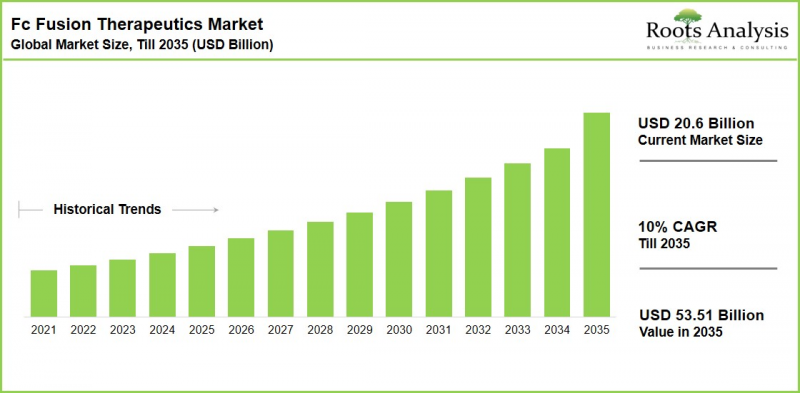
Fc 융합 치료제 시장 : 성장 및 동향
Fc 도메인은 신생아 Fc 수용체(FcRn)에 결합함으로써 치료용 페이로드의 혈중 반감기를 연장합니다. 이를 통해 분자는 리소좀에 의한 분해로부터 보호되어 혈류로 재순환됩니다. 이러한 반감기의 이점으로 인해 비융합형 바이오의약품에 비해 투여 빈도를 줄일 수 있으므로, 만성 질환 및 희귀 질환의 치료 요법에서 이 요법의 채택이 지속적으로 촉진되고 있습니다. Arcalyst®(재발성 심막염), Reblozyl®(β-지중해빈혈), Eylea®(신생혈관성 노인성 황반변성) 등의 최근 승인 사례는 이 치료법이 당초의 자가면역 질환이라는 영역을 훨씬 넘어 확장되고 있음을 보여줍니다.
치료제 개발 기업들은 종양 표적화 및 면역 조절 기능을 향상시키기 위해 SIRPa-Fc, FLT3L-Fc, 이중 특이성 Fc 융합체 등 차세대 융합체 구조의 개발을 더욱 적극적으로 추진하고 있습니다. 한편, 기존 주요 기업들은 부상하는 바이오시밀러와의 경쟁에 맞서 블록버스터 제품의 프랜차이즈를 계속해서 지켜나가고 있습니다. 스폰서 기업이 사내 인프라를 구축하지 않고도 임상 및 상업적 공급 규모를 확대하려는 가운데, 위탁 개발·제조 기관(CDMO), 전문 유통업체, 콜드체인 물류 제공업체는 이 생태계에서 점점 더 중요한 역할을 수행하고 있습니다.
성장의 원동력 : 세계 Fc 융합 치료제 시장 확장을 뒷받침하는 요인
이러한 성장은 Fc 융합 후보 약물의 후기 임상 개발 파이프라인 확대, 혈액 질환 등 만성 질환의 유병률 증가, 그리고 용해성, 안정성, 표적 특이성 향상을 목표로 한 융합 분자 공학 분야의 지속적인 혁신에 의해 주도되고 있습니다. 엠브렐, 아이레아, 레브로질의 상업적 성공으로 인해 이 치료법에 대한 규제 및 보험 급여 승인 절차에 대한 신뢰가 높아지고 있습니다. 또한, 주요 제약사들의 라이선싱 계약 및 공동 개발 계약 증가가 이 분야에 대한 투자를 촉진하고 있습니다.
시장의 과제 : 진전을 가로막는 중대한 장벽
양호한 펀더멘털에도 불구하고, 시장에는 Fc 도메인과 관련된 면역원성 위험이나, 일관된 약동학을 나타내는 융합체 구조를 설계하는 데 따르는 기술적 복잡성 등의 제약이 존재합니다. 게다가 엠브렐(Enbrel)과 같은 1세대 제품에 대한 바이오시밀러/바이오베터의 경쟁이 다가오고 있어, 시장 참여자들에게 큰 과제가 되고 있습니다. 또한, 이러한 온도에 민감한 생물학적 제제에 대한 콜드체인 및 취급 요건 역시 이 분야 진출을 목표로 하는 유통업체와 채널 파트너에게 운영상의 장벽을 높이고 있습니다.
Fc 융합 치료제 시장 : 주요 인사이트
본 보고서에서는 Fc 융합 치료제 시장의 현황을 분석하고, 유통 파트너, 전문 약국, 물류 제공업체를 위한 실행 가능한 진입 지점을 파악하고 있습니다. 주요 조사 결과는 다음과 같습니다:
- 현재 110건 이상의 Fc 융합 치료제 후보가 시판 중이거나 활발한 임상 개발이 진행되고 있습니다.
- 후보 약물의 안전성과 유효성을 평가하기 위해 전 세계적으로 1,500건 이상의 임상시험이 실시되고 있습니다.
- 전 세계 각지에서 진행된 임상시험에는 총 200만 명 이상의 환자가 등록되었습니다.
- 중기-후기 단계의 파이프라인 후보들은 주로 종양학 분야의 적응증에 집중되어 있습니다.
- Fc 단백질 변형 항체 구조체는 진행 중인 종양학 파이프라인 후보의 대부분을 차지하고 있습니다.
- 연구 자금은 주로 SBIR/STTR 이외의 자금 조달 경로를 통해 마련되고 있으며, 이는 주요 기관 및 기업의 투자가 활발함을 보여줍니다.
- 상업적 의약품 개발 기업과 학술 연구 기관 모두에서 지적 재산권 창출이 꾸준히 증가하고 있습니다.
Fc 융합 치료제 시장
시장 규모 및 기회 분석은 다음 매개변수를 기준으로 분류됩니다:
대상 질환별
- 류마티스 관절염
- 신생혈관형(습성) 노인성 황반변성
- A형 혈우병
- 유방암
- 비소세포폐암
- 호중구감소증
- 이식편 대 숙주병
- 시신경척수염 스펙트럼 장애
- 전신성 홍반성 루푸스
- 기타 적응증
융합 분자 유형별
- 항체 기반 Fc 융합체
- 사이토카인 기반 Fc 융합체
- 성장 인자 기반 Fc 융합체
- 수용체 ECD를 기반으로 하는 Fc 융합체
- 기타 융합 유형
투여 경로별
- 피하
- 정맥 내
- 유리체 내
지역별
- 북미
- 미국
- 캐나다
- 유럽
- 독일
- 영국
- 프랑스
- 이탈리아
- 스페인
- 기타 유럽 국가
- 아시아태평양
- 중국
- 일본
- 한국
- 호주
- 세계의 기타 지역
목차
제1장 서문
제2장 주요 요약
제3장 소개
제4장 파이프라인 리뷰 : 일반의약품 및 임상시험중인 의약품
제5장 기업 개요
제6장 임상시험 분석
제7장 학술 연구 조성금 분석
제8장 출판물 분석
제9장 특허 분석
제10장 파트너십과 협력 관계
제11장 시장 규모 산출과 기회 분석
제12장 사례 연구 : Fc 단백질 변형 항체 및 당사슬 변형 항체
제13장 결론
제14장 부록 1 : 표형식 데이터
제15장 부록 2 : 기업 및 조직 리스트
KSM 26.08.13FC FUSION THERAPEUTICS MARKET: OVERVIEW
As per Roots Analysis, the global Fc fusion therapeutics market is estimated to grow from USD 20.6 billion in the current year to USD 53.51 billion by 2035, at an impressive CAGR of 10%, during the forecast period, till 2035.
Fc Fusion Therapeutics Market: Growth and Trends
The Fc domain extends the circulating half-life of a therapeutic payload by binding to the neonatal Fc receptor (FcRn), which shields the molecule from lysosomal degradation and recycles it back into circulation. This half-life advantage reduces dosing frequency relative to non-fused biologics, a benefit that continues to drive adoption across chronic and rare-disease treatment regimens. Recent approvals, including Arcalyst(R) (recurrent pericarditis), Reblozyl(R) (beta-thalassemia) and Eylea(R) (neovascular AMD), illustrate how the modality has expanded well beyond its original autoimmune-disease roots.
Therapeutic drug developers are increasingly engineering next-generation fusion constructs including SIRPa-Fc, FLT3L-Fc and bispecific Fc fusion formats to improve tumor targeting and immune modulation in oncology. Meanwhile, established players continue to defend blockbuster franchises against emerging biosimilar competition. Contract development and manufacturing organizations, specialty distributors and cold-chain logistics providers are becoming more central to this ecosystem as sponsors look to scale clinical and commercial supply without building in-house infrastructure.
Growth Drivers: Factors Fueling Expansion of the Global Fc Fusion Therapeutics Market
Growth is being propelled by an expanding late-stage pipeline of Fc fusion candidates, rising prevalence of chronic conditions, such as haematological disorders and continued innovation in fusion-molecule engineering aimed at improving solubility, stability and target specificity. The commercial success of Enbrel, Eylea, and Reblozyl has strengthened confidence in the modality's regulatory and reimbursement pathway, while increasing licensing and co-development deals by major pharmaceutical companies are driving investment in the space.
Market Challenges: Critical Barriers Hindering Progress
Despite favorable fundamentals, the market faces restraints, such as immunogenicity risk associated with the Fc domain and technical complexity of engineering fusion constructs with consistent pharmacokinetic behavior. Further, the looming biosimilar / biobetter competition for first-generation assets such as Enbrel is creating significant challenges for the market players. Cold-chain and handling requirements for these temperature-sensitive biologics also raise the operational bar for distribution and channel partners seeking to enter the space.
Fc Fusion Therapeutics Market: Key Insights
The report examines the current state of the Fc fusion therapeutics market and identifies actionable entry points for distribution partners, specialty pharmacies and logistics providers. Key findings include:
- Over 110 Fc fusion therapeutic candidates are currently marketed or under active clinical development.
- More than 1,500 clinical trials have been conducted globally to evaluate candidate safety and efficacy.
- Clinical trials across global regions have enrolled over two million patients in total.
- Mid-to-late-stage pipeline candidates are predominantly concentrated in oncological indications.
- Fc protein-engineered antibody constructs represent the majority of active oncology pipeline candidates.
- Research funding is primarily driven by non-SBIR / STTR funding avenues, signaling major institutional and corporate investments.
- Intellectual property generation continues to grow steadily across both commercial drug developers and academic research institutions.
Fc Fusion Therapeutics Market
The market sizing and opportunity analysis has been segmented across the following parameters:
By Target Indication
- Rheumatoid Arthritis
- Neovascular (Wet) Age-related Macular Degeneration
- Hemophilia A
- Breast Cancer
- Non-Small Cell Lung Cancer
- Neutropenia
- Graft Versus Host Disease
- Neuromyelitis Optica Spectrum Disorders
- Systemic Lupus Erythematosus
- Other Indications
By Type of Fusion Molecule
- Antibody-based Fc Fusion
- Cytokine-based Fc Fusion
- Growth Factor-based Fc Fusion
- Receptor ECD-based Fc Fusion
- Other Fusion Types
By Route of Administration
- Subcutaneous
- Intravenous
- Intravitreal
By Geographical Regions
- North America
- US
- Canada
- Europe
- Germany
- UK
- France
- Italy
- Spain
- Rest of Europe
- Asia-Pacific
- China
- Japan
- South Korea
- Australia
- Rest of the World
Fc Fusion Therapeutics Market: Key Segments
Rheumatoid Arthritis Leads the Target Indication
Based on proprietary market analysis, rheumatoid arthritis holds the largest share of the market. This highest share is due to the long-standing commercial performance of Enbrel and its widespread use in the long-term treatment of chronic diseases.
On the other hand, oncology indications, led by non-small cell lung cancer and breast cancer, are expected to register a comparatively higher CAGR during the forecast period. This highest growth is due to the advancement of next-generation Fc fusion candidates for the treatment of oncology disorders into late-stage clinical trials.
North America Holds the Highest Share
According to our projections, North America holds the largest share of the global Fc fusion therapeutics market. This dominance is underpinned by the presence of well-established companies, strong reimbursement infrastructure and the highest per-capita treatment rates for anchor indications such as rheumatoid arthritis and wet AMD.
On the other hand, Asia-Pacific is expected to register the fastest CAGR during the forecast period. This unprecedented growth is propelled by an expanding domestic pipeline of oncology-focused Fc fusion candidates and increasing NMPA approval activity.
Example Players in Fc Fusion Therapeutics Market
- AbbVie
- Amgen
- AstraZeneca
- Bristol Myers Squibb
- Eli Lilly
- Johnson & Johnson
- Merck
- Novartis
- Pfizer
- Roche
Fc FUSION THERAPEUTICS MARKET: RESEARCH COVERAGE
- Market Sizing and Opportunity Analysis: An in-depth analysis of the market focusing on key segments, including target indication, type of fusion molecule, route of administration, and key geographical regions.
- Marketed and Pipeline Landscape: A detailed assessment of approved and clinical/preclinical Fc fusion candidates, including phase of development, fusion-molecule type, target indication, route of administration, and developer information.
- Company Profiles: In-depth profiles of prominent players engaged in Fc fusion therapeutics development, covering company overview, product portfolio, recent developments, and future outlook.
- Clinical Trial Analysis: An in-depth analysis of completed, ongoing and planned clinical studies, based on trial phase, study design, type of intervention, leading sponsors, and regional distribution of trials.
- Grant Analysis: A review of research grants awarded to institutes engaged in Fc fusion therapeutics-related projects, covering year of award, amount awarded, administering institute, and purpose of funding.
- Publication Analysis: A review of peer-reviewed scientific literature related to Fc fusion therapeutics, covering year of publication, emerging focus areas, leading authors, and key journals.
- Patent Analysis: A detailed analysis of patents filed / granted related to Fc fusion therapeutics, including patent jurisdiction, patent age, emerging focus areas, and leading players, along with a benchmarking and valuation analysis.
- Partnerships and Collaborations: An analysis of partnerships inked by stakeholders in the Fc fusion therapeutics domain, based on year, type of partnership, and most active players.
- Market Forecast and Opportunity Analysis: Historical trends and forecasted estimates across all key segments and geographies, developed using a top-down and bottom-up triangulated methodology.
- Case Study (Fc Protein Engineered and Glycoengineered Antibodies): A focused assessment of marketed and pipeline Fc-engineered and glycoengineered antibodies, covering phase of development, target indication, therapeutic area, type of Fc engineering, and route of administration.
Key Questions Answered in this Report
- Which are the leading companies in the Fc fusion therapeutics market?
- What is the current and future size of the Fc fusion therapeutics market?
- What is the CAGR of this market through 2035?
- Which target indication and fusion-molecule type dominate the market, and which are growing fastest?
- Which region leads the market, and which region is expected to grow fastest?
- What are the key trends and challenges shaping this market?
- What opportunities exist for distributors, specialty pharmacies and logistics partners entering this space?
- How is current and future market opportunity distributed across key segments?
Reasons to Buy this Report
This report is designed to give distributors, channel partners and investors a decisive analytical edge in a maturing, innovation-driven biologics category. Its core differentiators include:
- Top-Down and Bottom-Up Triangulated Forecasting: Market estimates are built using a hybrid methodology that cross-validates top-down macro assessments against bottom-up, molecule-level pipeline and demand data, minimizing forecast bias.
- Distribution and Channel-Partner Lens: Unlike conventional pipeline-only reports, this study explicitly maps the cold-chain, specialty-pharmacy and value-added service opportunities available to distribution partners entering the Fc fusion biologics supply chain.
- Comprehensive, Multi-Parameter Coverage: The report spans market sizing, pipeline and patent landscape, clinical trial and grant activity, funding and partnership analysis, and regulatory considerations across key global markets.
- Primary Research-Backed Insights: Findings are validated through direct engagement with drug developers, contract manufacturers and commercial leaders, ensuring insights reflect real operating conditions rather than desk research alone.
- Actionable Segmentation: Four-parameter segmentation (target indication, fusion-molecule type, route of administration, geography) enables precise opportunity sizing for any go-to-market or investment thesis.
Additional Benefits
- Complementary PPT Insights Pack
- Complementary Excel Data Packs for all Analytical Modules in the Report
- 15% Free Content Customization
- Detailed Report Walkthrough Session with Research Team
- Free Updated report if the report is 6-12 months old or older
TABLE OF CONTENTS
1. PREFACE
- 1.1. Scope of the Report
- 1.2. Research Methodology
- 1.3. Key Questions Answered
- 1.4. Chapter Outlines
2. EXECUTIVE SUMMARY
3. INTRODUCTION
- 3.1. Overview of Fc Fusion Therapeutics
- 3.2. Components of Fc Fusion Therapeutics
- 3.3. Mechanism of Action
- 3.4. Types of Fc Fusion Therapeutics
- 3.4.1. Antibody-based Fc Fusion Therapeutics
- 3.4.2. Cytokine-based Fc Fusion Therapeutics
- 3.4.3. Enzyme-based Fc Fusion Therapeutics
- 3.4.4. Peptide-based Fc Fusion Therapeutics
- 3.4.5. Receptor ECD-based Fc Fusion Therapeutics
- 3.5. Applications of Fc Fusion Therapeutics
- 3.6. Advantages of Fc Fusion Therapeutics over Other Biological Moieties
- 3.7. Future Perspectives
4. PIPELINE REVIEW: MARKETED AND CLINICAL DRUGS
- 4.1. Analysis Methodology and Key Parameters
- 4.2. Fc Fusion Therapeutics: Drug Pipeline
- 4.3. Fc Fusion Therapeutics: Pipeline Analysis
- 4.3.1. Analysis by Phase of Development
- 4.3.2. Analysis by Type of Fusion Molecule
- 4.3.3. Analysis by Target Gene
- 4.3.4. Analysis by Therapeutic Area(s)
- 4.3.5. Analysis by Target Disease Indication(s)
- 4.3.6. Analysis by Type of Therapy
- 4.3.7. Analysis by Route of Administration
- 4.3.8. Analysis by Dosing Frequency
- 4.4. Fc Fusion Therapeutics: List of Drug Developers
- 4.4.1. Analysis by Year of Establishment
- 4.4.2. Analysis by Company Size
- 4.4.3. Analysis by Location of Headquarters
- 4.4.4. Leading Developers
- 4.4.5. Grid Analysis: Distribution by Phase of Development, Company Size and Location of Headquarters
5. COMPANY PROFILES
- 5.1. Chapter Overview
- 5.2. Alphamab Oncology
- 5.2.1. Company Overview
- 5.2.2. Financial Information
- 5.2.3. Product Portfolio
- 5.2.4. Recent Developments and Future Outlook
- 5.3. Amgen
- 5.3.1. Company Overview
- 5.3.2. Financial Information
- 5.3.3. Product Portfolio
- 5.3.4. Recent Developments and Future Outlook
- 5.4. Acceleron Pharmaceuticals
- 5.4.1. Company Overview
- 5.4.2. Financial Information
- 5.4.3. Product Portfolio
- 5.4.4. Recent Developments and Future Outlook
- 5.5. Bristol Myers Squibb
- 5.5.1. Company Overview
- 5.5.2. Financial Information
- 5.5.3. Product Portfolio
- 5.5.4. Recent Developments and Future Outlook
- 5.6. Sanofi
- 5.6.1. Company Overview
- 5.6.2. Financial Information
- 5.6.3. Product Portfolio
- 5.6.4. Recent Developments and Future Outlook
6. CLINICAL TRIAL ANALYSIS
- 6.1. Analysis Methodology and Key Parameters
- 6.2. Fc Fusion Therapeutics: List of Clinical Trials
- 6.3.1. Analysis by Trial Registration Year
- 6.3.2. Analysis by Trial Phase
- 6.3.3. Analysis by Study Design
- 6.3.4. Analysis by Type of Masking
- 6.3.5. Analysis by Type of Intervention Model
- 6.3.6. World Cloud: Emerging Focus Areas
- 6.3.7. Analysis by Trial Registration Year and Geography
- 6.3.8. Analysis by Type of Sponsor
- 6.3.9. Leading Industry Players: Analysis by Number of Trials Registered
- 6.3.10. Leading Non-Industry Players: Analysis by Number of Trials Registered
- 6.3.11. Popular Indications: Analysis by Number of Registered Trials
- 6.3.12. Popular Interventions: Analysis by Number of Registered Trials
- 6.3.13. Geographical Analysis by Number of Registered Trials
- 6.3.14. Geographical Analysis by Number of Patients Enrolled
7. ACADEMIC GRANT ANALYSIS
- 7.1. Analysis Methodology and Key Parameters
- 7.2. Fc Fusion Therapeutics: Analysis of Academic Grants
- 7.2.1. Analysis by Year of Grant Award
- 7.2.2. Analysis by Amount Awarded
- 7.2.3. Analysis by Administering Institute Center
- 7.2.4. Analysis by Support Period
- 7.2.5. Analysis by Type of Grant Application
- 7.2.6. Analysis by Purpose of Grant Award
- 7.2.7. Analysis by Activity Code
- 7.2.8. Word Cloud Analysis: Emerging Focus Areas
- 7.2.9. Popular NIH Departments: Analysis by Number of Grants
- 7.2.10. Prominent Program Officers: Analysis by Number of Grants
- 7.2.11. Popular Recipient Organizations: Analysis by Number of Grants
8. PUBLICATION ANALYSIS
- 8.1. Analysis Methodology and Key Parameters
- 8.2. Fc Fusion Therapeutics: Recent Publications
- 8.3. Analysis by Year of Publication
- 8.4. Word Cloud Analysis: Emerging Focus Areas
- 8.5. Analysis by Target Therapeutic Area
- 8.6. Leading Authors: Analysis by Number of Publications
- 8.7. Key Journals: Analysis by Number of Publications
9. PATENT ANALYSIS
- 9.1. Analysis Methodology and Key Parameters
- 9.2. Fc Fusion Therapeutics: Patent Analysis
- 9.2.1. Analysis by Publication Year
- 9.2.2. Analysis by Type of Patent
- 9.2.3. Analysis by Geographical Location
- 9.2.4. Analysis by Patent Age
- 9.2.5. Analysis by CPC Symbols
- 9.2.6. Word Cloud Analysis: Emerging Focus Areas
- 9.2.7. Leading Patent Assignees: Analysis by Number of Patents
- 9.2.8. Leading Industry Players: Analysis by Number of Patents
- 9.2.9. Leading Non-Industry Players: Analysis by Number of Patents
- 9.2.10. Fc Fusion Therapeutics: Patent Benchmarking Analysis
- 9.2.10. Fc Fusion Therapeutics: Patent Valuation Analysis
10. PARTNERSHIPS AND COLLABORATIONS
- 10.1. Analysis Methodology and Key Parameters
- 10.2. Partnership Models
- 10.3. Fc Fusion Therapeutics: List of Partnerships and Collaborations
- 10.3.1. Analysis by Year of Partnership
- 10.3.2. Analysis by Type of Partnership
- 10.3.3. Analysis by Type of Partnership and Type of Fusion molecule
- 10.3.4. Analysis by Year of Partnership and Type of Partner
- 10.3.5. Analysis by Type of Partnership and Type of Partner
- 10.3.6. Most Active Players: Analysis by Number of Partnerships
- 10.3.7. Regional Analysis
- 10.3.7.1. Intercontinental and Intracontinental Agreements
11. MARKET SIZING AND OPPORTUNITY ANALYSIS
- 11.1. Forecast Methodology and Key Assumptions
- 11.2. Global Fc Fusion Therapeutics Market, 2021-2031
- 11.3. Global Fc Fusion Therapeutics Market, 2021-2031: Distribution by Target Indication
- 11.4. Global Fc Fusion Therapeutics Market, 2021-2031: Distribution by Type of Fusion Molecule
- 11.5. Global Fc Fusion Therapeutics Market, 2021-2031: Distribution by Type of Therapy
- 11.6. Global Fc Fusion Therapeutics Market, 2021-2031: Distribution by Route of Administration
- 11.7. Global Fc Fusion Therapeutics Market, 2021-2031: Distribution by Geography
- 11.8. Fc Fusion Therapeutics: Individual Product Sales Forecasts
- 11.8.1. ABP 938 (Amgen)
- 11.8.2. Alprolix(R) (Sanofi)
- 11.8.3. AnBaiNuo(R) (Hisun Pharmaceuticals)
- 11.8.4. Arcalyst(R) (Kiniska Pharmaceuticals)
- 11.8.5. BIVV001 (Sanofi)
- 11.8.6. CD24Fc (Merck)
- 11.8.7. Eloctate(R) (Biogen)
- 11.8.8. Eylea(TM) (Regeneron Pharmaceuticals)
- 11.8.9. FRSW107 (Zhengzhou Gensciences)
- 11.8.10. KN035 (Alphamab Oncology)
- 11.8.11. KN046 (Alphamab Oncology)
- 11.8.12. Lumitin(R) (Chengdu Kanghong Biotech)
- 11.8.13. Reblozyl(R) (Bristol-Myers Squibb)
- 11.8.14. RyzneutaTM (Evive Biotech)
- 11.8.15. Strensiq(R) (AstraZeneca)
- 11.8.16. Telitacicept (RemeGen)
12. CASE STUDY: FC PROTEIN ENGINEERED AND GLYCOENGINEERED ANTIBODIES
- 12.1. Fc Protein Engineered and Glycoengineered Antibodies: Drug Pipeline
- 12.1.1. Analysis by Phase of Development
- 12.1.2. Analysis by Target Disease Indication
- 12.1.3. Analysis by Therapeutic Area
- 12.1.4. Analysis by Type of Fc Engineering
- 12.1.5. Analysis by Impact of Fc Engineering
- 12.1.6. Analysis by Route of Administration
- 12.1.7. Analysis by Type of Therapy
- 12.2. Fc Protein Engineered and Glycoengineered Antibodies: List of Developers
- 12.2.1 Analysis by Year of Establishment
- 12.2.2 Analysis by Company Size
- 12.2.3 Analysis by Location of Headquarters
13. CONCLUSION
14. APPENDIX 1: TABULATED DATA
15. APPENDIX 2: LIST OF COMPANIES AND ORGANIZATIONS

(주말 및 공휴일 제외)


