

|
시장보고서
상품코드
2112606
치료용 백신 시장 : 백신 유형별, 백신 조성법별, 치료법별, 치료 영역별, 투여 경로별, 주요 지역별 - 동향과 예측(-2035년)Therapeutic Vaccines Market by Type of Vaccine, Method of Vaccine Composition, Type of Therapy, Therapeutic Area, Route of Administration, Key Geographical Regions - Trends and Forecast Till 2035 |
||||||

치료용 백신 시장 - 개요
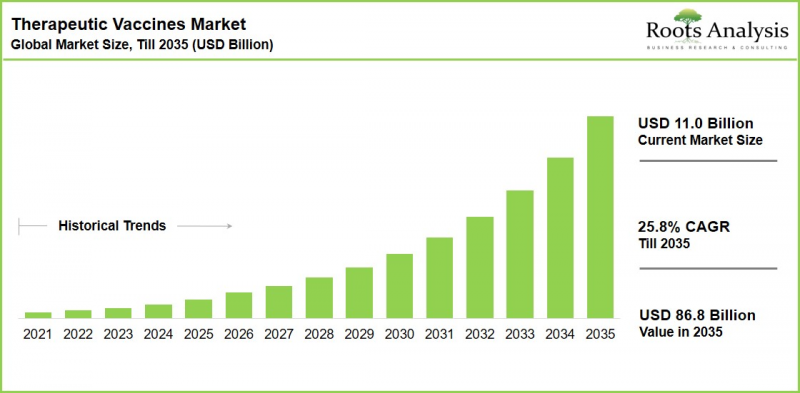
세계의 치료용 백신 시장 규모는 올해 110억 달러에서 2035년까지 868억 달러로 확대할 것으로 추정되고 있으며, 예측 기간 중 CAGR은 약 25.8%에 달할 전망입니다.
치료용 백신 시장 - 성장 및 동향
질병 예방을 위해 건강한 사람에게 투여되는 예방용 백신과 달리, 치료용 백신은 이미 질병이 진행된 후에 투여되도록 설계되어 있으며, 면역 체계가 질병을 인식하고 이에 대응하도록 훈련시키는 것을 목적으로 합니다. 그 유효성은 일반적으로 예방용 제제에 미치지 못하지만, 안전성, 특이성 및 지속성이라는 특징을 갖추고 있으며, 종양학 및 만성 감염증 치료 분야에서 매력적인 치료법으로 주목받고 있습니다. 또한 기존 감염증을 제어하기에 충분한 항체 반응을 얻지 못하는 환자를 위한 치료법으로서도 연구가 진행되고 있습니다.
지난 20년 동안 치료용 흑색종 백신 분야는 임상적 관심의 증가로 큰 발전을 이룩해 왔습니다. 그러나 흑색종 면역요법에서 현저한 진전이 있었음에도 불구하고 치료용 흑색종 백신 중 미국 식품의약국(USFDA)으로부터 완전한 승인을 받은 것은 아직 없습니다. 그 ‘기대’와 ‘제품’ 사이의 격차는 현재 점차 좁혀지고 있습니다. 현재 전 세계에서 400건 이상의 암 백신 임상 시험이 진행 중이며, 보조제 과학 및 제제 안정성 분야의 꾸준한 발전에 힘입어 광범위한 암 적응증을 대상으로 300건 이상의 암 백신 후보가 개발되고 있습니다.
이 분야의 결정적인 전환점은 차세대 네오항원 mRNA 백신으로의 전환입니다. 게놈 시퀀싱, 바이오정보학 및 맞춤형 의료 플랫폼을 기반으로 하는 이러한 백신 후보들은 공통 항원이 아닌 환자 자신의 종양 특이적 네오항원을 표적으로 설계되어, 기존 세대의 암 백신에 비해 정확도와 면역 활성화가 향상되었습니다. 최근 모더나(Moderna)와 머크(Merck)는 공동으로, 키트루다(Keytruda)와 병용한 자사 개발 맞춤형 암 백신이 흑색종 환자에서 재발 또는 사망 위험을 지속적으로 유의미하게 감소시켰다고 보고했습니다. 이러한 임상 결과는 이 접근법에 대한 신뢰를 강화하며, 네오항원 및 mRNA 백신 분야로의 지속적인 자금 유입을 촉진하고 있습니다.
성장의 원동력 - 시장 확대를 지원하는 요인
전 세계에서 증가하는 암 부담에 더해, HIV, HBV, HCV 등의 만성 감염증이 여전히 존재하고 있는 것이 이 시장의 핵심 성장 요인이 되고 있습니다. 이러한 질환은 일반적으로 장기적인 경과, 높은 재발률, 그리고 막대한 치료비를 수반하므로 지속적인 면역 요법에 대한 명확한 임상적 근거가 마련되고 있습니다. 각 지역에서 선별 검사 및 진단 능력이 향상됨에 따라 치료용 백신을 치료 계획에 포함시킬 수 있을 만큼 조기에 발견되는 환자가 증가하고 있으며, 잠재적 환자층이 확대되고 있습니다.
DNA 및 mRNA 플랫폼, 개선된 보조제, 차세대 벡터, 네오항원 기반 설계 등 면역종양학 및 백신 공학 분야의 병행된 발전으로 인해 더욱 강력하고 표적화된 T세포 반응을 유도하는 백신의 개발이 가능해졌습니다. 이러한 플랫폼은 개별 종양이나 환자에 맞춰 쉽게 맞춤화할 수 있다는 특징도 있으며, 정밀 의학으로의 업계 전반적 전환과 자연스럽게 조화를 이루며, 이 분야의 지속적인 연구개발 투자를 지원하고 있습니다.
시장이 해결해야 할 과제 - 진전을 가로막는 중대한 장벽
이러한 모멘텀에도 불구하고 치료용 백신은 전임상 단계에서의 유망성과 실제 환자의 예후 사이에 여전히 ‘전환 격차’에 직면해 있습니다. 인간의 면역 반응은, 특히 암과 같은 복잡한 질환의 경우, 실험실이나 동물 모델보다 제어하기 어렵고, 종양이나 환자의 이질성으로 인해 한 개인에게 효과적인 백신이 다른 개인에게는 효과가 낮을 수 있습니다. 이러한 변동성으로 인해 임상 시험에서 일관되고 통계적으로 확고한 유익성을 입증하기 어려우며, 그에 따라 확립된 표준 치료법을 대체하는 것도 어려워지고 있습니다.
개발 자체도 기술적으로 어려움을 수반합니다. 후원사는 안전성과 유효성을 확보하면서 적절한 항원, 전달 시스템, 보조제, 투여법을 선택해야 하며, 이 과정에서 후보 화합물의 탈락률이 높아집니다. 또한 등록되는 환자의 종양 유형과 병기가 다양하므로 시험 설계는 더욱 복잡해지고 있습니다. 또한 후기 임상 시험에서의 거듭된 실패가 주기적으로 투자자들의 심리를 위축시켜, 특히 중소규모 개발 기업에서 파이프라인의 진전을 둔화시키고 있습니다.
치료용 백신 시장 - 주요 인사이트
이 보고서에서는 치료용 백신 시장의 현황을 상세히 분석하고, 업계내 잠재적인 성장 기회를 파악하고 있습니다. 주요 조사 결과는 다음과 같습니다. :
- 플랫폼의 유연성이 암 및 희귀질환 분야에서 mRNA의 확장을 주도: 플랫폼이 본질적으로 지닌 유연성,높은 면역원성, 그리고 표적 치료법에 대한 절실한 수요에 힘입어, 지속적으로 성장하는 바이오의약품 혁신 기업 및 대형 제약사들은 복잡한 암 및 희귀질환 적응증 분야에서 mRNA 기반 의약품 개발을 우선시하고 있습니다.
- 업계 선구자별 파이프라인 집중: 300건이 넘는 치료용 백신 후보물질이 임상 개발의 다양한 단계에서 활발히 연구되고 있습니다. 특히 진행 중인 파이프라인 활동의 약 70%는 시장을 선도하는 모더나(Moderna)와 바이오엔테크(BioNTech)에 집중되어 있으며, 개발자의 전문 지식이 고도로 집약되어 있음을 여실히 보여주고 있습니다.
- 플랫폼 소유자와 적응증 전문가 간의 전략적 제휴 가속화: 새로운 질병 기전을 대상으로 한 제휴 움직임은 계속해서 탄력을 받고 있습니다. 예를 들어 모더나는 레코르다티(Recordati)사와 제휴하여 프로피온산혈증을 대상으로 하는 해당사의 임상 시험 단계에 있는 mRNA 후보물질 ‘mRNA-3927’의 개발을 추진하며, 최종적인 상용화를 목표로 하고 있습니다.
- 초기 단계에서의 벤처 캐피털 및 시드 자금의 견고한 유입: mRNA에 특화된 플랫폼에 대한 사모펀드 및 벤처 투자는 꾸준히 증가하고 있으며, 각 기업에 후보 약물을 주요 임상 평가 단계로 진행하기 위한 중요한 자금 기반을 제공하고 있습니다. 초기 단계의 자금 조달도 이러한 추세를 반영하고 있습니다. 리프로그래밍 바이오사이언시스(Reprogramming Biosciences)는 5월, 종양 부위를 활성 항원 제시 부위로 전환하는 것을 목표로 하는 독자적인 mRNA 기반 ‘in situ’ 세포 리프로그래밍 기법을 추진하기 위해 600만 달러의 시드 자금을 조달했습니다. 또한 ErVimmune사는 암 치료용 백신 ‘ErVac01’을 인간 임상시험 단계로 진행하기 위해 1,700만 유로의 시리즈 A 자금 조달을 완료했습니다.
- 임상적 성숙도와 후기 단계로의 진전: 전 세계 치료용 백신 파이프라인의 10% 이상이 3상 임상시험에 도달했으며, 이는 신흥 생물학적 치료법으로는 이례적으로 높은 후기 단계 비율을 보여줍니다. 이는 규제 당국의 수용도가 높아지고 있으며 임상적 성숙도가 높아지고 있음을 시사하지만, 파이프라인 전반에 걸친 주도권은 여전히 선구자들에 의해 강력하게 장악되고 있습니다.
- 자체 플랫폼 개발에서 M&A 및 라이선싱으로의 전환: 대형 기존 제약사들은 사내에서 mRNA 기술을 처음부터 구축하기보다는 전문 RNA 개발 기업을 적극적으로 인수하거나 긴밀한 제휴 계약을 체결하고 있습니다. 화이자는 여러 표적을 대상으로 한 플랫폼 제휴를 통해 이러한 추세를 주도하고 있으며, 그 뒤를 사노피(Translate Bio 인수를 통해 핵심 RNA 인프라를 확장함)와 표적에 맞춘 임상 제휴를 지속적으로 추진하고 있는 바이엘이 따르고 있습니다.
치료용 백신 시장
시장 규모 및 사업 기회 분석은 다음 매개변수를 기반으로 세분화됩니다. :
백신 유형별
- 펩티드 백신
- 항원 백신
- DNA 백신
- 수지상세포 백신
백신 조성법별
- 자가백신
- 동종 백신
치료법별
- 단일 요법
- 병용 요법
치료 분야별
- 종양성 질환
- 감염증
- 자가면역 질환
- 기타
투여 경로별
- 피내 투여
- 근육내 투여
- 피하 투여
- 비강내 투여
- 경구 투여
- 기타
지역별
- 북미
- 유럽
- 아시아태평양
- 기타 지역
목차
제1장 서문
제2장 조사 방법
제3장 시장 역학
제4장 거시경제 지표
제5장 개요
제6장 서론
제7장 시장 구도
제8장 기업 개요
제9장 스타트업 기업의 건전성 지표
제10장 임상시험 분석
제11장 학술연구 보조금 분석
제12장 파트너십과 협력 관계
제13장 시장 예측과 기회 분석
제14장 사례 연구 : 세계의 예방 백신
제15장 사례 연구 : 백신 수탁제조 시장
제16장 결론
제17장 경영진 인사이트
제18장 부록 I : 표형식 데이터
제19장 부록 II : 기업 및 조직 리스트
KSA 26.08.24THERAPEUTIC VACCINES MARKET: OVERVIEW
As per Roots Analysis, the global therapeutic vaccines market is estimated to grow from USD 11.0 billion in the current year to USD 86.8 billion by 2035, reflecting a compound annual growth rate (CAGR) of approximately 25.8% during the forecast period.
Therapeutic Vaccines Market: Growth and Trends
Unlike prophylactic vaccines, which are administered to healthy individuals to prevent disease, therapeutic vaccines are designed to be given after a disease has already taken hold, with the goal of training the immune system to recognize and act against it. Their efficacy generally trails that of prophylactic formulations, but they offer a safety, specificity, and durability profile that has made them an attractive modality for oncology and chronic infectious disease, and they are also being explored for individuals whose own antibody response is insufficient to control an existing infection.
For much of the past two decades, the therapeutic melanoma vaccine field has been driven by considerable clinical interest, however, despite significant advances in melanoma immunotherapy, no therapeutic melanoma vaccine has yet received full USFDA approval. That gap between promise and product is now narrowing. More than 400 cancer vaccine clinical trials are currently active worldwide, and over 300 cancer vaccine candidates are currently being developed for a broad range of oncological indications, supported by steady advances in adjuvant science and formulation stability.
A defining shift in the space is the move toward next generation neoantigen mRNA vaccines. Built on genomic sequencing, bioinformatics, and personalized-medicine platforms, these candidates are designed against a patient's own tumor-specific neoantigens rather than shared antigens, improving precision and immune activation relative to earlier cancer vaccine generations. Recently, Moderna and Merck jointly reported that their investigational personalized cancer vaccine, used alongside Keytruda, sustained a meaningful reduction in recurrence or death risk in melanoma patients. These clinical results are reinforcing confidence in this approach and drawing continued capital toward the neoantigen and mRNA vaccine segment.
Growth Drivers: Factors Fueling Market Expansion
The rising global burden of cancer, together with the persistence of chronic infectious diseases such as HIV, HBV, and HCV, is a central driver of this market. These conditions typically involve prolonged disease courses, high relapse rates, and significant treatment costs, creating a clear clinical case for durable immune-based therapies. As screening and diagnostic capabilities improve across geographies, more patients are being identified early enough for therapeutic vaccination to be incorporated into their treatment plans, widening the addressable patient pool.
Parallel advances in immuno-oncology and vaccine engineering, including DNA and mRNA platforms, improved adjuvants, next-generation vectors, and neoantigen-based design, are enabling vaccines that generate stronger and more targeted T-cell responses. These platforms are also easier to customize for individual tumors or patients, aligning naturally with the broader industry shift toward precision medicine and reinforcing sustained R&D investment in the category.
Market Challenges: Critical Barriers Hindering Progress
Despite this momentum, therapeutic vaccines continue to face a translational gap between preclinical promise and real-world patient outcomes. Human immune responses, particularly in complex diseases such as cancer, are harder to control than in laboratory or animal models, and tumor and patient heterogeneity mean that a vaccine effective in one individual may perform poorly in another. This variability makes it difficult to demonstrate consistent, statistically robust benefit in clinical trials, and correspondingly difficult to displace established standard-of-care therapies.
Development itself is technically demanding. Sponsors must select the right antigens, delivery systems, adjuvants, and dosing regimens while safeguarding safety and efficacy, a process that carries a high rate of candidate attrition. Trial design is further complicated by diverse tumor types and disease stages across enrolled repeated late-stage setbacks have periodically dampened investor sentiment, slowing pipeline advancement for smaller developers in particular.
Therapeutic Vaccines Market: Key Insights
The report delves into the current state of the therapeutic vaccines market and identifies potential growth opportunities within the industry. Some key findings include:
- Platform Flexibility Driving mRNA Expansion Across Oncology and Rare Diseases: Driven by the platform's inherent flexibility, high immunogenicity, and the pressing need for targeted treatment options, an expanding base of biopharmaceutical innovators and large pharmaceutical companies is prioritizing mRNA-based drug development across complex oncology and rare disease indications.
- Pipeline Concentration Among Industry Trailblazers: Over 300 therapeutic vaccine candidates are under active investigation across various stages of clinical development. Notably, approximately 70% of active pipeline activity remains concentrated among market leaders Moderna and BioNTech, underscoring an intense consolidation of developer expertise.
- Accelerating Strategic Alliances Between Platform Owners and Indication Specialists: Deal flow targeting novel disease mechanisms continues to gather momentum. For instance, Moderna partnered with Recordati to advance mRNA-3927, its investigational mRNA candidate for propionic acidemia, through development and toward eventual commercialization.
- Robust Early-Stage Venture Capital and Seed Funding Inflows: Private equity and venture investments into mRNA-focused platforms have risen steadily, providing companies with crucial runway to advance candidates toward pivotal clinical evaluations. Early-stage funding reflects this trend: Reprogram Biosciences raised USD 6 million in seed funding in May to advance its proprietary mRNA-based in situ cell reprogramming approach designed to transform tumor beds into active antigen-presenting sites. Additionally, ErVimmune closed a €17 million Series A to push its therapeutic cancer vaccine ErVac01 into human trials.
- Clinical Maturity and Late-Stage Advancement: More than 10% of the global therapeutic vaccines pipeline has reached Phase III, reflecting an unusually high late-stage proportion for an emerging biological modality. While this signals growing regulatory acceptance and clinical maturity, overall pipeline leadership remains heavily anchored by first-mover pioneers.
- Shift Toward M&A and Licensing Over In-House Platform Development: Rather than constructing internal mRNA capabilities from scratch, large pharmaceutical incumbents are actively acquiring or entering deep collaboration agreements with specialized RNA developers. Pfizer leads this trend through multi-target platform alliances, followed by Sanofi (which expanded its core RNA infrastructure via the acquisition of Translate Bio), and Bayer, which continues to enter targeted clinical collaborations.
Therapeutic Vaccines Market
The market sizing and opportunity analysis has been segmented across the following parameters:
By Type of Vaccine
- Peptide Vaccines
- Antigen Vaccines
- DNA Vaccines
- Dendritic Vaccines
By Method of Vaccine Composition
- Autologous Vaccines
- Allogeneic Vaccines
By Type of Therapy
- Monotherapies
- Combination Therapies
By Therapeutic Area
- Oncological Disorders
- Infectious Diseases
- Autoimmune Disorders
- Others
By Route of Administration
- Intradermal Route
- Intramuscular Route
- Subcutaneous Route
- Intranasal Route
- Oral Route
- Others
By Geographical Regions
- North America
- Europe
- Asia-Pacific
- Rest of the World
Therapeutic Vaccines Market: Key Segments
Peptide Vaccines Lead the Market and DNA Vaccines Will Register Higher CAGR
Based on our market assessment, the peptide vaccines segment is expected to account for the largest share of the therapeutic vaccines market. This highest share is due to its high specificity, safety profile, and broad applicability across cancer immunotherapy and infectious disease treatment. These vaccines rely on selected antigenic peptides to stimulate targeted immune responses against disease-associated markers. Owing to their target specificity, these vaccines limit off-target effects and improve treatment outcomes. Further, their relatively simple design and manufacturing scalability have supported wide clinical adoption.
On the other hand, the DNA vaccines segment is projected to grow at a higher CAGR during the forecast period. This potential growth is supported by advances in genetic engineering and rising demand for next-generation vaccine platforms. DNA vaccines offer rapid design cycles, manufacturing flexibility, and the ability to trigger both humoral and cellular immunity, and growing investment in genomic medicine and precision immunotherapy is expected to accelerate their uptake.
Oncological Disorders Dominate the Market
Oncological disorders account for the largest share of the therapeutic vaccines market. This highest share reflects the global cancer burden and the growing role of therapeutic vaccination as an immunotherapy approach that stimulates the immune system to target tumor-specific antigens. Sustained investment in cancer research, a deepening pipeline of vaccine candidates, and closer integration with other immuno-oncology modalities continue to accelerate clinical development and eventual commercialization in this segment.
The infectious diseases segment is expected to grow fastest CAGR during the forecast period. This lucrative growth is driven by growing interest in therapeutic vaccines for chronic and difficult-to-treat viral and bacterial infections. Advances in DNA, RNA, and vector-based platforms are enabling novel approaches that strengthen immune response and reduce reliance on long-term antimicrobial therapy.
North America Maintains Market Leadership
According to our market projections, North America is expected to hold the majority share of the market in the current year. This highest share is supported by the advanced healthcare infrastructure, a strong biotechnology and pharmaceutical base, and substantial investment in immunotherapy R&D. Further, the region's mature clinical trial ecosystem, favorable regulatory pathways, and high prevalence of cancer and other chronic conditions continue to reinforce its lead position.
Asia-Pacific is projected to grow at the fastest CAGR during the forecast period. This lucrative growth is driven by rising healthcare expenditure, expanding biopharmaceutical research capacity, and a growing burden of cancer and infectious disease across China, India, Japan, and South Korea. Increasing government support for biotechnology innovation and improving clinical infrastructure are creating favorable conditions for accelerated regional expansion.
Example Players in Therapeutic Vaccines Market
- BioNTech
- GlobeImmune
- Immatics
- Immunitor
- Inovio Pharmaceuticals
- Moderna
Expert Interview and Industry Insights
The opinions and insights presented in this study were shaped by discussions held with multiple stakeholders across the therapeutic vaccines value chain. The research report features detailed transcripts of interviews conducted with the following industry stakeholders:
- Chief Executive Officer and Chief Scientific Officer, Mid-sized Company, Italy
- Science Director Advanced Modalities, Senior Research Leader, and Director of Scientific Advisory Services, Very Large Company, US
- Director of Head and Neck Cancer Research, Very Large Company, US
- Associate Professor of Surgery, Integrative Immunology, and Pathology, Very Large Institute, US
- Physician Scientists, Very Large Institute, US
- Pediatric Oncologist, Very Large Institute, US
- Associate Director for Translational Research, Very Large Institute, US
- Research Group Leader, Mid-sized Institute, Germany
- Senior Public Health Researcher, Mid-sized Institute, India
THERAPEUTIC VACCINES MARKET: RESEARCH COVERAGE
- Market Sizing and Opportunity Analysis: In-depth analysis of the therapeutic vaccines market across type of vaccine, method of vaccine composition, type of therapy, therapeutic area, route of administration, and geographical regions.
- Market Landscape: A detailed pipeline assessment by phase of development, vaccine type, therapy type, therapeutic area, route of administration, and dosage, together with an analysis of vaccine developers by year of establishment, company size, and location of headquarters.
- Company Profiles: In-depth profiles of prominent players engaged in developing therapeutic vaccines, covering year of establishment, headquarters, company size, financial information, portfolio, and recent developments.
- Start-Up Health Indexing: Benchmarking of emerging vaccine developers by supplier strength, pipeline strength, pipeline maturity, financial investment, and partnership activity.
- Clinical Trial Analysis: An analysis of registered clinical trials by registration year, phase, recruitment status, study design, focus area, therapeutic area, sponsor type, and geography.
- Academic Grants Analysis: Assessment of research grants by year of award, amount awarded, administering institute, support period, and recipient organization.
- Partnerships and Collaborations: A review of deal activity by year, type of partnership, type of partner, focus area, therapeutic area, and geographical distribution.
- Market Forecast and Opportunity Analysis: Ten-year revenue forecasts for the global market and its sub-segments, together with country-level projections across twelve key markets.
- Case Study, Preventive Vaccines Market: A comparative view of the marketed and clinical-stage preventive vaccines landscape, positioned as an adjacent-market benchmark for the therapeutic vaccines.
- Case Study, Vaccine Contract Manufacturing Market: An overview of the vaccine CMO landscape by scale of operation, service offering, and expression system, relevant to distributors assessing supply-chain partners.
Key Questions Answered in this Report
- Which companies are leading the therapeutic vaccines market?
- Which region dominates the therapeutic vaccines market?
- What are the key trends observed in the therapeutic vaccines market?
- What factors are likely to influence the evolution of this market?
- What are the primary challenges faced by therapeutic vaccine developers?
- What is the current and future market size?
- What is the CAGR of this market?
- How is the current and future market opportunity likely to be distributed across key market segments?
Reasons to Buy this Report
- The report provides a comprehensive market analysis, offering detailed revenue projections of the overall market and its specific sub-segments. This information is valuable to both established market leaders and emerging entrants.
- The report offers stakeholders a comprehensive overview of the market, including key drivers, barriers, opportunities, and challenges. This information empowers stakeholders to stay abreast of market trends and make data-driven decisions to capitalize on growth prospects.
- The report can aid businesses in identifying future opportunities in any sector. It also helps in understanding if those opportunities are worth pursuing.
- The report helps in identifying customer demand by understanding the needs, preferences, and behavior of the target audience in order to tailor products or services effectively.
- The report equips new entrants with requisite information regarding a particular market to help them build successful business strategies.
- The report allows for more effective communication with the audience and in building strong business relations.
Additional Benefits
- Complementary PPT Data Packs
- Complementary Excel Data Packs for all Analytical Modules in the Report
- 15% Free Content Customization
- Detailed Report Walkthrough Session with Research Team
- Free Updated report if the report is 6-12 months old or older
TABLE OF CONTENTS
1. PREFACE
- 1.1. Introduction
- 1.2. Market Share Insights
- 1.3. Key Market Insights
- 1.4. Report Coverage
- 1.5. Key Questions Answered
- 1.6. Chapter Outlines
2. RESEARCH METHODOLOGY
- 2.1. Chapter Overview
- 2.2. Research Assumptions
- 2.2.1. Market Landscape and Market Trends
- 2.2.2. Market Forecast and Opportunity Analysis
- 2.2.3. Comparative Analysis
- 2.3. Database Building
- 2.3.1. Data Collection
- 2.3.2. Data Validation
- 2.3.3. Data Analysis
- 2.4. Project Methodology
- 2.4.1. Secondary Research
- 2.4.1.1. Annual Reports
- 2.4.1.2. Academic Research Papers
- 2.4.1.3. Company Websites
- 2.4.1.4. Investor Presentations
- 2.4.1.5. Regulatory Filings
- 2.4.1.6. White Papers
- 2.4.1.7. Industry Publications
- 2.4.1.8. Conferences and Seminars
- 2.4.1.9. Government Portals
- 2.4.1.10. Media and Press Releases
- 2.4.1.11. Newsletters
- 2.4.1.12. Industry Databases
- 2.4.1.13. Roots Proprietary Databases
- 2.4.1.14. Paid Databases and Sources
- 2.4.1.15. Social Media Portals
- 2.4.1.16. Other Secondary Sources
- 2.4.2. Primary Research
- 2.4.2.1. Types of Primary Research
- 2.4.2.1.1. Qualitative Research
- 2.4.2.1.2. Quantitative Research
- 2.4.2.1.3. Hybrid Approach
- 2.4.2.2. Advantages of Primary Research
- 2.4.2.3. Techniques for Primary Research
- 2.4.2.3.1. Interviews
- 2.4.2.3.2. Surveys
- 2.4.2.3.3. Focus Groups
- 2.4.2.3.4. Observational Research
- 2.4.2.3.5. Social Media Interactions
- 2.4.2.4. Key Opinion Leaders Considered in Primary Research
- 2.4.2.4.1. Company Executives (CXOs)
- 2.4.2.4.2. Board of Directors
- 2.4.2.4.3. Company Presidents and Vice Presidents
- 2.4.2.4.4. Research and Development Heads
- 2.4.2.4.5. Technical Experts
- 2.4.2.4.6. Subject Matter Experts
- 2.4.2.4.7. Scientists
- 2.4.2.4.8. Doctors and Other Healthcare Providers
- 2.4.2.5. Ethics and Integrity
- 2.4.2.5.1. Research Ethics
- 2.4.2.5.2. Data Integrity
- 2.4.2.1. Types of Primary Research
- 2.4.3. Analytical Tools and Databases
- 2.4.1. Secondary Research
- 2.5. Robust Quality Control
3. MARKET DYNAMICS
- 3.1. Chapter Overview
- 3.2. Forecast Methodology
- 3.2.1. Top-down Approach
- 3.2.2. Bottom-up Approach
- 3.2.3. Hybrid Approach
- 3.3. Market Assessment Framework
- 3.3.1. Total Addressable Market (TAM)
- 3.3.2. Serviceable Addressable Market (SAM)
- 3.3.3. Serviceable Obtainable Market (SOM)
- 3.3.4. Currently Acquired Market (CAM)
- 3.4. Forecasting Tools and Techniques
- 3.4.1. Qualitative Forecasting
- 3.4.2. Correlation
- 3.4.3. Regression
- 3.4.4. Extrapolation
- 3.4.5. Convergence
- 3.4.6. Sensitivity Analysis
- 3.4.7. Scenario Planning
- 3.4.8. Data Visualization
- 3.4.9. Time Series Analysis
- 3.4.10. Forecast Error Analysis
- 3.5. Key Considerations
- 3.5.1. Demographics
- 3.5.2. Government Regulations
- 3.5.3. Reimbursement Scenarios
- 3.5.4. Market Access
- 3.5.5. Supply Chain
- 3.5.6. Industry Consolidation
- 3.5.7. Pandemic / Unforeseen Disruptions Impact
- 3.6. Limitations
4. MACRO-ECONOMIC INDICATORS
- 4.1. Chapter Overview
- 4.2. Market Dynamics
- 4.2.1. Time Period
- 4.2.1.1. Historical Trends
- 4.2.1.2. Current and Forecasted Estimates
- 4.2.2. Currency Coverage
- 4.2.2.1. Major Currencies Affecting the Market
- 4.2.2.2. Factors Affecting Currency Fluctuations
- 4.2.2.3. Impact of Currency Fluctuations on the Industry
- 4.2.3. Foreign Currency Exchange Rate
- 4.2.3.1. Impact of Foreign Exchange Rate Volatility on the Market
- 4.2.3.2. Strategies for Mitigating Foreign Exchange Risk
- 4.2.4. Recession
- 4.2.4.1. Assessment of Current Economic Conditions and Potential Impact on the Market
- 4.2.4.2. Historical Analysis of Past Recessions and Lessons Learnt
- 4.2.5. Inflation
- 4.2.5.1. Measurement and Analysis of Inflationary Pressures in the Economy
- 4.2.5.2. Potential Impact of Inflation on the Market Evolution
- 4.2.6. Interest Rates
- 4.2.6.1. Interest Rates and Their Impact on the Market
- 4.2.6.2. Strategies for Managing Interest Rate Risk
- 4.2.7. Commodity Flow Analysis
- 4.2.7.1. Type of Commodity
- 4.2.7.2. Origins and Destinations
- 4.2.7.3. Values and Weights
- 4.2.7.4. Modes of Transportation
- 4.2.8. Global Trade Dynamics
- 4.2.8.1. Import Scenario
- 4.2.8.2. Export Scenario
- 4.2.8.3. Trade Policies
- 4.2.8.4. Strategies for Mitigating the Risks Associated with Trade Barriers
- 4.2.8.5. Impact of Trade Barriers on the Market
- 4.2.9. War Impact Analysis
- 4.2.9.1. Russian-Ukraine War
- 4.2.9.2. Israel-Hamas War
- 4.2.10. COVID Impact / Related Factors
- 4.2.10.1. Global Economic Impact
- 4.2.10.2. Industry-specific Impact
- 4.2.10.3. Government Response and Stimulus Measures
- 4.2.10.4. Future Outlook and Adaptation Strategies
- 4.2.11. Other Indicators
- 4.2.11.1. Fiscal Policy
- 4.2.11.2. Consumer Spending
- 4.2.11.3. Gross Domestic Product
- 4.2.11.4. Employment
- 4.2.11.5. Taxes
- 4.2.11.6. Stock Market Performance
- 4.2.11.7. Cross Border Dynamics
- 4.2.1. Time Period
- 4.3. Conclusion
5. EXECUTIVE SUMMARY
6. INTRODUCTION
- 6.1. Chapter Overview
- 6.2. Introduction to Therapeutic Vaccines
- 6.2.1. Classification of Vaccines by Method of Composition
- 6.2.1.1. Autologous Vaccines
- 6.2.1.2. Allogeneic Vaccines
- 6.2.1. Classification of Vaccines by Method of Composition
- 6.3. Classification of Vaccines by Mechanism of Action
- 6.3.1. Antigen Vaccines
- 6.3.2. Dendritic Vaccines
- 6.3.3. DNA Vaccines
- 6.3.4. Peptide Vaccines
- 6.4. Key Target Indications
- 6.4.1. Cancer
- 6.4.2. HIV Infection
- 6.4.3. HPV Infection
- 6.4.4. Herpes
- 6.5. Clinical Development and Approval of Vaccines
- 6.6. Concluding Remarks
7. MARKET LANDSCAPE
- 7.1. Chapter Overview
- 7.2. Therapeutic Vaccines: Pipeline Analysis
- 7.2.1. Analysis by Phase of Development
- 7.2.2. Analysis by Type of Vaccine
- 7.2.3. Analysis by Type of Vaccine (by Method of Composition)
- 7.2.4. Analysis by Type of Therapy
- 7.2.5. Analysis by Therapeutic Area
- 7.2.6. Analysis by Route of Administration
- 7.2.7. Analysis by Dosage
- 7.3. Therapeutic Vaccines: Analysis by Vaccine Developers
- 7.3.1. Analysis by Year of Establishment
- 7.3.2. Analysis by Company Size
- 7.3.3. Analysis by Location of Headquarters
- 7.3.4. Leading Developers
- 7.3.5. Grid Analysis: Distribution by Phase of Development, Company Size and Location of Headquarters
8. COMPANY PROFILES
- 8.1. Chapter Overview
- 8.2. BioNTech
- 8.2.1. Company Overview
- 8.2.2. Financial Information
- 8.2.3. Therapeutic Vaccines Portfolio
- 8.2.4. Recent Developments and Future Outlook
Similar details are presented for other companies mentioned below (based on information in the public domain)
- 8.3. Brii Biosciences
- 8.4. GlobeImmune
- 8.5. Immatics
- 8.6. Immune Response Biopharma
- 8.7. Immunitor
- 8.8. Inovio Pharmaceuticals
- 8.9. Moderna
9. START-UP HEALTH INDEXING
- 9.1. Chapter Overview
- 9.2. Start-ups in Therapeutic Vaccines Market
- 9.2.1. Analysis by Location of Headquarters
- 9.3. Benchmarking of Start-ups
- 9.3.1. Analysis by Supplier Strength
- 9.3.2. Analysis by Pipeline Strength
- 9.3.3. Analysis by Pipeline Maturity
- 9.3.4. Analysis by Financial Investment
- 9.3.5. Analysis by Partnership Activity
- 9.3.6. Start-ups Health Indexing: Roots Analysis Perspective
10. CLINICAL TRIAL ANALYSIS
- 10.1. Chapter Overview
- 10.2. Scope and Methodology
- 10.3. Therapeutic Vaccines: Clinical Trial Analysis
- 10.3.1. Analysis by Trial Registration Year
- 10.3.2. Analysis by Trial Registration Year and Enrolled Patient Population
- 10.3.3. Analysis by Trial Phase
- 10.3.4. Analysis by Trial Recruitment Status
- 10.3.5. Analysis by Study Design
- 10.3.6. Analysis by Trial Focus Area
- 10.3.7. Analysis by Therapeutic Area
- 10.3.8. Analysis by Type of Sponsor / Collaborator
- 10.3.9. Most Active Players: Analysis by Number of Registered Trials
- 10.3.10. Geographical Analysis by Number of Registered Trials
- 10.3.11. Geographical Analysis by Enrolled Patient Population
11. ACADEMIC GRANTS ANALYSIS
- 11.1. Chapter Overview
- 11.2. Scope and Methodology
- 11.3. Therapeutic Vaccines: Academic Grant Analysis
- 11.3.1. Analysis by Year of Grant Award
- 11.3.2. Analysis by Amount Awarded
- 11.3.3. Analysis by Administering Institute Center
- 11.3.4. Analysis by Support Period
- 11.3.5. Analysis by Administering Institute Center and Support Period
- 11.3.6. Analysis by Type of Grant Application
- 11.3.7. Analysis by Purpose of Grant Award
- 11.3.8. Analysis by Activity Code
- 11.3.9. Analysis by Study Section Involved
- 11.3.10. Analysis by Type of Recipient Organization
- 11.3.11. Word Cloud Analysis: Emerging Focus Areas
- 11.3.12. Geographical Distribution of Recipient Organizations
- 11.3.13. Popular NIH Departments: Analysis by Number of Grants
- 11.3.14. Prominent Program Officers: Analysis by Number of Grants
- 11.3.15. Popular Recipient Organizations: Analysis by Number of Grants
12. PARTNERSHIPS AND COLLABORATIONS
- 12.1. Chapter Overview
- 12.2. Partnership Models
- 12.3. Therapeutic Vaccines: Partnerships and Collaborations
- 12.3.1. Analysis by Year of Partnership
- 12.3.2. Analysis by Type of Partnership
- 12.3.3. Analysis by Year of Partnership and Type of Partner
- 12.3.4. Analysis by Type of Partnership and Type of Partner
- 12.3.5. Analysis by Focus Area
- 12.3.6. Analysis by Therapeutic Area
- 12.3.7. Most Active Players: Analysis by Number of Partnerships
- 12.3.8. Regional Analysis
- 12.3.8.1. Intercontinental and Intracontinental Agreements
13. MARKET FORECAST AND OPPORTUNITY ANALYSIS
- 13.1. Chapter Overview
- 13.2. Forecast Methodology and Key Assumptions
- 13.3. Global Therapeutic Vaccines Market, till 2035
- 13.4. Global Therapeutic Vaccines Market, till 2035: Distribution by Type of Vaccine
- 13.5. Global Therapeutic Vaccines Market, till 2035: Distribution by Method of Vaccine Composition
- 13.6. Global Therapeutic Vaccines Market, till 2035: Distribution by Type of Therapy
- 13.7. Global Therapeutic Vaccines Market, till 2035: Distribution by Therapeutic Area
- 13.8. Global Therapeutic Vaccines Market, till 2035: Distribution by Route of Administration
- 13.9. Global Therapeutic Vaccines Market, till 2035: Geographical Distribution
- 13.9.1. Therapeutic Vaccines Market in US, till 2035
- 13.9.2. Therapeutic Vaccines Market in Canada, till 2035
- 13.9.3. Therapeutic Vaccines Market in UK, till 2035
- 13.9.4. Therapeutic Vaccines Market in Germany, till 2035
- 13.9.5. Therapeutic Vaccines Market in France, till 2035
- 13.9.6. Therapeutic Vaccines Market in Italy, till 2035
- 13.9.7. Therapeutic Vaccines Market in Spain, till 2035
- 13.9.8. Therapeutic Vaccines Market in Australia, till 2035
- 13.9.9. Therapeutic Vaccines Market in Japan, till 2035
- 13.9.10. Therapeutic Vaccines Market in Korea, till 2035
- 13.9.11. Therapeutic Vaccines Market in Brazil, till 2035
- 13.9.12. Therapeutic Vaccines Market in Israel, till 2035
- 13.10. Global Therapeutic Vaccines Market, till 2035: Sales Forecast
14. CASE STUDY: GLOBAL PREVENTIVE VACCINES
- 14.1. Chapter Overview
- 14.2. Preventive Vaccines: Overall Market Landscape
- 14.2.1. Marketed Vaccines Landscape
- 14.2.2. Clinical-Stage Vaccines Landscape
- 14.2.3. Analysis by Phase of Development
- 14.2.4. Analysis by Route of Administration
- 14.2.5. Analysis by Type of Vaccine API
- 14.2.6. Analysis by Dosage Form
- 14.2.7. Analysis by Therapeutic Area
- 14.2.8. Key Industry Players: Analysis by Number of Vaccines in Clinical Development
- 14.2.9. Key Non-Industry Players: Analysis by Number of Vaccines in Clinical Development
15. CASE STUDY: VACCINE CONTRACT MANUFACTURING MARKET
- 15.1. Chapter Overview
- 15.2. Vaccine Contract Manufacturers: Overall Market Landscape
- 15.2.1. Analysis by Year of Establishment
- 15.2.2. Analysis by Company Size and Geographical Location
- 15.2.3. Analysis by Geography
- 15.2.4. Analysis by Type of Service(s) Offered
- 15.2.5. Analysis by Scale of Operation
- 15.2.6. Analysis by Type of Expression System(s) Used
- 15.2.7. Analysis by Type of Vaccines Manufactured


