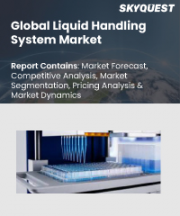
|
시장보고서
상품코드
1899828
액체 처리 시스템 시장 규모, 점유율, 성장 분석 : 제품 유형별, 유형별, 기기 유형별, 최종 용도별, 모달리티별, 지역별 - 업계 예측(2026-2033년)Liquid Handling System Market Size, Share, and Growth Analysis, By Product (Pipettes, Burettes), By Type (Automated, ManulDrug Discovery), By Instrument Type, By End Use, By Modality, By Region - Industry Forecast 2026-2033 |
||||||

액체 처리 시스템 시장 규모는 2024년에 43억 8,000만 달러로 평가되며, 2025년 46억 9,000만 달러에서 2033년까지 79억 9,000만 달러로 성장할 전망입니다. 예측 기간(2026-2033년)의 CAGR은 6.9%로 예측됩니다.
액체 처리 시스템 시장은 기술 발전과 실험 환경의 자동화 수요 증가를 배경으로 견고한 성장세를 보이고 있습니다. 제약, 생명공학 및 학술연구 분야의 전문가들은 액체 처리 작업의 효율성을 높이기 위해 이러한 시스템을 점점 더 많이 활용하고 있으며, 이를 통해 효율성, 정확성 및 반복성을 향상시키고 있습니다. 자동화 및 로봇 플랫폼과의 통합 추세는 실험실 프로세스의 처리량 증가와 정확도 향상으로 이어지고 있습니다. 또한 혁신적인 소프트웨어 인터페이스와 기능이 시스템의 능력과 사용자 경험을 향상시키고 있습니다. 장비 비용과 숙련된 인력의 필요성이라는 과제는 있지만, 업계가 더 나은 결과를 얻기 위해 액체 처리 조사 방법의 최적화를 모색하고 있으므로 전체 시장은 지속적으로 확대될 것으로 예측됩니다.
액체 처리 시스템 시장 성장 촉진요인
실험실 자동화에 대한 관심이 높아지고 액체 처리 시스템을 로봇 플랫폼에 통합하는 것이 결합되어 시장 성장을 크게 촉진하고 있습니다. 이러한 자동화의 발전은 액체 처리 공정의 효율성과 정확성을 향상시켜 생산성을 높이면서 인적 오류의 가능성을 최소화합니다. 연구소가 업무 효율성과 워크플로우 최적화를 위해 혁신적인 솔루션을 찾고 있는 가운데, 첨단 액체 처리 시스템의 도입이 점점 더 중요해지고 있습니다. 이러한 추세는 다양한 응용 분야에서 운영 능력 향상과 고정밀화를 실현하기 위한 광범위한 노력을 반영하고 있으며, 궁극적으로 수요를 견인하고 액체 처리 시스템 시장의 진화를 형성하고 있습니다.
액체 처리 시스템 시장 성장 억제요인
액체 처리 시스템 시장은 고처리량 환경에서의 오염 및 교차 오염 가능성으로 인해 상당한 제약에 직면해 있습니다. 이 문제는 여러 시료와 시약을 다룰 때 발생할 수 있으며, 결과의 신뢰성을 떨어뜨리고 전반적인 신뢰성에 영향을 미칠 수 있습니다. 따라서 연구소는 이러한 위험을 줄이기 위해 엄격한 프로토콜을 채택하고 종합적인 품질관리 조치를 시행해야 합니다. 시료의 무결성과 정확성을 유지하기 위한 이러한 추가적인 요구사항은 실험실에 도전이 될 수 있으며, 업무 효율성에 영향을 미치고 워크플로우의 복잡성을 증가시킬 수 있습니다. 이러한 오염 문제를 해결하는 것은 연구소가 최적의 성능을 보장하고 결과의 품질을 유지하기 위해 매우 중요합니다.
액체 처리 시스템 시장 동향
액체 처리 시스템 시장에서는 실험 환경의 효율성, 정확성, 처리 능력의 향상이 요구되는 가운데, 자동화에 대한 큰 흐름이 나타나고 있습니다. 로봇 통합 및 고급 소프트웨어 제어 기능을 갖춘 자동화 시스템은 인적 오류를 최소화하는 고정밀 액체 처리를 가능하게 하므로 점점 더 많은 지지를 받고 있습니다. 이 전환을 통해 더 많은 양의 샘플을 관리할 수 있게 됨과 동시에 실험실의 생산성을 크게 향상시킬 수 있습니다. 또한 제약, 생명공학, 임상 진단 등 다양한 분야에서 자동화 솔루션의 채택이 증가함에 따라 보다 효율적인 운영과 데이터 신뢰도 향상을 위한 공통적인 움직임이 강조되면서 이 시장 부문의 성장을 더욱 촉진하고 있습니다.
자주 묻는 질문
목차
서론
- 조사의 목적
- 조사 범위
- 정의
조사 방법
- 정보 조달
- 2차와 1차 데이터 방법
- 시장 규모 예측
- 시장 전제조건과 제한
개요
- 세계 시장 전망
- 공급과 수요 동향 분석
- 부문별 기회 분석
시장 역학과 전망
- 시장 규모
- 시장 역학
- 촉진요인과 기회
- 억제요인과 과제
- Porter의 산업 분석과 영향
주요 시장 인사이트
- 주요 성공 요인
- 경쟁의 정도
- 주요 투자 기회
- 시장 에코시스템
- 시장의 매력 지수(2025년)
- PESTEL 분석
- 거시경제 지표
- 밸류체인 분석
- 가격 분석
- 기술적 진보
- 규제 상황
- 특허 분석
- 사례 연구
- 고객과 구매 기준 분석
- 스타트업 분석
세계의 액체 처리 시스템 시장 규모 : 제품별 & CAGR(2026-2033)
- 피펫
- 수동 피펫
- 전자 피펫
- 피펫 컨트롤러
- 뷰렛
- 소모품
- 마이크로플레이트 시약 디스펜서
- 마이크로플레이트 워셔
- 기타
세계의 액체 처리 시스템 시장 규모 : 유형별 & CAGR(2026-2033)
- 자동 액체 처리 시스템
- 수동식 액체 처리 시스템
- 반자동 액체 처리 시스템
- 전자식 액체 처리 시스템
세계의 액체 처리 시스템 시장 규모 : 용도별 & CAGR(2026-2033)
- Drug Discovery
- 진단 센터
- 유전체학
- 단백질체학
- 임상 진단
- 바이오테크놀러지
- 기타
세계의 액체 처리 시스템 시장 규모 : 기기 유형별 & CAGR(2026-2033)
- 스탠드얼론형
- 개별형 벤치탑 워크스테이션
- 멀티 기기 시스템
- 기타
세계의 액체 처리 시스템 시장 규모 : 최종 용도별 & CAGR(2026-2033)
- 바이오테크놀러지 및 제약 기업
- 연구기관
- 학술기관
- 병원 및 진단 검사실
- 기타 최종사용자
세계의 액체 처리 시스템 시장 규모 : 모달리티별 & CAGR(2026-2033)
- 고정 팁
- 일회용 팁
세계의 액체 처리 시스템 시장 규모 & CAGR(2026-2033)
- 북미
- 미국
- 캐나다
- 유럽
- 영국
- 독일
- 스페인
- 프랑스
- 이탈리아
- 기타 유럽 지역
- 아시아태평양
- 중국
- 인도
- 일본
- 한국
- 기타 아시아태평양
- 라틴아메리카
- 브라질
- 기타 라틴아메리카 지역
- 중동 및 아프리카
- GCC 국가
- 남아프리카공화국
- 기타 중동 및 아프리카
경쟁 정보
- 상위 5사의 비교
- 주요 기업의 시장 포지셔닝(2025년)
- 주요 시장 기업이 채택한 전략
- 최근 시장 동향
- 기업의 시장 점유율 분석(2025년)
- 주요 기업의 기업 개요
- 기업의 상세
- 제품 포트폴리오 분석
- 기업의 부문별 점유율 분석
- 매출의 전년대비 비교(2021-2023년)
주요 기업 개요
- Agilent Technologies, Inc.(USA)
- Tecan Group Ltd.(Switzerland)
- PerkinElmer, Inc.(USA)
- Thermo Fisher Scientific, Inc.(USA)
- Hamilton Company(USA)
- Eppendorf AG(Germany)
- Bio-Rad Laboratories, Inc.(USA)
- Mettler-Toledo International, Inc.(Switzerland)
- Gilson, Inc.(USA)
- Corning Incorporated(USA)
- Labcyte Inc.(USA)
- Analytik Jena AG(Germany)
- Beckman Coulter, Inc.(USA)
- Hudson Robotics, Inc.(USA)
- Lonza Group AG(Switzerland)
- Sartorius AG(Germany)
- Zymo Research Corporation(USA)
- BRAND GMBH+CO KG(Germany)
- Formulatrix, Inc.(USA)
- BioTek Instruments, Inc.(USA)
- Qiagen N.V.(Germany)
- Orochem Technologies Inc.(USA)
결론·제안
KSA 26.01.19Liquid Handling System Market size was valued at USD 4.38 Billion in 2024 and is poised to grow from USD 4.69 Billion in 2025 to USD 7.99 Billion by 2033, growing at a CAGR of 6.9% during the forecast period (2026-2033).
The liquid handling system market is on a robust growth trajectory, driven by technological advancements and a rising demand for automation within laboratory environments. Professionals in pharmaceuticals, biotechnology, and academic research are increasingly leveraging these systems to streamline liquid-based tasks, thereby enhancing efficiency, accuracy, and reproducibility. The trend toward automation and integration with robotic platforms is leading to higher throughput and improved precision in laboratory processes. Additionally, innovative software interfaces and features are enhancing system capabilities and user experience. Despite some challenges like instrument costs and the requirement for skilled personnel, the overall market is poised for continued expansion as industries seek to optimize liquid handling methodologies for better outcomes.
Top-down and bottom-up approaches were used to estimate and validate the size of the Liquid Handling System market and to estimate the size of various other dependent submarkets. The research methodology used to estimate the market size includes the following details: The key players in the market were identified through secondary research, and their market shares in the respective regions were determined through primary and secondary research. This entire procedure includes the study of the annual and financial reports of the top market players and extensive interviews for key insights from industry leaders such as CEOs, VPs, directors, and marketing executives. All percentage shares split, and breakdowns were determined using secondary sources and verified through Primary sources. All possible parameters that affect the markets covered in this research study have been accounted for, viewed in extensive detail, verified through primary research, and analyzed to get the final quantitative and qualitative data.
Liquid Handling System Market Segments Analysis
Global Liquid Handling System Market is segmented by Product, Type, Application, Instrument Type, End-use, Modality and Region. Based on Products, the market is segmented into Pipettes, Burettes, Consumables Microplate Reagent Dispensers, Microplate Washers. Based on Type, the market is segmented into Automated Liquid Handling System, Manual Liquid Handling System, Semi-Automated Liquid Handling System, Electronic Liquid Handling System. Based on Application, the market is segmented into Drug Discovery, Diagnostics Centres, Genomics, Proteomics, Clinical Diagnostics, Biotechnology, Others. Based on Instrument Type, the market is segmented into Standalone, Individual Benchtop Workstation, Multi Instrument Systems, Others. Based on End-use, the market is segmented into Biotechnology and Pharmaceutical Companies, Research Institutes, Academic Institutes, Hospitals and Diagnostics Laboratories, Other End Users. Based on Modality, the market is segmented into Fixed Tips, Disposable Tips. Based on Region, the market is segmented into North America, Europe, Asia Pacific, Latin America and Middle East & and Africa.
Driver of the Liquid Handling System Market
The growing inclination towards laboratory automation, coupled with the integration of liquid handling systems into robotic platforms, significantly propels market growth. This advancement in automation fosters greater efficiency and precision in liquid handling processes, resulting in enhanced productivity while minimizing the potential for human errors. As laboratories seek innovative solutions to streamline operations and optimize workflows, the adoption of advanced liquid handling systems becomes increasingly essential. This trend reflects a broader commitment to improving operational capabilities and achieving higher accuracy in various applications, ultimately driving demand and shaping the evolution of the liquid handling system market.
Restraints in the Liquid Handling System Market
The Liquid Handling System market faces a notable restraint due to the potential for contamination or cross-contamination in high-throughput environments. This issue can arise when handling multiple samples or reagents, leading to compromised results and impacting overall reliability. Consequently, laboratories must adopt stringent protocols and implement comprehensive quality control measures to mitigate these risks. These additional requirements for maintaining sample integrity and accuracy can pose challenges for laboratories, potentially affecting the efficiency of operations and increasing the complexity of workflows. Addressing these contamination concerns is crucial for laboratories to ensure optimal performance and maintain the quality of their results.
Market Trends of the Liquid Handling System Market
The liquid handling system market is witnessing a significant trend towards automation, driven by the demand for enhanced efficiency, accuracy, and throughput in laboratory settings. Automated systems are increasingly favored for their capabilities in robotic integration and advanced software controls, allowing for high-precision liquid handling that minimizes human error. This transition facilitates the management of larger sample volumes while significantly boosting laboratory productivity. Moreover, the rising adoption of automated solutions across various sectors, including pharmaceuticals, biotechnology, and clinical diagnostics, underscores a collective movement towards more streamlined operations and improved data reliability, further propelling the growth of this market segment.
Table of Contents
Introduction
- Objectives of the Study
- Scope of the Report
- Definitions
Research Methodology
- Information Procurement
- Secondary & Primary Data Methods
- Market Size Estimation
- Market Assumptions & Limitations
Executive Summary
- Global Market Outlook
- Supply & Demand Trend Analysis
- Segmental Opportunity Analysis
Market Dynamics & Outlook
- Market Overview
- Market Size
- Market Dynamics
- Driver & Opportunities
- Restraints & Challenges
- Porters Analysis & Impact
- Competitive rivalry
- Threat of substitute
- Bargaining power of buyers
- Threat of new entrants
- Bargaining power of suppliers
Key Market Insights
- Key Success Factors
- Degree of Competition
- Top Investment Pockets
- Market Ecosystem
- Market Attractiveness Index, 2025
- PESTEL Analysis
- Macro-Economic Indicators
- Value Chain Analysis
- Pricing Analysis
- Technological Advancement
- Regulatory Landscape
- Patent Analysis
- Case Studies
- Customer & Buying Criteria Analysis
- Startup Analysis
Global Liquid Handling System Market Size by Product & CAGR (2026-2033)
- Market Overview
- Pipettes
- Manual Pipettes
- Electronic Pipettes
- Pipettes Controller
- Burettes
- Consumables
- Microplate Reagent Dispensers
- Microplate Washers
- Others
Global Liquid Handling System Market Size by Type & CAGR (2026-2033)
- Market Overview
- Automated Liquid Handling System
- Manual Liquid Handling System
- Semi-Automated Liquid Handling System
- Electronic Liquid Handling System
Global Liquid Handling System Market Size by Application & CAGR (2026-2033)
- Market Overview
- Drug Discovery
- Diagnostics Centres
- Genomics
- Proteomics
- Clinical Diagnostics
- Biotechnology
- Others
Global Liquid Handling System Market Size by Instrument Type & CAGR (2026-2033)
- Market Overview
- Standalone
- Individual Benchtop Workstation
- Multi Instrument Systems
- Others
Global Liquid Handling System Market Size by End-Use & CAGR (2026-2033)
- Market Overview
- Biotechnology and Pharmaceutical Companies
- Research Institute
- Academic Institutes
- Hospitals and Diagnostics Laboratories
- Other End Users
Global Liquid Handling System Market Size by Modality & CAGR (2026-2033)
- Market Overview
- Fixed Tips
- Disposable Tips
Global Liquid Handling System Market Size & CAGR (2026-2033)
- North America, (Product, Type, Application, Instrument Type, End-use, Modality)
- US
- Canada
- Europe, (Product, Type, Application, Instrument Type, End-use, Modality)
- UK
- Germany
- Spain
- France
- Italy
- Rest of Europe
- Asia-Pacific, (Product, Type, Application, Instrument Type, End-use, Modality)
- China
- India
- Japan
- South Korea
- Rest of Asia Pacific
- Latin America, (Product, Type, Application, Instrument Type, End-use, Modality)
- Brazil
- Rest of Latin America
- Middle East & Africa, (Product, Type, Application, Instrument Type, End-use, Modality)
- GCC Countries
- South Africa
- Rest of Middle East & Africa
Competitive Intelligence
- Top 5 Player Comparison
- Market Positioning of Key Players, 2025
- Strategies Adopted by Key Market Players
- Recent Developments in the Market
- Company Market Share Analysis, 2025
- Company Profiles of All Key Players
- Company Details
- Product Portfolio Analysis
- Company's Segmental Share Analysis
- Revenue Y-O-Y Comparison (2021-2023)
Key Company Profiles
- Agilent Technologies, Inc. (USA)
- Company Overview
- Business Segment Overview
- Financial Updates
- Key Developments
- Tecan Group Ltd. (Switzerland)
- Company Overview
- Business Segment Overview
- Financial Updates
- Key Developments
- PerkinElmer, Inc. (USA)
- Company Overview
- Business Segment Overview
- Financial Updates
- Key Developments
- Thermo Fisher Scientific, Inc. (USA)
- Company Overview
- Business Segment Overview
- Financial Updates
- Key Developments
- Hamilton Company (USA)
- Company Overview
- Business Segment Overview
- Financial Updates
- Key Developments
- Eppendorf AG (Germany)
- Company Overview
- Business Segment Overview
- Financial Updates
- Key Developments
- Bio-Rad Laboratories, Inc. (USA)
- Company Overview
- Business Segment Overview
- Financial Updates
- Key Developments
- Mettler-Toledo International, Inc. (Switzerland)
- Company Overview
- Business Segment Overview
- Financial Updates
- Key Developments
- Gilson, Inc. (USA)
- Company Overview
- Business Segment Overview
- Financial Updates
- Key Developments
- Corning Incorporated (USA)
- Company Overview
- Business Segment Overview
- Financial Updates
- Key Developments
- Labcyte Inc. (USA)
- Company Overview
- Business Segment Overview
- Financial Updates
- Key Developments
- Analytik Jena AG (Germany)
- Company Overview
- Business Segment Overview
- Financial Updates
- Key Developments
- Beckman Coulter, Inc. (USA)
- Company Overview
- Business Segment Overview
- Financial Updates
- Key Developments
- Hudson Robotics, Inc. (USA)
- Company Overview
- Business Segment Overview
- Financial Updates
- Key Developments
- Lonza Group AG (Switzerland)
- Company Overview
- Business Segment Overview
- Financial Updates
- Key Developments
- Sartorius AG (Germany)
- Company Overview
- Business Segment Overview
- Financial Updates
- Key Developments
- Zymo Research Corporation (USA)
- Company Overview
- Business Segment Overview
- Financial Updates
- Key Developments
- BRAND GMBH + CO KG (Germany)
- Company Overview
- Business Segment Overview
- Financial Updates
- Key Developments
- Formulatrix, Inc. (USA)
- Company Overview
- Business Segment Overview
- Financial Updates
- Key Developments
- BioTek Instruments, Inc. (USA)
- Company Overview
- Business Segment Overview
- Financial Updates
- Key Developments
- Qiagen N.V. (Germany)
- Company Overview
- Business Segment Overview
- Financial Updates
- Key Developments
- Orochem Technologies Inc. (USA)
- Company Overview
- Business Segment Overview
- Financial Updates
- Key Developments