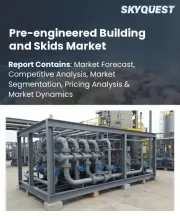
|
시장보고서
상품코드
2003619
조립식 건물 및 스키드 시장 규모, 점유율, 성장 분석 : 구조 유형별, 구성부품 카테고리별, 스키드 용도별, 최종 이용 산업별, 지역별 - 산업 예측(2026-2033년)Pre-engineered Building and Skids Market Size, Share, and Growth Analysis, By Structure Type (Clear Span PEB Frames, Multi-span Rigid Frames), By Component Category, By Skid Application, By End-Use Industry, By Region - Industry Forecast 2026-2033 |
||||||

세계의 조립식 건물 및 스키드 시장 규모는 2024년에 220억 달러로 평가되었으며, 2025년 239억 4,000만 달러에서 2033년까지 470억 달러로 확대되어 예측 기간(2026-2033년) 동안 CAGR 8.8%로 성장할 것으로 전망됩니다.
조립식 건물 및 스키드 시장은 산업, 상업, 에너지 등 다양한 분야에서 효율적이고 비용 효율적인 건설 솔루션에 대한 수요 증가에 힘입어 성장하고 있습니다. 조립식 건축은 신속한 조립을 목적으로 공장에서 제조된 철골 구조물로 구성되며, 스키드는 필수 설비를 수용하는 모듈식 플랫폼 역할을 합니다. 이 시장의 중요성은 프로젝트의 공사 기간을 단축하고, 노동 리스크를 줄이고, 비용의 예측 가능성을 높이는 능력에 있습니다. 이 산업은 철강 생산, 디지털 설계 및 세계 공급망의 발전을 통해 표준화로 전환하고 있습니다. 또한, IoT 기술의 통합으로 원격 모니터링 및 예지보전이 가능해져 운영 효율성이 향상되어 품질 향상과 다운타임 감소를 도모하고 있습니다. 지속가능성에 대한 관심은 모듈식 및 재활용 가능한 솔루션에 대한 수요를 더욱 촉진하여 성장 기회와 혁신을 가져오고 있습니다.
세계 조립식 건물 및 스키드 시장의 촉진요인
인프라 개발 및 도시 확장에 대한 관심이 높아짐에 따라 효율적이고 경제적인 건설 솔루션에 대한 요구가 증가하고 있으며, 그 결과 다양한 프로젝트에서 조립식 건물 및 스키드에 대한 관심이 높아지고 있습니다. 공장에서의 제조 공정은 현장의 노동력을 최소화하고 조정 작업을 단순화하여 프로젝트를 조기에 완료하고 물류의 효율성을 높입니다. 다양한 현장 조건에 대응할 수 있는 유연성과 모듈식 설계와의 호환성은 안정적인 공사 기간과 관리하기 쉬운 건설 워크플로우를 원하는 개발자들에게 더욱 매력적입니다. 그 결과, 공급업체와 계약업체들은 창고, 산업시설, 상업시설 건설에 이러한 시스템을 채택하는 경향이 증가하고 있으며, 이는 시장의 전반적인 성장 잠재력을 촉진하고 있습니다.
세계 조립식 건물 및 스키드 시장의 억제요인
세계 조립식 건물 및 스키드 시장은 철강, 단열재 등 필수 자재 공급 상황과 가격 불안정으로 인해 큰 제약에 직면해 있습니다. 이러한 예측 불가능성은 제조업체의 생산 계획과 조달을 복잡하게 만들고, 수익률 유지에 어려움을 겪고 있습니다. 그 결과, 제조업체는 이러한 변동에 대응하기 위해 주문을 연기하거나 설계 사양을 변경하여 표준화된 제품의 매력을 떨어뜨릴 수 있습니다. 또한, 조달의 복잡성으로 인해 리드 타임이 길어지고 공급업체와의 조정 요구 사항이 증가하여 빠른 납기와 비용 효율성이라는 이점을 훼손할 수 있습니다. 그 결과, 이해관계자들은 대규모 도입을 전면적으로 받아들이는 것을 꺼리게 되고, 이는 전체 시장의 성장을 저해할 수 있습니다.
세계 조립식 건물 및 스키드 시장 동향
세계 조립식 건물 및 스키드 시장은 디지털 설계와 조립식 기술의 통합에 힘입어 큰 변화를 겪고 있습니다. 첨단 설계 플랫폼과 빌딩 정보 모델링(BIM) 워크플로우와 같은 첨단 디지털 툴을 통해 엔지니어링, 제조, 현장 조립 간의 협업을 강화할 수 있습니다. 이러한 진화를 통해 프로젝트 결과물을 보다 예측 가능하게 만들고 납기를 단축할 수 있게 되었습니다. 가상 프로토타이핑과 프리패브리케이션을 활용하면, 이해관계자들은 리턴 타임을 최소화하고 품질 관리를 개선하는 동시에 복잡한 전문 공종의 연계성을 관리할 수 있습니다. 이러한 시장 동향은 공급망 간의 연계 강화를 촉진하고, 대규모 커스터마이징을 지원하며, 라이프사이클 계획을 최적화하여 궁극적으로 고객에게 더 큰 가치를 제공할 것입니다.
자주 묻는 질문
목차
소개
조사 방법
주요 요약
시장 역학과 전망
주요 시장 인사이트
세계의 조립식 건물 및 스키드 시장 규모 : 구조 유형별
세계의 조립식 건물 및 스키드 시장 규모 : 컴포넌트 카테고리별
세계의 조립식 건물 및 스키드 시장 규모 : 스키드 용도별
세계의 조립식 건물 및 스키드 시장 규모 : 최종 이용 산업별
세계의 조립식 건물 및 스키드 시장 규모 : 지역별
경쟁 정보
주요 기업 개요
결론과 제안
KSM 26.04.27Global Pre-Engineered Building And Skids Market size was valued at USD 22.0 Billion in 2024 and is poised to grow from USD 23.94 Billion in 2025 to USD 47.0 Billion by 2033, growing at a CAGR of 8.8% during the forecast period (2026-2033).
The pre-engineered building and skids market is propelled by the increasing demand for efficient, cost-effective construction solutions within various sectors, including industrial, commercial, and energy. Pre-engineered buildings consist of factory-manufactured steel structures designed for swift assembly, while skids serve as modular platforms housing essential equipment. This market's significance lies in its ability to expedite project timelines, mitigate labor risks, and enhance cost predictability. The industry is shifting toward standardization through advancements in steel production, digital design, and global supply chains. Additionally, the integration of IoT technology fosters operational efficiency by enabling remote monitoring and predictive maintenance, thus ensuring higher quality and reducing downtime. The focus on sustainability further drives demand for modular, recyclable solutions, presenting substantial opportunities for growth and innovation.
Top-down and bottom-up approaches were used to estimate and validate the size of the Global Pre-Engineered Building And Skids market and to estimate the size of various other dependent submarkets. The research methodology used to estimate the market size includes the following details: The key players in the market were identified through secondary research, and their market shares in the respective regions were determined through primary and secondary research. This entire procedure includes the study of the annual and financial reports of the top market players and extensive interviews for key insights from industry leaders such as CEOs, VPs, directors, and marketing executives. All percentage shares split, and breakdowns were determined using secondary sources and verified through Primary sources. All possible parameters that affect the markets covered in this research study have been accounted for, viewed in extensive detail, verified through primary research, and analyzed to get the final quantitative and qualitative data.
Global Pre-Engineered Building And Skids Market Segments Analysis
Global pre-engineered building and skids market is segmented by structure type, component category, skid application, end-use industry and region. Based on structure type, the market is segmented into Clear Span PEB Frames, Multi-span Rigid Frames and Industrial Skids. Based on component category, the market is segmented into Primary Frames, Secondary Members and Roof & Wall Cladding. Based on skid application, the market is segmented into Oil & Gas Metering/Pumping Skids, Chemical Injection Skids and Water Treatment/Filtration Skids. Based on end-use industry, the market is segmented into Logistics & Warehousing, Energy & Power Generation and Manufacturing & Infrastructure. Based on region, the market is segmented into North America, Europe, Asia Pacific, Latin America and Middle East & Africa.
Driver of the Global Pre-Engineered Building And Skids Market
The increasing focus on infrastructure development and urban expansion has led to a growing need for efficient and economical construction solutions, thereby driving interest in pre-engineered buildings and skids across various projects. The manufacturing process in a factory setting minimizes on-site labor and simplifies coordination, resulting in expedited project completion and streamlined logistics. This flexibility to accommodate various site conditions and compatibility with modular designs enhances appeal for developers looking for reliable timelines and manageable construction workflows. As a result, suppliers and contractors are increasingly leaning towards these systems for constructing warehouses, industrial sites, and commercial establishments, bolstering the overall growth potential of the market.
Restraints in the Global Pre-Engineered Building And Skids Market
The global market for pre-engineered buildings and skids faces significant constraints due to the inconsistent availability and pricing of essential materials such as steel and insulation. This unpredictability complicates production planning and procurement for manufacturers, leading to challenges in maintaining profit margins. Consequently, manufacturers might postpone orders or modify design specifications to adapt to these fluctuations, which diminishes the appeal of standardized offerings. Furthermore, the complexities associated with procurement can result in longer lead times and increased coordination requirements with suppliers, undermining the advantages of quick delivery and cost efficiency. As a result, stakeholders may be reluctant to fully embrace large-scale implementation, hindering overall market growth.
Market Trends of the Global Pre-Engineered Building And Skids Market
The Global Pre-Engineered Building and Skids market is experiencing a significant transformation driven by the integration of digital design and prefabrication techniques. Advanced digital tools, such as sophisticated design platforms and Building Information Modeling (BIM) workflows, are enhancing coordination among engineering, fabrication, and on-site assembly. This evolution is resulting in more predictable project outcomes and accelerated delivery times. By utilizing virtual prototyping and prefabrication, stakeholders can minimize rework and improve quality control, while also managing complex trade interfaces. This market trend promotes stronger supply chain collaboration, supports large-scale customization, and optimizes lifecycle planning, ultimately providing substantial value to clients.
Table of Contents
Introduction
- Objectives of the Study
- Market Definition & Scope
Research Methodology
- Research Process
- Secondary & Primary Data Methods
- Market Size Estimation Methods
Executive Summary
- Global Market Outlook
- Key Market Highlights
- Segmental Overview
- Competition Overview
Market Dynamics & Outlook
- Macro-Economic Indicators
- Drivers & Opportunities
- Restraints & Challenges
- Supply Side Trends
- Demand Side Trends
- Porters Analysis & Impact
- Competitive Rivalry
- Threat of Substitute
- Bargaining Power of Buyers
- Threat of New Entrants
- Bargaining Power of Suppliers
Key Market Insights
- Key Success Factors
- Market Impacting Factors
- Top Investment Pockets
- Ecosystem Mapping
- Market Attractiveness Index 2025
- PESTEL Analysis
- Regulatory Landscape
Global Pre-engineered Building and Skids Market Size by Structure Type & CAGR (2026-2033)
- Market Overview
- Clear Span PEB Frames
- Multi-span Rigid Frames
- Industrial Skids
Global Pre-engineered Building and Skids Market Size by Component Category & CAGR (2026-2033)
- Market Overview
- Primary Frames
- Secondary Members
- Roof & Wall Cladding
Global Pre-engineered Building and Skids Market Size by Skid Application & CAGR (2026-2033)
- Market Overview
- Oil & Gas Metering/Pumping Skids
- Chemical Injection Skids
- Water Treatment/Filtration Skids
Global Pre-engineered Building and Skids Market Size by End-Use Industry & CAGR (2026-2033)
- Market Overview
- Logistics & Warehousing
- Energy & Power Generation
- Manufacturing & Infrastructure
Global Pre-engineered Building and Skids Market Size & CAGR (2026-2033)
- North America (Structure Type, Component Category, Skid Application, End-Use Industry)
- US
- Canada
- Europe (Structure Type, Component Category, Skid Application, End-Use Industry)
- Germany
- Spain
- France
- UK
- Italy
- Rest of Europe
- Asia Pacific (Structure Type, Component Category, Skid Application, End-Use Industry)
- China
- India
- Japan
- South Korea
- Rest of Asia-Pacific
- Latin America (Structure Type, Component Category, Skid Application, End-Use Industry)
- Mexico
- Brazil
- Rest of Latin America
- Middle East & Africa (Structure Type, Component Category, Skid Application, End-Use Industry)
- GCC Countries
- South Africa
- Rest of Middle East & Africa
Competitive Intelligence
- Top 5 Player Comparison
- Market Positioning of Key Players, 2025
- Strategies Adopted by Key Market Players
- Recent Developments in the Market
- Company Market Share Analysis, 2025
- Company Profiles of All Key Players
- Company Details
- Product Portfolio Analysis
- Company's Segmental Share Analysis
- Revenue Y-O-Y Comparison (2023-2025)
Key Company Profiles
- Jindal Buildsys Limited
- Company Overview
- Business Segment Overview
- Financial Updates
- Key Developments
- Interarch Building Products
- Company Overview
- Business Segment Overview
- Financial Updates
- Key Developments
- BlueScope Steel
- Company Overview
- Business Segment Overview
- Financial Updates
- Key Developments
- Lloyd Insulations
- Company Overview
- Business Segment Overview
- Financial Updates
- Key Developments
- Kirby Building Systems
- Company Overview
- Business Segment Overview
- Financial Updates
- Key Developments
- Zamil Steel
- Company Overview
- Business Segment Overview
- Financial Updates
- Key Developments
- Nucor Building Systems
- Company Overview
- Business Segment Overview
- Financial Updates
- Key Developments
- Butler Buildings
- Company Overview
- Business Segment Overview
- Financial Updates
- Key Developments
- Tiger Steel Engineering
- Company Overview
- Business Segment Overview
- Financial Updates
- Key Developments
- Modular Engineering Co.
- Company Overview
- Business Segment Overview
- Financial Updates
- Key Developments
- Panel Built Inc.
- Company Overview
- Business Segment Overview
- Financial Updates
- Key Developments
- DENIOS Inc.
- Company Overview
- Business Segment Overview
- Financial Updates
- Key Developments
- Rhino Steel Building Systems
- Company Overview
- Business Segment Overview
- Financial Updates
- Key Developments
- Future Buildings
- Company Overview
- Business Segment Overview
- Financial Updates
- Key Developments
- Duro Steel
- Company Overview
- Business Segment Overview
- Financial Updates
- Key Developments
- Easi-Set Buildings
- Company Overview
- Business Segment Overview
- Financial Updates
- Key Developments
- Armstrong Metal Buildings
- Company Overview
- Business Segment Overview
- Financial Updates
- Key Developments
- Worldwide Steel Buildings
- Company Overview
- Business Segment Overview
- Financial Updates
- Key Developments
- Enerpan Building Systems
- Company Overview
- Business Segment Overview
- Financial Updates
- Key Developments
- Flexospan Steel Buildings
- Company Overview
- Business Segment Overview
- Financial Updates
- Key Developments