|
시장보고서
상품코드
2003732
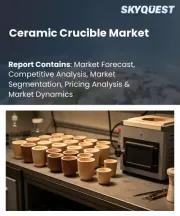
세라믹 도가니 시장 규모, 점유율, 성장 분석 : 재료 유형별, 제조 공정별, 용도별, 내열 온도 범위별, 지역별 - 산업 예측(2026-2033년)Ceramic Crucible Market Size, Share, and Growth Analysis, By Material Type (Alumina, Zirconia), By Manufacturing Process, By Application Vertical, By Temperature Resistance Range, By Region - Industry Forecast 2026-2033 |
||||||

세계의 세라믹 도가니 시장 규모는 2024년에 20억 달러로 평가되었으며, 2025년 20억 4,000만 달러에서 2033년까지 23억 9,000만 달러로 확대되어 예측 기간(2026-2033년) 동안 CAGR 2.0%로 성장할 것으로 전망됩니다.
세라믹 도가니 시장은 주로 첨단 제조 및 재료 가공에 필수적인 고순도 및 고온 내성 용기에 대한 수요 증가에 의해 주도되고 있습니다. 이러한 도가니는 오염 없이 다양한 재료를 용해 및 정제하는 데 필수적이며, 열충격을 견디면서 재료의 특성을 정밀하게 제어할 수 있게 해줍니다. 특히 반도체, 배터리 재활용 등의 분야에서 순도와 내구성에 대한 기준이 엄격해짐에 따라 기존의 점토나 흑연으로 만든 용기에서 엔지니어링 알루미나, 지르코니아, 탄화규소 용기로의 전환이 이루어지고 있습니다. 제조업체의 기술 혁신은 진화하는 요구 사항을 충족시키기 위해 혁신적인 재료 및 디자인 개발에 중점을 둡니다. 또한 AI는 고급 이미지 처리, 실시간 모니터링, 음향 분석을 통해 품질 관리를 강화하고 결함 감지 및 생산 효율을 크게 향상시키고 있습니다. 이를 통해 더 높은 품질의 도가니 생산과 공급의 신뢰도 향상으로 이어지고 있습니다.
세계 세라믹 도가니 시장의 촉진요인
세계 세라믹 도가니 시장은 열 안정성, 내화학성, 기계적 강도 등의 특성을 향상시키는 재료 구성 및 가공 기술의 지속적인 발전에 의해 크게 견인되고 있습니다. 이러한 개선으로 세라믹 도가니는 야금 및 실험실의 까다로운 응용 분야에서 점점 더 실용적인 선택이 되고 있습니다. 또한, 이러한 재료의 높은 순도와 균일성은 오염 위험을 최소화하고 부품의 수명을 연장하기 때문에 최종사용자는 기존 재료보다 세라믹 제품을 선호하게 되었습니다. 제조업체들이 엄격한 성능 기준을 충족하기 위해 제품을 강화하고 적용 범위를 다양화함에 따라 고온 환경에서의 신뢰성, 반복성, 내구성을 중시하는 업계에서 세라믹 도가니를 조달하는 추세가 강화되고 있습니다.
세계 세라믹 도가니 시장의 억제요인
세계 세라믹 도가니 시장은 첨단 세라믹 소재, 특수한 제조 공정, 엄격한 품질 관리 조치에 따른 높은 생산 비용으로 인해 도전에 직면해 있습니다. 이러한 요인들은 특히 비용에 민감한 최종사용자나 소규모 사업자의 경우 도입에 걸림돌이 될 수 있습니다. 원자재 및 가공 비용의 증가는 신규 진입자를 시장에서 퇴출시킬 수 있으며, 기본 성능 기준을 충족하는 보다 경제적인 대체품에 의존하는 산업에서 조달을 제한할 수 있습니다. 구매자가 예상 이익과 총 비용을 비교 검토하는 과정에서 주문을 연기하거나 규모를 축소할 수 있으며, 세라믹 도가니가 제공하는 우수한 기술적 이점에도 불구하고 판매량 증가를 저해하고 시장 확장을 둔화시킬 수 있습니다.
세계 세라믹 도가니 시장 동향
세계 세라믹 도가니 시장은 주로 고성능 야금, 반도체 제조 및 연구 기관의 수요에 힘입어 첨단 세라믹 공학에 대한 견고한 추세를 보이고 있습니다. 기술 혁신은 열충격 저항과 치수 안정성을 높이고, 설계된 미세 구조와 복합 보강재를 갖춘 세라믹 개발에 집중하고 있습니다. 제조업체들은 공정 통합을 최적화하고 오염 위험을 최소화하기 위해 용도에 맞는 도가니 모양과 특수 표면처리에 점점 더 많은 관심을 기울이고 있습니다. 이러한 진화하는 상황은 재료 과학자와 최종사용자 간의 협력을 촉진하고, 기존 및 신규 고온 처리 응용 분야 모두에서 신뢰성과 수명을 향상시키는 데 중점을 둔 고유한 배합 및 제품 등급을 채택하도록 장려하고 있습니다.
자주 묻는 질문
목차
소개
조사 방법
주요 요약
시장 역학과 전망
주요 시장 인사이트
세계의 세라믹 도가니 시장 규모 : 재료 유형별
세계의 세라믹 도가니 시장 규모 : 제조 공정별
세계의 세라믹 도가니 시장 규모 : 용도별
세계의 세라믹 도가니 시장 규모 : 내열 온도 범위별
세계의 세라믹 도가니 시장 규모 : 지역별
경쟁 정보
주요 기업 개요
결론과 제안
KSM 26.04.28Global Ceramic Crucible Market size was valued at USD 2.0 Billion in 2024 and is poised to grow from USD 2.04 Billion in 2025 to USD 2.39 Billion by 2033, growing at a CAGR of 2.0% during the forecast period (2026-2033).
The ceramic crucible market is primarily driven by the increasing demand for high-purity, high-temperature containment essential for advanced manufacturing and materials processing. These crucibles are critical in melting and refining a variety of materials without contamination and withstand thermal shock while enabling precise material properties. A shift from traditional clay and graphite vessels to engineered alumina, zirconia, and silicon carbide has occurred due to heightened purity and durability standards, particularly in sectors like semiconductors and battery recycling. Technological advancements by manufacturers focus on creating innovative materials and designs to meet the evolving requirements. Additionally, AI enhances quality control through advanced imaging, real-time monitoring, and acoustic analysis, significantly improving defect detection and production efficiency, leading to higher-quality crucible output and greater reliability in supply.
Top-down and bottom-up approaches were used to estimate and validate the size of the Global Ceramic Crucible market and to estimate the size of various other dependent submarkets. The research methodology used to estimate the market size includes the following details: The key players in the market were identified through secondary research, and their market shares in the respective regions were determined through primary and secondary research. This entire procedure includes the study of the annual and financial reports of the top market players and extensive interviews for key insights from industry leaders such as CEOs, VPs, directors, and marketing executives. All percentage shares split, and breakdowns were determined using secondary sources and verified through Primary sources. All possible parameters that affect the markets covered in this research study have been accounted for, viewed in extensive detail, verified through primary research, and analyzed to get the final quantitative and qualitative data.
Global Ceramic Crucible Market Segments Analysis
Global ceramic crucible market is segmented by material type, manufacturing process, application vertical, temperature resistance range and region. Based on material type, the market is segmented into Alumina (High Purity), Zirconia, Silicon Carbide (SiC), Quartz/Fused Silica and Graphite-Ceramic Composites. Based on manufacturing process, the market is segmented into Isostatic Pressing, Slip Casting and Injection Molding. Based on application vertical, the market is segmented into Metal Casting & Metallurgy, Chemical & Laboratory Analysis, Glass Manufacturing and Semiconductor Processing. Based on temperature resistance range, the market is segmented into Mid-range, High-range and Ultra-high range. Based on region, the market is segmented into North America, Europe, Asia Pacific, Latin America and Middle East & Africa.
Driver of the Global Ceramic Crucible Market
The global ceramic crucible market is significantly driven by ongoing advancements in material composition and processing technologies, which enhance properties such as thermal stability, chemical resistance, and mechanical strength. These improvements render ceramic crucibles increasingly viable for demanding applications in metallurgy and laboratories. Furthermore, the higher purity and consistency of these materials minimize contamination risks and extend the lifespan of components, motivating end users to favor ceramic options over traditional materials. As manufacturers enhance their offerings to meet strict performance standards and diversify application ranges, industries that value reliability, reproducibility, and durability in high-temperature settings are increasingly inclined to procure ceramic crucibles.
Restraints in the Global Ceramic Crucible Market
The Global Ceramic Crucible market faces challenges due to the high production costs linked to advanced ceramic materials, specialized manufacturing processes, and rigorous quality control measures. These factors can hinder adoption, especially among cost-conscious end users and smaller operations. Increased expenses for inputs and processing may deter new entrants into the market and limit procurement for industries that rely on more economical alternatives meeting basic performance criteria. As buyers evaluate overall expenses against anticipated benefits, they may postpone or scale back orders, which can impede volume growth and slow market expansion, despite the superior technical benefits provided by ceramic crucibles.
Market Trends of the Global Ceramic Crucible Market
The Global Ceramic Crucible market is experiencing a robust trend towards advanced ceramic engineering, primarily propelled by the demand from high-performance metallurgy, semiconductor fabrication, and research institutions. Innovations are focusing on the development of ceramics with engineered microstructures and composite reinforcements, which enhance thermal shock resistance and dimensional stability. Manufacturers are increasingly prioritizing tailored crucible geometries and specialized surface treatments to optimize process integration and minimize contamination risks. This evolving landscape encourages collaboration between material scientists and end users, facilitating the adoption of proprietary formulations and product tiers that emphasize reliability and extended service intervals in both established and emerging high-temperature processing applications.
Table of Contents
Introduction
- Objectives of the Study
- Market Definition & Scope
Research Methodology
- Research Process
- Secondary & Primary Data Methods
- Market Size Estimation Methods
Executive Summary
- Global Market Outlook
- Key Market Highlights
- Segmental Overview
- Competition Overview
Market Dynamics & Outlook
- Macro-Economic Indicators
- Drivers & Opportunities
- Restraints & Challenges
- Supply Side Trends
- Demand Side Trends
- Porters Analysis & Impact
- Competitive Rivalry
- Threat of Substitute
- Bargaining Power of Buyers
- Threat of New Entrants
- Bargaining Power of Suppliers
Key Market Insights
- Key Success Factors
- Market Impacting Factors
- Top Investment Pockets
- Ecosystem Mapping
- Market Attractiveness Index 2025
- PESTEL Analysis
- Regulatory Landscape
Global Ceramic Crucible Market Size by Material Type & CAGR (2026-2033)
- Market Overview
- Alumina (High Purity)
- Zirconia
- Silicon Carbide (SiC)
- Quartz/Fused Silica
- Graphite-Ceramic Composites
Global Ceramic Crucible Market Size by Manufacturing Process & CAGR (2026-2033)
- Market Overview
- Isostatic Pressing
- Slip Casting
- Injection Molding
Global Ceramic Crucible Market Size by Application Vertical & CAGR (2026-2033)
- Market Overview
- Metal Casting & Metallurgy
- Chemical & Laboratory Analysis
- Glass Manufacturing
- Semiconductor Processing
Global Ceramic Crucible Market Size by Temperature Resistance Range & CAGR (2026-2033)
- Market Overview
- Mid-range
- High-range
- Ultra-high range
Global Ceramic Crucible Market Size & CAGR (2026-2033)
- North America (Material Type, Manufacturing Process, Application Vertical, Temperature Resistance Range)
- US
- Canada
- Europe (Material Type, Manufacturing Process, Application Vertical, Temperature Resistance Range)
- Germany
- Spain
- France
- UK
- Italy
- Rest of Europe
- Asia Pacific (Material Type, Manufacturing Process, Application Vertical, Temperature Resistance Range)
- China
- India
- Japan
- South Korea
- Rest of Asia-Pacific
- Latin America (Material Type, Manufacturing Process, Application Vertical, Temperature Resistance Range)
- Mexico
- Brazil
- Rest of Latin America
- Middle East & Africa (Material Type, Manufacturing Process, Application Vertical, Temperature Resistance Range)
- GCC Countries
- South Africa
- Rest of Middle East & Africa
Competitive Intelligence
- Top 5 Player Comparison
- Market Positioning of Key Players, 2025
- Strategies Adopted by Key Market Players
- Recent Developments in the Market
- Company Market Share Analysis, 2025
- Company Profiles of All Key Players
- Company Details
- Product Portfolio Analysis
- Company's Segmental Share Analysis
- Revenue Y-O-Y Comparison (2023-2025)
Key Company Profiles
- Morgan Advanced Materials
- Company Overview
- Business Segment Overview
- Financial Updates
- Key Developments
- Saint-Gobain Performance Ceramics
- Company Overview
- Business Segment Overview
- Financial Updates
- Key Developments
- Vesuvius PLC
- Company Overview
- Business Segment Overview
- Financial Updates
- Key Developments
- RHI Magnesita
- Company Overview
- Business Segment Overview
- Financial Updates
- Key Developments
- Imerys
- Company Overview
- Business Segment Overview
- Financial Updates
- Key Developments
- Zircar Ceramics
- Company Overview
- Business Segment Overview
- Financial Updates
- Key Developments
- McDanel Advanced Ceramic
- Company Overview
- Business Segment Overview
- Financial Updates
- Key Developments
- CoorsTek
- Company Overview
- Business Segment Overview
- Financial Updates
- Key Developments
- BCE (Canada)
- Company Overview
- Business Segment Overview
- Financial Updates
- Key Developments
- SCJ Ceramic
- Company Overview
- Business Segment Overview
- Financial Updates
- Key Developments
- LECO Corporation
- Company Overview
- Business Segment Overview
- Financial Updates
- Key Developments
- Kashimira Ceramics
- Company Overview
- Business Segment Overview
- Financial Updates
- Key Developments
- Shandong Guojing
- Company Overview
- Business Segment Overview
- Financial Updates
- Key Developments
- MTS (Mizumoto)
- Company Overview
- Business Segment Overview
- Financial Updates
- Key Developments
- Anderman Ceramics
- Company Overview
- Business Segment Overview
- Financial Updates
- Key Developments
- Almatis
- Company Overview
- Business Segment Overview
- Financial Updates
- Key Developments
- Calderys
- Company Overview
- Business Segment Overview
- Financial Updates
- Key Developments
- LafargeHolcim
- Company Overview
- Business Segment Overview
- Financial Updates
- Key Developments
- Washington Mills
- Company Overview
- Business Segment Overview
- Financial Updates
- Key Developments
- Resco Products
- Company Overview
- Business Segment Overview
- Financial Updates
- Key Developments