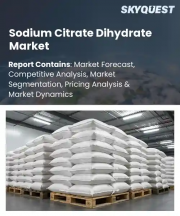
|
시장보고서
상품코드
2069030
구연산나트륨 이수화물 시장 규모, 점유율 및 성장 분석 : 제품 유형별, 용도별, 최종사용자 산업별, 유통 채널별, 지역별 - 업계 예측(2026-2033년)Sodium Citrate Dihydrate Market Size, Share, and Growth Analysis, By Product Type (Food Grade, Pharmaceutical Grade), By Application, By End User Industry, By Distribution Channel, By Region - Industry Forecast 2026-2033 |
||||||

세계의 구연산나트륨 이수화물 시장 규모는 2024년에 6억 8,930만 달러로 평가되었고, 2025년 7억 1,411만 달러에서 2033년까지 9억 4,765만 달러로 성장하여 예측 기간(2026-2033년)에 CAGR 3.6%를 기록할 전망입니다.
세계 구연산나트륨 이수화물 시장은 그 다양한 용도, 특히 수혈 시 혈액의 pH를 안정시키고 응고를 방지하는 치료 현장에서의 용도에 의해 형성되어 있습니다. 만성 질환의 유병률이 높아짐에 따라, 병원에서는 이 화합물의 사용이 점점 더 늘어나고 있으며, 이로 인해 항응고제 수요가 증가하고 있습니다. 그 결과, 각 제조업체는 비용 절감과 시장 진출 확대를 도모하기 위해 생산 능력 확충과 합성 공정의 최적화를 추진하고 있습니다. 식품 분야에서는 사업자들이 소스나 가공육 등의 제품 배합을 재검토하고, 구연산나트륨 이수화물을 사용함으로써 염화나트륨 함량을 줄이면서도 식감을 향상시키고 있습니다. 또한, AI를 활용한 자동화를 통해 수요 예측과 생산 계획이 통합되면서 공급망에 혁명적인 변화가 일어나고 있습니다. 이 기술은 예측 분석, 로봇 공학 및 자동 재고 관리를 통해 효율성을 높이고 시장 역학에 대한 대응력을 향상시키는 동시에 운영 비용을 최소화하고 있습니다.
세계 구연산나트륨 이수화물 시장의 성장 요인
가공을 최소화한 식품에 대한 소비자 수요가 증가함에 따라, 제조업체들은 효과적인 보존 솔루션을 모색하고 있으며, 구연산나트륨 이수화물은 뛰어난 완충 능력과 킬레이트 작용 덕분에 인기 있는 대안으로 부상하고 있습니다. 이 화합물은 맛이나 영양가를 해치지 않으면서 유통기한을 연장해 주기 때문에 유제품, 육류, 음료 등 다양한 식품 분야에 적합합니다. 또한, 규제 당국이 안전성이 입증된 원료의 사용을 권장하고 있기 때문에 생산자들은 클린 라벨 기준을 준수하기 위해 구연산나트륨 이수화물의 사용을 점점 더 늘리고 있습니다. 이는 결과적으로 제품 혁신을 촉진하고, 세계 시장의 성장을 주도하는 동시에 소비자의 브랜드 충성도를 강화하는 데 기여하고 있습니다.
세계 구연산나트륨 이수화물 시장의 제약 요인
세계 구연산나트륨 이수화물 시장은 각 지역 규제 당국이 부과하는 엄격한 안전성 평가 및 표시 요건으로 인해 큰 제약을 받고 있습니다. 시장에 진출하기 위해서는 구연산나트륨 이수화물이 특정 순도 기준 및 종합적인 문서화 기준을 준수해야 하며, 그 결과 제조업체의 경우 제품 출시까지의 기간이 길어지고 개발 비용이 급증하는 경우가 종종 있습니다. 이러한 규제상의 장벽은 소규모 생산자들이 이 원료를 활용하는 것을 주저하게 만드는 요인이 되며, 결과적으로 시장 전체의 성장을 저해할 가능성이 있습니다. 또한, 지역별 승인 절차의 차이는 세계 공급망에 불확실성을 초래하고 있으며, 기업들은 규제 준수를 효과적으로 관리하기 위해 더 많은 자원을 투입할 수밖에 없는 실정입니다.
세계 구연산나트륨 이수화물 시장 동향
세계 구연산나트륨 이수화물 시장은 식품 및 음료 업계의 지속가능성 노력에 대한 수요가 증가하는 것을 배경으로 뚜렷한 변화를 겪고 있습니다. 제조업체들이 친환경 포장 솔루션을 중시하는 가운데, 구연산나트륨 이수화물은 생분해성 필름을 보완하는 천연 완충제 및 킬레이트제로서의 효능 덕분에 주목을 받고 있습니다. 이 화합물은 합성 방부제에 의존하지 않고 제품의 안정성을 유지하는 데 있어 매우 중요한 역할을 하고 있으며, 보다 깨끗한 라벨과 플라스틱 폐기물 감소를 원하는 소비자의 요구에 부응하고 있습니다. 그 결과, 각 공급업체들은 구연산나트륨 이수화물을 지속 가능한 제품 처방의 필수 성분으로 전략적으로 추진하고 있으며, 전 세계 브랜드들이 다양한 시장에서 보다 친환경적인 포장 방안을 도입함에 따라 시장 성장이 가속화되고 있습니다.
자주 묻는 질문
목차
서론
조사 방법
주요 요약
시장 역학과 전망
주요 시장 인사이트
세계의 구연산나트륨 이수화물 시장 규모 : 제품 유형별
세계의 구연산나트륨 이수화물 시장 규모 : 용도별
세계의 구연산나트륨 이수화물 시장 규모 : 최종사용자 산업별
세계의 구연산나트륨 이수화물 시장 규모 : 유통 채널별
세계의 구연산나트륨 이수화물 시장 규모 : 지역별
경쟁 정보
주요 기업 개요
결론과 제안
LSH 26.07.01Global Sodium Citrate Dihydrate Market size was valued at USD 689.3 Million in 2024 and is poised to grow from USD 714.11 Million in 2025 to USD 947.65 Million by 2033, growing at a CAGR of 3.6% during the forecast period (2026-2033).
The global sodium citrate dihydrate market is shaped by its multifaceted applications, particularly in therapeutic settings where it stabilizes blood pH and prevents clotting during transfusions. As chronic disease prevalence rises, hospitals are increasingly utilizing this compound, thus driving demand for anticoagulant agents. Consequently, manufacturers are enhancing production capacities and optimizing synthesis processes to reduce costs and expand market access. In the food sector, operators are reformulating products like sauces and processed meats with sodium citrate dihydrate to lower sodium chloride content while improving texture. Additionally, AI-driven automation is revolutionizing the supply chain by integrating demand forecasting with production planning. This technology enhances efficiency through predictive analytics, robotics, and automated inventory management, ensuring better responsiveness to market dynamics while minimizing operational costs.
Top-down and bottom-up approaches were used to estimate and validate the size of the Global Sodium Citrate Dihydrate market and to estimate the size of various other dependent submarkets. The research methodology used to estimate the market size includes the following details: The key players in the market were identified through secondary research, and their market shares in the respective regions were determined through primary and secondary research. This entire procedure includes the study of the annual and financial reports of the top market players and extensive interviews for key insights from industry leaders such as CEOs, VPs, directors, and marketing executives. All percentage shares split, and breakdowns were determined using secondary sources and verified through Primary sources. All possible parameters that affect the markets covered in this research study have been accounted for, viewed in extensive detail, verified through primary research, and analyzed to get the final quantitative and qualitative data.
Global Sodium Citrate Dihydrate Market Segments Analysis
Global sodium citrate dihydrate market is segmented by product type, application, end user industry, distribution channel and region. Based on product type, the market is segmented into Food Grade, Pharmaceutical Grade and Industrial Grade. Based on application, the market is segmented into Food & Beverages, Pharmaceuticals, Personal Care & Cosmetics, Detergents & Cleaning Products, Water Treatment, Industrial Processes and Others. Based on end user industry, the market is segmented into Food Processing Industry, Pharmaceutical Industry, Cosmetics & Personal Care Industry, Chemical Industry, Water Treatment Industry and Others. Based on distribution channel, the market is segmented into Direct Sales, Distributors & Wholesalers and Online Sales. Based on region, the market is segmented into North America, Europe, Asia Pacific, Latin America and Middle East & Africa.
Driver of the Global Sodium Citrate Dihydrate Market
The increasing consumer demand for minimally processed foods is prompting manufacturers to explore effective preservation solutions, with sodium citrate dihydrate emerging as a popular choice due to its excellent buffering capacity and chelating abilities. This compound enhances shelf life without compromising taste or nutritional value, making it suitable for a variety of food applications, including dairy, meat, and beverages. Additionally, as regulatory agencies advocate for the use of ingredients that are recognized for their safety, producers are increasingly turning to sodium citrate dihydrate to align with clean-label standards, which in turn fosters product innovation and drives global market growth, reinforcing brand loyalty among consumers.
Restraints in the Global Sodium Citrate Dihydrate Market
The Global Sodium Citrate Dihydrate market faces significant restraints due to stringent safety evaluations and labeling requirements imposed by regulatory agencies across various regions. To enter the market, sodium citrate dihydrate must conform to specific purity levels and comprehensive documentation standards, which often leads to prolonged product launch timelines and elevated development costs for manufacturers. These regulatory hurdles can discourage smaller producers from utilizing this ingredient, thereby hindering overall market growth. Furthermore, discrepancies in approval processes across regions introduce uncertainties within the global supply chain, forcing companies to dedicate more resources to manage regulatory compliance effectively.
Market Trends of the Global Sodium Citrate Dihydrate Market
The Global Sodium Citrate Dihydrate market is experiencing a notable shift driven by the increasing demand for sustainable practices within the food and beverage industries. As manufacturers emphasize eco-friendly packaging solutions, sodium citrate dihydrate gains prominence for its effectiveness as a natural buffering and sequestration agent that complements biodegradable films. This compound plays a pivotal role in maintaining product stability without relying on synthetic preservatives, catering to consumer preferences for cleaner labels and less plastic waste. Consequently, suppliers are strategically promoting sodium citrate dihydrate as an essential ingredient for sustainable formulations, facilitating growth as brands worldwide embrace greener packaging initiatives across various markets.
Table of Contents
Introduction
- Objectives of the Study
- Market Definition & Scope
Research Methodology
- Research Process
- Secondary & Primary Data Methods
- Market Size Estimation Methods
Executive Summary
- Global Market Outlook
- Key Market Highlights
- Segmental Overview
- Competition Overview
Market Dynamics & Outlook
- Macro-Economic Indicators
- Drivers & Opportunities
- Restraints & Challenges
- Supply Side Trends
- Demand Side Trends
- Porters Analysis & Impact
- Competitive Rivalry
- Threat of Substitute
- Bargaining Power of Buyers
- Threat of New Entrants
- Bargaining Power of Suppliers
Key Market Insights
- Key Success Factors
- Market Impacting Factors
- Top Investment Pockets
- Ecosystem Mapping
- Market Attractiveness Index 2025
- PESTEL Analysis
- Regulatory Landscape
Global Sodium Citrate Dihydrate Market Size by Product Type & CAGR (2026-2033)
- Market Overview
- Food Grade
- Pharmaceutical Grade
- Industrial Grade
Global Sodium Citrate Dihydrate Market Size by Application & CAGR (2026-2033)
- Market Overview
- Food & Beverages
- Pharmaceuticals
- Personal Care & Cosmetics
- Detergents & Cleaning Products
- Water Treatment
- Industrial Processes
- Others
Global Sodium Citrate Dihydrate Market Size by End User Industry & CAGR (2026-2033)
- Market Overview
- Food Processing Industry
- Pharmaceutical Industry
- Cosmetics & Personal Care Industry
- Chemical Industry
- Water Treatment Industry
- Others
Global Sodium Citrate Dihydrate Market Size by Distribution Channel & CAGR (2026-2033)
- Market Overview
- Direct Sales
- Distributors & Wholesalers
- Online Sales
Global Sodium Citrate Dihydrate Market Size & CAGR (2026-2033)
- North America (Product Type, Application, End User Industry, Distribution Channel)
- US
- Canada
- Europe (Product Type, Application, End User Industry, Distribution Channel)
- Germany
- Spain
- France
- UK
- Italy
- Rest of Europe
- Asia Pacific (Product Type, Application, End User Industry, Distribution Channel)
- China
- India
- Japan
- South Korea
- Rest of Asia-Pacific
- Latin America (Product Type, Application, End User Industry, Distribution Channel)
- Mexico
- Brazil
- Rest of Latin America
- Middle East & Africa (Product Type, Application, End User Industry, Distribution Channel)
- GCC Countries
- South Africa
- Rest of Middle East & Africa
Competitive Intelligence
- Top 5 Player Comparison
- Market Positioning of Key Players, 2025
- Strategies Adopted by Key Market Players
- Recent Developments in the Market
- Company Market Share Analysis, 2025
- Company Profiles of All Key Players
- Company Details
- Product Portfolio Analysis
- Company's Segmental Share Analysis
- Revenue Y-O-Y Comparison (2023-2025)
Key Company Profiles
- Jungbunzlauer Suisse AG
- Company Overview
- Business Segment Overview
- Financial Updates
- Key Developments
- Cargill, Incorporated
- Company Overview
- Business Segment Overview
- Financial Updates
- Key Developments
- Gadot Biochemical Industries Ltd.
- Company Overview
- Business Segment Overview
- Financial Updates
- Key Developments
- Archer-Daniels-Midland Company
- Company Overview
- Business Segment Overview
- Financial Updates
- Key Developments
- Tate & Lyle PLC
- Company Overview
- Business Segment Overview
- Financial Updates
- Key Developments
- FBC Industries, Inc.
- Company Overview
- Business Segment Overview
- Financial Updates
- Key Developments
- RZBC Group Co., Ltd.
- Company Overview
- Business Segment Overview
- Financial Updates
- Key Developments
- COFCO Biochemical (Anhui) Co., Ltd.
- Company Overview
- Business Segment Overview
- Financial Updates
- Key Developments
- Weifang Ensign Industry Co., Ltd.
- Company Overview
- Business Segment Overview
- Financial Updates
- Key Developments
- TTCA Co., Ltd.
- Company Overview
- Business Segment Overview
- Financial Updates
- Key Developments
- Shandong Lemon Biochemical Co., Ltd.
- Company Overview
- Business Segment Overview
- Financial Updates
- Key Developments
- Huangshi Xinghua Biochemical Co., Ltd.
- Company Overview
- Business Segment Overview
- Financial Updates
- Key Developments
- Niran (Thailand) Co., Ltd.
- Company Overview
- Business Segment Overview
- Financial Updates
- Key Developments
- S.A. Citrique Belge N.V.
- Company Overview
- Business Segment Overview
- Financial Updates
- Key Developments
- Merck KGaA
- Company Overview
- Business Segment Overview
- Financial Updates
- Key Developments
- Avantor, Inc.
- Company Overview
- Business Segment Overview
- Financial Updates
- Key Developments
- Aditya Birla Chemicals (Thailand) Limited
- Company Overview
- Business Segment Overview
- Financial Updates
- Key Developments
- COFCO Biotechnology Co., Ltd.
- Company Overview
- Business Segment Overview
- Financial Updates
- Key Developments
- Sucroal S.A.
- Company Overview
- Business Segment Overview
- Financial Updates
- Key Developments
- Tate & Lyle Solutions USA LLC
- Company Overview
- Business Segment Overview
- Financial Updates
- Key Developments