|
시장보고서
상품코드
2078492
스티플레그 크레인 시장 : 시장 규모, 점유율, 성장 분석 - 유형별, 용량별, 용도별, 최종 사용자별, 유통 경로별, 지역별 업계 예측(2026-2033년)Stiffleg Crane Market Size, Share, and Growth Analysis, By Type (Fixed Stiffleg Derrick, Rotating Stiffleg Derrick), By Capacity (Below 50 Tons, 50-200 Tons), By Application, By End-User, By Distribution, By Region - Industry Forecast 2026-2033 |
||||||

세계의 스티플레그 크레인 시장 규모는 2024년에 3억 8,250만 달러로 평가되었고, 2025년 4억 55만 달러에서 2033년까지 5억 8,240만 달러로 확대될 전망이며, 예측 기간(2026-2033년) CAGR 4.72%로 성장할 전망입니다.
스티플레그 크레인 시장은 주로 인프라 확충에 힘입어 성장하고 있습니다. 이 크레인들은 높은 안정성과 대규모 토목 프로젝트에 최적화된 단순한 기계 설계를 갖추고 있어, 유지보수 비용과 가동 중단 시간을 효과적으로 최소화할 수 있기 때문입니다. 이러한 고정식 베이스의 설계는 이동이 제한되는 항만이나 조선소 등 좁은 공간에서 특히 유용합니다. IoT 기능을 포함한 기술의 통합을 통해, 기존의 크레인은 예측 유지보수 및 정밀한 하중 모니터링이 가능한 '연결된 자산'으로 변모하며 운영 효율이 향상되고 있습니다. 이로 인해 신뢰성이 향상되고 운영 비용이 절감되므로, 항만 운영이나 해상 풍력 발전 설비 설치와 같은 분야에서 도입이 확대되고 있습니다. 또한, 내식성 설계의 발전으로 장비의 수명이 연장되면서 새로운 해양 관련 계약 수주를 뒷받침하고 있으며, 혁신과 성능 향상에 힘입어 순환적인 성장 모멘텀이 형성되고 있습니다.
세계 스티프레그 크레인 시장의 성장 요인
세계의 스티프레그 크레인 수요는 민관 인프라 투자 증가에 힘입어 크게 늘어나고 있습니다. 이는 대규모 건설 프로젝트나 항만 현대화 사업에서 신뢰성이 높고 대용량의 리프팅 장비가 필요하기 때문입니다. 이해관계자들이 효율적인 자재관리과 자산의 장기적인 활용에 주력하는 가운데, 정밀성과 내구성을 갖춘 견고한 크레인이 확실히 선호되고 있습니다. 이러한 추세는 조달 및 장비 교체를 촉진하는 동시에, 공급업체로 하여금 모델 혁신과 사후 서비스 체계를 강화하도록 유도하고 있습니다. 그 결과, 인프라 개발에 힘쓰고 있는 각 지역에서 시장에 지속적인 활력이 생겨나고 있으며, 운영상의 안전 기준도 향상되고 있습니다.
세계 스티프레그 크레인 시장의 제약 요인
세계의 스티프레그 크레인 시장은 조달, 운송, 현장 준비에 막대한 초기 투자가 필요하기 때문에 많은 사업자, 특히 소규모 도급업체나 지방 항만에게 큰 재정적 부담이 되어 현저한 과제에 직면해 있습니다. 특수한 기초 공사가 필요하거나 기존 인프라와의 통합이 필요하기 때문에 리드타임이 길어지고 재무 계획이 복잡해질 가능성이 있습니다. 그 결과, 조직은 구매를 연기하거나 전문성은 낮지만 적응성이 높은 다른 리프팅 옵션을 선택하게 됩니다. 또한, 자금 조달 제한과 신중한 자본 배분이 조달 수준 저하로 이어지고 있어, 비용 회수 및 투자 수익률(ROI)에 대한 기대가 프로젝트 일정과 일치할 때까지는 시장 침투와 성장이 저해되고 있습니다.
세계의 스티프레그 크레인 시장 동향
세계의 스티프레그 크레인 시장에서는 연결된 센서와 텔레매틱스의 통합을 통해 원격 모니터링 및 제어 기술 도입을 향한 뚜렷한 추세가 나타나고 있습니다. 이러한 발전으로 인해 운영 담당자와 서비스 팀은 한 곳에서 장비의 성능을 모니터링할 수 있게 되며, 상태에 따른 개입을 통해 유지보수 소요 시간을 단축할 수 있게 됩니다. 운전자가 위험한 환경에 노출될 위험이 최소화됨으로써 안전 대책이 강화되는 한편, 차량 함대의 일정 관리와 가동률 향상도 실현됩니다. 또한, 기업 자산 관리 시스템과의 통합을 통해 선제적인 수명 주기 계획이 촉진되고, 애프터마켓 서비스 제공이 강화됩니다. 이를 통해 운영 현황의 가시성을 높이고, 정보에 기반한 의사결정을 가능하게 하는 부가가치가 높은 디지털 서비스의 전개가 기대됩니다.
자주 묻는 질문
목차
서론
조사 방법
주요 요약
시장 역학 및 전망
주요 시장 인사이트
세계의 스티플레그 크레인 시장 규모 : 유형별
세계의 스티플레그 크레인 시장 규모 : 용량별
세계의 스티플레그 크레인 시장 규모 : 용도별
세계의 스티플레그 크레인 시장 규모 : 최종 사용자별
세계의 스티플레그 크레인 시장 규모 : 유통 경로별
세계의 스티플레그 크레인 시장 규모 : 지역별
경쟁 정보
주요 기업 개요
결론 및 제안
AJY 26.07.13Global Stiffleg Crane Market size was valued at USD 382.5 Million in 2024 and is poised to grow from USD 400.55 Million in 2025 to USD 582.4 Million by 2033, growing at a CAGR of 4.72% during the forecast period (2026-2033).
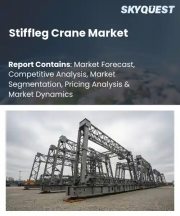
The stiffleg crane market is driven primarily by infrastructure expansion, as these cranes offer high stability and a straightforward mechanical design ideal for heavy civil projects, effectively minimizing maintenance costs and downtime. Their fixed-base design is particularly beneficial in confined spaces such as ports and shipyards, where mobility is constrained. The integration of technology, including IoT capabilities, enhances operational efficiency by transforming traditional cranes into connected assets that enable predictive maintenance and precise load monitoring. This fosters increased reliability and lowers operational expenses, prompting greater adoption in sectors like port operations and offshore wind installations. Furthermore, advancements in corrosion-resistant designs extend equipment longevity and support new marine contracts, creating a cyclical growth dynamic fueled by innovation and improved performance.
Top-down and bottom-up approaches were used to estimate and validate the size of the Global Stiffleg Crane market and to estimate the size of various other dependent submarkets. The research methodology used to estimate the market size includes the following details: The key players in the market were identified through secondary research, and their market shares in the respective regions were determined through primary and secondary research. This entire procedure includes the study of the annual and financial reports of the top market players and extensive interviews for key insights from industry leaders such as CEOs, VPs, directors, and marketing executives. All percentage shares split, and breakdowns were determined using secondary sources and verified through Primary sources. All possible parameters that affect the markets covered in this research study have been accounted for, viewed in extensive detail, verified through primary research, and analyzed to get the final quantitative and qualitative data.
Global Stiffleg Crane Market Segments Analysis
Global stiffleg crane market is segmented by type, capacity, application, end-user, distribution and region. Based on type, the market is segmented into Fixed Stiffleg Derrick and Rotating Stiffleg Derrick. Based on capacity, the market is segmented into Below 50 Tons, 50-200 Tons and Above 200 Tons. Based on application, the market is segmented into Shipbuilding & Shipyards, Construction and Offshore Operations. Based on end-user, the market is segmented into Shipyards, Industrial Plants and Ports & Terminals. Based on distribution, the market is segmented into Direct OEM and Equipment Dealers. Based on region, the market is segmented into North America, Europe, Asia Pacific, Latin America and Middle East & Africa.
Driver of the Global Stiffleg Crane Market
The global demand for stiffleg cranes is significantly driven by the rise in public and private infrastructure investment, as major construction and port modernization initiatives necessitate reliable and high-capacity lifting equipment. With stakeholders focusing on efficient material handling and the longevity of assets, there is a clear preference for sturdy cranes that ensure precision and durability. This trend fosters increased procurement and fleet upgrades while motivating suppliers to innovate their models and enhance aftermarket services. Consequently, this creates a lasting momentum in the market across regions engaged in infrastructure development, all while advancing operational safety standards.
Restraints in the Global Stiffleg Crane Market
The Global Stiffleg Crane market faces notable challenges due to the considerable initial investment required for procurement, transportation, and site preparation, creating a heavy financial burden for many operators, especially smaller contractors and regional ports. The necessity for specialized foundations and the need to integrate with existing infrastructure can lead to extended lead times and complicate financial planning, causing organizations to postpone acquisitions or choose more adaptable, albeit less specialized lifting options. Additionally, restricted access to financing and prudent capital allocation contribute to reduced procurement levels, hindering market penetration and growth until expectations for cost recovery and return on investment are harmonized with project schedules.
Market Trends of the Global Stiffleg Crane Market
The Global Stiffleg Crane market is witnessing a significant trend towards the adoption of remote monitoring and control technologies, facilitated by the integration of connected sensors and telematics. This development empowers operators and service teams to monitor equipment performance from centralized locations, leading to reduced maintenance turnaround through condition-based interventions. Enhanced safety measures are realized as operator exposure to hazardous environments is minimized, while improved fleet scheduling and utilization are achieved. Furthermore, the integration with enterprise asset management systems fosters proactive lifecycle planning and enhances aftermarket service offerings, creating avenues for value-added digital services that enhance operational visibility and informed decision-making.
Table of Contents
Introduction
- Objectives of the Study
- Market Definition & Scope
Research Methodology
- Research Process
- Secondary & Primary Data Methods
- Market Size Estimation Methods
Executive Summary
- Global Market Outlook
- Key Market Highlights
- Segmental Overview
- Competition Overview
Market Dynamics & Outlook
- Macro-Economic Indicators
- Drivers & Opportunities
- Restraints & Challenges
- Supply Side Trends
- Demand Side Trends
- Porters Analysis & Impact
- Competitive Rivalry
- Threat of Substitute
- Bargaining Power of Buyers
- Threat of New Entrants
- Bargaining Power of Suppliers
Key Market Insights
- Key Success Factors
- Market Impacting Factors
- Top Investment Pockets
- Ecosystem Mapping
- Market Attractiveness Index 2025
- PESTEL Analysis
- Regulatory Landscape
Global Stiffleg Crane Market Size by Type & CAGR (2026-2033)
- Market Overview
- Fixed Stiffleg Derrick
- Rotating Stiffleg Derrick
Global Stiffleg Crane Market Size by Capacity & CAGR (2026-2033)
- Market Overview
- Below 50 Tons
- 50-200 Tons
- Above 200 Tons
Global Stiffleg Crane Market Size by Application & CAGR (2026-2033)
- Market Overview
- Shipbuilding & Shipyards
- Construction
- Offshore Operations
Global Stiffleg Crane Market Size by End-User & CAGR (2026-2033)
- Market Overview
- Shipyards
- Industrial Plants
- Ports & Terminals
Global Stiffleg Crane Market Size by Distribution & CAGR (2026-2033)
- Market Overview
- Direct OEM
- Equipment Dealers
Global Stiffleg Crane Market Size & CAGR (2026-2033)
- North America (Type, Capacity, Application, End-User, Distribution)
- US
- Canada
- Europe (Type, Capacity, Application, End-User, Distribution)
- Germany
- Spain
- France
- UK
- Italy
- Rest of Europe
- Asia Pacific (Type, Capacity, Application, End-User, Distribution)
- China
- India
- Japan
- South Korea
- Rest of Asia-Pacific
- Latin America (Type, Capacity, Application, End-User, Distribution)
- Mexico
- Brazil
- Rest of Latin America
- Middle East & Africa (Type, Capacity, Application, End-User, Distribution)
- GCC Countries
- South Africa
- Rest of Middle East & Africa
Competitive Intelligence
- Top 5 Player Comparison
- Market Positioning of Key Players, 2025
- Strategies Adopted by Key Market Players
- Recent Developments in the Market
- Company Market Share Analysis, 2025
- Company Profiles of All Key Players
- Company Details
- Product Portfolio Analysis
- Company's Segmental Share Analysis
- Revenue Y-O-Y Comparison (2023-2025)
Key Company Profiles
- Manitowoc Crane Group
- Company Overview
- Business Segment Overview
- Financial Updates
- Key Developments
- Liebherr Group
- Company Overview
- Business Segment Overview
- Financial Updates
- Key Developments
- Tadano Ltd.
- Company Overview
- Business Segment Overview
- Financial Updates
- Key Developments
- Terex Corporation
- Company Overview
- Business Segment Overview
- Financial Updates
- Key Developments
- SANY Group
- Company Overview
- Business Segment Overview
- Financial Updates
- Key Developments
- XCMG Group
- Company Overview
- Business Segment Overview
- Financial Updates
- Key Developments
- Konecranes plc
- Company Overview
- Business Segment Overview
- Financial Updates
- Key Developments
- Demag Cranes (Terex)
- Company Overview
- Business Segment Overview
- Financial Updates
- Key Developments
- Palfinger AG
- Company Overview
- Business Segment Overview
- Financial Updates
- Key Developments
- Zoomlion Heavy Industry
- Company Overview
- Business Segment Overview
- Financial Updates
- Key Developments
- Kobelco Construction Machinery
- Company Overview
- Business Segment Overview
- Financial Updates
- Key Developments
- Link-Belt Cranes (KOBELCO)
- Company Overview
- Business Segment Overview
- Financial Updates
- Key Developments
- Lampson International
- Company Overview
- Business Segment Overview
- Financial Updates
- Key Developments
- Sarens Group
- Company Overview
- Business Segment Overview
- Financial Updates
- Key Developments
- Heavy Lift Group
- Company Overview
- Business Segment Overview
- Financial Updates
- Key Developments
- Mammoet
- Company Overview
- Business Segment Overview
- Financial Updates
- Key Developments
- ALE Heavylift
- Company Overview
- Business Segment Overview
- Financial Updates
- Key Developments
- BigLift Shipping
- Company Overview
- Business Segment Overview
- Financial Updates
- Key Developments
- FAGIOLI SpA
- Company Overview
- Business Segment Overview
- Financial Updates
- Key Developments
- Wagenborg Group
- Company Overview
- Business Segment Overview
- Financial Updates
- Key Developments