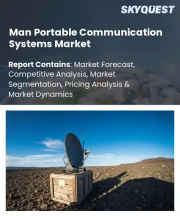
|
시장보고서
상품코드
2091924
휴대용 통신 시스템 시장 규모, 점유율 및 성장 분석 : 시스템 유형별, 주파수별, 용도별, 최종사용자별, 지역별 - 업계 예측(2026-2033년)Man Portable Communication Systems Market Size, Share, and Growth Analysis, By System Type, By Frequency, By Application, By End-User, By Region - Industry Forecast 2026-2033 |
||||||

세계의 휴대용 통신 시스템 시장 규모는 2024년에 85억 2,000만 달러로 평가되며, 2025년 90억 6,000만 달러에서 2033년까지 148억 5,000만 달러로 확대하며, 예측 기간(2026-2033년)에 CAGR 6.32%로 성장할 것으로 전망되고 있습니다.
전 세계 휴대용 통신 시스템 시장은 현재 5G 엣지 컴퓨팅과 견고한 휴대 단말기의 통합에 힘입어 성장하고 있으며, 이를 통해 기본적인 음성 통신이 지휘 센터용 첨단 센서 네트워크로 강화되고 있습니다. 엣지 노드에서의 로컬 데이터 처리를 통해 지연 시간과 대역폭에 대한 요구 사항이 모두 완화되므로, 방위 관련 기업은 위협 탐지 능력을 강화하기 위해 AI 기반 분석 기능을 휴대용 무전기 내에 탑재하고 있습니다. 이러한 진전은 다양한 작전 상황에서 지상 통신, LTE, 위성통신을 원활하게 전환할 수 있는 상호 운용 가능한 시스템을 추구하는 NATO 회원국들에게 특히 매력적입니다. 마찬가지로 유전 운영 사업자들도 원격지에 위치한 파이프라인의 상태를 모니터링하기 위해 이러한 기술을 활용하고 있으며, 통신 장비를 중요한 안전 및 운영 툴로 효과적으로 전환함으로써 시장 수요를 대폭 확대하고 있습니다.
세계 휴대용 통신 시스템 시장의 성장 요인
기업 및 공공안전 기관을 중심으로 신뢰성이 높고 안전한 음성·데이터 통신에 대한 수요가 증가함에 따라 고정 인프라에 의존하지 않고 작동하는 휴대용 통신 시스템의 도입이 확대되고 있습니다. 이러한 시스템은 상황 인식을 향상시키고, 연계된 대응을 효율화하며, 중요한 업무를 지원하기 위해 각 조직은 내구성이 뛰어나고 상호 운용이 가능한 휴대용 기기에 대한 투자를 확대하고 있습니다. 이에 대응하여 각 제조사들은 기능 확충과 새로운 연결 규격의 도입을 추진하고 있으며, 그 결과 시장 활동이 활성화되고 다양한 업계에서의 도입 확대가 촉진되고 있습니다. 이러한 변화는 공급업체와 최종사용자 간의 공동 혁신을 촉진하며, 휴대용 통신 기술의 발전을 이끌고 있습니다.
세계 휴대용 통신 시스템 시장의 제약 요인
전 세계 휴대용 통신 시스템 시장은 첨단 하드웨어와 통합 소프트웨어로 인한 높은 비용으로 인해 큰 과제에 직면해 있습니다. 이에 따른 대규모 연구개발 및 인증 절차가 소비자들에게 가격 상승으로 이어지고 있습니다. 그 결과, 예산에 제약이 있는 조직은 구매를 미루거나 구형 장비를 선택할 가능성이 있으며, 중요도가 낮은 용도에서의 이러한 최신 시스템 도입이 저해되고 있습니다. 이러한 가격에 대한 민감성은 특히 신흥 경제국에서의 시장 침투에 영향을 미치고 있습니다. 이러한 국가들에서는 제한된 재원 탓에 프리미엄 기능보다 필수적인 툴이 우선시되고 있으며, 그 결과 시장 전체의 성장세가 둔화되고 있습니다. 이러한 장벽을 해결하기 위해, 공급업체는 접근성을 향상시키기 위해 금융 솔루션이나 모듈형 제품 옵션을 제공하는 방안을 검토해야 할 것입니다.
세계 휴대용 통신 시스템 시장의 동향
전 세계 휴대용 통신 시스템 시장에서는 인공지능(AI)의 통합이 점점 더 두드러지고 있으며, 상호 운용성과 효율성 향상을 위한 혁신적인 변화를 주도하고 있습니다. 이러한 융합을 통해 자동 주파수 선택 및 상황에 따른 암호화가 가능해지며, 운영자는 기존 네트워크와 최첨단 네트워크 사이를 원활하게 전환할 수 있습니다. 실시간 주파수 대역 인식이 구현됨에 따라 수동 설정을 최소화할 수 있으며, 비상 상황시 통신 지연이 대폭 줄어듭니다. 적응형 파형을 도입함으로써 지형이나 간섭 상황에 따라 성능이 최적화되어 상황 인식 능력이 향상되는 동시에, 사용자의 훈련 효율도 높아집니다. 그 결과, 각 제조사들은 제품 설계에 AI 기능을 탑재하는 것을 우선시하고 있으며, 시장은 더욱 스마트하고 자율적인 통신 솔루션으로 나아가고 있습니다.
자주 묻는 질문
목차
서론
조사 방법
개요
시장 역학과 전망
주요 시장 인사이트
세계의 휴대용 통신 시스템 시장 규모 : 시스템 유형별
세계의 휴대용 통신 시스템 시장 규모 : 주파수별
세계의 휴대용 통신 시스템 시장 규모 : 용도별
세계의 휴대용 통신 시스템 시장 규모 : 최종사용자별
세계의 휴대용 통신 시스템 시장 규모 : 지역별
경쟁 정보
주요 기업 개요
결론과 제안
KSA 26.07.22Global Man Portable Communication Systems Market size was valued at USD 8.52 Billion in 2024 and is poised to grow from USD 9.06 Billion in 2025 to USD 14.85 Billion by 2033, growing at a CAGR of 6.32% during the forecast period (2026-2033).
The market for global man portable communication systems is currently driven by the integration of 5G edge computing with rugged portable terminals, which enhances basic voice communication into advanced sensor networks for command centers. With local data processing at edge nodes, both latency and bandwidth requirements are reduced, leading defense contractors to incorporate AI-enabled analytics into handheld radios for enhanced threat detection. This advancement is particularly appealing to NATO allies pursuing interoperable systems capable of seamlessly switching among terrestrial, LTE, and satellite links during various operations. Similarly, oil-field operators are using these technologies to monitor pipeline integrity in remote areas, effectively transforming communication devices into vital safety and operational tools, thereby significantly amplifying market demand.
Top-down and bottom-up approaches were used to estimate and validate the size of the Global Man Portable Communication Systems market and to estimate the size of various other dependent submarkets. The research methodology used to estimate the market size includes the following details: The key players in the market were identified through secondary research, and their market shares in the respective regions were determined through primary and secondary research. This entire procedure includes the study of the annual and financial reports of the top market players and extensive interviews for key insights from industry leaders such as CEOs, VPs, directors, and marketing executives. All percentage shares split, and breakdowns were determined using secondary sources and verified through Primary sources. All possible parameters that affect the markets covered in this research study have been accounted for, viewed in extensive detail, verified through primary research, and analyzed to get the final quantitative and qualitative data.
Global Man Portable Communication Systems Market Segments Analysis
Global man portable communication systems market is segmented by system type, frequency, application, end-user and region. Based on system type, the market is segmented into Man-Portable Radios (HF/VHF/UHF), Satellite Communication Terminals and Software-Defined Radios (SDR). Based on frequency, the market is segmented into HF (3-30 MHz), VHF (30-300 MHz) and UHF (300-3000 MHz). Based on application, the market is segmented into Tactical Operations, Special Forces and Disaster Relief. Based on end-user, the market is segmented into Army, Special Operations Forces and Paramilitary. Based on region, the market is segmented into North America, Europe, Asia Pacific, Latin America and Middle East & Africa.
Driver of the Global Man Portable Communication Systems Market
The demand for reliable and secure voice and data communication is growing among enterprises and public safety organizations, leading to an increased adoption of portable communication systems that function independently of fixed infrastructure. These systems enhance situational awareness, streamline coordinated responses, and support essential operations, prompting organizations to invest in durable and interoperable handheld devices. In response, manufacturers are broadening their feature offerings and incorporating new connectivity standards, thereby boosting market activity and facilitating wider implementation across various industries. This shift also fosters collaborative innovation between suppliers and end-users, driving advancements in portable communication technology.
Restraints in the Global Man Portable Communication Systems Market
The Global Man Portable Communication Systems market faces significant challenges due to the high costs associated with advanced hardware and integrated software. The extensive research, development, and certification involved lead to elevated prices for consumers. As a result, organizations with constrained budgets may postpone their purchases or choose outdated equipment, hindering the adoption of these modern systems in non-critical applications. This price sensitivity particularly impacts penetration in emerging economies, where limited financial resources prioritize essential tools over premium features, ultimately slowing down overall market growth. To address these barriers, vendors might consider providing financing solutions or modular product options to enhance accessibility.
Market Trends of the Global Man Portable Communication Systems Market
The Global Man Portable Communication Systems market is increasingly characterized by the integration of artificial intelligence, driving a transformative shift towards enhanced interoperability and efficiency. This convergence allows for automatic frequency selection and context-aware encryption, enabling operators to seamlessly transition between legacy and cutting-edge networks. As real-time spectrum awareness is achieved, manual configuration is minimized, significantly reducing communication latency in critical situations. The implementation of adaptive waveforms optimizes performance based on terrain and interference, augmenting situational awareness while streamlining user training. As a result, manufacturers are prioritizing the incorporation of AI functionalities in their product designs, steering the market toward smarter, autonomous communication solutions.
Table of Contents
Introduction
- Objectives of the Study
- Market Definition & Scope
Research Methodology
- Research Process
- Secondary & Primary Data Methods
- Market Size Estimation Methods
Executive Summary
- Global Market Outlook
- Key Market Highlights
- Segmental Overview
- Competition Overview
Market Dynamics & Outlook
- Macro-Economic Indicators
- Drivers & Opportunities
- Restraints & Challenges
- Supply Side Trends
- Demand Side Trends
- Porters Analysis & Impact
- Competitive Rivalry
- Threat of Substitute
- Bargaining Power of Buyers
- Threat of New Entrants
- Bargaining Power of Suppliers
Key Market Insights
- Key Success Factors
- Market Impacting Factors
- Top Investment Pockets
- Ecosystem Mapping
- Market Attractiveness Index 2025
- PESTEL Analysis
- Regulatory Landscape
Global Man Portable Communication Systems Market Size by System Type & CAGR (2026-2033)
- Market Overview
- Man-Portable Radios (HF/VHF/UHF)
- Satellite Communication Terminals
- Software-Defined Radios (SDR)
Global Man Portable Communication Systems Market Size by Frequency & CAGR (2026-2033)
- Market Overview
- HF (3-30 MHz)
- VHF (30-300 MHz)
- UHF (300-3000 MHz)
Global Man Portable Communication Systems Market Size by Application & CAGR (2026-2033)
- Market Overview
- Tactical Operations
- Special Forces
- Disaster Relief
Global Man Portable Communication Systems Market Size by End-User & CAGR (2026-2033)
- Market Overview
- Army
- Special Operations Forces
- Paramilitary
Global Man Portable Communication Systems Market Size & CAGR (2026-2033)
- North America (System Type, Frequency, Application, End-User)
- US
- Canada
- Europe (System Type, Frequency, Application, End-User)
- Germany
- Spain
- France
- UK
- Italy
- Rest of Europe
- Asia Pacific (System Type, Frequency, Application, End-User)
- China
- India
- Japan
- South Korea
- Rest of Asia-Pacific
- Latin America (System Type, Frequency, Application, End-User)
- Mexico
- Brazil
- Rest of Latin America
- Middle East & Africa (System Type, Frequency, Application, End-User)
- GCC Countries
- South Africa
- Rest of Middle East & Africa
Competitive Intelligence
- Top 5 Player Comparison
- Market Positioning of Key Players, 2025
- Strategies Adopted by Key Market Players
- Recent Developments in the Market
- Company Market Share Analysis, 2025
- Company Profiles of All Key Players
- Company Details
- Product Portfolio Analysis
- Company's Segmental Share Analysis
- Revenue Y-O-Y Comparison (2023-2025)
Key Company Profiles
- Harris Corporation (L3Harris)
- Company Overview
- Business Segment Overview
- Financial Updates
- Key Developments
- Thales Group
- Company Overview
- Business Segment Overview
- Financial Updates
- Key Developments
- General Dynamics Mission Systems
- Company Overview
- Business Segment Overview
- Financial Updates
- Key Developments
- Motorola Solutions
- Company Overview
- Business Segment Overview
- Financial Updates
- Key Developments
- Raytheon Technologies
- Company Overview
- Business Segment Overview
- Financial Updates
- Key Developments
- BAE Systems
- Company Overview
- Business Segment Overview
- Financial Updates
- Key Developments
- Elbit Systems
- Company Overview
- Business Segment Overview
- Financial Updates
- Key Developments
- Northrop Grumman
- Company Overview
- Business Segment Overview
- Financial Updates
- Key Developments
- Cobham (Advent International)
- Company Overview
- Business Segment Overview
- Financial Updates
- Key Developments
- Bren-Tronics
- Company Overview
- Business Segment Overview
- Financial Updates
- Key Developments
- Iridium Communications
- Company Overview
- Business Segment Overview
- Financial Updates
- Key Developments
- ViaSat Inc.
- Company Overview
- Business Segment Overview
- Financial Updates
- Key Developments
- Rockwell Collins (Collins Aerospace)
- Company Overview
- Business Segment Overview
- Financial Updates
- Key Developments
- TeleCommunication Systems (TCS)
- Company Overview
- Business Segment Overview
- Financial Updates
- Key Developments
- Barrett Communications
- Company Overview
- Business Segment Overview
- Financial Updates
- Key Developments
- Codan Radio Communications
- Company Overview
- Business Segment Overview
- Financial Updates
- Key Developments
- SEA (Signal Equipment Associates)
- Company Overview
- Business Segment Overview
- Financial Updates
- Key Developments
- KANDA COMMUNICATIONS
- Company Overview
- Business Segment Overview
- Financial Updates
- Key Developments
- Handheld Group
- Company Overview
- Business Segment Overview
- Financial Updates
- Key Developments
- Leonardo SpA
- Company Overview
- Business Segment Overview
- Financial Updates
- Key Developments