|
시장보고서
상품코드
1665230
안과용 광응고 장치 시장 : 기회, 성장 촉진요인, 산업 동향 분석, 예측(2025-2034년)Ophthalmic Photocoagulator Market Opportunity, Growth Drivers, Industry Trend Analysis, and Forecast 2025 - 2034 |
||||||

세계 안과용 광응고 장치 시장은 2024년 1억 5,460만 달러였고, 2025-2034년까지 CAGR 4.8%로 견조한 성장이 예측되고 있습니다.
이 성장을 뒷받침하는 주요 요인으로는 망막 질환의 유병률 증가, 의료 인프라 확대, 모바일 및 가정 의료 솔루션에 대한 수요 증가 등이 있습니다.

원격안과의료는 이 확대에 있어서 매우 중요한 역할을 하고 있으며, 특히 노인이나 이동이 곤란한 환자가 원격지로부터 진찰이나 경도의 치료를 받을 수 있도록 하고 있습니다. 휴대기기와 원격의료 플랫폼의 통합에 의해 충분한 의료가 미치지 못한 농촌에서의 안과 의료에 대한 액세스가 강화되어, 안과용 광응고 장치의 채용이 진행되고 있습니다. 또한, 비정부기구(NGO)와 의료기관은 신흥국에서 안과 의료에 대한 접근성을 개선하기 위해 원격 안과 의료를 이용하여 시장 성장을 더욱 촉진하고 있습니다.
| 시장 범위 | |
|---|---|
| 시작 연도 | 2024년 |
| 예측 연도 | 2025-2034년 |
| 시작 금액 | 1억 5,460만 달러 |
| 예측 금액 | 2억 4,520만 달러 |
| CAGR | 4.8% |
앉기 쉬운 생활, 식생활의 혼란, 비만률의 상승 등 현대적인 생활 습관으로의 세계의 이동은 당뇨병이나 고혈압 등 만성 질환 증가에 기여하고 있습니다. 이러한 건강 문제는 당뇨병성 망막증 및 고혈압성 망막증과 같은 망막 질환의 주요 위험 요소입니다. 세계 당뇨병 인구는 2045년까지 7억 명에 달할 것으로 예상되고 있으며, 레이저 광응고와 같은 효과적인 치료에 대한 수요는 계속 증가하고 있으며 안과용 광응고 장치 시장의 장기적인 성장을 지원할 것으로 예상됩니다.
제품 유형별로 시장은 휴대용 광응고 장치와 독립형 광응고 장치로 구분됩니다. 현재 독립형이 가장 큰 시장 점유율을 차지하고 있으며, 2024년 시장 규모는 9,000만 달러였습니다. 독립형 광응고 장치는 병원과 안과 센터와 같은 수요가 높은 의료 환경에서 선호됩니다. 이러한 시스템은 향상된 빔 안정성, 보다 넓은 치료 범위, 우수한 냉각 시스템과 같은 고급 기능을 갖추고 있으며 장시간 사용이 필요한 만성 망막 질환의 치료에 이상적입니다.
이 시장은 또한 병원, 외래수술센터(ASC), 안과 클리닉 등 최종 사용자 범주로 구분됩니다. 2024년에는 병원 부문이 시장을 선도했으며, 2034년에는 1억 1,350만 달러 시장 규모가 예측되고 있습니다. 병원은 특히 위험이 높은 망막 질환에 대한 전문적인 치료를 제공하는 설비가 갖추어져 있기 때문에 복잡한 안과 수술의 주요 장소인 것으로 변함이 없습니다.
미국 안과용 광응고 장치 시장은 2024년 5,500만 달러로 평가되었습니다. 이 나라의 유리한 상환 시책, 특히 메디케어에 의해 특히 망막 질환을 앓기 쉬운 노인에게 레이저 치료가 보다 친숙해지고 있습니다. 그 결과, 북미에서는 병원이나 외래에서의 선진적 안과 기술의 사용이 촉진되어 시장 성장이 더욱 가속될 것으로 예상됩니다.
목차
제1장 조사 방법과 조사 범위
제2장 주요 요약
제3장 산업 인사이트
- 생태계 분석
- 산업에 미치는 영향요인
- 성장 촉진요인
- 안 질환의 유병률의 상승
- 인지도와 진단률 향상
- 제품의 기술적 진보
- 산업의 잠재적 리스크 및 과제
- 높은 장치 비용과 엄격한 규제 요건
- 성장 촉진요인
- 성장 가능성 분석
- 규제 상황
- 상환 시나리오
- 기술
- 갭 분석
- Porter's Five Forces 분석
- PESTEL 분석
- 향후 시장 동향
제4장 경쟁 구도
- 소개
- 기업 점유율 분석
- 기업 매트릭스 분석
- 주요 시장 진출기업의 경쟁 분석
- 경쟁 포지셔닝 매트릭스
- 전략 대시보드
제5장 시장 추정·예측 : 제품 유형별, 2021-2034년
- 주요 동향
- 독립형 광응고 장치
- 휴대형 광응고 장치
제6장 시장 추정·예측 : 용도별, 2021-2034년
- 주요 동향
- 당뇨병 망막증
- 노화황반변성(AMD)
- 녹내장
- 망막열공과 망막박리
- 기타
제7장 시장 추정·예측 : 파장별, 2021-2034년
- 주요 동향
- 그린 스캔 레이저 광응고 장치
- 옐로우 스캔 레이저 광응고 장치
- 멀티 컬러 스캔 레이저 광응고 장치
제8장 시장 추정·예측 : 최종 용도별, 2021-2034년
- 주요 동향
- 병원
- 외래수술센터(ASC)
- 안과 클리닉
제9장 시장 추정·예측 : 지역별, 2021-2034년
- 주요 동향
- 북미
- 미국
- 캐나다
- 유럽
- 독일
- 영국
- 프랑스
- 스페인
- 이탈리아
- 네덜란드
- 아시아태평양
- 중국
- 일본
- 인도
- 호주
- 한국
- 라틴아메리카
- 브라질
- 멕시코
- 아르헨티나
- 중동 및 아프리카
- 남아프리카
- 사우디아라비아
- 아랍에미리트(UAE)
제10장 기업 프로파일
- ARC Laser
- Alcon
- Appasamy Associates
- Bausch Lomb
- Coherent
- IRIDEX
- LIGHTMED
- Lumenis
- Lumibird Medical
- MERIDIAN
- NIDEK
- Phoenix-Micron
- Topcon
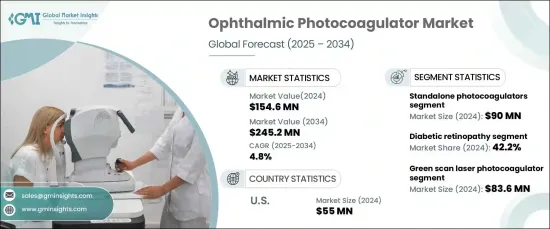
The Global Ophthalmic Photocoagulator Market was valued at USD 154.6 million in 2024 and is forecasted to grow at a robust CAGR of 4.8% from 2025 to 2034. Key drivers fueling this growth include the increasing prevalence of retinal diseases, the expansion of healthcare infrastructure, and the rising demand for mobile and home-based healthcare solutions.
Tele-ophthalmology plays a pivotal role in this expansion, enabling patients, especially the elderly and those with limited mobility, to access consultations and minor treatments remotely. The integration of portable devices with telemedicine platforms is enhancing access to eye care in underserved and rural regions, driving the adoption of ophthalmic photocoagulators. Furthermore, non-governmental organizations (NGOs) and healthcare institutions are using tele-ophthalmology to improve eye care accessibility in developing countries, further propelling the market growth.
| Market Scope | |
|---|---|
| Start Year | 2024 |
| Forecast Year | 2025-2034 |
| Start Value | $154.6 Million |
| Forecast Value | $245.2 Million |
| CAGR | 4.8% |
The global shift toward modern lifestyle habits, such as sedentary behavior, poor diets, and rising obesity rates, is contributing to the increase in chronic conditions like diabetes and hypertension. These health issues are major risk factors for retinal diseases, such as diabetic retinopathy and hypertensive retinopathy. With the global diabetic population expected to reach 700 million by 2045, the demand for effective treatments like laser photocoagulation will continue to rise, supporting the ophthalmic photocoagulator market's long-term growth.
In terms of product types, the market is segmented into portable and standalone photocoagulators. The standalone segment currently holds the largest market share, valued at USD 90 million in 2024. Standalone photocoagulators are preferred in high-demand healthcare settings like hospitals and ophthalmology centers. These systems offer advanced features, including enhanced beam stability, broader treatment ranges, and superior cooling systems, making them ideal for treating chronic retinal diseases that require prolonged usage.
The market is also divided by end-user categories, including hospitals, ambulatory surgery centers, and ophthalmology clinics. The hospital segment led the market in 2024, with a projected market value of USD 113.5 million by 2034. Hospitals remain the primary location for complex ophthalmic procedures, as they are equipped to provide specialized care, especially for high-risk retinal conditions.
The U.S. ophthalmic photocoagulator market was valued at USD 55 million in 2024. The country's favorable reimbursement policies, particularly through Medicare, are making laser treatments more accessible, especially for older adults who are more likely to suffer from retinal diseases. This, in turn, is expected to further accelerate market growth in North America, promoting the use of advanced ophthalmic technologies in hospitals and outpatient settings.
Table of Contents
Chapter 1 Methodology and Scope
- 1.1 Market scope and definitions
- 1.2 Research design
- 1.2.1 Research approach
- 1.2.2 Data collection methods
- 1.3 Base estimates and calculations
- 1.3.1 Base year calculation
- 1.3.2 Key trends for market estimation
- 1.4 Forecast model
- 1.5 Primary research and validation
- 1.5.1 Primary sources
- 1.5.2 Data mining sources
Chapter 2 Executive Summary
- 2.1 Industry 3600 synopsis
Chapter 3 Industry Insights
- 3.1 Industry ecosystem analysis
- 3.2 Industry impact forces
- 3.2.1 Growth drivers
- 3.2.1.1 Rising prevalence of eye disorders
- 3.2.1.2 Increasing awareness and diagnosis rates
- 3.2.1.3 Technological advancements in products
- 3.2.2 Industry pitfalls and challenges
- 3.2.2.1 High device cost and stringent regulatory requirements
- 3.2.1 Growth drivers
- 3.3 Growth potential analysis
- 3.4 Regulatory landscape
- 3.5 Reimbursement scenario
- 3.6 Technology landscape
- 3.7 Gap analysis
- 3.8 Porter's analysis
- 3.9 PESTEL analysis
- 3.10 Future market trends
Chapter 4 Competitive Landscape, 2024
- 4.1 Introduction
- 4.2 Company market share analysis
- 4.3 Company matrix analysis
- 4.4 Competitive analysis of major market players
- 4.5 Competitive positioning matrix
- 4.6 Strategy dashboard
Chapter 5 Market Estimates and Forecast, By Product Type, 2021 – 2034 ($ Mn)
- 5.1 Key trends
- 5.2 Standalone photocoagulators
- 5.3 Portable photocoagulators
Chapter 6 Market Estimates and Forecast, By Application, 2021 – 2034 ($ Mn)
- 6.1 Key trends
- 6.2 Diabetic retinopathy
- 6.3 Age-related macular degeneration (AMD)
- 6.4 Glaucoma
- 6.5 Retinal tears and detachments
- 6.6 Other applications
Chapter 7 Market Estimates and Forecast, By Wavelength, 2021 – 2034 ($ Mn)
- 7.1 Key trends
- 7.2 Green scan laser photocoagulator
- 7.3 Yellow scan laser photocoagulator
- 7.4 Multicolor scan laser photocoagulator
Chapter 8 Market Estimates and Forecast, By End Use, 2021 – 2034 ($ Mn)
- 8.1 Key trends
- 8.2 Hospitals
- 8.3 Ambulatory surgery centers
- 8.4 Ophthalmology clinics
Chapter 9 Market Estimates and Forecast, By Region, 2021 – 2034 ($ Mn)
- 9.1 Key trends
- 9.2 North America
- 9.2.1 U.S.
- 9.2.2 Canada
- 9.3 Europe
- 9.3.1 Germany
- 9.3.2 UK
- 9.3.3 France
- 9.3.4 Spain
- 9.3.5 Italy
- 9.3.6 Netherlands
- 9.4 Asia Pacific
- 9.4.1 China
- 9.4.2 Japan
- 9.4.3 India
- 9.4.4 Australia
- 9.4.5 South Korea
- 9.5 Latin America
- 9.5.1 Brazil
- 9.5.2 Mexico
- 9.5.3 Argentina
- 9.6 Middle East and Africa
- 9.6.1 South Africa
- 9.6.2 Saudi Arabia
- 9.6.3 UAE
Chapter 10 Company Profiles
- 10.1 A.R.C. Laser
- 10.2 Alcon
- 10.3 Appasamy Associates
- 10.4 Bausch + Lomb
- 10.5 Coherent
- 10.6 IRIDEX
- 10.7 LIGHTMED
- 10.8 Lumenis
- 10.9 Lumibird Medical
- 10.10 MERIDIAN
- 10.11 NIDEK
- 10.12 Phoenix-Micron
- 10.13 Topcon