|
시장보고서
상품코드
1871228
레독스 플로우 배터리 스토리지 시장 : 기회, 성장요인, 업계 동향 분석 및 예측(2025-2034년)Redox Flow Battery Storage Market Opportunity, Growth Drivers, Industry Trend Analysis, and Forecast 2025 - 2034 |
||||||

세계의 레독스 플로우 배터리 스토리지 시장은 2024년 63억 달러로 평가되었으며, 2034년까지 연평균 복합 성장률(CAGR) 29.6%로 성장하여 973억 달러에 이를 것으로 예측되고 있습니다.

이 급성장은 풍력과 태양광과 같은 신재생에너지원의 도입 가속에 지지되고 있습니다. 이러한 에너지원은 본질적으로 안정적이고 효율적인 장시간 저장 시스템을 필요로 합니다. 레독스 플로우 배터리(RFB)는 통상 4시간부터 24시간에 걸친 장시간 방전이 가능한 특성으로부터, 점점 선택되게 되어 있습니다. 이 특성은 재생에너지 발전의 변동 관리 및 전력 계통의 신뢰성 향상에 최적입니다. RFB는 잉여 전력의 효과적인 시간 이동을 가능하게 할 뿐만 아니라 주파수 제어 및 부하 분산과 같은 중요한 기능을 지원합니다. 세계 전력회사와 정부는 에너지 인프라의 현대화와 청정 에너지 전환을 지원하는 광범위한 노력의 일환으로 첨단 축전 기술에 대한 투자를 확대하고 있습니다. RFB 시스템의 확장성, 안전성 및 재활용 가능성은 특히 도시 및 농촌 지역 모두에서 지속 가능하고 화재 위험이 낮은 에너지 저장 솔루션을 목표로 하는 지역에서 채택 확대에 기여하고 있습니다.
| 시장 범위 | |
|---|---|
| 시작 연도 | 2024년 |
| 예측 연도 | 2025-2034년 |
| 시작 금액 | 63억 달러 |
| 예측 금액 | 973억 달러 |
| CAGR | 29.6% |
레독스 플로우 배터리의 결정적인 이점은 출력과 축전 용량을 분리하는 모듈형 설계에 있으며, 다양한 용도에 따라 유연한 확장이 가능합니다. 이 독특한 특성으로 인해 RFB는 전력 계통 지원 및 재생에너지 통합을 포함한 여러 시간 동안 에너지 저장 용도에 가장 적합한 옵션으로 자리매김하고 있습니다. 8-12시간의 방전 시스템에 대한 수요가 높아지고 안정성과 비용 효율성을 추구하는 에너지 포트폴리오에서 이러한 배터리는 우선적으로 채용되고 있습니다. 그 화학 조성은 본질적으로 불연성이며 열폭주 사고와 관련된 위험을 없애기 때문에 지역 수준과 중요한 인프라의 저장 시스템으로 안전한 옵션이됩니다. 또한, 재활용 가능한 전해액 솔루션과 함께 RFB는 세계 시장에서 지속 가능한 에너지 솔루션의 추진과 일치합니다.
전력 에너지 시간 시프트 분야는 2024년에 35.8%의 점유율을 차지했으며, 2034년까지 연평균 복합 성장률(CAGR) 29.7%로 확대가 전망되고 있습니다. RFB는 전력 수요가 낮은 시간대에 충전하고 소비가 급증하는 시간대에 방전하는 특성 때문에 이 용도에서 특히 우수한 성능을 발휘합니다. 이를 통해 전력회사는 변동가격 모델을 활용하면서 피크 부하를 보다 효과적으로 관리할 수 있습니다. 장시간 방전 지속성과 높은 사이클 성능은 특히 태양광과 풍력에 의존하는 전력 시스템에서 에너지 사용 패턴을 재구성하는 데 이상적입니다.
미국의 레독스 플로우 배터리 스토리지 시장은 2034년까지 145억 달러 규모에 이를 것으로 예측됩니다. 이 확장은 청정 에너지 도입, 에너지 안보 및 배터리 시스템의 국내 제조를 지원하는 연방 정책에 의해 지원됩니다. 혁신에 중점을 둔 프로그램의 뒷받침으로 현지 제조업체와 신생 기업이 새로운 화학 기술과 솔루션을 시장에 도입하고 있습니다. 미국 에너지 그리드가 기후 관련 스트레스 요인의 영향을 점점 받고 있는 가운데 전력회사와 주정부는 방화성이 높고 장시간 축전이 가능한 기술 도입을 적극적으로 추진하고 있습니다. 모듈식 구조와 깊은 사이클 성능을 갖춘 RFB는 재생가능 에너지의 축전부터 중요한 인프라의 내결함성 강화까지 모든 분야에서 도입이 진행되고 있습니다.
세계의 레독스 플로우 배터리 스토리지 시장을 견인하는 주요 기업으로는 ESS, Avalon Battery, Rongke Power, Voltstorage, Sumitomo Electric, Elestor, Invinity Energy Systems, CellCube Energy Storage Systems, Everflow, Primus Power, Largo, ViZn Energy Systems, and VRB Energy 등이 있습니다. 레독스 플로우 배터리 스토리지 시장의 기업은 시스템 효율 향상과 배터리 수명 연장을 목적으로 바나듐계 및 하이브리드 전해질 등의 선진적인 화학 기술에 대한 투자를 적극적으로 추진하고 있습니다. 에너지 공급 사업자, 정부, 연구기관과의 전략적 제휴를 통해 세계적인 에너지그리드에서 신속한 상업화와 도입이 가능해지고 있습니다. 많은 기업들이 장시간 에너지 저장에 대한 수요 증가에 대응하기 위해 생산 능력을 확대하고 있습니다. 한편, 마이크로그리드, 원격지 전기화, 산업용 백업 등 틈새 용도를 위해 시스템을 커스터마이즈하는 기업도 존재합니다.
자주 묻는 질문
목차
제1장 조사 방법과 범위
제2장 주요 요약
제3장 업계 인사이트
- 생태계 분석
- 중요 재료공급 체인 매핑
- 제조 설비 및 공정 요건
- 품질 관리 및 시험 인프라
- 공급망 통합의 기회
- 규제 상황
- 업계에 미치는 영향요인
- 성장 촉진요인
- 업계의 잠재적 위험 및 과제
- 성장 가능성 분석
- Porter's Five Forces 분석
- PESTEL 분석
- 가격 동향 분석(달러/MW)
- 지역별
- 투자 및 자금 조달 정세 분석
- 신기술 동향과 개발 상황
제4장 경쟁 구도
- 소개
- 기업의 시장 점유율 분석 : 지역별
- 북미
- 유럽
- 아시아태평양
- 세계 기타 지역
- 전략적 대시보드
- 전략적 노력
- 주요 제휴 및 협력관계
- 주요 M&A 활동
- 제품 혁신과 신제품 출시
- 시장 확대 전략
- 경쟁 벤치마킹
- 혁신과 지속가능성의 정세
제5장 시장 규모와 예측 : 용도별, 2021-2034년
- 주요 동향
- 전력의 시간대별 조정
- 주파수 조정
- 신재생에너지 통합
- 기타
제6장 시장 규모와 예측 : 지역별, 2021-2034년
- 주요 동향
- 북미
- 미국
- 캐나다
- 멕시코
- 유럽
- 영국
- 프랑스
- 독일
- 이탈리아
- 러시아
- 스페인
- 아시아태평양
- 중국
- 호주
- 인도
- 일본
- 한국
- 세계 기타 지역
제7장 기업 프로파일
- Avalon Battery
- CellCube Energy Storage Systems
- Elestor
- ESS
- Everflow
- Invinity Energy Systems
- Largo
- Primus Power
- Rongke Power
- Sumitomo Electric
- ViZn Energy Systems
- Voltstorage
- VRB Energy
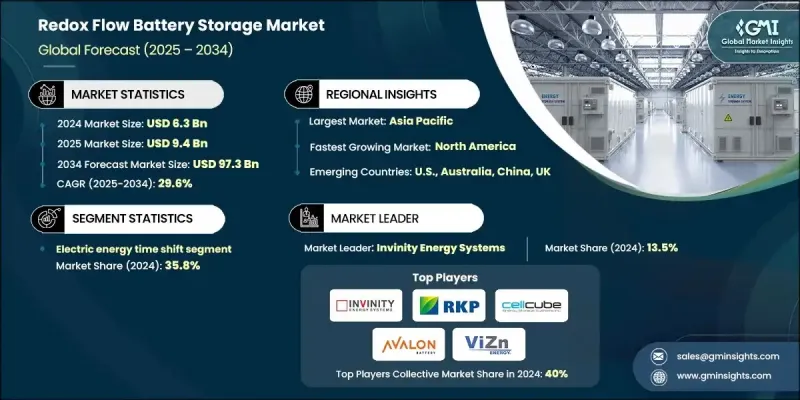
The Global Redox Flow Battery Storage Market was valued at USD 6.3 Billion in 2024 and is estimated to grow at a CAGR of 29.6% to reach USD 97.3 Billion by 2034.
The sharp growth is fueled by the accelerating deployment of renewable energy sources such as wind and solar, which inherently require stable and efficient long-duration storage systems. Redox flow batteries (RFBs) are increasingly gaining preference due to their ability to discharge over extended periods, typically between 4 and 24 hours. This makes them well-suited for managing the fluctuations in renewable generation and for enhancing grid reliability. In addition to enabling effective time-shifting of excess power, RFBs support critical functions like frequency control and load balancing. Global utilities and governments are ramping up investments in advanced storage technologies as part of broader efforts to modernize energy infrastructure and support clean energy transitions. The scalability, safety, and recyclability of RFB systems also contribute to their growing adoption, particularly in regions aiming for sustainable, fire-safe energy storage solutions in both urban and rural settings.
| Market Scope | |
|---|---|
| Start Year | 2024 |
| Forecast Year | 2025-2034 |
| Start Value | $6.3 Billion |
| Forecast Value | $97.3 Billion |
| CAGR | 29.6% |
A defining advantage of redox flow batteries is their modular design, which separates power output from energy storage capacity, enabling flexible scaling for diverse applications. This unique trait positions RFBs as the go-to option for multi-hour energy storage uses, including grid support and renewable integration. With growing demand for 8 to 12-hour discharge systems, these batteries are being prioritized in energy portfolios seeking stability and cost-efficiency. Their chemical composition is inherently non-flammable, eliminating risks associated with thermal events, which makes them a safe choice for community-level or critical infrastructure storage. This, combined with recyclable electrolyte solutions, aligns RFBs with the push for sustainable energy solutions across global markets.
The electric energy time shift segment held 35.8% share in 2024, and is forecasted to grow at a CAGR of 29.7% through 2034. RFBs perform exceptionally in these applications by charging during periods of low electricity demand and discharging when consumption spikes. This enables utilities to better manage peak loads while taking advantage of variable pricing models. Their extended discharge duration and high cycling capabilities make them ideal for reshaping energy use patterns, particularly in power systems heavily reliant on solar or wind.
U.S. Redox Flow Battery Storage Market will reach USD 14.5 Billion by 2034. Its expansion is underpinned by federal policies supporting clean energy adoption, energy security, and domestic manufacturing of battery systems. Encouragement from innovation-focused programs is helping local manufacturers and startups bring new chemistries and solutions to market. With the U.S. energy grid increasingly affected by climate-related stressors, utilities and state governments are actively pursuing fire-safe, long-duration storage technologies. RFBs, with their modular architecture and deep cycle capabilities, are being deployed for everything from renewable storage to critical infrastructure resilience.
Leading participants shaping the Global Redox Flow Battery Storage Market include ESS, Avalon Battery, Rongke Power, Voltstorage, Sumitomo Electric, Elestor, Invinity Energy Systems, CellCube Energy Storage Systems, Everflow, Primus Power, Largo, ViZn Energy Systems, and VRB Energy. Companies in the redox flow battery storage market are actively investing in advanced chemistries, such as vanadium-based or hybrid electrolytes, to enhance system efficiency and extend battery life. Strategic collaborations with energy providers, governments, and research institutes are enabling faster commercialization and deployment across global energy grids. Many players are scaling up their production capacities to meet increasing demand for long-duration energy storage, while others are customizing systems for niche applications like microgrids, remote electrification, and industrial backup.
Table of Contents
Chapter 1 Methodology & Scope
- 1.1 Research design
- 1.2 Market estimates & forecast parameters
- 1.3 Forecast calculation
- 1.4 Data sources
- 1.4.1 Primary
- 1.4.2 Secondary
- 1.4.2.1 Paid
- 1.4.2.2 Public
- 1.5 Market definitions
Chapter 2 Executive Summary
- 2.1 Industry synopsis, 2021 - 2034
Chapter 3 Industry Insights
- 3.1 Industry ecosystem analysis
- 3.1.1 Critical materials supply chain mapping
- 3.1.2 Manufacturing equipment and process requirements
- 3.1.3 Quality control and testing infrastructure
- 3.1.4 Supply chain integration opportunities
- 3.2 Regulatory landscape
- 3.3 Industry impact forces
- 3.3.1 Growth drivers
- 3.3.2 Industry pitfalls & challenges
- 3.4 Growth potential analysis
- 3.5 Porter's analysis
- 3.5.1 Bargaining power of suppliers
- 3.5.2 Bargaining power of buyers
- 3.5.3 Threat of new entrants
- 3.5.4 Threat of substitutes
- 3.6 PESTEL analysis
- 3.6.1 Political factors
- 3.6.2 Economic factors
- 3.6.3 Social factors
- 3.6.4 Technological factors
- 3.6.5 Legal factors
- 3.6.6 Environmental factors
- 3.7 Price trend analysis (USD/MW)
- 3.7.1 By region
- 3.8 Investment and funding landscape analysis
- 3.9 Emerging technology trends and developments
Chapter 4 Competitive Landscape, 2025
- 4.1 Introduction
- 4.2 Company market share analysis, by region, 2024
- 4.2.1 North America
- 4.2.2 Europe
- 4.2.3 Asia Pacific
- 4.2.4 Rest of World
- 4.3 Strategic dashboard
- 4.4 Strategic initiatives
- 4.4.1 Key partnerships & collaborations
- 4.4.2 Major M&A activities
- 4.4.3 Product innovations & launches
- 4.4.4 Market expansion strategies
- 4.5 Competitive benchmarking
- 4.6 Innovation & sustainability landscape
Chapter 5 Market Size and Forecast, By Application, 2021 - 2034 (USD Million & MW)
- 5.1 Key trends
- 5.2 Electric energy time shift
- 5.3 Frequency regulation
- 5.4 Renewable integration
- 5.5 Others
Chapter 6 Market Size and Forecast, By Region, 2021 - 2034 (USD Million & MW)
- 6.1 Key trends
- 6.2 North America
- 6.2.1 U.S.
- 6.2.2 Canada
- 6.2.3 Mexico
- 6.3 Europe
- 6.3.1 UK
- 6.3.2 France
- 6.3.3 Germany
- 6.3.4 Italy
- 6.3.5 Russia
- 6.3.6 Spain
- 6.4 Asia Pacific
- 6.4.1 China
- 6.4.2 Australia
- 6.4.3 India
- 6.4.4 Japan
- 6.4.5 South Korea
- 6.5 Rest of World
Chapter 7 Company Profiles
- 7.1 Avalon Battery
- 7.2 CellCube Energy Storage Systems
- 7.3 Elestor
- 7.4 ESS
- 7.5 Everflow
- 7.6 Invinity Energy Systems
- 7.7 Largo
- 7.8 Primus Power
- 7.9 Rongke Power
- 7.10 Sumitomo Electric
- 7.11 ViZn Energy Systems
- 7.12 Voltstorage
- 7.13 VRB Energy