|
시장보고서
상품코드
1871288
기능성 식품 시장 : 기회, 성장 요인, 업계 동향 분석 및 예측(2025-2034년)Functional Foods Market Opportunity, Growth Drivers, Industry Trend Analysis, and Forecast 2025 - 2034 |
||||||

세계의 기능성 식품 시장은 2024년에 3,322억 달러로 평가되었고, 2034년까지 연평균 복합 성장률(CAGR) 6.9%로 성장해 6,380억 달러에 이를 것으로 예측되고 있습니다.
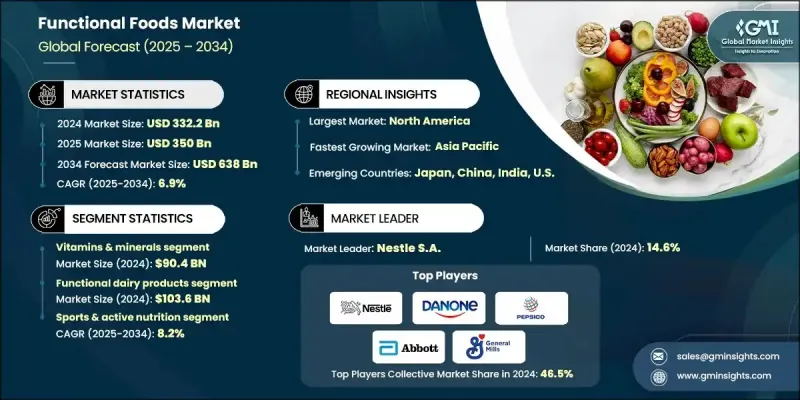
세계적인 고령화 사회의 진전은 노화에 따른 건강 유지를 목적으로 한 기능성 식품 수요를 견인하는 주요 요인입니다. 노인들은 종종 심장병, 당뇨병, 고혈압 등의 만성 질환에 직면하게 되며, 이들은 다이어트 선택에 직접적인 영향을 미칩니다. 연구에 따르면 기능성 식품은 노화와 관련된 건강 문제를 관리하고 완화하기 때문에 노인 섭취는 건강 요구와 밀접하게 관련되어 있습니다. 영양 개선을 촉진하고 부적절한 식생활이 건강에 미치는 영향을 강조하는 정부 시책도 기능성 식품의 보급을 더욱 뒷받침하고 있습니다. 보고에 따르면, 건강에 해로운 식습관은 만성 질환과 관련된 의료비 총액의 약 5분의 1을 차지하고 있으며, 식사 측면에서의 개입이 점점 더 중요해지고 있습니다. 이 동향을 받아, 제조업체 각사는 영양면에서의 혁신에 주력해, 면역력, 심장의 건강, 전체적인 웰빙에 대응하는 제품 개량을 진행하는 것과 동시에, 예방 영양에 대한 소비자의 기대에도 응하고 있습니다.
| 시장 범위 | |
|---|---|
| 시작 연도 | 2024년 |
| 예측 기간 | 2025-2034년 |
| 시작 금액 | 3,322억 달러 |
| 예측 금액 | 6,380억 달러 |
| CAGR | 6.9% |
비타민 및 미네랄 분야는 2024년에 904억 달러 시장 규모를 기록해, 그 건강 효과가 높게 평가되고 있습니다. 이러한 성분은 면역력과 체력, 종합적인 건강 유지를 목적으로 음료, 시리얼, 스낵, 유제품 등에 배합되어 있습니다. 성숙시장과 신흥 시장 모두 건강한 식단과 예방의료에 대한 의식이 높아짐에 따라 높은 채용률을 나타내고 있습니다. 강화 식품은 세계의 기능성 식품 포트폴리오의 핵심을 이루는 요소가 되고 있습니다.
기능성 유제품은 영양이 풍부한 조성과 높은 소비자 수용성으로 2024년 1,036억 달러에 달했습니다. 강화 우유, 요구르트, 치즈와 같은 이러한 제품에는 면역력, 뼈 건강, 소화기 건강을 지원하기 위해 비타민, 미네랄, 단백질, 프로바이오틱스가 첨가됩니다. 광범위한 유통 네트워크와 유제품에 대한 소비자의 강한 신뢰는 세계 시장에서의 보급을 촉진하고 기능성 식품 제공의 기반이되고 있습니다.
2024년 북미의 기능성 식품 시장은 38.2%의 점유율을 차지했습니다. 이 지역에서는 미국이 지배적이며 캐나다와 멕시코가 이어집니다. 비만, 당뇨병, 심혈관 질환과 같은 생활 습관병의 유병률이 증가함에 따라 영양 강화 대체 식품에 대한 소비자 수요가 가속화되고 있습니다. 이에 대응하기 위해 각 회사는 심장 건강, 소화기계 지원, 면역력 향상을 목적으로 한 제제를 도입하기 위해 조사, 제품 혁신, 다양화에 많은 투자를 하고 있습니다.
세계의 기능성 식품 시장에서 주요 기업으로는 Arla Foods amba, Amway, BASF SE, Abbott, Nestle S.A., Danone SA, PepsiCo Inc., Nutri-Nation, General Mills Inc., Herbalife International of America, Inc., Kellogg's, Standard Functional Foods Group Inc., GFR Pharma, The Coca-Cola Company, and Cargill 등이 있습니다. 기능성 식품 분야의 기업은 시장에서의 존재감을 강화하기 위해 여러 전략을 채택하고 있습니다. 특정 건강 문제에 대응하는 혁신적이고 과학적으로 뒷받침되는 제품을 개발하기 위한 연구 개발에 주력하고 있습니다. 다양화와 새로운 처방을 통해 제품 포트폴리오를 확대함으로써 보다 폭넓은 소비자층을 유치할 수 있습니다. 전략적 제휴, 합병 및 파트너십은 기술력과 세계 유통망을 강화합니다. 또한 소비자의 선호도에 맞추어 지속가능성과 깨끗한 라벨에 대한 노력도 강조하고 있습니다.
자주 묻는 질문
목차
제1장 조사 방법과 범위
제2장 주요 요약
제3장 업계 인사이트
- 생태계 분석
- 공급자의 상황
- 이익률
- 각 단계에서의 부가가치
- 밸류체인에 영향을 주는 요인
- 혁신
- 업계에 미치는 영향요인
- 성장 촉진요인
- 높아지는 건강 의식과 예방 의료의 도입
- 고령화와 노화에 따른 건강 문제
- 정부의 건강 증진 시책 및 식사 가이드 라인
- 업계의 잠재적 위험 및 과제
- 고비용의 생산과 복잡한 배합
- 규제 준수 및 건강 표시에 관한 제한 사항
- 시장 기회
- 식물 유래 및 클린 라벨의 기능성 식품의 인기 증가
- 디지털 건강과 개별화 영양 플랫폼의 통합
- 성장 촉진요인
- 성장 가능성 분석
- 규제 상황
- 북미
- 유럽
- 아시아태평양
- 라틴아메리카
- 중동 및 아프리카
- Porter's Five Forces 분석
- PESTEL 분석
- 가격 동향
- 지역별
- 원료 유형
- 제품
- 용도
- 장래 시장 동향
- 기술과 혁신의 상황
- 현재의 기술 동향
- 신흥기술
- 특허 상황
- 무역 통계(HS코드)(주: 무역 통계는 주요 국가만 제공)
- 주요 수입국
- 주요 수출국
- 지속가능성과 환경면
- 지속가능한 대처
- 폐기물 감축 전략
- 생산에 있어서의 에너지 효율
- 환경에 배려한 대처
- 탄소발자국에 관한 고려 사항
제4장 경쟁 구도
- 소개
- 기업의 시장 점유율 분석
- 지역별
- 북미
- 유럽
- 아시아태평양
- 라틴아메리카
- 중동 및 아프리카
- 지역별
- 기업 매트릭스 분석
- 주요 시장 기업의 경쟁 분석
- 경쟁 포지셔닝 매트릭스
- 주요 발전
- 인수합병
- 제휴 및 협력 관계
- 신제품 발매
- 확대 계획
제5장 시장 추계 및 예측 : 원료 유형별, 2021-2034년
- 주요 동향
- 프로바이오틱스
- 프리바이오틱스
- 비타민 및 미네랄
- 단백질 및 아미노산
- 오메가 지방산
- 식물 추출물
- 식이섬유
- 카로티노이드 및 항산화 물질
- 기타
제6장 시장 추계 및 예측 : 제품별, 2021-2034년
- 주요 동향
- 기능성 유제품
- 요구르트
- 강화 우유
- 치즈
- 베이커리 및 시리얼
- 강화 빵
- 시리얼
- 스낵바
- 기능성 음료
- 에너지 음료
- 주스
- 강화수
- 기능성 차 및 커피
- 과자류
- 단백질 바
- 무당 초콜릿
- 영양 보조 캔디
- 영유아용 식품
- 고기 및 어류 제품
- 오메가3 강화육
- 강화 해산물
- 기타
- 수프
- 조미료
제7장 시장 추계 및 예측 : 용도별, 2021-2034년
- 주요 동향
- 스포츠 및 액티브 영양
- 임상 및 의료 영양
- 영유아 및 소아 영양
- 고령자 및 나이에 따른 건강
- 여성의 건강과 임신
- 체중 관리
- 소화기 건강
제8장 시장 추계 및 예측 : 지역별, 2021-2034년
- 주요 동향
- 북미
- 미국
- 캐나다
- 유럽
- 독일
- 영국
- 프랑스
- 스페인
- 이탈리아
- 기타 유럽
- 아시아태평양
- 중국
- 인도
- 일본
- 호주
- 한국
- 기타 아시아태평양
- 라틴아메리카
- 브라질
- 멕시코
- 기타 라틴아메리카
- 중동 및 아프리카
- 사우디아라비아
- 남아프리카
- 아랍에미리트(UAE)
- 기타 중동 및 아프리카
제9장 기업 프로파일
- Nutri-Nation
- BASF SE
- Amway
- General Mills Inc.
- GFR Pharma
- The Coca-Cola Company
- Arla Foods amba
- Amway Corp.
- Herbalife International of America, Inc.
- Cargill, Incorporated
- Standard Functional Foods Group Inc.
- Kellogg's
- Danone SA
- PepsiCo Inc
- Abbott
- Nestle SA
The Global Functional Foods Market was valued at USD 332.2 billion in 2024 and is estimated to grow at a CAGR of 6.9% to reach USD 638 billion by 2034.
The increasing global aging population is a key factor driving the demand for functional foods designed to support health in later years. Older adults often face chronic conditions such as heart disease, diabetes, and high blood pressure, which directly influence their dietary choices. Studies have shown that seniors' consumption of functional foods is closely linked to their health needs, as these foods help manage or mitigate age-related health concerns. Government initiatives promoting better nutrition and highlighting the health impacts of poor diets further encourage functional food adoption. Reports indicate that unhealthy eating accounts for nearly one-fifth of the total healthcare costs associated with chronic diseases, making dietary interventions increasingly critical. This trend has prompted manufacturers to focus on nutritional innovation, reformulating products to address immunity, heart health, and overall well-being while meeting consumer expectations for preventive nutrition.
| Market Scope | |
|---|---|
| Start Year | 2024 |
| Forecast Year | 2025-2034 |
| Start Value | $332.2 Billion |
| Forecast Value | $638 Billion |
| CAGR | 6.9% |
The vitamins and minerals segment generated USD 90.4 billion in 2024, widely recognized for its health benefits. These ingredients are incorporated into beverages, cereals, snacks, and dairy products to support immunity, strength, and general wellness. Both mature and emerging markets show strong adoption rates, driven by rising awareness of healthy diets and preventive healthcare. Fortified products have become a core element of functional food portfolios worldwide.
The functional dairy products reached USD 103.6 billion in 2024, owing to their nutrient-rich composition and high consumer acceptance. These products, including fortified milk, yogurts, and cheeses, are enriched with vitamins, minerals, protein, and probiotics to support immunity, bone health, and digestive wellness. Extensive distribution networks and strong consumer trust in dairy enhance their widespread penetration in global markets, making them foundational to functional food offerings.
North America Functional Foods Market held 38.2% share in 2024. The United States dominates the region, followed by Canada and Mexico. The increasing prevalence of lifestyle-related health conditions such as obesity, diabetes, and cardiovascular diseases has accelerated consumer demand for nutrient-enriched alternatives. In response, companies are investing significantly in research, product innovation, and diversification to introduce formulations targeting heart health, digestive support, and immunity enhancement.
Prominent players in the Global Functional Foods Market include Arla Foods amba, Amway, BASF SE, Abbott, Nestle S.A., Danone SA, PepsiCo Inc., Nutri-Nation, General Mills Inc., Herbalife International of America, Inc., Kellogg's, Standard Functional Foods Group Inc., GFR Pharma, The Coca-Cola Company, and Cargill, Incorporated. Companies in the functional foods sector are adopting multiple strategies to strengthen their market presence. They focus on research and development to create innovative, science-backed products that cater to specific health concerns. Expanding product portfolios through diversification and new formulations helps attract a broader consumer base. Strategic collaborations, mergers, and partnerships enhance technological capabilities and global distribution reach. Firms are also emphasizing sustainability and clean-label initiatives to align with consumer preferences.
Table of Contents
Chapter 1 Methodology & Scope
- 1.1 Market scope and definition
- 1.2 Research design
- 1.2.1 Research approach
- 1.2.2 Data collection methods
- 1.3 Data mining sources
- 1.3.1 Global
- 1.3.2 Regional/Country
- 1.4 Base estimates and calculations
- 1.4.1 Base year calculation
- 1.4.2 Key trends for market estimation
- 1.5 Primary research and validation
- 1.5.1 Primary sources
- 1.6 Forecast model
- 1.7 Research assumptions and limitations
Chapter 2 Executive Summary
- 2.1 Industry 3600 synopsis
- 2.2 Key market trends
- 2.2.1 Regional
- 2.2.2 Ingredient Type
- 2.2.3 Product
- 2.2.4 Application
- 2.3 TAM Analysis, 2025-2034
- 2.4 CXO perspectives: Strategic imperatives
- 2.4.1 Executive decision points
- 2.4.2 Critical success factors
- 2.5 Future Outlook and Strategic Recommendations
Chapter 3 Industry Insights
- 3.1 Industry ecosystem analysis
- 3.1.1 Supplier Landscape
- 3.1.2 Profit Margin
- 3.1.3 Value addition at each stage
- 3.1.4 Factor affecting the value chain
- 3.1.5 Disruptions
- 3.2 Industry impact forces
- 3.2.1 Growth drivers
- 3.2.1.1 Rising health consciousness & preventive healthcare adoption
- 3.2.1.2 Aging population & age-related health concerns
- 3.2.1.3 Government health initiatives & dietary guidelines
- 3.2.2 Industry pitfalls and challenges
- 3.2.2.1 High production costs & complex formulation
- 3.2.2.2 Regulatory compliance & health claim restrictions
- 3.2.3 Market opportunities
- 3.2.3.1 Rising popularity of plant-based and clean-label functional foods
- 3.2.3.2 Integration of digital health and personalized nutrition platforms
- 3.2.1 Growth drivers
- 3.3 Growth potential analysis
- 3.4 Regulatory landscape
- 3.4.1 North America
- 3.4.2 Europe
- 3.4.3 Asia Pacific
- 3.4.4 Latin America
- 3.4.5 Middle East & Africa
- 3.5 Porter's analysis
- 3.6 PESTEL analysis
- 3.6.1 Technology and Innovation Landscape
- 3.6.2 Current technological trends
- 3.6.3 Emerging technologies
- 3.7 Price trends
- 3.7.1 By region
- 3.7.2 Ingredient type
- 3.7.3 Product
- 3.7.4 Application
- 3.8 Future market trends
- 3.9 Technology and Innovation Landscape
- 3.9.1 Current technological trends
- 3.9.2 Emerging technologies
- 3.10 Patent Landscape
- 3.11 Trade statistics (HS code) (Note: the trade statistics will be provided for key countries only)
- 3.11.1 Major importing countries
- 3.11.2 Major exporting countries
- 3.12 Sustainability and environmental aspects
- 3.12.1 Sustainable practices
- 3.12.2 Waste reduction strategies
- 3.12.3 Energy efficiency in production
- 3.12.4 Eco-friendly initiatives
- 3.13 Carbon footprint considerations
Chapter 4 Competitive Landscape, 2024
- 4.1 Introduction
- 4.2 Company market share analysis
- 4.2.1 By region
- 4.2.1.1 North America
- 4.2.1.2 Europe
- 4.2.1.3 Asia Pacific
- 4.2.1.4 LATAM
- 4.2.1.5 MEA
- 4.2.1 By region
- 4.3 Company matrix analysis
- 4.4 Competitive analysis of major market players
- 4.5 Competitive positioning matrix
- 4.6 Key developments
- 4.6.1 Mergers & acquisitions
- 4.6.2 Partnerships & collaborations
- 4.6.3 New product launches
- 4.6.4 Expansion plans
Chapter 5 Market Estimates and Forecast, By Ingredient Type, 2021 - 2034 (USD Billion) (Kilo Tons)
- 5.1 Key trends
- 5.2 Probiotics
- 5.3 Prebiotics
- 5.4 Vitamins & Minerals
- 5.5 Proteins & Amino Acids
- 5.6 Omega Fatty Acids
- 5.7 Plant Extracts
- 5.8 Fibers
- 5.9 Carotenoids & Antioxidants
- 5.10 Others
Chapter 6 Market Estimates and Forecast, By Product, 2021 - 2034 (USD Billion) (Kilo Tons)
- 6.1 Key trends
- 6.2 Functional dairy products
- 6.2.1 Yogurt
- 6.2.2 Fortified milk
- 6.2.3 Cheese
- 6.3 Bakery & cereals
- 6.3.1 Fortified bread
- 6.3.2 Cereals
- 6.3.3 Snacks bar
- 6.4 Functional beverages
- 6.4.1 Energy drinks
- 6.4.2 Juices
- 6.4.3 Enhanced water
- 6.4.4 Functional teas/coffee
- 6.5 Confectionary
- 6.5.1 Protein bares
- 6.5.2 Sugar free chocolates
- 6.5.3 Nutraceutical candies
- 6.6 Infants & baby foods
- 6.6.1 Meat & Fish products
- 6.6.2 Omega 3 Enriched meat
- 6.6.3 Fortified seafood
- 6.7 Others
- 6.7.1 Soups
- 6.7.2 Condiments
Chapter 7 Market Estimates and Forecast, By Application, 2021 - 2034 (USD Billion) (Kilo Tons)
- 7.1 Key trends
- 7.2 Sports & active nutrition
- 7.3 Clinical & medical nutrition
- 7.4 Infant & child nutrition
- 7.5 Elderly & age-related health
- 7.6 Women's health & pregnancy
- 7.7 Weight management
- 7.8 Digestive health
Chapter 8 Market Estimates and Forecast, By Region, 2021 - 2034 (USD Billion) (Kilo Tons)
- 8.1 Key trends
- 8.2 North America
- 8.2.1 U.S.
- 8.2.2 Canada
- 8.3 Europe
- 8.3.1 Germany
- 8.3.2 UK
- 8.3.3 France
- 8.3.4 Spain
- 8.3.5 Italy
- 8.3.6 Rest of Europe
- 8.4 Asia Pacific
- 8.4.1 China
- 8.4.2 India
- 8.4.3 Japan
- 8.4.4 Australia
- 8.4.5 South Korea
- 8.4.6 Rest of Asia Pacific
- 8.5 Latin America
- 8.5.1 Brazil
- 8.5.2 Mexico
- 8.5.3 Rest of Latin America
- 8.6 Middle East and Africa
- 8.6.1 Saudi Arabia
- 8.6.2 South Africa
- 8.6.3 UAE
- 8.6.4 Rest of Middle East and Africa
Chapter 9 Company Profiles
- 9.1 Nutri-Nation
- 9.2 BASF SE
- 9.3 Amway
- 9.4 General Mills Inc.
- 9.5 GFR Pharma
- 9.6 The Coca-Cola Company
- 9.7 Arla Foods amba
- 9.8 Amway Corp.
- 9.9 Herbalife International of America, Inc.
- 9.10 Cargill, Incorporated
- 9.11 Standard Functional Foods Group Inc.
- 9.12 Kellogg's
- 9.13 Danone SA
- 9.14 PepsiCo Inc
- 9.15 Abbott
- 9.16 Nestle S.A.