|
시장보고서
상품코드
1892684
PFAS 대체 화학제품 시장 기회, 성장요인, 업계 동향 분석 및 예측(2025-2034년)PFAS Alternative Chemicals Market Opportunity, Growth Drivers, Industry Trend Analysis, and Forecast 2025 - 2034 |
||||||

세계의 PFAS 대체 화학제품 시장은 2024년에 295억 달러로 평가되었고, 2034년까지 연평균 복합 성장률(CAGR) 14.4%로 성장하여 1,200억 달러에 이를 것으로 예측됩니다.
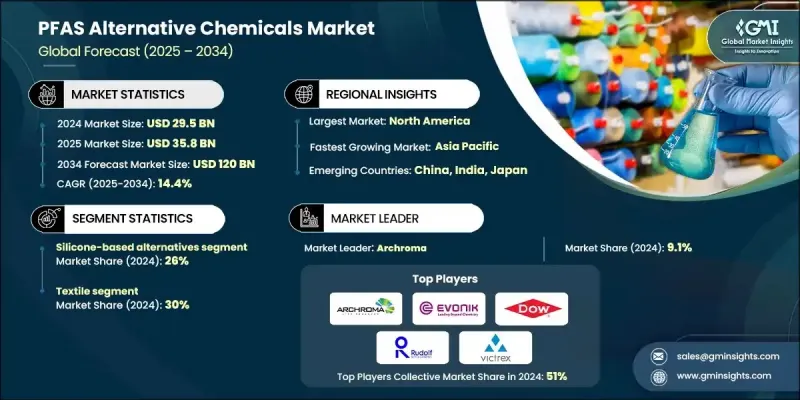
제조업체들이 보다 지속 가능한 바이오 배합으로 전환함에 따라, 안전하고 친환경적인 소재에 대한 선호도가 높아짐에 따라 시장의 모멘텀이 증가하고 있습니다. 연구기관에서는 PFAS계 제품에 필적하는 신뢰성 높은 발수성과 내구성을 제공하는 무불소 코팅 기술 및 바이오 솔루션의 개발이 진행되고 있습니다. 이러한 전환은 주로 세계 각국의 규제 강화 움직임에 힘입어 여러 지역에서 PFAS 노출을 줄이기 위해 더 엄격한 규제를 채택하고 있습니다. 수질 오염에 대한 대중의 우려가 높아지면서 안전한 대체품에 대한 수요가 더욱 증가하고 있습니다. 각 기관은 식수 기준 도입, 유해물질 식별, 보고 및 배출 요건 부과 등 규제 프레임워크가 더욱 종합적으로 발전하고 있습니다. 이와 동시에 여러 관할권에서 추가 규제와 제품 단계적 폐지 일정이 시행되면서 신뢰할 수 있는 PFAS 대체품의 필요성이 재인식되고, 업계 전반의 혁신이 가속화되고 있습니다.
| 시장 범위 | |
|---|---|
| 개시 연도 | 2024년 |
| 예측 연도 | 2025-2034년 |
| 개시 연도 시장 규모 | 295억 달러 |
| 예측 금액 | 1,200억 달러 |
| CAGR | 14.4% |
폴리우레탄 대체품 부문은 2024년 17%의 점유율을 차지했습니다. 수성 폴리우레탄 분산액은 불소계 원료를 사용하지 않고도 도료, 접착제 시스템, 섬유 가공이 가능합니다. 성능은 주로 이소시아네이트의 선택에 따라 달라지며, 지방족은 방향족보다 자외선 저항성과 변색 저항성이 우수합니다. 이 수성 배합은 용제 및 이소시아네이트 단량체에 대한 노출을 줄이고, 내후성 섬유 마감, 방수막, 자동차 및 산업 환경의 보호층과 같은 응용 분야를 지원합니다.
페인트 및 코팅 제조업체 부문은 2024년 18%의 점유율을 차지했습니다. PFAS는 기존에는 소포성, 평활성, 습윤성 등의 코팅 특성 향상을 위해 사용되어 왔으나, 현재 여러 공급업체에서 기존 불소계 첨가제와 동등 이상의 성능을 가진 대체품을 제공합니다.
유럽의 PFAS 대체 화학물질 시장은 엄격한 규제 프레임워크와 적극적인 대체품 채택에 힘입어 2024년 29%의 점유율을 차지했습니다. 개정된 PFAS 규제안은 전면 금지 및 위험 기반 조건부 허가를 포함하여 PFAS 사용량을 크게 줄일 수 있는 여러 경로를 제시하고 있습니다. 향후 몇년내에 최종 규제 결정이 내려질 것으로 예상되며, 유럽은 PFAS 대체품에 대해 가장 엄격한 규제 시장 중 하나가 될 것입니다.
자주 묻는 질문
목차
제1장 조사 방법과 범위
제2장 주요 요약
제3장 업계 인사이트
- 생태계 분석
- 공급업체 상황
- 이익률
- 각 단계별 부가가치
- 밸류체인에 영향을 미치는 요인
- 파괴적 변화
- 업계에 대한 영향요인
- 성장 촉진요인
- 업계의 잠재적 리스크&과제
- 시장 기회
- 성장 가능성 분석
- 규제 상황
- 북미
- 유럽
- 아시아태평양
- 라틴아메리카
- 중동 및 아프리카
- Porter's Five Forces 분석
- PESTEL 분석
- 가격 동향
- 지역별
- 향후 시장 동향
- 기술과 혁신 동향
- 현재 기술 동향
- 신기술
- 특허 상황
- 무역 통계(HS코드)(주 : 무역 통계는 주요 국가에 한해 제공됩니다)
- 주요 수입국
- 주요 수출국
- 지속가능성과 환경면
- 지속가능한 대처
- 폐기물 감축 전략
- 생산 에너지 효율
- 친환경 이니셔티브
- 탄소발자국에 관한 고려사항
제4장 경쟁 구도
- 서론
- 기업의 시장 점유율 분석
- 지역별
- 북미
- 유럽
- 아시아태평양
- 라틴아메리카
- 중동 및 아프리카
- 지역별
- 기업 매트릭스 분석
- 주요 시장 기업의 경쟁 분석
- 경쟁 포지셔닝 매트릭스
- 주요 발전
- 인수합병(M&A)
- 제휴 및 협업
- 신제품 발매
- 확대 계획
제5장 시장 규모와 예측 : 대체 화학물질 유형별, 2021-2034
- 주요 동향
- 실리콘계 대체품
- 폴리우레탄계 대체품
- 아크릴레이트 및 아크릴계 폴리머 대체품
- 탄화수소계 대체품
- 다당류 및 셀룰로오스계 대체품
- 무기 및 세라믹계 대체품
- 유기 인계 대체품
- 수지상 및 특수 폴리머
- 기타
제6장 시장 규모와 예측 : 최종 이용 산업별, 2021-2034
- 주요 동향
- 섬유 및 의류 제조업
- 페인트 및 코팅 제조업체
- 소방 및 긴급 서비스
- 식품 및 음료 포장 업계
- 반도체 및 전자기기 제조
- 자동차 제조
- 항공우주 및 방위
- 의료기기 제조
- 건설 및 건축자재
- 기타
제7장 시장 규모와 예측 : 지역별, 2021-2034
- 주요 동향
- 북미
- 미국
- 캐나다
- 유럽
- 영국
- 독일
- 프랑스
- 이탈리아
- 스페인
- 기타 유럽
- 아시아태평양
- 중국
- 인도
- 일본
- 한국
- 호주
- 기타 아시아태평양
- 라틴아메리카
- 브라질
- 멕시코
- 아르헨티나
- 기타 라틴아메리카
- 중동 및 아프리카
- 남아프리카공화국
- 사우디아라비아
- 아랍에미리트(UAE)
- 기타 중동 및 아프리카
제8장 기업 개요
- Archroma
- Evonik Industries
- Dow
- Daikin Industries
- Rudolf
- HeiQ Materials
- NICCA Chemical
- CHT Group
- Cerakote
- James Walker Group
- Victrex
The Global PFAS Alternative Chemicals Market was valued at USD 29.5 billion in 2024 and is estimated to grow at a CAGR of 14.4% to reach USD 120 billion by 2034.
Market momentum is increasing as manufacturers gradually shift toward more sustainable and bio-derived formulations, reflecting a growing preference for safer and environmentally responsible materials. Research organizations are advancing fluorine-free coating technologies and bio-based solutions that provide reliable water repellency and durability comparable to PFAS-based products. This transition is largely driven by expanding regulatory action worldwide, with several regions adopting stricter rules to reduce PFAS exposure. Public concern over water contamination has heightened awareness, strengthening the push for safer alternatives. Regulatory frameworks are becoming more comprehensive, with agencies introducing standards for drinking water, identifying hazardous substances, and imposing reporting and discharge requirements. In parallel, additional restrictions and product-phase-out timelines are being implemented across multiple jurisdictions, reinforcing the need for reliable PFAS replacements and accelerating industry-wide innovation.
| Market Scope | |
|---|---|
| Start Year | 2024 |
| Forecast Year | 2025-2034 |
| Start Value | $29.5 Billion |
| Forecast Value | $120 Billion |
| CAGR | 14.4% |
The polyurethane alternatives segment held a 17% share in 2024. Waterborne polyurethane dispersions enable coatings, adhesive systems, and textile treatments to function without fluorinated inputs. Performance is largely influenced by the selection of isocyanates, with aliphatic variants offering stronger UV and discoloration resistance than aromatic types. These waterborne formulations reduce exposure to solvents and isocyanate monomers and support applications such as weather-resistant textile finishes, waterproof membranes, and protective layers across automotive and industrial environments.
The paint and coating manufacturers segment held 18% share in 2024. PFAS were historically used to enhance coating properties such as defoaming, leveling, and wetting, and several suppliers now offer substitutes that match or exceed the capabilities of conventional fluorinated additives.
Europe PFAS Alternative Chemicals Market accounted for a 29% share in 2024, supported by strict regulatory frameworks and proactive adoption of alternatives. The updated PFAS restriction proposal outlines several pathways toward significant reductions in PFAS use, including options for full bans and risk-based conditional allowances. Final regulatory decisions are expected within the coming years, positioning Europe as one of the most tightly regulated markets for PFAS alternatives.
Key players in the PFAS Alternative Chemicals Market include NICCA Chemical, Archroma, James Walker Group, CHT Group, Victrex, Evonik Industries, Daikin Industries, Dow, Rudolf, Cerakote, and HeiQ Materials. Companies in the PFAS Alternative Chemicals Market are strengthening their competitive stance through a blend of innovation, regulatory alignment, and long-term collaboration. Many firms are increasing investments in bio-based chemistries, naturally derived additives, and fluorine-free coating technologies to deliver performance levels comparable to PFAS. Strategic partnerships with manufacturers and research institutions help accelerate product validation and broaden application testing. Companies are also focusing on expanding production capacity for next-generation materials to meet rising demand as phase-out deadlines approach. Continuous engagement with regulatory bodies ensures timely compliance and supports the development of solutions tailored to evolving legislation.
Table of Contents
Chapter 1 Methodology & Scope
- 1.1 Market scope and definition
- 1.2 Research design
- 1.2.1 Research approach
- 1.2.2 Data collection methods
- 1.3 Data mining sources
- 1.3.1 Global
- 1.3.2 Regional/Country
- 1.4 Base estimates and calculations
- 1.4.1 Base year calculation
- 1.4.2 Key trends for market estimation
- 1.5 Primary research and validation
- 1.5.1 Primary sources
- 1.6 Forecast model
- 1.7 Research assumptions and limitations
Chapter 2 Executive Summary
- 2.1 Industry 3600 synopsis
- 2.2 Key market trends
- 2.2.1 Alternative chemical type
- 2.2.2 End use industry
- 2.3 TAM analysis, 2025-2034
- 2.4 CXO perspectives: Strategic imperatives
- 2.4.1 Executive decision points
- 2.4.2 Critical success factors
- 2.5 Outlook and strategic recommendations
Chapter 3 Industry Insights
- 3.1 Industry ecosystem analysis
- 3.1.1 Supplier landscape
- 3.1.2 Profit margin
- 3.1.3 Value addition at each stage
- 3.1.4 Factor affecting the value chain
- 3.1.5 Disruptions
- 3.2 Industry impact forces
- 3.2.1 Growth drivers
- 3.2.2 Industry pitfalls and challenges
- 3.2.3 Market opportunities
- 3.3 Growth potential analysis
- 3.4 Regulatory landscape
- 3.4.1 North America
- 3.4.2 Europe
- 3.4.3 Asia Pacific
- 3.4.4 Latin America
- 3.4.5 Middle East & Africa
- 3.5 Porter's analysis
- 3.6 PESTEL analysis
- 3.7 Price trends
- 3.7.1 By region
- 3.8 Future market trends
- 3.9 Technology and innovation landscape
- 3.9.1 Current technological trends
- 3.9.2 Emerging technologies
- 3.10 Patent landscape
- 3.11 Trade statistics (HS code) (Note: the trade statistics will be provided for key countries only)
- 3.11.1 Major importing countries
- 3.11.2 Major exporting countries
- 3.12 Sustainability and environmental aspects
- 3.12.1 Sustainable practices
- 3.12.2 Waste reduction strategies
- 3.12.3 Energy efficiency in production
- 3.12.4 Eco-friendly initiatives
- 3.13 Carbon footprint considerations
Chapter 4 Competitive Landscape, 2024
- 4.1 Introduction
- 4.2 Company market share analysis
- 4.2.1 By region
- 4.2.1.1 North America
- 4.2.1.2 Europe
- 4.2.1.3 Asia Pacific
- 4.2.1.4 Latin America
- 4.2.1.5 Middle East & Africa
- 4.2.1 By region
- 4.3 Company matrix analysis
- 4.4 Competitive analysis of major market players
- 4.5 Competitive positioning matrix
- 4.6 Key developments
- 4.6.1 Mergers & acquisitions
- 4.6.2 Partnerships & collaborations
- 4.6.3 New product launches
- 4.6.4 Expansion plans
Chapter 5 Market Size and Forecast, By Alternative Chemical Type, 2021-2034 (USD Billion, Kilo Tons)
- 5.1 Key trends
- 5.2 Silicone-based alternatives
- 5.3 Polyurethane-based alternatives
- 5.4 Acrylate & acrylic polymer alternatives
- 5.5 Hydrocarbon-based alternatives
- 5.6 Polysaccharide & cellulose-based alternatives
- 5.7 Inorganic & ceramic alternatives
- 5.8 Organophosphorus alternatives
- 5.9 Dendritic & specialty polymers
- 5.10 Others
Chapter 6 Market Size and Forecast, By End Use Industry, 2021-2034 (USD Billion, Kilo Tons)
- 6.1 Key trends
- 6.2 Textile & apparel manufacturing
- 6.3 Paint & coating manufacturers
- 6.4 Firefighting & emergency services
- 6.5 Food & beverage packaging industry
- 6.6 Semiconductor & electronics manufacturing
- 6.7 Automotive manufacturing
- 6.8 Aerospace & defense
- 6.9 Medical device manufacturing
- 6.10 Construction & building materials
- 6.11 Others
Chapter 7 Market Size and Forecast, By Region, 2021-2034 (USD Billion, Kilo Tons)
- 7.1 Key trends
- 7.2 North America
- 7.2.1 U.S.
- 7.2.2 Canada
- 7.3 Europe
- 7.3.1 UK
- 7.3.2 Germany
- 7.3.3 France
- 7.3.4 Italy
- 7.3.5 Spain
- 7.3.6 Rest of Europe
- 7.4 Asia Pacific
- 7.4.1 China
- 7.4.2 India
- 7.4.3 Japan
- 7.4.4 South Korea
- 7.4.5 Australia
- 7.4.6 Rest of Asia Pacific
- 7.5 Latin America
- 7.5.1 Brazil
- 7.5.2 Mexico
- 7.5.3 Argentina
- 7.5.4 Rest of Latin America
- 7.6 Middle East & Africa
- 7.6.1 South Africa
- 7.6.2 Saudi Arabia
- 7.6.3 UAE
- 7.6.4 Rest of Middle East & Africa
Chapter 8 Company Profiles
- 8.1 Archroma
- 8.2 Evonik Industries
- 8.3 Dow
- 8.4 Daikin Industries
- 8.5 Rudolf
- 8.6 HeiQ Materials
- 8.7 NICCA Chemical
- 8.8 CHT Group
- 8.9 Cerakote
- 8.10 James Walker Group
- 8.11 Victrex