|
시장보고서
상품코드
1892832
수확기 시장 기회, 성장요인, 업계 동향 분석 및 예측(2026-2035년)Harvester Market Opportunity, Growth Drivers, Industry Trend Analysis, and Forecast 2026 - 2035 |
||||||

세계의 수확기 시장은 2025년에 412억 달러로 평가되었고, 2035년까지 연평균 복합 성장률(CAGR) 7.5%로 성장하여 846억 달러에 이를 것으로 예측됩니다.

지속 가능한 농업 방식에 대한 관심이 높아지면서 에너지 절약형 엔진과 저배출 기술을 갖춘 친환경 수확기 도입이 활발히 진행되고 있습니다. 정밀 농업 도구와 스마트 수확 시스템을 포함한 지속적인 기술 혁신으로 생산성, 연료 효율성, 운영 효율성이 향상되고 있습니다. 세계 식량 수요 증가로 변화하는 현대 농업의 진화하는 요구에 부응하기 위해 각 제조업체들은 적극적으로 새로운 모델을 출시하고 있습니다. 대규모 상업용 농장과 계약 농업 사업자들은 빠르고 효율적인 수확을 보장하고, 예측 불가능한 날씨로 인한 손실을 줄이고, 식량 작물의 품질을 유지하기 위해 고용량 기계에 투자하고 있습니다. 이러한 혁신과 기술 통합, 그리고 신선식품에 대한 수요 증가가 결합하여 세계 시장 확대를 촉진하고 있습니다.
| 시장 범위 | |
|---|---|
| 개시 연도 | 2025년 |
| 예측 연도 | 2026-2035년 |
| 개시 연도 시장 규모 | 412억 달러 |
| 예측 금액 | 846억 달러 |
| CAGR | 7.5% |
2025년, 콤바인 수확기 부문은 78억 달러의 매출을 기록할 것으로 예측됩니다. 콤바인 수확기는 상업용 곡물 생산에서 가장 가치 있고 필수적인 기계로 수확, 탈곡, 선별을 일련의 작업으로 완료할 수 있습니다. 그 효율성과 속도 덕분에 대규모 농장은 신속하게 수확을 완료하고 날씨와 관련된 위험을 최소화하며 최적의 곡물 품질을 유지할 수 있습니다.
제조업체 부문은 2025년 3160억 달러에 달할 것으로 예측됩니다. 각 제조업체는 가격 책정, 애프터 서비스, 독자적인 고정밀 농업 기술 통합, 브랜드 충성도 조성, 융자 옵션 제공, 복잡한 고마력 기계에 대한 전문 운영자 교육 등을 통해 강력한 지배력을 유지하고 있습니다.
아시아태평양의 수확기 시장은 2025년 36.9%의 점유율을 차지했습니다. 이 지역의 성장은 급속한 기계화, 소형 기계에 대한 정부 보조금, 주요 식량 작물의 효율적인 수확에 대한 수요에 의해 촉진되고 있습니다. 중국, 인도, 일본 등의 국가들은 농업 현대화를 위한 정부 정책의 지원을 받아 이앙기, 콤바인, 소형 동력 경운기, 첨단 전기 기계 등 현대화된 농기계에 대한 투자를 진행하고 있습니다.
자주 묻는 질문
목차
제1장 조사 방법과 범위
제2장 주요 요약
제3장 업계 인사이트
- 생태계 분석
- 공급업체 상황
- 이익률
- 각 단계별 부가가치
- 밸류체인에 영향을 미치는 요인
- 업계에 대한 영향요인
- 성장 촉진요인
- 업계의 잠재적 리스크&과제
- 기회
- 성장 가능성 분석
- 향후 시장 동향
- 기술과 혁신 동향
- 현재 기술 동향
- 신기술
- 가격 동향
- 지역별
- 유형별
- 규제 상황
- 규격 및 컴플라이언스 요건
- 지역별 규제 구조
- 인증 기준
- Porter's Five Forces 분석
- PESTEL 분석
제4장 경쟁 구도
- 서론
- 기업의 시장 점유율 분석
- 지역별
- 기업 매트릭스 분석
- 주요 시장 기업의 경쟁 분석
- 경쟁 포지셔닝 매트릭스
- 주요 발전
- 인수합병(M&A)
- 제휴 및 협업
- 신제품 발매
- 확대 계획
제5장 시장 추산 및 예측 : 유형별, 2022-2035
- 주요 동향
- 콤바인
- 사료 수확기
- 견인식 사일리지 수확기
- 자주식 사료 수확기
- 견인식 사료 수확기
- 탑재식 사료 수확기
- 승용 사일리지 수확기
- 사탕수수 수확기
- 감자 수확기
- 와인용 포도 수확기
- 사료용 낫
- 도시용 낫
제6장 시장 추산 및 예측 : 판매채널별, 2022-2035
- 주요 동향
- 제조업체
- 유통업체
제7장 시장 추산 및 예측 : 지역별, 2022-2035
- 주요 동향
- 북미
- 미국
- 캐나다
- 유럽
- 독일
- 영국
- 프랑스
- 이탈리아
- 스페인
- 아시아태평양
- 중국
- 일본
- 인도
- 호주
- 한국
- 라틴아메리카
- 브라질
- 멕시코
- 아르헨티나
- 중동 및 아프리카
- 남아프리카공화국
- 사우디아라비아
- 아랍에미리트(UAE)
제8장 기업 개요
- Anhui Heli
- BYD Company
- Clark Material Handling Company
- Combilift
- Crown Equipment
- Doosan Corporation Industrial Vehicle
- Hangcha Group
- Hyster-Yale Materials Handling
- Hyundai Heavy Industries
- Jungheinrich AG
- KION Group AG
- Komatsu
- Manitou Group
- Mitsubishi Logisnext
- Toyota Industries
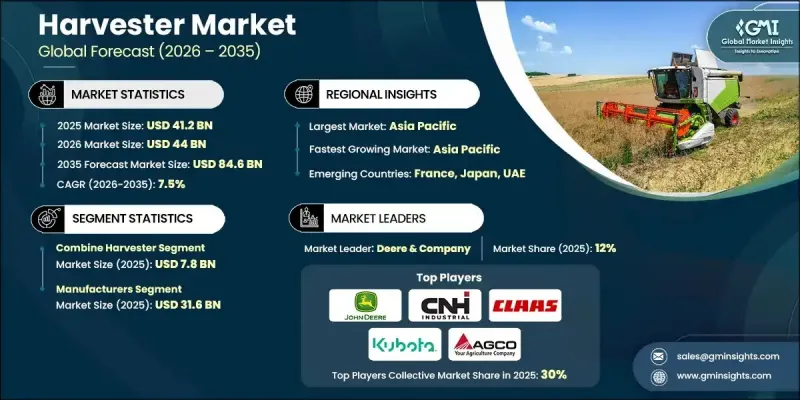
The Global Harvester Market was valued at USD 41.2 billion in 2025 and is estimated to grow at a CAGR of 7.5% to reach USD 84.6 billion by 2035.
The increasing focus on sustainable farming practices is driving the adoption of eco-friendly harvesters with energy-efficient engines and low-emission technologies. Continuous technological advancements, including precision agriculture tools and smart harvesting systems, are enhancing productivity, fuel efficiency, and operational effectiveness. Manufacturers are actively launching new models to meet the evolving needs of modern agriculture, which is being reshaped by rising global food demand. Large-scale commercial farms and contract farming providers are investing in high-capacity machines to ensure rapid and efficient harvesting, reducing losses caused by unpredictable weather and maintaining the quality of staple crops. This combination of innovation, technological integration, and growing demand for fresh produce is propelling market expansion globally.
| Market Scope | |
|---|---|
| Start Year | 2025 |
| Forecast Year | 2026-2035 |
| Start Value | $41.2 Billion |
| Forecast Value | $84.6 Billion |
| CAGR | 7.5% |
In 2025, the combine harvesters segment generated USD 7.8 billion. Combine harvesters remain the most valuable and essential machinery for commercial grain production, capable of reaping, threshing, and winnowing crops in a single operation. Their efficiency and speed allow large farms to complete harvests promptly, minimizing weather-related risks and maintaining optimal grain quality.
The manufacturers segment reached USD 31.6 billion in 2025. Manufacturers maintain strong control over pricing, after-sales support, and the integration of proprietary precision farming technologies, fostering brand loyalty, providing financing options, and offering specialized operator training for complex, high-horsepower machines.
Asia Pacific Harvester Market held a 36.9% share in 2025. The region's growth is fueled by rapid mechanization, government subsidies for small machinery, and the need for efficient harvesting of key staple crops. Countries like China, India, and Japan are investing in modernized farming equipment, including track-based combinations, compact power tillers, and advanced electric machinery, supported by government initiatives aimed at farm modernization.
Key players in the Global Harvester Market include Komatsu, Clark Material Handling Company, Crown Equipment, Mitsubishi Logisnext, Anhui Heli, Toyota Industries, Jungheinrich AG, KION Group AG, Doosan Corporation Industrial Vehicle, Hangcha Group, Hyster-Yale Materials Handling, Manitou Group, BYD Company, and Combilift. Companies in the Global Harvester Market are strengthening their position through continuous innovation, launching energy-efficient and technologically advanced machines that meet modern agriculture demands. Strategic R&D investments enable the development of precision farming solutions, smart harvesting systems, and electric-powered machinery. Firms are expanding their global distribution networks, providing financing solutions, after-sales support, and operator training programs to enhance customer loyalty. Collaborations with governments and agricultural agencies help promote mechanization and the adoption of eco-friendly harvesters.
Table of Contents
Chapter 1 Methodology and Scope
- 1.1 Market scope and definition
- 1.2 Research design
- 1.2.1 Research approach
- 1.2.2 Data collection methods
- 1.3 Data mining sources
- 1.3.1 Global
- 1.3.2 Regional/Country
- 1.4 Base estimates and calculations
- 1.4.1 Base year calculation
- 1.4.2 Key trends for market estimation
- 1.5 Primary research and validation
- 1.5.1 Primary sources
- 1.6 Forecast model
- 1.7 Research assumptions and limitations
Chapter 2 Executive Summary
- 2.1 Industry 3600 synopsis
- 2.2 Key market trends
- 2.2.1 Regional
- 2.2.2 Type
- 2.2.3 Sales channel
- 2.3 CXO perspectives: Strategic imperatives
- 2.3.1 Key decision points for industry executives
- 2.3.2 Critical success factors for market players
- 2.4 Future outlook and strategic recommendations
Chapter 3 Industry Insights
- 3.1 Industry ecosystem analysis
- 3.1.1 Supplier landscape
- 3.1.2 Profit margin
- 3.1.3 Value addition at each stage
- 3.1.4 Factor affecting the value chain
- 3.2 Industry impact forces
- 3.2.1 Growth drivers
- 3.2.1.1 E-commerce expansion & warehouse automation
- 3.2.1.2 Global population growth & food demand
- 3.2.1.3 Rising labor costs and shortages
- 3.2.1.4 Advancements in precision agriculture (Ag 4.0)
- 3.2.2 Industry pitfalls & challenges
- 3.2.2.1 High initial investment cost
- 3.2.2.2 Lack of skilled operators/technicians
- 3.2.3 Opportunities
- 3.2.3.1 Expansion of leasing & rental models
- 3.2.3.2 Development of specialty/electric harvesters
- 3.2.1 Growth drivers
- 3.3 Growth potential analysis
- 3.4 Future market trends
- 3.5 Technology and innovation landscape
- 3.5.1 Current technological trends
- 3.5.2 Emerging technologies
- 3.6 Price trends
- 3.6.1 By region
- 3.6.2 By type
- 3.7 Regulatory landscape
- 3.7.1 Standards and compliance requirements
- 3.7.2 Regional regulatory frameworks
- 3.7.3 Certification standards
- 3.8 Porter's analysis
- 3.9 PESTEL analysis
Chapter 4 Competitive Landscape, 2025
- 4.1 Introduction
- 4.2 Company market share analysis
- 4.2.1 By region
- 4.2.1.1 North America
- 4.2.1.2 Europe
- 4.2.1.3 Asia Pacific
- 4.2.1.4 Latin America
- 4.2.1.5 Middle East and Africa
- 4.2.1 By region
- 4.3 Company matrix analysis
- 4.4 Competitive analysis of major market players
- 4.5 Competitive positioning matrix
- 4.6 Key developments
- 4.6.1 Mergers & acquisitions
- 4.6.2 Partnerships & collaborations
- 4.6.3 New product launches
- 4.6.4 Expansion plans
Chapter 5 Market Estimates and Forecast, By Type, 2022 - 2035 (USD Billion) (Thousand Units)
- 5.1 Key trends
- 5.2 Combine harvester
- 5.3 Forage harvester
- 5.4 Trailed silage harvester
- 5.5 Self-propelled forage harvester
- 5.6 Trailed forage harvester
- 5.7 Mounted forage harvester
- 5.8 Mounted silage harvester
- 5.9 Surgarbeet harvester
- 5.10 Potato harvester
- 5.11 Wine grape harvester
- 5.12 Forage mowers
- 5.13 Municipal mowers
Chapter 6 Market Estimates and Forecast, By Sales Channel, 2022 - 2035 (USD Billion) (Thousand Units)
- 6.1 Key trends
- 6.2 Manufacturers
- 6.3 Distributors
Chapter 7 Market Estimates and Forecast, By Region, 2022 - 2035 (USD Billion) (Thousand Units)
- 7.1 Key trends
- 7.2 North America
- 7.2.1 U.S.
- 7.2.2 Canada
- 7.3 Europe
- 7.3.1 Germany
- 7.3.2 UK
- 7.3.3 France
- 7.3.4 Italy
- 7.3.5 Spain
- 7.4 Asia Pacific
- 7.4.1 China
- 7.4.2 Japan
- 7.4.3 India
- 7.4.4 Australia
- 7.4.5 South Korea
- 7.5 Latin America
- 7.5.1 Brazil
- 7.5.2 Mexico
- 7.5.3 Argentina
- 7.6 Middle East and Africa
- 7.6.1 South Africa
- 7.6.2 Saudi Arabia
- 7.6.3 UAE
Chapter 8 Company Profiles
- 8.1 Anhui Heli
- 8.2 BYD Company
- 8.3 Clark Material Handling Company
- 8.4 Combilift
- 8.5 Crown Equipment
- 8.6 Doosan Corporation Industrial Vehicle
- 8.7 Hangcha Group
- 8.8 Hyster-Yale Materials Handling
- 8.9 Hyundai Heavy Industries
- 8.10 Jungheinrich AG
- 8.11 KION Group AG
- 8.12 Komatsu
- 8.13 Manitou Group
- 8.14 Mitsubishi Logisnext
- 8.15 Toyota Industries