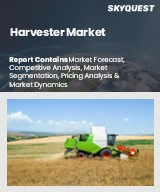
|
시장보고서
상품코드
1915938
수확기 시장 : 시장 규모, 점유율, 성장 분석 - 제품 유형별, 형태별, 종별, 용도별, 지역별 업계 예측(2026-2033년)Harvesting Machinery Market Size, Share, and Growth Analysis, By Product Type (Cereals, Legumes), By Form (Stored Forage, Fresh Forage), By Species, By Application, By Region - Industry Forecast 2026-2033 |
||||||

세계의 수확기 시장 규모는 2024년 269억 4,000만 달러로 평가되었고, 2025년 288억 달러에서 2033년까지 491억 1,000만 달러로 성장할 전망입니다. 예측 기간(2026-2033년) CAGR은 6.9%로 성장이 예상되고 있습니다.
세계의 수확기 시장은 주로 기계화의 진전, 노동력 부족, 생산성 향상의 필요성 증가에 의해 견인되고 있습니다. 이 시장을 독점하고 있는 것은 수확, 탈곡, 벼껍질 제거를 효율적으로 실시하는 콤바인 수확기인 반면, 사료용 작물 수확기는 증가하는 가축 사료 수요에 대응하기 위해, 주목을 끌고 있습니다. 사륜 구동 시스템은 특히 북미나 유럽에서 여전히 주류이지만, 아시아태평양에서는 논 작업에 특화된 트랙 기반 시스템이 급속히 발전하고 있습니다. 신흥 시장에서 정부의 우대 조치는 고급 기계의 도입을 촉진하고 있습니다. 지속가능성은 구매 결정에 중요한 역할을 하고 있으며, 특히 배출 규제가 심한 지역에서는 하이브리드 및 전기모델이 추진되고 있습니다. 아시아태평양에서 상업 농업이 성장하는 가운데 디지털 기술을 활용한 지속 가능한 솔루션에 주력하는 기업은 미래 성장을 위해 유리한 입장에 있습니다.
세계의 수확기 시장 성장 촉진요인
세계 수확기 시장의 주요 시장 성장 촉진요인 중 하나는 세계 인구 증가와 함께 식량 수요 증가입니다. 인구가 증가함에 따라 식량 안보를 보장하기 위해서는 효율적인 농업 기술이 필수적입니다. 이에 따라 생산성 향상, 인건비 절감, 수확 손실 최소화가 가능한 첨단 수확기에 대한 투자가 농업 종사자 및 농업 기업에 촉구되고 있습니다. 또한 자동화 및 정밀 농업과 같은 기술의 통합은 현대 수확 시설의 도입을 더욱 촉진하여 농업 경영의 효율성과 지속가능성을 향상시킬 수 있습니다. 이것에 의해 세계 규모에서의 식량 생산의 미래가 형성되어 가는 것입니다.
세계의 수확기 시장 성장 억제요인
세계의 수확기 시장의 주요 시장 성장 억제요인 중 하나는 고급 수확 장비와 함께 높은 초기 투자 및 유지 관리 비용입니다. 특히 소규모로 농업을 운영하는 농업 종사자는 자금면 제약으로 인해 최신 기계에 대한 투자가 어려운 상황에 직면하는 경우가 적지 않습니다. 게다가 산업 기술 진보의 급속한 페이스는 구입 후 곧 장비가 진부화할 우려를 초래하여 투자 의욕을 더욱 깎아내는 요인이 됩니다. 이러한 경제적 장벽은 현대적인 수확 기술의 보급을 방해할 수 있으며, 따라서 시장의 성장과 세계 농업 경영의 전반적인 효율성에 영향을 미칠 수 있습니다.
세계의 수확기 시장 동향
세계의 수확기 시장은 정밀농업 및 스마트 농업 기술의 융합에 의해 점점 영향을 받고 있으며, 텔레매틱스나 수량 모니터링 시스템과 통합된 GPS 탑재 및 IoT 대응 수확기의 채용 증가가 현저합니다. 이러한 추세를 통해 농업 종사자는 데이터 인사이트를 통해 업무 효율성 및 의사 결정을 강화할 수 있습니다. 특히 스마트 농업의 침투가 현저한 북미와 유럽에서는 정밀 수확 기술이 생산성을 향상시킬 뿐만 아니라 자원의 낭비를 최소화함으로써 지속가능한 농업 실천을 촉진하고 있습니다. 농업 종사자가 업무 최적화와 증가하는 식량 생산 수요에 대한 대응을 모색하는 동안, 이러한 혁신적인 변화는 수확기 시장에 있어 매우 중요한 추진력이 되고 있습니다.
자주 묻는 질문
목차
서문
- 조사 목적
- 조사 범위
- 정의
조사 방법
- 정보 조달
- 1차 및 2차 데이터의 방법
- 시장 규모 예측
- 시장의 전제조건 및 제한
주요 요약
- 세계 시장 전망
- 공급 및 수요 동향 분석
- 부문별 기회 분석
시장 역학 및 전망
- 시장 규모
- 시장 역학
- 성장 촉진요인 및 기회
- 성장 억제요인 및 과제
- Porter's Five Forces 분석
주요 시장 인사이트
- 중요 성공 요인
- 경쟁도
- 주요 투자 기회
- 시장 생태계
- 시장의 매력 지수(2025년)
- PESTEL 분석
- 거시경제지표
- 밸류체인 분석
- 가격 분석
세계의 수확기 시장 규모 : 제품 유형별 CAGR(2026-2033년)
- 곡물
- 콩류
- 벼과 작물
- 유채과 작물
- 기타
세계의 수확기 시장 규모 : 형태별 CAGR(2026-2033년)
- 저장 사료
- 생 사료
- 사일리지
- 건초
- 기타
세계의 수확기 시장 규모 : 종별 CAGR(2026-2033년)
- 알팔파
- 클로버
- 라이글라스
- 치커리
- 기타
세계의 수확기 시장 규모 : 용도별 CAGR(2026-2033년)
- 가금
- 소
- 돼지
- 양 및 염소
- 기타
세계의 수확기 시장 규모 : 지역별 CAGR(2026-2033년)
- 북미
- 미국
- 캐나다
- 유럽
- 독일
- 스페인
- 프랑스
- 영국
- 이탈리아
- 기타 유럽
- 아시아태평양
- 중국
- 인도
- 일본
- 한국
- 기타 아시아태평양
- 라틴아메리카
- 브라질
- 기타 라틴아메리카
- 중동 및 아프리카
- GCC
- 남아프리카
- 기타 중동 및 아프리카
경쟁 정보
- 상위 5개사 비교
- 주요 기업의 시장 포지셔닝(2025년)
- 주요 시장 기업이 채용한 전략
- 최근 시장 동향
- 기업의 시장 점유율 분석(2025년)
- 주요 기업의 기업 프로파일
- 기업의 상세
- 제품 포트폴리오 분석
- 기업의 부문별 점유율 분석
- 수익의 전년 대비 비교(2023-2025년)
주요 기업 프로파일
- Deere & Company(USA)
- CNH Industrial(UK/(Netherlands))
- AGCO Corporation(USA)
- CLAAS KGaA mbH(Germany)
- Kubota Corporation(Japan)
- Mahindra & Mahindra Ltd.(India)
- Yanmar Co., Ltd.(Japan)
- SDF Group(Italy)
- Kuhn Group(France)
- Rostselmash(Russia)
- Tractors and Farm Equipment Limited(TAFE)(India)
- Sampo-Rosenlew Oy(Finland)
- Exel Industries(France)
- Lovol Heavy Industry Co., Ltd.(China)
- PREET Group(India)
- Escorts Kubota Limited(India)
- MacDon Industries(Canada)
- Bernard Krone Holding SE & Co. KG(Germany)
- Kartar Agro Industries Pvt. Ltd.(India)
- Yanmar Holdings Co., Ltd.(Japan)
결론 및 권고
AJY 26.02.05Global Harvesting Machinery Market size was valued at USD 26.94 Billion in 2024 and is poised to grow from USD 28.8 Billion in 2025 to USD 49.11 Billion by 2033, growing at a CAGR of 6.9% during the forecast period (2026-2033).
The global market for harvesting machinery is primarily driven by rising mechanization, labor shortages, and an increasing need for productivity enhancements. Dominating this landscape are combine harvesters, which efficiently perform reaping, threshing, and winnowing, while forage harvesters are gaining traction to meet rising animal feed requirements. Four-wheel drive systems remain prevalent, particularly in North America and Europe, while track-based systems are rapidly developing in the Asia-Pacific, catering specifically to paddy field needs. Government incentives in emerging markets are encouraging the adoption of advanced machinery. Sustainability plays a significant role in purchasing decisions, promoting hybrid and electric models, especially where emissions regulations are stringent. As commercial agriculture grows in Asia-Pacific, companies focusing on digital, sustainable solutions are well-positioned for future growth.
Top-down and bottom-up approaches were used to estimate and validate the size of the Global Harvesting Machinery market and to estimate the size of various other dependent submarkets. The research methodology used to estimate the market size includes the following details: The key players in the market were identified through secondary research, and their market shares in the respective regions were determined through primary and secondary research. This entire procedure includes the study of the annual and financial reports of the top market players and extensive interviews for key insights from industry leaders such as CEOs, VPs, directors, and marketing executives. All percentage shares split, and breakdowns were determined using secondary sources and verified through Primary sources. All possible parameters that affect the markets covered in this research study have been accounted for, viewed in extensive detail, verified through primary research, and analyzed to get the final quantitative and qualitative data.
Global Harvesting Machinery Market Segments Analysis
Global Harvesting Machinery Market is segmented by Product Type, Form, Species, Application and region. Based on Product Type, the market is segmented into Cereals, Legumes, Grasses, Brassicas and Others. Based on Form, the market is segmented into Stored Forage, Fresh Forage, Silage, Hay and Others. Based on Species, the market is segmented into Alfalfa, Clover, Ryegrass, Chicory and Others. Based on Application, the market is segmented into Poultry, Cattle, Swine, Sheep & Goats and Others. Based on region, the market is segmented into North America, Europe, Asia Pacific, Latin America and Middle East & Africa.
Driver of the Global Harvesting Machinery Market
One of the key market drivers for the global harvesting machinery market is the increasing demand for food due to the growing global population. As populations expand, the need for efficient agricultural practices becomes vital to ensure food security. This drives farmers and agricultural enterprises to invest in advanced harvesting machinery that can enhance productivity, reduce labor costs, and minimize crop losses. Moreover, the integration of technology, such as automation and precision farming, further propels the adoption of modern harvesting equipment, allowing for higher efficiency and sustainability in agricultural operations, thereby shaping the future of food production on a global scale.
Restraints in the Global Harvesting Machinery Market
One key market restraint for the global harvesting machinery market is the high initial investment and maintenance costs associated with advanced harvesting equipment. Farmers, particularly those operating on a smaller scale, often face financial constraints that limit their ability to invest in state-of-the-art machinery. Additionally, the rapid pace of technological advancement in the industry can lead to concerns about the obsolescence of equipment shortly after purchase, further deterring investment. These economic barriers can hinder the adoption of modern harvesting technologies, thereby affecting market growth and the overall efficiency of agricultural operations globally.
Market Trends of the Global Harvesting Machinery Market
The global harvesting machinery market is increasingly influenced by the convergence of precision and smart farming technologies, marked by the rising adoption of GPS-equipped, IoT-enabled harvesters integrated with telematics and yield monitoring systems. This trend empowers farmers to enhance operational efficiency and decision-making through data-driven insights. Particularly prominent in North America and Europe, where smart agriculture penetration is robust, precision harvesting technology not only improves productivity but also promotes sustainable farming practices by minimizing resource wastage. As farmers seek to optimize operations and meet growing food production demands, this innovative shift stands as a pivotal driver for the harvesting machinery market.
Table of Contents
Introduction
- Objectives of the Study
- Scope of the Report
- Definitions
Research Methodology
- Information Procurement
- Secondary & Primary Data Methods
- Market Size Estimation
- Market Assumptions & Limitations
Executive Summary
- Global Market Outlook
- Supply & Demand Trend Analysis
- Segmental Opportunity Analysis
Market Dynamics & Outlook
- Market Overview
- Market Size
- Market Dynamics
- Drivers & Opportunities
- Restraints & Challenges
- Porters Analysis
- Competitive rivalry
- Threat of substitute
- Bargaining power of buyers
- Threat of new entrants
- Bargaining power of suppliers
Key Market Insights
- Key Success Factors
- Degree of Competition
- Top Investment Pockets
- Market Ecosystem
- Market Attractiveness Index, 2025
- PESTEL Analysis
- Macro-Economic Indicators
- Value Chain Analysis
- Pricing Analysis
Global Harvesting Machinery Market Size by Product Type & CAGR (2026-2033)
- Market Overview
- Cereals
- Legumes
- Grasses
- Brassicas
- Others
Global Harvesting Machinery Market Size by Form & CAGR (2026-2033)
- Market Overview
- Stored Forage
- Fresh Forage
- Silage
- Hay
- Others
Global Harvesting Machinery Market Size by Species & CAGR (2026-2033)
- Market Overview
- Alfalfa
- Clover
- Ryegrass
- Chicory
- Others
Global Harvesting Machinery Market Size by Application & CAGR (2026-2033)
- Market Overview
- Poultry
- Cattle
- Swine
- Sheep & Goats
- Others
Global Harvesting Machinery Market Size & CAGR (2026-2033)
- North America (Product Type, Form, Species, Application)
- US
- Canada
- Europe (Product Type, Form, Species, Application)
- Germany
- Spain
- France
- UK
- Italy
- Rest of Europe
- Asia Pacific (Product Type, Form, Species, Application)
- China
- India
- Japan
- South Korea
- Rest of Asia-Pacific
- Latin America (Product Type, Form, Species, Application)
- Brazil
- Rest of Latin America
- Middle East & Africa (Product Type, Form, Species, Application)
- GCC Countries
- South Africa
- Rest of Middle East & Africa
Competitive Intelligence
- Top 5 Player Comparison
- Market Positioning of Key Players, 2025
- Strategies Adopted by Key Market Players
- Recent Developments in the Market
- Company Market Share Analysis, 2025
- Company Profiles of All Key Players
- Company Details
- Product Portfolio Analysis
- Company's Segmental Share Analysis
- Revenue Y-O-Y Comparison (2023-2025)
Key Company Profiles
- Deere & Company (USA)
- Company Overview
- Business Segment Overview
- Financial Updates
- Key Developments
- CNH Industrial (UK/Netherlands)
- Company Overview
- Business Segment Overview
- Financial Updates
- Key Developments
- AGCO Corporation (USA)
- Company Overview
- Business Segment Overview
- Financial Updates
- Key Developments
- CLAAS KGaA mbH (Germany)
- Company Overview
- Business Segment Overview
- Financial Updates
- Key Developments
- Kubota Corporation (Japan)
- Company Overview
- Business Segment Overview
- Financial Updates
- Key Developments
- Mahindra & Mahindra Ltd. (India)
- Company Overview
- Business Segment Overview
- Financial Updates
- Key Developments
- Yanmar Co., Ltd. (Japan)
- Company Overview
- Business Segment Overview
- Financial Updates
- Key Developments
- SDF Group (Italy)
- Company Overview
- Business Segment Overview
- Financial Updates
- Key Developments
- Kuhn Group (France)
- Company Overview
- Business Segment Overview
- Financial Updates
- Key Developments
- Rostselmash (Russia)
- Company Overview
- Business Segment Overview
- Financial Updates
- Key Developments
- Tractors and Farm Equipment Limited (TAFE) (India)
- Company Overview
- Business Segment Overview
- Financial Updates
- Key Developments
- Sampo-Rosenlew Oy (Finland)
- Company Overview
- Business Segment Overview
- Financial Updates
- Key Developments
- Exel Industries (France)
- Company Overview
- Business Segment Overview
- Financial Updates
- Key Developments
- Lovol Heavy Industry Co., Ltd. (China)
- Company Overview
- Business Segment Overview
- Financial Updates
- Key Developments
- PREET Group (India)
- Company Overview
- Business Segment Overview
- Financial Updates
- Key Developments
- Escorts Kubota Limited (India)
- Company Overview
- Business Segment Overview
- Financial Updates
- Key Developments
- MacDon Industries (Canada)
- Company Overview
- Business Segment Overview
- Financial Updates
- Key Developments
- Bernard Krone Holding SE & Co. KG (Germany)
- Company Overview
- Business Segment Overview
- Financial Updates
- Key Developments
- Kartar Agro Industries Pvt. Ltd. (India)
- Company Overview
- Business Segment Overview
- Financial Updates
- Key Developments
- Yanmar Holdings Co., Ltd. (Japan)
- Company Overview
- Business Segment Overview
- Financial Updates
- Key Developments