
|
시장보고서
상품코드
1936509
복합재료 및 코팅용 나노셀룰로오스 시장 : 시장 기회, 성장 촉진요인, 산업 동향 분석 및 예측(2026-2035년)Nanocellulose in Composites and Coatings Market Opportunity, Growth Drivers, Industry Trend Analysis, and Forecast 2026 - 2035 |
||||||

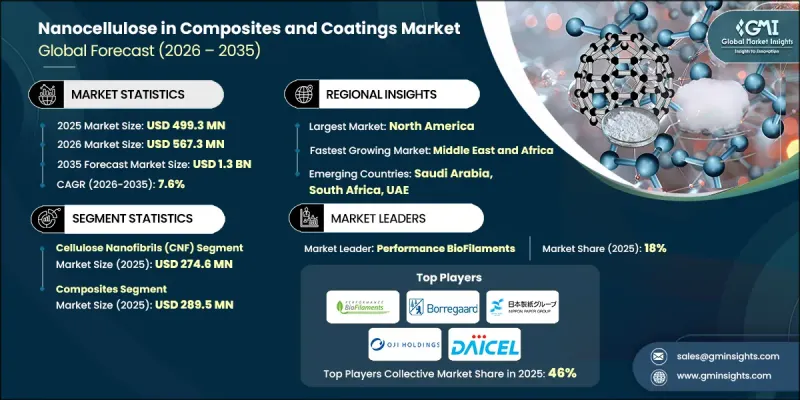
세계의 복합재료 및 코팅용 나노셀룰로오스 시장은 2025년에 4억 9,930만 달러로 평가되었고, 2035년까지 연평균 복합 성장률(CAGR)7.6%로 성장할 전망이며, 13억 달러에 이를 것으로 예측되고 있습니다.
나노셀룰로오스는 적어도 한 면이 나노미터 스케일인 셀룰로오스 물질을 말하며, 일반적으로 식물 섬유, 박테리아 및 조류로부터 추출됩니다. 재료 포트폴리오는 셀룰로오스 나노크리스탈, 셀룰로오스 나노피브릴, 박테리아 셀룰로오스를 포함하며, 각각 크기, 구조, 결정성의 차이에 의해 정의됩니다. 나노셀룰로오스는 높은 기계적 강도, 저밀도, 큰 표면적, 생분해성 및 적응성 표면 화학 특성을 결합한 독특한 재료입니다. 이러한 특성으로 인해 나노셀룰로오스는 고급 복합재료의 귀중한 보강제로, 코팅 시스템에서 기능성 첨가제로 자리매김하고 있습니다. 낮은 첨가량에서도 나노셀룰로오스는 기계적 특성, 내열성 및 장벽 성능을 향상시킵니다. 경량 특성을 유지하면서 폴리머 매트릭스를 강화하는 능력은 포장, 건설 및 산업용 재료 용도 분야에서 수요를 지원합니다. 지속가능성에 대한 배려도 채용을 더욱 가속화하고 있으며, 산업 분야에서는 재생가능하고 생분해성인 재료 솔루션이 점점 중시되고 있습니다.
| 시장 범위 | |
|---|---|
| 시작 연도 | 2025년 |
| 예측 연도 | 2026-2035년 |
| 시작 금액 | 4억 9,930만 달러 |
| 예측 금액 | 13억 달러 |
| CAGR | 7.6% |
나노셀룰로오스는 페인트 배합에 있어서 필름 형성 촉진, 배리어 성능 향상, 레올로지 제어 강화 등 뛰어난 성능 효과를 가져옵니다. 산소, 수분, 유분에 대한 투과성을 줄이기 위해, 보호 페인트 및 기능성 페인트 용도에서의 중요성이 높아지고 있습니다. 다양한 페인트 시스템과의 궁합이 좋기 때문에 환경 성능을 손상시키지 않고, 표면 균일성과 내구성의 향상을 실현할 수 있습니다. 이러한 기능적 우위성은 여러 최종 용도 분야에서 안정적인 수요 증가를 계속하고 있습니다.
셀룰로오스 나노피브릴 부문은 2025년 2억 7,460만 달러에 달했습니다. 셀룰로오스 나노피브릴 및 마이크로피브릴화 셀룰로오스는 복합재료 및 코팅에서 보강성, 인성 및 점도 제어를 크게 향상시키는 긴 유연한 섬유 네트워크를 갖고 있기 때문에 널리 채택되고 있습니다. 이러한 재료는 고분자 및 코팅 시스템 내에서 효율적으로 분산되어 균일한 구조 형성과 표면 균일성 향상을 가능하게 합니다. 비교적 간편한 가공 요건은 다양한 재료 배합에서 광범위한 채택을 더욱 강화하고 있습니다.
복합재료 부문은 2025년 2억 8,950만 달러 시장 규모를 기록했습니다. 나노셀룰로오스는 경량성을 유지하면서 강성, 내구성, 하중 분산성을 향상시켜 복합재료 시스템을 강화합니다. 천연 유래이기 때문에 종래의 합성 보강재를 대신하는 보다 지속 가능한 복합재료의 개발을 가능하게 합니다. 다중 매트릭스 유형과의 상용성으로 인해, 나노셀룰로오스는 광범위한 산업 분야에서 구조 및 반구조 복합재료 용도를 모두 지원합니다.
북미의 복합재료 및 코팅용 나노셀룰로오스 시장은 2025년 2억 8,330만 달러를 기록했습니다. 성장은 첨단 산업 인프라, 지속 가능한 재료의 높은 채용률, 운송, 항공우주 및 포장 분야의 안정적인 수요에 의해 지원됩니다. 조사와 재료 혁신에 대한 지속적인 투자는 지역 전망을 더욱 강화하고 있습니다. 친환경 재료를 장려하는 정부 인센티브가 채용을 가속화하는 한편, 미국은 대규모 생산 능력, 첨단 제조 기술, 지속 가능한 제품에 대한 소비자 의식 증가를 통해 이 지역을 선도하고 있습니다.
자주 묻는 질문
목차
제1장 조사 방법 및 범위
제2장 주요 요약
제3장 업계 인사이트
- 생태계 분석
- 공급자의 상황
- 이익률
- 각 단계에서의 부가가치
- 밸류체인에 영향을 주는 요인
- 혁신
- 업계에 미치는 영향요인
- 성장 촉진요인
- 지속 가능한 소재에 대한 수요 증가
- 생산에 있어서 기술적 진보
- 기계적 특성 및 장벽 특성의 강화
- 업계의 잠재적 위험 및 과제
- 높은 생산 비용
- 분산성 및 상용성의 문제
- 시장 기회
- 고성능 복합재료 개발
- 스마트 소재와의 통합
- 순환형 경제에 대한 대처
- 성장 촉진요인
- 성장 가능성 분석
- 규제 상황
- 북미
- 유럽
- 아시아태평양
- 라틴아메리카
- 중동 및 아프리카
- Porter's Five Forces 분석
- PESTEL 분석
- 기술 및 혁신 동향
- 현재 기술 동향
- 신흥 기술
- 가격 동향
- 지역별
- 제품 유형별
- 장래 시장 동향
- 기술 및 혁신 동향
- 현재 기술 동향
- 신흥 기술
- 특허 상황
- 무역 통계(HS코드)
- 주요 수입국
- 주요 수출국
- 지속가능성 및 환경면
- 지속가능한 대처
- 폐기물 감축 전략
- 생산에 있어서 에너지 효율
- 환경에 배려한 대처
- 탄소발자국 고려
제4장 경쟁 구도
- 서문
- 기업의 시장 점유율 분석
- 지역별
- 북미
- 유럽
- 아시아태평양
- 라틴아메리카
- 중동 및 아프리카
- 지역별
- 기업 매트릭스 분석
- 주요 시장 기업의 경쟁 분석
- 경쟁 포지셔닝 매트릭스
- 주요 발전
- 합병 및 인수
- 제휴 및 협업
- 신제품 발매
- 확대 계획
제5장 시장 추계 및 예측 : 제품 유형별(2022-2035년)
- 셀룰로오스 나노크리스탈(CNC)
- 셀룰로오스 나노피브릴(CNF)
- 박테리아 나노셀룰로오스(BNC)
- 마이크로피브릴화 셀룰로오스(MFC/CMF)
제6장 시장 추계 및 예측 : 용도별(2022-2035년)
- 복합재료
- 폴리머 매트릭스 복합재료
- 자동차용 복합재료
- 건설 및 건축 자재
- 포장용 복합재료
- 전자기기 및 첨단 재료
- 코팅
- 종이 및 포장용 배리어 코팅
- 섬유 코팅 및 표면 처리
- 기능성 및 보호 코팅
- 농업용 필름 및 스마트 코팅
제7장 시장 추계 및 예측 : 지역별(2022-2035년)
- 북미
- 미국
- 캐나다
- 멕시코
- 유럽
- 독일
- 영국
- 프랑스
- 스페인
- 이탈리아
- 기타 유럽
- 아시아태평양
- 중국
- 인도
- 일본
- 호주
- 한국
- 기타 아시아태평양
- 라틴아메리카
- 브라질
- 멕시코
- 아르헨티나
- 기타 라틴아메리카
- 중동 및 아프리카
- 사우디아라비아
- 남아프리카
- 아랍에미리트(UAE)
- 기타 중동 및 아프리카
제8장 기업 프로파일
- Anomera Inc.
- Blue Goose Biorefineries Inc.
- Borregaard AS
- CelluComp Ltd.
- Daicel Corporation
- GranBio Technologies
- Kao Corporation
- Kruger Inc.
- Melodea Ltd.
- Nippon Paper Industries Co., Ltd.
- Oji Holdings Corporation
- Performance BioFilaments
- Seiko PMC Corporation
The Global Nanocellulose in Composites and Coatings Market was valued at USD 499.3 million in 2025 and is estimated to grow at a CAGR of 7.6% to reach USD 1.3 billion by 2035.
Nanocellulose refers to cellulose materials that feature at least one dimension at the nanometer scale and are commonly sourced from plant fibers, bacteria, or algae. The material portfolio includes cellulose nanocrystals, cellulose nanofibrils, and bacterial cellulose, each defined by variations in size, structure, and crystallinity. Nanocellulose offers a unique combination of high mechanical strength, low density, large surface area, biodegradability, and adaptable surface chemistry. These characteristics position it as a valuable reinforcement agent in advanced composites and as a functional additive in coating systems. Even at low loadings, nanocellulose enhances mechanical, thermal, and barrier performance. Its ability to strengthen polymer matrices while preserving lightweight characteristics supports demand across packaging, construction, and industrial material applications. Sustainability considerations further accelerate adoption as industries increasingly favor renewable and biodegradable material solutions.
| Market Scope | |
|---|---|
| Start Year | 2025 |
| Forecast Year | 2026-2035 |
| Start Value | $499.3 Million |
| Forecast Value | $1.3 Billion |
| CAGR | 7.6% |
Nanocellulose also delivers strong performance benefits within coating formulations by supporting film formation, improving barrier efficiency, and enhancing rheological control. The material reduces permeability to oxygen, moisture, and oils, expanding its relevance in protective and functional coating applications. Its compatibility with various coating systems allows manufacturers to achieve improved surface uniformity and durability without compromising environmental performance. These functional advantages continue to support consistent demand growth across multiple end-use sectors.
The cellulose nanofibrils segment reached USD 274.6 million in 2025. Cellulose nanofibrils and microfibrillated cellulose remain widely adopted due to their long, flexible fiber networks that significantly improve reinforcement, toughness, and viscosity control in composites and coatings. These materials disperse efficiently within polymer and coating systems, enabling uniform structure formation and enhanced surface consistency. Their relatively straightforward processing requirements further support their broad adoption across diverse material formulations.
The composites segment generated USD 289.5 million in 2025. Nanocellulose strengthens composite systems by improving stiffness, durability, and load distribution while maintaining low material weight. Its natural origin enables the development of more sustainable composite alternatives to traditional synthetic reinforcements. Compatibility with multiple matrix types allows nanocellulose to support both structural and semi-structural composite applications across a wide range of industries.
North America Nanocellulose in Composites and Coatings Market captured USD 283.3 million in 2025. Growth is supported by advanced industrial infrastructure, high adoption of sustainable materials, and consistent demand from transportation, aerospace, and packaging sectors. Continued investment in research and material innovation further strengthens the regional outlook. Government incentives encouraging environmentally responsible materials accelerate adoption, while the US leads the region through scaled production capabilities, advanced manufacturing technologies, and growing consumer awareness regarding sustainable products.
Key companies active in the Global Nanocellulose in Composites and Coatings Market include Borregaard AS, Anomera Inc., Nippon Paper Industries Co., Ltd., Melodea Ltd., Kruger Inc., Kao Corporation, Performance BioFilaments, Daicel Corporation, CelluComp Ltd., Blue Goose Biorefineries Inc., Seiko PMC Corporation, Oji Holdings Corporation, and GranBio Technologies. Companies operating in the market focus on expanding production capacity and improving material consistency to strengthen their competitive position. Strategic investments in process optimization help reduce costs and enable large-scale commercialization. Many players prioritize partnerships with composite and coating manufacturers to accelerate application development and market penetration. Continuous research into surface modification and performance enhancement supports product differentiation.
Table of Contents
Chapter 1 Methodology & Scope
- 1.1 Market scope and definition
- 1.2 Research design
- 1.2.1 Research approach
- 1.2.2 Data collection methods
- 1.3 Data mining sources
- 1.3.1 Global
- 1.3.2 Regional/Country
- 1.4 Base estimates and calculations
- 1.4.1 Base year calculation
- 1.4.2 Key trends for market estimation
- 1.5 Primary research and validation
- 1.5.1 Primary sources
- 1.6 Forecast model
- 1.7 Research assumptions and limitations
Chapter 2 Executive Summary
- 2.1 Industry 360° synopsis
- 2.2 Key market trends
- 2.2.1 Product Type
- 2.2.2 Application
- 2.2.3 Regional
- 2.3 TAM Analysis, 2026-2035
- 2.4 CXO perspectives: Strategic imperatives
- 2.4.1 Executive decision points
- 2.4.2 Critical success factors
- 2.5 Future outlook and strategic recommendations
Chapter 3 Industry Insights
- 3.1 Industry ecosystem analysis
- 3.1.1 Supplier landscape
- 3.1.2 Profit margin
- 3.1.3 Value addition at each stage
- 3.1.4 Factor affecting the value chain
- 3.1.5 Disruptions
- 3.2 Industry impact forces
- 3.2.1 Growth drivers
- 3.2.1.1 Rising demand for sustainable materials
- 3.2.1.2 Technological advancements in production
- 3.2.1.3 Enhanced mechanical and barrier properties
- 3.2.2 Industry pitfalls and challenges
- 3.2.2.1 High production costs
- 3.2.2.2 Dispersion and compatibility issues
- 3.2.3 Market opportunities
- 3.2.3.1 Development of high-performance composites
- 3.2.3.2 Integration with smart materials
- 3.2.3.3 Circular economy initiatives
- 3.2.1 Growth drivers
- 3.3 Growth potential analysis
- 3.4 Regulatory landscape
- 3.4.1 North America
- 3.4.2 Europe
- 3.4.3 Asia Pacific
- 3.4.4 Latin America
- 3.4.5 Middle East & Africa
- 3.5 Porter's analysis
- 3.6 PESTEL analysis
- 3.7 Technology and innovation landscape
- 3.7.1 Current technological trends
- 3.7.2 Emerging technologies
- 3.8 Price trends
- 3.8.1 By region
- 3.8.2 By product type
- 3.9 Future market trends
- 3.10 Technology and innovation landscape
- 3.10.1 Current technological trends
- 3.10.2 Emerging technologies
- 3.11 Patent landscape
- 3.12 Trade statistics (HS code)
- 3.12.1 Major importing countries
- 3.12.2 Major exporting countries
- 3.13 Sustainability and environmental aspects
- 3.13.1 Sustainable practices
- 3.13.2 Waste reduction strategies
- 3.13.3 Energy efficiency in production
- 3.13.4 Eco-friendly initiatives
- 3.14 Carbon footprint consideration
Chapter 4 Competitive Landscape, 2025
- 4.1 Introduction
- 4.2 Company market share analysis
- 4.2.1 By region
- 4.2.1.1 North America
- 4.2.1.2 Europe
- 4.2.1.3 Asia Pacific
- 4.2.1.4 LATAM
- 4.2.1.5 MEA
- 4.2.1 By region
- 4.3 Company matrix analysis
- 4.4 Competitive analysis of major market players
- 4.5 Competitive positioning matrix
- 4.6 Key developments
- 4.6.1 Mergers & acquisitions
- 4.6.2 Partnerships & collaborations
- 4.6.3 New product launches
- 4.6.4 Expansion plans
Chapter 5 Market Estimates and Forecast, By Product Type, 2022-2035 (USD Million) (Kilo Tons)
- 5.1 Key trends
- 5.2 Cellulose nanocrystals (CNC)
- 5.3 Cellulose nanofibrils (CNF)
- 5.4 Bacterial nanocellulose (BNC)
- 5.5 Microfibrillated cellulose (MFC/CMF)
Chapter 6 Market Estimates and Forecast, By Application, 2022-2035 (USD Million) (Kilo Tons)
- 6.1 Key trends
- 6.2 Composites
- 6.2.1 Polymer matrix composites
- 6.2.2 Automotive composites
- 6.2.3 Construction & building materials
- 6.2.4 Packaging composites
- 6.2.5 Electronics & advanced materials
- 6.3 Coatings
- 6.3.1 Paper & packaging barrier coatings
- 6.3.2 Textile coatings & surface treatments
- 6.3.3 Functional & protective coatings
- 6.3.4 Agricultural films & smart coatings
Chapter 7 Market Estimates and Forecast, By Region, 2022-2035 (USD Million) (Kilo Tons)
- 7.1 Key trends
- 7.2 North America
- 7.2.1 U.S.
- 7.2.2 Canada
- 7.2.3 Mexico
- 7.3 Europe
- 7.3.1 Germany
- 7.3.2 UK
- 7.3.3 France
- 7.3.4 Spain
- 7.3.5 Italy
- 7.3.6 Rest of Europe
- 7.4 Asia Pacific
- 7.4.1 China
- 7.4.2 India
- 7.4.3 Japan
- 7.4.4 Australia
- 7.4.5 South Korea
- 7.4.6 Rest of Asia Pacific
- 7.5 Latin America
- 7.5.1 Brazil
- 7.5.2 Mexico
- 7.5.3 Argentina
- 7.5.4 Rest of Latin America
- 7.6 Middle East and Africa
- 7.6.1 Saudi Arabia
- 7.6.2 South Africa
- 7.6.3 UAE
- 7.6.4 Rest of Middle East and Africa
Chapter 8 Company Profiles
- 8.1 Anomera Inc.
- 8.2 Blue Goose Biorefineries Inc.
- 8.3 Borregaard AS
- 8.4 CelluComp Ltd.
- 8.5 Daicel Corporation
- 8.6 GranBio Technologies
- 8.7 Kao Corporation
- 8.8 Kruger Inc.
- 8.9 Melodea Ltd.
- 8.10 Nippon Paper Industries Co., Ltd.
- 8.11 Oji Holdings Corporation
- 8.12 Performance BioFilaments
- 8.13 Seiko PMC Corporation