

|
시장보고서
상품코드
2027523
자동차 열교환기 : 시장 기회, 성장 촉진요인, 업계 동향 분석 및 예측(2026-2035년)Automotive Heat Exchanger Market Opportunity, Growth Drivers, Industry Trend Analysis, and Forecast 2026 - 2035 |
||||||

세계의 자동차 열교환기 시장은 2025년에 432억 달러로 평가되었고 CAGR 8.9%를 나타내 2035년까지 972억 달러에 이를 것으로 추정되고 있습니다.
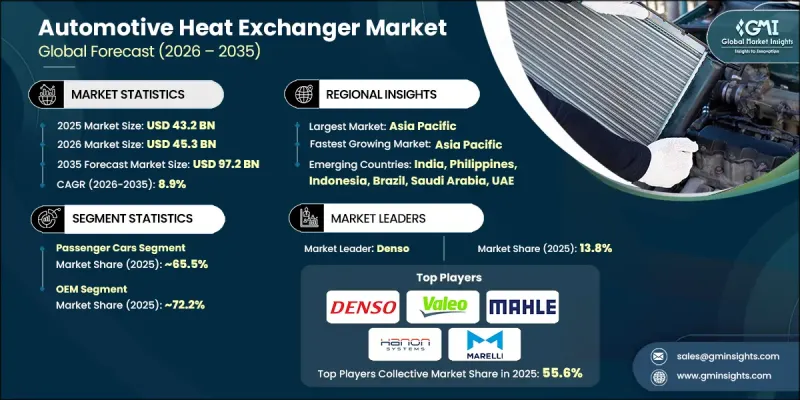
자동차의 급속한 전기화, 배출가스 규제 강화, 에너지 효율 향상에 대한 요구가 높아지면서 시장은 큰 변화를 겪고 있습니다. 과거에는 주로 내연기관차의 엔진 냉각과 기본적인 공조(HVAC)에 사용되던 열교환기는 이제 현대 차량의 복잡한 열 부하를 관리하는 데 필수적인 요소로 자리 잡았습니다. 전기자동차 및 하이브리드 자동차에서는 배터리 온도 제어, 파워일렉트로닉스의 냉각, 차내 쾌적성 유지 등을 담당하며 차량의 안전성, 성능, 주행거리에 직접적인 영향을 미치고 있습니다. 편안함과 프리미엄 차량 내 경험을 원하는 소비자 수요가 증가함에 따라 첨단 열 관리 시스템 채택이 증가하고 있습니다. 컴팩트한 고효율 열교환기가 자동 공조 제어, 멀티존 HVAC 및 시트 히터-쿨러 시스템에 내장되어 있습니다. 각 제조업체들은 열전달 효율을 높이면서 차량 무게를 줄이기 위해 알루미늄이나 복합소재와 같은 경량, 고성능 소재를 점점 더 많이 채택하고 있습니다. 전기자동차의 보급 확대와 연비 규제 강화로 인해 OEM 업체들은 여러 열교환 기능을 통합한 열 관리 아키텍처를 채택할 수밖에 없는 상황입니다.
| 시장 범위 | |
|---|---|
| 시작 연도 | 2025년 |
| 예측 기간 | 2026-2035년 |
| 개시 금액 | 432억 달러 |
| 예측 금액 | 972억 달러 |
| CAGR | 8.9% |
승용차 부문은 2025년 65.5%의 점유율을 차지했으며, 2035년까지 연평균 8.7%의 성장률을 나타낼 것으로 전망됩니다. 승용차가 시장을 주도하는 이유는 전 세계 개인 이동수단에 대한 수요 증가, 하이브리드 및 전기자동차의 보급, 그리고 편안함, 안전성, 에너지 효율성에 대한 소비자의 요구가 높아졌기 때문입니다. 이러한 차량은 최적의 주행거리와 실내 쾌적성을 보장하기 위해 엔진 냉각, 배터리 성능 및 HVAC 시스템에 대한 효율적인 열 관리가 요구됩니다. 마이크로채널 열교환기, 통합 열 관리 시스템, 경량화 설계의 기술 혁신은 이 부문의 성장을 더욱 촉진하고 있습니다.
OEM 부문은 2025년 72.2%의 점유율을 차지했으며, 2026년부터 2035년까지 연평균 복합 성장률(CAGR) 8.3%를 나타낼 것으로 예측됩니다. 열교환기는 차량 설계 및 조립 단계에서 통합되어 최적의 엔진 냉각, 배터리 관리 및 HVAC 성능을 보장하기 때문에 OEM이 시장을 주도하고 있습니다. OEM은 배출가스 규제 및 효율 기준을 충족하기 위해 고품질의 내구성 높은 열교환기에 집중하고 있습니다. OEM은 자동차 열교환기 시장의 주요 수익원으로서, 애프터마켓에 대한 의존도를 낮추고, 규정 준수를 보장하며, 전체 차량 성능을 향상시키기 때문에 OEM은 자동차 열교환기 시장의 주요 수익원이 되고 있습니다.
중국의 자동차 열교환기 시장은 64.2%의 점유율을 차지하며 2025년에는 110억 달러 규모에 도달했씁니다. 중국의 견조한 성장은 세계 자동차 생산의 선도적 지위와 승용차 및 상용차 부문의 급속한 전기화에서 기인합니다. 정부의 인센티브, 배출가스 규제, 전기차 도입 의무화 등이 첨단 열 관리 솔루션에 대한 수요를 촉진하고 있습니다. 중국의 광범위한 제조 생태계, 국내 OEM의 존재감, 배터리 및 전기자동차 공급망에서의 선도적 위치는 배터리 냉각 시스템 및 히트펌프 HVAC 기술과 같은 전문 열 관리 솔루션에 대한 수요를 견인하고 있습니다.
자주 묻는 질문
목차
제1장 조사 방법
제2장 주요 요약
제3장 업계 인사이트
제4장 경쟁 구도
제5장 시장 추산 및 예측 : 차량별(2022-2035년)
제6장 시장 추산 및 예측 : 추진력별(2022-2035년)
제7장 시장 추산 및 예측 : 판매 채널별(2022-2035년)
제8장 시장 추산 및 예측 : 제품별(2022-2035년)
제9장 시장 추산 및 예측 : 재료별(2022-2035년)
제10장 시장 추산 및 예측 : 설계별(2022-2035년)
제11장 시장 추산 및 예측 : 지역별(2022-2035년)
제12장 기업 개요
KTH 26.05.20The Global Automotive Heat Exchanger Market was valued at USD 43.2 billion in 2025 and is estimated to grow at a CAGR of 8.9% to reach USD 97.2 billion by 2035.
The market is undergoing significant transformation due to the rapid electrification of vehicles, stricter emission standards, and the growing need for improved energy efficiency. Heat exchangers, once primarily used for engine cooling and basic HVAC in internal combustion engine vehicles, are now crucial for managing complex thermal loads in modern vehicles. In electric and hybrid vehicles, they regulate battery temperature, cool power electronics, and maintain cabin comfort, directly impacting vehicle safety, performance, and driving range. Rising consumer demand for comfort and premium in-vehicle experiences is driving the adoption of advanced thermal systems. Compact, efficient heat exchangers are being integrated into automatic climate control, multi-zone HVAC, and heated or cooled seating systems. Manufacturers are increasingly using lightweight, high-performance materials like aluminum and composites to enhance heat transfer while reducing vehicle weight. The expansion of electric vehicles and tightening fuel efficiency regulations is pushing OEMs to adopt integrated thermal architectures that combine multiple heat exchange functions.
| Market Scope | |
|---|---|
| Start Year | 2025 |
| Forecast Year | 2026-2035 |
| Start Value | $43.2 Billion |
| Forecast Value | $97.2 Billion |
| CAGR | 8.9% |
The passenger cars segment held a 65.5% share in 2025 and is projected to grow at a CAGR of 8.7% through 2035. Passenger vehicles dominate due to rising global personal mobility, widespread adoption of hybrid and electric vehicles, and consumer demand for comfort, safety, and energy efficiency. These vehicles require efficient thermal management for engine cooling, battery performance, and HVAC systems to ensure optimal driving range and cabin comfort. Innovations in microchannel heat exchangers, integrated thermal management systems, and lightweight designs further drive growth in this segment.
The OEM segment accounted for 72.2% share in 2025 and is expected to grow at a CAGR of 8.3% from 2026 to 2035. OEMs lead the market as heat exchangers are integrated during vehicle design and assembly, ensuring optimal engine cooling, battery management, and HVAC performance. OEMs focus on high-quality, durable heat exchangers to meet emission and efficiency standards. Early integration reduces aftermarket dependency, ensures regulatory compliance, and enhances overall vehicle performance, making OEMs the primary revenue contributors in the automotive heat exchanger market.
China Automotive Heat Exchanger Market held a 64.2% share, generating USD 11 billion in 2025. The country's robust growth stems from its global vehicle production leadership and rapid electrification in both passenger and commercial segments. Government incentives, emission regulations, and EV mandates are boosting demand for advanced thermal solutions. China's extensive manufacturing ecosystem, domestic OEM presence, and leadership in battery and electric vehicle supply chains are driving the need for specialized thermal management solutions such as battery cooling systems and heat pump-based HVAC technologies.
Key players operating in the Global Automotive Heat Exchanger Market include Denso, BorgWarner, Valeo, Sanden, Mahle, Dana, T.RAD, Marelli, Hanon Systems, and Spectra Premium. Companies in the Automotive Heat Exchanger Market are strengthening their position by investing in research and development to improve efficiency, reduce weight, and enhance durability. They are expanding product portfolios to include integrated thermal management solutions for ICE, hybrid, and electric vehicles. Strategic collaborations with OEMs ensure early integration and regulatory compliance. Firms focus on lightweight and high-performance materials, microchannel designs, and advanced manufacturing processes to optimize heat transfer. Additionally, companies are expanding into emerging markets, offering cost-efficient and high-performance solutions to meet the growing global demand for EVs, battery cooling systems, and compact HVAC applications.
Table of Contents
Chapter 1 Methodology
- 1.1 Research approach
- 1.2 Quality Commitments
- 1.2.1 GMI AI policy & data integrity commitment
- 1.2.1.1 Source consistency protocol
- 1.2.1 GMI AI policy & data integrity commitment
- 1.3 Research Trail & Confidence Scoring
- 1.3.1 Research Trail Components
- 1.3.2 Scoring Components
- 1.4 Data Collection
- 1.4.1 Partial list of primary sources
- 1.5 Data mining sources
- 1.5.1 Paid sources
- 1.5.1.1 Sources, by region
- 1.5.1 Paid sources
- 1.6 Base estimates and calculations
- 1.6.1 Base year calculation for any one approach
- 1.7 Forecast
- 1.7.1 Quantified market impact analysis
- 1.7.1.1 Mathematical impact of growth parameters on forecast
- 1.7.1 Quantified market impact analysis
- 1.8 Research transparency addendum
- 1.8.1 Source attribution framework
- 1.8.2 Quality assurance metrics
- 1.8.3 Our commitment to trust
Chapter 2 Executive Summary
- 2.1 Industry 360° synopsis, 2022 - 2035
- 2.2 Key market trends
- 2.2.1 Regional
- 2.2.2 Product
- 2.2.3 Material
- 2.2.4 Design
- 2.2.5 Vehicle
- 2.2.6 Propulsion
- 2.2.7 Sales Channel
- 2.3 TAM Analysis, 2026-2035
- 2.4 CXO perspectives: Strategic imperatives
Chapter 3 Industry Insights
- 3.1 Industry ecosystem analysis
- 3.1.1 Supplier landscape
- 3.1.2 Profit margin analysis
- 3.1.3 Cost structure
- 3.1.4 Value addition at each stage
- 3.1.5 Factor affecting the value chain
- 3.1.6 Disruptions
- 3.2 Industry impact forces
- 3.2.1 Growth drivers
- 3.2.1.1 Growth of electric and hybrid vehicles
- 3.2.1.2 Stringent emissions and fuel efficiency regulations
- 3.2.1.3 Advancements in heat exchanger material
- 3.2.1.4 Increasing vehicle production and demand
- 3.2.2 Industry pitfalls and challenges
- 3.2.2.1 High material and manufacturing costs
- 3.2.2.2 Complexity of thermal management systems
- 3.2.3 Market opportunities
- 3.2.3.1 Expansion of electric vehicle thermal management systems
- 3.2.3.2 Adoption of advanced heat pump-based HVAC systems
- 3.2.3.3 Integration of smart and connected thermal systems
- 3.2.3.4 Growth in emerging markets and vehicle production
- 3.2.1 Growth drivers
- 3.3 Growth potential analysis
- 3.4 Regulatory guideline
- 3.4.1 North America
- 3.4.1.1 U.S.: EPA Vehicle Emission & Fuel Efficiency Standards
- 3.4.1.2 Canada: Transport Canada Safety & Thermal Performance Standards
- 3.4.2 Europe
- 3.4.2.1 Germany: End-of-Life Vehicle (ELV) Directive
- 3.4.2.2 UK: Zero Emission Vehicle (ZEV) Mandate
- 3.4.2.3 France: Energy Transition Law
- 3.4.2.4 Italy: National Energy & Climate Plan (PNIEC) Alignment
- 3.4.3 Asia Pacific
- 3.4.3.1 China: NEV Mandate & Dual Credit Policy
- 3.4.3.2 India: FAME II & PLI Scheme for Auto Components
- 3.4.3.3 Japan: Green Growth Strategy & JEVS Standards
- 3.4.3.4 Australia: National Electric Vehicle Strategy
- 3.4.4 Latin America
- 3.4.4.1 Brazil: Rota 2030 Program
- 3.4.4.2 Mexico: USMCA Localization Requirements
- 3.4.4.3 Argentina: National Sustainable Mobility Policies
- 3.4.5 MEA
- 3.4.5.1 UAE: Net Zero 2050 Strategy & EV Infrastructure Expansion
- 3.4.5.2 Saudi Arabia: Vision 2030 & EV Localization Strategy
- 3.4.5.3 South Africa: Green Transport Strategy
- 3.4.1 North America
- 3.5 Porter’s analysis
- 3.6 PESTEL analysis
- 3.7 Technology and Innovation landscape
- 3.7.1 Current technological trends
- 3.7.2 Emerging technologies
- 3.8 Patent analysis (driven by primary research)
- 3.9 Pricing Analysis (driven by primary research)
- 3.9.1 Historical Price Trend Analysis
- 3.9.2 Pricing Strategy by Player Type
- 3.10 Trade data analysis (driven by paid database)
- 3.10.1 Import/export volume & value trends
- 3.10.2 Key trade corridors & tariff impact
- 3.11 Capacity & production landscape (driven by primary research)
- 3.11.1 Installed capacity by region & key producer
- 3.11.2 Capacity utilization rates & expansion pipelines
- 3.12 Cost breakdown analysis
- 3.13 Sustainability and environmental impact analysis
- 3.13.1 Sustainable practices
- 3.13.2 Waste reduction strategies
- 3.13.3 Energy efficiency in production
- 3.13.4 Eco-friendly initiatives
- 3.13.5 Carbon footprint considerations
- 3.14 Future outlook & opportunities
- 3.15 Impact of AI & Generative AI on the Market
- 3.15.1 AI-Driven Disruption of Existing Business Models
- 3.15.2 GenAI Use Cases & Adoption Roadmap by Segment
- 3.15.2.1 Predictive Thermal Modeling & Temperature Profile Optimization
- 3.15.2.2 AI-Enabled Fast Charging Thermal Management
- 3.15.2.3 Real-Time Adaptive Cooling Strategies for Battery Longevity
- 3.15.2.4 Autonomous Vehicle Thermal Load Prediction
- 3.15.3 Risks, Limitations & Regulatory Considerations
- 3.16 Forecast assumptions & scenario analysis (driven by primary research)
- 3.16.1 Base Case - key macro & industry variables driving CAGR
- 3.16.2 Optimistic Scenarios - Favorable Macro and Industry Tailwinds
- 3.16.3 Pessimistic Scenario - Macroeconomic slowdown or industry headwinds
Chapter 4 Competitive Landscape, 2025
- 4.1 Introduction
- 4.2 Company market share analysis
- 4.2.1 North America
- 4.2.2 Europe
- 4.2.3 Asia Pacific
- 4.2.4 Latin America
- 4.2.5 MEA
- 4.3 Competitive analysis of major market players
- 4.4 Competitive positioning matrix
- 4.5 Key developments
- 4.5.1 Mergers & acquisitions
- 4.5.2 Partnerships & collaborations
- 4.5.3 New Product Launches
- 4.5.4 Expansion Plans and funding
- 4.6 Company Tier Benchmarking
- 4.6.1 Tier Classification Criteria & Qualifying Thresholds
- 4.6.2 Tier Positioning Matrix by Revenue, Geography & Innovation
Chapter 5 Market Estimates & Forecast, By Vehicle, 2022 - 2035 ($Bn, Units)
- 5.1 Key trends
- 5.2 Passenger vehicles
- 5.2.1 Hatchback
- 5.2.2 Sedan
- 5.2.3 SUVs
- 5.3 Commercial vehicles
- 5.3.1 Light-duty
- 5.3.2 Medium-duty
- 5.3.3 Heavy-duty
- 5.4 Off highway vehicle
Chapter 6 Market Estimates & Forecast, By Propulsion, 2022 - 2035 ($Bn, Units)
- 6.1 Key trends
- 6.2 ICE
- 6.3 Electric
- 6.4 Hybrid
Chapter 7 Market Estimates & Forecast, By Sales Channel, 2022 - 2035 ($Bn, Units)
- 7.1 Key trends
- 7.2 OEMs
- 7.3 Aftermarket
Chapter 8 Market Estimates & Forecast, By Product, 2022 - 2035 ($Bn, Units)
- 8.1 Key trends
- 8.2 Radiators
- 8.3 Intercoolers
- 8.4 Oil coolers
- 8.5 Exhaust gas recirculation (EGR)
- 8.6 Others
Chapter 9 Market Estimates & Forecast, By Material, 2022 - 2035 ($Bn, Units)
- 9.1 Key trends
- 9.2 Aluminum
- 9.3 Copper
- 9.4 Others
Chapter 10 Market Estimates & Forecast, By Design, 2022 - 2035 ($Bn, Units)
- 10.1 Key trends
- 10.2 Plate Bar
- 10.3 Tube Fin
- 10.4 Others
Chapter 11 Market Estimates & Forecast, By Region, 2022 - 2035 ($Bn, Units)
- 11.1 Key trends
- 11.2 North America
- 11.2.1 US
- 11.2.2 Canada
- 11.3 Europe
- 11.3.1 Germany
- 11.3.2 UK
- 11.3.3 France
- 11.3.4 Italy
- 11.3.5 Spain
- 11.3.6 Russia
- 11.3.7 Netherlands
- 11.3.8 Belgium
- 11.4 Asia Pacific
- 11.4.1 China
- 11.4.2 India
- 11.4.3 Japan
- 11.4.4 Australia
- 11.4.5 South Korea
- 11.4.6 Philippines
- 11.4.7 Indonesia
- 11.5 Latin America
- 11.5.1 Brazil
- 11.5.2 Mexico
- 11.5.3 Argentina
- 11.6 MEA
- 11.6.1 South Africa
- 11.6.2 Saudi Arabia
- 11.6.3 UAE
Chapter 12 Company Profiles
- 12.1 Global Players
- 12.1.1 Borgwarner
- 12.1.2 Dana
- 12.1.3 Denso
- 12.1.4 Hanon systems
- 12.1.5 Hitachi Astemo
- 12.1.6 Mahle
- 12.1.7 Marelli
- 12.1.8 Sanden
- 12.1.9 Valeo
- 12.1.10 Webasto
- 12.2 Regional Players
- 12.2.1 Eberspacher
- 12.2.2 Koyorad
- 12.2.3 Modine manufacturing company
- 12.2.4 Nissens
- 12.2.5 Pwr
- 12.2.6 Samvardhana motherson (SMRC)
- 12.2.7 Sogefi
- 12.2.8 T.rad co
- 12.3 Emerging Players
- 12.3.1 Dana tm4
- 12.3.2 Gentherm
- 12.3.3 Sanhua automotive components
- 12.3.4 Yinlun machinery


