

|
시장보고서
상품코드
2038298
대형 산업용 벌크 포장 시장 : 시장 기회, 성장요인, 업계 동향 분석 및 예측(2026-2035년)Heavy-Duty Industrial Bulk Packaging Market Opportunity, Growth Drivers, Industry Trend Analysis, and Forecast 2026 - 2035 |
||||||

세계의 대형 산업용 벌크 포장 시장은 2025년에 288억 달러로 평가되었고, CAGR 4.8%로 성장할 전망이며, 2035년까지 462억 달러에 이를 것으로 예측됩니다.
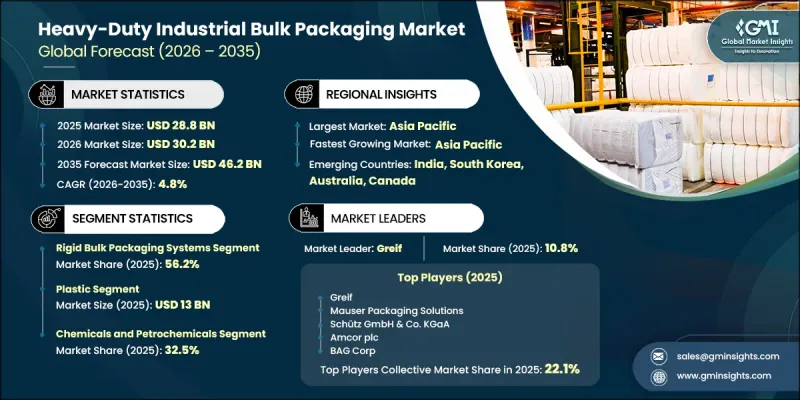
이러한 성장은 화학 및 석유화학제품의 운송 확대에 힘입은 것으로, 대량의 위험한 물질을 취급하는 데 있어 안전한 포장이 필수적입니다. 벌크 형태의 식품 원료에 대한 세계 수요 증가와 의약품 벌크 물류의 이용 확대도 시장 수요를 더욱 강화시키고 있습니다. 각 업계에서는 업무 효율성 향상과 장기적인 비용 절감을 위해 재사용 및 반납이 가능한 포장 시스템에 대한 관심이 높아지고 있습니다. 동시에, 안전 규정 및 컴플라이언스 요건이 강화됨에 따라 내구성이 뛰어난 포장 솔루션의 채택이 증가하고 있습니다. 공급망 인프라의 지속적인 개선과 지속가능성 및 라이프사이클 효율성에 대한 관심이 높아지면서 중공업용 벌크 포장 시장 확대에 더욱 기여하고 있습니다.
| 시장 범위 | |
|---|---|
| 개시 연도 | 2025년 |
| 예측 기간 | 2026-2035년 |
| 개시 연도 시장 규모 | 288억 달러 |
| 예측 시장 규모 | 462억 달러 |
| CAGR | 4.8% |
또한, 이 시장은 산업용 자재의 세계 무역 확대의 수혜를 받고 있습니다. 이 분야에서는 포장 솔루션이 장거리 운송 및 반복적인 적재 및 하역 과정에서도 내구성을 보장해야 합니다. 제품 손상 감소와 물류 효율성 향상에 대한 관심이 높아짐에 따라 각 업계에서는 첨단 패키징 시스템 도입이 활발히 진행되고 있습니다. 공급망 현대화를 위한 투자 확대와 지속 가능한 포장 솔루션으로의 전환은 전체 산업 분야에서 장기적인 시장 성장을 더욱 촉진하고 있습니다.
2025년에는 경질 벌크 포장 시스템 부문이 56.2%의 점유율을 차지했습니다. 이 부문은 높은 강도, 내구성, 위험물 및 대량 운송에 적합한 특성으로 인해 계속해서 선두를 유지하고 있습니다. 안전, 컴플라이언스, 제품 보호가 매우 중요한 화학, 석유화학, 식품 관련 분야에서 널리 사용되고 있습니다. 여러 번의 취급 주기와 장거리 물류에 견딜 수 있는 능력으로 인해 산업 사용자들이 선호하는 선택이며, 전 세계 공급망에서 안정적인 수요를 확보하고 있습니다.
복합재 부문은 2026-2035년 연평균 복합 성장률(CAGR) 6.4%를 나타낼 것으로 예측됩니다. 이 부문의 성장은 강도, 경량화, 내구성의 균형을 갖춘 첨단 소재에 대한 수요 증가에 의해 주도되고 있습니다. 내식성 및 기계적 스트레스에 대한 내성이 향상되어 복합재 포장은 열악한 산업 응용 분야에 매우 적합합니다. 재료 혁신과 장기적인 성능 효율성에 대한 관심이 높아지면서 신뢰할 수 있는 벌크 포장 솔루션이 필요한 산업 전반에 걸쳐 채택이 더욱 확대되고 있습니다.
북미의 중공업 벌크 포장 시장은 2025년 27%의 점유율을 차지했습니다. 이 지역의 성장은 안전하고 규정을 준수하는 벌크 운송이 필수적인 화학, 석유화학, 식품 가공 산업의 강력한 수요에 힘입어 성장하고 있습니다. 산업용 용기와 드럼통을 포함한 재사용 가능한 포장 시스템의 보급은 시장 확대를 더욱 촉진하고 있습니다. 잘 정비된 물류 인프라와 활발한 국경 간 무역이 안정적인 수요에 기여하고 있습니다. 또한, 지속 가능한 포장 시스템과 재활용 인프라에 대한 투자 증가는 업무 효율성을 높이고 장기적인 시장 발전을 뒷받침하고 있습니다.
자주 묻는 질문
목차
제1장 조사 방법과 범위
제2장 주요 요약
제3장 업계 인사이트
제4장 경쟁 구도
제5장 시장 추산 및 예측 : 제품 유형별(2022-2035년)
제6장 시장 추산 및 예측 : 소재 유형별(2022-2035년)
제7장 시장 추산 및 예측 : 최종 이용 산업별(2022-2035년)
제8장 시장 추산 및 예측 : 지역별(2022-2035년)
제9장 기업 개요
AJY 26.06.11The Global Heavy-Duty Industrial Bulk Packaging Market was valued at USD 28.8 billion in 2025 and is estimated to grow at a CAGR of 4.8% to reach USD 46.2 billion by 2035.
Growth is supported by expanding chemical and petrochemical transportation, where secure packaging is essential for handling high-volume and hazardous materials. Increasing global demand for food ingredients in bulk form and the rising use of pharmaceutical bulk logistics are further strengthening market demand. Industries are increasingly focusing on reusable and returnable packaging systems to improve operational efficiency and reduce long-term costs. At the same time, stricter safety regulations and compliance requirements are driving adoption of high-durability packaging solutions. Continuous improvements in supply chain infrastructure and a growing emphasis on sustainability and lifecycle efficiency are further contributing to the expansion of the heavy-duty industrial bulk packaging market.
| Market Scope | |
|---|---|
| Start Year | 2025 |
| Forecast Year | 2026-2035 |
| Start Value | $28.8 Billion |
| Forecast Value | $46.2 Billion |
| CAGR | 4.8% |
The market is also benefiting from rising global trade in industrial materials, where packaging solutions must ensure durability across long-distance transportation and multiple handling cycles. Increased emphasis on reducing product damage and improving logistics efficiency is encouraging industries to adopt advanced bulk packaging systems. Growing investments in supply chain modernization and the shift toward sustainable packaging solutions are further reinforcing long-term market growth across industrial sectors.
The rigid bulk packaging systems segment accounted for 56.2% share in 2025. This segment continues to lead due to its high strength, durability, and suitability for transporting hazardous and high-volume materials. It is widely used across chemical, petrochemical, and food-related applications where safety, compliance, and product protection are critical. Its ability to withstand multiple handling cycles and long-distance logistics makes it a preferred choice for industrial users, ensuring consistent demand across global supply chains.
The composite segment is expected to register a CAGR of 6.4% during 2026-2035. Growth in this segment is driven by increasing demand for advanced materials that offer a balance of strength, reduced weight, and durability. Enhanced resistance to corrosion and mechanical stress makes composite packaging highly suitable for demanding industrial applications. Rising focus on material innovation and long-term performance efficiency is further supporting adoption across industries requiring reliable bulk packaging solutions.
North America Heavy-Duty Industrial Bulk Packaging Market held a 27% share in 2025. The region's growth is supported by strong demand from chemical, petrochemical, and food processing industries, where safe and compliant bulk transportation is essential. The widespread use of reusable packaging systems, including industrial containers and drums, is further strengthening market expansion. Well-developed logistics infrastructure and active cross-border trade are contributing to steady demand. Additionally, increasing investments in sustainable packaging systems and recycling infrastructure are enhancing operational efficiency and supporting long-term market development.
Key companies operating in the Global Heavy-Duty Industrial Bulk Packaging Market include Greif, Schutz GmbH & Co. KGaA, Mauser Packaging Solutions, Amcor plc, Myers Industries, Bulk Lift International, LC Packaging, Conitex Sonoco, BAG Corp, Emmbi Industries Ltd., Flexituff Ventures International Ltd., Global-Pak, Hawman Container, Rishi FIBC Solutions Pvt. Ltd., Taihua Group, and Yantai Haiwan. Companies in the Heavy-Duty Industrial Bulk Packaging Market are focusing on strengthening their competitive position through innovation in materials and product design. They are investing in durable, reusable, and high-performance packaging solutions that improve operational efficiency and reduce environmental impact. Expanding global manufacturing and distribution networks is helping companies meet rising demand across multiple industries. Strategic partnerships and acquisitions are being used to enhance product portfolios and expand geographic reach. Businesses are also focusing on sustainability initiatives, including recyclable materials and returnable packaging systems.
Table of Contents
Chapter 1 Methodology and Scope
- 1.1 Market scope and definition
- 1.2 Research design
- 1.2.1 Research approach
- 1.2.2 Data collection methods
- 1.3 Data mining sources
- 1.3.1 Global
- 1.3.2 Regional/Country
- 1.4 Base estimates and calculations
- 1.4.1 Base year calculation
- 1.4.2 Key trends for market estimation
- 1.5 Primary research and validation
- 1.5.1 Primary sources
- 1.6 Forecast model
- 1.7 Research assumptions and limitations
Chapter 2 Executive Summary
- 2.1 Industry 360° synopsis, 2022 - 2035
- 2.2 Key market trends
- 2.2.1 Product type trends
- 2.2.2 Material type trends
- 2.2.3 End-use industry trends
- 2.2.4 Regional trends
- 2.3 TAM Analysis, 2026-2035
- 2.4 CXO perspectives: Strategic imperatives
Chapter 3 Industry Insights
- 3.1 Industry ecosystem analysis
- 3.1.1 Supplier Landscape
- 3.1.2 Profit Margin
- 3.1.3 Cost structure
- 3.1.4 Value addition at each stage
- 3.1.5 Factor affecting the value chain
- 3.1.6 Disruptions
- 3.2 Industry impact forces
- 3.2.1 Growth drivers
- 3.2.1.1 Rapid chemical and petrochemical bulk transport demand
- 3.2.1.2 Growth in cross-border industrial trade volumes
- 3.2.1.3 Increasing adoption of reusable industrial packaging systems
- 3.2.1.4 Expansion of global food ingredient bulk logistics
- 3.2.1.5 Rising demand from pharmaceutical bulk handling applications
- 3.2.2 Industry pitfalls and challenges
- 3.2.2.1 High initial investment in durable bulk packaging solutions
- 3.2.2.2 Volatility in polymer and raw material pricing
- 3.2.3 Market opportunities
- 3.2.3.1 Circular economy driving reusable packaging adoption
- 3.2.3.2 Smart packaging integration with IoT tracking technologies
- 3.2.1 Growth drivers
- 3.3 Growth potential analysis
- 3.4 Regulatory landscape
- 3.4.1 North America
- 3.4.2 Europe
- 3.4.3 Asia Pacific
- 3.4.4 Latin America
- 3.4.5 Middle East & Africa
- 3.5 Porter's analysis
- 3.6 PESTEL analysis
- 3.7 Technology and Innovation landscape
- 3.7.1 Current technological trends
- 3.7.2 Emerging technologies
- 3.8 Price trends
- 3.8.1 By region
- 3.8.2 By product
- 3.9 Pricing Strategies
- 3.10 Emerging Business Models
- 3.11 Compliance Requirements
- 3.12 Patent and IP analysis
Chapter 4 Competitive Landscape, 2025
- 4.1 Introduction
- 4.2 Company market share analysis
- 4.2.1 By region
- 4.2.1.1 North America
- 4.2.1.2 Europe
- 4.2.1.3 Asia Pacific
- 4.2.1.4 Latin America
- 4.2.1.5 Middle East & Africa
- 4.2.2 Market concentration analysis
- 4.2.1 By region
- 4.3 Competitive benchmarking of key players
- 4.3.1 Financial performance comparison
- 4.3.1.1 Revenue
- 4.3.1.2 Profit margin
- 4.3.1.3 R&D
- 4.3.2 Product portfolio comparison
- 4.3.2.1 Product range breadth
- 4.3.2.2 Technology
- 4.3.2.3 Innovation
- 4.3.3 Geographic presence comparison
- 4.3.3.1 Global footprint analysis
- 4.3.3.2 Service network coverage
- 4.3.3.3 Market penetration by region
- 4.3.4 Competitive positioning matrix
- 4.3.4.1 Leaders
- 4.3.4.2 Challengers
- 4.3.4.3 Followers
- 4.3.4.4 Niche players
- 4.3.5 Strategic outlook matrix
- 4.3.1 Financial performance comparison
- 4.4 Key developments
- 4.4.1 Mergers and acquisitions
- 4.4.2 Partnerships and collaborations
- 4.4.3 Technological advancements
- 4.4.4 Expansion and investment strategies
- 4.4.5 Digital transformation initiatives
- 4.5 Emerging/ startup competitors landscape
Chapter 5 Market Estimates and Forecast, By Product Type, 2022 - 2035 (USD Million)
- 5.1 Key trends
- 5.2 Rigid bulk packaging systems
- 5.2.1 Intermediate bulk containers (IBCs) - rigid
- 5.2.2 Industrial drums
- 5.2.3 Rigid bulk boxes / pallet containers
- 5.2.4 Collapsible rigid containers
- 5.3 Flexible bulk packaging systems
- 5.3.1 Flexible intermediate bulk containers (FIBCs / bulk bags)
- 5.3.2 Industrial flexible liners
- 5.4 Semi-rigid / hybrid bulk packaging
- 5.4.1 Composite IBCs
- 5.4.2 Reinforced flexible containers
Chapter 6 Market Estimates and Forecast, By Material Type, 2022 - 2035 (USD Million)
- 6.1 Key trends
- 6.2 Plastic
- 6.2.1 HDPE (high-density polyethylene)
- 6.2.2 LDPE (low-density polyethylene)
- 6.2.3 PP (polypropylene)
- 6.2.4 Others
- 6.3 Metal
- 6.3.1 Steel
- 6.3.2 Aluminum
- 6.4 Composite
- 6.4.1 Metal-lined
- 6.4.2 Plastic-lined
- 6.5 Fiber/paper
- 6.5.1 Corrugated fiberboard
- 6.5.2 Paperboard
Chapter 7 Market Estimates and Forecast, By End-Use Industry, 2022 - 2035 (USD Million)
- 7.1 Key trends
- 7.2 Chemicals & petrochemicals
- 7.3 Food & beverages
- 7.4 Pharmaceuticals
- 7.5 Agriculture
- 7.6 Construction materials
- 7.7 Others
Chapter 8 Market Estimates and Forecast, By Region, 2022 - 2035 (USD Million)
- 8.1 Key trends
- 8.2 North America
- 8.2.1 U.S.
- 8.2.2 Canada
- 8.3 Europe
- 8.3.1 Germany
- 8.3.2 UK
- 8.3.3 France
- 8.3.4 Spain
- 8.3.5 Italy
- 8.3.6 Netherlands
- 8.4 Asia Pacific
- 8.4.1 China
- 8.4.2 India
- 8.4.3 Japan
- 8.4.4 Australia
- 8.4.5 South Korea
- 8.5 Latin America
- 8.5.1 Brazil
- 8.5.2 Mexico
- 8.5.3 Argentina
- 8.6 Middle East and Africa
- 8.6.1 South Africa
- 8.6.2 Saudi Arabia
- 8.6.3 UAE
Chapter 9 Company Profiles
- 9.1 Global Key Players
- 9.1.1 Greif
- 9.1.2 Mauser Packaging Solutions
- 9.1.3 Schutz GmbH & Co. KGaA
- 9.1.4 Amcor plc
- 9.2 Regional key players
- 9.2.1 North America
- 9.2.1.1 BAG Corp
- 9.2.1.2 Conitex Sonoco
- 9.2.1.3 Myers Industries
- 9.2.2 Asia Pacific
- 9.2.2.1 Emmbi Industries Ltd.
- 9.2.2.2 Flexituff Ventures International Ltd.
- 9.2.2.3 Rishi FIBC Solutions Pvt. Ltd.
- 9.2.2.4 Taihua Group
- 9.2.2.5 Yantai Haiwan
- 9.2.3 Europe
- 9.2.3.1 LC Packaging
- 9.2.1 North America
- 9.3 Niche Players/Disruptors
- 9.3.1 Global-Pak
- 9.3.2 Hawman Container
- 9.3.3 Bulk Lift International


