

|
시장보고서
상품코드
2038361
토우 프리프레그 시장 비즈니스 기회, 성장요인, 업계 동향 분석 및 예측(2026-2035년)Tow Prepreg Market Opportunity, Growth Drivers, Industry Trend Analysis, and Forecast 2026 - 2035 |
||||||

세계의 토우 프리프레그 시장은 2025년에 4억 1,670만 달러로 평가되었고, 2035년까지 연평균 복합 성장률(CAGR) 12.3%로 성장하여 13억 달러에 이를 것으로 추정되고 있습니다.
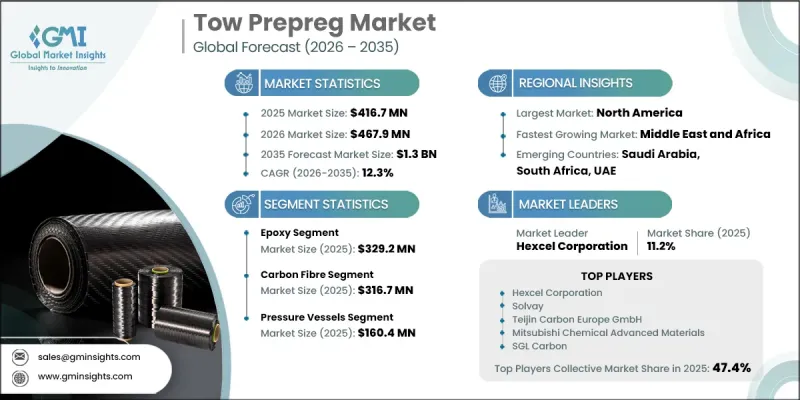
이 산업은 연속 섬유 토우에 수지 함량을 조절하여 함침시켜 제조되는 엔지니어링 소재를 중심으로 전개되고 있으며, 제조업체는 복합재료 제조에 있어 높은 정밀도를 실현할 수 있습니다. 이 소재들은 제조 공정에서 일관된 섬유 배향, 균일한 수지 분포 및 신뢰할 수 있는 기계적 특성을 보장하도록 설계되었습니다. 토우 프리프레그는 탄소섬유, 유리섬유, 아라미드 섬유를 열경화성 또는 열가소성 수지 시스템과 결합하여 광범위하게 개발되어 첨단 엔지니어링 응용 분야에서 폭넓은 다용도성을 제공합니다. 수지 화학 및 자동화 제조와의 호환성에 대한 지속적인 혁신으로 시장은 진화하고 있으며, 최신 생산 시스템과의 원활한 통합을 가능하게 하고 있습니다. 이러한 발전은 효율성을 높이고, 재료 낭비를 줄이며, 반복 가능한 품질을 보장합니다. 각 산업에서 경량 구조, 재료 사용 최적화 및 확장 가능한 생산 공정이 우선순위에 따라 수요가 계속 증가하고 있습니다. 토우 프리프레그는 정확한 배치를 가능하게 하고 수작업 개입을 최소화하여 복잡한 복합재료의 제조를 지원합니다. 고성능 소재에 대한 관심 증가와 더불어 공정 일관성 및 운영 생산성 향상에 대한 요구가 전체 토우 프리프레그 시장의 지속적인 성장을 견인하고 있습니다.
| 시장 범위 | |
|---|---|
| 시작 연도 | 2025년 |
| 예측 기간 | 2026-2035년 |
| 시작 연도 시장 규모 | 4억 1,670만 달러 |
| 예측 시장 규모 | 13억 달러 |
| CAGR | 12.3% |
에폭시 부문은 우수한 성능 특성과 복합재료 제조에 대한 적응성으로 인해 2025년 3억 2,920만 달러 시장 점유율을 차지했습니다. 에폭시계 토우 프리프레그는 구조적 강도, 제어된 경화 거동 및 자동화 시스템과의 호환성을 제공할 수 있기 때문에 널리 선호되고 있습니다. 에폭시 배합의 지속적인 발전으로 저장 안정성, 접착 성능 및 가공 유연성이 향상되어 광범위한 산업 응용 분야에 적합합니다. 이러한 개선을 통해 제조업체는 고품질 생산 표준을 유지하면서 복합재 생산의 일관성과 효율성을 높일 수 있습니다.
압력 용기 부문은 2025년 1억 6,040만 달러 시장 규모를 기록했고, 이는 토우 프리프레그 소재의 채택이 두드러진 것을 반영합니다. 이 소재들은 정밀한 필라멘트 와인딩 공정을 가능하게 하고 구조적 무결성을 제어할 수 있다는 점에서 활용되고 있습니다. 이 부문은 일관된 섬유 배향, 최적화된 수지 분포 및 신뢰할 수 있는 가공 기술의 혜택을 누리고 있으며, 이는 가혹한 조건에서 내구성과 성능 향상에 기여하고 있습니다. 균일한 기계적 특성을 제공하면서 효율적인 생산 워크플로우를 지원하는 능력은 이 분야에서 토우 프리프레그의 사용을 계속 주도하고 있습니다.
북미 토우 프리프레그 시장은 2025년 1억 3,960만 달러에서 2035년까지 4억 1,680만 달러로 성장할 것으로 예측됩니다. 이 지역에서는 고도의 제조 능력과 고성능 복합소재에 대한 의존도가 높아지면서 꾸준한 보급이 이루어지고 있습니다. 잘 구축된 산업 인프라의 존재와 자동화에 대한 집중력이 안정적인 수요를 뒷받침하고 있습니다. 제조업체들은 장기적인 사업 운영을 지원하기 위해 생산 효율성 유지, 인증 기준 준수, 그리고 신뢰할 수 있는 공급망 확보에 주력하고 있습니다. 고정밀 재료와 확장 가능한 생산 공정에 대한 요구가 높아지면서 이 지역 시장 전망은 더욱 견고해지고 있습니다.
자주 묻는 질문
목차
제1장 조사 방법과 범위
제2장 주요 요약
제3장 업계 인사이트
제4장 경쟁 구도
제5장 시장 추산 및 예측 : 수지 유형별, 2022-2035년
제6장 시장 추산 및 예측 : 섬유 유형별, 2022-2035년
제7장 시장 추산 및 예측 : 용도별, 2022-2035년
제8장 시장 추산 및 예측 : 지역별, 2022-2035년
제9장 기업 개요
JHS 26.05.29The Global Tow Prepreg Market was valued at USD 416.7 million in 2025 and is estimated to grow at a CAGR of 12.3% to reach USD 1.3 billion by 2035.
The industry revolves around engineered materials produced by impregnating continuous fiber tows with controlled resin content, enabling manufacturers to achieve precision in composite fabrication. These materials are designed to support consistent fiber orientation, uniform resin distribution, and reliable mechanical properties during production. Tow prepregs are widely developed using carbon, glass, and aramid fibers combined with thermoset or thermoplastic resin systems, offering versatility across advanced engineering applications. The market is evolving with continuous innovation in resin chemistry and automated manufacturing compatibility, allowing seamless integration with modern production systems. These advancements are improving efficiency, reducing material waste, and ensuring repeatable quality outcomes. Demand continues to rise as industries prioritize lightweight structures, optimized material usage, and scalable production processes. Tow prepregs support complex composite manufacturing by enabling accurate placement and minimizing manual intervention. The increasing emphasis on high-performance materials, combined with the need for process consistency and improved operational productivity, is driving sustained expansion across the tow prepreg market.
| Market Scope | |
|---|---|
| Start Year | 2025 |
| Forecast Year | 2026-2035 |
| Start Value | $416.7 Million |
| Forecast Value | $1.3 Billion |
| CAGR | 12.3% |
The epoxy segment accounted for USD 329.2 million in 2025, supported by its strong performance characteristics and adaptability in composite manufacturing. Epoxy-based tow prepregs are widely preferred due to their ability to deliver structural strength, controlled curing behavior, and compatibility with automated systems. Continuous advancements in epoxy formulations are enhancing storage stability, bonding performance, and processing flexibility, making them suitable for a wide range of industrial applications. These improvements are helping manufacturers achieve better consistency and efficiency in composite production while maintaining high-quality output standards.
The pressure vessels segment generated USD 160.4 million in 2025, reflecting its strong adoption of tow prepreg materials. These materials are utilized for their ability to enable precise filament winding processes and controlled structural integrity. The segment benefits from consistent fiber alignment, optimized resin distribution, and reliable processing techniques, which contribute to improved durability and performance under demanding conditions. The ability to deliver uniform mechanical properties while supporting efficient production workflows continues to drive the use of tow prepregs in this segment.
North America Tow Prepreg Market is projected to grow from USD 139.6 million in 2025 to USD 416.8 million by 2035. The region demonstrates steady adoption driven by advanced manufacturing capabilities and increasing reliance on high-performance composite materials. The presence of well-established industrial infrastructure and emphasis on automation are supporting consistent demand. Manufacturers focus on maintaining production efficiency, meeting certification standards, and ensuring reliable supply chains to support long-term operations. The need for precision-driven materials and scalable production processes continues to strengthen the regional market outlook.
Major players operating in the Global Tow Prepreg Industry include Axiom Materials, Solvay, ENEOS Techno Material Corporation, Hexcel Corporation, Mitsubishi Chemical Advanced Materials, Gurit Services AG, Zurich, Renegade Materials Corporation, SGL Carbon, Teijin Carbon Europe GmbH, and Park Aerospace Corp. Companies operating in the Global Tow Prepreg Market are implementing strategic initiatives to enhance their competitive positioning and expand market reach. They are investing in research and development to create advanced resin systems and improve material performance, enabling compatibility with automated manufacturing technologies. Expanding production capacity and optimizing supply chains are key priorities to meet rising global demand. Organizations are also forming partnerships and collaborations to strengthen technological capabilities and access new markets. Product diversification and customization allow companies to address specific application requirements across industries. In addition, firms are focusing on quality certifications and process standardization to build customer trust. Continuous innovation, operational efficiency, and geographic expansion remain central to strengthening market presence and long-term growth.
Table of Contents
Chapter 1 Methodology & Scope
- 1.1 Market scope and definition
- 1.2 Research design
- 1.2.1 Research approach
- 1.2.2 Data collection methods
- 1.3 Data mining sources
- 1.3.1 Global
- 1.3.2 Regional/Country
- 1.4 Base estimates and calculations
- 1.4.1 Base year calculation
- 1.4.2 Key trends for market estimation
- 1.5 Primary research and validation
- 1.5.1 Primary sources
- 1.6 Forecast model
- 1.7 Research assumptions and limitations
Chapter 2 Executive Summary
- 2.1 Industry 360° synopsis
- 2.2 Key market trends
- 2.2.1 Resin Type
- 2.2.2 Fiber Type
- 2.2.3 Application
- 2.2.4 Regional
- 2.3 TAM Analysis, 2026-2035
- 2.4 CXO perspectives: Strategic imperatives
- 2.5 Future outlook and strategic recommendations
Chapter 3 Industry Insights
- 3.1 Industry ecosystem analysis
- 3.1.1 Supplier landscape
- 3.1.2 Profit margin
- 3.1.3 Value addition at each stage
- 3.1.4 Factor affecting the value chain
- 3.1.5 Disruptions
- 3.2 Industry impact forces
- 3.2.1 Growth drivers
- 3.2.1.1 Increasing adoption of automated manufacturing
- 3.2.1.2 Need for consistent composite material quality
- 3.2.1.3 Lightweight material demand across industries
- 3.2.2 Pitfalls/challenge
- 3.2.2.1 High material handling and storage costs
- 3.2.2.2 Limited awareness in traditional manufacturing
- 3.2.3 Opportunities
- 3.2.3.1 Expansion of automated fiber placement usage
- 3.2.3.2 Development of recyclable prepreg materials
- 3.2.1 Growth drivers
- 3.3 Growth potential analysis
- 3.4 Regulatory landscape
- 3.4.1 North America
- 3.4.2 Europe
- 3.4.3 Asia Pacific
- 3.4.4 Latin America
- 3.4.5 Middle East & Africa
- 3.5 Porter's analysis
- 3.6 PESTEL analysis
- 3.7 Technology and innovation landscape
- 3.7.1 Current technological trends
- 3.7.2 Emerging technologies
- 3.8 Price trends
- 3.8.1 By region
- 3.8.2 By resin type
- 3.9 Future market trends
- 3.10 Patent landscape
- 3.11 Trade statistics (HS code)
- 3.11.1 Major importing countries
- 3.11.2 Major exporting countries
- 3.12 Sustainability and environmental aspects
- 3.12.1 Sustainable practices
- 3.12.2 Waste reduction strategies
- 3.12.3 Energy efficiency in production
- 3.12.4 Eco-friendly initiatives
- 3.13 Carbon footprint consideration
Chapter 4 Competitive Landscape, 2025
- 4.1 Introduction
- 4.2 Company market share analysis
- 4.2.1 By region
- 4.2.1.1 North America
- 4.2.1.2 Europe
- 4.2.1.3 Asia Pacific
- 4.2.1.4 LATAM
- 4.2.1.5 MEA
- 4.2.1 By region
- 4.3 Company matrix analysis
- 4.4 Competitive analysis of major market players
- 4.5 Competitive positioning matrix
- 4.6 Key developments
- 4.6.1 Mergers & acquisitions
- 4.6.2 Partnerships & collaborations
- 4.6.3 New product launches
- 4.6.4 Expansion plans
Chapter 5 Market Estimates and Forecast, By Resin Type, 2022-2035 (USD Million) (Kilo Tons)
- 5.1 Key trends
- 5.2 Epoxy
- 5.3 Phenolic
Chapter 6 Market Estimates and Forecast, By Fiber Type, 2022-2035 (USD Million) (Kilo Tons)
- 6.1 Key trends
- 6.2 Carbon fibre
- 6.3 Glass fibre
Chapter 7 Market Estimates and Forecast, By Application, 2022-2035 (USD Million) (Kilo Tons)
- 7.1 Key trends
- 7.2 Pressure vessels
- 7.3 Oxygen cylinders
- 7.4 Scuba tanks
- 7.5 Others
Chapter 8 Market Estimates and Forecast, By Region, 2022-2035 (USD Million) (Kilo Tons)
- 8.1 Key trends
- 8.2 North America
- 8.2.1 U.S.
- 8.2.2 Canada
- 8.3 Europe
- 8.3.1 Germany
- 8.3.2 UK
- 8.3.3 France
- 8.3.4 Spain
- 8.3.5 Italy
- 8.3.6 Rest of Europe
- 8.4 Asia Pacific
- 8.4.1 China
- 8.4.2 India
- 8.4.3 Japan
- 8.4.4 Australia
- 8.4.5 South Korea
- 8.4.6 Rest of Asia Pacific
- 8.5 Latin America
- 8.5.1 Brazil
- 8.5.2 Mexico
- 8.5.3 Argentina
- 8.5.4 Rest of Latin America
- 8.6 Middle East and Africa
- 8.6.1 Saudi Arabia
- 8.6.2 South Africa
- 8.6.3 UAE
- 8.6.4 Rest of Middle East and Africa
Chapter 9 Company Profiles
- 9.1 Axiom Materials
- 9.2 Solvay
- 9.3 ENEOS Techno Material Corporation
- 9.4 Hexcel Corporation
- 9.5 Mitsubishi Chemical Advanced Materials
- 9.6 Gurit Services AG, Zurich
- 9.7 Renegade Materials Corporation
- 9.8 SGL Carbon
- 9.9 Teijin Carbon Europe GmbH
- 9.10 Park Aerospace Corp


