

|
시장보고서
상품코드
2157055
토우 프리프레그 : 시장 점유율 분석, 업계 동향과 통계, 성장 예측(2026-2031년)Tow Prepreg - Market Share Analysis, Industry Trends & Statistics, Growth Forecasts (2026 - 2031) |
||||||
 Mordor Intelligence
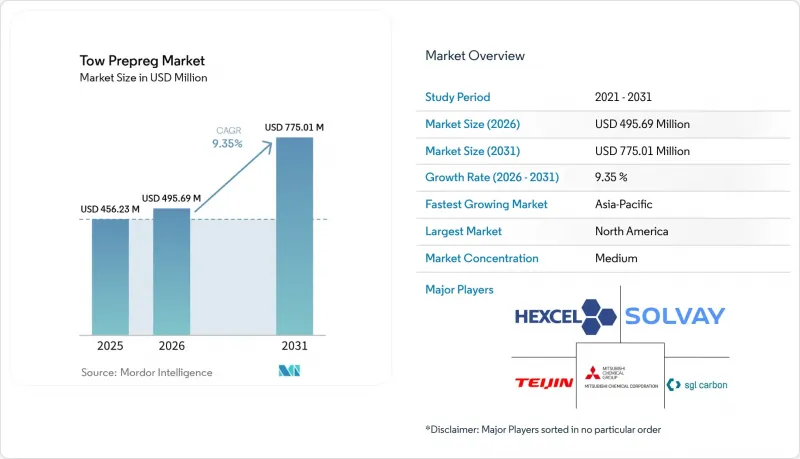
에 따르면 토우 프리프레그 시장 규모는 2025년에 4억 5,623만 달러로 평가되어 예측 기간(2026-2031년)에 CAGR 9.35%로 확대하며, 2026년 4억 9,569만 달러에서 2031년에는 7억 7,501만 달러에 달할 것으로 추정되고 있습니다.
전 세계 토우 프리프레그 시장의 동향 및 인사이트
경량이며 고강도인 복합재 구조물에 대한 수요
구조물 중량 감축에 대한 요구로 인해 모빌리티 및 산업용 토우 프리프레그 시장의 적용 사례는 지속적으로 확대되고 있습니다. 토우 프리프레그는 용기, 샤프트, 스퍼 등 하중 지지 성능에서 연속적인 섬유가 중요한 원통형 및 측지선 형상의 부품에 적합합니다. 이는 평평한 표면이나 완만하게 곡첨단 표면에 일반적으로 사용되는 시트 프리프레그와는 다릅니다. 2025년 Type IV 수소 용기에 관한 연구에 따르면 최적화된 드라이 토우 프리프레그를 이용한 권취는 습식 권취에 비해 질량을 15.4% 줄이고, 중량 대비 수소 저장 효율을 17% 향상시켰다고 보고되었습니다. 동 조사에서는 권취 매개변수를 최적화함으로써 무게, 강도 및 실용적인 수소 저장 성능의 균형을 개선할 수 있다는 점도 보고되었습니다. 그 결과 얻어지는 균일한 보강 구조를 통해 습식 수지 탱크에 의존하지 않고도 용기의 성능을 향상시킬 수 있습니다. 보잉 787 및 에어버스 A350 프로그램에서는 주요 구조부에 50%를 초과하는 섬유 함유율이 채택되어 있으며, 이를 통해 오버랩 피팅 및 구동축과 같은 복합재료 부품에 대한 수요를 지원하고 있습니다.
수소 및 압축 가스 저장 용기의 확대
압력 용기는 토우 프리프레그 시장에서 가장 큰 응용 분야이자 가장 빠르게 성장하고 있는 분야입니다. 유형 IV 폴리머 라이닝 실린더와 새롭게 등장한 유형 V 라이너리스 용기는 연료전지차, 대형 트럭 및 고정식 수소 인프라에서 사용되고 있습니다. 이러한 용기 형태에서는 제조시 재현성 있는 섬유 배열, 제어된 수지 분포, 그리고 신뢰성 높은 권취 품질이 요구됩니다. 그 사용 확대에 따라 재료의 일관성은 압력 성능과 더불어 공급업체 선정에 있으며, 중요한 기준이 되고 있습니다. 카이저슬라우테른의 IVW에서 실시한 조사에서는 수소 압력 탱크의 재료 효율이 뛰어나고 사이클 타임이 최적화된 산업 생산에 대해 검토가 이루어졌습니다. 따라서 조달 요건은 압력 용기의 재료, 제조 방법 및 완제품에 관한 일관된 인증 데이터에 중점을 두고 있습니다.
높은 탄소섬유 비용과 가공 비용
탄소섬유는 토우 및 프리프레그 생산에서 가장 큰 비용 요소를 차지하고 있으며, 산업용 압력 용기나 중저가 스포츠 용품 등 비용에 민감한 용도에서의 채택을 제한하고 있습니다. 2025년 조사에 따르면 자동 섬유 배치법을 이용한 압력 용기의 비용은 필라멘트 와인딩법의 최소 1.77배인 것으로 밝혀졌습니다. 또한 드라이 파이버에 비해 수지 함량이 높기 때문에 가공 시작 전의 납품 비용도 상승합니다. 이로 인해 특히 제품의 성능이 높은 공정 비용을 정당화할 수 없는 경우, 생산량이 많은 웨트 와인딩과 비교했을 때 대량 생산시 단위당 경제성이 저하될 가능성이 있습니다. 자체 섬유 공급 체계를 갖추지 않은 독립형 컨버터는 자재 공급이 부족한 기간에 이익률 하락 위험에 더 쉽게 노출됩니다. 전용 설비 요건과 숙련된 인력의 필요성은 아시아태평양(APAC) 및 중동 및 아프리카의 개발도상국에서 이러한 과제를 더욱 심각하게 만들고 있습니다.
부문 분석
2025년 시점에 수지 유형별 토우 프리프레그 시장 점유율의 60.76%를 에폭시 수지가 차지했습니다. 이러한 위상은 검증된 가공 특성이 중요한 항공우주, 압력 용기, 풍력발전 분야에서 수십년에 걸친 인증 실적을 반영한 것입니다. 에폭시 수지는 120°C-180°C에서 오토클레이브 경화 및 오토클레이브 외부의 속경화 시스템에 대응합니다. 이러한 온도 범위 덕분에 제조업체는 부품의 형상, 생산량 요구 사항, 이용 가능한 설비를 바탕으로 경화 방법을 선택할 수 있으며, 다양한 와인딩 및 배치 기법에서의 사용도 지원합니다. 헥셀(Hexel)사가 2026년 3월에 출시한 ‘Towpreg’ 시리즈는 필라멘트 와인딩용으로 속경화·고온 열경화성 수지 시스템을 채택하고 있습니다.
토우프레그 시장에서 에폭시 수지의 점유율은 2026-2031년까지 연평균 성장률(CAGR) 9.85%로 확대될 것으로 예측됩니다. 시장 점유율과 성장률 양면에서 선두를 달리고 있다는 사실은, 현재의 가격 대비 성능 수준에서는 대체 수지 화학 물질이 의미 있는 입지를 다질 것으로 기대하기 어렵다는 것을 시사합니다. 이에 따라 배합, 경화 거동 및 인증에 관한 경험은 계속해서 에폭시계 시스템을 중심으로 축적될 것입니다. 페놀 수지는 연방항공규정(FAR) 25의 연기 및 독성 관련 요건을 충족해야 하는 항공기 내장 부품에서 여전히 중요한 역할을 하고 있습니다. 그러나 자동 와인딩과의 호환성은 에폭시 수지에 비해 떨어지며, 더 높은 가공 온도가 필요합니다. 그 밖의 수지는 특유의 열적 특성이 요구되는 고온 용도나 특수 용도에 사용되고 있습니다. 이러한 제한적인 용도는 예측 기간 중 수지의 구성 비율에 실질적인 변화를 가져오지는 않을 것으로 예상됩니다.
2025년 시점에 섬유 유형별 토우 프리프레그 시장 점유율의 76.03%를 탄소섬유가 차지했습니다. 항공우주 구조물이나 고압 수소 용기는 하중이 극히 중요한 설계에서 탄소섬유의 강도와 강성에 의존하고 있습니다. 이러한 성능 요건으로 인해 가혹한 압력 및 하중 조건에 대응하도록 설계된 구조물에서는 유리섬유나 아라미드 섬유로의 대체가 제한됩니다. 따라서 탄소섬유의 사용은 경량화와 기계적 성능을 동시에 달성해야 하는 용도와 밀접하게 관련되어 있습니다. 도레이 카본 파이버스 유럽은 2026년에 새로운 생산 시설을 가동하여, 에어버스 A350 및 A320neo의 공급망을 위해 유럽의 탄소섬유 연간 생산 능력을 6,000톤으로 확대했습니다.
유리섬유는 가장 빠르게 성장하는 섬유 유형로, 2026-2031년까지 연평균 성장률(CAGR) 9.92%가 예상됩니다. 해상 풍력발전용 블레이드 프로젝트가 이러한 성장을 지원하고 있는데, 이는 긴 블레이드에 경쟁력 있는 비용으로 내피로성이 뛰어난 스퍼 캡 소재가 요구되기 때문입니다. 유리섬유는 전체 길이에 걸쳐 탄소섬유가 필요하지 않은 구조물에 대해 비용 효율적인 대안을 제공합니다. 아라미드 섬유 및 기타 섬유는 스포츠 용품의 충격 보호, 방탄성 및 하이브리드 구조 적용 분야에 계속해서 중점을 두고 있습니다. 서로 다른 구역마다 다른 하중 요구 사항이 필요한 풍력발전용 블레이드에서는 탄소섬유와 유리섬유를 결합한 하이브리드 설계의 활용이 확대되고 있습니다. 유리 프리프레그에 대한 수요는 블레이드 전체가 아닌 특정 구조 구역에 집중되어 있으며, 그 수요는 블레이드 형상 선택과 설치 대수 모두에 따라 달라집니다.
지역별 분석
2025년, 북미는 토우 프리프레그 시장 점유율의 33.22%를 차지하며 최대 지역 부문이 되었습니다. 수요는 보잉사의 복합재 항공기 프로그램, 방위 장비 현대화, 회전익기, 무인 시스템 및 특수 방위 플랫폼에 의해 지원되고 있습니다. FAA 인증 체계와 AS9100 공급업체 규격은 확립된 국내 생산 능력과 항공우주 분야에서의 실적을 보유한 공급업체를 우대하고 있습니다. 캐나다는 압축 가스 용기 제조를 통해 멕시코는 자동차용 복합재를 통해 시장에 기여하고 있습니다.
아시아태평양은 2026-2031년까지 연평균 성장률(CAGR) 10.02%로 성장할 것으로 예측되며, 이는 토우 프리프레그 시장에서 가장 높은 지역별 성장률입니다. 중국, 일본, 한국, 인도의 수요는 수소 모빌리티, 항공우주 제조 및 국방 투자에 의해 지원되고 있습니다. 2025년 7월, 일본의 우주 전략 기금은 로켓용 CFRP 수소 연료 탱크 개발 기업으로 바닥하치를 선정했습니다. 이 프로그램은 2029년까지의 실증 시험과 2030년대 초반의 상용화를 목표로 하고 있으며, 수소 저장 소재가 우주 용도로 어떻게 확대될 수 있는지를 보여주고 있습니다. 한국에서의 유형 IV 탱크 인증 활동과 중국에서의 PAN계 탄소섬유 생산 능력 확대도 해당 지역의 조달을 지원하고 있습니다. 인도는 eVTOL용 복합재료 공급망 참여를 확대하고 있는 반면, 아세안(ASEAN) 국가들은 여전히 조립 작업에 중점을 두고 있습니다.
유럽은 두 번째로 큰 소비 지역이며, 독일, 프랑스, 북유럽 국가들이 주도하고 있습니다. 이 지역에서는 에어버스의 공급망과 해상 풍력발전용 블레이드 제조가 수요의 핵심을 이루고 있습니다. 독일의 IVW 카이저슬라우테른(IVW Kaiserslautern)은 수소 압력 탱크용으로 재료 효율이 높고 사이클 타임이 최적화된 생산 공법을 개발하고 있습니다. 이러한 노력은 공정 개발 및 첨단 등급 소재의 조기 도입에 있으며, 유럽의 위상을 강화할 것입니다. 남미는 여전히 토우 프리프레그 시장으로서 신흥 시장입니다. 대조적으로, 중동 및 아프리카에서는 규모가 제한적이지만, 수소 인프라 프로젝트를 통해 향후 두 지역 모두에서 압력 용기 수요가 발생할 가능성이 있습니다.
기타 혜택:
- 엑셀 형식의 시장 예측(ME) 시트
- 3개월간의 애널리스트 지원
자주 묻는 질문
목차
제1장 서론
- 조사 전제조건과 시장 정의
- 조사 범위
제2장 조사 방법
제3장 개요
제4장 시장 구도
- 시장 개요
- 시장 성장 촉진요인
- 시장 성장 억제요인
- 밸류체인 분석
- Porter's Five Forces 분석
제5장 시장 규모와 성장 예측
- 수지 유형별
- 섬유 유형별
- 용도별
- 최종사용자 산업별
- 지역별
- 아시아태평양
- 중국
- 인도
- 일본
- 한국
- ASEAN 국가
- 기타 아시아태평양 국가
- 북미
- 미국
- 캐나다
- 멕시코
- 유럽
- 독일
- 영국
- 프랑스
- 이탈리아
- 북유럽 국가
- 기타 유럽 국가
- 남미
- 브라질
- 아르헨티나
- 기타 남미 국가
- 중동 및 아프리카
- 사우디아라비아
- 남아프리카공화국
- 기타 중동 및 아프리카 국가
- 아시아태평양
제6장 경쟁 구도
- 시장 집중도
- 전략적 동향
- 시장 점유율·순위 분석
- 기업 개요
- 3M
- Axiom Materials
- ENEOS Group
- Gurit Services AG
- Hexcel Corporation
- Huntsman International LLC
- Kordsa Teknik Tekstil A.S.
- Mitsubishi Chemical Corporation
- PORCHER INDUSTRIES
- Red Composites
- SGL Carbon
- Solvay
- TCR Composites, Inc.
- TEIJIN LIMITED
- Toray Industries, Inc.
- Vitech Composites
제7장 시장 기회와 향후 전망
KSA 26.10.30According to Mordor Intelligence, the tow prepreg market size was valued at USD 456.23 million in 2025 and is estimated to grow from USD 495.69 million in 2026 to USD 775.01 million by 2031, at a CAGR of 9.35% during the forecast period (2026-2031).
Global Tow Prepreg Market Trends and Insights
Demand for Lightweight and High-Strength Composite Structures
The need to reduce structural weight continues to expand the use cases for the tow prepreg market across mobility and industrial applications. Tow prepreg is suited to cylindrical and geodesic parts, including vessels, shafts, and spars, where uninterrupted fibers are important for load-bearing performance. It is distinct from sheet prepreg, which is more commonly used for flat or lightly curved surfaces. A 2025 study of Type IV hydrogen vessels reported a 15.4% mass reduction and 17% higher gravimetric hydrogen storage efficiency for optimized dry tow prepreg winding compared to wet winding. The same research reported that optimized winding parameters can improve the balance among weight, strength, and usable hydrogen storage performance. The resulting uniform reinforcement can improve vessel performance without reliance on a wet resin bath. The Boeing 787 and Airbus A350 programs use fiber content above 50% in primary structures, thereby supporting demand for composite parts such as overwrapped fittings and drive shafts.
Expansion of Hydrogen and Compressed-Gas Storage Vessels
Pressure vessels represent the largest application segment and the fastest-growing application in the tow prepreg market. Type IV polymer-lined cylinders and emerging Type V linerless vessels are used in fuel cell vehicles, heavy-duty trucks, and stationary hydrogen infrastructure. These vessel formats require repeatable fiber placement, controlled resin distribution, and reliable winding quality during manufacture. Their growing use places material consistency alongside pressure performance as key criteria in supplier selection. Research at IVW Kaiserslautern has examined material-efficient and cycle-time-optimized industrial production of hydrogen pressure tanks. Procurement requirements are therefore centered on consistent qualification data for pressure-vessel materials, production methods, and finished parts.
High Carbon Fiber and Processing Costs
Carbon fiber represents the largest cost component in tow prepreg production, limiting its adoption in cost-sensitive applications such as industrial pressure vessels and mid-tier sporting goods. A 2025 study found that the cost of automated fiber placement pressure vessels was at least 1.77X that of filament winding. Higher resin content relative to dry fiber also increases delivered cost before processing begins. This can weaken per-unit economics for high-volume vessel production compared with wet winding at higher run rates, particularly where product performance does not justify a premium process route. Independent converters without integrated fiber supply face greater margin exposure during periods of material tightness. Specialized equipment requirements and the need for trained labor further compound this challenge in developing economies across APAC, the Middle East, and Africa.
Other drivers and restraints analyzed in the detailed report include:
- Adoption of Automated Fiber Placement and Filament Winding
- Aerospace, Defense, and Advanced Air Mobility Production
- Controlled Storage and Resin Shelf-Life Requirements
For complete list of drivers and restraints, kindly check the Table Of Contents.
Segment Analysis
Epoxy resin held 60.76% of the tow prepreg market share by resin type in 2025. This position reflects decades of qualification experience in aerospace, pressure vessels, and wind energy, where validated processing behavior is important. Epoxy supports autoclave cure at 120°C to 180°C and fast-cure out-of-autoclave systems. This range allows manufacturers to select cure routes based on part geometry, throughput needs, and available equipment, and it supports use across multiple winding and placement routes. Hexcel's March 2026 Towpreg range uses fast-cure, high-temperature thermoset resin systems for filament winding.
The epoxy portion of the tow prepreg market is forecast to grow at a 9.85% CAGR from 2026 to 2031. Its lead in both share and growth indicates that alternative resin chemistries are not expected to gain meaningful ground at current price-performance levels. This keeps formulation, curing behavior, and qualification experience centered on epoxy-based systems. Phenolic resin remains relevant for aircraft interior parts that must meet Federal Aviation Regulations (FAR) 25 smoke and toxicity requirements. However, its compatibility with automated winding is less favorable than epoxy's, and it requires higher processing temperatures. Other resins serve high-temperature and specialty applications where their distinct thermal characteristics are needed. These narrower applications are not expected to change the resin mix during the forecast period materially.
Carbon fiber held 76.03% of the tow prepreg market share by fiber type in 2025. Aerospace structures and high-pressure hydrogen vessels rely on their strength and stiffness in load-critical designs. These performance requirements limit substitution by glass or aramid in structures designed for demanding pressure or load conditions. Carbon fiber use is therefore closely associated with applications where weight reduction and mechanical performance must be achieved together. Toray Carbon Fibers Europe started up a new production facility in 2026, raising European annual carbon fiber capacity to 6,000 tons for Airbus A350 and A320neo supply chains.
Glass fiber is the fastest-growing fiber type, with a projected 9.92% CAGR from 2026 to 2031. Offshore wind blade programs support this growth, as long blades require fatigue-resistant spar-cap materials at competitive cost points. Glass fiber offers a cost-oriented option for structures that do not require carbon fiber across their entire length. Aramid and other fibers remain focused on impact protection, ballistic resistance, and hybrid constructions in sporting goods. Hybrid carbon-glass designs are gaining use in wind blades, where different zones have distinct load requirements. Glass prepreg demand remains concentrated in selected structural zones rather than across entire blades, leaving demand dependent on both blade geometry choices and installation figures.
Complete Report Scope:
- By Resin Type
- Epoxy Resin
- Phenolic Resin
- Other Resin Types
- By Fiber Type
- Carbon Fiber
- Glass Fiber
- Aramid Fiber
- Other Fiber Types
- By Application
- Pressure Vessels
- Oxygen Cylinders
- Scuba Tanks
- Other Applications
- By End-User Industry
- Aerospace and Defense
- Automotive and Transportation
- Sports and Recreational
- Oil and Gas
- Wind Energy
- Other End-Use Industries
- By Geography
- Asia-Pacific
- China
- India
- Japan
- South Korea
- ASEAN Countries
- Rest of Asia-Pacific
- North America
- United States
- Canada
- Mexico
- Europe
- Germany
- United Kingdom
- France
- Italy
- NORDIC Countries
- Rest of Europe
- South America
- Brazil
- Argentina
- Rest of South America
- Middle East and Africa
- Saudi Arabia
- South Africa
- Rest of Middle East and Africa
- Asia-Pacific
Geography Analysis
North America held 33.22% of the tow prepreg market share in 2025, making it the largest regional segment. Demand is supported by Boeing composite aircraft programs, defense modernization, rotorcraft, unmanned systems, and specialized defense platforms. FAA qualification frameworks and AS9100 supplier standards favor suppliers with established domestic capabilities and prior aerospace experience. Canada contributes through compressed-gas vessel manufacturing, while Mexico contributes through automotive composites.
Asia-Pacific is forecast to grow at a 10.02% CAGR from 2026 to 2031, the fastest regional growth rate in the tow prepreg market. Demand across China, Japan, South Korea, and India is supported by hydrogen mobility, aerospace manufacturing, and defense investment. In July 2025, Japan's Space Strategy Fund selected Maruhachi to develop CFRP hydrogen fuel tanks for rockets. The program targets demonstration tests through 2029 and commercial realization in the early 2030s, indicating how hydrogen-storage materials can extend into space applications. South Korean Type IV tank certification activity and Chinese PAN-based carbon fiber capacity development also support regional procurement. India is developing its participation in eVTOL composite supply chains, while ASEAN remains largely focused on assembly activities.
Europe is the second-largest consuming region, led by Germany, France, and the Nordic countries, where Airbus supply chains and offshore wind blade manufacturing are core sources of demand. Germany's IVW Kaiserslautern is developing material-efficient, cycle-time-optimized production methods for hydrogen pressure tanks. This work supports Europe's position in process development and early adoption of advanced grades. South America remains an emerging market for tow prepreg. In contrast, the Middle East and Africa remain limited in scale, although hydrogen infrastructure projects could generate demand for pressure vessels in both regions at a later stage.
- 3M
- Axiom Materials
- ENEOS Group
- Gurit Services AG
- Hexcel Corporation
- Huntsman International LLC
- Kordsa Teknik Tekstil A.S.
- Mitsubishi Chemical Corporation
- PORCHER INDUSTRIES
- Red Composites
- SGL Carbon
- Solvay
- TCR Composites, Inc.
- TEIJIN LIMITED
- Toray Industries, Inc.
- Vitech Composites
Additional Benefits:
- The market estimate (ME) sheet in Excel format
- 3 months of analyst support
TABLE OF CONTENTS
1 Introduction
- 1.1 Study Assumptions and Market Definition
- 1.2 Scope of the Study
2 Research Methodology
3 Executive Summary
4 Market Landscape
- 4.1 Market Overview
- 4.2 Market Drivers
- 4.2.1 Demand for Lightweight and High-Strength Composite Structures
- 4.2.2 Expansion of Hydrogen and Compressed-Gas Storage Vessels
- 4.2.3 Adoption of Automated Fiber Placement and Filament Winding
- 4.2.4 Aerospace, Defense and Advanced Air Mobility Production
- 4.2.5 Wind Energy and Renewable Infrastructure Deployment
- 4.3 Market Restraints
- 4.3.1 High Carbon Fiber and Processing Costs
- 4.3.2 Controlled Storage and Resin Shelf-Life Requirements
- 4.3.3 Specialized Equipment and Skilled Labor Requirements
- 4.4 Value Chain Analysis
- 4.5 Porter's Five Forces Analysis
- 4.5.1 Bargaining Power of Suppliers
- 4.5.2 Bargaining Power of Buyers
- 4.5.3 Threat of New Entrants
- 4.5.4 Threat of Substitutes
- 4.5.5 Competitive Rivalry
5 Market Size And Growth Forecasts (Value)
- 5.1 By Resin Type
- 5.1.1 Epoxy Resin
- 5.1.2 Phenolic Resin
- 5.1.3 Other Resin Types
- 5.2 By Fiber Type
- 5.2.1 Carbon Fiber
- 5.2.2 Glass Fiber
- 5.2.3 Aramid Fiber
- 5.2.4 Other Fiber Types
- 5.3 By Application
- 5.3.1 Pressure Vessels
- 5.3.2 Oxygen Cylinders
- 5.3.3 Scuba Tanks
- 5.3.4 Other Applications
- 5.4 By End-User Industry
- 5.4.1 Aerospace and Defense
- 5.4.2 Automotive and Transportation
- 5.4.3 Sports and Recreational
- 5.4.4 Oil and Gas
- 5.4.5 Wind Energy
- 5.4.6 Other End-Use Industries
- 5.5 By Geography
- 5.5.1 Asia-Pacific
- 5.5.1.1 China
- 5.5.1.2 India
- 5.5.1.3 Japan
- 5.5.1.4 South Korea
- 5.5.1.5 ASEAN Countries
- 5.5.1.6 Rest of Asia-Pacific
- 5.5.2 North America
- 5.5.2.1 United States
- 5.5.2.2 Canada
- 5.5.2.3 Mexico
- 5.5.3 Europe
- 5.5.3.1 Germany
- 5.5.3.2 United Kingdom
- 5.5.3.3 France
- 5.5.3.4 Italy
- 5.5.3.5 NORDIC Countries
- 5.5.3.6 Rest of Europe
- 5.5.4 South America
- 5.5.4.1 Brazil
- 5.5.4.2 Argentina
- 5.5.4.3 Rest of South America
- 5.5.5 Middle East and Africa
- 5.5.5.1 Saudi Arabia
- 5.5.5.2 South Africa
- 5.5.5.3 Rest of Middle East and Africa
- 5.5.1 Asia-Pacific
6 Competitive Landscape
- 6.1 Market Concentration
- 6.2 Strategic Moves
- 6.3 Market Share (%)/Ranking Analysis
- 6.4 Company Profiles (includes Global Overview, Market Overview, Core Segments, Financials as available, Strategic Information, Products and Services, and Recent Developments)
- 6.4.1 3M
- 6.4.2 Axiom Materials
- 6.4.3 ENEOS Group
- 6.4.4 Gurit Services AG
- 6.4.5 Hexcel Corporation
- 6.4.6 Huntsman International LLC
- 6.4.7 Kordsa Teknik Tekstil A.S.
- 6.4.8 Mitsubishi Chemical Corporation
- 6.4.9 PORCHER INDUSTRIES
- 6.4.10 Red Composites
- 6.4.11 SGL Carbon
- 6.4.12 Solvay
- 6.4.13 TCR Composites, Inc.
- 6.4.14 TEIJIN LIMITED
- 6.4.15 Toray Industries, Inc.
- 6.4.16 Vitech Composites
7 Market Opportunities and Future Outlook
- 7.1 White-Space and Unmet-Need Assessment


