
|
시장보고서
상품코드
2038405
슬러지 탈수 장비 시장 비즈니스 기회, 성장요인, 업계 동향 분석 및 예측(2026-2035년)Sludge Dewatering Equipment Market Opportunity, Growth Drivers, Industry Trend Analysis, and Forecast 2026 - 2035 |
||||||

세계의 슬러지 탈수 장비 시장은 2025년에 58억 달러로 평가되었고 CAGR 9.1%로 성장하여 2035년까지 140억 달러에 이를 것으로 예측됩니다.
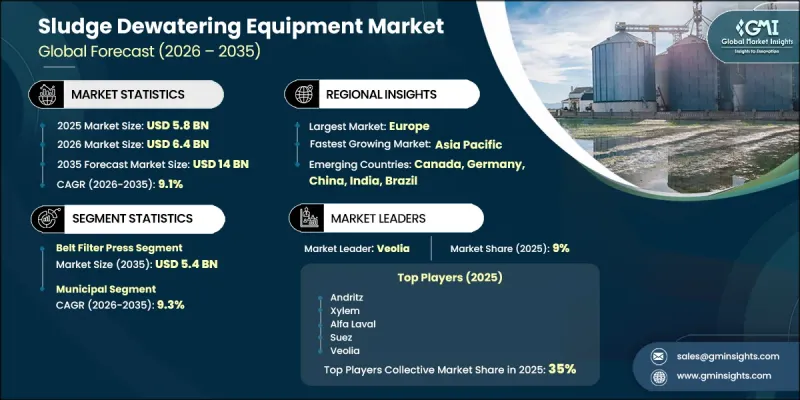
효율적인 폐수 처리에 대한 전 세계적인 관심 증가와 처리 인프라의 현대화를 촉진하는 환경 규제 강화로 인해 이 시장은 강력한 모멘텀을 보이고 있습니다. 도시화와 급속한 산업 성장으로 인해 폐수 발생량이 증가함에 따라 슬러지 관리는 지자체 및 산업 부문 전반에 걸쳐 필수적인 운영 요건이 되었습니다. 산업 분야가 신뢰할 수 있고 에너지 효율적이며 고성능의 솔루션을 요구함에 따라 원심분리기, 벨트 필터 프레스, 스크류 프레스와 같은 고급 탈수 시스템에 대한 수요는 계속 증가하고 있습니다. 디지털 모니터링 시스템, 자동화 및 스마트 제어 기술의 통합으로 슬러지 처리 시설의 운영 효율성과 공정 최적화가 더욱 향상되고 있습니다. 순환 경제의 원칙에 대한 관심이 높아지면서 시장 역학도 변화하고 있으며, 에너지와 영양소 추출을 포함한 슬러지로부터의 자원 회수에 대한 관심이 높아지고 있습니다. 이러한 변화는 슬러지의 가치를 향상시키면서 처리 비용을 절감할 수 있는 첨단 기계에 대한 투자를 촉진하고 있습니다. 지속적인 기술 발전은 물 회수율 향상과 환경 영향 감소를 지원하여 업계의 장기적인 전망을 강화하고 있습니다.
| 시장 범위 | |
|---|---|
| 시작 연도 | 2025년 |
| 예측 기간 | 2026-2035년 |
| 시작 연도 시장 규모 | 58억 달러 |
| 예측 규모 | 140억 달러 |
| CAGR | 9.1% |
벨트 필터 프레스 시장은 2035년까지 54억 달러에 달할 것으로 예측됩니다. 이 기술은 연속적인 가압 여과 공정을 통해 수분 함량을 줄이고 처리 비용을 절감하여 기계식 슬러지 탈수에서 중요한 역할을 합니다. 효율성, 조작의 편리성 및 대량 처리 능력으로 인해 하수 처리 시설에서 널리 사용되고 있습니다. 미처리 폐기물의 배출을 최소화하라는 규제 압력이 증가하고 있으며, 많은 지역에서 매립지 용량이 제한되어 있어 도입이 가속화되고 있습니다. 지속 가능한 폐기물 관리 인프라에 대한 투자 확대는 지자체 및 산업 분야 모두에서 벨트 필터 프레스 시스템에 대한 수요를 더욱 증가시키고 있습니다.
지자체 부문은 2035년까지 연평균 복합 성장률(CAGR) 9.3%를 나타낼 것으로 예측됩니다. 지자체 하수처리시설에서는 운영 효율을 높이고 환경에 미치는 영향을 줄이기 위해 첨단 탈수 기술을 도입하고 있습니다. 도시 인구 증가와 도시 인프라의 확장으로 하수 발생량이 증가하고 있어 효율적인 슬러지 처리 시스템이 요구되고 있습니다. 당국은 지속 가능한 폐기물 처리 방식을 우선시하며, 환경 기준을 준수하고 전체 처리 성능을 향상시킬 수 있는 최신 시설에 투자하고 있습니다.
북미 슬러지 탈수 장비 시장은 87.9%의 점유율을 차지하며 2025년 7억 달러 시장 규모를 형성했습니다. 이 지역의 성장은 산업 및 지자체 부문 전반에 걸쳐 지속 가능한 하수 처리 및 환경 보호를 촉진하는 강력한 규제 프레임워크에 의해 주도되고 있습니다. 노후화된 인프라의 지속적인 업데이트와 고도화된 처리기술의 도입 확대가 시장 확대를 뒷받침하고 있습니다. 에너지 효율, 자원 회수 및 하수 처리 시설의 현대화에 대한 관심이 높아지면서 이 지역 전체에서 슬러지 탈수 시스템에 대한 수요가 더욱 증가하고 있습니다.
자주 묻는 질문
목차
제1장 조사 방법과 범위
제2장 주요 요약
제3장 업계 인사이트
제4장 경쟁 구도
제5장 시장 규모와 예측 : 기술별, 2022-2035년
제6장 시장 규모와 예측 : 용도별, 2022-2035년
제7장 시장 규모와 예측 : 지역별, 2022-2035년
제8장 기업 개요
JHS 26.05.29The Global Sludge Dewatering Equipment Market was valued at USD 5.8 billion in 2025 and is estimated to grow at a CAGR of 9.1% to reach USD 14 billion by 2035.
The market is gaining strong traction due to the rising global focus on efficient wastewater treatment and stricter environmental regulations that are driving the modernization of treatment infrastructure. Increasing urbanization and rapid industrial growth have intensified wastewater generation, making sludge management a critical operational requirement across municipal and industrial sectors. Demand for advanced dewatering systems such as centrifuges, belt filter presses, and screw presses continues to rise as industries seek reliable, energy-efficient, and high-performance solutions. Integration of digital monitoring systems, automation, and smart control technologies is further enhancing operational efficiency and process optimization in sludge treatment facilities. Growing emphasis on circular economy principles is also reshaping market dynamics, with increasing focus on resource recovery from sludge, including energy and nutrient extraction. This shift is encouraging investment in advanced machinery capable of improving sludge valorization while reducing disposal costs. Continuous technological improvements are supporting better water recovery rates and reduced environmental impact, strengthening the long-term outlook for the industry.
| Market Scope | |
|---|---|
| Start Year | 2025 |
| Forecast Year | 2026-2035 |
| Start Value | $5.8 Billion |
| Forecast Value | $14 Billion |
| CAGR | 9.1% |
The belt filter press segment is projected to reach USD 5.4 billion by 2035. This technology plays a key role in mechanical sludge dewatering by reducing moisture content and lowering disposal costs through a continuous pressure-based filtration process. Its efficiency, operational simplicity, and ability to handle large volumes make it widely used across wastewater treatment facilities. Growing regulatory pressure to minimize untreated waste discharge, combined with limited landfill capacity in many regions, is accelerating adoption. Increasing investment in sustainable waste management infrastructure is further strengthening demand for belt filter press systems across both municipal and industrial applications.
The municipal application segment is expected to grow at a CAGR of 9.3% through 2035. Municipal wastewater treatment facilities are increasingly adopting advanced dewatering technologies to improve operational efficiency and reduce environmental impact. Rising urban populations and expanding city infrastructure are contributing to higher volumes of wastewater generation, requiring efficient sludge handling systems. Authorities are prioritizing sustainable waste treatment practices and investing in modern equipment that ensures compliance with environmental standards while improving overall treatment performance.
North America Sludge Dewatering Equipment Market accounted for 87.9% share, generating USD 700 million in 2025. The region's growth is driven by strong regulatory frameworks that promote sustainable wastewater treatment and environmental protection across industrial and municipal sectors. Continuous upgrades of aging infrastructure and increasing adoption of advanced treatment technologies are supporting market expansion. The focus on energy efficiency, resource recovery, and modernization of wastewater facilities is further reinforcing demand for sludge dewatering systems across the region.
Major players operating in the Global Sludge Dewatering Equipment Industry are Alfa Laval, ANDRITZ, Veolia, GEA Group, Flottweg SE, HUBER, Xylem, SUEZ, Aqseptence Group, FLSmidth, Pieralisi, Bucher Unipektin, Komline Sanderson, Hitachi Zosen, Phoenix Process Equipment, Sebright Products, Encon Evaporators, Hiller Separation & Process, Kontek Ecology Systems, and Flotrend. Companies in the Sludge Dewatering Equipment Market are focusing on enhancing product efficiency through advanced mechanical designs and energy-optimized systems. Strong investment in automation and digital monitoring technologies is enabling real-time process control and improved operational reliability. Strategic collaborations with municipal authorities and industrial clients are helping firms expand long-term contracts and strengthen market penetration. Manufacturers are increasingly prioritizing sustainable solutions that support resource recovery and align with circular economy goals. Expansion into emerging markets is being supported by localized production facilities and service networks to improve accessibility and reduce operational costs. Continuous research and development efforts are driving innovation in high-capacity and low-maintenance equipment.
Table of Contents
Chapter 1 Methodology & Scope
- 1.1 Research approach
- 1.2 Quality commitments
- 1.2.1 GMI AI policy & data integrity commitment
- 1.2.1.1 Source consistency protocol
- 1.2.1 GMI AI policy & data integrity commitment
- 1.3 Research trail & confidence scoring
- 1.3.1 Research trail components
- 1.3.2 Scoring components
- 1.4 Data collection
- 1.4.1 Partial list of primary sources
- 1.5 Data mining sources
- 1.5.1 Paid sources
- 1.5.1.1 Sources, by region
- 1.5.1 Paid sources
- 1.6 Base estimates and calculations
- 1.6.1 Base year calculation for any one approach
- 1.7 Market estimates & forecasts parameters
- 1.8 Forecast model
- 1.8.1 Quantified market impact analysis
- 1.8.1.1 Mathematical impact of growth parameters on forecast
- 1.8.1 Quantified market impact analysis
- 1.9 Research transparency addendum
- 1.9.1 Source attribution framework
- 1.9.2 Quality assurance metrics
- 1.9.3 Our commitment to trust
- 1.10 Market definitions
Chapter 2 Executive Summary
- 2.1 Industry synopsis, 2022 - 2035
- 2.1.1 Business trends
- 2.1.2 Technology trends
- 2.1.3 Application trends
- 2.1.4 Regional trends
Chapter 3 Industry Insights
- 3.1 Industry ecosystem analysis
- 3.1.1 Raw material availability & sourcing analysis
- 3.1.2 Supply chain resilience & risk factors
- 3.1.3 Distribution network analysis
- 3.2 Regulatory landscape
- 3.3 Industry impact forces
- 3.3.1 Growth drivers
- 3.3.2 Industry pitfalls & challenges
- 3.4 Growth potential analysis
- 3.5 Porter's analysis
- 3.5.1 Bargaining power of suppliers
- 3.5.2 Bargaining power of buyers
- 3.5.3 Threat of new entrants
- 3.5.4 Threat of substitutes
- 3.6 PESTEL analysis
- 3.6.1 Political factors
- 3.6.2 Economic factors
- 3.6.3 Social factors
- 3.6.4 Technology factors
- 3.6.5 environmental factors
- 3.6.6 Legal factors
- 3.7 Emerging opportunities & trends
- 3.8 Digitalization & IoT integration
- 3.9 Investment analysis & future prospects
- 3.10 Impact of AI & Generative AI on the market (Solution Core)
- 3.10.1 AI-Driven production optimization (Solution Core)
- 3.10.2 Predictive maintenance & fault detection (Solution Core)
Chapter 4 Competitive landscape, 2026
- 4.1 Introduction
- 4.2 Company market share analysis, 2025
- 4.2.1 North America
- 4.2.2 Europe
- 4.2.3 Asia Pacific
- 4.2.4 Middle East & Africa
- 4.2.5 Latin America
- 4.3 Competitive positioning matrix
- 4.4 Key developments
- 4.4.1 Mergers & acquisitions
- 4.4.2 Partnerships & collaborations
- 4.4.3 New product launches
- 4.4.4 Expansion plans & funding
Chapter 5 Market Size and Forecast, By Technology, 2022 - 2035 (USD Million)
- 5.1 Key trends
- 5.2 Belt Filter Press
- 5.3 Centrifuges
- 5.4 Screw Press
- 5.5 Others
Chapter 6 Market Size and Forecast, By Application, 2022 - 2035 (USD Million)
- 6.1 Key trends
- 6.2 Municipal
- 6.3 Industrial
Chapter 7 Market Size and Forecast, By Region, 2022 - 2035 (USD Million)
- 7.1 Key trends
- 7.2 North America
- 7.2.1 U.S.
- 7.2.2 Canada
- 7.2.3 Mexico
- 7.3 Europe
- 7.3.1 Germany
- 7.3.2 France
- 7.3.3 UK
- 7.3.4 Spain
- 7.3.5 Italy
- 7.4 Asia Pacific
- 7.4.1 China
- 7.4.2 India
- 7.4.3 Japan
- 7.4.4 South Korea
- 7.4.5 Australia
- 7.5 Middle East & Africa
- 7.5.1 Saudi Arabia
- 7.5.2 South Africa
- 7.6 Latin America
- 7.6.1 Brazil
- 7.6.2 Argentina
Chapter 8 Company Profiles
- 8.1 Alfa Laval
- 8.2 ANDRITZ
- 8.3 Aqseptence Group
- 8.4 Bucher Unipektin
- 8.5 Encon Evaporators
- 8.6 Flotrend
- 8.7 Flottweg SE
- 8.8 FLSmidth
- 8.9 GEA Group
- 8.10 Hiller Separation & Process
- 8.11 Hitachi Zosen
- 8.12 HUBER
- 8.13 Komline-Sanderson
- 8.14 Kontek Ecology Systems
- 8.15 Phoenix Process Equipment
- 8.16 Pieralisi
- 8.17 Sebright Products
- 8.18 SUEZ
- 8.19 Veolia
- 8.20 Xylem