|
시장보고서
상품코드
2038778
연속 혈당 모니터링 시장 : 시장 비즈니스 기회, 성장요인, 업계 동향 분석 및 예측(2026-2035년)Continuous Glucose Monitoring Market Opportunity, Growth Drivers, Industry Trend Analysis, and Forecast 2026 - 2035 |
||||||

세계의 연속 혈당 모니터링 시장은 2025년에 124억 달러로 평가되었고, 2035년까지 연평균 복합 성장률(CAGR) 16.3%로 성장할 전망이며, 555억 달러에 이를 것으로 추정되고 있습니다.
시장 확대는 전 세계 당뇨병 부담 증가, 실시간 혈당 추적 솔루션에 대한 수요 증가, 웨어러블 의료 기술의 지속적인 발전, 당뇨병에 대한 인식 제고 및 관리를 위한 공중보건 이니셔티브 증가에 영향을 받고 있습니다. 환자와 의료진이 데이터 기반 치료법으로 전환함에 따라 정확하고 지속적인 모니터링 도구에 대한 수요가 증가함에 따라 당뇨병 치료의 방식이 변화하고 있습니다. 센서의 소형화, 무선 연결, 모바일 통합의 기술 발전은 기기의 사용 편의성과 임상적 효율성을 더욱 향상시키고 있습니다. 연속 혈당 모니터링(CGM) 시스템은 혈당 변동에 대한 실시간 정보를 제공하고, 발견 지연에 따른 합병증 감소에 기여하기 때문에 주목받고 있습니다. 원격 진료 및 재택 진료 모델의 도입 확대도 시장 침투를 촉진하고 있습니다. 또한, 의료에 대한 접근성 확대, 상환 제도 개선, 환자 교육 수준 향상으로 인해 선진국과 신흥국 의료 시장 모두에서 CGM 시스템 이용이 촉진되고 있습니다.
| 시장 범위 | |
|---|---|
| 개시 연도 | 2025년 |
| 예측 기간 | 2026-2035년 |
| 개시 연도 시장 규모 | 124억 달러 |
| 예측액 | 555억 달러 |
| CAGR | 16.3% |
센서 기반 모니터링 장치 시장은 2025년 63억 달러 규모에 달했습니다. 이 시장은 센서의 정확도, 내구성 및 전반적인 성능의 지속적인 향상으로 인해 계속 확대되고 있습니다. 최신 센서 기술을 통해 측정 정확도가 크게 향상되었으며, 고급 시스템의 경우 평균 절대 상대 오차가 10% 미만을 달성했습니다. 또한, 소형화의 진전은 환자의 편안함을 향상시켜 장기적인 사용이 더욱 실용적이고 널리 수용될 수 있게 되었습니다. 이러한 발전으로 인해 지속적이고 신뢰할 수 있는 혈당 모니터링에 있어 센서 기반 장치의 역할이 더욱 강화되고 있습니다.
홈케어 환경 부문은 2025년 101억 달러에 달했습니다. 임상 환경 밖에서도 환자가 실시간으로 혈당 수치를 추적할 수 있게 되면서 이 분야에서의 도입이 활발하게 이루어지고 있습니다. 이 기기들은 비정상적인 혈당변동을 조기에 발견하고 병원 방문에 대한 의존도를 낮춰 적극적인 당뇨병 관리를 돕습니다. 의료서비스의 분산화로 인해 합병증 예방을 위해 지속적인 관찰이 필수적인 장기적인 당뇨병 관리, 치료 후 모니터링, 노인 케어에 CGM 솔루션의 활용이 가속화되고 있습니다.
미국의 연속 혈당 모니터링 시장은 2025년 57억 달러에 달했습니다. 이 나라 시장 성장은 높은 의료비 지출, 첨단 의료 기술의 풍부한 가용성, 당뇨병 환자 수 증가에 의해 뒷받침되고 있습니다. 디지털 헬스 솔루션과 지속적 모니터링 기기의 채택 확대도 시장 확대에 기여하고 있습니다. 또한, 유리한 상환 제도는 CGM 시스템에 대한 접근성을 개선하고, 환자들의 광범위한 채택을 가능하게 하여 전체 시장 전망을 강화합니다.
자주 묻는 질문
목차
제1장 조사 방법
제2장 주요 요약
제3장 업계 인사이트
제4장 경쟁 구도
제5장 시장 추산 및 예측 : 컴포넌트별(2022-2035년)
제6장 시장 추산 및 예측 : 최종 용도별(2022-2035년)
제7장 시장 추산 및 예측 : 지역별(2022-2035년)
제8장 기업 개요
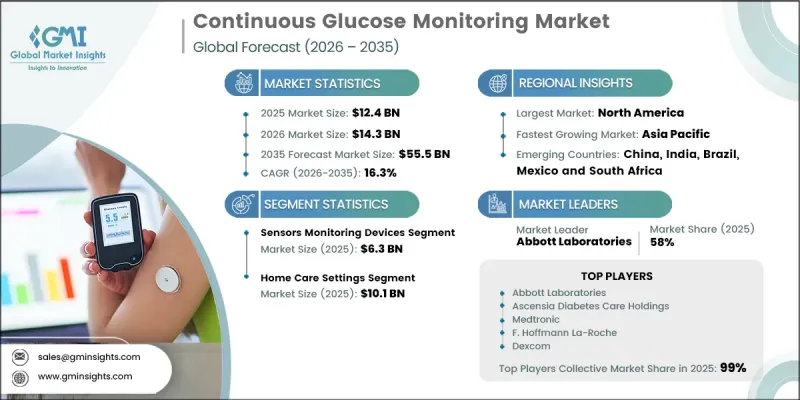
AJY 26.06.11The Global Continuous Glucose Monitoring Market was valued at USD 12.4 billion in 2025 and is estimated to grow at a CAGR of 16.3% to reach USD 55.5 billion by 2035.
Market expansion is influenced by the escalating global burden of diabetes, rising preference for real-time glucose tracking solutions, continuous improvements in wearable medical technologies, and increasing public health initiatives aimed at diabetes awareness and management. Growing demand for accurate and continuous monitoring tools is reshaping diabetes care, as patients and healthcare providers shift toward data-driven treatment approaches. Technological progress in sensor miniaturization, wireless connectivity, and mobile integration is further enhancing device usability and clinical efficiency. Continuous glucose monitoring systems are gaining traction as they provide real-time insights into glucose fluctuations, helping reduce complications associated with delayed detection. Increasing adoption of remote and home-based care models is also supporting market penetration. Additionally, expanding healthcare access, improved reimbursement frameworks, and rising patient education levels are encouraging wider utilization of CGM systems across both developed and emerging healthcare markets.
| Market Scope | |
|---|---|
| Start Year | 2025 |
| Forecast Year | 2026-2035 |
| Start Value | $12.4 Billion |
| Forecast Value | $55.5 Billion |
| CAGR | 16.3% |
The sensor-based monitoring devices segment accounted for USD 6.3 billion in 2025. This segment continues to expand due to ongoing improvements in sensor precision, durability, and overall performance. Modern sensor technologies have significantly enhanced measurement accuracy, with advanced systems achieving a mean absolute relative difference below 10%. Enhanced miniaturization has also improved patient comfort, making long-term usage more practical and widely accepted. These advancements are strengthening the role of sensor-based devices in continuous and reliable glucose tracking.
The home care settings segment reached USD 10.1 billion in 2025. Adoption in this segment is increasing as continuous glucose monitoring systems enable patients to track glucose levels in real time outside clinical environments. These devices support proactive diabetes management by allowing early identification of abnormal glucose fluctuations and reducing dependence on hospital visits. The growing shift toward decentralized healthcare delivery is accelerating the use of CGM solutions for long-term diabetes management, post-treatment monitoring, and elderly care, where continuous observation is essential for preventing complications.
U.S. Continuous Glucose Monitoring Market reached USD 5.7 billion in 2025. Market growth in the country is supported by high healthcare expenditure, strong availability of advanced medical technologies, and a rising diabetes population. Increasing adoption of digital health solutions and continuous monitoring devices is further contributing to market expansion. Favorable reimbursement frameworks have also improved access to CGM systems, enabling broader patient adoption and strengthening the overall market outlook.
Leading players such as Abbott Laboratories, Dexcom, Medtronic, Senseonics, F. Hoffmann-La Roche, A. Menarini Diagnostics, i-SENS, Medtrum Technologies, Med Trust, Sinocare, and Zhejiang POCTech continue to focus on product innovation and global expansion strategies to reinforce their competitive position. Companies in the Continuous Glucose Monitoring Market are focusing on continuous innovation in sensor accuracy, device miniaturization, and longer sensor lifespan to improve patient compliance and clinical reliability. They are expanding integration with smartphones and digital health platforms to enhance real-time data access and remote monitoring capabilities. Strategic collaborations with healthcare providers and insurers are helping improve reimbursement coverage and market accessibility. Manufacturers are also investing heavily in research and development to enhance algorithm-driven glucose prediction and improve user experience. Additionally, companies are strengthening global distribution networks and increasing investments in emerging markets to expand patient reach and accelerate adoption of advanced diabetes management solutions.
Table of Contents
Chapter 1 Research Methodology
- 1.1 Research approach
- 1.2 Quality commitments
- 1.2.1 GMI AI policy & data integrity commitment
- 1.2.1.1 Source consistency protocol
- 1.2.1 GMI AI policy & data integrity commitment
- 1.3 Research trail & confidence scoring
- 1.3.1 Research trail components
- 1.3.2 Scoring components
- 1.4 Data collection
- 1.4.1 Partial list of primary sources
- 1.5 Data mining sources
- 1.5.1 Paid sources
- 1.5.1.1 Sources, by region
- 1.5.1 Paid sources
- 1.6 Base estimates and calculations
- 1.6.1 Base year calculation for any one approach
- 1.7 Forecast model
- 1.7.1 Quantified market impact analysis
- 1.7.1.1 Mathematical impact of growth parameters on forecast
- 1.7.1 Quantified market impact analysis
- 1.8 Research transparency addendum
- 1.8.1 Source attribution framework
- 1.8.2 Quality assurance metrics
- 1.8.3 Our commitment to trust
Chapter 2 Executive Summary
- 2.1 Industry 360° synopsis
- 2.1.1 Key market trends
- 2.1.2 Component trends
- 2.1.3 End use trends
- 2.1.4 Regional trends
- 2.2 CXO perspectives: Strategic imperatives
Chapter 3 Industry Insights
- 3.1 Industry ecosystem analysis
- 3.2 Industry impact forces
- 3.2.1 Growth drivers
- 3.2.1.1 Increasing prevalence of diabetes, globally
- 3.2.1.2 Rising demand for continuous monitoring devices
- 3.2.1.3 Technological advancements in devices
- 3.2.1.4 Increasing government initiatives to generate awareness regarding diabetes
- 3.2.2 Industry pitfalls and challenges
- 3.2.2.1 High cost related to devices
- 3.2.2.2 Stringent regulatory scenario
- 3.2.3 Market opportunity
- 3.2.3.1 Expansion in emerging markets
- 3.2.1 Growth drivers
- 3.3 Growth potential analysis
- 3.4 Regulatory landscape (Driven by Primary Research)
- 3.4.1 North America
- 3.4.2 Europe
- 3.4.3 Asia Pacific
- 3.5 Technological landscape (Driven by Primary Research)
- 3.5.1 Current technologies
- 3.5.1.1 Real time continuous glucose monitoring systems
- 3.5.1.2 Bluetooth enabled CGM sensors and transmitters
- 3.5.1.3 Mobile apps and cloud based CGM data platforms
- 3.5.2 Emerging technologies
- 3.5.2.1 AI driven glucose prediction and decision-support algorithms
- 3.5.2.2 Non invasive and minimally invasive glucose sensing technologies
- 3.5.2.3 Extended wear and multi-day CGM sensors
- 3.5.2.4 Fully integrated digital diabetes management ecosystems
- 3.5.1 Current technologies
- 3.6 Future market trends (Driven by Primary Research)
- 3.7 Patent analysis (Driven by Primary Research)
- 3.8 Pricing analysis, 2025 (Driven by Primary Research)
- 3.9 Impact of AI and Generative AI on the market (Driven by Primary Research)
- 3.10 Porter's analysis
- 3.11 PESTEL analysis
Chapter 4 Competitive Landscape, 2025
- 4.1 Introduction
- 4.2 Company market share analysis
- 4.3 Company matrix analysis
- 4.4 Competitive analysis of major market players
- 4.5 Competitive positioning matrix
- 4.6 Key developments
- 4.6.1 Merger and acquisition
- 4.6.2 Partnership and collaboration
- 4.6.3 New product launches
- 4.6.4 Expansion plans
Chapter 5 Market Estimates and Forecast, By Component, 2022 - 2035 ($ Mn)
- 5.1 Key trends
- 5.2 Transmitters
- 5.3 Sensors
- 5.4 Receivers
Chapter 6 Market Estimates and Forecast, By End Use, 2022 - 2035 ($ Mn)
- 6.1 Key trends
- 6.2 Hospitals
- 6.3 Home care settings
- 6.4 Diagnostic centres and clinics
- 6.5 Other end users
Chapter 7 Market Estimates and Forecast, By Region, 2022 - 2035 ($ Mn)
- 7.1 Key trends
- 7.2 North America
- 7.2.1 U.S.
- 7.2.2 Canada
- 7.3 Europe
- 7.3.1 Germany
- 7.3.2 UK
- 7.3.3 France
- 7.3.4 Spain
- 7.3.5 Italy
- 7.3.6 Netherlands
- 7.4 Asia Pacific
- 7.4.1 China
- 7.4.2 Japan
- 7.4.3 India
- 7.4.4 Australia
- 7.4.5 South Korea
- 7.5 Latin America
- 7.5.1 Brazil
- 7.5.2 Mexico
- 7.5.3 Argentina
- 7.6 Middle East and Africa
- 7.6.1 South Africa
- 7.6.2 Saudi Arabia
- 7.6.3 UAE
Chapter 8 Company Profiles
- 8.1 Abbott Laboratories
- 8.2 A. Menarini Diagnostics
- 8.3 Dexcom
- 8.4 i-SENS
- 8.5 F. Hoffmann-La Roche
- 8.6 Med Trust
- 8.7 Medtronic
- 8.8 Medtrum Technologies
- 8.9 Senseonics
- 8.10 Sinocare
- 8.11 Zhejiang POCTech