

|
시장보고서
상품코드
2061345
상용차용 HVAC 서비스 시장 기회, 성장요인, 업계 동향 분석 및 예측(2026-2035년)Commercial Vehicle HVAC Service Market Opportunity, Growth Drivers, Industry Trend Analysis, and Forecast 2026 - 2035 |
||||||

세계의 상용차용 HVAC 서비스 시장은 2025년에 81억 달러로 평가되고 CAGR 7%로 성장하며, 2035년까지 160억 달러에 달할 것으로 예측됩니다.
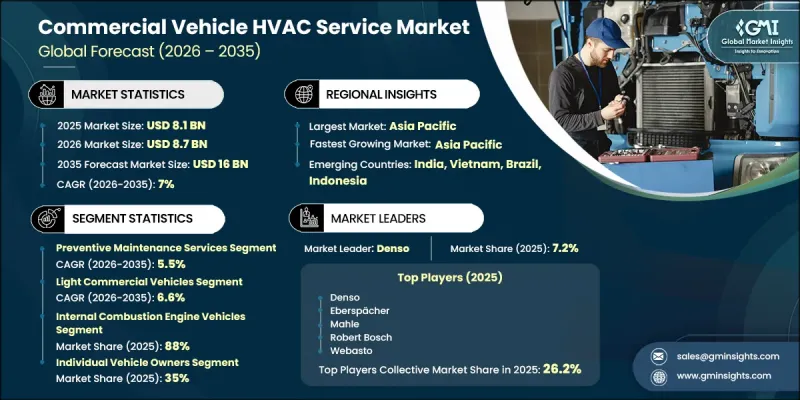
상용차용 HVAC 서비스 업계는 상용 운송 차량의 지속적인 증가와 HVAC 시스템의 정기 점검 및 수리에 대한 수요 증가에 힘입어 강력한 성장을 달성하고 있습니다. 여러 지역에서 상용차 생산 대수가 증가함에 따라 시스템의 효율성과 운영상의 신뢰성을 확보하는 유지보수 솔루션에 대한 수요가 더욱 확대되고 있습니다. 온도 관리가 필요한 운송에 대한 의존도가 높아지고 화물 운송 업무가 확대됨에 따라 상용차 부문 전반에서 첨단 HVAC 서비스에 대한 수요가 가속화되고 있습니다. 규제 당국 또한 차량 배기가스 및 차량내 공기질에 관한 더 엄격한 기준을 도입하고 있으며, HVAC 시스템의 정기적인 점검 및 정비를 장려하고 있습니다. 또한 차량 운영 사업자들은 HVAC 성능, 냉매 사용량 및 유지보수 일정을 보다 효과적으로 추적하기 위해 커넥티드 차량 기술과 디지털 모니터링 플랫폼의 도입을 확대하고 있습니다. 기업이 기존 차량 함대의 운영 효율 향상, 공조 성능 강화, 그리고 필터 시스템 업그레이드에 주력함에 따라 구형 상용차에 최신 HVAC 기술을 사후 장착하는 움직임도 업계 동향으로서 확대되고 있습니다.
| 시장 범위 | |
|---|---|
| 시작연도 | 2025년 |
| 예측 기간 | 2026-2035 |
| 개시 금액 | 81억 달러 |
| 예측액 | 160억 달러 |
| CAGR | 7% |
예방 유지보수 서비스 부문은 2025년에 37%의 시장 점유율을 차지하며, 2026-2035년 연평균 성장률(CAGR) 5.5%를 기록할 것으로 전망됩니다. 운송업체들이 업무 혼란을 줄이고 예기치 못한 장비 고장을 방지하기 위해 정기 점검을 점점 더 중요하게 여기면서, 예방 정비 서비스에 대한 수요는 계속해서 증가하고 있습니다. 운송 업계 전반에 걸친 차량 대수 증가와 가동률 상승에 따라 사업자들은 시스템 성능 향상, 가동 중단 시간 최소화, 그리고 장비 수명 연장을 도모하기 위해 정기적인 HVAC 점검 및 유지보수 프로그램의 도입을 촉진하고 있습니다. 사업 연속성과 비용 효율성에 대한 관심이 높아짐에 따라 시장 전반에서 예방적 HVAC 유지보수 솔루션에 대한 수요는 계속해서 증가하고 있습니다.
소형 상용차 부문은 2025년에 73.2%의 시장 점유율을 차지하며, 2035년까지 연평균 성장률(CAGR) 6.6%로 성장할 것으로 전망됩니다. 상용 운송 차량에서 HVAC 시스템의 지속적인 사용이 이 부문 전체의 수리, 유지보수 및 정비 활동에 대한 꾸준한 수요를 이끌고 있습니다. 장거리 운송 업무에 종사하는 상용차는 쾌적한 운전 환경을 유지하고 차량의 성능을 끊임없이 지원하기 위해 효율적인 공조 시스템이 필요합니다. 상업용 운송 활동에 대한 의존도가 높아지고 차량 가동률이 개선됨에 따라 소형 상용차 부문의 견고한 서비스 수요가 지속적으로 지원되고 있습니다.
중국의 상용차용 HVAC 서비스 시장은 2025년에 20억 달러의 시장 규모를 기록하며 61%의 점유율을 차지했습니다. 이 국가는 대규모 상용차 보유 대수와 급속히 성장하는 운송·물류 부문을 바탕으로 계속해서 지역 시장을 주도하고 있습니다. 화물 운송량의 증가와 장거리 운송 수요의 확대가 상용차 차량군 전체에서 HVAC의 유지보수, 수리 및 서비스 솔루션에 대한 수요를 더욱 부추기고 있습니다. 또한 중국에서 전기 상용차의 도입이 가속화됨에 따라 첨단 열 관리 시스템과 전문적인 HVAC 서비스 솔루션에 새로운 성장 기회가 창출되고 있습니다. 물류 인프라 확충과 상용차 도입 증가는 예측 기간 중 시장 성장을 더욱 촉진할 것으로 전망됩니다.
자주 묻는 질문
목차
제1장 조사 방법
제2장 개요
제3장 업계 인사이트
제4장 경쟁 구도
제5장 시장 추산·예측 : 서비스별, 2022-2035년
제6장 시장 추산·예측 : 차량별, 2022-2035년
제7장 시장 추산·예측 : 추진력별, 2022-2035년
제8장 시장 추산·예측 : 최종사용자별, 2022-2035년
제9장 시장 추산·예측 : 지역별, 2022-2035년
제10장 기업 개요
KSA 26.06.23The Global Commercial Vehicle HVAC Service Market was valued at USD 8.1 billion in 2025 and is estimated to grow at a CAGR of 7% to reach USD 16 billion by 2035.
The commercial vehicle HVAC service industry is witnessing strong growth due to the continuous expansion of commercial transportation fleets and increasing demand for routine HVAC system servicing and repair activities. Rising production of commercial vehicles across multiple regions is further contributing to the growing requirement for maintenance solutions that ensure system efficiency and operational reliability. The increasing dependence on temperature-controlled transportation and extended freight operations has accelerated demand for advanced HVAC servicing throughout the commercial vehicle sector. Regulatory authorities are also implementing stricter standards related to vehicle emissions and in-cabin air quality, encouraging regular inspection and servicing of HVAC systems. In addition, fleet operators are increasingly adopting connected fleet technologies and digital monitoring platforms to track HVAC performance, refrigerant usage, and maintenance schedules more effectively. Retrofitting older commercial vehicles with modern HVAC technologies has also become a growing industry trend as companies focus on improving operational efficiency, enhancing climate control performance, and upgrading filtration systems within existing vehicle fleets.
| Market Scope | |
|---|---|
| Start Year | 2025 |
| Forecast Year | 2026-2035 |
| Start Value | $8.1 Billion |
| Forecast Value | $16 Billion |
| CAGR | 7% |
The preventive maintenance services segment accounted for 37% share in 2025 and is anticipated to register a CAGR of 5.5% from 2026 to 2035. Preventive maintenance services continue to generate significant demand as transportation companies increasingly prioritize scheduled servicing to reduce operational disruptions and avoid unexpected equipment failures. Growing fleet sizes and rising utilization rates across the transportation industry are encouraging operators to adopt routine HVAC inspection and maintenance programs to improve system performance, minimize downtime, and extend equipment lifespan. The increasing focus on operational continuity and cost efficiency continues to strengthen demand for preventive HVAC servicing solutions throughout the market.
The light commercial vehicles segment held a 73.2% share in 2025 and is projected to grow at a CAGR of 6.6% through 2035. Continuous utilization of HVAC systems in commercial transportation vehicles is driving steady demand for repair, maintenance, and servicing activities across this segment. Commercial vehicles engaged in long-distance transportation operations require efficient climate control systems to maintain comfortable operating conditions and support uninterrupted vehicle performance. The growing reliance on commercial transportation activities and increasing vehicle utilization rates continue to support strong service demand within the light commercial vehicle category.
China Commercial Vehicle HVAC Service Market accounted for 61% share generating USD 2 billion in 2025. The country continues to dominate the regional market due to its large commercial vehicle fleet and rapidly expanding transportation and logistics sector. Rising freight movement and increasing long-distance transportation requirements are driving stronger demand for HVAC maintenance, repair, and servicing solutions across commercial fleets. In addition, the accelerating adoption of electric commercial vehicles in China is creating new growth opportunities for advanced thermal management systems and specialized HVAC service solutions. Expanding logistics infrastructure and increasing commercial vehicle deployment are expected to further support market growth throughout the forecast period.
Major companies operating in the Global Commercial Vehicle HVAC Service Market include Denso, Eberspacher, Hanon Systems, Mahle, Marelli, Robert Bosch, Sanden, Subros, Thermo King, and Webasto. Companies operating in the commercial vehicle HVAC service market are implementing several strategic initiatives to strengthen their competitive position and expand market presence. Industry participants are increasing investments in advanced HVAC technologies designed to improve energy efficiency, system reliability, and climate control performance across commercial vehicle fleets. Many companies are also focusing on expanding service networks and strengthening aftermarket support capabilities to improve customer retention and service accessibility. Strategic collaborations with fleet operators, transportation companies, and vehicle manufacturers are helping service providers secure long-term contracts and enhance business growth opportunities. In addition, businesses are integrating digital monitoring systems, predictive maintenance solutions, and connected diagnostics technologies to improve operational efficiency and reduce maintenance downtime. Product innovation, thermal management advancements, and expansion into electric commercial vehicle servicing continue to remain key priorities for companies competing in the global commercial vehicle HVAC service industry.
Table of Contents
Chapter 1 Research Methodology
- 1.1 Research approach
- 1.2 Quality Commitments
- 1.2.1 GMI AI policy & data integrity commitment
- 1.2.1.1 Source consistency protocol
- 1.2.1 GMI AI policy & data integrity commitment
- 1.3 Research Trail & Confidence Scoring
- 1.3.1 Research Trail Components
- 1.3.2 Scoring Components
- 1.4 Data Collection
- 1.4.1 Partial list of primary sources
- 1.5 Data mining sources
- 1.5.1 Paid sources
- 1.5.1.1 Sources, by region
- 1.5.1 Paid sources
- 1.6 Base estimates and calculations
- 1.6.1 Base year calculation for any one approach
- 1.7 Forecast model
- 1.7.1 Quantified market impact analysis
- 1.7.1.1 Mathematical impact of growth parameters on forecast
- 1.7.1 Quantified market impact analysis
- 1.8 Research transparency addendum
- 1.8.1 Source attribution framework
- 1.8.2 Quality assurance metrics
- 1.8.3 Our commitment to trust
Chapter 2 Executive Summary
- 2.1 Industry 360° synopsis, 2022 - 2035
- 2.2 Key market trends
- 2.2.1 Regional
- 2.2.2 Service
- 2.2.3 Vehicle
- 2.2.4 Propulsion
- 2.2.5 End User
- 2.3 TAM Analysis, 2026-2035
- 2.4 CXO perspectives: Strategic imperatives
Chapter 3 Industry Insights
- 3.1 Industry ecosystem analysis
- 3.1.1 Supplier landscape
- 3.1.2 Profit margin analysis
- 3.1.3 Cost structure
- 3.1.4 Value addition at each stage
- 3.1.5 Factor affecting the value chain
- 3.1.6 Disruptions
- 3.2 Industry impact forces
- 3.2.1 Growth drivers
- 3.2.1.1 Expansion of commercial vehicle fleets
- 3.2.1.2 Rising adoption of electric commercial vehicles
- 3.2.1.3 Increasing cold chain and logistics operations
- 3.2.1.4 Stringent cabin comfort and air quality regulations
- 3.2.2 Industry pitfalls and challenges
- 3.2.2.1 High maintenance cost of advanced HVAC systems
- 3.2.2.2 Shortage of skilled service technicians
- 3.2.3 Market opportunities
- 3.2.3.1 Adoption of predictive maintenance technologies
- 3.2.3.2 Expansion of electric bus and truck fleets
- 3.2.3.3 Growth in aftermarket service networks
- 3.2.1 Growth drivers
- 3.3 Growth potential analysis
- 3.4 Technology and innovation landscape
- 3.4.1 Current technological trends
- 3.4.2 Emerging technologies
- 3.5 Pricing Analysis (Driven by primary research)
- 3.5.1 Historical Price Trend Analysis
- 3.5.2 Pricing Strategy by Player Type
- 3.6 Regulatory landscape
- 3.6.1 North America
- 3.6.1.1 U.S. EPA Section 609 MVAC Servicing Regulations
- 3.6.1.2 U.S. EPA Section 609 Technician Certification Standards
- 3.6.1.3 U.S. EPA Refrigerant Handling Standards
- 3.6.1.4 Canada Federal Halocarbon Regulations
- 3.6.2 Europe
- 3.6.2.1 EU F gas Regulation
- 3.6.2.2 EU Mobile Air Conditioning Directive
- 3.6.2.3 Germany Chemikalien Klimaschutzverordnung
- 3.6.3 Asia Pacific
- 3.6.3.1 Japan Act on Rational Use and Proper Management of Fluorocarbons
- 3.6.3.2 Australia Ozone Protection and Synthetic Greenhouse Gas Management Act
- 3.6.3.3 Australia Ozone Protection and Synthetic Greenhouse Gas Management Regulations
- 3.6.3.4 India Ozone Depleting Substances Regulation and Control Rules
- 3.6.3.5 India HCFC Phase Out Management Plan
- 3.6.4 Latin America
- 3.6.4.1 Brazil HCFC Phase Out Measures
- 3.6.4.2 Brazil Montreal Protocol HCFC Phase Out Roadmap
- 3.6.4.3 Mexico HCFC Consumption Limit Agreement
- 3.6.5 Middle East & Africa
- 3.6.5.1 Dubai Green Building Regulations and Specifications
- 3.6.5.2 South Africa Regulations Regarding the Phasing out and Management of Ozone Depleting Substances
- 3.6.5.3 South Africa National Environmental Management Air Quality Act
- 3.6.1 North America
- 3.7 Porter’s analysis
- 3.8 PESTEL analysis
- 3.9 Patent analysis (Driven by primary research)
- 3.10 Cost breakdown analysis
- 3.11 Impact of AI and Generative AI on the Market
- 3.11.1 AI Driven Disruption of Existing Business Models
- 3.11.2 GenAI Use Cases and Adoption Roadmap by Segment
- 3.11.3 Risks Limitations and Regulatory Considerations
- 3.12 Sustainability and environmental aspects
- 3.12.1 Sustainable practices
- 3.12.2 Waste reduction strategies
- 3.12.3 Energy efficiency in production
- 3.12.4 Eco-friendly Initiatives
- 3.12.5 Carbon footprint considerations
- 3.13 Forecast assumptions & scenario analysis (Driven by Primary Research)
- 3.13.1 Base Case- Key Macro & Industry Variables Driving CAGR
- 3.13.2 Optimistic Scenarios- Favorable macro and industry tailwinds
- 3.13.3 Pessimistic Scenario - Macroeconomic slowdown or industry headwinds
Chapter 4 Competitive Landscape, 2025
- 4.1 Introduction
- 4.2 Company market share analysis
- 4.2.1 North America
- 4.2.2 Europe
- 4.2.3 Asia Pacific
- 4.2.4 LATAM
- 4.2.5 MEA
- 4.3 Competitive analysis of major market players
- 4.4 Competitive positioning matrix
- 4.5 Key developments
- 4.5.1 Mergers & acquisitions
- 4.5.2 Partnerships & collaborations
- 4.5.3 New Product Launches
- 4.5.4 Expansion Plans and funding
- 4.6 Company tier benchmarking
- 4.6.1 Tier classification criteria & qualifying thresholds
- 4.6.2 Tier positioning matrix by revenue, geography & innovation
Chapter 5 Market Estimates & Forecast, By Service, 2022 - 2035 (USD Mn)
- 5.1 Key trends
- 5.2 Preventive Maintenance Services
- 5.3 Diagnostic Services
- 5.4 Repair & Replacement Services
- 5.5 Installation & Retrofit Services
- 5.6 Software & Calibration Services
Chapter 6 Market Estimates & Forecast, By Vehicle, 2022 - 2035 (USD Mn)
- 6.1 Key trends
- 6.2 Light Commercial Vehicles (LCVs)
- 6.2.1 Pickup Trucks
- 6.2.2 Vans
- 6.2.3 Mini Trucks
- 6.2.4 Others
- 6.3 Medium Commercial Vehicles (MCVs)
- 6.3.1 Box Trucks
- 6.3.2 Distribution Trucks
- 6.3.3 Refrigerated Trucks
- 6.3.4 Others
- 6.4 Heavy Commercial Vehicles (HCVs)
- 6.4.1 Heavy Duty Trucks
- 6.4.2 Long-Haul Trucks
- 6.4.3 Buses & Coaches
- 6.4.4 Others
Chapter 7 Market Estimates & Forecast, By Propulsion, 2022 - 2035 (USD Mn)
- 7.1 Key trends
- 7.2 Internal Combustion Engine (ICE) Vehicles
- 7.3 Battery Electric Vehicles (BEVs)
- 7.4 Hybrid Electric Vehicles (HEVs)
- 7.5 Plug-in Hybrid Electric Vehicles (PHEVs)
- 7.6 Fuel Cell Electric Vehicles (FCEVs)
Chapter 8 Market Estimates & Forecast, By End User, 2022 - 2035 (USD Mn)
- 8.1 Key trends
- 8.2 Individual Vehicle Owners
- 8.3 Fleet Operators
- 8.4 Ride-Hailing & Mobility Companies
- 8.5 Public Transport Authorities
- 8.6 Logistics & Delivery Operators
Chapter 9 Market Estimates & Forecast, By Region, 2022 - 2035 (USD Mn)
- 9.1 Key trends
- 9.2 North America
- 9.2.1 US
- 9.2.2 Canada
- 9.3 Europe
- 9.3.1 Germany
- 9.3.2 UK
- 9.3.3 France
- 9.3.4 Italy
- 9.3.5 Spain
- 9.3.6 Russia
- 9.3.7 Norway
- 9.3.8 Netherlands
- 9.3.9 Sweden
- 9.4 Asia Pacific
- 9.4.1 China
- 9.4.2 India
- 9.4.3 Japan
- 9.4.4 Australia
- 9.4.5 South Korea
- 9.4.6 Singapore
- 9.4.7 Thailand
- 9.4.8 Indonesia
- 9.4.9 Vietnam
- 9.5 Latin America
- 9.5.1 Brazil
- 9.5.2 Mexico
- 9.5.3 Argentina
- 9.6 MEA
- 9.6.1 South Africa
- 9.6.2 Saudi Arabia
- 9.6.3 UAE
- 9.6.4 Turkey
Chapter 10 Company Profiles
- 10.1 Global Players
- 10.1.1 Denso
- 10.1.2 Eberspacher
- 10.1.3 Hanon Systems
- 10.1.4 MAHLE
- 10.1.5 Marelli
- 10.1.6 Robert Bosch
- 10.1.7 Sanden
- 10.1.8 Thermo King
- 10.1.9 Valeo
- 10.1.10 Webasto
- 10.2 Regional Players
- 10.2.1 Carrier Transicold
- 10.2.2 Japan Climate Systems
- 10.2.3 Mitsubishi Heavy Industries
- 10.2.4 Samvardhana Motherson
- 10.2.5 Subros
- 10.3 Emerging Players
- 10.3.1 Bergstrom
- 10.3.2 FORVIA Hella
- 10.3.3 Keihin
- 10.3.4 T/CCI Manufacturing
- 10.3.5 Valeo Motherson


