

|
시장보고서
상품코드
2099301
자동차용 리드 스위치 센서 : 시장 점유율 분석, 업계 동향 및 통계, 성장 예측(2026-2031년)Automotive Reed Switches Sensors - Market Share Analysis, Industry Trends & Statistics, Growth Forecasts (2026 - 2031) |
||||||
 Mordor Intelligence
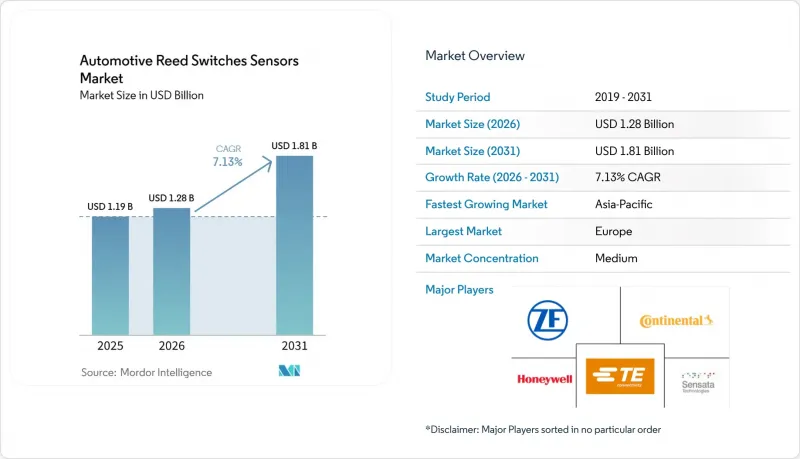
Mordor Intelligence에 의하면, 자동차용 리드 스위치 센서 시장 규모는 2025년에 11억 9,000만 달러로 평가되었습니다. 2026년 12억 8,000만 달러, 2031년 18억 1,000만 달러에 이를 것으로 예측되며, 2026년부터 2031년에 걸쳐 CAGR 7.13%로 성장할 전망입니다.
본 보고서는 차량 시스템(파워트레인 및 배터리 관리, ADAS 및 안전 시스템 등), 실장 유형(표면 실장, 스루홀 등), 차량 유형(승용차, 소형 상용차 등), 판매 채널(OEM 및 애프터마켓), 지역별로 분류되어 있습니다. 시장 규모 및 전망은 금액(달러)으로 표시되어 있습니다.
세계의 자동차용 리드 스위치 센서 시장 동향 및 인사이트
전기차(EV) 생산 증가가 배터리 안전성을 확보하는 리드 스위치 센서 수요를 끌어올리고 있습니다
세계 전기차(EV) 생산 대수는 급격히 증가하는 추세를 보이고 있으며, 현재 모든 고전압 배터리 팩에는 제어 회로와 전원 회로 간의 스파크 없는 절연을 보장하는 여러 개의 리드 스위치가 내장되어 있습니다. 이러한 리드 스위치는 대기 전류가 제로라는 특성 덕분에 주차 중인 차량의 주행 거리를 극대화하고, 엄격한 보증 목표를 충족시키고 있습니다. 콘티넨탈(Continental)사의 최신 전기 모터용 로터 온도 센서는 허용 오차를 ±3°C로 더욱 엄격하게 조정하는 추세를 여실히 보여주고 있습니다. 이를 통해 희토류 자석의 질량을 줄이고 모터의 총 비용을 절감하는 한편, 갈바닉 절연에는 기밀 밀봉된 리드 코어를 채택하고 있습니다. Taifang Technology사는 이미 리드 트리거를 사용하여 충돌로 인한 변형을 감지하고, ECE R100 규격을 준수하는 배터리 지능형 모니터링 시스템을 양산하고 있으며, 이는 EV 안전 기준에서 이러한 스위치가 기본 2차 보호 장치로 통합되어 있음을 보여줍니다. 이 기술의 견고한 자기 감도 덕분에 차량 등급에 따라 배터리 팩의 차폐, 셀 수, 열전도 패드가 다르더라도 정확한 작동을 보장합니다. 이를 통해 각 제조업체는 모듈 절단부 주변에 추가 리드 노드를 통합하고, 예측 유지보수 분석을 지원함으로써 서비스 중심의 새로운 수익원을 개척하고 있습니다.
전 세계적으로 강화되는 수동 안전 규제
규제 당국은 첨단 긴급 제동, 긴급 차선 유지, 운전자 졸음 감지 기능에 대한 도입 일정을 지속적으로 강화하고 있습니다. 2024년 7월부터 시행되고 있는 EU 일반 안전 규정 II에서는 모든 신형 M1 및 N1 차량에 대해 안전벨트 버클과 탑승자 모듈에 이중화된 상태 센서를 탑재할 것을 의무화하고 있으며, 여기서 드라이 리드 접점이 확실한 폐쇄 확인을 제공합니다. 미국 NHTSA(국가도로교통안전국)의 규정에 따르면, 2029년 9월까지 시속 90마일 이하의 속도 범위에서 자동 긴급 제동 장치를 의무화할 예정이며, 야간 성능 기준을 충족하기 위해서는 광학식 및 레이더식 하위 시스템에 대해 고장 시에도 작동하는 백업 장치가 요구됩니다. 이러한 프로그램 전반에 걸쳐 리드 스위치는 주요 솔리드 스테이트 채널에 장애가 발생했을 때 제어 장치에 경고를 발령하는 비용 효율적인 모니터링 장치로 기능합니다. 2024년 5월에 발표된 Euro 7 배기가스 기준에는 조작 방지 기능을 갖춘 차량 진단 포트가 추가되었습니다. 이 포트에는 밀폐된 캡티브 쉘 내에 리드 스위치가 채택되는 경우가 많으며, 이로 인해 이 부품이 장기적인 규정 준수를 확보하는 데 있어 그 역할이 더욱 강화되고 있습니다.
홀 효과 및 AMR 센서의 가격 하락
반도체 비용은 노드 미세화에 따라 예상대로 하락하고 있으며, 이에 따라 홀 효과 센서 공급업체는 더 낮은 시스템 비용으로 신호 조정 기능 및 LIN 버스 출력을 통합할 수 있게 되었습니다. AMR(안티마그네틱 저항) 센서의 다양한 모델은 더 높은 감도와 전극성 감지를 실현하여, 레이아웃 유연성을 추구하는 설계 엔지니어들에게 지지를 받고 있습니다. Allegro MicroSystems사의 최신 TMR-VHT 제품군은 ISO 26262 ASIL D의 자가 진단 요건을 충족하며, 과거에는 디스크리트 소자를 통한 중복 구성이 필요했던 안전 루프에서 기존 리드 스위치 시장 점유율을 점차 잠식하고 있습니다. 솔리드 스테이트 부품에는 여전히 정지 전류가 흐르지만, 연간 8-10%의 비용 절감으로 가격 차이가 좁혀지면서, 제로 전류가 필수적이지 않은 가성비 부문의 차량에서 반도체 솔루션의 채택이 확대되고 있습니다.
부문 분석
2025년, ADAS 및 안전 모듈은 자동차용 리드 스위치 센서 시장 점유율의 34.22%를 차지했으며, 이는 충돌 회피 기능에 페일세이프 센서의 중복성을 통합해야 한다는 규제 당국의 주장을 뒷받침합니다. 파워트레인 및 배터리 관리 분야는 11.98%라는 가장 높은 연평균 성장률(CAGR)을 기록하고 있습니다. 이는 고전압 절연 및 열 폭주 억제 요건을 충족하기 위해 모든 트랙션 배터리 스트링에 여러 개의 리드 스위치가 필요하기 때문입니다. 차체 편의 전자 장치와 관련된 자동차용 리드 스위치 센서 시장 규모는 안정적이며, 시트 레일, 선루프 및 HVAC 댐퍼 감지에 대한 수요가 견조하게 유지되고 있습니다. 인포테인먼트용 인클로저는 각 OEM 업체들이 OTA(Over-the-Air) 소프트웨어 게이트웨이에 대한 변조 방지 접근을 확보함에 따라 적정한 판매량 증가가 예상됩니다.
매출 구성을 살펴보면, 전동화와 안전 규제가 센서 아키텍처에 어떤 영향을 미치고 있는지 알 수 있습니다. 리드 접점은 홀 센서 및 AMR 실리콘과 함께 사용되어, ISO 26262의 독립성 요건을 충족하는 다양한 센싱 트리오를 형성하고 있습니다. 예측 기간 동안, 성장세가 빠른 파워트레인 분야는 ADAS와의 격차를 좁혀갈 전망입니다. 특히, 솔리드 스테이트 배터리 팩에서는 더욱 세밀한 모니터링이 필요하기 때문에 자동차용 리드 스위치 센서 시장은 더욱 확대될 것입니다.
2025년 시점에서 표면 실장 패키지는 자동차용 리드 스위치 센서 시장의 51.48%를 차지했으며, 인건비를 절감하고 더 고밀도 PCB 레이아웃을 가능하게 하는 자동 픽 앤 플레이스 라인의 지원에 힘입어 연평균 성장률(CAGR) 11.25%로 성장을 지속하고 있습니다. 한편, 기계적 고정이 필수적인 고충격 환경의 파워트레인 브래킷에서는 여전히 스루홀 유형이 사용되고 있습니다. 나사 고정식 패널 모듈과 인라인 플러그인은 진단 포트에 사용되어, 차량 운영 사업자가 현장에서 쉽게 교체할 수 있도록 해줍니다.
표면 실장의 기세는 배터리 트레이, 모터 인버터, 스마트 액추에이터 포드 내에 수납된 소형 컨트롤러로의 업계 전환을 반영하고 있습니다. 이러한 하우징에서는 기판과 덮개 사이의 간격이 1mm 미만으로 설정되는 경우가 많아, 얇은 리드 패키지가 선호되고 있습니다. 각 자동차 제조업체가 -40°C에서 150°C의 온도 변동을 견디는 리플로우 대응 솔더 합금을 표준화하고 있기 때문에 표면 실장의 보급률은 다른 모든 실장 방식을 계속해서 앞지를 것이며, 자동차용 리드 스위치 센서 시장 전체에서 그 우위를 더욱 공고히할 것입니다.
지역별 분석
유럽은 중복 감지 및 변조 방지 진단을 의무화하는 엄격한 안전 및 배기가스 규제를 배경으로, 2025년 자동차용 리드 스위치 센서 시장 매출의 27.12%를 차지했습니다. 독일은 통합 수준에서 선도적인 위치를 차지하는 반면, 프랑스와 이탈리아는 차량당 리드 노드 수를 늘리는 배터리식 전기차(BEV) 프로그램을 가속화하고 있습니다. Euro 7 차량 내 모니터링 규정은 밀폐형 리드 스위치가 대응하는 밀폐된 액세스 포인트를 규정함으로써 수요를 더욱 뒷받침하고 있습니다.
아시아태평양은 중국이 전기차 생산에서 압도적인 우위를 보이며 배터리 팩 스위치 수요를 크게 끌어올리고 있어, 연평균 성장률(CAGR) 10.86%로 가장 빠르게 성장하는 지역입니다. 일본은 여전히 센서 기술 강국으로, 48V 아키텍처에 최적화된 소형 리드 스위치 제품군을 정기적으로 출시하고 있습니다. 한국과 인도는 수출 지향적인 자동차 프로그램을 통해 성장세를 보이고 있으며, 저가형에서 프리미엄형에 이르기까지 채택이 확대되고 있습니다.
북미에서는 NHTSA(미국 도로교통안전국)의 제동 규정 및 특정 수입품에 대한 25% 관세를 배경으로 한 부품 공급의 국내 회귀가 영향을 미치며, 견조한 성장이 나타나고 있습니다. 캐나다와 멕시코는 지역별 제조 체계를 통합하여, 미국 OEM 사양에 맞춘 리드 스위치 패키지를 비용 효율적으로 조립하고 있습니다. 대형 차량의 전동화와 자율주행 트럭 실증 실험도 센서 출하량을 끌어올리며, 자동차용 리드 스위치 센서 시장의 범위를 확대되고 있습니다.
기타 혜택 :
- 엑셀 형식 시장 예측(ME) 시트
- 3개월간의 애널리스트 지원
자주 묻는 질문
목차
제1장 서론
제2장 조사 방법
제3장 주요 요약
제4장 시장 구도
제5장 시장 규모 및 성장 예측
제6장 경쟁 구도
제7장 시장 기회 및 향후 전망
KTH 26.08.10According to Mordor Intelligence, the automotive reed switches sensors market size is projected to be USD 1.19 billion in 2025, USD 1.28 billion in 2026, and reach USD 1.81 billion by 2031, growing at a CAGR of 7.13% from 2026 to 2031.
This report is Segmented by Vehicle System (Powertrain & Battery Management, ADAS & Safety Systems, and More), Mounting Type (Surface Mount, Through Hole, and More), Vehicle Type (Passenger Cars, Light Commercial Vehicles, and More), Sales Channel (OEM and Aftermarket) and Geography. The Market Sizes and Forecasts are Provided in Terms of Value (USD).
Global Automotive Reed Switches Sensors Market Trends and Insights
Rising EV production boosts demand for battery-safe reed sensors
World electric-vehicle output continues to rise steeply, and every high-voltage battery pack now integrates multiple reed switches that guarantee spark-free isolation between control and power circuits. Their zero-standby-current characteristic maximizes parked-vehicle range, meeting stringent warranty targets. Continental's latest e-motor rotor temperature sensor illustrates the push toward tighter +-3 °C tolerance, which lowers rare-earth magnet mass and reduces total motor cost while relying on hermetically sealed reed cores for galvanic isolation. Taifang Technology already mass-produces a battery intelligent monitoring system that uses reed triggers to detect collision-induced deformation and still meets ECE R100 compliance, showing how EV safety norms embed these switches as default second-line protectors. The technology's robust magnetic sensitivity assures accurate actuation even when pack shielding, cell count, and thermal pads vary between vehicle trims. Manufacturers thus embed additional reed nodes around module disconnects to support predictive maintenance analytics, opening new service-oriented revenue streams.
Stricter Global Passive-safety Mandates
Regulators continue to tighten timelines for advanced emergency braking, emergency lane keeping and driver-drowsiness detection. The EU General Safety Regulation II, effective since July 2024, compels every new M1 and N1 vehicle to integrate redundant status sensors in seat-belt buckles and occupant modules where dry-reed contacts provide reliable closure verification. The United States NHTSA rule will enforce automatic emergency braking at speeds up to 90 mph by September 2029, with nighttime performance thresholds that demand fail-operational backup for optical and radar subsystems . Across these programs, reed switches serve as cost-effective watchdogs that alert control units when primary solid-state channels fail. Euro 7 emissions standards, released in May 2024, add tamper-proof onboard diagnostics ports that often employ reed switches within sealed captive shells, reinforcing the long-term compliance role of the component.
Hall-effect & AMR sensor price erosion
Semiconductor costs fall predictably with node scaling, enabling Hall-effect suppliers to bundle signal conditioning and LIN bus outputs at lower system cost. AMR variants deliver higher sensitivity and omnipolar detection that appeals to design engineers seeking layout flexibility. Allegro MicroSystems' recent TMR-VHT family meets ISO 26262 ASIL D self-diagnostic coverage, cutting into legacy reed share in safety loops that once required discrete redundancy . Although solid-state parts still draw quiescent current, cost reductions of 8-10% per year narrow the price gap, prompting value-segment vehicles to adopt semiconductor solutions where zero current is not mission-critical.
Other drivers and restraints analyzed in the detailed report include:
- Shift Toward Steer-by-wire & Brake-by-wire Redundancy
- Rapid Proliferation Of Smart Keyless-entry and Door-Latch Systems
- Glass Reed Fragility In Harsh E-axle Vibration
For complete list of drivers and restraints, kindly check the Table Of Contents.
Segment Analysis
ADAS and safety modules accounted for 34.22% of the automotive reed switches/sensors market share in 2025, underscoring regulators' insistence that collision-avoiding functions include fail-safe sensor redundancy. Powertrain & battery management posts the fastest 11.98% CAGR because every traction battery string requires multiple reed switches to satisfy high-voltage isolation and thermal runaway containment. The automotive reed switches market size tied to body-comfort electronics remains stable, with steady demand for seat-track, sunroof, and HVAC-damper detection. Infotainment enclosures add moderate volume as OEMs secure tamper-proof access for over-the-air software gateways.
The revenue mix illustrates how electrification and safety legislation influence sensor architectures. Reed contacts sit alongside Hall and AMR silicon, forming diverse sensing trios that address ISO 26262 independence rules. Over the forecast horizon, the faster-growing powertrain segment will narrow the gap with ADAS, especially when solid-state battery packs require even more granular monitoring, further expanding the automotive reed switches market.
Surface-mount packages accounted for 51.48% of the automotive reed switches/sensors market in 2025 and exhibit an 11.25% CAGR, propelled by automated pick-and-place lines that lower labor cost and enable denser PCB layouts. Through-hole styles persist in high-shock powertrain brackets where mechanical retention is crucial. Threaded-panel modules and inline plug-ins serve diagnostic ports, making field replacement easier for fleet operators.
Surface-mount momentum mirrors the industry shift toward compact controllers housed inside battery trays, motor inverters, and smart-actuator pods. These enclosures frequently allocate less than 1 mm board-to-lid clearance, favoring low-profile reed packages. As automakers standardize on reflow-compatible solder alloys to withstand -40 °C to 150 °C excursions, surface-mount penetration will continue to outpace all other mount styles, reinforcing its lead within the broader automotive reed switches market.
Complete Report Scope:
- By Vehicle System
- Powertrain & Battery Management
- ADAS & Safety Systems
- Body & Comfort Electronics
- Infotainment & Connectivity
- HVAC & Thermal Management
- Others
- By Mounting Type
- Surface Mount
- Through Hole
- Threaded / Panel
- Inline / Plug-in
- By Vehicle Type
- Passenger Cars
- Light Commercial Vehicles
- Medium & Heavy Commercial Vehicles
- Two-Wheelers & Three-Wheelers
- Off-Highway & Special Vehicles
- By Sales Channel
- OEM
- Aftermarket
- By Geography
- North America
- United States
- Canada
- Rest of North America
- South America
- Brazil
- Argentina
- Rest of South America
- Europe
- Germany
- United Kingdom
- France
- Italy
- Spain
- Russia
- Rest of Europe
- Asia-Pacific
- China
- Japan
- India
- South Korea
- Indonesia
- Vietnam
- Philippines
- Australia
- Rest of Asia-Pacific
- Middle East and Africa
- Saudi Arabia
- United Arab Emirates
- Turkey
- South Africa
- Nigeria
- Egypt
- Rest of Middle East and Africa
- North America
Geography Analysis
Europe retained 27.12% of the automotive reed switches/sensors market revenue in 2025 on the back of stringent safety and emissions directives that mandate redundant sensing and tamper-proof diagnostics. Germany leads integration depth, whereas France and Italy accelerate battery-electric programs that embed more reed nodes per vehicle. Euro 7 on-board monitoring rules further anchor demand by stipulating sealed access points that the hermetic reed switch supports.
Asia-Pacific is the fastest-growing region at 10.86% CAGR as China's dominance in EV production drives immense volume for battery pack switches. Japan remains a sensor technology powerhouse, regularly launching compact reed variants optimized for 48-V architectures. South Korea and India add momentum through export-oriented vehicle programs, spreading adoption across budget and premium tiers.
North America shows solid expansion influenced by the NHTSA braking mandate and renewed on-shoring of component supply due to 25% tariffs on selected imports. Canada and Mexico integrate regional manufacturing, providing cost-effective assembly for reed packages tailored to US OEM specifications. Heavy-duty electrification and autonomous trucking pilots also lift sensor volume, broadening the reach of the automotive reed switches market.
- Standex International Corp.
- Littelfuse Inc.
- TE Connectivity Ltd.
- Coto Technology Inc.
- Nippon Aleph Corp.
- ZF Friedrichshafen AG
- Continental AG
- Omron Corporation
- Honeywell International Inc.
- Infineon Technologies AG
- OKI Electric Industry Co.
- Pickering Electronics Ltd.
- Comus International
- Reed Relays & Electronics India Ltd.
- Magnet-Schultz GmbH
- Sensata Technologies Inc.
- Hamlin Electronics Inc. (brand)
- Melexis NV
Additional Benefits:
- The market estimate (ME) sheet in Excel format
- 3 months of analyst support
TABLE OF CONTENTS
1 Introduction
- 1.1 Study Assumptions and Market Definition
- 1.2 Scope of the Study
2 Research Methodology
3 Executive Summary
4 Market Landscape
- 4.1 Market Overview
- 4.2 Market Drivers
- 4.2.1 Rising EV production boosts demand for battery-safe reed sensors
- 4.2.2 Stricter global passive-safety mandates (e.g., UN R152)
- 4.2.3 Shift toward steer-by-wire & brake-by-wire redundancy loops
- 4.2.4 Rapid proliferation of smart keyless-entry & door-latch systems
- 4.2.5 OEM drive for zero-standby-current components
- 4.2.6 Hydrogen fuel-cell vehicle fluid-level monitoring
- 4.3 Market Restraints
- 4.3.1 Hall-effect & AMR sensor price erosion
- 4.3.2 Glass reed fragility in harsh e-axle vibration
- 4.3.3 Supply-chain risk for nickel-iron alloys
- 4.3.4 Upcoming RoHS phase-out of mercury-wetted reeds
- 4.4 Value Chain and Supply-Chain Analysis
- 4.5 Regulatory Landscape
- 4.6 Technological Outlook
- 4.7 Porter's Five Forces
- 4.7.1 Threat of New Entrants
- 4.7.2 Bargaining Power of Buyers
- 4.7.3 Bargaining Power of Suppliers
- 4.7.4 Threat of Substitutes
- 4.7.5 Competitive Rivalry
5 Market Size & Growth Forecasts (Value (USD))
- 5.1 By Vehicle System
- 5.1.1 Powertrain & Battery Management
- 5.1.2 ADAS & Safety Systems
- 5.1.3 Body & Comfort Electronics
- 5.1.4 Infotainment & Connectivity
- 5.1.5 HVAC & Thermal Management
- 5.1.6 Others
- 5.2 By Mounting Type
- 5.2.1 Surface Mount
- 5.2.2 Through Hole
- 5.2.3 Threaded / Panel
- 5.2.4 Inline / Plug-in
- 5.3 By Vehicle Type
- 5.3.1 Passenger Cars
- 5.3.2 Light Commercial Vehicles
- 5.3.3 Medium & Heavy Commercial Vehicles
- 5.3.4 Two-Wheelers & Three-Wheelers
- 5.3.5 Off-Highway & Special Vehicles
- 5.4 By Sales Channel
- 5.4.1 OEM
- 5.4.2 Aftermarket
- 5.5 By Geography
- 5.5.1 North America
- 5.5.1.1 United States
- 5.5.1.2 Canada
- 5.5.1.3 Rest of North America
- 5.5.2 South America
- 5.5.2.1 Brazil
- 5.5.2.2 Argentina
- 5.5.2.3 Rest of South America
- 5.5.3 Europe
- 5.5.3.1 Germany
- 5.5.3.2 United Kingdom
- 5.5.3.3 France
- 5.5.3.4 Italy
- 5.5.3.5 Spain
- 5.5.3.6 Russia
- 5.5.3.7 Rest of Europe
- 5.5.4 Asia-Pacific
- 5.5.4.1 China
- 5.5.4.2 Japan
- 5.5.4.3 India
- 5.5.4.4 South Korea
- 5.5.4.5 Indonesia
- 5.5.4.6 Vietnam
- 5.5.4.7 Philippines
- 5.5.4.8 Australia
- 5.5.4.9 Rest of Asia-Pacific
- 5.5.5 Middle East and Africa
- 5.5.5.1 Saudi Arabia
- 5.5.5.2 United Arab Emirates
- 5.5.5.3 Turkey
- 5.5.5.4 South Africa
- 5.5.5.5 Nigeria
- 5.5.5.6 Egypt
- 5.5.5.7 Rest of Middle East and Africa
- 5.5.1 North America
6 Competitive Landscape
- 6.1 Market Concentration
- 6.2 Strategic Moves
- 6.3 Market Share Analysis
- 6.4 Company Profiles (includes Global Level Overview, Market Level Overview, Core Segments, Financials as Available, Strategic Information, Market Rank/Share for Key Companies, Products and Services, SWOT Analysis, and Recent Developments)
- 6.4.1 Standex International Corp.
- 6.4.2 Littelfuse Inc.
- 6.4.3 TE Connectivity Ltd.
- 6.4.4 Coto Technology Inc.
- 6.4.5 Nippon Aleph Corp.
- 6.4.6 ZF Friedrichshafen AG
- 6.4.7 Continental AG
- 6.4.8 Omron Corporation
- 6.4.9 Honeywell International Inc.
- 6.4.10 Infineon Technologies AG
- 6.4.11 OKI Electric Industry Co.
- 6.4.12 Pickering Electronics Ltd.
- 6.4.13 Comus International
- 6.4.14 Reed Relays & Electronics India Ltd.
- 6.4.15 Magnet-Schultz GmbH
- 6.4.16 Sensata Technologies Inc.
- 6.4.17 Hamlin Electronics Inc. (brand)
- 6.4.18 Melexis NV
7 Market Opportunities & Future Outlook
- 7.1 White-space and Unmet-Need Assessment


