
|
시장보고서
상품코드
2061406
내강 봉합 디바이스 시장 기회, 성장요인, 업계 동향 분석 및 예측(2026-2035년)Endoluminal Suturing Devices Market Opportunity, Growth Drivers, Industry Trend Analysis, and Forecast 2026 - 2035 |
||||||

세계의 내강 봉합 디바이스 시장은 2025년에 8,110만 달러로 평가되며, 2035년까지 CAGR 14.1%로 성장하며, 2억 9,090만 달러에 달할 것으로 예측됩니다.
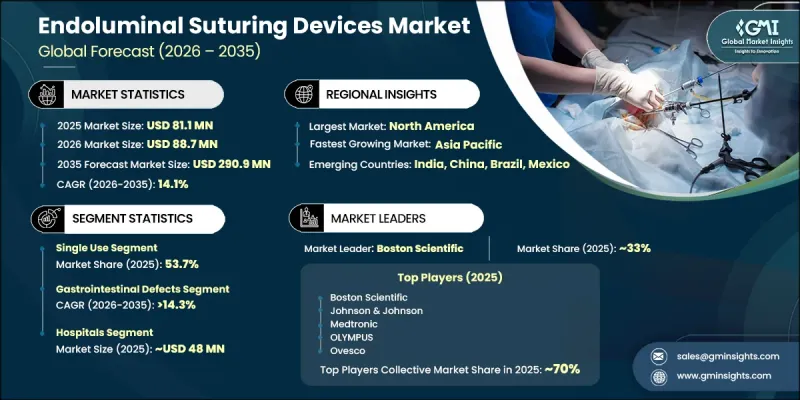
저침습 치료법에 대한 수요 증가와 전 세계 만성질환 유병률의 상승이 시장 확대의 주요 요인으로 작용하고 있습니다. 관강내 봉합 기기는 체내의 관강 경로를 통해 이루어지는 내시경 수술 중 봉합을 수행하기 위해 개발된 첨단 의료기기입니다. 이러한 시스템은 비만 수술이나 소화기 질환 관련 치료를 포함한 소화기 계통 시술시 조직 봉합, 복원 및 고정에 널리 활용되고 있습니다. 고령화 사회에서 저침습 치료에 대한 선호도가 높아지고 있는 점도 시장 성장을 더욱 지원하고 있습니다. 이는 고령자들이 비만과 관련된 합병증이나 첨단 치료 조치가 필요한 소화기 질환에 드는 사례가 증가하고 있기 때문입니다. 장치 기술의 지속적인 혁신을 통해 조직 포착 시스템, 전층 봉합 성능 및 표준 내시경 플랫폼과의 호환성이 향상되었습니다. 이러한 발전으로 인해 결손부 관리, 지혈 처치, 조직 접근, 고정 처치 등 다양한 임상 분야에서 내강 봉합 시스템의 활용 범위가 확대됨과 동시에, 기존의 개복 수술의 필요성이 줄어들고 있습니다.
| 시장 범위 | |
|---|---|
| 시작연도 | 2025년 |
| 예측 기간 | 2026-2035년 |
| 개시 금액 | 8,110만 달러 |
| 예측액 | 2억 9,090만 달러 |
| CAGR | 14.1% |
2025년에는 환자 안전, 감염 예방 및 표준화된 임상 성과에 대한 중요성이 부각되면서 일회용 부문이 53.7%의 점유율을 차지했습니다. 일회용 경관 봉합 기구는 오염 위험을 제거하고 멸균 절차에 수반되는 복잡성을 줄이는 데 도움이 되므로 널리 선호되고 있습니다. 의료진은 치료용 내시경 검사에서 일관된 치료 품질을 유지하기 위해 이러한 제품을 점점 더 많이 도입하고 있습니다. 위생 중심의 의료 실천에 대한 인식이 높아지고, 규정 준수 기준이 강화됨에 따라 병원 및 전문 의료 센터에서 일회용 기기의 도입이 더욱 가속화되고 있습니다.
2025년, 병원 부문은 4,800만 달러의 시장 규모를 기록하며 시장의 주요 최종 용도 부문으로 자리매김했습니다. 병원은 여전히 내강 봉합 시스템이 필요한 고난도 소화기 질환, 비만 치료 및 치료용 내시경 시술의 주요 시행 장소로 자리 잡고 있습니다. 기술적으로 첨단화된 내시경실의 구축, 첨단 훈련을 받은 다직종 팀, 그리고 전문적인 환자 치료 서비스에 대한 접근성이 병원 환경 전반에서 제품 활용을 강화하고 있습니다. 저침습 치료 방식에 대한 관심이 높아지고 시술 효율이 향상된 점도 이러한 기기들이 임상 워크플로우에 널리 도입되는 한 가지 원인이 되고 있습니다.
2025년, 북미의 내강 봉합 기기 시장은 36.3%의 점유율을 차지했습니다. 이 지역 시장은 비만 및 소화기 질환 유병률의 증가에 힘입어 성장하고 있으며, 이에 따라 비침습적 비만 치료 및 치료적 시술에 대한 수요가 지속적으로 증가하고 있습니다. 탄탄한 의료 인프라, 첨단 내시경 기술의 급속한 도입, 그리고 경험이 풍부한 의료 전문가들의 존재가 해당 지역 전체의 시장 발전을 더욱 지원하고 있습니다. 의료 서비스 제공자들은 환자의 회복을 촉진하고, 입원 기간을 단축하며, 치료 성과를 향상시키는 기술을 점점 더 중요하게 여기고 있으며, 이로 인해 북미 전역에서 내강 봉합 시스템에 대한 수요가 더욱 증가하고 있습니다.
자주 묻는 질문
목차
제1장 조사 방법
제2장 개요
제3장 업계 인사이트
제4장 경쟁 구도
제5장 시장 추산·예측 : 제품 유형별, 2022-2035년
제6장 시장 추산·예측 : 용도별, 2022-2035년
제7장 시장 추산·예측 : 최종 사용별, 2022-2035년
제8장 시장 추산·예측 : 지역별, 2022-2035년
제9장 기업 개요
KSA 26.06.24The Global Endoluminal Suturing Devices Market was valued at USD 81.1 million in 2025 and is estimated to grow at a CAGR of 14.1% to reach USD 290.9 million by 2035.
Rising demand for minimally invasive treatment procedures and the increasing incidence of chronic health conditions worldwide are major factors contributing to market expansion. Endoluminal suturing devices are advanced medical instruments developed to place sutures during endoscopic procedures performed through internal luminal pathways. These systems are widely utilized for tissue closure, repair, and fixation during gastrointestinal interventions, including bariatric procedures and treatments associated with digestive disorders. Growing preference for minimally invasive care among aging populations is further supporting market growth, as older adults are increasingly affected by obesity-related complications and gastrointestinal conditions that require advanced therapeutic procedures. Continuous innovation in device technology has improved tissue capture systems, full-thickness suturing performance, and compatibility with standard endoscopic platforms. These advancements have broadened the use of endoluminal suturing systems across multiple clinical applications, including defect management, hemostatic procedures, tissue approximation, and fixation procedures, while reducing the need for conventional open surgeries.
| Market Scope | |
|---|---|
| Start Year | 2025 |
| Forecast Year | 2026-2035 |
| Start Value | $81.1 Million |
| Forecast Value | $290.9 Million |
| CAGR | 14.1% |
The single-use segment accounted for 53.7% share in 2025 due to increasing emphasis on patient safety, infection prevention, and standardized clinical performance. Disposable endoluminal suturing devices have become widely preferred because they help eliminate contamination risks and reduce the complexity associated with sterilization procedures. Healthcare providers are increasingly adopting these products to maintain consistent treatment quality during therapeutic endoscopic procedures. Rising awareness regarding hygiene-focused healthcare practices and stricter compliance standards has further accelerated the adoption of single-use devices across hospitals and specialty care centers.
The hospitals segment generated USD 48 million in 2025, making it the leading end-use category in the market. Hospitals continue to represent the primary setting for advanced gastrointestinal, bariatric, and therapeutic endoscopic procedures that require endoluminal suturing systems. The availability of technologically advanced endoscopy suites, highly trained multidisciplinary teams, and access to specialized patient care has strengthened product utilization across hospital environments. Increasing focus on minimally invasive treatment approaches and improved procedural efficiency has also contributed to the widespread integration of these devices into clinical workflows.
North America Endoluminal Suturing Devices Market accounted for 36.3% share in 2025. The regional market is being driven by the growing prevalence of obesity and gastrointestinal disorders, which continue to increase the demand for minimally invasive bariatric and therapeutic procedures. Strong healthcare infrastructure, rapid adoption of advanced endoscopic technologies, and the presence of experienced medical professionals have further supported market development across the region. Healthcare providers are increasingly prioritizing technologies that improve patient recovery, shorten hospital stays, and enhance treatment outcomes, which continues to strengthen demand for endoluminal suturing systems throughout North America.
Key companies operating in the Endoluminal Suturing Devices Market include Medtronic, Teleflex, Karl Storz, Ovesco, Olympus, Endo Tools Therapeutics, B. Braun, Boston Scientific, Terumo, RICHARD WOLF, Cook Group, ergosuture, LUMENDi, Johnson & Johnson, and USGI MEDICAL. Companies participating in the endoluminal suturing devices market are focusing heavily on technological innovation, strategic collaborations, and product portfolio expansion to strengthen their market position. Manufacturers are investing in advanced suturing platforms with improved tissue handling, enhanced precision, and compatibility with modern endoscopic systems to support complex minimally invasive procedures. Many companies are also expanding their presence through partnerships with hospitals, gastroenterology centers, and healthcare distributors to improve product accessibility across developed and emerging markets. In addition, businesses are emphasizing regulatory approvals, clinician training programs, and research initiatives to improve adoption rates and strengthen brand credibility. Market participants are further concentrating on single-use device development, workflow optimization, and integration with advanced endoscopic technologies to improve procedural efficiency and enhance patient outcomes across healthcare facilities.
Table of Contents
Chapter 1 Research Methodology
- 1.1 Research approach
- 1.2 Quality commitments
- 1.2.1 GMI AI policy & data integrity commitment
- 1.2.1.1 Source consistency protocol
- 1.2.1 GMI AI policy & data integrity commitment
- 1.3 Research trail & confidence scoring
- 1.3.1 Research trail components
- 1.3.2 Scoring components
- 1.4 Data collection
- 1.4.1 Partial list of primary sources
- 1.5 Data mining sources
- 1.5.1 Paid sources
- 1.5.1.1 Sources, by region
- 1.5.1 Paid sources
- 1.6 Base estimates and calculations
- 1.6.1 Base year calculation
- 1.7 Forecast model
- 1.7.1 Quantified market impact analysis
- 1.7.1.1 Mathematical impact of growth parameters on forecast
- 1.7.1 Quantified market impact analysis
- 1.8 Research transparency addendum
- 1.8.1 Source attribution framework
- 1.8.2 Quality assurance metrics
- 1.8.3 Our commitment to trust
Chapter 2 Executive Summary
- 2.1 Industry 360° synopsis
- 2.2 Key market trends
- 2.2.1 Regional trends
- 2.2.2 Product type trends
- 2.2.3 Application trends
- 2.2.4 End use trends
- 2.3 CXO perspectives: Strategic imperatives
Chapter 3 Industry Insights
- 3.1 Industry ecosystem analysis
- 3.2 Industry impact forces
- 3.2.1 Growth drivers
- 3.2.1.1 Rising prevalence of chronic disease across the globe
- 3.2.1.2 Increasing demand for minimally invasive procedures
- 3.2.1.3 Technological advancements
- 3.2.1.4 Rising geriatric population
- 3.2.1.5 Rising demand for outpatient and same-day surgical care
- 3.2.2 Industry pitfalls and challenges
- 3.2.2.1 Stringent regulatory scenario
- 3.2.2.2 Dearth of skilled healthcare professionals
- 3.2.3 Opportunities
- 3.2.3.1 Integration of robotic platforms to simplify procedural workflows
- 3.2.3.2 Development of portable systems tailored for ambulatory surgical centers (ASCs)
- 3.2.1 Growth drivers
- 3.3 Growth potential analysis
- 3.4 Regulatory landscape
- 3.5 Pricing trend analysis
- 3.6 Technology and innovation landscape (Driven by Primary Research)
- 3.6.1 Current technological trends
- 3.6.2 Emerging technologies
- 3.7 Future market trends (Driven by Primary Research)
- 3.8 Patent analysis
- 3.9 Impact of AI & Generative AI on the Market (Driven by Primary Research)
- 3.10 Porter's analysis
- 3.11 PESTEL analysis
Chapter 4 Competitive Landscape, 2025
- 4.1 Introduction
- 4.2 Company matrix analysis
- 4.3 Company market share analysis (Driven by Primary Research)
- 4.3.1 Global
- 4.3.2 North America
- 4.3.3 Europe
- 4.3.4 Asia Pacific
- 4.3.5 LAMEA
- 4.4 Competitive analysis of major market players
- 4.5 Competitive positioning matrix
- 4.6 Key developments
- 4.6.1 Mergers & acquisitions
- 4.6.2 Partnerships & collaborations
- 4.6.3 New product launches
- 4.6.4 Expansion plans
Chapter 5 Market Estimates and Forecast, By Product Type, 2022 - 2035 ($ Mn)
- 5.1 Key trends
- 5.2 Single use
- 5.3 Reusable
Chapter 6 Market Estimates and Forecast, By Application, 2022 - 2035 ($ Mn)
- 6.1 Key trends
- 6.2 Gastrointestinal defects
- 6.3 Bariatric surgery
- 6.4 Gastroesophageal reflux disease (GERD)
- 6.5 Other applications
Chapter 7 Market Estimates and Forecast, By End Use, 2022 - 2035 ($ Mn)
- 7.1 Key trends
- 7.2 Hospitals
- 7.3 Ambulatory surgical centers
- 7.4 Other end users
Chapter 8 Market Estimates and Forecast, By Region, 2022 - 2035 ($ Mn)
- 8.1 Key trends
- 8.2 North America
- 8.2.1 U.S.
- 8.2.2 Canada
- 8.3 Europe
- 8.3.1 Germany
- 8.3.2 UK
- 8.3.3 France
- 8.3.4 Spain
- 8.3.5 Italy
- 8.3.6 Netherlands
- 8.4 Asia Pacific
- 8.4.1 China
- 8.4.2 Japan
- 8.4.3 India
- 8.4.4 Australia
- 8.4.5 South Korea
- 8.5 Latin America
- 8.5.1 Brazil
- 8.5.2 Mexico
- 8.5.3 Argentina
- 8.6 MEA
- 8.6.1 South Africa
- 8.6.2 Saudi Arabia
- 8.6.3 UAE
Chapter 9 Company Profiles
- 9.1 B. Braun
- 9.2 Boston Scientific
- 9.3 Cook Group
- 9.4 Endo Tools Therapeutics
- 9.5 ergosuture
- 9.6 Johnson & Johnson
- 9.7 Karl Storz
- 9.8 LUMENDi
- 9.9 Medtronic
- 9.10 OLYMPUS
- 9.11 Ovesco
- 9.12 RICHARD WOLF
- 9.13 Teleflex
- 9.14 Terumo
- 9.15 USGI MEDICAL