|
시장보고서
상품코드
2071339
비살상 무기 시장 : 기회, 성장요인, 업계 동향 분석 및 예측(2026-2035년)Non-lethal weapons Market Opportunity, Growth Drivers, Industry Trend Analysis, and Forecast 2026 - 2035 |
||||||

세계의 비살상 무기 시장은 2025년에 91억 3,000만 달러로 평가되었고 CAGR 4.6%로 성장하여 2035년까지 167억 8,000만 달러에 이를 것으로 추정되고 있습니다.
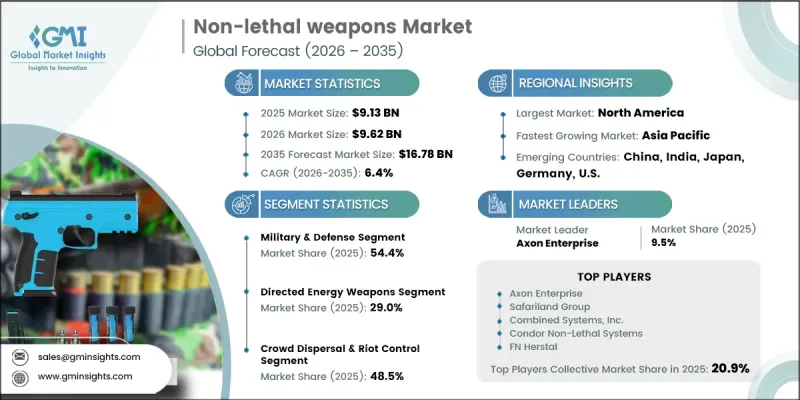
시장 확대는 전 세계적으로 공공 안전에 대한 우려가 커지고, 시민 소요 사태 발생 건수가 증가하며, 국방 및 국토 안보 현대화 프로그램에 대한 투자가 확대됨에 따라 주도되고 있습니다. 정부와 치안 기관은 군중 통제, 법과 질서 유지, 그리고 전술 작전 중 사망이나 영구적 부상의 위험을 줄이기 위해 비치명적 해결책의 도입을 점점 더 확대되고 있습니다. 기술의 발전도 중요한 역할을 하고 있으며, 비치명적 시스템의 정확도, 조작 제어 및 안전 성능이 지속적으로 향상되고 있습니다. 에너지 이용형 시스템, 음향 장치, 그 밖의 첨단 억제 기술 분야의 혁신을 통해 효과성이 향상되는 동시에, 부수적인 피해도 줄어들고 있습니다. 군, 법 집행 기관, 국경 경비 등 각 분야에서 신뢰성이 높고 확장성이 있으며 효율적인 보안 도구에 대한 수요가 증가하고 있습니다. 전반적으로 시장은 변화하는 안보 정세, 현대화 노력, 그리고 전 세계적으로 균형 잡힌 무력 행사 전략의 필요성에 발맞추어 진화하고 있습니다.
| 시장 범위 | |
|---|---|
| 시작 연도 | 2025년 |
| 예측 기간 | 2026-2035년 |
| 시작 연도 시장 규모 | 91억 3,000만 달러 |
| 예측 금액 | 167억 8,000만 달러 |
| CAGR | 4.6% |
2025년, 군 및 방위 부문은 54.4%의 점유율을 차지했습니다. 이러한 압도적인 시장 점유율은 평화유지 활동, 국경 경비, 반란 진압 작전 및 통제된 군중 관리 활동에서 비살상 시스템의 활용이 확대되고 있는 데 기인합니다. 국방비 증액과 현대화 노력에 힘입어 각 군에서 도입이 더욱 가속화되고 있습니다. 작전상의 효율성을 유지하면서 부상을 최소화하는 데 중점을 두는 것이 계속해서 이 부문의 성장을 뒷받침하고 있습니다.
2025년, 지향성 에너지 무기 부문은 29%의 점유율을 차지하며 시장에서 확고한 입지를 유지했습니다. 이 부문의 성장은 정밀하고 장거리에서 제어되는 교전 능력이 필요한 치안 및 방위 작전에서의 배치 증가에 힘입고 있습니다. 이러한 시스템은 작전의 정확도를 높이는 동시에 의도파관 않은 피해를 줄일 수 있다는 점에서 높이 평가받고 있습니다. 차세대 방위 기술에 대한 투자 증가가 이 부문의 성장세를 계속해서 뒷받침하고 있습니다.
북미의 비살상 무기 시장은 2025년에 32.1%의 점유율을 차지하며, 계속해서 주요 지역 시장으로서의 역할을 수행하고 있습니다. 이 지역의 성장은 공공 안전과 작전 준비 태세 강화에 주력하는 군, 법 집행 기관 및 국토안보 기관의 강력한 수요에 힘입어 이끌리고 있습니다. 시민 소요 사태의 발생 빈도 증가와 치안에 대한 우려의 고조도 도입을 더욱 뒷받침하고 있습니다. 방위 및 국경 경비 시스템 전반에 걸친 현대화 프로그램에 대한 지속적인 투자 역시 해당 지역 시장 성장을 뒷받침하고 있습니다.
자주 묻는 질문
목차
제1장 조사 방법과 범위
제2장 주요 요약
제3장 업계 인사이트
제4장 경쟁 구도
제5장 시장 추산 및 예측 : 제품 유형별, 2022-2035년
제6장 시장 추산 및 예측 : 최종 사용자별, 2022-2035년
제7장 시장 추산 및 예측 : 용도별, 2022-2035년
제8장 시장 추산 및 예측 : 지역별, 2022-2035년
제9장 기업 개요
JHS 26.07.01The Global Non-Lethal Weapons Market was valued at USD 9.13 billion in 2025 and is estimated to grow at a CAGR of 4.6% to reach USD 16.78 billion by 2035.
Market expansion is driven by rising global concerns related to public safety, increasing incidents of civil unrest, and growing investments in defense and homeland security modernization programs. Governments and security agencies are increasingly adopting less-lethal solutions to manage crowds, maintain law and order, and reduce the risk of fatalities or permanent injuries during tactical operations. Technological advancements are also playing a critical role, with continuous improvements in precision, operational control, and safety performance of non-lethal systems. Innovations in energy-based systems, acoustic devices, and other advanced deterrent technologies are enhancing effectiveness while reducing collateral damage. The demand for reliable, scalable, and efficient security tools is increasing across military, law enforcement, and border protection applications. Overall, the market is evolving in response to changing security dynamics, modernization initiatives, and the need for balanced force application strategies worldwide.
| Market Scope | |
|---|---|
| Start Year | 2025 |
| Forecast Year | 2026-2035 |
| Start Value | $9.13 Billion |
| Forecast Value | $16.78 Billion |
| CAGR | 4.6% |
The military and defense segment held a 54.4% share in 2025. This dominance is attributed to the growing use of less-lethal systems for peacekeeping missions, border protection, counter-insurgency operations, and controlled crowd management activities. Increased defense spending and modernization initiatives are further strengthening adoption across armed forces. The emphasis on minimizing injuries while maintaining operational effectiveness continues to support segment expansion.
The directed energy weapons segment accounted for 29% share in 2025, maintaining a strong position in the market. Growth in this category is supported by increasing deployment across security and defense operations that require precise, long-range, and controlled engagement capabilities. These systems are valued for their ability to reduce unintended damage while improving operational accuracy. Rising investment in next-generation defense technologies continues to reinforce segment momentum.
North America Non-Lethal Weapons Market captured 32.1% share in 2025 and remains a key regional contributor. Growth in the region is driven by strong demand from military forces, law enforcement agencies, and homeland security organizations focused on enhancing public safety and operational preparedness. Increasing occurrences of civil disturbances and rising security concerns are further encouraging adoption. Continuous investment in modernization programs across defense and border protection systems is also supporting regional market growth.
Key companies operating in the Global Non-Lethal Weapons Market include Rheinmetall Defence, Axon, Safariland Group, General Dynamics, Brugger & Thomet, FN Herstal, Combined Systems, Inc., Condor Non-Lethal Systems, Defentec GmbH, EnforceTac GmbH, Eurasia Non-Lethal Systems, FLIR Systems, Laser Technology GmbH, Magforce, NEXTER Systems, Nonlethal Technologies Ltd., POLICE Systems Ltd., Amaron Systems, Harris Corporation (L3 Technologies), and Trellisware Technologies. Companies in the non-lethal weapons market are strengthening their competitive position through continuous technological innovation, strategic defense collaborations, and expansion of product portfolios. A key focus is placed on developing advanced systems with improved accuracy, safety, and operational control to meet evolving security requirements. Firms are investing heavily in research and development to enhance directed energy systems, acoustic technologies, and advanced crowd-control solutions. Partnerships with defense agencies, law enforcement bodies, and homeland security organizations are helping companies secure long-term contracts and improve market penetration. Expansion into emerging defense markets is also a key strategy, supported by localized production and distribution networks. Companies are further emphasizing compliance with regulatory frameworks and international safety standards to ensure broader adoption.
Table of Contents
Chapter 1 Methodology and Scope
- 1.1 Market scope and definition
- 1.2 Research design
- 1.2.1 Research approach
- 1.2.2 Data collection methods
- 1.3 Data mining sources
- 1.3.1 Global
- 1.3.2 Regional/Country
- 1.4 Base estimates and calculations
- 1.4.1 Base year calculation
- 1.4.2 Key trends for market estimation
- 1.5 Primary research and validation
- 1.5.1 Primary sources
- 1.6 Forecast model
- 1.7 Research assumptions and limitations
Chapter 2 Executive Summary
- 2.1 Industry 360° synopsis, 2022 - 2035
- 2.2 Key market trends
- 2.2.1 Product Type trends
- 2.2.2 Application trends
- 2.2.3 End-user industry trends
- 2.2.4 Regional trends
- 2.3 TAM Analysis, 2026-2035
- 2.4 CXO perspectives: Strategic imperatives
Chapter 3 Industry Insights
- 3.1 Industry ecosystem analysis
- 3.1.1 Supplier Landscape
- 3.1.2 Profit Margin
- 3.1.3 Cost structure
- 3.1.4 Value addition at each stage
- 3.1.5 Factor affecting the value chain
- 3.1.6 Disruptions
- 3.2 Industry impact forces
- 3.2.1 Growth drivers
- 3.2.1.1 Increasing incidents of civil unrest and crowd control requirements
- 3.2.1.2 Growing focus on reducing fatalities and human rights concerns
- 3.2.1.3 Rising defense and homeland security investments
- 3.2.1.4 Technological advancements in non-lethal weapon systems
- 3.2.1.5 Increasing demand for civilian self-defense products
- 3.2.2 Industry pitfalls and challenges
- 3.2.2.1 Risk of misuse and accidental injuries
- 3.2.2.2 Stringent regulations and ethical concerns
- 3.2.3 Market opportunities
- 3.2.3.1 Growing adoption of smart and connected non-lethal technologies
- 3.2.3.2 Expansion in emerging economies and border security programs
- 3.2.1 Growth drivers
- 3.3 Growth potential analysis
- 3.4 Regulatory landscape
- 3.4.1 North America
- 3.4.2 Europe
- 3.4.3 Asia Pacific
- 3.4.4 Latin America
- 3.4.5 Middle East & Africa
- 3.5 Porter's analysis
- 3.6 PESTEL analysis
- 3.7 Technology and Innovation landscape
- 3.7.1 Current technological trends
- 3.7.2 Emerging technologies
- 3.8 Price trends
- 3.8.1 By region
- 3.8.2 By product
- 3.9 Pricing Strategies
- 3.10 Emerging Business Models
- 3.11 Compliance Requirements
- 3.12 Patent and IP analysis
Chapter 4 Competitive Landscape, 2025
- 4.1 Introduction
- 4.2 Company market share analysis
- 4.2.1 By region
- 4.2.1.1 North America
- 4.2.1.2 Europe
- 4.2.1.3 Asia Pacific
- 4.2.1.4 Latin America
- 4.2.1.5 Middle East & Africa
- 4.2.2 Market concentration analysis
- 4.2.1 By region
- 4.3 Competitive benchmarking of key players
- 4.3.1 Financial performance comparison
- 4.3.1.1 Revenue
- 4.3.1.2 Profit margin
- 4.3.1.3 R&D
- 4.3.2 Product portfolio comparison
- 4.3.2.1 Product range breadth
- 4.3.2.2 Technology
- 4.3.2.3 Innovation
- 4.3.3 Geographic presence comparison
- 4.3.3.1 Global footprint analysis
- 4.3.3.2 Service network coverage
- 4.3.3.3 Market penetration by region
- 4.3.4 Competitive positioning matrix
- 4.3.4.1 Leaders
- 4.3.4.2 Challengers
- 4.3.4.3 Followers
- 4.3.4.4 Niche players
- 4.3.5 Strategic outlook matrix
- 4.3.1 Financial performance comparison
- 4.4 Key developments
- 4.4.1 Mergers and acquisitions
- 4.4.2 Partnerships and collaborations
- 4.4.3 Technological advancements
- 4.4.4 Expansion and investment strategies
- 4.4.5 Digital transformation initiatives
- 4.5 Emerging/ startup competitors landscape
Chapter 5 Market Estimates and Forecast, By Product Type, 2022 - 2035 (USD Billion)
- 5.1 Key trends
- 5.2 Directed Energy Weapons
- 5.2.1 Active Denial Systems (ADS)
- 5.2.2 Laser Dazzlers
- 5.2.3 Microwave-Based Systems
- 5.2.4 Others
- 5.3 Electroshock Weapons
- 5.3.1 Tasers & Conducted Energy Devices (CEDs)
- 5.3.2 Stun Guns
- 5.3.3 Stun Batons
- 5.4 Chemical Irritants
- 5.4.1 Pepper Spray (Oleoresin Capsicum)
- 5.4.2 Tear Gas (CS/CN)
- 5.4.3 Others
- 5.5 Blunt Impact Munitions
- 5.5.1 Rubber Bullets
- 5.5.2 Bean Bag Rounds
- 5.5.3 Foam Projectiles
- 5.5.4 Baton Rounds
- 5.5.5 Others
- 5.6 Acoustic Weapons
- 5.6.1 Long Range Acoustic Devices (LRAD)
- 5.6.2 Sonic Hailing Devices
- 5.7 Optical Distracters
- 5.7.1 Flashbangs & Stun Grenades
- 5.7.2 Laser-Based Optical Distractors
- 5.8 Entanglement Systems
- 5.8.1 Net Guns
- 5.8.2 Vehicle Barriers & Stopping Equipment
- 5.8.3 Immobilization Traps
- 5.8.4 Others
- 5.9 Others
Chapter 6 Market Estimates and Forecast, By End User, 2022 - 2035 (USD Billion)
- 6.1 Key trends
- 6.2 Military & Defense
- 6.3 Law Enforcement
- 6.4 Civilian & Personal Defense
Chapter 7 Market Estimates and Forecast, By Application, 2022 - 2035 (USD Billion)
- 7.1 Key trends
- 7.2 Crowd Dispersal & Riot Control
- 7.3 Perimeter Security & Area Denial
- 7.4 Personal Protection & Self-Defense
- 7.5 Others
Chapter 8 Market Estimates and Forecast, By Region, 2022 - 2035 (USD Billion)
- 8.1 Key trends
- 8.2 North America
- 8.2.1 U.S.
- 8.2.2 Canada
- 8.3 Europe
- 8.3.1 Germany
- 8.3.2 UK
- 8.3.3 France
- 8.3.4 Spain
- 8.3.5 Italy
- 8.4 Asia Pacific
- 8.4.1 China
- 8.4.2 India
- 8.4.3 Japan
- 8.4.4 Australia
- 8.4.5 South Korea
- 8.5 Latin America
- 8.5.1 Brazil
- 8.5.2 Mexico
- 8.5.3 Argentina
- 8.6 Middle East and Africa
- 8.6.1 South Africa
- 8.6.2 Saudi Arabia
- 8.6.3 UAE
Chapter 9 Company Profiles
- 9.1 Global Key Players
- 9.1.1 Axon Enterprise
- 9.1.2 Safariland Group
- 9.1.3 Combined Systems, Inc.
- 9.1.4 Condor Non-Lethal Systems
- 9.1.5 FN Herstal
- 9.2 Regional key players
- 9.2.1 North America
- 9.2.1.1 General Dynamics
- 9.2.1.2 FLIR Systems
- 9.2.1.3 L3Harris Technologies
- 9.2.2 Asia Pacific
- 9.2.2.1 Amaron Systems
- 9.2.2.2 Magforce
- 9.2.2.3 Eurasia Non-Lethal Systems
- 9.2.2.4 Europe
- 9.2.2.5 Rheinmetall Defence
- 9.2.2.6 Brugger & Thomet
- 9.2.1 North America
- 9.3 Niche Players/Disruptors
- 9.3.1 Defentec GmbH
- 9.3.2 Nonlethal Technologies Ltd.