

|
시장보고서
상품코드
2071367
섬유기계 시장 기회, 성장 촉진요인, 산업 동향 분석, 예측(2026-2035년)Textile Machinery Market Opportunity, Growth Drivers, Industry Trend Analysis, and Forecast 2026 - 2035 |
||||||

세계의 섬유기계 시장은 2025년에 340억 달러 규모에 달하고, CAGR 5.3%로 성장하여 2035년까지 568억 달러에 달할 것으로 추정됩니다.
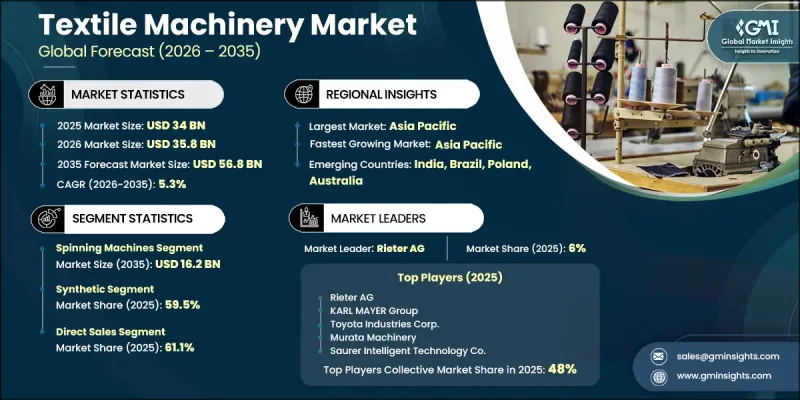
시장의 성장은 전 세계 섬유 제조 업계 전반에 걸쳐 자동화, 디지털화 및 고효율 생산 시스템으로의 강력한 전환에 힘입어 이루어지고 있습니다. 각 제조사는 생산성, 정밀도 및 업무 효율을 높이는 동시에 인력 의존도를 낮추기 위해 첨단 기계 도입을 더욱 적극적으로 추진하고 있습니다. 이러한 전환은 생산상의 실수를 최소화하고 제품 전반의 품질을 향상시키는 데에도 기여하고 있으며, 생산자가 끊임없이 변화하는 산업계와 소비자의 기대에 부응할 수 있도록 하고 있습니다. 이와 더불어, IoT 지원 시스템 및 인더스트리 4.0 기술의 통합을 통해 실시간 성과 추적, 예측 유지보수 기능, 데이터 기반 공정 최적화를 바탕으로 섬유 제조 업무가 혁신되고 있습니다. 이러한 발전은 제조 효율을 대폭 향상시켜, 더욱 스마트한 생산 생태계를 뒷받침하고 있습니다. 또한, 보호용 원단, 의료용 섬유, 지오텍스타일 등의 분야에서 기능성 및 엔지니어링 섬유에 대한 수요가 증가하고 있으며, 이는 부직포 및 편직 시스템 등의 특수 기계에 대한 수요를 견인하고 있습니다. 이러한 성장은 진행 중인 산업 현대화, 신흥 지역의 생산능력 확대, 그리고 전 세계 섬유 생산 네트워크에서 이루어지는 지속적인 기술 혁신에 힘입어 더욱 가속화되고 있습니다.
| 시장 범위 | |
|---|---|
| 시작 연도 | 2025년 |
| 예측 기간 | 2026-2035년 |
| 초기 시장 규모 | 340억 달러 |
| 예측액 | 568억 달러 |
| CAGR | 5.3% |
방적 기계 부문은 2025년에 104억 달러의 시장 규모를 기록했으며, 2035년까지 162억 달러에 달할 것으로 전망됩니다. 섬유 제조업체들이 다양한 용도에 걸쳐 안정적이고 고품질의 원사 생산에 주력하고 있는 만큼, 방적 기계에 대한 수요는 계속해서 견조한 양상을 보이고 있습니다. 최신 시스템에는 자동 도프 기능, 통합된 품질 관리 시스템, 그리고 에너지 효율이 뛰어난 구동 기술이 점점 더 많이 탑재되고 있습니다. 이러한 기능들은 대규모의 연속적인 실 생산을 뒷받침하는 동시에 가동 신뢰성을 높여줍니다. 이 부문은 전 세계 섬유 생산량의 증가와 생산성을 중시하는 제조 설비에 대한 지속적인 투자에 힘입어 꾸준한 성장을 이어갈 것으로 예상됩니다.
2025년에는 직접 판매 채널이 61.1%의 점유율을 차지했으며, 섬유기계 조달이 고도의 기술과 막대한 자본을 필요로 한다는 특성 덕분에 그 주도적인 위치를 유지했습니다. 구매 결정에는 대개 맞춤형 구성, 기술 상담 및 설치 후의 종합적인 지원이 필요하며, 이러한 사항들은 제조업체와의 직접적인 협력을 통해 가장 적절하게 관리됩니다. 이 모델은 기계의 사양과 최종사용자의 생산 요건 간의 일관성을 높이는 데에도 기여합니다. 구매자는 일반적으로 상세한 시연, 설치 지원 및 교육 지원을 필요로 하며, 이는 기계의 최적의 성능과 통합을 보장하는 데 있어 직접 판매 관계의 중요성을 더욱 높여줍니다.
2025년, 미국의 섬유기계 시장은 74.2%의 점유율을 차지했습니다. 이 나라의 시장 수요는 국내 섬유 생산의 지속적인 현대화와 새로운 생산능력에 대한 투자를 촉진하는 니어쇼어링 활동의 확대에 힘입어 지탱되고 있습니다. 제조 규모는 아시아의 주요 거점에 비해 작지만, 미국의 생산자들은 기술 섬유, 고부가가치 특수 제품 및 자동화 제조 시스템에 집중하고 있습니다. 생산성, 지속가능성, 품질 향상에 대한 이러한 집중적인 노력이 해당 지역 전체에서 첨단 섬유기계 솔루션에 대한 수요를 지속적으로 견인하고 있습니다.
자주 묻는 질문
목차
제1장 조사 방법
제2장 주요 요약
제3장 업계 인사이트
제4장 경쟁 구도
제5장 시장 추정 및 예측 : 유형별, 2022-2035년
제6장 시장 추정 및 예측 : 소재별, 2022-2035년
제7장 시장 추정 및 예측 : 조작별, 2022-2035년
제8장 시장 추정 및 예측 : 용도별, 2022-2035년
제9장 시장 추정 및 예측 : 유통 채널별, 2022-2035년
제10장 시장 추정 및 예측 : 지역별, 2022-2035년
제11장 기업 개요
KSM 26.07.03The Global Textile Machinery Market was valued at USD 34 billion in 2025 and is estimated to grow at a CAGR of 5.3% to reach USD 56.8 billion by 2035.
Market growth is being shaped by a strong shift toward automation, digitalization, and high-efficiency production systems across global textile manufacturing. Manufacturers are increasingly adopting advanced machinery to improve productivity, precision, and operational efficiency while reducing reliance on manual labor. This transition is also helping minimize production errors and improve overall product quality, enabling producers to meet evolving industrial and consumer expectations. In parallel, the integration of IoT-enabled systems and Industry 4.0 technologies is transforming textile operations through real-time performance tracking, predictive maintenance capabilities, and data-driven process optimization. These developments are significantly improving manufacturing efficiency and supporting smarter production ecosystems. Additionally, demand for functional and engineered textiles is rising across applications such as protective fabrics, medical textiles, and geotextiles, which is driving the need for specialized machinery such as non-woven and knitting systems. Growth is further reinforced by ongoing industrial modernization, capacity expansion in emerging regions, and continuous technological innovation across textile production networks worldwide.
| Market Scope | |
|---|---|
| Start Year | 2025 |
| Forecast Year | 2026-2035 |
| Start Value | $34 Billion |
| Forecast Value | $56.8 Billion |
| CAGR | 5.3% |
The spinning machines segment generated USD 10.4 billion in 2025 and is anticipated to reach USD 16.2 billion by 2035. Demand for spinning machinery remains strong as textile manufacturers focus on producing consistent, high-quality yarn across a wide range of applications. Modern systems are increasingly equipped with automated doffing functions, integrated quality control mechanisms, and energy-efficient drive technologies. These capabilities support large-scale continuous yarn production while enhancing operational reliability. The segment is expected to maintain steady expansion, supported by rising global textile output and continued investment in productivity-focused manufacturing equipment.
The direct sales channel accounted for 61.1% share in 2025, maintaining its leading position due to the highly technical and capital-intensive nature of textile machinery procurement. Purchasing decisions often require customized configurations, technical consultation, and comprehensive post-installation support, which are best managed through direct manufacturer engagement. This model also enables better alignment between machine specifications and end-user production requirements. Buyers typically rely on detailed demonstrations, installation assistance, and training support, further reinforcing the importance of direct sales relationships in ensuring optimal machine performance and integration.
United States Textile Machinery Market accounted for 74.2% share in 2025. Market demand in the country is supported by ongoing modernization of domestic textile production and increasing nearshoring activities that encourage new capacity investments. Although manufacturing scale is smaller compared to major Asian hubs, U.S. producers are strongly focused on technical textiles, high-value specialty products, and automated manufacturing systems. This emphasis on productivity, sustainability, and quality enhancement continues to drive demand for advanced textile machinery solutions across the region.
Key companies operating in the global textile machinery industry include Rieter AG, Picanol NV, Toyota Industries Corp., KARL MAYER Group, Itema Group, Trutzschler Group SE, Saurer Intelligent Technology Co., Murata Machinery, Shima Seiki MFG., Ltd., Vandewiele Group, Bruckner Textile Technologies, Benninger AG, Tsudakoma Corp., Thies GmbH & Co. KG, Mayer & Cie. Global, CHTC Fong's International, Kornit Digital Ltd., SPGPrints B.V., LMW Limited, Mimaki Engineering Co., Ltd., and Staubli International AG. Companies in the textile machinery market are increasingly focusing on digital transformation by integrating automation, IoT systems, and Industry 4.0 solutions into their product portfolios to enhance efficiency and precision. Many manufacturers are strengthening R&D investments to develop energy-efficient, high-performance machines capable of supporting advanced textile applications. Strategic collaborations with textile producers are being used to customize machinery solutions and improve long-term customer relationships. Firms are also expanding after-sales services, including training, maintenance, and technical support, to improve customer retention.
Table of Contents
Chapter 1 Research Methodology
- 1.1 Research approach
- 1.2 Quality Commitments
- 1.2.1 GMI AI policy & data integrity commitment
- 1.2.1.1 Source consistency protocol
- 1.2.1 GMI AI policy & data integrity commitment
- 1.3 Research Trail & Confidence Scoring
- 1.3.1 Research Trail Components
- 1.3.2 Scoring Components
- 1.4 Data Collection
- 1.4.1 Partial list of primary sources
- 1.5 Data mining sources
- 1.5.1 Paid sources
- 1.5.1.1 Sources, by region
- 1.5.1 Paid sources
- 1.6 Base estimates and calculations
- 1.6.1 Base year calculation for any one approach
- 1.7 Forecast model
- 1.7.1 Quantified market impact analysis
- 1.7.1.1 Mathematical impact of growth parameters on forecast
- 1.7.1 Quantified market impact analysis
- 1.8 Research transparency addendum
- 1.8.1 Source attribution framework
- 1.8.2 Quality assurance metrics
- 1.8.3 Our commitment to trust
Chapter 2 Executive Summary
- 2.1 Industry 360° synopsis, 2022 - 2035
- 2.2 Key market trends
- 2.2.1 Regional
- 2.2.2 Type
- 2.2.3 Material
- 2.2.4 Operation
- 2.2.5 Application
- 2.2.6 Distribution Channel
Chapter 3 Industry Insights
- 3.1 Industry ecosystem analysis
- 3.1.1 Factor affecting the value chain
- 3.1.2 Profit margin analysis
- 3.1.3 Disruptions
- 3.1.4 Future outlook
- 3.1.5 Manufacturers
- 3.1.6 Distributors
- 3.2 Supplier landscape
- 3.3 Key news & initiatives
- 3.4 Technology & Innovation Landscape
- 3.5 Regulatory landscape
- 3.6 Impact on forces
- 3.6.1 Growth drivers
- 3.6.2 Industry pitfalls & challenges
- 3.6.3 Opportunities
- 3.7 Pricing analysis, 2025 (driven by primary research)
- 3.7.1 Historical price trend analysis (2022-2025)
- 3.7.2 Pricing strategy by player type (premium/value/cost-plus)
- 3.7.3 Regional price variation analysis
- 3.7.4 Impact of raw material costs on pricing
- 3.8 Growth potential analysis
- 3.9 Porter's analysis
- 3.10 PESTEL analysis
- 3.11 Trade data analysis (driven by paid database)
- 3.11.1 Import/export volume & value trends (Driven by Primary Research)
- 3.11.2 Key trade corridors & tariff impact (Driven by Primary Research)
- 3.12 Impact of AI & generative AI on the market
- 3.12.1 AI-driven disruption of existing business models
- 3.12.2 GenAI use cases & adoption roadmap by segment
- 3.12.3 Risks, limitations & regulatory considerations
- 3.13 Capacity & Production Landscape (Driven by Primary Research)
- 3.13.1 Installed Capacity by Region & Key Producer (Driven by Primary Research)
- 3.13.2 Capacity Utilization Rates & Expansion Pipelines (Driven by Primary Research)
Chapter 4 Competitive Landscape, 2025
- 4.1 Introduction
- 4.2 Company market share analysis
- 4.3 Competitive positioning matrix
- 4.4 Strategic outlook matrix
- 4.5 Competitive analysis of major market players
- 4.6 Key developments
- 4.6.1 Mergers & acquisitions
- 4.6.2 Partnerships & collaborations
- 4.6.3 New product launches
- 4.6.4 Expansion plans
Chapter 5 Market Estimates & Forecast, By Type, 2022-2035 (USD Billion) (Thousand Units)
- 5.1 Key Trends
- 5.2 Spinning Machines
- 5.3 Weaving Machines
- 5.4 Dyeing & finishing machines
- 5.5 Knitting Machines
- 5.6 Printing Machines
- 5.7 Others
Chapter 6 Market Estimates & Forecast, By Material, 2022-2035 (USD Billion) (Thousand Units)
- 6.1 Key Trends
- 6.2 Synthetic
- 6.3 Natural
Chapter 7 Market Estimates & Forecast, By Operation, 2022-2035 (USD Billion) (Thousand Units)
- 7.1 Key Trends
- 7.2 Automatic
- 7.3 Semi-automatic
Chapter 8 Market Estimates & Forecast, By Application, 2022 - 2035, (USD Billion) (Thousand Units)
- 8.1 Key Trends
- 8.2 Garments and apparel
- 8.3 Household and home textiles
- 8.4 Technical textiles
- 8.5 Others
Chapter 9 Market Estimates & Forecast, By Distribution Channel, 2022 - 2035, (USD Billion) (Thousand Units)
- 9.1 Key Trends
- 9.2 Direct Sales
- 9.3 Indirect Sales
Chapter 10 & Forecast, By Region, 2022 - 2035, (USD Billion) (Thousand Units)
- 10.1 Key trends
- 10.2 North America
- 10.2.1 U.S.
- 10.2.2 Canada
- 10.3 Europe
- 10.3.1 Germany
- 10.3.2 U.K.
- 10.3.3 France
- 10.3.4 Italy
- 10.3.5 Spain
- 10.4 Asia Pacific
- 10.4.1 China
- 10.4.2 India
- 10.4.3 Japan
- 10.4.4 South Korea
- 10.4.5 Australia
- 10.5 Latin America
- 10.5.1 Brazil
- 10.5.2 Mexico
- 10.5.3 Argentina
- 10.6 MEA
- 10.6.1 UAE
- 10.6.2 Saudi Arabia
- 10.6.3 South Africa
Chapter 11 Company Profiles (Business Overview, Financial Data, Product Landscape, Strategic Outlook, SWOT Analysis)
- 11.1 Global players
- 11.1.1 Rieter AG
- 11.1.2 KARL MAYER Group
- 11.1.3 Picanol NV
- 11.1.4 Trutzschler Group SE
- 11.1.5 Itema Group
- 11.1.6 Shima Seiki MFG., Ltd.
- 11.1.7 Staubli International AG
- 11.2 Regional players
- 11.2.1 CHTC Fong's International
- 11.2.2 Bruckner Textile Technologies
- 11.2.3 Toyota Industries Corp.
- 11.2.4 Murata Machinery
- 11.2.5 Kornit Digital Ltd.
- 11.2.6 Mimaki Engineering Co., Ltd.
- 11.2.7 LMW Limited
- 11.2.8 Saurer Intelligent Technology Co.
- 11.3 Emerging players
- 11.3.1 Vandewiele Group
- 11.3.2 Benninger AG
- 11.3.3 Thies GmbH & Co. KG
- 11.3.4 Tsudakoma Corp.
- 11.3.5 Mayer & Cie. Global
- 11.3.6 SPGPrints B.V.


