

|
시장보고서
상품코드
2116602
환편기 시장 : 점유율 분석, 업계 동향과 통계, 성장 예측(2026-2031년)Circular Knitting Machine - Market Share Analysis, Industry Trends & Statistics, Growth Forecasts (2026 - 2031) |
||||||
 Mordor Intelligence
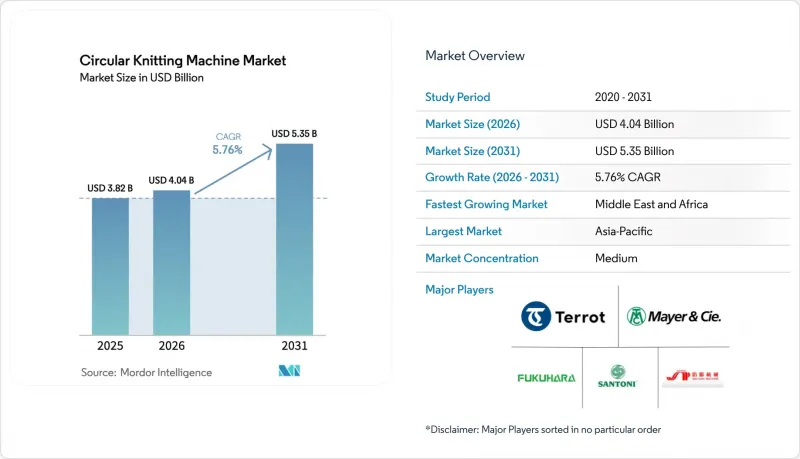
Mordor Intelligence에 의하면, 환편기 시장 규모는 2025년 38억 2,000만 달러에서 2026년에는 40억 4,000만 달러로 확대되어 2026년부터 2031년까지 CAGR 5.76%로 성장을 지속하여, 2031년에는 53억 5,000만 달러에 이를 것으로 예측됩니다.
본 보고서는 기계 유형(하이브리드/컨버터블 기계 등), 게이지(세 게이지(24 이상) 등), 직경(소형(15인치 미만), 기타), 자동화 수준(기계 제어, 기타), 용도(의류·섬유, 기타),원사 유형(면, 기타), 지역(북미, 기타)별로 분류되어 있습니다. 시장 예측은 금액(달러)으로 제시되어 있습니다.
세계 환편기 시장 동향 및 인사이트
심리스/애슬레저 의류에 대한 수요 증가
애슬레저 시장의 구조적 확대가 신규 기계 구매를 촉진하고 있습니다. 이는 심리스 기술로 인해 비용 증가와 착용감 저하를 초래하는 재단 및 봉제 공정이 불필요해지기 때문입니다. 산토니(Santoni)사의 고게이지 플랫폼은 압축 구역과 인체공학 구역을 한 번의 공정으로 편직하여, 부드러우면서도 내구성이 뛰어난 의류를 생산함으로써 프리미엄 가격 책정이 가능하게 합니다. 스포츠웨어 브랜드들은 로고나 통기 구역을 원단 튜브에 직접 직조하기 위해 전자 자카드 헤드의 채택을 점점 더 늘리고 있으며, 이를 통해 스타일 리뉴얼에 소요되는 리드 타임이 단축되고 있습니다. 일상복에서 편안함과 기능성이 융합됨에 따라, 원단 제조업체들은 초극세사에 대응하기 위해 기존 생산 라인에 멀티 게이지 실린더를 도입하고 있습니다. 또한, 심리스 패션은 원단 폐기물을 줄이고, 소매업체들이 규정 준수 보고서에서 면밀히 추적하고 있는 지속가능성 지표의 향상에도 기여하고 있습니다.
편직 공정의 자동화 및 디지털화
인더스트리 4.0의 통합으로 현장 관리 체제가 새롭게 바뀌고 있습니다. Pailung사의 제조 실행 시스템(MES)은 캠 조정을 모두 기록하여 전 세계 공장에서 원단을 정확하게 재현할 수 있게 해줍니다. IoT 센서가 실의 장력, 온도, 진동 데이터를 클라우드 분석 시스템으로 전송하여, 생산 라인이 중단되기 몇 시간 전에 문제를 예측합니다. 디지털 트윈을 통해 기술자는 새로운 편직 밀도를 가상으로 시험해 볼 수 있어, 비용이 많이 드는 샘플 제작 과정을 대폭 줄일 수 있습니다. 컴퓨터 비전이 최고 속도로 결함을 감지하므로, 완벽한 롤만 염색 공정으로 넘어갑니다. 일부 사업장에서 인력 부족이 심화되는 가운데, 자율적인 레시피 제어는 더 이상 선택 사항이 아니라 가동 시간을 확보하고 인력 리스크를 완화하는 중요한 역할을 하고 있습니다.
막대한 초기 설비 투자
완전한 ‘인더스트리 4.0’을 지원하는 원형 편직 라인의 비용은 1,500만-5,000만 달러이며, 여기에는 고속 실린더, 권취 장치, 검사 장치 및 디지털 백엔드가 포함됩니다. 중소기업은 특히 인프라 임대 체계가 갖춰지지 않은 지역에서 자금 조달에 어려움을 겪고 있습니다. 기술의 주기가 빠르기 때문에 5년 이내에 설비가 구식으로 느껴질 가능성이 있어 리스크가 확대됩니다. 그 결과, 일부 구매자는 업그레이드를 미루거나 기능을 최소화한 모델을 선택하고 있으며, 유연한 ‘사용량 기반 과금제’ 플랜이 보급되기 전까지는 시장 확대가 둔화될 것입니다.
부문 분석
2025년, 싱글 실린더식 환편기는 시장 점유율의 53.00%를 차지했습니다. 그 이유는 단순한 캠 기구 덕분에 티셔츠, 속옷, 침대 시트 등의 생산에서 높은 야드/분(YPM)을 실현할 수 있기 때문입니다. 특수 자카드 플랫폼용 환편기 시장 규모는 현재로서는 작지만, 패션 브랜드들이 평균 판매 가격을 끌어올릴 수 있는 복잡한 모티프를 추구하고 있기 때문에 이 틈새 시장은 연평균 성장률(CAGR) 6.92%로 확대되고 있습니다. 최신 자카드 헤드는 각 바늘에 마이크로 스텝 모터를 채택하고 있어, 패턴이 하드웨어 플레이트가 아닌 소프트웨어를 통해 변경되므로 설정 시간을 몇 분으로 단축할 수 있습니다. 웰니트(Wellknit)사의 이중 컴퓨터 제어 자카드 모델은 트리플 액션 편직을 특징으로 하며, 공장에서는 아침에는 무지 저지 원단을 생산하고, 점심 무렵에는 입체감이 있는 릴리프 원단으로 생산을 전환할 수 있습니다.
둘째, 신축성 유지가 요구되는 리브나 인터록 제품의 경우, 더블 저지 편직기가 여전히 필수적입니다. 그 성장률은 자카드에 미치지 못하지만, 속옷이나 스포츠웨어의 소매 끝 부분 등에서 수요는 견조하게 유지되고 있습니다. 하이브리드 플랫폼에는 현재 탈부착 가능한 바늘판이 장착되어 있어, 작업자는 프레임 전체를 교체하지 않고도 싱글 편직과 더블 편직 중 하나를 선택할 수 있습니다. 이러한 유연성은 하나의 시설 내에서 다양한 브랜드의 주문을 동시에 처리하는 수탁 제조업체에게 매력적입니다. 그 결과, 지난 10년 동안 시장을 독점해 온 싱글 편직기와 부상하고 있는 자카드 편직기 간의 경쟁 격차는 점차 좁혀질 것입니다.
2025년에는 중게이지(12-24 NPI)가 출하 대수의 47.40%를 차지했습니다. 이는 대량 생산용 의류에 적합한 사용 가능한 원사의 범위, 생산 속도, 원단의 질감 간의 균형이 잘 잡혀 있기 때문입니다. 미세 게이지 모델은 비용이 높지만, 란제리나 애슬레저 제품에서 피부에 밀착되는 착용감을 실현하기 위해 마이크로 데니어 원사가 요구됨에 따라, 2031년까지 연평균 성장률(CAGR) 6.02%가 예상됩니다. 여기서 원편직기 시장 규모 확대에 기여하고 있는 것은 28 NPI에서 마모를 최소화하는 파이론(Pylon)사의 재설계된 싱커 링과 같은 기술적 도약입니다. 초미세 실린더를 통해, 과거에는 평편직으로만 한정되었던 200침 배럴을 이용한 이음매 없는 양말 제품의 제조가 가능해졌습니다.
굵은 게이지 시스템은 보온 속옷이나 산업용 슬리브 분야에서 여전히 중요하지만, 혁신은 거의 보이지 않습니다. 실의 굵기에 따른 가격 차이가 작기 때문에 굵은 원단에서는 가격 인상을 정당화하기 어려워 매출 성장에 제동이 걸리고 있습니다. 그 결과, 각 공급업체들은 바늘 수명을 훼손하지 않으면서 속도를 높이기 위해 고정밀 레이저 연마 캠, 세라믹 원사 가이드, 오일 미스트 윤활 등의 연구 개발에 주력하고 있습니다.
지역별 분석
아시아태평양은 원사에서 의류에 이르는 통합된 생태계, 수출 환급 제도의 지원, 그리고 풍부한 기술자층이 기계 수요를 뒷받침하고 있어 2025년 출하량의 47.90%를 계속 차지했습니다. 중국이 주도적인 입지를 차지하고 있지만, 국내 인건비 상승과 RCEP에 따른 국경을 넘는 장비 판매 관세 철폐에 따라 판매 대수는 베트남과 인도네시아로 이동하고 있습니다. 인도의 ‘생산 연계형 인센티브 제도’는 신규 수주를 촉진하고 있지만, 전력 공급의 불안정성과 구역 지정 규제로 인해 생산 확대 속도는 둔화되고 있습니다. 일본 제조업체들은 프리미엄 틈새 시장을 점유하고 있으며, 의료용 임플란트용 초미세 직경 생산 라인을 공급함으로써 생산량은 적지만 높은 이익률을 확보하고 있습니다.
북미 시장의 부활은 니어쇼어링에 힘입고 있습니다. 미국에서는 각 브랜드사가 관세 회피와 탄소 발자국 감축을 중시하는 가운데, 새로운 설비 투자가 이루어지고 있습니다. 쇼모트사의 노스캐롤라이나주 거점은 현지 투자의 타당성을 보여주고 있습니다. 스마트 실린더 도입을 통해 노동 의존도를 대폭 낮추면서도, 높은 임금을 정당화할 수 있는 특수 섬유를 생산하고 있습니다. 수는 적지만, 캐나다의 방적 공장도 같은 흐름에 편승하여 전자상거래 브랜드를 대상으로 단기 납기 니트 제품을 제공합니다. 멕시코는 USMCA(미국·멕시코·캐나다 협정)의 원산지 규정에 힘입어 자동차용 및 보호용 섬유 제품의 생산 잉여분을 흡수하고 있습니다.
유럽은 기술 면에서 우위를 점하고 있습니다. 독일과 이탈리아의 OEM 기업들은 자동화의 비약적인 발전을 주도하며, 촘촘한 서비스 네트워크를 유지하고 있습니다. EU 그린 딜에서는 재활용 소재의 사용이 의무화되어 있으며, 이에 따라 포르투갈과 스페인의 방적 공장에서는 재생 섬유에 대응하는 장력 적응형 기계의 발주가 진행되고 있습니다. 중동 및 아프리카은 5.48%라는 가장 높은 연평균 성장률(CAGR)을 기록하고 있습니다. 이는 걸프 국가들의 국부펀드가 석유 달러를 다각화된 산업 단지에 투자하고 있는 데다, 튀르키예가 EU로부터 단기 납기 주문을 확보하기 위해 기존 직기를 업그레이드하고 있기 때문입니다. 이집트는 EU에 대한 관세 면제 혜택을 받고 있지만, 그 잠재력을 최대한 발휘하기 위해서는 항만 시설과 에너지 인프라의 정비가 필요합니다.
기타 혜택:
- 엑셀 형식 시장 예측(ME) 시트
- 3개월간의 애널리스트 지원
자주 묻는 질문
목차
제1장 서론
제2장 조사 방법
제3장 개요
제4장 시장 구도
제5장 시장 규모와 성장 예측
제6장 경쟁 구도
제7장 시장 기회와 향후 전망
제8장 부록
JHS 26.09.01According to Mordor Intelligence, the circular knitting machines market size is expected to grow from USD 3.82 billion in 2025 to USD 4.04 billion in 2026 and is forecast to reach USD 5.35 billion by 2031 at 5.76% CAGR over 2026-2031.
This report is Segmented by Machine Type (Hybrid / Convertible Machines, and More), by Gauge (Fine Gauge (Over 24), and More), by Diameter (Small (Under 15"), and More), by Automation Level (Mechanical Control, and More), by Application (Apparel Textiles, and More), by Yarn Type (Cotton, and More), and by Geography (North America, and More). The Market Forecasts are Provided in Terms of Value (USD).
Global Circular Knitting Machine Market Trends and Insights
Growing Demand for Seamless/Athleisure Garments
Athleisure's structural rise is propelling new machinery purchases because seamless technology eliminates cut-and-sew steps that add cost and compromise fit. Santoni's high-gauge platforms knit compression and ergonomic zones in one pass, creating soft yet durable garments that support premium pricing. Sportswear brands increasingly specify electronic jacquard heads to weave logos and ventilation zones directly into fabric tubes, shrinking lead times for style refreshes. As comfort and performance converge in everyday apparel, fabricators are retrofitting existing bays with multi-gauge cylinders to handle ultrafine yarns. Seamless fashions also trim material waste, bolstering sustainability metrics that retailers track closely in compliance reports.
Automation & Digitization of Knitting Operations
Industry 4.0 integration is rewriting shop-floor management. Pailung's Manufacturing Execution System records every cam adjustment, enabling exact fabric replication across global plants. IoT sensors feed yarn tension, temperature, and vibration data into cloud analytics that predict faults hours before they stop the line. Digital twins let technicians trial new stitch densities virtually, slashing costly sample loops. Computer vision now flags defects at full speed, so only perfect rolls reach dyeing. With worker shortages in several hubs, autonomous recipe control is no longer optional; it guards uptime and cushions labor risk.
High Upfront Capital Expenditure
A full Industry 4.0 circular knitting line costs USD 15-50 million, covering high-speed cylinders, winding, inspection, and digital backend. Small firms struggle to source that financing, especially where leasing infrastructure lags. Rapid tech cycles magnify risk because equipment can feel dated within five years. Consequently, some buyers postpone upgrades or choose stripped-down models, which slows market acceleration until flexible pay-per-use packages gain traction.
Other drivers and restraints analyzed in the detailed report include:
- Expansion of Technical- & Medical-Textile Applications
- Manufacturing Migration to Cost-Efficient Asian Clusters
- Raw-Material (Yarn) Price Volatility
For complete list of drivers and restraints, kindly check the Table Of Contents.
Segment Analysis
Single-cylinder units generated 53.00% of the circular knitting machines market share in 2025 because their straightforward cam architecture delivers high yards per minute for T-shirts, underwear, and sheets. The circular knitting machines market size for specialty jacquard platforms is smaller today, but this niche is on a 6.92% CAGR track as fashion labels chase intricate motifs that lift average selling prices. Modern jacquard heads use micro-step motors for every needle, so patterns change via software rather than hardware plates, trimming setup to minutes. Wellknit's double computerized jacquard model showcases triple-action knitting, letting mills pivot from plain jerseys at dawn to sculpted relief fabrics by lunch.
Second, double-jersey machinery remains crucial for rib and interlock pieces that demand stretch retention. Although its growth rate trails jacquard, demand holds steady in underwear and sports cuffs. Hybrid platforms now embed removable needle beds, giving operators the choice of single or double knitting without swapping the entire frame. This flexibility appeals to contract manufacturers juggling diverse brand orders under one roof. As a result, the competitive gap between dominant single machines and rising jacquard contenders will narrow through the decade.
Medium gauges (12-24 NPI) owned 47.40% of shipments in 2025 because they balance yarn range, speed, and fabric hand suitable for mass apparel. Fine-gauge models, although costlier, promise a 6.02% CAGR by 2031 as lingerie and athleisure require micro-denier yarns for a second-skin feel. Here, the circular knitting machines market size benefits from technological leaps such as Pailung's redesigned sinker rings that minimize abrasion at 28 NPI. Ultra-fine cylinders allow seamless hosiery with 200-needle barrels, once exclusive to flat knitting.
Coarse-gauge systems still matter for thermal wear and industrial sleeves, yet face little innovation. The premium differential in yarn weight means coarse fabrics struggle to justify price hikes, capping revenue growth. Consequently, suppliers channel R&D into fine tolerances laser-ground cams, ceramic yarn guides, and oil-mist lubrication to boost speed without compromising needle life.
Complete Report Scope:
- By Machine Type
- Single Circular Knitting Machines
- Double Circular Knitting Machines
- Hybrid / Convertible Machines
- Specialty Jacquard Machines
- By Gauge
- Fine Gauge (Over 24)
- Medium Gauge (12-24)
- Coarse Gauge (less than 12)
- By Diameter
- Small (less than 15")
- Mid (15"-30")
- Large (more than 30")
- By Automation Level
- Mechanical Control
- Electronic Control
- Computerized Control
- Industry-4.0 Integrated
- By Application
- Apparel Textiles
- Home Textiles
- Technical Textiles
- Medical Textiles
- Automotive Textiles
- Others
- By Yarn Type
- Cotton
- Synthetic (Polyester, Nylon)
- Blends
- High-Performance Fibers
- Recycled Yarns
- By Geography
- North America
- United States
- Canada
- Mexico
- South America
- Brazil
- Argentina
- Rest of South America
- Europe
- United Kingdom
- Germany
- France
- Italy
- Spain
- BENELUX (Belgium, Netherlands, and Luxembourg)
- NORDICS (Denmark, Finland, Iceland, Norway, and Sweden)
- Rest of Europe
- Asia-Pacific
- China
- India
- Japan
- Australia
- South Korea
- ASEAN (Indonesia, Thailand, Philippines, Malaysia, Vietnam)
- Rest of Asia-Pacific
- Middle East and Africa
- Saudi Arabia
- United Arab Emirates
- Qatar
- Kuwait
- Turkey
- Egypt
- South Africa
- Nigeria
- Rest of Middle East and Africa
- North America
Geography Analysis
Asia-Pacific retained 47.90% of 2025 shipments because integrated yarn-to-garment ecosystems, supportive export rebates, and abundant technician pools anchor machinery demand. China leads, yet unit sales migrate to Vietnam and Indonesia as labor costs rise at home and RCEP waives duties on cross-border equipment sales. India's Production-Linked Incentive scheme fuels fresh orders, though patchy power and zoning rules temper ramp-up speed. Japan's makers occupy premium niches, supplying micro-diameter lines for medical implants that secure high margins despite modest volume.
North America's resurgence rests on near-shoring. The United States sees fresh capex as brands value tariff avoidance and carbon-footprint cuts. Shawmut's North Carolina site demonstrates local investment logic: smart cylinders slash labor reliance while producing specialty fabrics that justify higher wages. Canadian mills, smaller in number, ride the same wave, offering quick-turn knits to e-commerce labels. Mexico absorbs overflow for automotive and protective textiles, helped by USMCA rules of origin.
Europe commands the technology high ground. German and Italian OEMs steer automation breakthroughs and maintain dense service networks. EU Green Deal mandates recycled content, prompting mills in Portugal and Spain to order tension-adaptive machines compatible with reclaimed fibers. The Middle East and Africa register the fastest 5.48% CAGR because Gulf sovereign funds deploy petro-dollars into diversification parks, while Turkey upgrades existing looms to capture EU quick-response orders. Egypt leverages duty-free EU access, yet requires port and energy upgrades to exploit its full potential.
- Baiyuan Machine
- Mayer & Cie
- Terrot
- Santoni
- Fukuhara
- Pailung
- Fukuhama
- Wellknit
- Santec Precision Machinery
- Trutzschler
- Senher
- Orizio Srl
- Monarch Knitting Machinery
- Hangzhou Zhongde Machinery
- Quanzhou Jingmei
- Zhejiang Canworld Machinery
- Nan Sing Machinery
- Jingmen Hongda
- Unitex
- Zhongyi Knitting Machine
Additional Benefits:
- The market estimate (ME) sheet in Excel format
- 3 months of analyst support
TABLE OF CONTENTS
1 Introduction
- 1.1 Study Assumptions & Market Definition
- 1.2 Scope of the Study
2 Research Methodology
3 Executive Summary
4 Market Landscape
- 4.1 Market Overview
- 4.2 Market Drivers
- 4.2.1 Growing demand for seamless/athleisure garments
- 4.2.2 Automation & digitization of knitting operations
- 4.2.3 Expansion of technical- & medical-textile applications
- 4.2.4 Manufacturing migration to cost-efficient Asian clusters
- 4.2.5 Near-shoring pressuring flexible, small-lot machinery
- 4.2.6 Recycled-yarn compatibility attracting sustainability capex
- 4.3 Market Restraints
- 4.3.1 High upfront capital expenditure
- 4.3.2 Raw-material (yarn) price volatility
- 4.3.3 Skilled machine-operator shortage
- 4.3.4 Secondary (used-machine) market cannibalization
- 4.4 Value / Supply-Chain Analysis
- 4.5 Regulatory Landscape
- 4.6 Technological Outlook
- 4.7 Industry Attractiveness - Porter's Five Forces Analysis
- 4.7.1 Bargaining Power of Suppliers
- 4.7.2 Bargaining Power of Buyers
- 4.7.3 Threat of New Entrants
- 4.7.4 Threat of Substitutes
- 4.7.5 Intensity of Competitive Rivalry
5 Market Size & Growth Forecasts(Value, In USD Billion)
- 5.1 By Machine Type
- 5.1.1 Single Circular Knitting Machines
- 5.1.2 Double Circular Knitting Machines
- 5.1.3 Hybrid / Convertible Machines
- 5.1.4 Specialty Jacquard Machines
- 5.2 By Gauge
- 5.2.1 Fine Gauge (Over 24)
- 5.2.2 Medium Gauge (12-24)
- 5.2.3 Coarse Gauge (less than 12)
- 5.3 By Diameter
- 5.3.1 Small (less than 15")
- 5.3.2 Mid (15"-30")
- 5.3.3 Large (more than 30")
- 5.4 By Automation Level
- 5.4.1 Mechanical Control
- 5.4.2 Electronic Control
- 5.4.3 Computerized Control
- 5.4.4 Industry-4.0 Integrated
- 5.5 By Application
- 5.5.1 Apparel Textiles
- 5.5.2 Home Textiles
- 5.5.3 Technical Textiles
- 5.5.4 Medical Textiles
- 5.5.5 Automotive Textiles
- 5.5.6 Others
- 5.6 By Yarn Type
- 5.6.1 Cotton
- 5.6.2 Synthetic (Polyester, Nylon)
- 5.6.3 Blends
- 5.6.4 High-Performance Fibers
- 5.6.5 Recycled Yarns
- 5.7 By Geography
- 5.7.1 North America
- 5.7.1.1 United States
- 5.7.1.2 Canada
- 5.7.1.3 Mexico
- 5.7.2 South America
- 5.7.2.1 Brazil
- 5.7.2.2 Argentina
- 5.7.2.3 Rest of South America
- 5.7.3 Europe
- 5.7.3.1 United Kingdom
- 5.7.3.2 Germany
- 5.7.3.3 France
- 5.7.3.4 Italy
- 5.7.3.5 Spain
- 5.7.3.6 BENELUX (Belgium, Netherlands, and Luxembourg)
- 5.7.3.7 NORDICS (Denmark, Finland, Iceland, Norway, and Sweden)
- 5.7.3.8 Rest of Europe
- 5.7.4 Asia-Pacific
- 5.7.4.1 China
- 5.7.4.2 India
- 5.7.4.3 Japan
- 5.7.4.4 Australia
- 5.7.4.5 South Korea
- 5.7.4.6 ASEAN (Indonesia, Thailand, Philippines, Malaysia, Vietnam)
- 5.7.4.7 Rest of Asia-Pacific
- 5.7.5 Middle East and Africa
- 5.7.5.1 Saudi Arabia
- 5.7.5.2 United Arab Emirates
- 5.7.5.3 Qatar
- 5.7.5.4 Kuwait
- 5.7.5.5 Turkey
- 5.7.5.6 Egypt
- 5.7.5.7 South Africa
- 5.7.5.8 Nigeria
- 5.7.5.9 Rest of Middle East and Africa
- 5.7.1 North America
6 Competitive Landscape
- 6.1 Market Concentration
- 6.2 Strategic Moves
- 6.3 Market Share Analysis
- 6.4 Company Profiles (includes Global level Overview, Market level overview, Core Segments, Financials as available, Strategic Information, Products & Services, and Recent Developments)
- 6.4.1 Baiyuan Machine
- 6.4.2 Mayer & Cie
- 6.4.3 Terrot
- 6.4.4 Santoni
- 6.4.5 Fukuhara
- 6.4.6 Pailung
- 6.4.7 Fukuhama
- 6.4.8 Wellknit
- 6.4.9 Santec Precision Machinery
- 6.4.10 Trutzschler
- 6.4.11 Senher
- 6.4.12 Orizio Srl
- 6.4.13 Monarch Knitting Machinery
- 6.4.14 Hangzhou Zhongde Machinery
- 6.4.15 Quanzhou Jingmei
- 6.4.16 Zhejiang Canworld Machinery
- 6.4.17 Nan Sing Machinery
- 6.4.18 Jingmen Hongda
- 6.4.19 Unitex
- 6.4.20 Zhongyi Knitting Machine
- 6.5 Other Companies (Overview/Key Information)
7 Market Opportunities & Future Outlook
- 7.1 White-space & Unmet-Need Assessment


