

|
시장보고서
상품코드
2083313
LEO 단말기 시장 기회, 성장 촉진요인, 업계 동향 분석 및 예측(2026-2035년)LEO Terminal Market Opportunity, Growth Drivers, Industry Trend Analysis, and Forecast 2026 - 2035 |
||||||

세계의 LEO 단말기 시장은 2025년에 90억 달러 규모에 달하고, 2035년까지 CAGR 13.9%로 성장하여 351억 달러에 달할 것으로 추정됩니다.
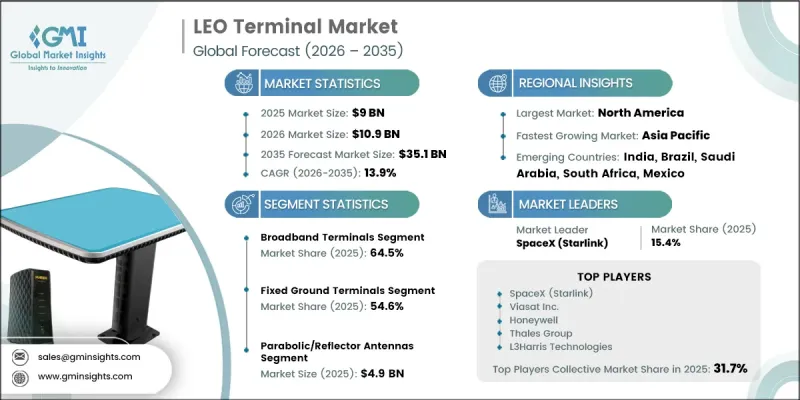
시장의 성장은 저궤도(LEO) 위성 군집의 급속한 확대와 전 세계 사용자층에서 대용량·저지연 광대역 연결에 대한 수요가 증가함에 따라 주도되고 있습니다. 또한, 커넥티드 모빌리티 생태계에 대한 의존도가 높아지고 있는 점도 항공, 해운, 육상 운송 각 부문의 수요를 뒷받침하고 있으며, 이러한 분야에서는 끊김 없는 연결성이 중요한 운영 요건으로 자리 잡고 있습니다. 전자 제어식 및 평면 패널 안테나 시스템의 지속적인 기술 혁신을 통해 단말기의 성능이 더욱 향상되어, 더욱 콤팩트하고 효율적이며 모바일 환경에 적합한 솔루션을 구현할 수 있게 되었습니다. 안전하고 내결함성이 뛰어난 통신 네트워크에 대한 정부 및 국방 분야의 투자 증가는, 특히 미션 크리티컬한 용도에서 그 도입을 촉진하고 있습니다. 기업의 디지털 전환, 클라우드 기반 운영, 그리고 실시간 데이터 교환 요구 사항의 융합 또한 LEO 지원 단말기의 도입을 가속화하고 있습니다. 위성 군집의 커버리지 범위가 전 세계적으로 확대됨에 따라, 상호 운용이 가능한 고대역폭 사용자 단말기에 대한 수요는 계속해서 증가하고 있으며, LEO 단말기 생태계는 상용 및 기관용 애플리케이션 모두에서 차세대 광대역 인프라의 핵심 동력으로서의 입지를 확립해 가고 있습니다.
| 시장 범위 | |
|---|---|
| 시작 연도 | 2025년 |
| 예측 기간 | 2026-2035년 |
| 개시 금액 | 90억 달러 |
| 예측 금액 | 351억 달러 |
| CAGR | 13.9% |
2025년에는 광대역 단말기 부문이 시장 점유율의 64.5%를 차지하며, 고속 위성 인터넷 서비스 제공에 있어 필수적인 역할을 수행함에 따라 그 주도적인 위치를 유지했습니다. 이 부문은 지속적인 데이터 전송과 안정적인 대역폭 성능이 필수적인 기업 연결 환경, 지방의 광대역 접속, 정부 통신 시스템 및 해상 네트워크 운영을 뒷받침하고 있습니다. 위성을 활용한 광대역 솔루션에 대한 의존도가 높아짐에 따라, 다양한 이용 환경에서 높은 데이터 처리량과 안정적인 연결성을 지원할 수 있는 확장성이 뛰어난 단말기 아키텍처에 대한 수요가 증가하고 있습니다.
고정 지상 단말기 부문은 2025년에 54.6%의 시장 점유율을 차지했으며, 이는 기업 네트워크, 지방 광대역 인프라, 정부 통신 시스템 및 게이트웨이 스테이션 운영에 걸친 광범위한 도입에 힘입은 것입니다. 이러한 단말기는 고정 설치 방식의 장점을 활용하여 이동형 단말기에 비해 더 높은 신호 이득, 처리량 성능 향상 및 운영 안정성 향상을 실현하고 있습니다. 이러한 비용 효율성과 신뢰성 덕분에, 장기간에 걸친 연결 요구 사항에 있어 선호되는 솔루션이 되고 있습니다. 위성 커버리지의 확대와 안정적인 지상 통합 지점에 대한 수요 증가가 고정 지상 단말 시스템의 장기적인 보급을 지속적으로 뒷받침하고 있습니다.
북미의 LEO 단말기 시장은 위성 광대역 서비스의 조기 도입과 주택, 기업, 기관의 각 연결 생태계에서의 강력한 통합에 힘입어 2025년에는 38.1%의 시장 점유율을 차지했습니다. 이 지역은 선진적인 위성 통신 인프라 생태계와, 비정지 궤도 위성 시스템의 구축을 지원하는 성숙한 규제 환경의 혜택을 누리고 있습니다. 주요 기술 제공업체와 단말기 제조업체들의 강력한 존재감이 시장 발전을 더욱 뒷받침하고 있습니다. 고속 광대역 서비스에 대한 수요가 증가하는 데다, 외딴 지역이나 서비스가 미치지 않는 지역에서 위성 통신에 대한 의존도가 높아지는 현상이 맞물리면서, 북미 전역에서 지속적인 시장 성장을 이끌고 있습니다.
자주 묻는 질문
목차
제1장 조사 방법과 범위
제2장 주요 요약
제3장 업계 인사이트
제4장 경쟁 구도
제5장 시장 추정 및 예측 : 연결성별, 2022-2035년
제6장 시장 추정 및 예측 : 플랫폼별, 2022-2035년
제7장 시장 추정 및 예측 : 주파수대별, 2022-2035년
제8장 시장 추정 및 예측 : 안테나 기술별, 2022-2035년
제9장 시장 추정 및 예측 : 최종사용자별, 2022-2035년
제10장 시장 추정 및 예측 : 지역별, 2022-2035년
제11장 기업 개요
KSM 26.07.16The Global LEO Terminal Market was valued at USD 9 billion in 2025 and is estimated to grow at a CAGR of 13.9% to reach USD 35.1 billion by 2035.
Market growth is driven by the rapid scaling of low Earth orbit satellite constellations and the increasing requirement for high-capacity, low-latency broadband connectivity across global user bases. Expanding reliance on connected mobility ecosystems is also strengthening demand across aviation, maritime, and ground transportation sectors, where uninterrupted connectivity is becoming a critical operational requirement. Continuous innovation in electronically steered and flat-panel antenna systems is further improving terminal performance, enabling more compact, efficient, and mobile-ready solutions. Rising government and defense investment in secure and resilient communication networks is reinforcing adoption, particularly in mission-critical applications. The convergence of enterprise digital transformation, cloud-based operations, and real-time data exchange requirements is also accelerating the deployment of LEO-compatible terminals. As satellite constellation coverage expands globally, demand for interoperable, high-throughput user terminals continues to strengthen, positioning the LEO terminal ecosystem as a core enabler of next-generation broadband infrastructure across both commercial and institutional applications.
| Market Scope | |
|---|---|
| Start Year | 2025 |
| Forecast Year | 2026-2035 |
| Start Value | $9 Billion |
| Forecast Value | $35.1 Billion |
| CAGR | 13.9% |
The broadband terminals segment accounted for 64.5% share in 2025, maintaining its leading position due to its essential role in delivering high-speed satellite-based internet services. This segment supports enterprise connectivity, rural broadband access, government communication systems, and maritime network operations, where continuous data transmission and stable bandwidth performance are critical. Growing dependence on satellite-enabled broadband solutions is reinforcing demand for scalable terminal architectures capable of supporting high data throughput and consistent connectivity across diverse end-use environments.
The fixed ground terminals segment held 54.6% share in 2025, supported by widespread deployment in enterprise networks, rural broadband infrastructure, government communication systems, and gateway station operations. These terminals benefit from stationary installation configurations that enable higher signal gain, improved throughput performance, and enhanced operational stability compared to mobile alternatives. Their cost efficiency and reliability make them a preferred solution for long-duration connectivity requirements. Increasing expansion of satellite coverage and growing demand for stable terrestrial integration points continue to support long-term adoption of fixed ground terminal systems.
North America LEO Terminal Market accounted for 38.1% share in 2025, supported by early adoption of satellite broadband services and strong integration across residential, enterprise, and institutional connectivity ecosystems. The region benefits from an advanced satellite communication infrastructure ecosystem and a mature regulatory environment that supports the deployment of non-geostationary satellite systems. Strong presence of leading technology providers and terminal manufacturers is further strengthening market development. Rising demand for high-speed broadband services, coupled with increasing reliance on satellite-based connectivity in remote and underserved regions, continues to drive sustained market growth across North America.
Leading companies operating in the global LEO terminal market include Intellian Technologies, Gilat Satellite Networks, Kymeta Corporation, Hughes Network Systems, Thales Group, L3Harris Technologies, Viasat Inc., Cobham SATCOM, Amazon (Project Kuiper), SpaceX (Starlink), Telesat, Comtech Telecommunications, Honeywell, AvL Technologies, SWISSto12, ThinKom Solutions, Isotropic Systems, and Requtech. Companies operating in the LEO terminal market are focusing on strategic initiatives aimed at strengthening technological capabilities and expanding global market presence. Significant investments in research and development are being directed toward advanced antenna technologies, including electronically steered and flat-panel systems that enhance mobility and performance. Market participants are forming strategic partnerships with satellite operators, defense agencies, and telecom providers to expand service integration and improve deployment scalability. Product innovation remains a key focus area, with companies developing compact, energy-efficient, and high-throughput terminal solutions to address diverse end-user requirements. Geographic expansion into emerging connectivity markets is also supporting revenue diversification.
Table of Contents
Chapter 1 Methodology and Scope
- 1.1 Market scope and definition
- 1.2 Research design
- 1.2.1 Research approach
- 1.2.2 Data collection methods
- 1.3 Data mining sources
- 1.3.1 Global
- 1.3.2 Regional/Country
- 1.4 Base estimates and calculations
- 1.4.1 Base year calculation
- 1.4.2 Key trends for market estimation
- 1.5 Primary research and validation
- 1.5.1 Primary sources
- 1.6 Forecast model
- 1.7 Research assumptions and limitations
Chapter 2 Executive Summary
- 2.1 Industry 360° synopsis, 2022 - 2035
- 2.2 Key market trends
- 2.2.1 Connectivity trends
- 2.2.2 Platform trends
- 2.2.3 Antenna technology trends
- 2.2.4 Frequency band trends
- 2.2.5 End-User trends
- 2.2.6 Regional trends
- 2.3 TAM Analysis, 2026-2035
- 2.4 CXO perspectives: Strategic imperatives
Chapter 3 Industry Insights
- 3.1 Industry ecosystem analysis
- 3.1.1 Supplier Landscape
- 3.1.2 Profit Margin
- 3.1.3 Cost structure
- 3.1.4 Value addition at each stage
- 3.1.5 Factor affecting the value chain
- 3.1.6 Disruptions
- 3.2 Industry impact forces
- 3.2.1 Growth drivers
- 3.2.1.1 Proliferation of LEO satellite constellations
- 3.2.1.2 Rising demand for high-speed, low-latency connectivity
- 3.2.1.3 Expansion of mobility applications across aviation, maritime, and land transport
- 3.2.1.4 Advancements in flat panel and electronically steered antenna technologies
- 3.2.1.5 Government and defense investments in resilient communication infrastructure
- 3.2.2 Industry pitfalls and challenges
- 3.2.2.1 High upfront cost of LEO terminals and installation complexity
- 3.2.2.2 Spectrum allocation challenges and regulatory fragmentation
- 3.2.3 Market opportunities
- 3.2.3.1 Emergence of direct-to-device (D2D) satellite connectivity
- 3.2.3.2 Rural broadband expansion and digital inclusion initiatives
- 3.2.1 Growth drivers
- 3.3 Growth potential analysis
- 3.4 Regulatory landscape
- 3.4.1 North America
- 3.4.2 Europe
- 3.4.3 Asia Pacific
- 3.4.4 Latin America
- 3.4.5 Middle East & Africa
- 3.5 Porter's analysis
- 3.6 PESTEL analysis
- 3.7 Technology and Innovation landscape
- 3.7.1 Current technological trends
- 3.7.2 Emerging technologies
- 3.8 Price trends
- 3.8.1 By region
- 3.8.2 By product
- 3.9 Pricing Strategies
- 3.10 Emerging Business Models
- 3.11 Compliance Requirements
- 3.12 Patent and IP analysis
Chapter 4 Competitive Landscape, 2025
- 4.1 Introduction
- 4.2 Company market share analysis
- 4.2.1 By region
- 4.2.1.1 North America
- 4.2.1.2 Europe
- 4.2.1.3 Asia Pacific
- 4.2.1.4 Latin America
- 4.2.1.5 Middle East & Africa
- 4.2.2 Market concentration analysis
- 4.2.1 By region
- 4.3 Competitive benchmarking of key players
- 4.3.1 Financial performance comparison
- 4.3.1.1 Revenue
- 4.3.1.2 Profit margin
- 4.3.1.3 R&D
- 4.3.2 Product portfolio comparison
- 4.3.2.1 Product range breadth
- 4.3.2.2 Technology
- 4.3.2.3 Innovation
- 4.3.3 Geographic presence comparison
- 4.3.3.1 Global footprint analysis
- 4.3.3.2 Service network coverage
- 4.3.3.3 Market penetration by region
- 4.3.4 Competitive positioning matrix
- 4.3.4.1 Leaders
- 4.3.4.2 Challengers
- 4.3.4.3 Followers
- 4.3.4.4 Niche players
- 4.3.5 Strategic outlook matrix
- 4.3.1 Financial performance comparison
- 4.4 Key developments
- 4.4.1 Mergers and acquisitions
- 4.4.2 Partnerships and collaborations
- 4.4.3 Technological advancements
- 4.4.4 Expansion and investment strategies
- 4.4.5 Digital transformation initiatives
- 4.5 Emerging/ startup competitors landscape
Chapter 5 Market Estimates and Forecast, By Connectivity, 2022 - 2035 (USD Million & Units)
- 5.1 Key trends
- 5.2 Broadband terminals
- 5.3 IoT/M2M terminals
- 5.4 Direct-to-device (D2D) terminals
- 5.5 Tactical communication terminals
Chapter 6 Market Estimates and Forecast, By Platform, 2022 - 2035 (USD Million & Units)
- 6.1 Key trends
- 6.2 Fixed ground terminals
- 6.3 Transportable/portable terminals
- 6.4 Land mobile terminals
- 6.5 Maritime mobile terminals
- 6.6 Aeronautical mobile terminals
Chapter 7 Market Estimates and Forecast, By Frequency Band, 2022 - 2035 (USD Million & Units)
- 7.1 Key trends
- 7.2 L-band
- 7.3 S-band
- 7.4 C-band
- 7.5 X-band
- 7.6 Ku-band
- 7.7 Ka-band
- 7.8 Q/V-band
- 7.9 Multi-band
Chapter 8 Market Estimates and Forecast, By Antenna Technology, 2022 - 2035 (USD Million & Units)
- 8.1 Key trends
- 8.2 Parabolic/reflector antennas
- 8.3 Active electronically steered arrays (AESA)
- 8.4 Passive electronically steered arrays (PESA)
- 8.5 Mechanically steered flat panel arrays
Chapter 9 Market Estimates and Forecast, By End User, 2022 - 2035 (USD Million & Units)
- 9.1 Key trends
- 9.2 Commercial
- 9.2.1 Telecommunications & network operators
- 9.2.2 Enterprise & business services
- 9.2.3 Maritime & offshore
- 9.2.4 Aviation
- 9.2.5 Media & broadcasting
- 9.2.6 Energy & utilities
- 9.2.7 Consumer/direct-to-user
- 9.2.8 Others
- 9.3 Government & defense
- 9.3.1 Military
- 9.3.2 Civil government & emergency services
Chapter 10 Market Estimates and Forecast, By Region, 2022 - 2035 (USD Million & Units)
- 10.1 Key trends
- 10.2 North America
- 10.2.1 U.S.
- 10.2.2 Canada
- 10.3 Europe
- 10.3.1 Germany
- 10.3.2 UK
- 10.3.3 France
- 10.3.4 Spain
- 10.3.5 Italy
- 10.3.6 Russia
- 10.4 Asia Pacific
- 10.4.1 China
- 10.4.2 India
- 10.4.3 Japan
- 10.4.4 Australia
- 10.4.5 South Korea
- 10.5 Latin America
- 10.5.1 Brazil
- 10.5.2 Mexico
- 10.5.3 Argentina
- 10.6 Middle East and Africa
- 10.6.1 South Africa
- 10.6.2 Saudi Arabia
- 10.6.3 UAE
Chapter 11 Company Profiles
- 11.1 Global Key Players
- 11.1.1 SpaceX (Starlink)
- 11.1.2 Viasat Inc.
- 11.1.3 Honeywell
- 11.1.4 Thales Group
- 11.1.5 L3Harris Technologies
- 11.2 Regional key players
- 11.2.1 North America
- 11.2.1.1 Amazon (Project Kuiper)
- 11.2.1.2 AvL Technologies
- 11.2.1.3 Comtech Telecommunications
- 11.2.1.4 Hughes Network Systems
- 11.2.1.5 Kymeta Corporation
- 11.2.1.6 ThinKom Solutions
- 11.2.2 Asia Pacific
- 11.2.2.1 Intellian Technologies
- 11.2.3 Europe
- 11.2.3.1 Cobham SATCOM
- 11.2.3.2 Isotropic Systems
- 11.2.3.3 Requtech
- 11.2.3.4 SWISSto12
- 11.2.4 Middle East & Africa
- 11.2.4.1 Gilat Satellite Networks
- 11.2.1 North America
- 11.3 Niche Players/Disruptors
- 11.3.1 Telesat


