

|
시장보고서
상품코드
2083359
카타마란 시장 기회, 성장 촉진요인, 업계 동향 분석 및 예측(2026-2035년)Catamarans Market Opportunity, Growth Drivers, Industry Trend Analysis, and Forecast 2026 - 2035 |
||||||

세계의 카타마란 시장은 2025년에 45억 달러 규모에 달하고, CAGR 7.1%로 성장하여 2035년까지 88억 달러에 달할 것으로 추정됩니다.
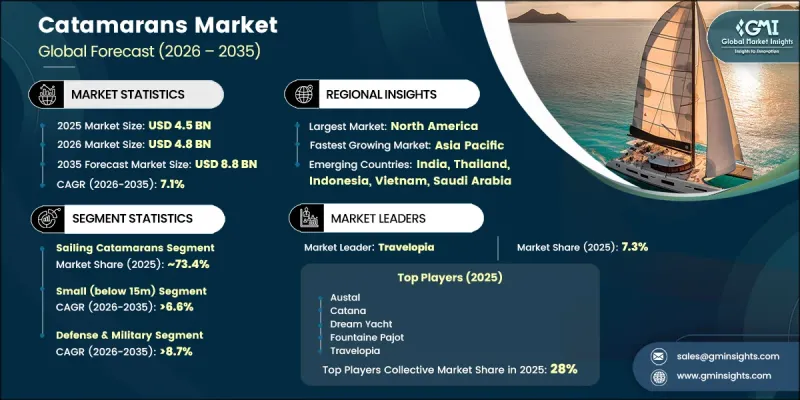
레크리에이션용 보트, 해양 관광, 세일링 휴가, 해안가 레저 활동 등이 전 세계적으로 계속해서 인기를 끌면서 시장은 꾸준히 확대되고 있습니다. 가처분 소득의 증가와 여행 및 야외 레저 활동에 대한 소비자 지출 확대가 레저용 선박에 대한 투자 확대를 뒷받침하고 있습니다. 카타마란은 기존의 단동선과 비교해 뛰어난 안정성과 널찍한 구조, 그리고 선내의 쾌적성을 높여주므로 선호되는 선택지가 되고 있습니다. 이 쌍동선 구조는 선체의 흔들림을 최소화하여 수상에서의 균형을 향상시키고, 승객에게 더욱 부드럽고 쾌적한 경험을 제공합니다. 넓은 데크 공간과 넉넉한 거주 공간은 가족 단위의 크루징, 레저 보트, 그리고 상업용 여객 운송 분야에서 이 배의 매력을 한층 더 높여줍니다. 뛰어난 승선 편의성 외에도, 쌍동선은 다양한 해양 분야에서 운영 효율성과 다목적 성능을 발휘합니다. 고급 레저 체험에 대한 수요 증가, 해양 관광 활동의 확대, 그리고 선박 설계의 지속적인 발전으로 인해, 예측 기간 동안 쌍동선 시장에 유리한 성장 기회가 창출될 것으로 전망됩니다.
| 시장 범위 | |
|---|---|
| 시작 연도 | 2025년 |
| 예측 기간 | 2026-2035년 |
| 개시 금액 | 45억 달러 |
| 예측 금액 | 88억 달러 |
| CAGR | 7.1% |
추진 방식별로 보면 2025년에는 세일링 카타마란 부문이 시장 점유율의 73.4%를 차지했으며, 2035년까지 연평균 성장률(CAGR) 6.8%로 성장할 것으로 전망됩니다. 이 부문은 레저용 보트 소유자, 요트 대여 업체, 장거리 크루징 애호가들 사이에서 인기가 높기 때문에 계속해서 견고한 시장 지위를 유지하고 있습니다. 세일링 카타마란은 풍력을 추진력으로 활용함으로써 연료 효율을 높이고 운영 비용을 절감할 수 있어 널리 선호되고 있습니다. 넓은 실내 공간, 뛰어난 안정성, 쾌적한 선내 시설은 장기 레저 여행에 있어 매우 매력적입니다. 세일링 활동, 해양 관광, 레저 보트 이용에 대한 참여가 증가하고 있는 만큼, 예측 기간 동안 세일링 카타마란에 대한 수요가 계속해서 증가할 것으로 전망됩니다.
선박 규모별로는 소형(15미터 미만) 부문이 2025년에 58.1%의 점유율을 차지했으며, 2026년부터 2035년까지 연평균 성장률(CAGR) 6.6%로 성장할 것으로 전망됩니다. 이 부문의 시장 선도적 지위는 합리적인 가격, 사용 편의성, 그리고 레저 이용자나 요트 초보자들 사이에서 소형 쌍동선이 널리 받아들여지고 있다는 점에 힘입고 있습니다. 이러한 선박은 유지보수가 거의 필요하지 않고 소유 비용도 절감할 수 있어, 연안 크루징, 레저 여행, 세일링 강습, 전세 사업 등에서 일반적으로 선택되고 있습니다. 또한, 컴팩트한 크기 덕분에 마리나나 항구로의 접근이 용이하며, 해양 레저 및 수상 스포츠 참가자가 지속적으로 증가하고 있는 점도 이 부문의 성장을 더욱 뒷받침하고 있습니다.
미국의 쌍동선 시장은 83.6%의 점유율을 차지했으며, 2025년에는 13억 7,000만 달러의 시장 규모를 기록했습니다. 시장의 성장은 레저용 보트 이용 증가, 요트 대여 활동의 확대, 그리고 고급 해양 레저 체험에 대한 소비자의 관심 고조 등에 힘입어 이루어지고 있습니다. 잘 정비된 해양 인프라, 대규모 레저 보트 애호가 커뮤니티, 그리고 확고한 입지를 다진 제조사, 딜러, 서비스 제공업체들의 존재가 이 나라의 시장 내 입지를 지속적으로 강화하고 있습니다. 해양 관광, 연안 레크리에이션, 수상 레저 활동에 대한 수요가 증가함에 따라, 미국에서는 세일링 카타마란과 모터 카타마란 모두의 보급이 더욱 확대될 것으로 예상됩니다.
자주 묻는 질문
목차
제1장 조사 방법
제2장 주요 요약
제3장 업계 인사이트
제4장 경쟁 구도
제5장 시장 추정 및 예측 : 유형별, 2022-2035년
제6장 시장 추정 및 예측 : 사이즈별, 2022-2035년
제7장 시장 추정 및 예측 : 용도별, 2022-2035년
제8장 시장 추정 및 예측 : 추진력별, 2022-2035년
제9장 시장 추정 및 예측 : 선체 형상별, 2022-2035년
제10장 시장 추정 및 예측 : 범위별, 2022-2035년
제11장 시장 추정 및 예측 : 건설자재별, 2022-2035년
제12장 시장 추정 및 예측 : 지역별, 2022-2035년
제13장 기업 개요
KSM 26.07.20The Global Catamarans Market was valued at USD 4.5 billion in 2025 and is estimated to grow at a CAGR of 7.1% to reach USD 8.8 billion by 2035.
The market is expanding steadily as recreational boating, marine tourism, sailing vacations, and waterfront leisure activities continue to gain popularity worldwide. Rising disposable incomes and growing consumer spending on travel and outdoor recreation are encouraging greater investment in leisure watercraft. Catamarans have become a preferred choice because they offer exceptional stability, spacious layouts, and enhanced onboard comfort compared to conventional single-hull vessels. Their twin-hull configuration improves balance on the water by minimizing vessel movement, delivering a smoother and more comfortable experience for passengers. Larger deck areas and generous living spaces further increase their appeal for family cruising, leisure boating, and commercial passenger transportation. In addition to superior comfort, catamarans provide operational efficiency and versatile performance across a wide range of marine applications. Increasing demand for premium recreational experiences, expanding marine tourism activities, and continuous advancements in vessel design are expected to create favorable growth opportunities for the catamarans market throughout the forecast period.
| Market Scope | |
|---|---|
| Start Year | 2025 |
| Forecast Year | 2026-2035 |
| Start Value | $4.5 Billion |
| Forecast Value | $8.8 Billion |
| CAGR | 7.1% |
Based on propulsion type, the sailing catamarans segment accounted for 73.4% share in 2025 and is expected to grow at a CAGR of 6.8% through 2035. This segment continues to maintain a strong market position due to its popularity among recreational boat owners, yacht charter operators, and long-distance cruising enthusiasts. Sailing catamarans are widely preferred because they utilize wind propulsion, improving fuel efficiency while reducing operating costs. Their spacious interiors, excellent stability, and comfortable onboard accommodations make them highly attractive for extended leisure trips. Growing participation in sailing activities, marine tourism, and recreational boating is expected to continue driving demand for sailing catamarans over the forecast period.
Based on vessel size, the small (below 15 meters) segment captured 58.1% share in 2025 and is anticipated to grow at a CAGR of 6.6% from 2026 to 2035. Market leadership is supported by the affordability, ease of operation, and widespread acceptance of smaller catamarans among recreational users and first-time sailing enthusiasts. These vessels are commonly selected for coastal cruising, leisure excursions, sailing instruction, and charter operations due to their lower maintenance requirements and cost-effective ownership. Their compact dimensions also improve accessibility to marinas and harbors, while the continued rise in marine recreation and water sports participation further supports segment growth.
U.S. Catamarans Market held 83.6% share, generating USD 1.37 billion in 2025. Market growth is being supported by increasing participation in recreational boating, expanding yacht charter activities, and rising consumer interest in premium marine leisure experiences. A well-developed marine infrastructure, a large recreational boating community, and the presence of established manufacturers, dealers, and service providers continue to strengthen the country's market position. Growing demand for marine tourism, coastal recreation, and water-based leisure activities is expected to further increase the adoption of both sailing and power catamarans across the United States.
Key companies operating in the global catamarans market include Beneteau, Fountaine Pajot, Catana, Austal, Travelopia, Dream Yacht, and Incat Tasmania. Leading companies in the catamarans market are strengthening their competitive position by investing in innovative vessel designs, expanding manufacturing capabilities, and introducing technologically advanced models that improve performance, comfort, and fuel efficiency. Manufacturers emphasize lightweight construction materials, enhanced onboard amenities, and sustainable marine technologies to address evolving customer preferences. Strategic partnerships, geographic expansion, dealership network development, and portfolio diversification remain important approaches for increasing market reach. Companies are also focusing on customized vessel offerings, premium customer experience, and after-sales service enhancements to improve brand loyalty.
Table of Contents
Chapter 1 Methodology
- 1.1 Research approach
- 1.2 Quality Commitments
- 1.2.1 GMI AI policy & data integrity commitment
- 1.2.1.1 Source consistency protocol
- 1.2.1 GMI AI policy & data integrity commitment
- 1.3 Research Trail & Confidence Scoring
- 1.3.1 Research Trail Components
- 1.3.2 Scoring Components
- 1.4 Data Collection
- 1.4.1 Partial list of primary sources
- 1.5 Data mining sources
- 1.5.1 Paid sources
- 1.5.1.1 Sources, by region
- 1.5.1 Paid sources
- 1.6 Base estimates and calculations
- 1.6.1 Base year calculation
- 1.7 Forecast Model
- 1.7.1 Quantified market impact analysis
- 1.7.1.1 Mathematical impact of growth parameters on forecast
- 1.7.1 Quantified market impact analysis
- 1.8 Research transparency addendum
- 1.8.1 Source attribution framework
- 1.8.2 Quality assurance metrics
- 1.8.3 Our commitment to trust
Chapter 2 Executive Summary
- 2.1 Industry 360° synopsis, 2022 - 2035
- 2.2 Key market trends
- 2.2.1 Regional
- 2.2.2 Type
- 2.2.3 Size
- 2.2.4 Application
- 2.2.5 Propulsion
- 2.2.6 Hull configuration
- 2.2.7 Range
- 2.2.8 Construction material
- 2.3 TAM Analysis, 2026-2035
- 2.4 CXO perspectives: Strategic imperatives
Chapter 3 Industry Insights
- 3.1 Industry ecosystem analysis
- 3.1.1 Supplier landscape
- 3.1.2 Profit margin analysis
- 3.1.3 Cost structure
- 3.1.4 Value addition at each stage
- 3.1.5 Factor affecting the value chain
- 3.1.6 Disruptions
- 3.2 Industry impact forces
- 3.2.1 Growth drivers
- 3.2.1.1 Growing demand for recreational boating and marine leisure activities
- 3.2.1.2 Rising popularity of catamarans due to superior stability and space efficiency
- 3.2.1.3 Expansion of yacht charter and marine tourism industries worldwide
- 3.2.1.4 Increasing investments in coastal transportation and high-speed ferry services
- 3.2.2 Industry pitfalls and challenges
- 3.2.2.1 High initial purchase cost compared to conventional monohull vessels
- 3.2.2.2 Expensive maintenance, repair, and marina berthing costs
- 3.2.3 Market opportunities
- 3.2.3.1 Growing adoption of electric, hybrid, and solar-powered catamarans
- 3.2.3.2 Expansion of marina infrastructure across emerging coastal economies
- 3.2.3.3 Rising demand for luxury live-aboard and long-range cruising catamarans
- 3.2.3.4 Increasing procurement of commercial passenger ferries and water taxis
- 3.2.1 Growth drivers
- 3.3 Growth potential analysis
- 3.4 Technology and Innovation landscape
- 3.4.1 Current technological trends
- 3.4.2 Emerging technologies
- 3.5 Pricing Analysis (Driven by Primary Research)
- 3.5.1 Historical Price Trend Analysis
- 3.5.2 Pricing Strategy by Player Type (Premium / Value / Cost-plus)
- 3.6 Regulatory guideline
- 3.6.1 North America
- 3.6.1.1 U.S.: U.S. Coast Guard (USCG) Vessel Safety Regulations & Environmental Protection Agency (EPA) Marine Emission Standards
- 3.6.1.2 Canada: Transport Canada Small Vessel Regulations & Marine Safety and Security Framework.
- 3.6.2 Europe
- 3.6.2.1 Germany: EU Recreational Craft Directive (RCD 2013/53/EU) & Federal Maritime Safety Requirements
- 3.6.2.2 UK: UK Recreational Craft Regulations & Maritime and Coastguard Agency (MCA) Safety Standards
- 3.6.2.3 France: Division 240 Recreational Vessel Safety Regulations & Environmental Marine Protection Standards
- 3.6.2.4 Italy: EU Recreational Craft Directive Compliance & Italian Coast Guard Maritime Safety Regulations
- 3.6.3 Asia Pacific
- 3.6.3.1 China: China Maritime Safety Administration (MSA) Vessel Inspection Regulations & Domestic Ship Safety Standards
- 3.6.3.2 India: Inland Vessels Act, 2021 & Directorate General of Shipping Vessel Safety Regulations
- 3.6.3.3 Japan: Japan Maritime Safety Agency Vessel Inspection Framework & Marine Environmental Protection Standards
- 3.6.3.4 Australia: Australian Maritime Safety Authority (AMSA) National Standard for Commercial Vessels (NSCV)
- 3.6.3.5 South Korea: Korean Register (KR) Ship Classification Rules & Maritime Safety Act
- 3.6.4 Latin America
- 3.6.4.1 Brazil: Brazilian Navy Maritime Authority Standards (NORMAM) & Recreational Vessel Safety Regulations
- 3.6.4.2 Mexico: Maritime Authority Vessel Registration & Recreational Craft Safety Requirements
- 3.6.4.3 Argentina: Prefectura Naval Argentina Vessel Certification & Passenger Transport Safety Regulations
- 3.6.5 MEA
- 3.6.5.1 UAE: UAE Maritime Administration Recreational Vessel Regulations & Marine Tourism Safety Standards
- 3.6.5.2 Saudi Arabia: Transport General Authority Maritime Safety Framework & Recreational Vessel Licensing Requirements
- 3.6.5.3 South Africa: South African Maritime Safety Authority (SAMSA) Small Vessel Safety Regulations & Commercial Passenger Vessel Standards
- 3.6.1 North America
- 3.7 Porter's analysis
- 3.8 PESTEL analysis
- 3.9 Trade data analysis (Driven by Paid Research)
- 3.9.1 Import/export volume & value trends
- 3.9.2 Key trade corridors & tariff impact
- 3.10 Cost breakdown analysis
- 3.11 Patent analysis (Driven by Primary Research)
- 3.12 Impact of AI & generative AI on the market
- 3.12.1 AI-driven disruption of existing business models
- 3.12.2 GenAI use cases & adoption roadmap by segment
- 3.12.3 Risks, limitations & regulatory considerations
- 3.13 Capacity & production landscape (Driven by Primary Research)
- 3.13.1 Installed capacity by region & key producer
- 3.13.2 Capacity utilization rates & expansion pipelines
- 3.14 Marina & marine infrastructure analysis
- 3.15 Sustainability and environmental aspects
- 3.15.1 Sustainable practices
- 3.15.2 Waste reduction strategies
- 3.15.3 Energy efficiency in production
- 3.15.4 Eco-friendly Initiatives
- 3.15.5 Carbon footprint considerations
- 3.16 Forecast assumptions & scenario analysis (Driven by Primary Research)
- 3.16.1 Base Case - key macro & industry variables driving CAGR
- 3.16.2 Optimistic Scenarios - Favorable macro and industry tailwinds
- 3.16.3 Pessimistic Scenario - Macroeconomic slowdown or industry headwinds
Chapter 4 Competitive Landscape, 2025
- 4.1 Introduction
- 4.2 Company market share analysis
- 4.2.1 North America
- 4.2.2 Europe
- 4.2.3 Asia Pacific
- 4.2.4 Latin America
- 4.2.5 MEA
- 4.3 Competitive analysis of major market players
- 4.4 Competitive positioning matrix
- 4.5 Key developments
- 4.5.1 Mergers & acquisitions
- 4.5.2 Partnerships & collaborations
- 4.5.3 New Product Launches
- 4.5.4 Expansion Plans and funding
- 4.6 Company Tier Benchmarking
- 4.6.1 Tier Classification Criteria & Qualifying Thresholds
- 4.6.2 Tier Positioning Matrix by Revenue, Geography & Innovation
Chapter 5 Market Estimates & Forecast, By Type, 2022 - 2035 ($Bn, Units)
- 5.1 Key trends
- 5.2 Sailing catamarans
- 5.2.1 Leisure
- 5.2.2 Sport & racing
- 5.2.3 Commercial
- 5.3 Power catamarans
- 5.3.1 Leisure
- 5.3.2 Commercial
- 5.3.3 Defense
Chapter 6 Market Estimates & Forecast, By Size, 2022 - 2035 ($Bn, Units)
- 6.1 Key trends
- 6.2 Small (below 15m)
- 6.3 Medium (15m-30m)
- 6.4 Large (above 30m)
Chapter 7 Market Estimates & Forecast, By Application, 2022 - 2035 ($Bn, Units)
- 7.1 Key trends
- 7.2 Leisure & recreation
- 7.2.1 Personal ownership
- 7.2.2 Charter & rental
- 7.2.3 Live-abroad
- 7.3 Commercial
- 7.3.1 Passenger ferry services
- 7.3.2 Water taxi & coastal transport
- 7.3.3 Commercial charter operations
- 7.4 Sport & racing
- 7.4.1 Competitive racing (offshore & regatta)
- 7.4.2 Club & recreational racing
- 7.5 Defense & military
- 7.5.1 Naval & support vessels
- 7.6 Others
Chapter 8 Market Estimates & Forecast, By Propulsion, 2022 - 2035 ($Bn, Units)
- 8.1 Key trends
- 8.2 ICE
- 8.2.1 Diesel
- 8.2.2 Gasoline/petrol
- 8.3 Electric
- 8.3.1 Battery-electric (full electric)
- 8.3.2 Shore-power charging infrastructure dependency
- 8.4 Hybrid
- 8.5 Solar/renewable-assisted
- 8.5.1 Solar panel-integrated systems
- 8.5.2 Regenerative & wind-generator-assisted systems
Chapter 9 Market Estimates & Forecast, By Hull Configuration, 2022 - 2035 ($Bn, Units)
- 9.1 Key trends
- 9.2 Conventional hull
- 9.2.1 Standard twin-hull (displacement)
- 9.2.2 Semi-displacement twin-hull
- 9.3 Foiling/ hydrofoil
- 9.3.1 Fully foiling catamarans
- 9.3.2 Assisted foiling (partial lift) catamarans
Chapter 10 Market Estimates & Forecast, By Range, 2022 - 2035 ($Bn, Units)
- 10.1 Key trends
- 10.2 Short range
- 10.3 Medium range
- 10.4 Long range
Chapter 11 Market Estimates & Forecast, By Construction Material, 2022 - 2035 ($Bn, Units)
- 11.1 Key trends
- 11.2 Fiberglass (GRP)
- 11.3 Carbon fiber
- 11.4 Aluminum
- 11.5 Others
Chapter 12 Market Estimates & Forecast, By Region, 2022 - 2035 ($Bn, Units)
- 12.1 Key trends
- 12.2 North America
- 12.2.1 US
- 12.2.2 Canada
- 12.3 Europe
- 12.3.1 Germany
- 12.3.2 UK
- 12.3.3 France
- 12.3.4 Italy
- 12.3.5 Spain
- 12.3.6 Russia
- 12.3.7 Netherlands
- 12.3.8 Belgium
- 12.4 Asia Pacific
- 12.4.1 China
- 12.4.2 India
- 12.4.3 Japan
- 12.4.4 Australia
- 12.4.5 South Korea
- 12.4.6 New Zealand
- 12.5 Latin America
- 12.5.1 Brazil
- 12.5.2 Mexico
- 12.5.3 Argentina
- 12.6 MEA
- 12.6.1 South Africa
- 12.6.2 Saudi Arabia
- 12.6.3 UAE
Chapter 13 Company Profiles
- 13.1 Global Players
- 13.1.1 Austal
- 13.1.2 Catana
- 13.1.3 Fountaine Pajot
- 13.1.4 Groupe Beneteau
- 13.1.5 HH Catamarans
- 13.1.6 Incat
- 13.1.7 Leopard Catamarans
- 13.1.8 Robertson & Caine
- 13.1.9 Seawind
- 13.1.10 Sunreef Yachts
- 13.1.11 Travelopia
- 13.2 Regional Players
- 13.2.1 Balance Catamarans
- 13.2.2 CATATHAI
- 13.2.3 Knysna Yacht Company
- 13.2.4 Outremer Yachting
- 13.2.5 Two Oceans Marine
- 13.2.6 Voyage Yachts
- 13.2.7 Xquisite Yachts
- 13.3 Emerging Players
- 13.3.1 Alva Yachts
- 13.3.2 Silent Yachts
- 13.3.3 Windelo


