

|
시장보고서
상품코드
2117360
카타마란 시장 : 점유율 분석, 업계 동향과 통계, 성장 예측(2026-2031년)Catamaran - Market Share Analysis, Industry Trends & Statistics, Growth Forecasts (2026 - 2031) |
||||||
 Mordor Intelligence
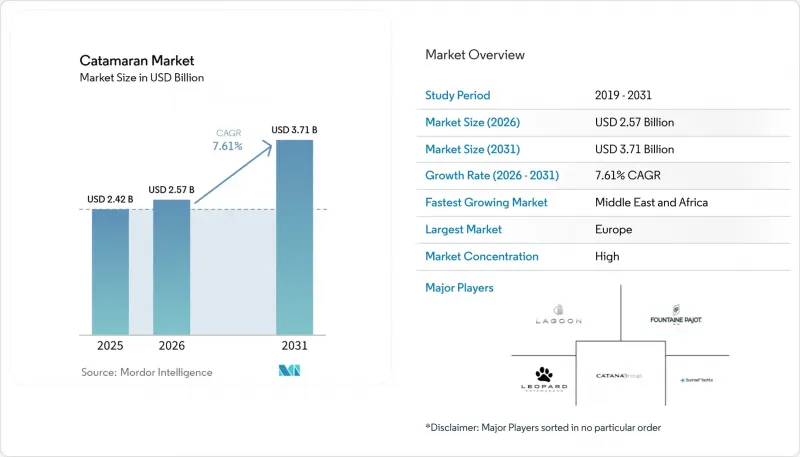
Mordor Intelligence에 의하면, 카타마란 시장 규모는 2025년에 24억 2,000만 달러로 평가되었고 2026년에는 25억 7,000만 달러로 추정되고 있어 2031년까지 37억 1,000만 달러에 이를 것으로 예측됩니다.
2026년부터 2031년까지 연평균 성장률(CAGR) 7.61%로 성장할 것으로 전망됩니다.
본 보고서는 유형별(세일링 카타마란, 동력 카타마란 등), 전장별(소형(15미터 이하), 중형(15미터-30미터) 등), 추진 방식별(세일링/기존, 내연기관(IC) 카타마란, 기타),건조 재료(유리 섬유, 탄소섬유, 기타), 용도 및 지역별로 분류되어 있습니다. 시장 전망은 금액(달러) 및 수량(대수)의 관점에서 제시되어 있습니다.
세계 카타마란 시장 동향 및 인사이트
증가하는 해양 관광 및 전세 수요
전세 사업자들은 멀티헐 선박을 통해 현저히 높은 연간 수익을 올리고 있습니다. 이는 트윈헐 구조 덕분에 동일한 전장이라도 더 많은 승객을 수용할 수 있어, 주 단위 운임을 프리미엄 가격으로 책정할 수 있기 때문입니다. 선단 관리자들은 베어보트 라이선싱 기준을 충족하면서 4개의 객실에서 8-10명의 승객을 수용할 수 있는 45-55피트급 카타마란을 계속해서 도입하고 있습니다. 지중해 예약이 여전히 핵심을 차지하고 있지만, 지역 내 항공편 및 마리나 수용 능력이 향상됨에 따라 푸켓에서 라자 암팟에 이르는 아시아태평양 항로의 점유율이 확대되고 있습니다. 견조한 관광 수요가 수주 잔고를 뒷받침하고 있어, 경기의 주기적인 둔화기에도 생산을 유지하고 있습니다.
레저 보트에서 럭셔리와 쾌적함에 대한 선호도 증가
정년을 맞이한 부부나 소규모 가족은 정박 시의 안정성, 수평인 바닥, 메인 데크의 마스터 스위트 등의 이유로 카타마란을 선택하는 경향이 강해지고 있습니다. 각 조선사는 플라이브리지, 유압식 수영 플랫폼, 그리고 장비 배치를 위해 충분한 선폭을 활용한 주택 수준의 주방 설비 등으로 이에 부응하고 있습니다. 선내 발전기, 에어컨, 정수 장치는 15-30미터의 주요 크기 대에서 표준 사양으로 장착되고 있으며, 카타마란 시장은 소박한 세일링의 틈새 시장이라기보다는 오히려 ‘물 위의 고급 아파트’라는 부문으로 변모하고 있습니다.
중고 보트의 과잉 재고가 신조 보트 수요를 둔화시키고 있다.
2025년, 카리브해의 중개업자들은 카타마란 판매에 있어 난관에 직면했으며, 매물로 나온 보트의 상당 부분이 팔리지 않고 남아 시장 내 체류 기간이 장기화되었습니다. 전 세계적으로 볼 때, 시장에 유통되고 있는 재고의 대부분은 비교적 새로운 선박들이었으며, 이들은 고가의 신조 선박과 직접 경쟁하고 있었습니다. 예를 들어, 특정 모델의 가치는 2021년부터 2022년 COVID-19 사태가 절정에 달했을 때와 비교해 크게 하락했는데, 그 주된 요인은 전세 선단이 노후 선박을 교체했기 때문입니다. 매도자들은 종종 희망 가격을 낮출 수밖에 없었고, 많은 매물이 성사되지 못하자 일부 소유주들은 일시적인 해결책으로 전세 관리에 눈을 돌리기 시작했습니다. 이러한 어려움에도 불구하고, 중개 시장에서는 대형 고가 모델의 판매에 힘입어 총 거래액은 증가했으나, 보급형 선박은 고전을 면치 못했습니다. 중고 카타마란은 비용을 중시하는 구매자들의 관심을 계속 끌어모아, 같은 크기의 신형 선박에 대한 관심을 분산시켰습니다.
부문 분석
2025년 매출에서 세일링용 카타마란의 점유율은 61.22%였으나, 동력 모델은 2031년까지 연평균 성장률(CAGR) 10.05%로 가장 빠른 성장이 예상됩니다. 선단 투자자들은 잔존 가치의 추이를 주의 깊게 모니터링하고 있습니다. 동력 모델은 처음 3년 동안 감가상각이 빠르게 진행되지만, 전세 이용 현황이 예측 가능하다는 것이 입증됨에 따라 그 이후에는 안정화됩니다. 현재 모터가 장착된 카타마란은 신규 수주에서 가장 큰 증가분을 차지하고 있는데, 이는 단동 모터보트에서 갈아타는 구매자들이 익숙한 조종 감각과 다동선의 안정성을 겸비한 선박을 원하기 때문입니다. 조선소는 이에 부응하여 1,000마력의 디젤 엔진 2기와 조이스틱을 통한 도킹 기능을 갖춘 ‘아퀼라 70 럭셔리’ 등의 모델을 출시하고 있습니다.
엑세스(Excess)사와 퐁텐 파조(Fontaine Pajot)사는 공장 출고 시 기본으로 장착된 48볼트 추진 시스템을 출시했습니다. 이러한 혁신적인 시스템은 항해 중 회생 전력을 활용하여 일반 항해 시 디젤 연료 소비량을 대폭 줄여줍니다. 개인 소유자의 경우 초기 비용이 높아 투자 회수 기간이 길어지지만, 기업 전세 운항사는 마케팅상의 이점과 운영비 변동 폭이 줄어드는 점에 매력을 느끼고 있습니다.
15m에서 30m에 이르는 중형급은 승객 수용 능력과 계류 비용의 균형이 잘 잡혀 있어, 2025년에도 74.29%의 점유율을 차지하며 카타마란 시장을 계속해서 주도하고 있습니다. 이 부문은 2031년까지 연평균 성장률(CAGR) 8.13%를 나타낼 것으로 예측됩니다. 50피트급 설계의 경우, 4개의 선실에 총 8명이 숙박할 수 있으며, 대부분의 관할 구역에서 무인 전세 면허 및 전문 승무원 요건을 충족할 수 있습니다. 대형 요트는 보트 쇼의 하이라이트가 되어 높은 수익률을 가져다주지만, 매년 건조되는 선체 수에서 차지하는 비율은 극히 미미합니다.
15미터 미만의 소형 선박은 주로 보호 수역에서의 당일치기 세일링이나 생태 관광 전세 용도로 이용되지만, 선내 용적이 제한적이어서 장기 체류형 전세 선박으로서의 매력은 한계가 있습니다. 각 조선사는 살롱 공간을 확대하기 위해 선폭 대 전장 비율을 점차 늘려왔으나, 마리나의 계류 공간 여유 상황이 폭의 자연스러운 상한선이 되고 있습니다.
지역별 분석
유럽은 지중해의 밀집된 전세 네트워크와 수직 통합된 프랑스의 생산 클러스터에 힘입어 2025년 매출의 35.10%를 차지하며 여전히 가장 규모가 큰 지역 기여자로 남아 있습니다. 이탈리아와 스페인이 생산량을 보완하는 한편, 독일은 대륙 전체의 하이브리드 선박 생산 라인에 공급되는 전동 구동 장치와 배터리 부품을 공급하고 있습니다. 북유럽에서는 노르웨이 피오르드의 배출 규제로 인해 점진적인 성장이 나타나고 있으며, 관광 크루즈용 수소 및 하이브리드 카타마란의 조기 도입이 촉진되고 있습니다.
중동 및 아프리카은 홍해 연안의 리조트 개발, 걸프 지역의 마리나 확장, 그리고 정부 주도의 탈탄소화 시범 사업의 뒷받침을 받아 예측 연평균 성장률(CAGR) 7.78%로 가장 높은 성장률을 보이고 있습니다. 사우디아라비아의 고급 낚시 부문과 아랍에미리트(UAE)의 카타마란 전세 선단이, 에어컨이 완비된 파워 카타마란에 대한 지역적 수요를 끌어올리고 있습니다. 남아프리카공화국은 세이셸과 모리셔스로의 선체 수출을 위한 제조 거점으로서의 위상을 유지하고 있는 반면, 몰디브에서는 SPC MTCC-Pacific의 틀 아래 태양광 하이브리드 페리가 시범 운영되고 있으며, 운영 비용이 대폭 절감된 것으로 보고되고 있습니다.
아시아태평양에서는 2022년부터 2024년까지 슈퍼요트 시장이 눈부신 성장을 이루었습니다. 호주의 해안 지역에서 은퇴자 붐, 인도네시아의 섬들을 오가는 운송 수요, 그리고 인도의 전세 규제 완화로 인해 잠재적인 슈퍼요트 소유자층이 확대되고 있습니다. 태국과 말레이시아는 안다만해에 전세 항로를 개설한 반면, 싱가포르는 보세 창고와 매력적인 세제 혜택을 자랑하며 주요 규제 및 서비스 거점으로 부상하고 있습니다.
기타 혜택:
- 엑셀 형식 시장 예측(ME) 시트
- 3개월간의 애널리스트 지원
자주 묻는 질문
목차
제1장 서론
제2장 조사 방법
제3장 개요
제4장 시장 구도
제5장 시장 규모와 성장 예측
제6장 경쟁 구도
제7장 시장 기회와 향후 전망
JHS 26.09.01According to Mordor Intelligence, the catamaran market size was valued at USD 2.42 billion in 2025, is estimated at USD 2.57 billion in 2026, and is projected to reach USD 3.71 billion by 2031, growing at a CAGR of 7.61% from 2026 to 2031.
This report is Segmented by Type (Sailing Catamarans, Powered Catamarans, and More), Length (Small (Up To 15 M), Medium (15 M To 30 M), and More), Propulsion (Sail/Conventional, IC-Engine Catamarans, and More), Construction Material (Fiberglass, Carbon Fiber, and More), Usage, and Geography. Market Forecasts are Provided in Terms of Value (USD) and Volume (Units).
Global Catamaran Market Trends and Insights
Rising Marine-Tourism and Charter Demand
Charter operators generate materially higher annual revenue on multihulls because the twin-hull layout carries more guests at comparable length and commands premium weekly tariffs. Fleet managers continue adding 45-to-55-foot cats that fit under bareboat-licensing thresholds yet sleep eight to ten passengers in four cabins. Mediterranean bookings remain the nucleus, but Asia-Pacific itineraries from Phuket to Raja Ampat are gaining share as regional airlift and marina capacity improve. Resilient tourism demand cushions order backlogs, sustaining production even through cyclical slowdowns.
Growing Preference for Luxury and Comfort in Leisure Boating
Retiring couples and small families increasingly choose catamarans for their stability at anchor, level flooring, and main-deck master suites. Builders respond with flybridges, hydraulic swim platforms, and residential-grade galley appliances that rely on ample beam for equipment spacing. Onboard generators, air-conditioning, and watermakers have become standard fit-outs in the core 15-to-30-meter bracket, converting the catamaran market into a floating luxury-apartment segment rather than an austere sailing niche.
Surplus Used-Boat Inventory Dampening New-Build Demand
In 2025, Caribbean brokers faced challenges in selling catamarans, with a significant portion of listings remaining unsold and requiring extended time on the market. Globally, the majority of available inventory consisted of relatively newer vessels, which directly competed with higher-priced new builds. For example, the value of certain models has significantly declined since the peak during the COVID period in 2021-2022, largely due to charter fleets replacing older vessels. Sellers often had to reduce their asking prices, and many listings failed to transact, prompting some owners to turn to charter management as a temporary solution. Despite these difficulties, the brokerage market saw growth in value, driven by the sale of larger, higher-priced models, while entry-level units struggled. Used catamarans continued to attract cost-sensitive buyers, diverting attention from new builds in similar size ranges.
Other drivers and restraints analyzed in the detailed report include:
- Fractional Ownership and Peer-to-Peer Charter Platforms Boost Utilization
- Rising Disposable Incomes in Emerging Economies
- High Acquisition and Maintenance Costs vs. Monohulls
For complete list of drivers and restraints, kindly check the Table Of Contents.
Segment Analysis
Sailing catamarans held 61.22% share of 2025 revenue, while the powered models are set for the fastest growth at a 10.05% CAGR through 2031. Fleet investors monitor residual-value curves closely; powered units depreciate faster in the first three years but stabilize thereafter as charter utilization proves predictable. Powered catamarans now absorb the largest increment of new orders as buyers shifting from monohull powerboats seek familiar helm behavior combined with multihull stability. Shipyards have responded with models such as the Aquila 70 Luxury, featuring twin 1,000-hp diesels and joystick docking .
Excess and Fountaine Pajot have rolled out factory-installed 48-volt propulsion packages. These innovative systems harness regenerative power while sailing, significantly reducing diesel consumption on standard journeys. Although private owners face an extended payback period due to high upfront costs, corporate charter operators are drawn to the marketing advantages and the reduced variance in operating expenses.
The medium-length cohort between 15 m and 30 m continues to dominate the catamaran market size with a 74.29% share in 2025, because it balances guest capacity with berthing economics. The same segment is projected to grow at an 8.13% CAGR through 2031. A 50-foot design that sleeps eight across four cabins without breaching bareboat-license or professional-crew triggers in most jurisdictions. Larger yachts headline boat shows and earn custom margins, yet they represent a small portion of hulls laid each year.
Smaller sub-15-meter craft cater mainly to day-sail and eco-tourism charters in protected waters, but constrained interior volume caps live-aboard appeal. Builders have gradually extended beam-to-length ratios to enlarge saloon space, though marina slot availability remains the natural ceiling on width.
Complete Report Scope:
- By Type
- Sailing Catamarans
- Powered Catamarans
- Catamaran Houseboats
- By Length
- Small (Up to 15 m)
- Medium (15 m to 30 m)
- Large (Over 30 m)
- By Propulsion
- Sail/Conventional
- IC-Engine Catamarans
- Electric and Hybrid Catamarans
- By Construction Material
- Fiberglass
- Carbon Fiber
- Aluminum
- Wooden Catamarans
- By Usage
- Day-sailing Catamarans
- Racing Catamarans
- Cruising/Live-aboard Catamarans
- By Geography
- North America
- United States
- Canada
- Rest of North America
- South America
- Brazil
- Argentina
- Chile
- Rest of South America
- Europe
- Germany
- France
- United Kingdom
- Italy
- Spain
- Rest of Europe
- Asia-Pacific
- China
- India
- Japan
- South Korea
- Australia
- New Zealand
- Indonesia
- Thailand
- Malaysia
- Singapore
- Vietnam
- Rest of Asia-Pacific
- Middle East and Africa
- United Arab Emirates
- Saudi Arabia
- Qatar
- South Africa
- Rest of Middle East and Africa
- North America
Geography Analysis
Europe remains the largest regional contributor with 35.10% of 2025 turnover, underpinned by dense Mediterranean charter networks and vertically integrated French production clusters. Italy and Spain supplement output, while Germany supplies electric-drive and battery components that feed hybrid pipelines across the continent. Northern Europe sees incremental growth from Norway's fjord-emission regulations, spurring early adoption of hydrogen and hybrid cats for tourist excursions.
The Middle East and Africa post the fastest forecast CAGR at 7.78%, fueled by Red Sea resort builds, Gulf marina expansions, and government-backed decarbonization pilots. Saudi Arabia's luxury-fishing sector and the United Arab Emirates' dual-hull charter fleets lift regional demand for climate-controlled power cats. South Africa remains a manufacturing foothold for export hulls to the Seychelles and Mauritius, while the Maldives tests solar-hybrid ferries under SPC MTCC-Pacific frameworks that report notable operating-cost savings.
In the Asia-Pacific, the superyacht market has experienced significant growth from 2022 to 2024. A coastal retiree boom in Australia, transport demands across Indonesia's archipelagos, and relaxed charter regulations in India are expanding the pool of potential superyacht owners. Thailand and Malaysia have established charter circuits in the Andaman Sea, while Singapore has emerged as a key regulatory and service hub, boasting bonded storage and attractive tax incentives.
- Lagoon Catamarans
- Fountaine Pajot
- Leopard Catamarans
- Sunreef Yachts
- Bali Catamarans
- Excess Catamarans
- Catana Group
- Gunboat
- HH Catamarans
- Aquila Power Catamarans
- Seawind Catamarans
- Nautitech Catamarans
- Outremer Yachting
- Silent-Yachts
- Balance Catamarans
- Incat Crowther
- Vaan Yachts
- Alumarine Shipyard
- Zen Yachts (Zero Emission Nautic Ltd.)
- Group Island Spirit, LLC
Additional Benefits:
- The market estimate (ME) sheet in Excel format
- 3 months of analyst support
TABLE OF CONTENTS
1 Introduction
- 1.1 Study Assumptions and Market Definition
- 1.2 Scope of the Study
2 Research Methodology
3 Executive Summary
4 Market Landscape
- 4.1 Market Overview
- 4.2 Market Drivers
- 4.2.1 Rising Marine-Tourism and Charter Demand
- 4.2.2 Growing Preference for Luxury and Comfort in Leisure Boating
- 4.2.3 Fractional Ownership and Peer-to-Peer Charter Platforms Boost Utilization
- 4.2.4 Rising Disposable Incomes in Emerging Economies
- 4.2.5 Advances in Composite and Lightweight Materials
- 4.2.6 Island Nations' Decarbonization Policies Driving Solar-Hybrid Adoption
- 4.3 Market Restraints
- 4.3.1 Surplus Used-Boat Inventory Dampening New-Build Demand
- 4.3.2 High Acquisition and Maintenance Costs vs. Monohulls
- 4.3.3 Limited Marina/Haul-Out Infrastructure for Wide-Beam Vessels
- 4.3.4 Tightening Insurance Underwriting Standards on Multihulls
- 4.4 Value / Supply-Chain Analysis
- 4.5 Regulatory Landscape
- 4.6 Technological Outlook (Sustainable Propulsion, Advanced Composites)
- 4.7 Porter's Five Forces Analysis
- 4.7.1 Bargaining Power of Suppliers
- 4.7.2 Bargaining Power of Buyers/Consumers
- 4.7.3 Threat of New Entrants
- 4.7.4 Intensity of Competitive Rivalry
- 4.7.5 Threat of Substitute Products
5 Market Size & Growth Forecasts (Value (USD) and Volume (Units))
- 5.1 By Type
- 5.1.1 Sailing Catamarans
- 5.1.2 Powered Catamarans
- 5.1.3 Catamaran Houseboats
- 5.2 By Length
- 5.2.1 Small (Up to 15 m)
- 5.2.2 Medium (15 m to 30 m)
- 5.2.3 Large (Over 30 m)
- 5.3 By Propulsion
- 5.3.1 Sail/Conventional
- 5.3.2 IC-Engine Catamarans
- 5.3.3 Electric and Hybrid Catamarans
- 5.4 By Construction Material
- 5.4.1 Fiberglass
- 5.4.2 Carbon Fiber
- 5.4.3 Aluminum
- 5.4.4 Wooden Catamarans
- 5.5 By Usage
- 5.5.1 Day-sailing Catamarans
- 5.5.2 Racing Catamarans
- 5.5.3 Cruising/Live-aboard Catamarans
- 5.6 By Geography
- 5.6.1 North America
- 5.6.1.1 United States
- 5.6.1.2 Canada
- 5.6.1.3 Rest of North America
- 5.6.2 South America
- 5.6.2.1 Brazil
- 5.6.2.2 Argentina
- 5.6.2.3 Chile
- 5.6.2.4 Rest of South America
- 5.6.3 Europe
- 5.6.3.1 Germany
- 5.6.3.2 France
- 5.6.3.3 United Kingdom
- 5.6.3.4 Italy
- 5.6.3.5 Spain
- 5.6.3.6 Rest of Europe
- 5.6.4 Asia-Pacific
- 5.6.4.1 China
- 5.6.4.2 India
- 5.6.4.3 Japan
- 5.6.4.4 South Korea
- 5.6.4.5 Australia
- 5.6.4.6 New Zealand
- 5.6.4.7 Indonesia
- 5.6.4.8 Thailand
- 5.6.4.9 Malaysia
- 5.6.4.10 Singapore
- 5.6.4.11 Vietnam
- 5.6.4.12 Rest of Asia-Pacific
- 5.6.5 Middle East and Africa
- 5.6.5.1 United Arab Emirates
- 5.6.5.2 Saudi Arabia
- 5.6.5.3 Qatar
- 5.6.5.4 South Africa
- 5.6.5.5 Rest of Middle East and Africa
- 5.6.1 North America
6 Competitive Landscape
- 6.1 Market Concentration
- 6.2 Strategic Moves
- 6.3 Market Share Analysis
- 6.4 Company Profiles (includes Global Level Overview, Market Level Overview, Core Segments, Financials as Available, Strategic Information, Market Rank/Share for Key Companies, Products and Services, SWOT Analysis, and Recent Developments)
- 6.4.1 Lagoon Catamarans
- 6.4.2 Fountaine Pajot
- 6.4.3 Leopard Catamarans
- 6.4.4 Sunreef Yachts
- 6.4.5 Bali Catamarans
- 6.4.6 Excess Catamarans
- 6.4.7 Catana Group
- 6.4.8 Gunboat
- 6.4.9 HH Catamarans
- 6.4.10 Aquila Power Catamarans
- 6.4.11 Seawind Catamarans
- 6.4.12 Nautitech Catamarans
- 6.4.13 Outremer Yachting
- 6.4.14 Silent-Yachts
- 6.4.15 Balance Catamarans
- 6.4.16 Incat Crowther
- 6.4.17 Vaan Yachts
- 6.4.18 Alumarine Shipyard
- 6.4.19 Zen Yachts (Zero Emission Nautic Ltd.)
- 6.4.20 Group Island Spirit, LLC
7 Market Opportunities and Future Outlook
- 7.1 White-space and Unmet-Need Assessment


