|
시장보고서
상품코드
2101689
자동차용 공기청정기 시장 기회, 성장 촉진요인, 업계 동향 분석 및 예측(2026-2035년)Automotive Air Purifier Market Opportunity, Growth Drivers, Industry Trend Analysis, and Forecast 2026 - 2035 |
||||||

세계의 자동차용 공기청정기 시장은 2025년에 26억 달러 규모에 달하고, CAGR 8%로 성장하여 2035년까지 57억 달러에 달할 것으로 추정됩니다.
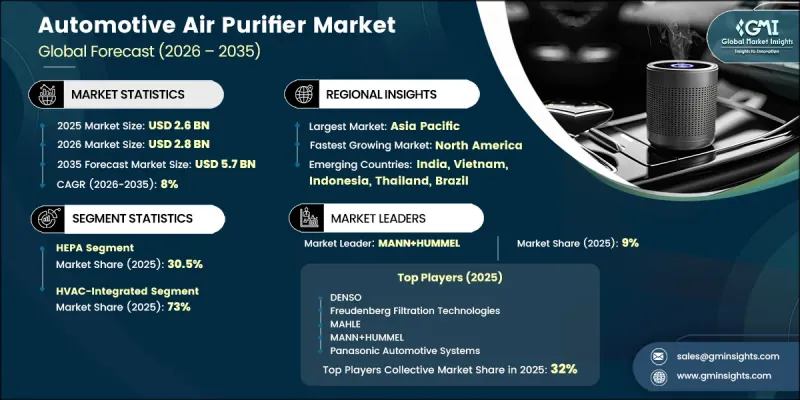
자동차용 공기청정기 시장은 규제 요건의 강화, 전기자동차(EV) 플랫폼과의 호환성 향상, 그리고 차량 내 공기질 및 건강에 대한 소비자의 인식 제고로 인해 계속해서 혜택을 받고 있습니다. 이 업계는 기존의 실내 공기 필터에서 첨단 감지 기능과 전자 제어 기능을 갖춘 지능형 정화 시스템으로 크게 발전하여, 제조사들은 공기질 개선과 탑승자의 쾌적성 향상을 실현할 수 있게 되었습니다. 기본적인 여과 솔루션에서 첨단 다단계 정화 기술로의 전환으로 인해 OEM과 부품 공급업체 모두에게 시장 기회가 확대되고 있습니다. 애프터마켓 판매를 통한 수요는 공장 장착형 시스템의 보급률이 낮고 규제 시행이 아직 발전 단계에 있는 지역에서 특히 견조한 추세를 보이고 있습니다. 그러나 비용에 민감한 차종 카테고리의 경우, 첨단 여과 시스템에 따른 추가 제조 비용으로 인해 프리미엄 다단계 정화 기술의 도입이 여전히 과제로 남아 있으며, 공급업체들은 제품의 성능과 품질을 유지하면서 비용 대비 효율이 더 높은 솔루션을 개발해야 하는 압박을 받고 있습니다.
| 시장 범위 | |
|---|---|
| 시작 연도 | 2025년 |
| 예측 기간 | 2026-2035년 |
| 초기 시장 규모 | 26억 달러 |
| 예측액 | 57억 달러 |
| CAGR | 8% |
HEPA 기술 부문은 2025년에 30.5%의 점유율을 차지했습니다. 이러한 선도적인 지위는 자동차용 여과 시스템에서의 광범위한 채택, 확립된 인증 기준, 그리고 자동차 제조사와 여과 기술 공급업체 간의 오랜 협력 관계에 의해 뒷받침되고 있습니다. 여과 효율, 제품 신뢰성, 제조 능력의 지속적인 발전으로 인해 승용차 및 상용차 분야 모두에서 HEPA 기반 공기 정화 시스템의 견고한 시장 지위가 계속해서 강화되고 있습니다.
HVAC 통합형 부문은 2025년에 73%의 점유율을 차지했으며, 2035년까지 연평균 성장률(CAGR) 8.4%로 성장할 것으로 전망됩니다. 이 부문은 자동차 제조 공정과의 긴밀한 통합이라는 이점을 가지고 있어, 자동차 제조사들은 진화하는 차량의 품질, 안전성, 환경 기준을 충족하면서 생산 공정에 첨단 공기 정화 기술을 접목할 수 있게 되었습니다. 공기질 요건이 차량 개발 및 인증 과정에 점점 더 많이 반영됨에 따라, 공장 출고 시 장착형 공기 정화 시스템은 신차 플랫폼 전반에 걸쳐 계속해서 선호되는 설치 방식이 될 전망입니다.
아시아태평양의 자동차용 공기청정기 시장은 2025년에 45.1%의 점유율을 차지했으며, 2035년까지 연평균 성장률(CAGR) 8.4%를 기록할 것으로 전망됩니다. 중국은 광범위한 자동차 제조 기반, 급속히 확대되는 전기자동차 생산, 그리고 자동차 제조사와 부품 공급업체를 연결하는 확립된 공급망 생태계의 뒷받침을 받아, 계속해서 이 지역 내에서 가장 큰 시장을 차지하고 있습니다. 지속적인 규제 지원, 차량 내 공기질 개선을 요구하는 소비자 수요의 증가, 그리고 끊임없는 기술 발전으로 인해 향후 몇 년간 이 지역은 세계 자동차용 공기청정기 시장에서 주도적인 위치를 유지할 것으로 예상됩니다.
자주 묻는 질문
목차
제1장 조사 방법과 범위
제2장 주요 요약
제3장 업계 인사이트
제4장 경쟁 구도
제5장 시장 추정 및 예측 : 기술별, 2022-2035년
제6장 시장 추정 및 예측 : 설치별, 2022-2035년
제7장 시장 추정 및 예측 : 차량별, 2022-2035년
제8장 시장 추정 및 예측 : 추진력별, 2022-2035년
제9장 시장 추정 및 예측 : 판매 채널별, 2022-2035년
제10장 시장 추정 및 예측 : 용도별, 2022-2035년
제11장 시장 추정 및 예측 : 지역별, 2022-2035년
제12장 기업 개요
KSM 26.08.05The Global Automotive Air Purifier Market was valued at USD 2.6 billion in 2025 and is estimated to grow at a CAGR of 8% to reach USD 5.7 billion by 2035.
The automotive air purifier market continues to benefit from increasingly stringent regulatory requirements, rising compatibility with electric vehicle platforms, and lasting consumer awareness regarding in-cabin air quality and health. The industry has progressed significantly from conventional cabin air filters to intelligent purification systems equipped with advanced sensing and electronic control capabilities, allowing manufacturers to deliver improved air quality and enhanced passenger comfort. The transition from basic filtration solutions to sophisticated multi-stage purification technologies has broadened market opportunities for both original equipment manufacturers and component suppliers. Continued demand through aftermarket sales remains particularly strong in regions where factory-installed systems have lower penetration and regulatory implementation is still developing. However, cost-sensitive vehicle categories continue to present challenges for premium multi-stage purification technologies due to the additional manufacturing costs associated with advanced filtration systems, encouraging suppliers to develop more cost-effective solutions while maintaining product performance and quality.
| Market Scope | |
|---|---|
| Start Year | 2025 |
| Forecast Year | 2026-2035 |
| Start Value | $2.6 Billion |
| Forecast Value | $5.7 Billion |
| CAGR | 8% |
The HEPA technology segment held a 30.5% share in 2025. Its leading position is supported by extensive adoption across automotive filtration systems, established certification standards, and long-standing relationships between automotive manufacturers and filtration technology suppliers. Continuous advancements in filtration efficiency, product reliability, and manufacturing capabilities continue to reinforce the strong market position of HEPA-based air purification systems across both passenger and commercial vehicle applications.
The HVAC-integrated factory-fit installation segment held 73% share in 2025 and projected to grow at a CAGR of 8.4% through 2035. This segment benefits from its close integration with vehicle manufacturing processes, enabling automotive manufacturers to incorporate advanced air purification technologies during production while meeting evolving vehicle quality, safety, and environmental standards. As air quality requirements become increasingly integrated into vehicle development and certification processes, factory-installed purification systems are expected to remain the preferred installation method across new vehicle platforms.
Asia Pacific Automotive Air Purifier Market accounted for 45.1% share in 2025 and is anticipated to register a CAGR of 8.4% throughout 2035. China continues to represent the largest market within the region, supported by its extensive automotive manufacturing base, rapidly expanding electric vehicle production, and well-established supply chain ecosystem connecting vehicle manufacturers with component suppliers. Continued regulatory support, increasing consumer demand for improved cabin air quality, and ongoing technological advancements are expected to sustain the region's leadership position in the global automotive air purifier market over the coming years.
Major companies operating in the global automotive air purifier market include Bosch, DENSO, MANN+HUMMEL, MAHLE, Valeo, Donaldson, Blueair, Panasonic Automotive Systems, Continental, and Freudenberg Filtration Technologies. Companies operating in the automotive air purifier market are strengthening their competitive position by investing in advanced filtration technologies, expanding manufacturing capacity, and developing innovative air purification systems that improve filtration efficiency and passenger comfort. Manufacturers are increasing research and development activities to enhance product performance while reducing size, weight, and energy consumption for better compatibility with modern vehicle platforms. Strategic partnerships with automotive manufacturers and component suppliers continue to support long-term OEM supply agreements and accelerate technology integration into new vehicle models. Companies are also expanding their regional manufacturing and distribution networks to improve product availability and meet growing global demand.
Table of Contents
Chapter 1 Methodology & Scope
- 1.1 Research approach
- 1.2 Quality Commitments
- 1.2.1 GMI AI policy & data integrity commitment
- 1.2.1.1 Source consistency protocol
- 1.2.1 GMI AI policy & data integrity commitment
- 1.3 Research Trail & Confidence Scoring
- 1.3.1 Research Trail Components
- 1.3.2 Scoring Components
- 1.4 Data Collection
- 1.4.1 Partial list of primary sources
- 1.5 Data mining sources
- 1.5.1 Paid sources
- 1.5.1.1 Sources, by region
- 1.5.1 Paid sources
- 1.6 Base estimates and calculations
- 1.6.1 Base year calculation
- 1.7 Forecast
- 1.7.1 Quantified market impact analysis
- 1.7.1.1 Mathematical impact of growth parameters on forecast
- 1.7.1 Quantified market impact analysis
- 1.8 Research transparency addendum
- 1.8.1 Source attribution framework
- 1.8.2 Quality assurance metrics
- 1.8.3 Our commitment to trust
Chapter 2 Executive Summary
- 2.1 Industry 360° synopsis
- 2.2 Key market trends
- 2.2.1 Regional
- 2.2.2 Technology
- 2.2.3 Installation
- 2.2.4 Vehicle
- 2.2.5 Propulsion
- 2.2.6 Sales Channel
- 2.2.7 Application
- 2.3 TAM Analysis, 2026-2035
- 2.4 CXO perspectives: Strategic imperatives
Chapter 3 Industry Insights
- 3.1 Industry ecosystem analysis
- 3.1.1 Supplier landscape
- 3.1.1.1 Raw material suppliers
- 3.1.1.2 Component suppliers
- 3.1.1.3 Manufacturers
- 3.1.1.4 Service providers
- 3.1.1.5 Distribution channel
- 3.1.1.6 End Use
- 3.1.2 Cost structure
- 3.1.3 Profit margin
- 3.1.4 Value addition at each stage
- 3.1.5 Vertical integration trends
- 3.1.6 Disruptors
- 3.1.1 Supplier landscape
- 3.2 Industry impact forces
- 3.2.1 Growth drivers
- 3.2.1.1 Rising in-cabin PM2.5 and VOC pollution
- 3.2.1.2 Euro 7 and China GB/T cabin filtration regulations
- 3.2.1.3 Growing EV adoption driving HVAC-integrated purification
- 3.2.1.4 Increased post-COVID awareness of cabin air quality
- 3.2.2 Market Restraints
- 3.2.2.1 Lack of global cabin air quality standards
- 3.2.2.2 OEM cost pressure limiting adoption in entry-level vehicles
- 3.2.2.3 Ozone emission concerns with ionizer-based purifiers
- 3.2.3 Market Opportunities
- 3.2.3.1 IoT-enabled smart air quality monitoring
- 3.2.3.2 Growing demand from robotaxi and shared mobility fleets
- 3.2.3.3 OEM opportunities in FCEVs and luxury EVs
- 3.2.3.4 Rising aftermarket demand in emerging markets
- 3.2.1 Growth drivers
- 3.3 Growth potential analysis
- 3.4 Technology and Innovation landscape
- 3.4.1 Current technologies
- 3.4.2 Emerging technologies
- 3.5 Pricing Analysis (Driven by Primary Research)
- 3.5.1 Historical Price Trend Analysis
- 3.5.2 Pricing Strategy by Player Type (Premium / Value / Cost-plus)
- 3.6 Regulatory guideline
- 3.6.1 North America
- 3.6.1.1 Environmental Protection Agency (EPA)
- 3.6.1.2 National Highway Traffic Safety Administration (NHTSA)
- 3.6.1.3 California Air Resources Board (CARB)
- 3.6.1.4 Occupational Safety and Health Administration (OSHA)
- 3.6.1.5 Canadian Motor Vehicle Safety Standards (CMVSS)
- 3.6.2 Europe
- 3.6.2.1 Euro 7 Vehicle Emission Regulation
- 3.6.2.2 UNECE Regulation No. 10 (Electromagnetic Compatibility)
- 3.6.2.3 REACH (Registration, Evaluation, Authorisation and Restriction of Chemicals)
- 3.6.2.4 RoHS (Restriction of Hazardous Substances)
- 3.6.2.5 CE Marking Compliance
- 3.6.3 Asia Pacific
- 3.6.3.1 China GB/T Cabin Air Quality Standards
- 3.6.3.2 China Compulsory Certification (CCC)
- 3.6.3.3 Indian Central Motor Vehicles Rules (CMVR)
- 3.6.3.4 Japanese Industrial Standards (JIS)
- 3.6.3.5 Korean Motor Vehicle Safety Standards (KMVSS)
- 3.6.4 Latin America
- 3.6.4.1 Brazilian National Institute of Metrology (INMETRO)
- 3.6.4.2 Brazilian National Traffic Council (CONTRAN)
- 3.6.4.3 Mexican Official Standards (NOM)
- 3.6.4.4 Regional Vehicle Import and Certification Requirements
- 3.6.5 MEA
- 3.6.5.1 GCC Standardization Organization (GSO)
- 3.6.5.2 Saudi Standards, Metrology and Quality Organization (SASO)
- 3.6.5.3 South African National Regulator for Compulsory Specifications (NRCS)
- 3.6.5.4 Emirates Authority for Standardization and Metrology (ESMA)
- 3.6.1 North America
- 3.7 Trade data analysis (Driven by Paid Research)
- 3.7.1 Import/export volume & value trends
- 3.7.2 Key trade corridors & tariff impact
- 3.8 Capacity & production landscape (Driven by Primary Research)
- 3.8.1 Installed capacity by region & key producer
- 3.8.2 Capacity utilization rates & expansion pipelines
- 3.9 Cost breakdown analysis
- 3.10 Patent analysis (Driven by Primary Research)
- 3.11 Porter’s analysis
- 3.12 PESTEL analysis
- 3.13 Impact of AI & generative AI on the market
- 3.13.1 AI-driven disruption of existing business models
- 3.13.2 GenAI use cases & adoption roadmap by segment
- 3.13.3 Risks, limitations & regulatory considerations
- 3.14 Sustainability and environmental aspects
- 3.14.1 Sustainable practices
- 3.14.2 Waste reduction strategies
- 3.14.3 Energy efficiency in production
- 3.14.4 Eco-friendly Initiatives
- 3.14.5 Carbon footprint considerations
- 3.15 Forecast assumptions & scenario analysis (Driven by Primary Research)
- 3.15.1 Base Case key macro & industry variables driving CAGR
- 3.15.2 Optimistic Scenarios Favorable macro and industry tailwinds
- 3.15.3 Pessimistic Scenario Macroeconomic slowdown or industry headwinds
Chapter 4 Competitive Landscape, 2025
- 4.1 Introduction
- 4.2 Company market share analysis
- 4.2.1 North America
- 4.2.2 Europe
- 4.2.3 Asia-Pacific
- 4.2.4 Latin America
- 4.2.5 Middle East & Africa
- 4.3 Competitive positioning matrix
- 4.4 Key developments
- 4.4.1 Mergers & acquisitions
- 4.4.2 Partnerships & collaborations
- 4.4.3 New product launches
- 4.4.4 Expansion plans and funding
- 4.5 Company tier benchmarking
- 4.5.1 Tier classification criteria & qualifying thresholds
- 4.5.2 Tier positioning matrix by revenue, geography & innovation
Chapter 5 Market Estimates & Forecast, By Technology, 2022 - 2035 ($Mn, Units)
- 5.1 Key trends
- 5.2 HEPA (High-Efficiency Particulate Air)
- 5.3 Activated carbon
- 5.4 Ionic/electrostatic
- 5.5 Photocatalytic oxidation (PCO)
- 5.6 Plasma cluster
- 5.7 UV-LED purification
- 5.8 Multi-technology/hybrid
Chapter 6 Market Estimates & Forecast, By Installation, 2022 - 2035 ($Mn, Units)
- 6.1 Key trends
- 6.2 HVAC-integrated
- 6.3 Standalone plug-in
Chapter 7 Market Estimates & Forecast, By Vehicle, 2022 - 2035 ($Mn, Units)
- 7.1 Key trends
- 7.2 Passenger cars
- 7.2.1 Hatchback
- 7.2.2 Sedan
- 7.2.3 SUV
- 7.3 Commercial vehicles
- 7.3.1 Light duty
- 7.3.2 Medium duty
- 7.3.3 Heavy duty
Chapter 8 Market Estimates & Forecast, By Propulsion, 2022 - 2035 ($Mn, Units)
- 8.1 Key trends
- 8.2 Gasoline
- 8.3 Diesel
- 8.4 BEV
- 8.5 HEV
- 8.6 PHEV
- 8.7 FCEV
Chapter 9 Market Estimates & Forecast, By Sales Channel, 2022 - 2035 ($Mn, Units)
- 9.1 Key Trends
- 9.2 OEM
- 9.3 Aftermarket
- 9.3.1 Online retail
- 9.3.2 Offline retail
- 9.3.2.1 Automotive accessory stores
- 9.3.2.2 Electronics stores
- 9.3.2.3 Authorized dealers & service centers
Chapter 10 Market Estimates & Forecast, By Application, 2022 - 2035 ($Mn, Units)
- 10.1 Key Trends
- 10.2 Private/personal use vehicles
- 10.3 Commercial fleet vehicles
- 10.3.1 Ride-hailing & taxi services
- 10.3.2 Logistics & delivery fleets
- 10.4 Specialty & institutional vehicles
- 10.4.1 Ambulances & emergency vehicles
- 10.4.2 Government & public transport vehicles
Chapter 11 Market Estimates & Forecast, By Region, 2022 - 2035 ($Mn, Units)
- 11.1 Key Trends
- 11.2 North America
- 11.2.1 US
- 11.2.2 Canada
- 11.3 Europe
- 11.3.1 UK
- 11.3.2 Germany
- 11.3.3 France
- 11.3.4 Italy
- 11.3.5 Spain
- 11.3.6 Russia
- 11.3.7 Nordics
- 11.4 Asia Pacific
- 11.4.1 China
- 11.4.2 India
- 11.4.3 Japan
- 11.4.4 South Korea
- 11.4.5 Southeast Asia
- 11.4.5.1 Indonesia
- 11.4.5.2 Malaysia
- 11.4.5.3 Singapore
- 11.4.5.4 Thailand
- 11.4.5.5 Vietnam
- 11.4.6 ANZ
- 11.5 Latin America
- 11.5.1 Brazil
- 11.5.2 Mexico
- 11.5.3 Argentina
- 11.6 MEA
- 11.6.1 South Africa
- 11.6.2 Saudi Arabia
- 11.6.3 UAE
Chapter 12 Company Profiles
- 12.1 Global Players
- 12.1.1 3M
- 12.1.2 Blueair
- 12.1.3 Bosch
- 12.1.4 Continental
- 12.1.5 DENSO
- 12.1.6 Donaldson
- 12.1.7 Freudenberg Filtration Technologies
- 12.1.8 Hanon Systems
- 12.1.9 Hengst
- 12.1.10 Honeywell
- 12.1.11 MAHLE
- 12.1.12 MANN+HUMMEL
- 12.1.13 Panasonic Automotive Systems
- 12.1.14 Toyota Boshoku
- 12.1.15 Valeo
- 12.2 Regional Players
- 12.2.1 ADA Electrotech
- 12.2.2 CabinAir Sweden
- 12.2.3 IQAir
- 12.2.4 Paragon
- 12.2.5 Atmus Filtration Technologies