

|
시장보고서
상품코드
2101881
수평형 카토닝 머신 시장 기회, 성장 촉진요인, 업계 동향 분석 및 예측(2026-2035년)Horizontal Cartoning Machines Market Opportunity, Growth Drivers, Industry Trend Analysis, and Forecast 2026 - 2035 |
||||||

세계의 수평형 카토닝 머신 시장은 2025년에 22억 달러 규모에 달하고, CAGR 4.9%로 성장하여 2035년까지 35억 달러에 달할 것으로 예측됩니다.
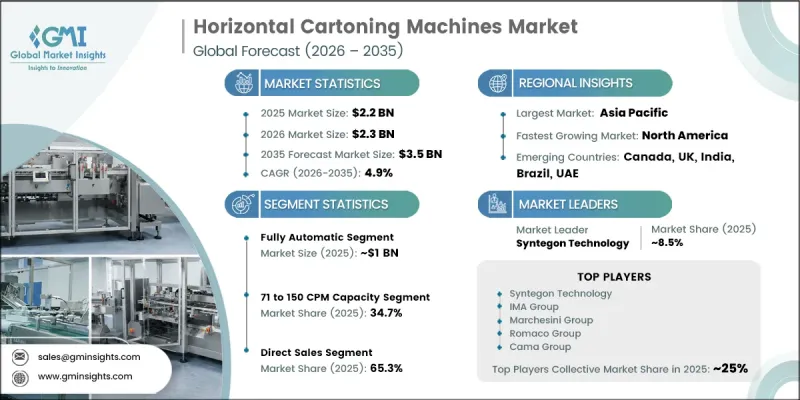
수평형 카토닝 머신 시장은 생산성, 업무 효율성 및 포장 일관성을 향상시키기 위해 다양한 업계의 제조업체들이 자동화된 포장 솔루션 도입을 가속화하고 있어 꾸준히 확대되고 있습니다. 대량 생산에 대한 중요성이 커짐에 따라, 기업들은 수작업 개입을 최소화하면서 더 높은 정밀도, 재현성 및 비용 효율성을 실현할 수 있는 첨단 카토닝 시스템에 대한 투자를 진행하고 있습니다. 산업 자동화 분야의 탄탄한 전문 지식이 기술 개발을 지속적으로 뒷받침하고 있으며, 공급업체들은 진화하는 생산 요건을 충족하는 점점 더 정교한 포장 장비를 도입할 수 있게 되었습니다. 최신 수평형 카트닝 시스템은 여러 포장 공정을 간소화하여 제조업체가 처리 능력을 향상시키고, 생산 가동 중지 시간을 줄이며, 자재 낭비를 최소화하고, 설비 종합 효율(OEE)을 최적화할 수 있도록 지원합니다. 인건비 상승, 노동력 부족, 그리고 확장성이 뛰어난 제조 운영에 대한 수요 증가로 인해 수동 및 반자동 공정에서 완전 자동화된 포장 라인으로의 전환이 더욱 가속화되고 있습니다. 지능형 기계 기술, 모션 제어 시스템, 로봇 공학, 프로그래머블 자동화, 디지털 인터페이스의 지속적인 발전으로 제품의 기능성이 강화되는 동시에 생산 유연성도 향상되고 있습니다. 이러한 요인들로 인해 예측 기간 동안 전 세계 수평형 카토닝 머신 시장 전체에서 장기적인 성장이 지속될 것으로 전망됩니다.
| 시장 범위 | |
|---|---|
| 시작 연도 | 2025년 |
| 예측 기간 | 2026-2035년 |
| 시작 시점 시장 규모 | 22억 달러 |
| 예측액 | 35억 달러 |
| CAGR | 4.9% |
완전 자동화 부문은 2025년에 10억 달러의 시장 규모를 기록했으며, 2026년부터 2035년까지 연평균 성장률(CAGR) 5.4%로 성장할 것으로 전망됩니다. 제조업체들이 생산 효율성 향상, 일관된 제품 품질, 인건비 절감을 실현하는 고속 포장 작업을 점점 더 중시함에 따라, 이 부문은 계속해서 시장 성장을 주도하고 있습니다. 또한, 완전 자동화 시스템은 운영 신뢰성 향상을 지원할 뿐만 아니라, 정밀한 검사, 코딩, 검증 및 포장 공정과의 원활한 통합을 가능하게 하므로 현대 제조 환경에 매우 적합합니다.
직판 부문은 2025년에 65.3%의 점유율을 차지했으며, 2026년부터 2035년까지 연평균 성장률(CAGR) 5%로 성장할 것으로 전망됩니다. 포장 시스템은 고유한 생산 요건을 충족하기 위해 맞춤 제작되는 경우가 많기 때문에 장비 제조업체와 고객 간의 직접적인 관계는 계속해서 매우 중요한 역할을 수행하고 있습니다. 이러한 접근 방식을 통해 공급업체는 장비 맞춤화, 시스템 통합, 설치, 운영자 교육, 유지보수 서비스, 기술 지원, 장기적인 제품 지원을 포함한 종합적인 프로젝트 지원을 제공할 수 있으며, 이 모든 것이 고객 만족도 향상과 총 소유 비용 절감에 기여하고 있습니다.
미국 수평형 카토닝 머신 시장은 2025년에 5억 290만 달러의 시장 규모를 기록했으며, 2026년부터 2035년까지 연평균 성장률(CAGR) 4.8%로 성장할 것으로 전망됩니다. 이러한 시장 성장은 업무 효율, 포장 품질 및 규제 준수의 향상으로 이어지는 첨단 자동 포장 솔루션을 요구하는 대규모 제조 업계의 강력한 수요에 힘입고 있습니다. 현대적인 포장 인프라에 대한 지속적인 투자와 고속 생산 시스템에 대한 수요 증가가 전미 시장에서 지속적인 시장 확장을 이끌 것으로 예상됩니다.
자주 묻는 질문
목차
제1장 조사 방법과 범위
제2장 주요 요약
제3장 업계 인사이트
제4장 경쟁 구도
제5장 시장 추정 및 예측 : 자동화 레벨별, 2022-2035년
제6장 시장 추정 및 예측 : 모션 유형별, 2022-2035년
제7장 시장 추정 및 예측 : 용량별, 2022-2035년
제8장 시장 추정 및 예측 : 카톤 유형별, 2022-2035년
제9장 시장 추정 및 예측 : 최종 이용 산업별, 2022-2035년
제10장 시장 추정 및 예측 : 유통 채널별, 2022-2035년
제11장 시장 추정 및 예측 : 지역별, 2022-2035년
제12장 기업 개요
KSM 26.08.05The Global Horizontal Cartoning Machines Market was valued at USD 2.2 billion in 2025 and is estimated to grow at a CAGR of 4.9% to reach USD 3.5 billion by 2035.
The horizontal cartoning machines market is expanding steadily as manufacturers across multiple industries accelerate the adoption of automated packaging solutions to improve productivity, operational efficiency, and packaging consistency. Growing emphasis on high-volume manufacturing is encouraging companies to invest in advanced cartoning systems capable of delivering greater accuracy, repeatability, and cost efficiency while minimizing manual intervention. Strong expertise in industrial automation continues to support technology development, enabling suppliers to introduce increasingly sophisticated packaging equipment that meets evolving production requirements. Modern horizontal cartoning systems streamline multiple packaging operations, helping manufacturers improve throughput, reduce production downtime, minimize material waste, and optimize overall equipment effectiveness. Rising labor costs, workforce shortages, and the growing need for scalable manufacturing operations are further accelerating the transition from manual and semi-automatic processes to fully automated packaging lines. Continuous advancements in intelligent machine technologies, motion control systems, robotics, programmable automation, and digital interfaces are strengthening product capabilities while improving production flexibility. These factors are expected to sustain long-term growth across the global horizontal cartoning machines market throughout the forecast period.
| Market Scope | |
|---|---|
| Start Year | 2025 |
| Forecast Year | 2026-2035 |
| Start Value | $2.2 Billion |
| Forecast Value | $3.5 Billion |
| CAGR | 4.9% |
The fully automatic segment generated USD 1 billion in 2025 and is projected to grow at a CAGR of 5.4% from 2026 to 2035. The segment continues to lead market growth as manufacturers increasingly prioritize high-speed packaging operations that deliver greater production efficiency, consistent product quality, and reduced labor requirements. Fully automated systems also support improved operational reliability while enabling seamless integration with advanced inspection, coding, verification, and packaging processes, making them highly suitable for modern manufacturing environments.
The direct sales segment accounted for 65.3% share in 2025 and is expected to grow at a CAGR of 5% during 2026-2035. Direct engagement between equipment manufacturers and customers continues to play a vital role because packaging systems are frequently customized to meet unique production requirements. This approach enables suppliers to provide complete project support, including equipment customization, system integration, installation, operator training, maintenance services, technical assistance, and long-term product support, all of which contribute to higher customer satisfaction and lower total ownership costs.
U.S. Horizontal Cartoning Machines Market generated USD 502.9 million in 2025 and is anticipated to register a CAGR of 4.8% from 2026 to 2035. Market growth is supported by strong demand from large-scale manufacturing industries seeking advanced automated packaging solutions that improve operational efficiency, packaging quality, and regulatory compliance. Continued investments in modern packaging infrastructure and increasing demand for high-speed production systems are expected to sustain market expansion across the country.
Major companies operating in the global horizontal cartoning machines market include Coesia S.p.A., Syntegon Technology GmbH, IMA Industria Macchine Automatiche S.p.A., Marchesini Group S.p.A., Korber AG, Cama Group S.p.A., OPTIMA Packaging Group GmbH, Mpac Group plc, ADCO Manufacturing Inc., Econocorp Inc., ACG Worldwide Private Limited, Pakona Engineers Pvt. Ltd., PMI KYOTO Packaging Systems, ELITER Packaging Machinery Co., Ltd., and Jacob White Packaging Ltd. Companies operating in the horizontal cartoning machines market are strengthening their market position by investing in automation technologies, intelligent machine controls, and advanced packaging solutions that improve productivity and operational flexibility. Manufacturers are expanding product portfolios with high-speed, energy-efficient, and customizable equipment designed to meet evolving customer requirements across multiple industries. Strategic collaborations, acquisitions, and global distribution partnerships help companies broaden their geographic reach and strengthen customer support capabilities. Businesses are also increasing investments in research and development to enhance machine performance, simplify system integration, and improve digital connectivity.
Table of Contents
Chapter 1 Methodology & Scope
- 1.1 Market scope and definition
- 1.2 Research design
- 1.2.1 Research approach
- 1.2.2 Data collection methods
- 1.3 Data mining sources
- 1.3.1 Global
- 1.3.2 Regional/Country
- 1.4 Base estimates and calculations
- 1.4.1 Base year calculation
- 1.4.2 Key trends for market estimation
- 1.5 Primary research and validation
- 1.5.1 Primary sources
- 1.6 Forecast model
- 1.7 Research assumptions and limitations
Chapter 2 Executive Summary
- 2.1 Industry 360° synopsis
- 2.2 Key market trends
- 2.2.1 Regional
- 2.2.2 Automation level
- 2.2.3 Motion type
- 2.2.4 Capacity
- 2.2.5 Carton type
- 2.2.6 End-use industry
- 2.2.7 Distribution channel
Chapter 3 Industry Insights
- 3.1 Industry ecosystem analysis
- 3.1.1 Supplier landscape
- 3.1.2 Profit margin
- 3.1.3 Value addition at each stage
- 3.1.4 Factor affecting the value chain
- 3.2 Industry impact forces
- 3.2.1 Growth drivers
- 3.2.1.1 Rising automation adoption across food, pharma & FMCG packaging lines
- 3.2.1.2 Growing pharmaceutical packaging stringency driving precision cartoner demand
- 3.2.1.3 Surge in E-commerce & secondary packaging requirements
- 3.2.1.4 Increasing demand for flexible, multi-format cartoning solutions
- 3.2.2 Industry pitfalls & challenges
- 3.2.2.1 Rapid product & carton format changeover requirements
- 3.2.2.2 Supply chain volatility in electronic & mechanical components
- 3.2.2.3 Intensifying price competition from Asian manufacturers
- 3.2.3 Opportunities
- 3.2.3.1 Shift toward sustainable & paper-based secondary packaging
- 3.2.3.2 Aftermarket services, retrofitting & digitalization upgrades
- 3.2.3.3 Pharmaceutical serialization & track-and-trace compliance driving machine upgrades
- 3.2.1 Growth drivers
- 3.3 Growth potential analysis
- 3.4 Future market trends
- 3.5 Technology and innovation landscape
- 3.5.1 Current technological trends
- 3.5.2 Emerging technologies
- 3.6 Regulatory landscape
- 3.6.1 Standards and compliance requirements
- 3.6.2 Regional regulatory frameworks
- 3.6.3 Certification standards
- 3.7 Trade data analysis (HS Code 8422)
- 3.7.1 Import/export volume & value trends
- 3.7.2 Key trade corridors & tariff impact
- 3.8 Pricing analysis
- 3.8.1 Historical price trend analysis (driven by primary research)
- 3.8.2 Pricing strategy by player type (premium / value / mass market)
- 3.9 Impact of AI & generative AI on the market
- 3.9.1 AI-driven disruption of existing business models
- 3.9.2 GenAI use cases & adoption roadmap by segment
- 3.9.3 Risks, limitations & regulatory considerations
- 3.10 Porter's analysis
- 3.11 PESTEL analysis
Chapter 4 Competitive Landscape, 2025
- 4.1 Introduction
- 4.2 Company market share analysis
- 4.2.1 By Region
- 4.2.1.1 North America
- 4.2.1.2 Europe
- 4.2.1.3 Asia Pacific
- 4.2.1.4 Latin America
- 4.2.1.5 Middle East & Africa
- 4.2.1 By Region
- 4.3 Company matrix analysis
- 4.4 Competitive analysis of major market players
- 4.5 Competitive positioning matrix
- 4.6 Key developments
- 4.6.1 Mergers & acquisitions
- 4.6.2 Partnerships & collaborations
- 4.6.3 New product launches
- 4.6.4 Expansion plans
Chapter 5 Market Estimates & Forecast, By Automation Level, 2022 - 2035, (USD Billion) (Million Units)
- 5.1 Key trends
- 5.2 Fully automatic
- 5.3 Semi-automatic
- 5.4 Manual
Chapter 6 Market Estimates & Forecast, By Motion type, 2022 - 2035, (USD Billion) (Million Units)
- 6.1 Key trends
- 6.2 Continuous motion
- 6.3 Intermittent motion
Chapter 7 Market Estimates & Forecast, By Capacity, 2022 - 2035, (USD Billion) (Million Units)
- 7.1 Key trends
- 7.2 Up to 70 CPM
- 7.3 71 to 150 CPM
- 7.4 151 to 400 CPM
- 7.5 Above 400 CPM
Chapter 8 Market Estimates & Forecast, By Carton Type, 2022 - 2035, (USD Billion) (Million Units)
- 8.1 Key trends
- 8.2 Straight tuck end (STE)
- 8.3 Reverse tuck end (RTE)
- 8.4 Crash lock bottom (CLB)
- 8.5 Others (seal-end, tuck-and-tongue, specialty closures)
Chapter 9 Market Estimates & Forecast, By End-Use Industry, 2022 - 2035, (USD Billion) (Million Units)
- 9.1 Key trends
- 9.2 Food & beverage
- 9.3 Pharmaceuticals & healthcare
- 9.4 Personal care & cosmetics
- 9.5 Household products
- 9.6 Others (electronics, tobacco, chemicals, industrial)
Chapter 10 Market Estimates & Forecast, By Distribution Channel, 2022 - 2035, (USD Billion) (Million Units)
- 10.1 Key trends
- 10.2 Direct sales
- 10.3 Indirect sales
Chapter 11 Market Estimates & Forecast, By Region, 2022 - 2035, (USD Billion) (Million Units)
- 11.1 Key trends
- 11.2 North America
- 11.2.1 U.S.
- 11.2.2 Canada
- 11.3 Europe
- 11.3.1 Germany
- 11.3.2 UK
- 11.3.3 France
- 11.3.4 Italy
- 11.3.5 Spain
- 11.4 Asia Pacific
- 11.4.1 China
- 11.4.2 India
- 11.4.3 Japan
- 11.4.4 South Korea
- 11.4.5 Australia
- 11.4.6 Indonesia
- 11.4.7 Malaysia
- 11.5 Latin America
- 11.5.1 Brazil
- 11.5.2 Mexico
- 11.5.3 Argentina
- 11.6 MEA
- 11.6.1 Saudi Arabia
- 11.6.2 UAE
- 11.6.3 South Africa
Chapter 12 Company Profiles
- 12.1 Top Global Players
- 12.1.1 IMA Industria Macchine Automatiche S.p.A.
- 12.1.2 Marchesini Group S.p.A.
- 12.1.3 Syntegon Technology GmbH
- 12.1.4 Coesia S.p.A.
- 12.1.5 Korber AG
- 12.2 Regional Champions
- 12.2.1 Mpac Group plc
- 12.2.2 Econocorp Inc.
- 12.2.3 ADCO Manufacturing Inc.
- 12.2.4 Cama Group S.p.A.
- 12.2.5 OPTIMA Packaging Group GmbH
- 12.3 Emerging Players
- 12.3.1 ACG Worldwide Private Limited
- 12.3.2 Pakona Engineers Pvt. Ltd.
- 12.3.3 ELITER Packaging Machinery Co., Ltd.
- 12.3.4 PMI KYOTO Packaging Systems
- 12.3.5 Jacob White Packaging Ltd.


