

|
시장보고서
상품코드
2101923
카토닝 기계 시장 기회, 성장 촉진요인, 업계 동향 분석 및 예측(2026-2035년)Cartoning Machinery Market Opportunity, Growth Drivers, Industry Trend Analysis, and Forecast 2026 - 2035 |
||||||

세계의 카토닝 기계 시장은 2025년에 53억 달러 규모에 달하고, CAGR 5.1%로 성장하여 2035년까지 87억 달러에 달할 것으로 예측됩니다.
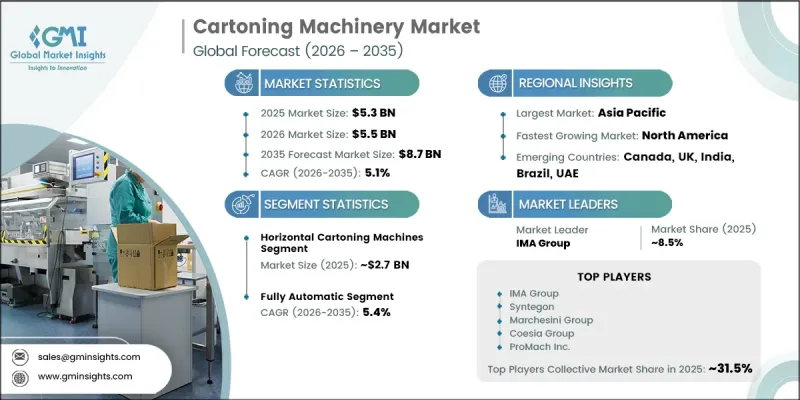
다양한 업계의 제조사들이 업무 효율, 제품 품질 및 생산 일관성을 향상시키기 위해 포장 자동화에 대한 투자를 확대함에 따라, 카토닝 기계 시장은 계속해서 성장하고 있습니다. 인력에 대한 의존도를 낮추고, 포장 오류를 제거하며, 제조 생산성을 향상시켜야 한다는 압박이 커짐에 따라 기업들은 대량 생산에 대응할 수 있는 첨단 카토닝 설비 도입을 추진하고 있습니다. 자동 카토닝 시스템은 다양한 포장 형식을 지원하면서도 생산 유연성을 높여, 끊임없이 변화하는 제조 요구 사항에 최적입니다. 기업들이 디지털 기술, 지능형 자동화, 로봇 공학, 인공지능 및 실시간 생산 모니터링을 포장 업무에 통합함에 따라, 스마트 제조로의 지속적인 전환이 시장 성장을 더욱 가속화하고 있습니다. 이러한 혁신을 통해 설비 성능이 향상되고, 유지보수 일정이 최적화되며, 전반적인 생산 효율이 높아집니다. 또한, 제품 추적성, 일련번호 부여, 공급망 투명성과 관련된 의약품 포장 규제가 강화됨에 따라, 전 세계 제조 시설에서 고속 생산과 포장 정밀도를 유지하면서 규제 준수를 지원할 수 있는 첨단 카토닝 기계에 대한 수요가 지속적으로 증가하고 있습니다.
| 시장 범위 | |
|---|---|
| 시작 연도 | 2025년 |
| 예측 기간 | 2026-2035년 |
| 시작 시점 시장 규모 | 53억 달러 |
| 예측액 | 87억 달러 |
| CAGR | 5.1% |
수평형 카토닝 기계 시장은 2025년에 27억 달러의 시장 규모를 기록했으며, 2026년부터 2035년까지 연평균 성장률(CAGR) 5.1%로 성장할 것으로 전망됩니다. 수평형 카토닝 기계는 높은 속도, 정밀도, 일관성을 유지하면서 복잡한 포장 작업을 효율적으로 관리할 수 있어 계속해서 시장을 선도하고 있습니다. 다양한 패키지 구성을 지원하며 신속한 제품 전환이 가능하고, 대량 생산 환경에서도 효율적으로 가동될 수 있다는 특징 덕분에 까다로운 포장 요건이 요구되는 업계 전반에서 도입이 지속적으로 확대되고 있습니다. 업무의 유연성과 생산 효율성에 대한 중요성이 높아짐에 따라, 예측 기간 동안 수평형 카토닝 기계에 대한 수요는 더욱 강해질 것으로 전망됩니다.
전자동 카토닝 기계 시장은 2025년에 59.4%의 점유율을 차지했으며, 2035년까지 연평균 성장률(CAGR) 5.4%로 성장할 것으로 전망됩니다. 인건비 급등과 지속적인 인력 부족으로 인해 제조업체들은 수작업을 최소화하면서 처리 능력을 향상시키는 전자동 포장 시스템에 대한 투자를 확대하고 있습니다. 이러한 기계는 일관된 포장 품질, 생산 신뢰성 향상 및 운영 효율성 증대를 실현하기 때문에 정밀도, 속도 및 규제 준수가 요구되는 대규모 제조 업무에서 점점 더 매력적인 선택지가 되고 있습니다. 공장 자동화에 대한 지속적인 투자로 인해 완전 자동 카토닝 기계의 도입이 더욱 가속화될 것으로 예상됩니다.
2025년 미국 카토닝 기계 시장 규모는 10억 5,400만 달러였습니다. 이러한 성장은 자동화, 커넥티드 기기, 디지털 생산 관리를 통해 포장 효율을 향상시키는 스마트 제조 기술에 대한 투자 확대에 힘입은 것입니다. 주요 산업 전반에 걸쳐 제조 자동화에 대한 설비 투자가 지속됨에 따라, 기업들이 생산성 향상, 운영 비용 절감, 생산 시설 현대화에 주력하는 가운데 첨단 카토닝 기계에 대한 수요는 계속해서 강세를 보이고 있습니다.
자주 묻는 질문
목차
제1장 조사 방법과 범위
제2장 주요 요약
제3장 업계 인사이트
제4장 경쟁 구도
제5장 시장 추정 및 예측 : 기계 유형별, 2022-2035년
제6장 시장 추정 및 예측 : 자동화 레벨별, 2022-2035년
제7장 시장 추정 및 예측 : 능력별, 2022-2035년
제8장 시장 추정 및 예측 : 카톤/포장 자재별, 2022-2035년
제9장 시장 추정 및 예측 : 최종 이용 산업별, 2022-2035년
제10장 시장 추정 및 예측 : 유통 채널별, 2022-2035년
제11장 시장 추정 및 예측 : 지역별, 2022-2035년
제12장 기업 개요
KSM 26.08.06The Global Cartoning Machinery Market was valued at USD 5.3 billion in 2025 and estimated to grow at a CAGR of 5.1% to reach USD 8.7 billion by 2035.
The cartoning machinery market continues to expand as manufacturers across multiple industries increase investments in packaging automation to improve operational efficiency, product quality, and production consistency. Growing pressure to reduce labor dependency, eliminate packaging errors, and increase manufacturing productivity is encouraging businesses to adopt advanced cartoning equipment capable of supporting high-volume operations. Automated cartoning systems provide greater production flexibility while accommodating a broad range of packaging formats, making them well suited for evolving manufacturing requirements. The ongoing shift toward smart manufacturing is further accelerating market growth as companies integrate digital technologies, intelligent automation, robotics, artificial intelligence, and real-time production monitoring into packaging operations. These innovations improve equipment performance, optimize maintenance schedules, and increase overall production efficiency. In addition, stricter pharmaceutical packaging regulations related to product traceability, serialization, and supply chain transparency continue to strengthen demand for advanced cartoning machinery capable of supporting regulatory compliance while maintaining high-speed production and packaging accuracy across global manufacturing facilities.
| Market Scope | |
|---|---|
| Start Year | 2025 |
| Forecast Year | 2026-2035 |
| Start Value | $5.3 Billion |
| Forecast Value | $8.7 Billion |
| CAGR | 5.1% |
The horizontal cartoning machinery market generated USD 2.7 billion in 2025 and is expected to grow at a CAGR of 5.1% from 2026 to 2035. Horizontal cartoning machines continue to lead the market because they efficiently manage complex packaging operations while maintaining high levels of speed, precision, and consistency. Their ability to support multiple package configurations, accommodate rapid product changeovers, and operate efficiently within high-volume manufacturing environments continues to drive adoption across industries with demanding packaging requirements. Increasing emphasis on operational flexibility and production efficiency is expected to further strengthen demand for horizontal cartoning machinery throughout the forecast period.
The fully automatic cartoning machinery market accounted for 59.4% share in 2025 and is anticipated to grow at a CAGR of 5.4% through 2035. Rising labor costs and ongoing workforce shortages are encouraging manufacturers to invest in fully automated packaging systems that improve throughput while minimizing manual intervention. These machines deliver consistent packaging quality, enhanced production reliability, and greater operational efficiency, making them increasingly attractive for large-scale manufacturing operations that require precision, speed, and regulatory compliance. Continued investments in factory automation are expected to further accelerate adoption of fully automatic cartoning machinery.
U.S. Cartoning Machinery Market was valued at USD 1,054 million in 2025. Growth is being supported by increasing investments in smart manufacturing technologies that improve packaging efficiency through automation, connected equipment, and digital production management. Ongoing capital investment in manufacturing automation across major industries continues to strengthen demand for advanced cartoning machinery as companies focus on improving productivity, reducing operating costs, and modernizing production facilities.
Key companies operating in the global cartoning machinery market include IMA Group, Syntegon Technology GmbH, Coesia Group, Marchesini Group, Uhlmann Group, Romaco Group, ProMach Inc., ACG Worldwide, ADCO Manufacturing, Kama GmbH, Pharmaworks, Jacob White Packaging, Econocorp Inc., Nuspark Inc., and Cama Group. Companies operating in the cartoning machinery market are strengthening their market position by expanding automation capabilities, improving machine flexibility, and investing in advanced packaging technologies. Manufacturers continue to develop high-speed systems that support multiple packaging formats while reducing downtime and increasing production efficiency. Businesses are also integrating digital monitoring, intelligent controls, and predictive maintenance features to enhance equipment performance and minimize operational interruptions. Strategic investments in research and development enable companies to introduce innovative solutions that meet evolving industry requirements and regulatory standards.
Table of Contents
Chapter 1 Methodology & Scope
- 1.1 Market scope and definition
- 1.2 Research design
- 1.2.1 Research approach
- 1.2.2 Data collection methods
- 1.3 Data mining sources
- 1.3.1 Global
- 1.3.2 Regional/Country
- 1.4 Base estimates and calculations
- 1.4.1 Base year calculation
- 1.4.2 Key trends for market estimation
- 1.5 Primary research and validation
- 1.5.1 Primary sources
- 1.6 Forecast model
- 1.7 Research assumptions and limitations
Chapter 2 Executive Summary
- 2.1 Industry 360° synopsis
- 2.2 Key market trends
- 2.2.1 Regional
- 2.2.2 Machine type
- 2.2.3 Automation level
- 2.2.4 Capacity
- 2.2.5 Carton/packaging material
- 2.2.6 End-use industry
- 2.2.7 Distribution channel
Chapter 3 Industry Insights
- 3.1 Industry ecosystem analysis
- 3.1.1 Supplier landscape
- 3.1.2 Profit margin
- 3.1.3 Value addition at each stage
- 3.1.4 Factor affecting the value chain
- 3.2 Industry impact forces
- 3.2.1 Growth drivers
- 3.2.1.1 Rising automation adoption driven by labor cost inflation & skilled labor shortage
- 3.2.1.2 Pharmaceutical serialization & track-and-trace compliance mandates globally
- 3.2.1.3 E-commerce expansion driving demand for high-speed secondary packaging
- 3.2.1.4 Sustainability regulations accelerating shift from plastic to carton-based packaging
- 3.2.2 Industry pitfalls & challenges
- 3.2.2.1 Supply chain disruptions for critical components
- 3.2.2.2 Skilled operator shortage for installation, validation & maintenance of advanced lines
- 3.2.3 Opportunities
- 3.2.3.1 Modular & compact cartoner designs unlocking SME adoption
- 3.2.3.2 Packaging-as-a-service (PaaS) & leasing models reducing capex barriers
- 3.2.1 Growth drivers
- 3.3 Growth potential analysis
- 3.4 Future market trends
- 3.5 Technology and innovation landscape
- 3.5.1 Current technological trends
- 3.5.2 Emerging technologies
- 3.6 Regulatory landscape
- 3.6.1 Standards and compliance requirements
- 3.6.2 Regional regulatory frameworks
- 3.6.3 Certification standards
- 3.7 Trade data analysis (HS Code 8422.40)
- 3.7.1 Import/export volume & value trends
- 3.7.2 Key trade corridors & tariff impact
- 3.8 Pricing analysis
- 3.8.1 Historical price trend analysis (driven by primary research)
- 3.8.2 Pricing strategy by player type (premium / value / mass market)
- 3.9 Impact of AI & generative AI on the market
- 3.9.1 AI-driven disruption of existing business models
- 3.9.2 GenAI use cases & adoption roadmap by segment
- 3.9.3 Risks, limitations & regulatory considerations
- 3.10 Porter's analysis
- 3.11 PESTEL analysis
- 3.12 Consumer buying behavior analysis
- 3.12.1 Demographic trends
- 3.12.2 Factors affecting buying decisions
- 3.12.3 Consumer product adoption
- 3.12.4 Preferred distribution channel
Chapter 4 Competitive Landscape, 2025
- 4.1 Introduction
- 4.2 Company market share analysis
- 4.2.1 By Region
- 4.2.1.1 North America
- 4.2.1.2 Europe
- 4.2.1.3 Asia Pacific
- 4.2.1.4 Latin America
- 4.2.1.5 Middle East & Africa
- 4.2.1 By Region
- 4.3 Company matrix analysis
- 4.4 Competitive analysis of major market players
- 4.5 Competitive positioning matrix
- 4.6 Key developments
- 4.6.1 Mergers & acquisitions
- 4.6.2 Partnerships & collaborations
- 4.6.3 New product launches
- 4.6.4 Expansion plans
Chapter 5 Market Estimates & Forecast, By Machine Type, 2022 - 2035, (USD Billion) (Million Units)
- 5.1 Key trends
- 5.2 Horizontal cartoning machines
- 5.3 Vertical cartoning machines
- 5.4 Wraparound cartoners
Chapter 6 Market Estimates & Forecast, By Automation Level, 2022 - 2035, (USD Billion) (Million Units)
- 6.1 Key trends
- 6.2 Fully automatic
- 6.3 Semi-automatic
- 6.4 Manual
Chapter 7 Market Estimates & Forecast, By Capacity, 2022 - 2035, (USD Billion) (Million Units)
- 7.1 Key trends
- 7.2 Low speed (Below 70 CPM)
- 7.3 Medium speed (70-150 CPM)
- 7.4 High speed (Above 150 CPM)
Chapter 8 Market Estimates & Forecast, By Carton/Packaging Material, 2022 - 2035, (USD Billion) (Million Units)
- 8.1 Key trends
- 8.2 Paperboard
- 8.3 Corrugated fiberboard
- 8.4 Others (recycled board, bio-based composites)
Chapter 9 Market Estimates & Forecast, By End-Use Industry, 2022 - 2035, (USD Billion) (Million Units)
- 9.1 Key trends
- 9.2 Food & beverage
- 9.3 Pharmaceuticals & healthcare
- 9.4 Personal care & cosmetics
- 9.5 Consumer goods & household products
- 9.6 Others (chemicals, agrochemicals)
Chapter 10 Market Estimates & Forecast, By Distribution Channel, 2022 - 2035, (USD Billion) (Million Units)
- 10.1 Key trends
- 10.2 Direct sales
- 10.3 Indirect sales
Chapter 11 Market Estimates & Forecast, By Region, 2022 - 2035, (USD Billion) (Million Units)
- 11.1 Key trends
- 11.2 North America
- 11.2.1 U.S.
- 11.2.2 Canada
- 11.3 Europe
- 11.3.1 Germany
- 11.3.2 UK
- 11.3.3 France
- 11.3.4 Italy
- 11.3.5 Spain
- 11.4 Asia Pacific
- 11.4.1 China
- 11.4.2 India
- 11.4.3 Japan
- 11.4.4 South Korea
- 11.4.5 Australia
- 11.4.6 Indonesia
- 11.4.7 Malaysia
- 11.5 Latin America
- 11.5.1 Brazil
- 11.5.2 Mexico
- 11.5.3 Argentina
- 11.6 MEA
- 11.6.1 Saudi Arabia
- 11.6.2 UAE
- 11.6.3 South Africa
Chapter 12 Company Profiles
- 12.1 Global Players
- 12.1.1 IMA Group
- 12.1.2 Syntegon Technology GmbH
- 12.1.3 Coesia Group
- 12.1.4 Marchesini Group
- 12.1.5 Uhlmann Group
- 12.2 Regional Champions
- 12.2.1 Romaco Group
- 12.2.2 ProMach Inc.
- 12.2.3 ACG Worldwide
- 12.2.4 ADCO Manufacturing
- 12.2.5 Kama GmbH
- 12.3 Emerging Players
- 12.3.1 Pharmaworks
- 12.3.2 Jacob White Packaging
- 12.3.3 Econocorp Inc.
- 12.3.4 Nuspark Inc.
- 12.3.5 Cama Group


