|
시장보고서
상품코드
2109148
보행자용 자동문 시장 비즈니스 기회, 성장요인, 업계 동향 분석 및 예측(2026-2035년)Pedestrian Automatic Door Market Opportunity, Growth Drivers, Industry Trend Analysis, and Forecast 2026 - 2035 |
||||||

세계의 보행자용 자동문 시장은 2025년에 51억 달러로 평가되었고, CAGR 6.1%로 성장하여 2035년까지 92억 달러에 이를 것으로 추정되고 있습니다.
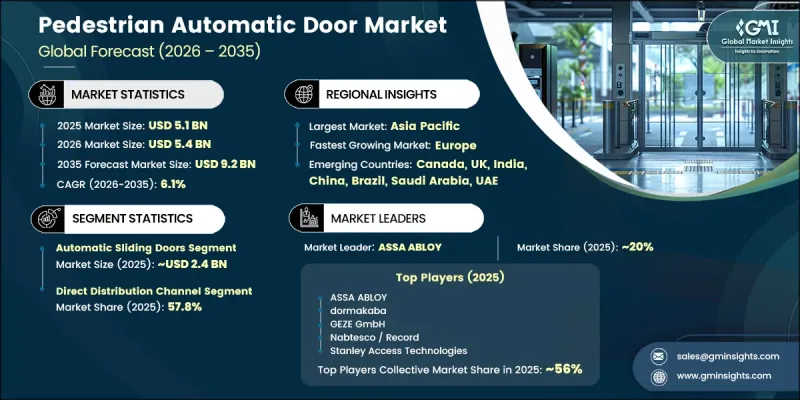
보행자용 자동문 업계 전반의 성장은 전 세계적으로 지속되는 상업용 건축 투자 및 인프라 개보수 덕분에 계속해서 뒷받침되고 있습니다. 접근성, 운영 효율성, 건물 성능을 향상시키는 지능형 입구 솔루션에 대한 수요가 증가함에 따라 보행자용 자동 출입 시스템의 보급이 촉진되고 있습니다. 또한, 부동산 소유주들이 진화하는 안전성, 접근성, 에너지 효율 기준에 부합하는 기술적으로 진보된 자동문을 기존 출입 시스템으로 교체하는 움직임이 가속화되면서, 개보수 및 건물 현대화 프로젝트의 속도가 빨라지고 있는 점도 시장에 긍정적인 영향을 미치고 있습니다. 기존 시설의 업그레이드는 건물의 기능성을 향상시키는 동시에 인프라의 수명을 연장하는 경제적인 접근 방식이며, 많은 상업 환경에서 기존 시설에 대한 사후 설치가 매력적인 선택지가 되고 있습니다. 또한, 지속가능성 노력의 일환으로 공기 유입을 줄이고 실내 기후 제어를 최적화하도록 설계된 에너지 효율이 높은 자동문 시스템의 도입이 가속화되면서 운영 비용 절감에 기여하고 있습니다. 동작 감지 기술, 지능형 센서, 안전 장치 및 자동화 기능의 지속적인 발전으로 시스템의 성능, 신뢰성 및 사용자 편의성이 더욱 향상되어 보행자용 자동문 시장의 장기적인 성장 기회가 강화되고 있습니다.
| 시장 범위 | |
|---|---|
| 개시 연도 | 2025년 |
| 예측 기간 | 2026-2035년 |
| 개시 연도 시장 규모 | 51억 달러 |
| 예측액 | 92억 달러 |
| CAGR | 6.1% |
자동 슬라이딩 도어 시장은 2025년에 24억 달러 시장 규모를 기록할 것으로 예상되며, 2026년부터 2035년까지 연평균 성장률(CAGR) 5.6%로 성장할 것으로 전망됩니다. 이 시장이 주도적인 위치를 유지하고 있는 이유는 문이 수평 방향으로 개폐됨으로써 이용 가능한 입구 공간을 최대한 확보하면서도, 매끄럽고 끊김 없는 보행자 통행을 실현하기 때문입니다. 이러한 설계 덕분에 가동 중에 추가적인 여유 공간을 필요로 하지 않으면서도 유동 인구가 많은 입구에서 효율적인 이동이 가능해져, 편의성과 건물 전체의 기능성이 향상됩니다. 혼잡을 최소화하면서도 보행자의 연속적인 이동을 유지할 수 있는 이러한 특성이 광범위한 상업용 분야에서 계속해서 견조한 수요를 이끌고 있습니다.
직접 판매 부문은 2025년에 57.8%의 점유율을 차지할 것으로 예상되며, 2035년까지 연평균 성장률(CAGR) 6%로 성장할 것으로 전망됩니다. 자동문 시스템은 전문적인 계획, 전문 업체에 의한 설치, 시스템 통합, 지속적인 유지보수, 그리고 확립된 안전 및 접근성 기준 준수가 필요하기 때문에 제조업체와의 직접 거래가 여전히 선호되는 구매 방식입니다. 이러한 유통 모델을 통해 제조업체는 개별 건물의 요구 사항을 충족하는 맞춤형 솔루션을 제공하는 동시에, 종합적인 기술 지원, 보증, 유지보수 프로그램 및 신속한 사후 서비스를 제공할 수 있습니다. 개별적인 시스템 제안과 장기적인 라이프사이클 지원을 제공할 수 있다는 점이 직접 판매 채널의 우위를 계속해서 공고히 하고 있습니다.
미국 보행자용 자동문 시장은 2025년에 8억 3,970만 달러 규모를 기록했습니다. 시장의 성장은 상업 인프라 및 건축 개발에 대한 지속적인 투자에 힘입고 있으며, 접근성, 운영 효율성, 이용자의 편의성을 높이기 위해 자동 출입 시스템 도입이 점점 더 확대되고 있습니다. 배리어프리 건축 설계를 촉진하는 규제 요건으로 인해 공공시설 및 민간 시설 모두에서 보행자용 자동문 도입이 더욱 확대되고 있습니다. 현대적인 인프라와 첨단 건축 기술에 대한 지속적인 투자가 전미 전역에서 자동 출입구 솔루션에 대한 수요를 더욱 강화하고 있습니다.
자주 묻는 질문
목차
제1장 조사 방법과 범위
제2장 주요 요약
제3장 업계 인사이트
제4장 경쟁 구도
제5장 시장 추산 및 예측 : 제품 유형별, 2022년-2035년
제6장 시장 추산 및 예측 : 기능별, 2022년-2035년
제7장 시장 추산 및 예측 : 설치 형태별, 2022년-2035년
제8장 시장 추산 및 예측 : 용도별, 2022년-2035년
제9장 시장 추산 및 예측 : 유통 채널별, 2022년-2035년
제10장 시장 추산 및 예측 : 지역별, 2022년-2035년
제11장 기업 개요
LSHThe Global Pedestrian Automatic Door Market was valued at USD 5.1 billion in 2025 and is estimated to grow at a CAGR of 6.1% to reach USD 9.2 billion by 2035.
Growth across the pedestrian automatic door industry continues to be fueled by ongoing investments in commercial construction and infrastructure upgrades worldwide. Rising demand for intelligent entrance solutions that improve accessibility, operational efficiency, and building performance is encouraging broader adoption of automated pedestrian access systems. The market is also benefiting from the growing pace of renovation and building modernization projects, as property owners increasingly replace conventional entrance systems with technologically advanced automatic doors that align with evolving safety, accessibility, and energy efficiency standards. Upgrading existing facilities provides an economical approach to improving building functionality while extending infrastructure lifespan, making retrofit installations an attractive option across numerous commercial environments. In addition, sustainability initiatives are accelerating the installation of energy-efficient automatic door systems designed to reduce air infiltration and optimize indoor climate control, contributing to lower operating costs. Continuous advancements in motion detection technologies, intelligent sensors, safety mechanisms, and automation capabilities are further improving system performance, reliability, and user convenience, strengthening long-term growth opportunities for the pedestrian automatic door market.
| Market Scope | |
|---|---|
| Start Year | 2025 |
| Forecast Year | 2026-2035 |
| Start Value | $5.1 Billion |
| Forecast Value | $9.2 Billion |
| CAGR | 6.1% |
The automatic sliding doors segment generated USD 2.4 billion in 2025 and is forecast to register a CAGR of 5.6% between 2026 and 2035. This segment maintains a leading position because horizontal door movement maximizes usable entrance space while delivering smooth and uninterrupted pedestrian access. The design supports efficient movement through high-traffic entry points without requiring additional clearance during operation, improving convenience and overall building functionality. Their ability to maintain continuous pedestrian movement while minimizing congestion continues to drive strong demand across a wide range of commercial applications.
The direct distribution segment accounted for 57.8% share in 2025 and is expected to grow at a CAGR of 6% throughout 2035. Direct engagement with manufacturers remains the preferred purchasing approach because automatic door systems require specialized planning, professional installation, system integration, ongoing servicing, and adherence to established safety and accessibility standards. This distribution model enables manufacturers to deliver customized solutions that meet individual building requirements while offering comprehensive technical support, warranty coverage, maintenance programs, and faster after-sales service. The ability to provide personalized system recommendations and long-term lifecycle support continues to reinforce the dominance of direct distribution channels.
U.S. Pedestrian Automatic Door Market captured USD 839.7 million in 2025. Market growth remains supported by sustained investment in commercial infrastructure and building development, where automated entrance systems are increasingly adopted to enhance accessibility, operational efficiency, and user convenience. Regulatory requirements promoting accessible building design continue to encourage wider installation of pedestrian automatic doors across both public and private facilities. Continuous investment in modern infrastructure and advanced building technologies further strengthens demand for automatic entrance solutions throughout the country.
Major companies operating in the global pedestrian automatic door industry include ASSA ABLOY Entrance Systems, Dormakaba Group, GEZE GmbH, Nabtesco Corporation, Royal Boon Edam International B.V., Horton Automatics, Record USA, TORMAX USA Inc., Panasonic Corporation, Stanley Access Technologies, Wilcox Door Service Inc., FAAC Group, Manusa, Portalp, KBB Automatic Door Group, and Gilgen Door Systems AG. Companies participating in the pedestrian automatic door market are strengthening their competitive position through continuous investment in product innovation, technology enhancement, and portfolio expansion. Manufacturers are focusing on developing advanced automatic door systems with improved sensor accuracy, enhanced safety features, greater energy efficiency, and smarter automation capabilities to address evolving customer requirements. Many organizations are also expanding their geographic presence by strengthening distribution networks, increasing service capabilities, and enhancing customer support. Strategic collaborations, long-term business partnerships, and investments in research and development remain key priorities for accelerating innovation and improving product performance.
Table of Contents
Chapter 1 Methodology & Scope
Chapter 2 Executive Summary
- 2.1 Industry 360° synopsis
- 2.2 Key market trends
- 2.2.1 Regional
- 2.2.2 Product type
- 2.2.3 Function
- 2.2.4 Installation type
- 2.2.5 Application
- 2.2.6 Distribution channel
Chapter 3 Industry Insights
- 3.1 Industry ecosystem analysis
- 3.1.1 Supplier landscape
- 3.1.2 Profit margin
- 3.1.3 Value addition at each stage
- 3.1.4 Factor affecting the value chain
- 3.2 Industry impact forces
- 3.2.1 Growth drivers
- 3.2.1.1 Growth in commercial and infrastructure development
- 3.2.1.2 Increasing integration with smart building systems
- 3.2.1.3 Growth in retrofit and modernization projects
- 3.2.1.4 Advancements in sensor and safety technologies
- 3.2.2 Industry pitfalls & challenges
- 3.2.2.1 Ongoing maintenance and repair requirements
- 3.2.2.2 Technical complexity and skilled installation needs
- 3.2.3 Opportunities
- 3.2.3.1 Expansion of smart building and IoT ecosystems
- 3.2.3.2 Rising demand for touchless and hygienic infrastructure
- 3.2.3.3 Increasing retrofit and modernization projects
- 3.2.1 Growth drivers
- 3.3 Growth potential analysis
- 3.4 Future market trends
- 3.5 Technology and innovation landscape
- 3.5.1 Current technological trends
- 3.5.2 Emerging technologies
- 3.6 Regulatory landscape
- 3.6.1 Standards and compliance requirements
- 3.6.2 Regional regulatory frameworks
- 3.6.3 Certification standards
- 3.7 Trade data analysis (HS Code 8302.60)
- 3.7.1 Import/export volume & value trends
- 3.7.2 Key trade corridors & tariff impact
- 3.8 Pricing analysis
- 3.8.1 Historical price trend analysis (driven by primary research)
- 3.8.2 Pricing strategy by player type (premium / value / mass market)
- 3.9 Impact of AI & generative AI on the market
- 3.9.1 AI-driven disruption of existing business models
- 3.9.2 GenAI use cases & adoption roadmap by segment
- 3.9.3 Risks, limitations & regulatory considerations
- 3.10 Porter’s analysis
- 3.11 PESTEL analysis
Chapter 4 Competitive Landscape, 2025
- 4.1 Introduction
- 4.2 Company market share analysis
- 4.2.1 By Region
- 4.2.1.1 North America
- 4.2.1.2 Europe
- 4.2.1.3 Asia Pacific
- 4.2.1.4 Latin America
- 4.2.1.5 Middle East & Africa
- 4.2.1 By Region
- 4.3 Company matrix analysis
- 4.4 Competitive analysis of major market players
- 4.5 Competitive positioning matrix
- 4.6 Key developments
- 4.6.1 Mergers & acquisitions
- 4.6.2 Partnerships & collaborations
- 4.6.3 New product launches
- 4.6.4 Expansion plans
Chapter 5 Market Estimates & Forecast, By Product Type, 2022 – 2035, (USD Billion) (Million Units)
- 5.1 Key trends
- 5.2 Automatic sliding doors
- 5.3 Automatic swing doors
- 5.4 Automatic folding doors
- 5.5 Automatic curved / semicircular sliding doors
- 5.6 Automatic revolving doors
Chapter 6 Market Estimates & Forecast, By Function, 2022 – 2035, (USD Billion) (Million Units)
- 6.1 Key trends
- 6.2 Sensor based
- 6.3 Motion based
- 6.4 Push button
- 6.5 Access control
Chapter 7 Market Estimates & Forecast, By Installation Type, 2022 – 2035, (USD Billion) (Million Units)
- 7.1 Key trends
- 7.2 New installations
- 7.3 Retrofit / Modernization / Replacement
Chapter 8 Market Estimates & Forecast, By Application, 2022 – 2035, (USD Billion) (Million Units)
- 8.1 Key trends
- 8.2 Healthcare
- 8.3 Commercial buildings
- 8.4 Retail
- 8.5 Hospitality
- 8.6 Transportation
- 8.7 Industrial facilities
- 8.8 Residential
- 8.9 Public & government buildings
Chapter 9 Market Estimates & Forecast, By Distribution Channel, 2022 – 2035, (USD Billion) (Million Units)
- 9.1 Key trends
- 9.2 Direct channel
- 9.3 Indirect channel
Chapter 10 Market Estimates & Forecast, By Region, 2022 – 2035, (USD Billion) (Million Units)
- 10.1 Key trends
- 10.2 North America
- 10.2.1 U.S.
- 10.2.2 Canada
- 10.3 Europe
- 10.3.1 Germany
- 10.3.2 UK
- 10.3.3 France
- 10.3.4 Italy
- 10.3.5 Spain
- 10.4 Asia Pacific
- 10.4.1 China
- 10.4.2 India
- 10.4.3 Japan
- 10.4.4 South Korea
- 10.4.5 Australia
- 10.4.6 Indonesia
- 10.4.7 Malaysia
- 10.5 Latin America
- 10.5.1 Brazil
- 10.5.2 Mexico
- 10.5.3 Argentina
- 10.6 MEA
- 10.6.1 Saudi Arabia
- 10.6.2 UAE
- 10.6.3 South Africa
Chapter 11 Company Profiles
- 11.1 ASSA ABLOY Entrance Systems
- 11.2 Dormakaba Group
- 11.3 GEZE GmbH
- 11.4 Nabtesco Corporation
- 11.5 Royal Boon Edam International B.V.
- 11.6 Horton Automatics
- 11.7 Record USA
- 11.8 TORMAX USA Inc.
- 11.9 Panasonic Corporation
- 11.10 Stanley Access Technologies
- 11.11 Wilcox Door Service Inc.
- 11.12 FAAC Group
- 11.13 Manusa
- 11.14 Portalp
- 11.15 KBB Automatic Door Group
- 11.16 Gilgen Door Systems AG