

|
시장보고서
상품코드
2109169
작물 저장용 항균 및 항진균 처리제 시장 기회, 성장 촉진요인, 산업 동향 분석 및 예측(2026-2035년)Anti-Microbial/Antifungal Crop Storage Treatments Market Opportunity, Growth Drivers, Industry Trend Analysis, and Forecast 2026 - 2035 |
||||||

세계의 작물 저장용 항균 및 항진균 처리제 시장은 2025년에 27억 달러 규모로 평가되었고, CAGR 8.7%로 성장하여 61억 달러에 이를 것으로 예측됩니다.
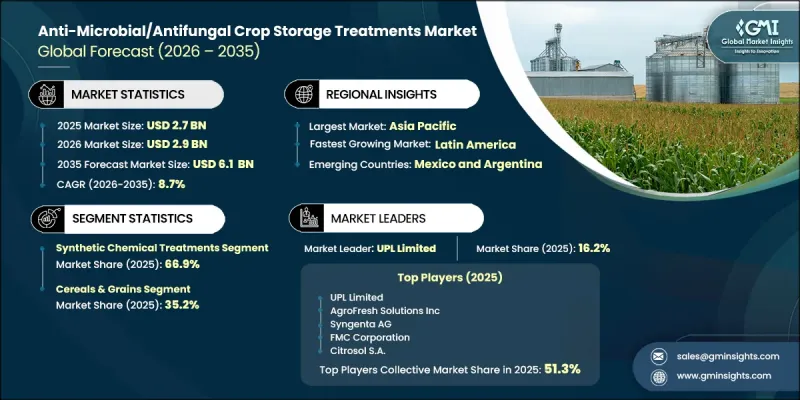
식량 안보에 대한 우려, 저장 품질 요건의 강화, 수확 후 손실 감소에 대한 관심 고조가 전 세계 농업 공급망에 지속적인 영향을 미치고 있어 이 시장은 성장세를 이어가고 있습니다. 특히 유럽 전역의 규제 동향에 따라 특정 합성 화학 활성 성분에 대한 규제가 더욱 엄격해지는 가운데, 생물학적 방제 솔루션 및 천연·식물 유래 저장 처리로의 전환이 가속화되고 있습니다. 이러한 변화로 인해 예측 기간 동안 지속 가능한 처리 솔루션에 큰 성장 기회가 창출될 것으로 전망됩니다. 또한, IoT를 활용한 모니터링 기술을 저장 관리 실무에 통합함으로써 저장 상태의 실시간 평가, 부패 위험의 조기 파악 및 처리 최적화가 가능해져 작물 보호 전략도 변화하고 있습니다. 이러한 기술은 사업자가 효율성을 높이는 동시에 불필요한 처리 사용을 줄이는 데 도움이 됩니다. 저장된 농산물의 오염 위험에 대한 우려가 높아짐에 따라, 특히 국내 및 국제 무역에서 엄격한 품질 기준 유지를 중시하는 시장에서 예방적 항진균 프로그램의 도입이 공급망 보호의 필수 요소로서 더욱 가속화되고 있습니다.
| 시장 범위 | |
|---|---|
| 시작 연도 | 2025년 |
| 예측 기간 | 2026-2035년 |
| 초기 시장 규모 | 27억 달러 |
| 예측 금액 | 61억 달러 |
| CAGR | 8.7% |
2025년에는 합성 화학 약제를 이용한 방제가 66.9%의 점유율을 차지했습니다. 이러한 솔루션은 입증된 효능, 확립된 규제 당국의 승인, 그리고 농업용 저장 시설 내에서의 광범위한 접근성 덕분에 계속해서 높은 채택률을 유지하고 있습니다. 비용 측면의 고려 사항은 특히 가격이 구매 결정에 영향을 미치는 지역에서 합성 화학제품 사용을 뒷받침하는 중요한 요인으로 남아 있습니다. 그러나 제조업체들이 유익한 미생물을 기반으로 한 제제의 개발을 확대함에 따라, 생물학적 방제 솔루션은 꾸준히 성장하고 있습니다. 지속 가능한 작물 보호 대안에 대한 수요가 증가함에 따라, 유럽과 북미는 생물학적 처리 도입에 있어 계속해서 중요한 시장이 될 전망입니다.
2025년, 곡물 부문은 35.2%의 점유율을 차지했습니다. 이 부문의 우위는 상업 및 공공 저장 네트워크를 통해 유지되는 주요 곡물 상품에 대한 광범위한 저장 요건에 의해 뒷받침되고 있습니다. 저장 곡물을 위한 작물 보호 프로그램은 일반적으로 저장 입고 시의 예방적 처리와 장기적인 품질 유지를 위한 추가적인 보존 방법을 결합하고 있습니다. 시장의 성장은 개발도상 지역의 저장 인프라 확충에 힘입고 있는 반면, 성숙한 시장에서는 잔류 기준의 강화 및 규정 준수 요건의 변화에 따라 처리 제제의 조정이 진행되고 있습니다.
2025년, 북미의 작물 저장용 항균 및 항진균 처리제 시장은 25.9%의 점유율을 차지했습니다. 이 지역에는 대규모 농업용 저장 시설이 존재하고, 저장 농산물의 보존에 대한 요건이 광범위하게 적용되고 있어 작물 저장 처리 솔루션에 대한 수요가 계속해서 견조합니다. 상업용 곡물 저장 시설과 신선 농산물 보존 시스템은 여전히 해당 지역 수요를 견인하는 중요한 요인으로 작용하고 있습니다. 잔류물 관리 및 제품 안전성에 초점을 맞춘 규제 기준에 따라, 각 제조업체는 미생물 및 곰팡이로 인한 위협에 대한 효과적인 방어를 유지하면서, 진화하는 농업적 요건을 충족하는 개선된 제형의 개발을 추진하고 있습니다.
자주 묻는 질문
목차
제1장 조사 방법과 범위
제2장 주요 요약
제3장 업계 인사이트
제4장 경쟁 구도
제5장 시장 규모 및 예측 : 처리 유형별(2022-2035년)
제6장 시장 규모 및 예측 : 작물 유형별(2022-2035년)
제7장 시장 규모 및 예측 : 제제별(2022-2035년)
제8장 시장 규모 및 예측 : 지역별(2022-2035년)
제9장 기업 개요
KTH 26.08.20The Global Anti-Microbial/Antifungal Crop Storage Treatments Market was valued at USD 2.7 billion in 2025 and is estimated to grow at a CAGR of 8.7% to reach USD 6.1 billion by 2035.
The market is gaining momentum as food security concerns, stricter storage quality requirements, and increasing focus on reducing post-harvest losses continue to influence agricultural supply chains worldwide. Regulatory developments, particularly across Europe, are accelerating the transition toward biological control solutions and natural or plant-based storage treatments as restrictions on certain synthetic chemical active ingredients become more stringent. This shift is expected to create significant growth opportunities for sustainable treatment solutions during the forecast period. The integration of IoT-enabled monitoring technologies into storage management practices is also transforming crop protection strategies by supporting real-time assessment of storage conditions, early identification of spoilage risks, and optimized treatment application. These technologies help operators improve efficiency while reducing unnecessary treatment usage. Rising concerns regarding contamination risks in stored agricultural commodities are further encouraging preventive antifungal programs as an essential component of supply chain protection, especially among markets focused on maintaining strict quality standards for domestic and international trade.
| Market Scope | |
|---|---|
| Start Year | 2025 |
| Forecast Year | 2026-2035 |
| Start Value | $2.7 Billion |
| Forecast Value | $6.1 Billion |
| CAGR | 8.7% |
Synthetic chemical treatments accounted for a 66.9% share in 2025. These solutions continue to maintain strong adoption due to their proven effectiveness, established regulatory approvals, and widespread availability within agricultural storage operations. Cost considerations remain a significant factor supporting the use of synthetic chemical products, particularly in regions where affordability influences purchasing decisions. However, biological biocontrol solutions are experiencing consistent expansion as manufacturers scale up formulations based on beneficial microorganisms. Europe and North America are expected to remain important markets for biological treatment adoption as demand for sustainable crop protection alternatives increases.
The cereals and grains segment held a 35.2% share in 2025. The segment's dominance is supported by the extensive storage requirements for major grain commodities maintained through commercial and public storage networks. Crop protection programs for stored grains commonly combine preventive treatments during storage intake with additional preservation methods to maintain quality over extended periods. Market growth is supported by expanding storage infrastructure in developing regions, while mature markets are witnessing adjustments in treatment formulations due to increasingly strict residue regulations and changing compliance requirements.
North America Anti-Microbial/Antifungal Crop Storage Treatments Market held 25.9% share in 2025. The region continues to experience strong demand for crop storage treatment solutions due to the presence of large-scale agricultural storage operations and extensive requirements for preserving stored commodities. Commercial grain storage facilities and fresh produce preservation systems remain important contributors to regional demand. Regulatory standards focused on residue management and product safety are encouraging manufacturers to develop improved formulations that meet evolving agricultural requirements while maintaining effective protection against microbial and fungal threats.
Major players operating in the global anti-microbial/antifungal crop storage treatments industry include Syngenta AG, AgroFresh Solutions Inc., UPL Limited, FMC Corporation, Certis Biologicals, Nufarm Limited, Lallemand Plant Care, Citrosol S.A., Fomesa Fruitech S.L.U., STK Bio-Ag Technologies, and Xeda International S.A. Companies operating in the anti-microbial/antifungal crop storage treatments market are implementing strategies centered on product innovation, sustainable formulation development, partnerships, and expansion into emerging agricultural markets. Manufacturers are increasing investments in biological and natural treatment technologies to address rising demand for environmentally responsible crop protection solutions. Companies are also strengthening research and development activities to improve product efficiency, storage performance, and regulatory compliance. Expanding distribution networks, enhancing farmer outreach programs, and developing customized solutions for different crop categories are helping market participants improve their competitive position.
Table of Contents
Chapter 1 Methodology & Scope
- 1.1 Research approach
- 1.2 Quality Commitments
- 1.2.1 GMI AI policy & data integrity commitment
- 1.2.1.1 Source consistency protocol
- 1.2.1 GMI AI policy & data integrity commitment
- 1.3 Research Trail & Confidence Scoring
- 1.3.1 Research Trail Components
- 1.3.2 Scoring Components
- 1.4 Data Collection
- 1.4.1 Partial list of primary sources
- 1.5 Data mining sources
- 1.5.1 Paid sources
- 1.5.1.1 Sources, by region
- 1.5.1 Paid sources
- 1.6 Base estimates and calculations
- 1.6.1 Base year calculation for any one approach
- 1.7 Forecast model
- 1.7.1 Quantified market impact analysis
- 1.7.1.1 Mathematical impact of growth parameters on forecast
- 1.7.1 Quantified market impact analysis
- 1.8 Research transparency addendum
- 1.8.1 Source attribution framework
- 1.8.2 Quality assurance metrics
- 1.8.3 Our commitment to trust
Chapter 2 Executive Summary
- 2.1 Industry 360° synopsis
- 2.2 Key market trends
- 2.2.1 Regional
- 2.2.2 Treatment type
- 2.2.3 Crop type
- 2.2.4 Formulation
Chapter 3 Industry Insights
- 3.1 Industry ecosystem analysis
- 3.1.1 Supplier landscape
- 3.1.2 Profit margin
- 3.1.3 Value addition at each stage
- 3.1.4 Factor affecting the value chain
- 3.1.5 Disruptions
- 3.2 Industry impact forces
- 3.2.1 Growth drivers
- 3.2.2 Industry pitfalls and challenges
- 3.2.3 Market opportunities
- 3.3 Growth potential analysis
- 3.4 Regulatory landscape
- 3.4.1 North America
- 3.4.2 Europe
- 3.4.3 Asia Pacific
- 3.4.4 Latin America
- 3.4.5 Middle East & Africa
- 3.5 Porter's analysis
- 3.6 PESTEL analysis
- 3.7 Price trends
- 3.7.1 By region
- 3.7.2 By crop type
- 3.8 Future market trends
- 3.9 Technology and innovation landscape
- 3.9.1 Current technological trends
- 3.9.2 Emerging technologies
- 3.10 Patent Landscape
- 3.11 Trade statistics (HS code)
- 3.11.1 Major importing countries
- 3.11.2 Major exporting countries
- 3.12 Sustainability and environmental aspects
- 3.12.1 Sustainable practices
- 3.12.2 Waste reduction strategies
- 3.12.3 Energy efficiency in production
- 3.12.4 Eco-friendly initiatives
- 3.13 Carbon footprint consideration
Chapter 4 Competitive Landscape, 2025
- 4.1 Introduction
- 4.2 Company market share analysis
- 4.2.1 By region
- 4.2.1.1 North America
- 4.2.1.2 Europe
- 4.2.1.3 Asia Pacific
- 4.2.1.4 LATAM
- 4.2.1.5 MEA
- 4.2.1 By region
- 4.3 Competitive analysis of major market players
- 4.4 Competitive positioning matrix
- 4.5 Key developments
- 4.5.1 Mergers & acquisitions
- 4.5.2 Partnerships & collaborations
- 4.5.3 New Product Launches
- 4.5.4 Expansion Plans
Chapter 5 Market Estimates and Forecast, By Treatment Type, 2022-2035 (USD Billion) (Kilo Tons)
- 5.1 Key trends
- 5.2 Synthetic chemical treatments
- 5.3 Biological biocontrol treatments
- 5.4 Natural & botanical treatments
Chapter 6 Market Estimates and Forecast, By Crop Type, 2022-2035 (USD Billion) (Kilo Tons)
- 6.1 Key trends
- 6.2 Cereals & grains
- 6.2.1 Wheat
- 6.2.2 Rice
- 6.2.3 Maize/corn
- 6.2.4 Barley
- 6.2.5 Others
- 6.3 Fruits
- 6.3.1 Citrus fruits
- 6.3.2 Pome fruits
- 6.3.3 Tropical fruits
- 6.3.4 Stone fruits
- 6.3.5 Others
- 6.4 Vegetables
- 6.4.1 Root & tuber vegetables
- 6.4.2 Leafy & brassica vegetables
- 6.4.3 Cucurbit vegetables
- 6.4.4 Allium crops
- 6.5 Oilseeds & pulses
- 6.6 Spices, herbs & specialty crops
Chapter 7 Market Estimates and Forecast, By Formulation, 2022-2035 (USD Billion) (Kilo Tons)
- 7.1 Key trends
- 7.2 Liquid formulations
- 7.3 Solid formulations
- 7.4 Gaseous & fumigant formulations
- 7.5 Coatings & film formulations
Chapter 8 Market Estimates and Forecast, By Region, 2022-2035 (USD Billion) (Kilo Tons)
- 8.1 Key trends
- 8.2 North America
- 8.2.1 U.S.
- 8.2.2 Canada
- 8.3 Europe
- 8.3.1 Germany
- 8.3.2 UK
- 8.3.3 France
- 8.3.4 Spain
- 8.3.5 Italy
- 8.3.6 Rest of Europe
- 8.4 Asia Pacific
- 8.4.1 China
- 8.4.2 India
- 8.4.3 Japan
- 8.4.4 Australia
- 8.4.5 South Korea
- 8.4.6 Rest of Asia Pacific
- 8.5 Latin America
- 8.5.1 Brazil
- 8.5.2 Mexico
- 8.5.3 Argentina
- 8.5.4 Rest of Latin America
- 8.6 Middle East and Africa
- 8.6.1 Saudi Arabia
- 8.6.2 South Africa
- 8.6.3 UAE
- 8.6.4 Rest of Middle East and Africa
Chapter 9 Company Profiles
- 9.1 AgroFresh Solutions Inc
- 9.2 Certis Biologicals
- 9.3 Citrosol S.A.
- 9.4 FMC Corporation
- 9.5 Fomesa Fruitech S.L.U.
- 9.6 Lallemand Plant Care
- 9.7 Nufarm Limited
- 9.8 STK Bio-ag Technologies
- 9.9 Syngenta AG
- 9.10 UPL Limited
- 9.11 Xeda International S.A.


