

|
시장보고서
상품코드
2121099
안구 안전 레이저 거리측정기 모듈 시장 기회, 성장 촉진요인, 업계 동향 분석 및 예측(2026-2035년)Eye-Safe Laser Rangefinder Module Market Opportunity, Growth Drivers, Industry Trend Analysis, and Forecast 2026 - 2035 |
||||||

세계의 안구 안전 레이저 거리측정기 모듈 시장은 2025년에 5억 4,420만 달러로 평가되며, CAGR 7.5%로 성장하여 2035년까지 11억 달러에 달할 것으로 예측됩니다.
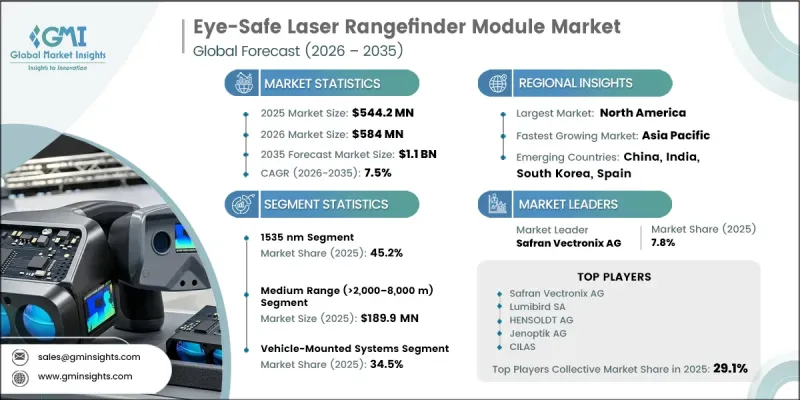
시장의 성장은 국방 역량의 지속적인 현대화와 레이저 안전 요건의 확산에 힘입고 있습니다. 또한 무인·자율형 플랫폼의 도입 확대도 소형이며 신뢰성이 높은 거리 측정 기술에 대한 수요를 창출하고 있습니다. 동시에, 조직들이 정확하고 신뢰할 수 있는 거리 측정 솔루션을 추구하는 가운데, 측량 및 산업용 분야에서도 추가적인 기회가 생겨나고 있습니다. 안구 안전 포토닉스 분야의 지속적인 발전으로 레이저 거리측정기 모듈의 성능과 실용성은 더욱 향상되고 있습니다. 각 제조사는 높은 측정 정밀도와 소형화, 경량화, 효율적인 작동을 겸비한 솔루션 개발에 주력하고 있습니다. 이러한 개선을 통해 국방 분야 및 상업 환경에서의 안구 안전 레이저 거리측정기 모듈의 잠재적 용도가 확대되고 있습니다. 고정밀 센싱에 대한 수요 증가와 첨단 전기광학 기술의 지속적인 개발이 맞물리면서 차세대 거리 측정 솔루션에 대한 투자가 촉진되고 있습니다. 사용자들이 성능과 더불어 운용상의 안전성을 점점 더 중시함에 따라, 정확한 거리 측정이 필요한 용도에서 안구 안전 레이저 기술의 중요성이 높아지고 있습니다. 이러한 동향으로 인해 2035년까지 안구 안전 레이저 거리측정기 모듈 시장의 지속적인 확장이 뒷받침될 것으로 예상됩니다.
| 시장 범위 | |
|---|---|
| 시작 연도 | 2025년 |
| 예측 기간 | 2026-2035년 |
| 개시 금액 | 5억 4,420만 달러 |
| 예측 금액 | 11억 달러 |
| CAGR | 7.5% |
중거리(2,000-8,000m 초과) 부문은 2025년에 1억 8,990만 달러의 시장 규모를 기록했습니다. 중거리 모듈에 대한 수요는 신뢰성 높은 거리 측정이 필요한 국방 및 보안 시스템에 광범위하게 탑재됨에 따라 뒷받침되고 있습니다. 이러한 모듈은 탐지 거리, 측정 정확도, 컴팩트한 크기 및 전력 요구 사항 사이에서 실용적인 균형을 실현하고 있습니다. 이러한 성능 특성 덕분에 표준 전장 요구사항은 물론 보안 및 산업용으로도 적합합니다. 중거리 솔루션은 1535 nm 및 1550 nm 레이저 광원을 사용하여 눈에 안전한 작동을 지원할 수 있다는 점에서도 계속해서 매력적입니다. 장거리 대체 제품에 비해 복잡성과 비용이 상대적으로 낮은 점도 국방 및 상업용 분야에서 지속적인 수요에 기여하고 있습니다.
2025년에는 1535 nm 부문이 45.2%의 점유율을 차지했습니다. 이 부문의 선도적 지위는 장거리 성능, 뛰어난 대기 투과율, 그리고 클래스 1 레이저의 눈 안전성이라는 유리한 조합에 의해 뒷받침되고 있습니다. 이러한 특성 덕분에 1535 nm 기술은 엄격한 안전 요건을 유지하면서 신뢰할 수 있는 거리 측정이 필요한 분야에서 매력적인 선택지가 되고 있습니다. 이 파장의 지속적인 채택이 안구 안전 레이저 거리측정기 모듈 업계에서 이 기술의 지배적인 위치를 뒷받침하고 있습니다.
북미의 안구 안전 레이저 거리측정기 모듈 시장은 2025년에 32.8%의 점유율을 차지했습니다. 이 지역의 성장은 진행 중인 국방 현대화 프로그램과 첨단 전기광학 시스템의 조달 증가에 의해 주도되고 있습니다. 국경 감시 능력 및 정밀 표적 포착 기술에 대한 투자 증가도 안구 안전 레이저 거리측정기 모듈 수요에 기여하고 있습니다. 첨단 방위·보안 인프라의 지속적인 개발은 이 지역 전체의 제조업체와 기술 제공업체에게 유리한 기회를 창출하고 있습니다.
자주 묻는 질문
목차
제1장 조사 방법과 범위
제2장 주요 요약
제3장 업계 인사이트
제4장 경쟁 구도
제5장 시장 추정 및 예측 : 동작 파장별, 2022-2035년
제6장 시장 추정 및 예측 : 측정 범위별, 2022-2035년
제7장 시장 추정 및 예측 : 플랫폼별, 2022-2035년
제8장 시장 추정 및 예측 : 지역별, 2022-2035년
제9장 기업 개요
KSM 26.09.03The Global Eye-Safe Laser Rangefinder Module Market was valued at USD 544.2 million in 2025 and is estimated to grow at a CAGR of 7.5% to reach USD 1.1 billion by 2035.
Market growth is being supported by the continued modernization of defense capabilities and the wider adoption of laser safety requirements. Increasing deployment of unmanned and autonomous platforms is also creating demand for compact and reliable distance measurement technologies. At the same time, surveying and industrial applications are generating additional opportunities as organizations seek accurate and dependable distance measurement solutions. Ongoing advances in eye-safe photonics are further improving the performance and practicality of laser rangefinder modules. Manufacturers are focusing on developing solutions that combine high measurement accuracy with compact dimensions, lower weight, and efficient operation. These improvements are expanding the potential use of eye-safe laser rangefinder modules across defense and commercial environments. Growing demand for precision sensing, combined with continued development of advanced electro-optical technologies, is encouraging investment in next-generation rangefinder solutions. As users increasingly prioritize operational safety alongside performance, eye-safe laser technologies are gaining importance in applications requiring accurate distance measurement. These trends are expected to support continued expansion of the eye-safe laser rangefinder module market through 2035.
| Market Scope | |
|---|---|
| Start Year | 2025 |
| Forecast Year | 2026-2035 |
| Start Value | $544.2 Million |
| Forecast Value | $1.1 Billion |
| CAGR | 7.5% |
The medium range (>2,000-8,000 m) segment held USD 189.9 million in 2025. Demand for medium-range modules is supported by their broad integration into defense and security systems requiring dependable distance measurement. These modules provide a practical balance between detection distance, measurement accuracy, compact size, and power requirements. Their performance characteristics make them suitable for standard battlefield requirements as well as security and industrial operations. Medium-range solutions also remain attractive because they can support eye-safe operation using 1535 nm and 1550 nm laser sources. Their comparatively lower complexity and cost compared with long-range alternatives further contribute to their continued demand across defense and commercial applications.
The 1535 nm segment accounted for 45.2% share in 2025. The segment's leading position is supported by the favorable combination of extended-distance performance, strong atmospheric transmission, and Class 1 laser eye-safety characteristics. These properties make 1535 nm technology an attractive option for applications that require reliable range measurement while maintaining stringent safety requirements. Continued adoption of this wavelength is supporting its dominant position within the eye-safe laser rangefinder module industry.
North America Eye-Safe Laser Rangefinder Module Market captured a 32.8% share in 2025. Regional growth is being driven by ongoing defense modernization programs and increasing procurement of advanced electro-optical systems. Rising investment in border surveillance capabilities and precision targeting technologies is also contributing to demand for eye-safe laser rangefinder modules. The continued development of advanced defense and security infrastructure is creating favorable opportunities for manufacturers and technology providers across the region.
Prominent companies operating in the global eye-safe laser rangefinder module market include Lumibird SA, HENSOLDT AG, CILAS, Safran Vectronix AG, Jenoptik AG, Newcon Optik Inc., ERDI Tech Ltd., LumiSpot Tech Co., Ltd., Eyoung Technology Co., Ltd., LaserWorks Co., Ltd., Jinan Farsight Electro-optical Technology Co., Ltd., IADIY Technology Co., Ltd., Jioptic Technology Co., Ltd., Lumimetric Technology Co., Ltd., Newtron Technology Co., Ltd., and Raythink Technology Co., Ltd. Companies in the global eye-safe laser rangefinder module market are focusing on product innovation, photonics technology development, strategic partnerships, and portfolio expansion to strengthen their competitive positions. Manufacturers are investing in research and development to improve range accuracy, detection performance, compactness, weight, and power efficiency. Companies are also developing advanced modules based on eye-safe laser wavelengths to address increasingly stringent operational and safety requirements. Strategic collaborations with defense contractors, electro-optical system providers, and industrial customers are helping participants expand application opportunities and accelerate product development. Manufacturers are broadening their portfolios to serve different distance measurement requirements across defense, security, surveying, and industrial applications. Investment in miniaturization and advanced optical technologies is helping companies develop more portable and efficient solutions. Regional expansion is also supporting market penetration as companies target growing demand for advanced sensing and ranging technologies. These strategies are enabling market participants to improve product differentiation, strengthen customer relationships, and establish a stronger foothold in the global eye-safe laser rangefinder module industry.
Table of Contents
Chapter 1 Methodology and Scope
- 1.1 Market scope and definition
- 1.2 Research design
- 1.2.1 Research approach
- 1.2.2 Data collection methods
- 1.3 Data mining sources
- 1.3.1 Global
- 1.3.2 Regional/Country
- 1.4 Base estimates and calculations
- 1.4.1 Base year calculation
- 1.4.2 Key trends for market estimation
- 1.5 Primary research and validation
- 1.5.1 Primary sources
- 1.6 Forecast model
- 1.7 Research assumptions and limitations
Chapter 2 Executive Summary
- 2.1 Industry 360° synopsis, 2022 – 2035
- 2.2 Key market trends
- 2.2.1 Operating Wavelength trends
- 2.2.2 Measurement Range trends
- 2.2.3 Platform trends
- 2.2.4 Regional trends
- 2.3 TAM Analysis, 2026-2035
- 2.4 CXO perspectives: Strategic imperatives
Chapter 3 Industry Insights
- 3.1 Industry ecosystem analysis
- 3.1.1 Supplier Landscape
- 3.1.2 Profit Margin
- 3.1.3 Cost structure
- 3.1.4 Value addition at each stage
- 3.1.5 Factor affecting the value chain
- 3.1.6 Disruptions
- 3.2 Industry impact forces
- 3.2.1 Growth drivers
- 3.2.1.1 Rising defense modernization and soldier digitization programs
- 3.2.1.2 Stringent laser safety regulations and adoption of eye-safe wavelengths
- 3.2.1.3 Growing deployment of autonomous systems and unmanned platforms
- 3.2.1.4 Expansion of precision surveying, industrial automation, and infrastructure inspection
- 3.2.1.5 Advancements in photonics, fiber lasers, and detector technologies
- 3.2.2 Industry pitfalls and challenges
- 3.2.2.1 High cost of advanced eye-safe laser components
- 3.2.2.2 Performance limitations under adverse environmental conditions
- 3.2.3 Market opportunities
- 3.2.3.1 Expansion of autonomous platforms and next-generation defense systems
- 3.2.3.2 Advancements in photonic integration and solid-state laser technologies
- 3.2.1 Growth drivers
- 3.3 Growth potential analysis
- 3.4 Regulatory landscape
- 3.4.1 North America
- 3.4.2 Europe
- 3.4.3 Asia Pacific
- 3.4.4 Latin America
- 3.4.5 Middle East & Africa
- 3.5 Porter’s analysis
- 3.6 PESTEL analysis
- 3.7 Technology and Innovation landscape
- 3.7.1 Current technological trends
- 3.7.2 Emerging technologies
- 3.8 Price trends
- 3.8.1 By region
- 3.8.2 By product
- 3.9 Pricing Strategies
- 3.10 Emerging Business Models
- 3.11 Compliance Requirements
- 3.12 Patent and IP analysis
Chapter 4 Competitive Landscape, 2025
- 4.1 Introduction
- 4.2 Company market share analysis
- 4.2.1 By region
- 4.2.1.1 North America
- 4.2.1.2 Europe
- 4.2.1.3 Asia Pacific
- 4.2.1.4 Latin America
- 4.2.1.5 Middle East & Africa
- 4.2.2 Market concentration analysis
- 4.2.1 By region
- 4.3 Competitive benchmarking of key players
- 4.3.1 Financial performance comparison
- 4.3.1.1 Revenue
- 4.3.1.2 Profit margin
- 4.3.1.3 R&D
- 4.3.2 Product portfolio comparison
- 4.3.2.1 Product range breadth
- 4.3.2.2 Technology
- 4.3.2.3 Innovation
- 4.3.3 Geographic presence comparison
- 4.3.3.1 Global footprint analysis
- 4.3.3.2 Service network coverage
- 4.3.3.3 Market penetration by region
- 4.3.4 Competitive positioning matrix
- 4.3.4.1 Leaders
- 4.3.4.2 Challengers
- 4.3.4.3 Followers
- 4.3.4.4 Niche players
- 4.3.5 Strategic outlook matrix
- 4.3.1 Financial performance comparison
- 4.4 Key developments
- 4.4.1 Mergers and acquisitions
- 4.4.2 Partnerships and collaborations
- 4.4.3 Technological advancements
- 4.4.4 Expansion and investment strategies
- 4.4.5 Digital transformation initiatives
- 4.5 Emerging/ startup competitors landscape
Chapter 5 Market Estimates and Forecast, By Operating Wavelength, 2022 – 2035 (USD Million)
- 5.1 Key trends
- 5.2 905 nm
- 5.3 1535 nm
- 5.4 1550 nm
- 5.5 1570 nm
Chapter 6 Market Estimates and Forecast, By Measurement Range, 2022 – 2035 (USD Million)
- 6.1 Key trends
- 6.2 Short Range (≤2,000 m)
- 6.3 Medium Range (>2,000–8,000 m)
- 6.4 Long Range (>8,000–20,000 m)
- 6.5 Ultra-Long Range (>20,000 m)
Chapter 7 Market Estimates and Forecast, By Platform, 2022 – 2035 (USD Million)
- 7.1 Key trends
- 7.2 Handheld & man-portable systems
- 7.3 Vehicle-mounted systems
- 7.4 Airborne & UAV/UAS payloads
- 7.5 Naval & maritime systems
- 7.6 Fixed installation systems
- 7.7 Industrial & commercial equipment
Chapter 8 Market Estimates and Forecast, By Region, 2022 – 2035 (USD Million)
- 8.1 Key trends
- 8.2 North America
- 8.2.1 U.S.
- 8.2.2 Canada
- 8.3 Europe
- 8.3.1 Germany
- 8.3.2 UK
- 8.3.3 France
- 8.3.4 Spain
- 8.3.5 Italy
- 8.4 Asia Pacific
- 8.4.1 China
- 8.4.2 India
- 8.4.3 Japan
- 8.4.4 Australia
- 8.4.5 South Korea
- 8.5 Latin America
- 8.5.1 Brazil
- 8.5.2 Mexico
- 8.5.3 Argentina
- 8.6 Middle East and Africa
- 8.6.1 South Africa
- 8.6.2 Saudi Arabia
- 8.6.3 UAE
Chapter 9 Company Profiles
- 9.1 Global Key Players
- 9.1.1 Safran Vectronix AG
- 9.1.2 Lumibird SA
- 9.1.3 HENSOLDT AG
- 9.1.4 Jenoptik AG
- 9.1.5 CILAS
- 9.2 Regional key players
- 9.2.1 North America
- 9.2.1.1 Newcon Optik Inc.
- 9.2.2 Asia Pacific
- 9.2.2.1 ERDI Tech Ltd.
- 9.2.2.2 Jinan Farsight Electro-optical Technology Co., Ltd.
- 9.2.2.3 Lumimetric Technology Co., Ltd.
- 9.2.2.4 IADIY Technology Co., Ltd.
- 9.2.2.5 Raythink Technology Co., Ltd
- 9.2.1 North America
- 9.3 Niche Players/Disruptors
- 9.3.1 LumiSpot Tech Co., Ltd.
- 9.3.2 Jioptic Technology Co., Ltd.
- 9.3.3 LaserWorks Co., Ltd.
- 9.3.4 Newtron Technology Co., Ltd.
- 9.3.5 Eyoung Technology Co., Ltd.


