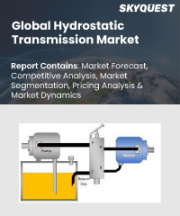
|
시장보고서
상품코드
1976311
정유압 변속기 시장 : 유형별, 정격 출력별, 용도별, 최종 이용 산업별 - 세계 예측(2026-2032년)Hydrostatic Transmission Market by Type, Power Rating, Application, End Use Industry - Global Forecast 2026-2032 |
||||||
 360iResearch
정유압 변속기 시장은 2025년에 32억 7,000만 달러로 평가되었으며, 2026년에는 35억 1,000만 달러로 성장하여 CAGR 7.45%를 기록하며 2032년까지 54억 1,000만 달러에 달할 것으로 예측됩니다.
| 주요 시장 통계 | |
|---|---|
| 기준 연도 2025년 | 32억 7,000만 달러 |
| 추정 연도 2026년 | 35억 1,000만 달러 |
| 예측 연도 2032년 | 54억 1,000만 달러 |
| CAGR(%) | 7.45% |
정유압 변속기의 기본 원리, 운영상의 이점, 현대 산업 기계에서 채택을 촉진하는 전략적 배경에 대한 종합적인 소개
정유압 변속기 시스템은 가변 용량 펌프와 모터를 통해 원동기 에너지를 제어 가능한 정압식 동력으로 변환하여 현대의 다양한 이동식 및 고정식 기계를 지원하고 있습니다. 이 시스템은 기계식 기어 변속기와 비교하여 지속적인 토크 전달, 무단계 속도 변화, 콤팩트한 통합, 열악한 환경에서 미묘한 기계 제어를 가능하게 합니다. 엔지니어와 차량 관리자는 적절한 설계 및 사양을 통해 운전자 편의성 향상, 정밀한 부하 유지, 간소화된 파워트레인 레이아웃, 다운타임 감소 및 유지보수 편의성 향상 등의 이점을 누릴 수 있습니다.
전동화, 디지털화, 공급망 혁신의 융합, 등압식 변속기 설계, 서비스 모델, 경쟁 우위를 재정의하는 트렌드
유압식 변속기 부문은 전동화, 디지털화, 새로운 기술 트레이드오프 및 비즈니스 모델에 대한 규제 압력 증가로 인해 변혁적인 변화를 겪고 있습니다. 전기 파워트레인은 하이브리드 구조를 촉진하고 있으며, 정압식 시스템은 고토크 및 가변 속도 작업에서 여전히 중요한 위치를 차지하고 있으며, 전기 구동 시스템은 최고 효율과 제로 에미션 영역에 대응하고 있습니다. 디지털 제어와 내장형 센서를 통해 실시간 부하에 대한 적응형 응답이 가능하며, 폐루프 제어 전략을 통해 연료 효율과 부품 수명을 모두 향상시킬 수 있습니다.
최근 관세 동향이 정유압 변속기 부품 조달의 탄력성을 어떻게 재구축하고 있는지, 운영, 공급망 및 조달 측면에 미치는 영향을 평가합니다.
최근 몇 년간의 정책 사이클에서 발표 및 시행된 관세 변경은 정유압 변속기를 탑재한 장비의 조달 전략, 공급업체 선정, 비용 모델링에 새로운 변수를 도입했습니다. 특정 수입 부품에 대한 높은 관세는 세계 공급업체의 경쟁력을 변화시키고, 추가 착륙 비용을 줄이기 위해 지역 조달, 조립, 현지 조달 전략을 촉진합니다. 그 결과, 조직은 연속성과 비용 예측 가능성을 보장하기 위해 공급업체 기반을 재평가하고, 니어쇼어링 기회를 검토하고, 장기 계약을 재협상하고 있습니다.
애플리케이션 유형, 루프 아키텍처, 출력 수준, 산업별 애플리케이션이 설계 우선순위, 판매 전략, 애프터마켓 수요를 결정하는 방식을 파악할 수 있는 상세한 세분화 분석
분석을 통해 사용 사례와 기술 사양에 따라 다른 역학을 밝혀내어 제품 개발, 판매 전략, 애프터마켓 지원을 형성합니다. 용도별로는 농기계, 건설기계, 선박장비, 자재운반장비, 광산기계에 이르기까지 다양합니다. 농기계 내에서 수확기, 분무기, 트랙터에 따라 수요 요인이 다르고, 작동 주기와 제어 정확도 요구 사항이 현저하게 달라집니다. 건설기계는 콘크리트 설비, 토목 기계, 포장 장비 등 각 서브 도메인마다 서로 다른 열적 제약과 가동 사이클 제약이 존재하며, 이는 부품의 크기 선정과 냉각 전략에 영향을 미칩니다. 또한 자재 취급 장비의 경우, 컨베이어, 크레인, 지게차는 각각 다른 작동 리듬을 나타내며, 이는 여과 시스템 및 서비스 간격에 영향을 미칩니다. 각 애플리케이션 클러스터는 전용 토크 및 속도 프로파일, 패키징 제약, 제어 인터페이스를 요구하기 때문에 공급업체는 최종사용자의 기대에 부응하기 위해 다양한 제품 포트폴리오와 구성 가능한 모듈을 제공해야 합니다.
아메리카, 유럽, 중동 및 아프리카, 아시아태평양 시장의 시장 역학 및 전략적 요구는 제품 적응 및 시장 출시 실행에 영향을 미칩니다.
지역별 동향은 차별화된 수요 패턴과 경쟁 구조를 만들어내고 있으며, 기업이 세계 시장에서 성공하기 위해서는 이를 제대로 파악해야 합니다. 아메리카 대륙에서는 인프라 업데이트, 농업 현대화, 자재 취급 부문에 대한 지속적인 투자로 인해 견고한 정수압 솔루션에 대한 안정적인 수요가 창출되고 있습니다. 이 지역의 바이어들은 라이프사이클 지원, 개조 대응 능력, 현지 배출가스 규제 및 안전 기준 적합성을 중요시하고 있으며, 공급업체들은 딜러 네트워크와 부품 유통 체계를 강화해야 합니다. 유럽, 중동 및 아프리카는 성숙한 유럽 OEM 생태계와 중동 및 아프리카 전역의 다양한 신흥 시장 요구가 융합된 지역입니다. 유럽 고객들은 에너지 효율성, 전자기 호환성, 전기 시스템과의 통합을 우선시하는 반면, 중동 및 아프리카 시장에서는 견고성, 유지보수 용이성, 장기적인 예비 부품 공급을 중요시하는 경향이 있습니다. 아시아태평양에서는 제조업 자동화의 급속한 확산, 적극적인 인프라 확장, 광범위한 농업 기계화 프로그램을 볼 수 있습니다. 이 지역은 치열한 현지 경쟁, 가속화되는 부품 혁신, 내수와 수출 수요를 모두 충족시키기 위한 현지 생산능력에 대한 막대한 투자가 특징입니다.
정압 하드웨어, 임베디드 제어, 라이프사이클 서비스를 결합한 주요 경쟁 우위 및 파트너십 전략으로 OEM 및 애프터마켓에서 주도권을 확보합니다.
경쟁 우위는 정압식 하드웨어의 우수성, 제어 소프트웨어 능력, 라이프 사이클 서비스 플랫폼의 조합에 점점 더 의존하고 있습니다. 주요 업체들은 펌프와 모터의 내구성 향상을 위한 재료 과학에 대한 투자, 누출을 줄이는 첨단 씰링 기술, 연속 작동 범위를 확대하는 열 관리 기술을 통해 차별화를 꾀하고 있습니다. 하드웨어를 보완하는 형태로 자체 개발한 제어 알고리즘과 지원 전자장치를 결합하여 공급업체는 OEM의 시스템 통합을 간소화하고 시장 출시 시간을 단축하는 통합 솔루션을 제공할 수 있습니다. 서비스 측면에서의 차별화는 예지보전 제공, 성능 기반 계약, 다운타임 감소 및 설비 가동률 향상을 위한 신속한 부품 물류로 실현됩니다.
제조업체와 공급업체가 경쟁 우위를 확보할 수 있도록 모듈식 설계, 탄력적 조달, 서비스 중심의 상업적 모델을 통합하기 위한 실질적인 전략적 제안을 제공합니다.
업계 리더는 제품 혁신, 공급망 탄력성, 서비스 지향적 상업 모델의 균형을 맞추는 통합 전략을 우선시해야 합니다. 먼저, 농업용 수확기, 토목기계, 지게차 등 다양한 용도로 신속한 구성 변경이 가능한 모듈형 제품 플랫폼에 투자하여 설계 주기를 단축하고 고객 사양에 대한 대응력을 높입니다. 제어 소프트웨어와 센서 통합에 대한 동시 투자는 운영 효율을 높이고, 예지보전 및 금액 기반 계약을 지원하는 서비스 가능한 데이터 스트림을 생성합니다.
전문가 인터뷰, 기술 문헌 통합, 시나리오 분석을 결합한 엄격한 다중 방법론적 조사 방법을 통해 전략적 인사이트와 조달에 미치는 영향을 검증합니다.
이번 조사는 기술 문헌 검토, 공급업체 및 OEM 인터뷰, 규제 및 무역 동향 분석을 결합한 다각적인 방법을 채택하여 시스템 수준과 시장 동향에 대한 종합적인 관점을 확보하고자 했습니다. 주요 정성적 데이터로 여러 산업의 설계 기술자, 유지보수 관리자, 영업 책임자를 대상으로 구조화된 인터뷰를 실시하여 현장의 운영 우선순위와 조달상의 제약조건을 직접 파악했습니다. 2차 정보로는 동료평가를 거친 엔지니어링 연구, 표준 문서, 공개 기술 백서를 활용하여 부품 레벨의 성능 특성과 새로운 제어 방법을 검증하였습니다.
통합된 제품 및 서비스 조달 전략이 진화하는 등압식 변속기 부문에서 경쟁 우위를 결정짓는다는 것을 보여주는 전략적 요구사항 통합
결론적으로, 정유압 변속기 기술은 제어 가능한 토크, 컴팩트한 패키징, 견고한 성능이 필수적인 광범위한 산업 응용 분야에서 여전히 핵심적인 위치를 차지하고 있습니다. 전동화, 디지털 제어의 통합, 무역 환경의 변화가 상호 작용하여 제품 요구 사항과 상업 모델을 재구성하고 모듈식 아키텍처와 서비스 지원 제공의 중요성이 증가하고 있습니다. 우수한 정수압 하드웨어와 임베디드 제어 기능, 강력한 조달 전략을 결합하는 데 투자하는 조직은 진화하는 고객의 기대에 부응하고 라이프사이클 수익을 창출하는 데 더 유리한 입장에 서게 될 것입니다.
자주 묻는 질문
목차
제1장 서문
제2장 조사 방법
제3장 주요 요약
제4장 시장 개요
제5장 시장 인사이트
제6장 미국 관세의 누적 영향, 2025년
제7장 AI의 누적 영향, 2025년
제8장 정유압 변속기 시장 : 유형별
제9장 정유압 변속기 시장 : 정격 출력별
제10장 정유압 변속기 시장 : 용도별
제11장 정유압 변속기 시장 : 최종 이용 산업별
제12장 정유압 변속기 시장 : 지역별
제13장 정유압 변속기 시장 : 그룹별
제14장 정유압 변속기 시장 : 국가별
제15장 미국의 정유압 변속기 시장
제16장 중국의 정유압 변속기 시장
제17장 경쟁 구도
KSM 26.04.09The Hydrostatic Transmission Market was valued at USD 3.27 billion in 2025 and is projected to grow to USD 3.51 billion in 2026, with a CAGR of 7.45%, reaching USD 5.41 billion by 2032.
| KEY MARKET STATISTICS | |
|---|---|
| Base Year [2025] | USD 3.27 billion |
| Estimated Year [2026] | USD 3.51 billion |
| Forecast Year [2032] | USD 5.41 billion |
| CAGR (%) | 7.45% |
Comprehensive introduction to hydrostatic transmission fundamentals, operational advantages, and the strategic context driving adoption across modern industrial machinery
Hydrostatic transmission systems underpin a wide range of modern mobile and stationary machinery by converting prime mover energy into controllable hydraulic power through variable displacement pumps and motors. These systems offer continuous torque transmission, stepless speed variation, and compact integration compared with mechanical geartrains, enabling nuanced machine control in demanding environments. Engineers and fleet managers benefit from improved operator comfort, precise load holding, and simplified powertrain layouts that can reduce downtime and enhance serviceability when designed and specified correctly.
In recent deployments, the emphasis has shifted toward integrating electronic controls, sensor feedback, and predictive maintenance algorithms with traditional hydrostatic architectures. This integration increases the systems' capability to optimize efficiency across duty cycles, coordinate with hybrid-electric architectures, and meet regulatory imperatives for emissions and energy use. The rising complexity of machine functions, coupled with a demand for higher uptime and lower total cost of ownership, positions hydrostatic transmission as a strategic component where design choices directly influence competitive differentiation.
This analysis introduces the technical fundamentals, typical applications, and the strategic context that shapes procurement, product development, and aftermarket service models. By framing the technology's core benefits alongside emerging integration trends, the introduction sets expectations for the operational and commercial considerations detailed in subsequent sections.
How electrification, digitalization, and supply chain innovation are converging to redefine hydrostatic transmission design, service models, and competitive advantage
The landscape for hydrostatic transmission is undergoing transformative shifts driven by electrification, digitalization, and evolving regulatory pressures that force new engineering trade-offs and business models. Electrified powertrains are prompting hybrid architectures where hydrostatic systems remain relevant for high-torque, variable-speed tasks while electric drives address peak efficiency and zero-emission zones. Digital controls and embedded sensors enable adaptive response to real-time loads, improving both fuel efficiency and component longevity through closed-loop control strategies.
Simultaneously, supply chain reconfiguration and component-level innovation are accelerating. Additive manufacturing and advanced materials offer opportunities to reduce weight and improve thermal performance, while tighter supplier-manufacturer collaboration shortens development cycles for bespoke pump and motor solutions. Aftermarket service is also transforming, with remote diagnostics and predictive maintenance enabling longer service intervals and performance-based contracts that shift value from one-time sales to recurring revenue streams.
These shifts converge to create a new competitive landscape in which manufacturers that combine robust hydraulic hardware with digital services and modular integration offerings can capture both equipment OEM relationships and lifecycle revenue. Strategic partnerships, cross-domain expertise, and investment in control software are becoming as critical as hydraulic component performance in determining market leadership.
Assessing the operational, supply chain, and sourcing implications of recent tariff dynamics and how they reshape procurement resilience for hydrostatic transmission components
Tariff changes announced and implemented in recent policy cycles have introduced additional variables into procurement strategies, supplier selection, and cost modeling for equipment that incorporates hydrostatic transmissions. Higher duties on certain imported components can alter the competitiveness of global suppliers and encourage regional sourcing, assembly, or local content strategies to mitigate added landed costs. As a result, organizations are reassessing supplier bases, evaluating nearshoring opportunities, and renegotiating long-term contracts to secure continuity and cost predictability.
Beyond direct cost effects, tariffs influence supplier investment decisions and lead times. Suppliers may respond by consolidating production in lower-tariff jurisdictions or by accelerating localization investments, which can create short-term capacity constraints and extend lead times for specialized components such as variable displacement pumps and precision control valves. Purchasing teams must therefore integrate tariff scenarios into procurement risk matrices and qualify alternative suppliers earlier in the sourcing process.
Moreover, tariffs drive strategic considerations around product configuration and modularity. Design for manufacturability and modular assembly can reduce the exposure of finished goods to targeted tariff classifications by shifting higher-value fabrication steps to domestic facilities. Companies also refine total landed-cost analyses to include compliance burdens and supply chain resilience premiums, and they adopt flexible sourcing strategies that balance cost with availability and technical compatibility. These adaptive measures help maintain program timelines and protect margin while navigating an uncertain trade policy environment.
Granular segmentation analysis revealing how application types, loop architectures, power tiers, and industry end uses determine design priorities, sales strategies, and aftermarket demands
Segmentation-based analysis reveals differentiated dynamics across use cases and technical specifications, shaping product development, sales strategy, and aftermarket support. Based on Application, the landscape spans Agricultural Machinery, Construction Equipment, Marine Equipment, Material Handling Equipment, and Mining Equipment; within Agricultural Machinery, demand drivers differ between Harvesters, Sprayers, and Tractors where duty cycles and control precision requirements vary markedly; within Construction Equipment, the subdomains of Concrete Equipment, Earthmoving Equipment, and Paving Equipment impose divergent thermal and duty-cycle constraints that influence component sizing and cooling strategies; and within Material Handling Equipment, Conveyors, Cranes, and Forklifts present distinct operational cadences that affect filtration regimes and service intervals. Each application cluster demands tailored torque-speed profiles, packaging constraints, and control interfaces, compelling suppliers to offer variant portfolios or configurable modules to meet end-user expectations.
Based on Type, systems are principally categorized into Closed Loop and Open Loop architectures, and this distinction governs efficiency behaviors, feedback control complexity, and ease of integration with electronic controllers; closed loop systems tend to offer better dynamic response and torque control while open loop configurations can deliver cost advantages and simpler maintenance in lower-control applications. Based on Power Rating, the market spans High Power, Low Power, and Medium Power segments, and these tiers dictate component scale, cooling requirements, and testing regimes; high-power systems face more stringent durability testing and often incorporate advanced materials and heat management. Based on End Use Industry, primary sectors include Agriculture, Construction, Manufacturing, Mining, and Oil and Gas, each with sector-specific regulatory, environmental, and performance constraints that influence product roadmaps and aftermarket service offers. Understanding these layered segmentations enables precise targeting of engineering development, pricing strategies, and service propositions.
Regional market dynamics and strategic imperatives across the Americas, Europe Middle East & Africa, and Asia-Pacific that influence product adaptation and go-to-market execution
Regional dynamics create differentiated demand patterns and competitive structures that companies must navigate to succeed across global markets. In the Americas, infrastructure renewal programs, agricultural modernization, and sustained investment in material handling create steady demand for robust hydrostatic solutions; buyers in this region emphasize lifecycle support, retrofit capabilities, and compliance with local emissions and safety standards, leading suppliers to strengthen dealer networks and parts distribution. Europe, Middle East & Africa combines mature European OEM ecosystems with diverse emerging-market needs across the Middle East and Africa; European customers often prioritize energy efficiency, electromagnetic compatibility, and integration with electrified systems, while markets in the Middle East and Africa place a premium on ruggedness, ease of maintenance, and long-term spare parts availability. Asia-Pacific exhibits rapid adoption of automation in manufacturing, aggressive infrastructure expansions, and a wide range of agricultural mechanization programs; this region typically features intense local competition, accelerating component innovation, and significant investments in localized production capabilities to serve both domestic and export demand.
Each region also imposes different regulatory frameworks, labor considerations, and procurement practices that inform go-to-market strategies. Effective regional execution therefore requires aligning product portfolios with local technical expectations, establishing reliable aftermarket pathways, and balancing centralized R&D with regionally responsive engineering and supplier networks to preserve competitiveness across geographies.
Key competitive differentiators and partnership strategies that combine hydraulic hardware, embedded controls, and lifecycle services to secure OEM and aftermarket leadership
Competitive positioning increasingly depends on the combination of hydraulic hardware excellence, control software capability, and lifecycle service platforms. Leading vendors differentiate through investments in materials science to improve pump and motor durability, advanced sealing technologies to reduce leakage, and thermal management to expand continuous-duty envelopes. Complementing hardware, developing in-house control algorithms and supporting electronics allows suppliers to offer integrated solutions that simplify OEM system integration and accelerate time to market. Service differentiation emerges from offering predictive maintenance, performance-based contracts, and rapid parts logistics that reduce downtime and extend equipment availability.
Partnerships between component manufacturers, control software specialists, and system integrators are reshaping go-to-market models. Strategic alliances and joint development agreements enable faster validation of new configurations and shared risk on costly validation cycles. Some firms pursue vertical integration to secure critical components and protect intellectual property, while others focus on modular product platforms that facilitate customization without extensive reengineering. Additionally, companies are investing in training programs and digital service tools to enhance dealer productivity and end-user self-service capabilities, recognizing that aftermarket revenue streams and long-term customer relationships are as essential to profitability as initial equipment sales.
For suppliers and OEMs alike, the imperative is to align R&D priorities with service delivery models and to ensure that advancements in efficiency or control translate into demonstrable reductions in total operating burden for equipment owners.
Actionable strategic recommendations for manufacturers and suppliers to integrate modular design, resilient sourcing, and service-led commercial models to drive competitive advantage
Industry leaders should prioritize an integrated strategy that balances product innovation, supply chain resilience, and service-oriented commercial models. First, invest in modular product platforms that allow rapid configuration across applications such as agricultural harvesters, earthmoving equipment, and forklifts, thereby reducing engineering cycles and improving responsiveness to customer specifications. Parallel investments in control software and sensor integration will unlock operational efficiencies and create serviceable data streams that support predictive maintenance and value-based contracting.
Second, pursue supplier diversification and regional manufacturing options to mitigate tariff exposure and lead-time risks. Establishing dual-source arrangements for critical components, combined with feasibility studies for localized assembly, can soften the impact of trade policy changes while preserving technical standards. Third, develop aftermarket ecosystems that emphasize uptime: deploy remote diagnostics, streamline parts logistics, and train dealer networks to reduce mean time to repair. These elements enable a shift toward recurring revenue and closer customer relationships.
Finally, align commercial incentives with sustainability objectives by demonstrating how hydrostatic solutions can contribute to energy efficiency and emissions reductions in mixed powertrain environments. Packaging these technical and commercial measures into clear value propositions will help industry leaders capture long-term contracts and build defensible market positions.
Rigorous multi-method research methodology combining expert interviews, technical literature synthesis, and scenario analysis to validate strategic insights and procurement implications
This research applies a multi-method approach combining technical literature review, supplier and OEM interviews, and analysis of regulatory and trade developments to ensure a well-rounded perspective on system-level and market forces. Primary qualitative inputs included structured interviews with design engineers, maintenance managers, and sales leaders across multiple industries to capture first-hand operational priorities and procurement constraints. Secondary sources comprised peer-reviewed engineering studies, standards documentation, and publicly available technical whitepapers to validate component-level performance characteristics and emerging control approaches.
The approach emphasized triangulation: cross-referencing interview insights with documented technical trends and observable industry behaviors such as product announcements, patent filings, and supplier investments. Scenario analysis was used to model the implications of tariff shifts and technology adoption trajectories on supplier strategies and procurement risk. Wherever possible, findings were corroborated by multiple independent sources to strengthen reliability. Limitations include the evolving nature of trade policy and rapid technological innovation, which require periodic updates to maintain relevance. The methodology nonetheless provides a robust foundation for strategic decision-making by synthesizing operational experience, technical evidence, and market signals into actionable insights.
Synthesis of strategic imperatives showing how integrated product, service, and sourcing strategies will determine competitive success in the evolving hydrostatic transmission landscape
In conclusion, hydrostatic transmission technologies remain central to a spectrum of industrial applications where controllable torque, compact packaging, and robust performance are essential. The interplay of electrification, digital control integration, and shifting trade dynamics is reshaping both product requirements and commercial models, elevating the importance of modular architectures and service-enabled offerings. Organizations that invest in combining hydraulic hardware excellence with embedded control capabilities and resilient sourcing strategies will be better positioned to meet evolving customer expectations and to capture lifecycle revenue.
Operational execution must focus on aligning engineering roadmaps with aftermarket capabilities, and on creating flexible supply chains that can respond to tariff-driven cost pressures and capacity changes. By adopting a customer-centric approach that emphasizes uptime, predictable performance, and demonstrable efficiency gains, industry participants can differentiate their offerings and secure long-term partnerships with OEMs and fleet operators. The conclusion underscores the need for continuous monitoring of regulatory shifts, technological advances, and regional demand patterns to ensure strategies remain adaptive and future-proof.
Table of Contents
1. Preface
- 1.1. Objectives of the Study
- 1.2. Market Definition
- 1.3. Market Segmentation & Coverage
- 1.4. Years Considered for the Study
- 1.5. Currency Considered for the Study
- 1.6. Language Considered for the Study
- 1.7. Key Stakeholders
2. Research Methodology
- 2.1. Introduction
- 2.2. Research Design
- 2.2.1. Primary Research
- 2.2.2. Secondary Research
- 2.3. Research Framework
- 2.3.1. Qualitative Analysis
- 2.3.2. Quantitative Analysis
- 2.4. Market Size Estimation
- 2.4.1. Top-Down Approach
- 2.4.2. Bottom-Up Approach
- 2.5. Data Triangulation
- 2.6. Research Outcomes
- 2.7. Research Assumptions
- 2.8. Research Limitations
3. Executive Summary
- 3.1. Introduction
- 3.2. CXO Perspective
- 3.3. Market Size & Growth Trends
- 3.4. Market Share Analysis, 2025
- 3.5. FPNV Positioning Matrix, 2025
- 3.6. New Revenue Opportunities
- 3.7. Next-Generation Business Models
- 3.8. Industry Roadmap
4. Market Overview
- 4.1. Introduction
- 4.2. Industry Ecosystem & Value Chain Analysis
- 4.2.1. Supply-Side Analysis
- 4.2.2. Demand-Side Analysis
- 4.2.3. Stakeholder Analysis
- 4.3. Porter's Five Forces Analysis
- 4.4. PESTLE Analysis
- 4.5. Market Outlook
- 4.5.1. Near-Term Market Outlook (0-2 Years)
- 4.5.2. Medium-Term Market Outlook (3-5 Years)
- 4.5.3. Long-Term Market Outlook (5-10 Years)
- 4.6. Go-to-Market Strategy
5. Market Insights
- 5.1. Consumer Insights & End-User Perspective
- 5.2. Consumer Experience Benchmarking
- 5.3. Opportunity Mapping
- 5.4. Distribution Channel Analysis
- 5.5. Pricing Trend Analysis
- 5.6. Regulatory Compliance & Standards Framework
- 5.7. ESG & Sustainability Analysis
- 5.8. Disruption & Risk Scenarios
- 5.9. Return on Investment & Cost-Benefit Analysis
6. Cumulative Impact of United States Tariffs 2025
7. Cumulative Impact of Artificial Intelligence 2025
8. Hydrostatic Transmission Market, by Type
- 8.1. Closed Loop
- 8.2. Open Loop
9. Hydrostatic Transmission Market, by Power Rating
- 9.1. High Power
- 9.2. Low Power
- 9.3. Medium Power
10. Hydrostatic Transmission Market, by Application
- 10.1. Agricultural Machinery
- 10.1.1. Harvesters
- 10.1.2. Sprayers
- 10.1.3. Tractors
- 10.2. Construction Equipment
- 10.2.1. Concrete Equipment
- 10.2.2. Earthmoving Equipment
- 10.2.3. Paving Equipment
- 10.3. Marine Equipment
- 10.4. Material Handling Equipment
- 10.4.1. Conveyors
- 10.4.2. Cranes
- 10.4.3. Forklifts
- 10.5. Mining Equipment
11. Hydrostatic Transmission Market, by End Use Industry
- 11.1. Agriculture
- 11.2. Construction
- 11.3. Manufacturing
- 11.4. Mining
- 11.5. Oil And Gas
12. Hydrostatic Transmission Market, by Region
- 12.1. Americas
- 12.1.1. North America
- 12.1.2. Latin America
- 12.2. Europe, Middle East & Africa
- 12.2.1. Europe
- 12.2.2. Middle East
- 12.2.3. Africa
- 12.3. Asia-Pacific
13. Hydrostatic Transmission Market, by Group
- 13.1. ASEAN
- 13.2. GCC
- 13.3. European Union
- 13.4. BRICS
- 13.5. G7
- 13.6. NATO
14. Hydrostatic Transmission Market, by Country
- 14.1. United States
- 14.2. Canada
- 14.3. Mexico
- 14.4. Brazil
- 14.5. United Kingdom
- 14.6. Germany
- 14.7. France
- 14.8. Russia
- 14.9. Italy
- 14.10. Spain
- 14.11. China
- 14.12. India
- 14.13. Japan
- 14.14. Australia
- 14.15. South Korea
15. United States Hydrostatic Transmission Market
16. China Hydrostatic Transmission Market
17. Competitive Landscape
- 17.1. Market Concentration Analysis, 2025
- 17.1.1. Concentration Ratio (CR)
- 17.1.2. Herfindahl Hirschman Index (HHI)
- 17.2. Recent Developments & Impact Analysis, 2025
- 17.3. Product Portfolio Analysis, 2025
- 17.4. Benchmarking Analysis, 2025
- 17.5. Bucher Hydraulics
- 17.6. Carraro SpA
- 17.7. Dana Incorporated
- 17.8. Danfoss A/S
- 17.9. Deere & Company
- 17.10. Eaton Corporation PLC
- 17.11. Esco Power SRL
- 17.12. Exxon Mobil Corporation
- 17.13. GS Global Resources, Inc.
- 17.14. Hansa TMP
- 17.15. HAWE Hydraulik SE
- 17.16. Hydro-Gear LLC
- 17.17. Kanzaki Kokyukoki Mfg. Co., Ltd
- 17.18. Kawasaki Heavy Industries, Ltd.
- 17.19. Komatsu Ltd.
- 17.20. Linde Hydraulics GmbH & Co. KG by Weichai Power Co., Ltd.
- 17.21. M+S Hydraulic PLC
- 17.22. Parker Hannifin Corporation
- 17.23. Perea Maritima SA
- 17.24. PMC Hydraulics Group AB
- 17.25. Poclain Hydraulics Industrie SAS
- 17.26. Poclain Hydraulics Industrie SAS
- 17.27. Robert Bosch GmbH
- 17.28. Toyota Industries Corporation
- 17.29. Tuff Torq Corporation
- 17.30. ZF Friedrichshafen AG