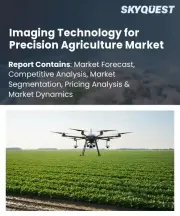
|
시장보고서
상품코드
2012176
정밀농업용 이미징 기술 시장 : 기술 유형, 플랫폼, 스펙트럼 범위, 구성요소, 용도별 예측(2026-2032년)Imaging Technology for Precision Agriculture Market by Technology Type, Platform, Spectral Range, Component, Application - Global Forecast 2026-2032 |
||||||
 360iResearch
정밀농업용 이미징 기술 시장은 2025년에 5억 3,464만 달러로 평가되었고 2026년에는 5억 9,661만 달러로 성장하여 CAGR 12.96%로 성장을 지속하여, 2032년까지 12억 5,515만 달러에 이를 것으로 예측됩니다.
| 주요 시장 통계 | |
|---|---|
| 기준 연도 : 2025년 | 5억 3,464만 달러 |
| 추정 연도 : 2026년 | 5억 9,661만 달러 |
| 예측 연도 : 2032년 | 12억 5,515만 달러 |
| CAGR(%) | 12.96% |
첨단 센싱, 데이터 분석 및 플랫폼의 융합이 고해상도 이미징을 통해 농업 의사결정을 어떻게 변화시키고 있는지에 대한 권위 있는 분석
정밀농업은 센싱 기술, 데이터 분석 및 플랫폼 통합의 발전에 힘입어 빠르게 발전하고 있습니다. 현재 이미징 기술은 농업과 데이터 사이언스의 교차점에 위치하여 생산자, 서비스 제공업체, 장비 제조업체가 작물의 수관, 토양, 관개 시스템에서 전례 없는 공간적, 분광학적 정확도로 실행 가능한 인사이트를 얻을 수 있도록 돕고 있습니다. 그 결과, 이미징은 실험적인 시도 단계에서 농업 가치사슬 전반에 걸친 실질적인 의사결정 지원으로 전환되고 있습니다.
기술의 상품화, 플랫폼의 다양화, 통합 서비스 제공이 농업용 이미징의 경쟁과 도입 경로를 재구성하는 방법
정밀농업용 이미징 전망은 기술의 성숙, 규제 변화, 고객의 기대치 변화에 힘입어 혁신적인 변화를 겪고 있습니다. 센서 기술은 틈새 시장과 고비용 시스템에서 해상도, 스펙트럼 깊이, 비용의 균형이 잘 잡힌 다양한 옵션으로 전환되어 중규모 및 대규모 농장 모두에 보급될 수 있게 되었습니다. 이러한 보급은 머신러닝의 발전과 함께 질병 조기 발견, 관개 최적화 등 이미지를 통해 해결할 수 있는 농학적 과제의 범위를 넓혀가고 있습니다.
2025년 미국 관세가 이미징 가치사슬 전반공급망, 조달 전략 및 탄력적 설계 방식에 미치는 다각적인 영향 평가
2025년 미국에서 도입된 관세 및 무역 조치는 정밀농업용 이미징 생태계에 복잡한 영향을 미쳤으며, 공급망, 조달 전략, 제품 로드맵에 영향을 미쳤습니다. 단기적으로는 수입되는 영상 관련 부품 및 플랫폼에 대한 관세 인상으로 인해 전체 시스템 총비용이 상승하고, 구매자는 조달 시기 및 공급업체 선정에 대해 재검토하게 되었습니다. 이러한 비용 압박으로 인해 조직이 안정적인 투입재 공급과 총소유비용을 관리하기 위해 국내 제조 및 지역 공급업체를 포함한 대체 조달처에 대한 관심이 가속화되었습니다.
기술 유형, 플랫폼 아키텍처, 용도, 구성 요소 및 스펙트럼 범위를 실용적인 농업적 의사결정 요건과 연계하는 종합적인 세분화 프레임워크
세부적인 세분화 접근 방식을 통해 정밀농업용 이미징에서 가치가 창출되는 곳과 도입 장벽이 남아있는 곳을 파악할 수 있습니다. 기술 유형에 따라 이 시장에는 생화학 분석을 위한 풍부한 스펙트럼 시그니처를 제공하는 하이퍼 스펙트럼 시스템, 수관 및 지형의 3차원 구조를 포착하는 LiDAR 센서, 식생 지수에 최적화된 멀티 스펙트럼 카메라, 물 스트레스 및 관개 비효율성을 밝혀내는 열화상 카메라가 포함됩니다. 각 기술은 고유한 분석 기능을 제공하며, 각기 다른 농업적 이용 사례에 적합하며, 통합 옵션과 예상 투자 수익률에 영향을 미칠 수 있습니다.
이미징 기술 도입에 있어 각기 다른 경로를 정의하고, 미주, 유럽, 중동 및 아프리카, 아시아태평양의 지역별 도입 패턴과 규제 환경
지역 동향은 기술 도입 경로와 비즈니스 모델에 중요한 영향을 미치고 있습니다. 북미와 남미의 농업 경영은 고도로 기계화 된 재배 시스템에서 정밀농업을 지향하는 특산품 농업에 이르기까지 다양하며, 모듈식 센서 제품군, 견고한 서비스 및 농기계 제조업체와의 긴밀한 협력의 도입을 촉진하고 있습니다. 지상 및 항공 모니터링에 대한 투자는 디지털 농장 기록 시스템과 병행하여 확대되고 있으며, UAV(무인항공기) 운영에 대한 규제가 명확해짐에 따라 많은 관할권에서 상용화를 촉진하고 있습니다.
센서 개발 기업, 플랫폼 통합 기업, 위성 사업자, 분석 제공업체가 차별화된 영상 솔루션과 농업적 가치를 제공하기 위해 어떻게 전략을 연계하고 있는가?
정밀농업용 이미징 분야의 주요 기업들은 센서 혁신, 플랫폼 제휴, 소프트웨어 생태계를 결합한 차별화된 전략을 추구하고 있습니다. 센서 제조업체들은 스펙트럼 충실도를 높이고, 크기와 전력 소비를 줄이며, 장치 간 및 환경 간 비교 가능성을 높이기 위해 교정 절차를 확장하고 있습니다. 카메라 제공업체들은 UAV, 유인 플랫폼, 지상 장비 간의 통합을 간소화하는 교환 가능한 페이로드 제작에 주력하고 있으며, 센서 업체들은 대역폭 수요를 줄이기 위해 엣지 사이드 프로세싱을 더 많이 통합하기 위해 노력하고 있습니다.
상호운용성, 서비스 차별화, 공급망 탄력성 및 검증된 분석을 보장하고, 이미징 기술을 농장에서의 성과로 연결하기 위해 리더가 해결해야 할 실행 가능한 전략적 우선순위를 제시합니다.
업계 리더는 이미징 기능을 지속 가능한 농업적 영향력과 상업적 우위로 전환하기 위해 단호한 조치를 취해야 합니다. 우선, 다양한 이용 사례에서 센서, 플랫폼, 소프트웨어를 유연하게 조합할 수 있도록 상호운용성과 개방형 데이터 표준을 우선시해야 합니다. 표준화된 캘리브레이션과 공통 데이터 스키마에 대한 투자는 통합의 마찰을 줄이고 파트너 간에 공유되는 데이터 세트의 가치를 높입니다.
이해관계자 인터뷰, 기술적 보정, 현장 검증 및 2차 자료를 결합한 엄격한 혼합 연구 접근 방식을 통해 견고하고 재현 가능한 결과를 확보했습니다.
본 분석의 기초가 되는 조사는 주요 이해관계자와의 대화, 기술적 성능 평가 및 2차 문헌의 통합을 결합한 혼합 방법론적 접근법을 기반으로 합니다. 1차 조사에는 센서 제조업체, 플랫폼 사업자, 농업 컨설턴트, 서비스 제공업체 및 기관 사용자를 대상으로 한 구조화된 인터뷰를 통해 현재 실행 현황, 과제 및 혁신 우선순위를 파악했습니다. 이러한 대화를 통해 비즈니스 모델, 도입상의 제약, 그리고 변화하는 고객의 기대에 대한 이해가 깊어졌습니다.
성숙한 센싱 기술, 검증된 분석 및 강력한 제공 모델이 어떻게 결합되어 이미징을 지속 가능하고 효율적인 농업 운영의 실질적인 원동력이 될 수 있는지에 대한 개요
이미징 기술은 실험적 보조 수단에서 정밀농업 전략의 핵심 요소로 전환하고 있으며, 더 깊은 표현형에 대한 인사이트와 더 나은 의사결정 지원을 제공합니다. 센서, 플랫폼, 분석 기술의 시너지적 성숙으로 인해 솔루션이 업무 워크플로우 전반에 통합되어 자원 효율성 향상, 환경 부하 감소, 생산성 향상의 기회를 창출하고 있습니다. 그러나 이러한 가능성을 실현하기 위해서는 상호운용성, 검증된 모델, 그리고 센서의 출력을 명확한 농학적 행동으로 변환하는 서비스 제공이 필수적입니다.
자주 묻는 질문
목차
제1장 서문
제2장 조사 방법
제3장 주요 요약
제4장 시장 개요
제5장 시장 인사이트
제6장 미국 관세의 누적 영향, 2025년
제7장 AI의 누적 영향, 2025년
제8장 정밀농업용 이미징 기술 시장 : 기술 유형별
제9장 정밀농업용 이미징 기술 시장 : 플랫폼별
제10장 정밀농업용 이미징 기술 시장 : 파장대별
제11장 정밀농업용 이미징 기술 시장 : 컴포넌트별
제12장 정밀농업용 이미징 기술 시장 : 용도별
제13장 정밀농업용 이미징 기술 시장 : 지역별
제14장 정밀농업용 이미징 기술 시장 : 그룹별
제15장 정밀농업용 이미징 기술 시장 : 국가별
제16장 미국의 정밀농업용 이미징 기술 시장
제17장 중국의 정밀농업용 이미징 기술 시장
제18장 경쟁 구도
JHS 26.04.30The Imaging Technology for Precision Agriculture Market was valued at USD 534.64 million in 2025 and is projected to grow to USD 596.61 million in 2026, with a CAGR of 12.96%, reaching USD 1,255.15 million by 2032.
| KEY MARKET STATISTICS | |
|---|---|
| Base Year [2025] | USD 534.64 million |
| Estimated Year [2026] | USD 596.61 million |
| Forecast Year [2032] | USD 1,255.15 million |
| CAGR (%) | 12.96% |
An authoritative framing of how advanced sensing, data analytics, and platform convergence are transforming agricultural decision-making through high-resolution imaging
Precision agriculture is undergoing a rapid evolution driven by advances in sensing technologies, data analytics, and platform integration. Imaging technologies now sit at the intersection of agronomy and data science, enabling producers, service providers, and equipment manufacturers to derive actionable intelligence from crop canopies, soils, and irrigation systems with unprecedented spatial and spectral fidelity. As a result, imaging is shifting from experimental trials to operational decision support across the agricultural value chain.
The convergence of hyperspectral, multispectral, thermal, and LiDAR imaging with robust sensors and software ecosystems empowers stakeholders to monitor plant physiology, water stress, nutrient status, pest presence, and soil variability across entire fields. This integration supports more precise interventions, reduces input waste, and enhances traceability. Critical to this progress are improvements in sensor miniaturization, on-board processing, cloud compute capabilities, and machine learning models trained on diverse agroecological conditions.
Looking ahead, imaging will increasingly tie into autonomous platforms, precision application systems, and farm management information systems, making timely, location-specific recommendations practicable at scale. As industry participants adapt to this shift, the emphasis moves from data collection to data quality management, interoperability, and practical decision workflows that translate remote sensing outputs into reliable agronomic actions.
How technology commoditization, platform diversification, and integrated service delivery are reshaping competitive dynamics and adoption pathways in agricultural imaging
The landscape for imaging in precision agriculture is experiencing transformative shifts driven by technology maturation, regulatory changes, and changing customer expectations. Sensor technologies have moved from niche high-cost systems to a broader spectrum of options that balance resolution, spectral depth, and cost, enabling wider adoption among mid-sized and large farms alike. This democratization intersects with improvements in machine learning, which have expanded the set of agronomic problems addressable via imagery, including early disease detection and irrigation optimization.
Concurrently, platforms have diversified. Ground-based systems now offer high-frequency, targeted monitoring while aerial platforms, including UAVs and manned aircraft, deliver area-wide surveillance. Satellite architectures have evolved to provide higher revisit rates and multispectral capabilities that complement airborne and ground sensing. These platform shifts enable multi-scale monitoring strategies where data from different altitudes and perspectives fuse into richer analytics.
Operational practices are also changing. Service delivery models are moving away from pure hardware sales toward integrated offerings that combine sensors, software, and advisory services. Farm managers increasingly expect turnkey solutions that integrate into existing farm management systems and provide clear return-focused recommendations. Together, these shifts are reconfiguring competitive dynamics and raising the bar for interoperability, data governance, and demonstrable agronomic value.
Assessing the multifaceted effects of 2025 United States tariffs on supply chains, procurement strategies, and resilient design practices across the imaging value chain
The introduction of tariffs and trade measures in the United States in 2025 has exerted a complex influence on the precision agriculture imaging ecosystem, affecting supply chains, procurement strategies, and product roadmaps. In the short term, increased duties on imported imaging components and platforms elevated landed costs for complete systems and spurred buyers to reassess procurement timing and supplier selection. This cost pressure accelerated interest in alternative sourcing, including domestic manufacturing and regional supply partners, as organizations sought to stabilize input availability and control total cost of ownership.
Tariff-driven trade frictions also incentivized design changes. Manufacturers prioritized modular architectures that allow substitution of specific modules sourced from lower-tariff jurisdictions or domestically produced equivalents. Sensor vendors increased collaboration with regional partners to localize production of critical components such as optics, electronic boards, and sensor modules. These adjustments helped mitigate disruption but required retooling and new qualification processes that extended product development timelines.
On the demand side, service providers adjusted pricing models and emphasized subscription and service-based offerings to smooth cost impacts for end users. Investment in software and edge processing increased as firms sought to offset higher hardware costs with value added through analytics and decision support. Longer term, the policy environment stimulated a strategic reorientation toward supply chain resilience, encouraging diversified supplier networks and near-shoring where feasible, while sustaining innovation through targeted capital allocation to adaptable platform designs.
A comprehensive segmentation framework linking technology types, platform architectures, applications, components, and spectral ranges to practical agronomic decision requirements
A detailed segmentation approach illuminates where value is generated and where adoption barriers persist within precision agriculture imaging. Based on technology type, the market encompasses hyperspectral systems that deliver rich spectral signatures for biochemical analysis, LiDAR sensors that capture three-dimensional canopy and terrain structure, multispectral cameras optimized for vegetation indices, and thermal imagers that reveal water stress and irrigation inefficiencies. Each technology contributes distinct analytical capabilities and fits different agronomic use cases, influencing integration choices and return expectations.
When considered by platform, monitoring strategies span ground-based systems that include handheld devices for spot assessments and tractor-mounted rigs for systematic field passes, manned aircraft platforms that comprise fixed wing aircraft for broad area sweeps and helicopters for rapid, targeted ops, satellite architectures differentiated into constellation systems for high revisit frequency and single satellite assets for specific spectral payloads, and UAV platforms offering fixed wing solutions for endurance flights alongside rotary wing systems for high maneuverability and precision hover tasks. The interplay between platform endurance, payload capacity, and operational cost governs where each platform excels.
Application segmentation reveals priority use cases such as crop health monitoring, where subdomains like disease identification, nutrient deficiency detection, and water stress analysis require different spectral and temporal resolutions; irrigation management, which benefits from drip optimization and return-on-investment analysis; nutrient management with fertilizer recommendation and foliar analysis; pest and disease detection including fungal detection and insect monitoring; soil analysis covering moisture assessment and texture profiling; and yield prediction tasks that rely on biomass estimation and harvest planning. These application needs drive component selection across cameras, sensors, services, and software, which themselves break down into hyperspectral, multispectral, and thermal camera options, CCD and CMOS sensor technologies, consulting, installation and maintenance, and training services, and software modules focused on data analysis and image processing. Finally, spectral range considerations-spanning near infrared, short wave infrared, thermal infrared, and visible bands-dictate the types of physiological and environmental insights available, requiring careful matching of spectral capability to agronomic question.
Regional adoption patterns and regulatory environments in the Americas, Europe-Middle East-Africa, and Asia-Pacific that define differentiated pathways for imaging technology deployment
Regional dynamics shape technology adoption pathways and business models in meaningful ways. In the Americas, agricultural operations range from highly mechanized row crop systems to precision-oriented specialty agriculture, encouraging adoption of modular sensor suites, robust services, and close integration with farm equipment manufacturers. Investment in ground-based and aerial monitoring has scaled alongside digital farm record systems, while regulatory clarity around UAV operations has facilitated commercial deployments across many jurisdictions.
Across Europe, the Middle East, and Africa, diverse climatic regimes and regulatory frameworks create a mosaic of needs. Western European markets emphasize sustainability metrics, regulatory reporting, and supply chain traceability, which drive demand for standardized data formats and interoperable workflows. In parts of the Middle East and Africa, imaging technologies are leveraged to address water scarcity and cropping risk, with bespoke solutions that prioritize thermal and multispectral capabilities to manage irrigation and stress detection under harsh environmental conditions.
The Asia-Pacific region presents a mix of high-intensity agriculture and fragmented smallholder systems, creating demand for both high-throughput airborne monitoring in large production zones and low-cost, easy-to-use options for smaller farms. Rapid improvements in satellite coverage and regional UAV ecosystems have enabled scaled monitoring solutions, while partnerships with local service providers and extension networks help drive adoption in diverse agroecological contexts. Across all regions, interoperability, local service capabilities, and alignment with regulatory expectations remain critical success factors.
How sensor innovators, platform integrators, satellite operators, and analytics providers are coordinating strategies to deliver differentiated imaging solutions and agronomic value
Key companies across the precision agriculture imaging landscape are pursuing differentiated strategies that combine sensor innovation, platform partnerships, and software ecosystems. Sensor manufacturers are advancing spectral fidelity, reducing size and power requirements, and expanding calibration procedures to improve comparability across devices and environments. Camera providers focus on producing interchangeable payloads that simplify integration across UAVs, manned platforms, and ground rigs, while sensor firms work to embed more processing at the edge to reduce bandwidth demands.
Platform and systems integrators are forging alliances with software firms and agronomy experts to offer vertically integrated services that reduce the burden on end users. These collaborations often include field validation programs and pilot partnerships that prove algorithms against local conditions. Satellite and constellation operators complement airborne and ground capabilities by delivering consistent baseline imagery and temporal coverage, enabling blended analytics that combine spatial detail with frequent revisit.
Software companies are competing on analytics accuracy, user experience, and integration capability. They prioritize open APIs, compatibility with farm management platforms, and explainable models that provide confidence to agronomists. Service providers and consultancies position themselves as trusted advisors, offering installation, training, and ongoing maintenance that translate remote sensing outputs into measurable operational changes. Together, these company strategies reflect a movement toward commoditized hardware combined with differentiated intelligence and services as the primary sources of competitive advantage.
Actionable strategic priorities for leaders to ensure interoperability, service differentiation, supply chain resilience, and validated analytics translate imaging into on-farm impact
Industry leaders should act decisively to convert imaging capabilities into sustained agronomic impact and commercial advantage. First, they should prioritize interoperability and open data standards to ensure that sensors, platforms, and software can be combined flexibly across a broad set of use cases. Investing in standardized calibration and common data schemas will reduce integration friction and increase the value of shared datasets across partners.
Second, companies should balance hardware innovation with robust services and analytics. Given that end users increasingly value actionable recommendations, pairing sensor deployments with agronomy expertise, installation support, and training programs will drive adoption and retention. Third, supply chain resilience should be a strategic priority: diversifying suppliers, qualifying regional manufacturing partners, and designing modular systems that allow component substitution will mitigate policy and logistics risks.
Fourth, leaders must commit to rigorous field validation and explainable AI to build user trust. Demonstrations under diverse agroecological conditions and transparent model documentation will accelerate commercial uptake. Finally, organizations should pursue channel partnerships with equipment OEMs, cooperatives, and advisory networks to embed imaging insights directly into farmer workflows, ensuring that technological advances translate into on-farm decisions and measurable operational improvements.
A rigorous mixed-methods research approach combining stakeholder interviews, technical calibration, field validation, and secondary evidence to ensure robust and reproducible insights
The research underpinning this analysis relied on a mixed-methods approach that combined primary stakeholder engagement, technical performance assessment, and secondary literature synthesis. Primary research included structured interviews with sensor manufacturers, platform operators, agronomy consultants, service providers, and institutional users to capture current practices, pain points, and innovation priorities. These conversations informed the understanding of commercial models, deployment constraints, and evolving customer expectations.
Technical assessment involved comparative evaluation of sensor modalities across spectral ranges and platform integrations. Bench and field calibration exercises examined radiometric consistency, geolocation accuracy, and operational constraints such as power, payload compatibility, and data throughput. In parallel, software capabilities were evaluated for data ingestion, processing latency, analytics breadth, and integration with farm management tools.
Secondary research synthesized peer-reviewed literature, technical white papers, and regulatory sources to contextualize technological trends and policy influences. Triangulation across data sources ensured that conclusions reflect both practical field realities and broader industry dynamics. Throughout the process, emphasis was placed on reproducibility of methods, transparency of assumptions, and validation of claims through cross-stakeholder corroboration.
Concluding synthesis on how matured sensing, validated analytics, and resilient delivery models combine to make imaging a practical enabler of sustainable and efficient agricultural operations
Imaging technologies are shifting from experimental adjuncts to central components of precision agriculture strategies, offering deeper phenotypic insight and more timely decision support. The combined maturation of sensors, platforms, and analytics creates opportunities to improve resource efficiency, reduce environmental footprint, and enhance productivity when solutions integrate across operational workflows. However, realizing this potential depends on interoperability, validated models, and service offerings that translate sensor outputs into clear agronomic actions.
Supply chain dynamics and policy changes underscore the need for flexibility in procurement and design. Organizations that emphasize modular architectures, diversified sourcing, and regional partnerships will be better positioned to weather external shocks. Likewise, vendors that invest in explainable analytics and rigorous field trials will secure greater trust from agronomists and farm managers. As adoption widens, the competitive frontier will shift toward value delivered through analytics, services, and integration rather than hardware alone.
In sum, the pathway to impactful deployment lies in marrying technical capability with practical delivery models that embed imaging intelligence into everyday farm decision cycles, yielding resilient, sustainable, and economically viable outcomes.
Table of Contents
1. Preface
- 1.1. Objectives of the Study
- 1.2. Market Definition
- 1.3. Market Segmentation & Coverage
- 1.4. Years Considered for the Study
- 1.5. Currency Considered for the Study
- 1.6. Language Considered for the Study
- 1.7. Key Stakeholders
2. Research Methodology
- 2.1. Introduction
- 2.2. Research Design
- 2.2.1. Primary Research
- 2.2.2. Secondary Research
- 2.3. Research Framework
- 2.3.1. Qualitative Analysis
- 2.3.2. Quantitative Analysis
- 2.4. Market Size Estimation
- 2.4.1. Top-Down Approach
- 2.4.2. Bottom-Up Approach
- 2.5. Data Triangulation
- 2.6. Research Outcomes
- 2.7. Research Assumptions
- 2.8. Research Limitations
3. Executive Summary
- 3.1. Introduction
- 3.2. CXO Perspective
- 3.3. Market Size & Growth Trends
- 3.4. Market Share Analysis, 2025
- 3.5. FPNV Positioning Matrix, 2025
- 3.6. New Revenue Opportunities
- 3.7. Next-Generation Business Models
- 3.8. Industry Roadmap
4. Market Overview
- 4.1. Introduction
- 4.2. Industry Ecosystem & Value Chain Analysis
- 4.2.1. Supply-Side Analysis
- 4.2.2. Demand-Side Analysis
- 4.2.3. Stakeholder Analysis
- 4.3. Porter's Five Forces Analysis
- 4.4. PESTLE Analysis
- 4.5. Market Outlook
- 4.5.1. Near-Term Market Outlook (0-2 Years)
- 4.5.2. Medium-Term Market Outlook (3-5 Years)
- 4.5.3. Long-Term Market Outlook (5-10 Years)
- 4.6. Go-to-Market Strategy
5. Market Insights
- 5.1. Consumer Insights & End-User Perspective
- 5.2. Consumer Experience Benchmarking
- 5.3. Opportunity Mapping
- 5.4. Distribution Channel Analysis
- 5.5. Pricing Trend Analysis
- 5.6. Regulatory Compliance & Standards Framework
- 5.7. ESG & Sustainability Analysis
- 5.8. Disruption & Risk Scenarios
- 5.9. Return on Investment & Cost-Benefit Analysis
6. Cumulative Impact of United States Tariffs 2025
7. Cumulative Impact of Artificial Intelligence 2025
8. Imaging Technology for Precision Agriculture Market, by Technology Type
- 8.1. Hyperspectral
- 8.2. LiDAR
- 8.3. Multispectral
- 8.4. Thermal Imaging
9. Imaging Technology for Precision Agriculture Market, by Platform
- 9.1. Ground Based
- 9.1.1. Handheld
- 9.1.2. Tractor Mounted
- 9.2. Manned Aircraft
- 9.2.1. Fixed Wing Aircraft
- 9.2.2. Helicopter
- 9.3. Satellite
- 9.3.1. Constellation
- 9.3.2. Single Satellite
- 9.4. UAV
- 9.4.1. Fixed Wing
- 9.4.2. Rotary Wing
10. Imaging Technology for Precision Agriculture Market, by Spectral Range
- 10.1. Near Infrared
- 10.2. Short Wave Infrared
- 10.3. Thermal Infrared
- 10.4. Visible
11. Imaging Technology for Precision Agriculture Market, by Component
- 11.1. Cameras
- 11.1.1. Hyperspectral Camera
- 11.1.2. Multispectral Camera
- 11.1.3. Thermal Camera
- 11.2. Sensors
- 11.2.1. CCD
- 11.2.2. CMOS
- 11.3. Services
- 11.3.1. Consulting
- 11.3.2. Installation & Maintenance
- 11.3.3. Training
- 11.4. Software
- 11.4.1. Data Analysis
- 11.4.2. Image Processing
12. Imaging Technology for Precision Agriculture Market, by Application
- 12.1. Crop Health Monitoring
- 12.1.1. Disease Identification
- 12.1.2. Nutrient Deficiency Detection
- 12.1.3. Water Stress Analysis
- 12.2. Irrigation Management
- 12.2.1. Drip Optimization
- 12.2.2. ROI Analysis
- 12.3. Nutrient Management
- 12.3.1. Fertilizer Recommendation
- 12.3.2. Foliar Analysis
- 12.4. Pest And Disease Detection
- 12.4.1. Fungal Detection
- 12.4.2. Insect Monitoring
- 12.5. Soil Analysis
- 12.5.1. Moisture Content Assessment
- 12.5.2. Texture Analysis
- 12.6. Yield Prediction
- 12.6.1. Biomass Estimation
- 12.6.2. Harvest Planning
13. Imaging Technology for Precision Agriculture Market, by Region
- 13.1. Americas
- 13.1.1. North America
- 13.1.2. Latin America
- 13.2. Europe, Middle East & Africa
- 13.2.1. Europe
- 13.2.2. Middle East
- 13.2.3. Africa
- 13.3. Asia-Pacific
14. Imaging Technology for Precision Agriculture Market, by Group
- 14.1. ASEAN
- 14.2. GCC
- 14.3. European Union
- 14.4. BRICS
- 14.5. G7
- 14.6. NATO
15. Imaging Technology for Precision Agriculture Market, by Country
- 15.1. United States
- 15.2. Canada
- 15.3. Mexico
- 15.4. Brazil
- 15.5. United Kingdom
- 15.6. Germany
- 15.7. France
- 15.8. Russia
- 15.9. Italy
- 15.10. Spain
- 15.11. China
- 15.12. India
- 15.13. Japan
- 15.14. Australia
- 15.15. South Korea
16. United States Imaging Technology for Precision Agriculture Market
17. China Imaging Technology for Precision Agriculture Market
18. Competitive Landscape
- 18.1. Market Concentration Analysis, 2025
- 18.1.1. Concentration Ratio (CR)
- 18.1.2. Herfindahl Hirschman Index (HHI)
- 18.2. Recent Developments & Impact Analysis, 2025
- 18.3. Product Portfolio Analysis, 2025
- 18.4. Benchmarking Analysis, 2025
- 18.5. Ag Leader Technology, Inc.
- 18.6. AGCO Corporation
- 18.7. AgJunction Inc.
- 18.8. Agremo
- 18.9. AGRIVI d.o.o.
- 18.10. BharatAgri
- 18.11. Ceres Imaging, Inc.
- 18.12. Cropin Technology Solutions Pvt. Ltd.
- 18.13. CropMetrics LLC
- 18.14. Deere & Company
- 18.15. Farmers Edge Inc.
- 18.16. FarmQA, Inc.
- 18.17. FieldX, Inc.
- 18.18. Grownetics, Inc.
- 18.19. Intello Labs Pvt. Ltd.
- 18.20. Proagrica Ltd.
- 18.21. Raven Industries, Inc.
- 18.22. The Climate Corporation
- 18.23. Topcon Corporation
- 18.24. Trimble Inc.