|
시장보고서
상품코드
2066982
체외 독성 시험 시장 : 제공별, 유형별, 독성 엔드포인트 및 시험별, 기술별, 방법별, 최종사용자별, 지역별 - 세계 예측(-2031년)In Vitro Toxicology Testing Market by Product (Equipment, Reagents, Kits, Software), Toxicity Endpoints & Type, Technology (Cell Culture, HTS), Method (Cell-based, Computational), Service (Type, Method), Region, Competition - Global Forecast to 2031 |
||||||

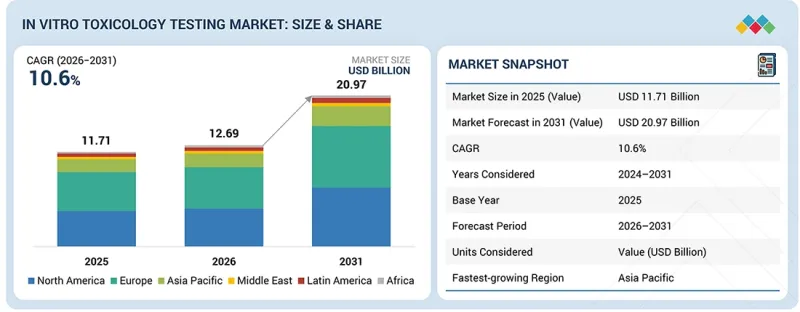
체외 독성 시험 시장 규모는 2026년 126억 9,000만 달러에서 예측 기간 동안 CAGR 10.6%로 확대되어 2031년까지 209억 7,000만 달러에 달할 것으로 예측됩니다.
이러한 성장은 화합물의 초기 단계에서 진행되는 스크리닝 및 안전성 프로파일링 과정에서 세포 기반 분석법, 3D 배양 모델, 오가노이드, 오가노이드-온-칩 시스템, 하이콘텐츠 스크리닝, 자동화, 그리고 AI를 활용한 예측 독성학의 활용이 증가하고 있는 데서 비롯된 것입니다.
| 조사 범위 | |
|---|---|
| 조사 대상 기간 | 2026-2031년 |
| 기준 연도 | 2025년 |
| 예측 기간 | 2026-2031년 |
| 산정 단위 | 금액(10억 달러) |
| 부문 | 제공별, 유형별, 독성 엔드포인트 및 시험별, 기술별, 방법별, 최종사용자별, 지역별 |
| 대상 지역 | 북미, 유럽, 아시아태평양, 라틴아메리카, 중동 및 아프리카 |
이 시장은 제약 및 생명공학 분야의 연구개발비 증가, 보다 신속하고 인간 중심적인 독성 예측에 대한 수요, CRO에 대한 업무 위탁, 그리고 전임상 단계에서의 의사결정을 개선하면서 동물 실험을 줄이려는 규제적 움직임에 힘입어 더욱 성장하고 있습니다.
“2025년에는 제품 부문이 서비스 부문보다 더 높은 점유율을 차지했습니다.”
제품군별로 보면 제품 부문이 전 세계 체외 독성 시험 시장에서 가장 큰 점유율을 차지했습니다. 제품 부문이 시장을 주도한 이유는, 체외 독성학 워크플로가 어세이 키트, 시약, 세포 배양 배지, 혈청, 완충액, 마이크로플레이트, 검출 기질, 기준 표준 물질 및 검증된 세포 모델 등 반복적으로 사용되는 제품의 소비에 크게 의존하고 있기 때문입니다. 서비스와 달리, 이러한 제품들은 세포 독성, 유전 독성, 장기 독성, 경피 독성, 안구 독성 및 기전에 기반한 독성 시험 등 모든 시험에서 반복적으로 수행되어야 합니다.
“2025년, 북미는 체외 독성 시험 시장을 장악했습니다.”
2025년, 북미는 체외 독성 시험 시장을 독점했습니다. 이는 주로 제약회사 및 생명공학 기업의 강력한 입지, 선진적인 CRO 인프라, 자금력이 풍부한 학술 연구 센터, 그리고 미국 및 캐나다 전역에 걸친 비동물 안전성 시험 기술의 조기 도입 덕분입니다. 해당 지역에서는 신약 개발, 전임상 개발, 화장품 안전성 평가, 화학제품 평가 및 의료기기의 생체적합성 시험 분야에서 세포 독성, 유전 독성, 간 독성, 심장 독성 및 기전 기반 독성 시험에 대한 수요가 증가하고 있습니다. 또한 미국에는 어세이 키트 공급업체, 세포 모델 제공업체, 장기-온-칩 기업, 하이콘텐츠 스크리닝 플랫폼, 예측 독성학 소프트웨어 개발업체로 구성된 성숙한 생태계가 있어, 체외 독성학 제품 및 서비스의 광범위한 상용화를 뒷받침하고 있습니다. 동물 실험을 대체할 수 있는 방법을 장려하는 규제 현대화 노력 또한 이러한 도입을 더욱 뒷받침하고 있습니다.
본 보고서에서 다룬 기업 개요 목록:
- Thermo Fisher Scientific Inc.(미국)
- Merck KGaA(독일)
- Eurofins Scientific(룩셈부르크)
- Laboratory Corporation of America Holdings(미국)
- Charles River Laboratories(미국)
- SGS SA(스위스)
- Bio-Rad Laboratories, Inc.(미국)
- Evotec SE(독일)
- Promega Corporation(미국)
- Catalent, Inc.(미국)
- Agilent Technologies, Inc.(미국)
- Intertek Group plc(영국)
- Revvity(미국)
- Inotiv(미국)
- BioIVT(미국)
- Lonza(스위스)
- Creative Biolabs(미국)
- Shanghai Medicilon Inc.(중국)
- Creative Bioarray(미국)
- Aragen Life Sciences Ltd.(인도)
- Enzo Biochem Inc.(미국)
- Microbac Laboratories, Inc.(미국)
- Vimta Labs Ltd.(인도)
- Pacific BioLabs Inc.(미국)
- MB Research Laboratories(미국)
조사 범위:
본 조사 보고서에서는 체외 독성 시험 시장을 제품군별, 유형별, 독성 평가 지표 및 시험별, 기술별, 방법별, 최종사용자별, 지역별로 분류하고 있습니다.
본 보고서의 범위에는 체외 독성 시험 시장의 성장을 좌우하는 주요 영향요인(촉진요인, 동향, 과제, 기회 등)에 대한 상세한 정보가 포함되어 있습니다. 주요 업계 진출 기업에 대해 종합적인 분석을 수행하여, 각 기업의 사업 개요, 제품, 주요 전략, 제휴, 파트너십 및 계약에 관한 인사이트를 제공합니다. 또한, 본 보고서에서는 체외 독성 시험 시장의 신제품 출시, 합병, 인수 등 최근 동향에 대해서도 다루고 있습니다.
본 보고서를 구매할 때의 주요 이점:
본 보고서는 체외 독성 시험 시장 전체 및 그 하위 부문의 매출에 대해 가장 정확한 추정치를 제공함으로써, 시장을 선도하는 기업과 신규 진입 기업을 지원합니다. 또한, 이해관계자들이 경쟁 구도를 더 깊이 이해하고, 자사의 비즈니스를 최적의 위치로 이끌며, 적절한 시장 진입 전략을 수립하는 데 필요한 인사이트를 얻는 데에도 도움이 됩니다. 본 보고서를 통해 이해관계자들은 시장 동향을 파악하고, 주요 시장 촉진요인, 억제요인, 기회 및 과제에 관한 정보를 얻을 수 있습니다.
본 보고서에서는 다음 사항에 대한 인사이트를 제공합니다:
- 주요 촉진요인(비동물 독성 시험법으로의 업계 전환이 진행되고 있음, 기술 발전이 가속화되고 있음), 제약요인(복잡한 평가 지표에서 생체 내(in vivo)와 생체 외(in vitro) 간의 상관관계 한계), 기회(AI/ML을 활용한 예측 독성학, in vitro 방법을 이용한 신약 개발에 대한 관심 증가, 대마, 전자담배 및 신제품의 안전성 시험) 및 과제(AI 주도 독성학 분야의 윤리적·규제적 과제) 등, 시장 성장에 영향을 미치는 요인들에 대해 분석하고 있습니다
- 제품 및 서비스 개발·혁신 : 체외 독성 시험 시장에서 새롭게 출시된 제품 및 서비스에 대한 상세한 인사이트
- 시장 개발 : 다양한 지역의 수익성이 높은 시장에 대한 종합적인 정보
- 시장의 다각화 : 체외 독성 시험 시장의 신제품, 미개척 지역, 최근 동향 및 투자에 관한 종합적인 정보
- 경쟁사 분석 : Thermo Fisher Scientific Inc.(미국), Merck KGaA(독일), Eurofins Scientific(룩셈부르크), Laboratory Corporation of America Holdings(미국), Charles River Laboratories(미국), SGS SA(스위스), Bio-Rad Laboratories, Inc.(미국), Evotec SE(독일), Promega Corporation(미국), Catalent, Inc.(미국), Agilent Technologies, Inc.(미국), Intertek Group plc(영국), Revvity(미국), Inotiv(미국), BioIVT(미국), Lonza(스위스), Creative Biolabs(미국), Shanghai Medicilon Inc.(중국), Creative Bioarray(미국), Aragen Life Sciences Ltd.(인도), Enzo Biochem Inc.(미국), Microbac Laboratories, Inc.(미국), Vimta Labs Ltd.(인도), Pacific BioLabs Inc.(미국), MB Research Laboratories(미국) 등이 시장에 진출해 있습니다
자주 묻는 질문
목차
제1장 소개
제2장 주요 요약
제3장 주요 인사이트
제4장 시장 개요
제5장 업계 동향
제6장 기술 진보, AI에 의한 영향, 특허, 혁신, 그리고 향후 응용
제7장 지속가능성과 규제 상황
제8장 고객 상황과 구매 행동
제9장 체외 독성 시험 시장(제공별)
제10장 체외 독성 시험 제품 시장(유형별)
제11장 체외 독성 시험 제품 시장(독성 엔드포인트 및 시험별)
제12장 체외 독성 시험 제품 시장(기술별)
제13장 체외 독성 시험 제품 시장(방법별)
제14장 체외 독성 시험 제품 시장(최종사용자별)
제15장 체외 독성 시험 서비스 시장(유형별)
제16장 체외 독성 시험 서비스 시장(방법별)
제17장 체외 독성 시험 서비스 시장(최종사용자별)
제18장 체외 독성 시험 시장(지역별)
제19장 경쟁 구도
제20장 기업 개요
제21장 조사 방법
제22장 부록
KSM 26.06.30The in vitro toxicology testing market is projected to reach USD 20.97 billion by 2031, growing from an estimated USD 12.69 billion in 2026, at a CAGR of 10.6% during the forecast period. Growth is being driven by increasing use of cell-based assays, 3D culture models, organoids, organ-on-chip systems, high-content screening, automation, and AI-enabled predictive toxicology for early-stage compound screening and safety profiling.
| Scope of the Report | |
|---|---|
| Years Considered for the Study | 2026-2031 |
| Base Year | 2025 |
| Forecast Period | 2026-2031 |
| Units Considered | Value (USD billion) |
| Segments | Offering, Product, Type, Method, End User |
| Regions covered | North America, Europe, Asia Pacific, Latin America, the Middle East, and Africa |
The market is further supported by rising pharmaceutical and biotechnology R&D spending, demand for faster and more human-relevant toxicity prediction, outsourcing to CROs, and regulatory momentum to reduce animal testing while improving preclinical decision-making.
"The products segment accounted for a larger share than the services segment in 2025."
By offering, the products segment accounted for the largest share in the global in vitro toxicology testing market. The products segment led the market because in vitro toxicology workflows depend heavily on recurring product consumption, including assay kits, reagents, cell culture media, sera, buffers, microplates, detection substrates, reference standards, and validated cell models. Unlike services, these products are repeatedly required across every cytotoxicity, genotoxicity, organ toxicity, dermal, ocular, and mechanistic toxicity study.
"North America dominated the in vitro toxicology testing market in 2025."
North America dominated the in vitro toxicology testing market in 2025, primarily due to the strong presence of pharmaceutical and biotechnology companies, advanced CRO infrastructure, well-funded academic research centers, and early adoption of non-animal safety testing technologies across the US and Canada. The region has high demand for cytotoxicity, genotoxicity, hepatotoxicity, cardiotoxicity, and mechanistic toxicity testing during drug discovery, preclinical development, cosmetics safety assessment, chemical evaluation, and medical device biocompatibility testing. The US also has a mature ecosystem of assay kit suppliers, cell model providers, organ-on-chip companies, high-content screening platforms, and predictive toxicology software developers, supporting broad commercialization of in vitro toxicology products and services. Regulatory modernization initiatives encouraging alternative methods to animal testing further support adoption.
The primary interviews conducted for this report can be categorized as follows:
- By Respondent: Supply Side - 70%; Demand Side 30%
- By Designation: Managers - 45%; CXO & Directors - 30%; and Executives - 25%
- By Region: North America - 40%; Europe - 25%; Asia Pacific - 20%; Latin America - 10%; and Middle East & Africa - 5%
List of Companies Profiled in the Report:
- Thermo Fisher Scientific Inc. (US)
- Merck KGaA (Germany)
- Eurofins Scientific (Luxembourg)
- Laboratory Corporation of America Holdings (US)
- Charles River Laboratories (US)
- SGS SA (Switzerland)
- Bio-Rad Laboratories, Inc. (US)
- Evotec SE (Germany)
- Promega Corporation (US)
- Catalent, Inc. (US)
- Agilent Technologies, Inc. (US)
- Intertek Group plc (UK)
- Revvity (US)
- Inotiv (US)
- BioIVT (US)
- Lonza (Switzerland)
- Creative Biolabs (US)
- Shanghai Medicilon Inc. (China)
- Creative Bioarray (US)
- Aragen Life Sciences Ltd. (India)
- Enzo Biochem Inc. (US)
- Microbac Laboratories, Inc. (US)
- Vimta Labs Ltd. (India)
- Pacific BioLabs Inc. (US)
- MB Research Laboratories (US)
Research Coverage:
This research report categorizes the in vitro toxicology testing market by offering {Products [Reagents & Consumables (Cell Lines & Primary Cells, Culture Reagents, Media & Consumables, 3D Models and Tissue Systems, Other Reagents & Consumables), Assay Kits (Cytotoxicity Assay, Genotoxicity Assay, Organ-Specific Toxicity Assay, Other Assays), Equipment (Detection, Imaging & Analytical Systems (Imaging Systems, Detection Instruments, Other Instruments), Liquid Handling & Automation Systems, Other Equipment), Software & Informatics, and Services; Product - By Toxicity End Point (Organ Toxicity Testing, Cytotoxicity Testing, Genotoxicity Testing, Dermal Toxicity and Skin Irritation, Corrosion and Sensitization, Oxidative Stress and Mechanistic Toxicity, Other Toxicity Endpoints and Tests); Product - By Technology (Cell Culture Technologies, High-Throughput and High-Content Technologies, Omics Technologies, Organotypic and Microphysiological Based Technologies, Other Technologies); Product - By Method (Cell-Based Toxicity Testing Method, Biochemical Toxicity Testing Method, In Silico/Computational Toxicity Testing Method, Ex Vivo Models-Based Toxicity Testing Method, Molecular & Omics-Based Toxicology Method, Other Methods); Product - By End User (Pharmaceuticals & Biotechnology Companies, Consumer Care Companies, Food & Beverages Companies, Cros, Academic And Research Institutes, Other End Users); Service- By Type (Toxicology Testing Service, Biological Model And Assay Development Services, Imaging And Analytical Toxicology Services, Data Analysis, Bioinformatics, And Predictive Toxicology); Service - By Method (Cell-Based Toxicity Testing Method, Biochemical Toxicity Testing Method, In Silico/Computational Toxicity Testing Method, Ex Vivo Models-Based Toxicity Testing Method, Molecular & Omics-Based Toxicology Method, Other Methods); Service - By End User (Pharmaceuticals & Biotechnology Companies, Consumer Care Companies, Food & Beverages Companies, Academic And Research Institutes, Other End Users).
The report's scope encompasses detailed information regarding major influencing factors such as drivers, trends, challenges, and opportunities shaping the growth of the in vitro toxicology testing market. A comprehensive analysis of key industry players has been conducted to offer insights into their business overview, products, key strategies, collaborations, partnerships, and agreements. The report also covers recent developments, including new product launches, mergers, and acquisitions, in the in vitro toxicology testing market.
Key Benefits of Buying the Report:
The report will help market leaders/new entrants by providing them with the closest approximations of the revenue numbers for the overall in vitro toxicology testing market and its subsegments. It will also help stakeholders better understand the competitive landscape and gain more insights to better position their business and make suitable go-to-market strategies. This report will enable stakeholders to understand the market's pulse and provide them with information on the key market drivers, restraints, opportunities, and challenges.
The report provides insights into the following pointers:
- Analysis of key drivers (Growing industry shift toward non-animal toxicology testing methods, increasing technological advancements), restraints (Limited in vivo-to-in vitro correlation for complex endpoints), opportunities (AI/ML-powered predictive toxicology, increasing focus on drug discovery using in vitro methods, cannabis, e-cigarette, and novel product safety testing), and challenges (Ethical and regulatory challenges in AI-driven toxicology), influencing the growth of the market
- Product/Service Development/Innovation: Detailed insights on newly launched products/services of the in vitro toxicology testing market
- Market Development: Comprehensive information about lucrative markets across varied regions
- Market Diversification: Exhaustive information about new products, untapped geographies, recent developments, and investments in the in vitro toxicology testing market
- Competitive Assessment: Thermo Fisher Scientific Inc. (US), Merck KGaA (Germany), Eurofins Scientific (Luxembourg), Laboratory Corporation of America Holdings (US), Charles River Laboratories (US), SGS SA (Switzerland), Bio-Rad Laboratories, Inc. (US), Evotec SE (Germany), Promega Corporation (US), Catalent, Inc. (US), Agilent Technologies, Inc. (US), Intertek Group plc (UK), Revvity (US), Inotiv (US), BioIVT (US), Lonza (Switzerland), Creative Biolabs (US), Shanghai Medicilon Inc. (China), Creative Bioarray (US), Aragen Life Sciences Ltd. (India), Enzo Biochem Inc. (US), Microbac Laboratories, Inc. (US), Vimta Labs Ltd. (India), Pacific BioLabs Inc. (US), and MB Research Laboratories (US), among others, in the market
TABLE OF CONTENTS
1 INTRODUCTION
- 1.1 STUDY OBJECTIVES
- 1.2 MARKET DEFINITION
- 1.3 MARKET SCOPE
- 1.3.1 MARKETS COVERED
- 1.3.2 INCLUSIONS & EXCLUSIONS
- 1.3.3 YEARS CONSIDERED
- 1.3.4 CURRENCY CONSIDERED
- 1.4 STAKEHOLDERS
2 EXECUTIVE SUMMARY
- 2.1 KEY INSIGHTS AND MARKET HIGHLIGHTS
- 2.2 KEY MARKET PARTICIPANTS: SHARE INSIGHTS AND STRATEGIC DEVELOPMENTS
- 2.3 DISRUPTIVE TRENDS SHAPING THE MARKET
- 2.4 HIGH-GROWTH SEGMENTS & EMERGING FRONTIERS
- 2.5 SNAPSHOT: GLOBAL MARKET SIZE, GROWTH RATE, AND FORECAST
3 PREMIUM INSIGHTS
- 3.1 IN VITRO TOXICOLOGY TESTING MARKET OVERVIEW
- 3.2 NORTH AMERICA: IN VITRO TOXICOLOGY TESTING PRODUCTS MARKET, BY TYPE
- 3.3 IN VITRO TOXICOLOGY TESTING MARKET: GEOGRAPHIC GROWTH OPPORTUNITIES
- 3.4 IN VITRO TOXICOLOGY TESTING PRODUCTS MARKET SHARE, BY END USER, 2026 VS 2031 (%)
4 MARKET OVERVIEW
- 4.1 INTRODUCTION
- 4.2 MARKET DYNAMICS
- 4.2.1 DRIVERS
- 4.2.1.1 Growing Industry Shift Toward Non-Animal Toxicology Testing Methods
- 4.2.1.2 Increasing Technological Advancements
- 4.2.1.3 Rising Pharmaceutical R&D Expenditure and Drug Attrition Costs
- 4.2.2 RESTRAINTS
- 4.2.2.1 Limited In Vivo-to-In Vitro Correlation for Complex Endpoints
- 4.2.2.2 High Cost of Advanced Platforms (Organ-on-Chip, 3D Models)
- 4.2.3 OPPORTUNITIES
- 4.2.3.1 AI/ML-Powered Predictive Toxicology
- 4.2.3.2 Increasing Focus on Drug Discovery Using In Vitro Methods
- 4.2.3.3 Cannabis, E-Cigarette, and Novel Product Safety Testing
- 4.2.4 CHALLENGES
- 4.2.4.1 Ethical and Regulatory Challenges in AI-Driven Toxicology
- 4.2.1 DRIVERS
- 4.3 UNMET NEEDS AND WHITE SPACES
- 4.4 INTERCONNECTED MARKETS & CROSS-SECTOR OPPORTUNITIES
- 4.5 STRATEGIC MOVES BY TIER-1/2/3 PLAYERS
5 INDUSTRY TRENDS
- 5.1 PORTER'S FIVE FORCES ANALYSIS
- 5.1.1 THREAT OF NEW ENTRANTS
- 5.1.2 THREAT OF SUBSTITUTES
- 5.1.3 BARGAINING POWER OF BUYERS
- 5.1.4 BARGAINING POWER OF SUPPLIERS
- 5.1.5 INTENSITY OF COMPETITIVE RIVALRY
- 5.2 MACROECONOMIC OUTLOOK
- 5.2.1 INTRODUCTION
- 5.2.2 GDP TRENDS AND FORECAST
- 5.2.3 TRENDS IN GLOBAL IN VITRO TOXICOLOGY TESTING MARKET
- 5.3 VALUE CHAIN ANALYSIS
- 5.4 ECOSYSTEM ANALYSIS
- 5.5 PRICING ANALYSIS
- 5.5.1 AVERAGE SELLING PRICE TREND OF KEY PLAYERS, BY PRODUCT, 2025
- 5.5.2 INDICATIVE SELLING PRICE, BY REGION, 2025
- 5.6 KEY CONFERENCES & EVENTS
- 5.7 TRENDS/DISRUPTIONS IMPACTING CUSTOMERS' BUSINESSES
- 5.8 INVESTMENT/FUNDING ACTIVITY
- 5.9 IMPACT OF 2025 TARIFFS-IN VITRO TOXICOLOGY TESTING MARKET
- 5.9.1 INTRODUCTION
- 5.9.2 KEY TARIFF RATES
- 5.9.3 PRICE IMPACT ANALYSIS
- 5.9.4 IMPACT ON COUNTRIES/REGIONS
- 5.9.4.1 North America
- 5.9.4.2 Europe
- 5.9.4.3 Asia Pacific
- 5.9.5 IMPACT ON END-USE INDUSTRIES
- 5.9.5.1 Pharmaceutical and biotechnology companies
- 5.9.5.2 CROs
- 5.9.5.3 Academic & Research Institutes
6 TECHNOLOGICAL ADVANCEMENTS, AI-DRIVEN IMPACT, PATENTS, INNOVATIONS, AND FUTURE APPLICATIONS
- 6.1 KEY TECHNOLOGIES
- 6.1.1 CELL CULTURE TECHNOLOGIES
- 6.1.2 OMICS TECHNOLOGIES
- 6.2 ADJACENT TECHNOLOGIES
- 6.2.1 COMPUTATIONAL TOXICOLOGY AND AI
- 6.3 COMPLEMENTARY TECHNOLOGIES
- 6.3.1 LAB-ON-A-CHIP (LOC)/ORGAN-ON-A-CHIP (OOC) SYSTEMS
- 6.4 TECHNOLOGY/PRODUCT ROADMAP
- 6.5 PATENT ANALYSIS
- 6.5.1 TOP APPLICANTS/OWNERS (COMPANIES) FOR IN VITRO TOXICOLOGY TESTING PATENTS, 2015-2025
- 6.6 FUTURE APPLICATIONS
- 6.7 IMPACT OF AI/GEN AI ON IN VITRO TOXICOLOGY TESTING MARKET
- 6.7.1 TOP USE CASES AND MARKET POTENTIAL
- 6.7.2 CASE STUDIES OF AI IMPLEMENTATION IN IN VITRO TOXICOLOGY TESTING MARKET
- 6.7.3 INTERCONNECTED ADJACENT ECOSYSTEM AND IMPACT ON MARKET PLAYERS
- 6.7.4 CLIENTS' READINESS TO ADOPT GENERATIVE AI IN IN VITRO TOXICOLOGY TESTING MARKET
7 SUSTAINABILITY AND REGULATORY LANDSCAPE
- 7.1 REGIONAL REGULATIONS AND COMPLIANCE
- 7.1.1 REGULATORY BODIES, GOVERNMENT AGENCIES, AND OTHER ORGANIZATIONS
- 7.1.2 REGULATORY FRAMEWORK
- 7.1.3 INDUSTRY STANDARDS
- 7.2 SUSTAINABILITY IMPACT AND REGULATORY POLICY INITIATIVES
- 7.3 CERTIFICATIONS, LABELING, & ECO-STANDARDS
8 CUSTOMER LANDSCAPE & BUYER BEHAVIOR
- 8.1 DECISION-MAKING PROCESS
- 8.2 BUYER STAKEHOLDERS AND BUYING EVALUATION CRITERIA
- 8.2.1 KEY STAKEHOLDERS IN BUYING PROCESS
- 8.2.2 KEY BUYING CRITERIA, BY END USER
- 8.3 ADOPTION BARRIERS & INTERNAL CHALLENGES
- 8.4 UNMET NEEDS FROM VARIOUS END-USE INDUSTRIES
- 8.5 MARKET PROFITABILITY
9 IN VITRO TOXICOLOGY TESTING MARKET, BY OFFERING
- 9.1 INTRODUCTION
- 9.2 PRODUCTS
- 9.2.1 GROWING ADOPTION OF ADVANCED ASSAY PRODUCTS TO SUPPORT GROWTH
- 9.3 SERVICES
- 9.3.1 INCREASING FOCUS ON OUTSOURCING TOXICOLOGY TO AID GROWTH
10 IN VITRO TOXICOLOGY TESTING PRODUCTS MARKET, BY TYPE
- 10.1 INTRODUCTION
- 10.2 REAGENTS & CONSUMABLES
- 10.2.1 CULTURE REAGENTS, MEDIA, AND CONSUMABLES
- 10.2.1.1 Increasing adoption of IVTT workflows and recurring use of reagents to support growth
- 10.2.2 3D MODELS & TISSUE SYSTEMS
- 10.2.2.1 Support from regulatory agencies and wide usage to drive market growth
- 10.2.3 CELL LINES & PRIMARY CELLS
- 10.2.3.1 Emphasis on personalized medicine and driving quality improvement in commercially available cells to propel market
- 10.2.4 OTHER REAGENTS & CONSUMABLES
- 10.2.1 CULTURE REAGENTS, MEDIA, AND CONSUMABLES
- 10.3 ASSAY KITS
- 10.3.1 ORGAN-SPECIFIC TOXICITY ASSAYS
- 10.3.1.1 Market is driven well-documented failure of generic cytotoxicity screens to predict organ-level adverse effects
- 10.3.2 CYTOTOXICITY ASSAYS
- 10.3.2.1 Cytotoxicity assays are the most universally applied assays in IVTT
- 10.3.3 GENOTOXICITY ASSAYS
- 10.3.3.1 Stringent regulatory mandates to support growth
- 10.3.4 OTHER ASSAYS
- 10.3.1 ORGAN-SPECIFIC TOXICITY ASSAYS
- 10.4 EQUIPMENT
- 10.4.1 DETECTION, IMAGING, AND ANALYTICAL SYSTEMS
- 10.4.1.1 Detection instruments
- 10.4.1.1.1 Growth is supported by the increasing volume of HTS workflows in pharmaceutical R&D and expanding use of functional safety pharmacology assays
- 10.4.1.2 Imaging systems
- 10.4.1.2.1 Demand for imaging systems in IVTT is being driven by the transition from single-endpoint to multiparametric, image-based toxicity assessment
- 10.4.1.3 Other instruments
- 10.4.1.4 Liquid handling & automation systems
- 10.4.1.4.1 Ease offered by automation and the important role of liquid handling in workflow to aid growth
- 10.4.1.5 Other instruments
- 10.4.1.1 Detection instruments
- 10.4.1 DETECTION, IMAGING, AND ANALYTICAL SYSTEMS
- 10.5 SOFTWARE & INFORMATICS
- 10.5.1 DEMAND FOR AI/ML CAPABILITIES WITH TOXICOLOGY DATA TO DRIVE GROWTH
11 IN VITRO TOXICOLOGY TESTING PRODUCTS MARKET, BY TOXICITY ENDPOINT & TEST
- 11.1 INTRODUCTION
- 11.2 ORGAN TOXICITY TESTING
- 11.2.1 HEPATOTOXICITY
- 11.2.1.1 Regulatory mandates and focus on developing advanced liver models to support growth
- 11.2.2 OCULAR TOXICITY
- 11.2.2.1 Demand for cosmetics application to aid growth
- 11.2.3 CARDIOTOXICITY
- 11.2.3.1 Regulatory imperative for comprehensive cardiac safety profiling to drive growth
- 11.2.4 NEUROTOXICITY
- 11.2.4.1 Focus on developmental neurotoxicity and the expanding CNS drug pipelines to support growth
- 11.2.5 OTHER TOXICITY END POINTS
- 11.2.1 HEPATOTOXICITY
- 11.3 CYTOTOXICITY TESTING
- 11.3.1 A GROWING NUMBER OF NEW CLINICAL ENTITIES AND THE EXPANSION OF HTS PROGRAMS DRIVES MARKET
- 11.4 DERMAL TOXICITY & SKIN IRRITATION, CORROSION, AND SENSITIZATION
- 11.4.1 RISING AWARENESS AND BAN ON ANIMAL TESTING TO PROPEL MARKET
- 11.5 GENOTOXICITY TESTING
- 11.5.1 MANDATORY REQUIREMENT IN DRUG APPLICATIONS SUPPORTS MARKET GROWTH
- 11.6 OXIDATIVE STRESS AND MECHANISTIC TOXICITY
- 11.6.1 SHIFT TOWARD MECHANISTIC UNDERSTANDING TO DRIVE DEMAND FOR ASSAYS
- 11.7 OTHER TOXICITY ENDPOINTS & TESTS
12 IN VITRO TOXICOLOGY TESTING PRODUCTS MARKET, BY TECHNOLOGY
- 12.1 INTRODUCTION
- 12.2 CELL CULTURE TECHNOLOGIES
- 12.2.1 ADVANCING ADOPTION OF HUMAN-RELEVANT CELL CULTURE MODELS TO SUPPORT MARKET GROWTH
- 12.3 HIGH-THROUGHPUT & HIGH-CONTENT TECHNOLOGIES
- 12.3.1 EXPANDING HIGH-THROUGHPUT TOXICITY SCREENING TO ACCELERATE EARLY SAFETY ASSESSMENT
- 12.4 ORGANOTYPIC & MICROPHYSIOLOGICAL-BASED TECHNOLOGIES
- 12.4.1 GROWING FOCUS ON HUMAN-RELEVANT TOXICITY PREDICTION TO SUPPORT GROWTH
- 12.5 OMICS TECHNOLOGIES
- 12.5.1 INCREASING INTEGRATION OF OMICS-BASED TOXICOLOGY TO IMPROVE MECHANISTIC RISK ASSESSMENT
- 12.6 OTHER TECHNOLOGIES
13 IN VITRO TOXICOLOGY TESTING PRODUCTS MARKET, BY METHOD
- 13.1 INTRODUCTION
- 13.2 CELL-BASED TOXICITY TESTING
- 13.2.1 CELL-BASED TOXICITY TESTING HOLDS LARGEST MARKET SHARE
- 13.3 BIOCHEMICAL TOXICITY TESTING METHOD
- 13.3.1 SPEED AND REPRODUCIBILITY TO AID GROWTH
- 13.4 MOLECULAR & OMICS-BASED TOXICOLOGY METHOD
- 13.4.1 TRANSITION FROM SINGLE-ENDPOINT TO SYSTEMS-LEVEL TOXICOLOGICAL ASSESSMENT DRIVES DEMAND GROWTH
- 13.5 EX VIVO MODEL-BASED TOXICITY TESTING METHOD
- 13.5.1 INCREASING AVAILABILITY OF HUMAN DONOR TISSUE TO SUPPORT ADOPTION
- 13.6 IN SILICO/COMPUTATIONAL TOXICITY TESTING METHOD
- 13.6.1 ESCALATING COST AND TIME PRESSURES OF PHYSICAL TESTING TO AID GROWTH
- 13.7 OTHER METHODS
14 IN VITRO TOXICOLOGY TESTING PRODUCTS MARKET, BY END USER
- 14.1 INTRODUCTION
- 14.2 PHARMACEUTICAL & BIOTECHNOLOGY COMPANIES
- 14.2.1 RISING GLOBAL PHARMACEUTICAL R&D EXPENDITURE SUPPORTING DRUG DISCOVERY EFFORTS
- 14.3 CONSUMER CARE COMPANIES
- 14.3.1 ANIMAL TESTING BANS TO SUPPORT SEGMENT GROWTH
- 14.4 CROS
- 14.4.1 HIGH CAPITAL AND OPERATIONAL COSTS OF MAINTAINING ADVANCED TECHNOLOGIES SUPPORT OUTSOURCING TO CROS
- 14.5 ACADEMIC & RESEARCH INSTITUTES
- 14.5.1 INCREASING GOVERNMENT FUNDING FOR ALTERNATIVE TESTING RESEARCH TO AID GROWTH
- 14.6 FOOD & BEVERAGE COMPANIES
- 14.6.1 GROWTH OF FUNCTIONAL FOODS, PLANT-BASED PROTEINS, AND NOVEL INGREDIENTS DRIVES DEMAND FOR TESTING
- 14.7 OTHER END USERS
15 IN VITRO TOXICOLOGY TESTING SERVICES MARKET, BY TYPE
- 15.1 INTRODUCTION
- 15.2 TOXICOLOGY TESTING SERVICES
- 15.2.1 ORGAN-SPECIFIC TOXICITY SERVICES
- 15.2.1.1 High reliance on outsourced services and growing demand for cardiotoxicity testing to drive market
- 15.2.2 CYTOTOXICITY TESTING SERVICES
- 15.2.2.1 Growing preclinical pipelines requiring cytotoxicity testing to propel demand
- 15.2.3 GENOTOXICITY TESTING SERVICES
- 15.2.3.1 Expanding impurity testing obligations to drive market
- 15.2.4 OTHER TOXICITY TESTING SERVICES
- 15.2.1 ORGAN-SPECIFIC TOXICITY SERVICES
- 15.3 BIOLOGICAL MODEL & ASSAY DEVELOPMENT SERVICES
- 15.3.1 STRONG GROWTH SUPPORTED BY RISING DEMAND FOR APPLICATION-SPECIFIC MODELS AND ASSAYS
- 15.4 IMAGING & ANALYTICAL TOXICOLOGY SERVICES
- 15.4.1 CAPITAL-INTENSIVE INSTRUMENTATION AND SPECIALIZED REQUIREMENTS SUPPORT OUTSOURCING
- 15.5 DATA ANALYSIS, BIOINFORMATICS, AND PREDICTIVE TOXICOLOGY
- 15.5.1 INTEGRATION OF AI/ML AND RISING DATA COMPLEXITY PROPEL DEMAND
16 IN VITRO TOXICOLOGY TESTING SERVICES MARKET, BY METHOD
- 16.1 INTRODUCTION
- 16.2 CELL-BASED TOXICITY TESTING SERVICES
- 16.2.1 HIGH COST AND COMPLEXITY OF MAINTAINING ADVANCED CELL CULTURE INFRASTRUCTURE TO DRIVE GROWTH
- 16.3 BIOCHEMICAL TOXICITY TESTING SERVICES
- 16.3.1 GROWTH OF BIOLOGIC DRUG DEVELOPMENT IS DRIVING DEMAND FOR SPECIALIZED BIOCHEMICAL IMMUNOGENICITY TESTING SERVICES
- 16.4 IN SILICO/COMPUTATIONAL TOXICITY TESTING SERVICES
- 16.4.1 GROWING DATA COMPLEXITY, AI/ML MATURITY, AND REGULATORY ACCEPTANCE DRIVE GROWTH
- 16.5 MOLECULAR & OMICS-BASED TOXICOLOGY SERVICES
- 16.5.1 SPECIALIZED ANALYTICAL EXPERTISE REQUIREMENTS RELATED TO OMICS TO DRIVE GROWTH
- 16.6 EX VIVO MODEL-BASED TOXICITY TESTING SERVICES
- 16.6.1 USE OF EX VIVO MODELS FOR IN VITRO AND IN SILICO VALIDATION TO SUPPORT GROWTH
- 16.7 OTHER SERVICES
17 IN VITRO TOXICOLOGY TESTING SERVICE MARKET, BY END USER
- 17.1 INTRODUCTION
- 17.2 PHARMACEUTICAL & BIOTECHNOLOGY COMPANIES
- 17.2.1 INCREASING COST AND COMPLEXITY OF MAINTAINING ADVANCED IVTT PLATFORMS IN-HOUSE TO SUPPORT GROWTH
- 17.3 CONSUMER CARE COMPANIES
- 17.3.1 REGULATION MANDATING IN VITRO-ONLY SAFETY ASSESSMENT IS SUPPORTING GROWTH
- 17.4 FOOD & BEVERAGE COMPANIES
- 17.4.1 EXPANDING SCOPE OF FUNCTIONAL FOOD AND ALTERNATIVE PROTEIN SAFETY ASSESSMENT TO SUPPORT GROWTH
- 17.5 ACADEMIC & RESEARCH INSTITUTES
- 17.5.1 OUTSOURCING OF SPECIALIZED SERVICES TO SUPPORT GROWTH
- 17.6 OTHER END USERS
18 IN VITRO TOXICOLOGY TESTING MARKET, BY REGION
- 18.1 INTRODUCTION
- 18.2 NORTH AMERICA
- 18.2.1 US
- 18.2.1.1 Growing focus on biomarker discovery and research in structure-based drug design to propel the market
- 18.2.2 CANADA
- 18.2.2.1 Strong support for R&D in pharmaceuticals and proteomics to boost market growth
- 18.2.1 US
- 18.3 EUROPE
- 18.3.1 GERMANY
- 18.3.1.1 Well-established pharmaceuticals industry to support market growth
- 18.3.2 UK
- 18.3.2.1 Rising focus on research activities and academia-industry partnerships to drive market
- 18.3.3 FRANCE
- 18.3.3.1 Increasing government funding for proteomics and genomics research to drive market
- 18.3.4 ITALY
- 18.3.4.1 Increasing life sciences research to propel market
- 18.3.5 SPAIN
- 18.3.5.1 Growing chemicals industry to support market growth
- 18.3.6 REST OF EUROPE
- 18.3.1 GERMANY
- 18.4 ASIA PACIFIC
- 18.4.1 CHINA
- 18.4.1.1 Increasing international pressure to ban animal testing methods to propel the market
- 18.4.2 JAPAN
- 18.4.2.1 Rising demand for technologically advanced research products to drive market
- 18.4.3 INDIA
- 18.4.3.1 Growing focus of universities on avoiding animal testing for cosmetic products to propel the market
- 18.4.4 SOUTH KOREA
- 18.4.4.1 Growing government focus on boosting pharmaceutical spending to propel market growth
- 18.4.5 AUSTRALIA
- 18.4.5.1 Growing pharmaceutical research to help market growth
- 18.4.6 REST OF ASIA PACIFIC
- 18.4.1 CHINA
- 18.5 LATIN AMERICA
- 18.5.1 BRAZIL
- 18.5.1.1 Adoption of non-animal testing methods to propel market
- 18.5.2 MEXICO
- 18.5.2.1 Ban on animal testing for cosmetics to support market growth
- 18.5.3 REST OF LATIN AMERICA
- 18.5.1 BRAZIL
- 18.6 MIDDLE EAST
- 18.6.1 GCC COUNTRIES
- 18.6.1.1 Saudi Arabia
- 18.6.1.1.1 Rising pharmaceutical R&D activities and regulatory focus on alternative testing methods to support market growth
- 18.6.1.2 United Arab Emirates (UAE)
- 18.6.1.2.1 Expanding biotechnology ecosystem and growing focus on advanced safety assessment technologies supporting market growth
- 18.6.1.3 Rest of GCC Countries
- 18.6.1.4 Rest of Middle East
- 18.6.1.1 Saudi Arabia
- 18.6.2 AFRICA
- 18.6.2.1 Precision medicine initiatives to fuel market growth
- 18.6.1 GCC COUNTRIES
19 COMPETITIVE LANDSCAPE
- 19.1 OVERVIEW
- 19.2 KEY PLAYER STRATEGIES/RIGHT TO WIN
- 19.2.1 OVERVIEW OF STRATEGIES ADOPTED BY PLAYERS IN IN VITRO TOXICOLOGY TESTING MARKET
- 19.3 REVENUE SHARE ANALYSIS
- 19.4 MARKET SHARE ANALYSIS
- 19.5 COMPANY EVALUATION MATRIX: KEY PLAYERS, 2025
- 19.5.1 STARS
- 19.5.2 EMERGING LEADERS
- 19.5.3 PERVASIVE PLAYERS
- 19.5.4 PARTICIPANTS
- 19.5.5 COMPANY FOOTPRINT: KEY PLAYERS, 2025
- 19.5.5.1 Company footprint
- 19.5.5.2 Region footprint
- 19.5.5.3 Offering footprint
- 19.5.5.4 Technology footprint
- 19.6 COMPANY EVALUATION MATRIX: STARTUPS/SMES, 2025
- 19.6.1 PROGRESSIVE COMPANIES
- 19.6.2 STARTING BLOCKS
- 19.6.3 RESPONSIVE COMPANIES
- 19.6.4 DYNAMIC COMPANIES
- 19.6.5 COMPETITIVE BENCHMARKING OF KEY STARTUP/SME PLAYERS
- 19.6.5.1 Competitive benchmarking of key startups/SMEs
- 19.7 COMPANY VALUATION & FINANCIAL METRICS
- 19.7.1 FINANCIAL METRICS
- 19.7.2 COMPANY VALUATION
- 19.8 BRAND/PRODUCT COMPARISON
- 19.9 COMPETITIVE SCENARIO
- 19.9.1 PRODUCT LAUNCHES
- 19.9.2 DEALS
- 19.9.3 EXPANSIONS
20 COMPANY PROFILES
- 20.1 THERMO FISHER SCIENTIFIC INC.
- 20.1.1 BUSINESS OVERVIEW
- 20.1.1.1 Products/Services/Solutions offered
- 20.1.1.2 Recent developments
- 20.1.1.2.1 Product launches
- 20.1.1.2.2 Deals
- 20.1.1.2.3 Expansions
- 20.1.1.3 MnM view
- 20.1.1.3.1 Key strengths
- 20.1.1.3.2 Strategic choices
- 20.1.1.3.3 Weaknesses and competitive threats
- 20.1.2 AGILENT TECHNOLOGIES, INC.
- 20.1.2.1 Business overview
- 20.1.2.2 Products/Services/Solutions offered
- 20.1.2.3 Recent developments
- 20.1.2.3.1 Product launches & enhancements
- 20.1.2.3.2 Deals
- 20.1.2.4 MnM view
- 20.1.2.4.1 Key strengths
- 20.1.2.4.2 Strategic choices
- 20.1.2.4.3 Weaknesses and competitive threats
- 20.1.3 MERCK KGAA
- 20.1.3.1 Business overview
- 20.1.3.2 Products/Services/Solutions offered
- 20.1.3.3 Recent developments
- 20.1.3.3.1 Deals
- 20.1.3.4 MnM view
- 20.1.3.4.1 Key strengths
- 20.1.3.4.2 Strategic choices
- 20.1.3.4.3 Weaknesses and competitive threats
- 20.1.4 EUROFINS SCIENTIFIC
- 20.1.4.1 Business overview
- 20.1.4.2 Products/Services/Solutions offered
- 20.1.4.3 Recent developments
- 20.1.4.3.1 Expansions
- 20.1.5 CHARLES RIVER LABORATORIES
- 20.1.5.1 Business overview
- 20.1.5.2 Products/Services/Solutions offered
- 20.1.5.3 Recent developments
- 20.1.5.3.1 Product launches
- 20.1.5.3.2 Deals
- 20.1.5.3.3 Other developments
- 20.1.5.4 MnM view
- 20.1.5.4.1 Key strengths
- 20.1.5.4.2 Strategic choices
- 20.1.5.4.3 Weaknesses and competitive threats
- 20.1.6 LABORATORY CORPORATION OF AMERICA HOLDINGS
- 20.1.6.1 Business overview
- 20.1.6.2 Products/Services/Solutions offered
- 20.1.6.3 Recent developments
- 20.1.6.3.1 Deals
- 20.1.6.3.2 Expansions
- 20.1.6.3.3 Other developments
- 20.1.6.4 MnM view
- 20.1.6.4.1 Key strengths
- 20.1.6.4.2 Strategic choices
- 20.1.6.4.3 Weaknesses and competitive threats
- 20.1.7 SGS SA
- 20.1.7.1 Business overview
- 20.1.7.2 Products/Services/Solutions offered
- 20.1.7.3 Recent developments
- 20.1.7.3.1 Deals
- 20.1.7.3.2 Expansions
- 20.1.8 LONZA
- 20.1.8.1 Business overview
- 20.1.8.2 Products/Services/Solutions offered
- 20.1.9 REVVITY
- 20.1.9.1 Business overview
- 20.1.9.2 Products/Services/Solutions offered
- 20.1.9.3 Recent developments
- 20.1.9.3.1 Product launches
- 20.1.9.3.2 Other developments
- 20.1.10 BIO-RAD LABORATORIES, INC.
- 20.1.10.1 Business overview
- 20.1.10.2 Products/Services/Solutions offered
- 20.1.10.3 Recent developments
- 20.1.10.3.1 Product launches
- 20.1.10.3.2 Deals
- 20.1.11 EVOTEC SE
- 20.1.11.1 Business overview
- 20.1.11.2 Products/Services/Solutions offered
- 20.1.11.3 Recent developments
- 20.1.11.3.1 Deals
- 20.1.11.3.2 Other developments
- 20.1.12 NOVO HOLDINGS
- 20.1.12.1 Business overview
- 20.1.12.2 Products & services offered
- 20.1.13 INTERTEK GROUP PLC
- 20.1.13.1 Business overview
- 20.1.13.2 Products & services offered
- 20.1.14 INOTIV
- 20.1.14.1 Business overview
- 20.1.14.2 Products & services offered
- 20.1.15 PROMEGA CORPORATION
- 20.1.15.1 Business overview
- 20.1.15.2 Products & services offered
- 20.1.15.3 Recent developments
- 20.1.15.3.1 Deals
- 20.1.1 BUSINESS OVERVIEW
- 20.2 OTHER PLAYERS
- 20.2.1 BIOIVT
- 20.2.2 CREATIVE BIOLABS
- 20.2.3 MEDICILON
- 20.2.4 CREATIVE BIOARRAY
- 20.2.5 ARAGEN LIFE SCIENCES LTD.
- 20.2.6 ENZO BIOCHEM INC.
- 20.2.7 MICROBAC LABORATORIES, INC.
- 20.2.8 VIMTA LABS LTD.
- 20.2.9 PACIFIC BIOLABS, INC.
- 20.2.10 MB RESEARCH LABORATORIES
21 RESEARCH METHODOLOGY
- 21.1 RESEARCH DATA
- 21.1.1 SECONDARY DATA
- 21.1.2 PRIMARY DATA
- 21.2 MARKET SIZE ESTIMATION
- 21.2.1 GLOBAL IN VITRO TOXICOLOGY TESTING MARKET ESTIMATION, 2025
- 21.2.1.1 Key industry insights
- 21.2.1 GLOBAL IN VITRO TOXICOLOGY TESTING MARKET ESTIMATION, 2025
- 21.3 GROWTH RATE ASSUMPTIONS/GROWTH FORECAST
- 21.4 MARKET BREAKDOWN AND DATA TRIANGULATION
- 21.5 RESEARCH ASSUMPTIONS
- 21.6 RESEARCH LIMITATIONS
- 21.7 RISK ANALYSIS
22 APPENDIX
- 22.1 DISCUSSION GUIDE
- 22.2 KNOWLEDGESTORE: MARKETSANDMARKETS' SUBSCRIPTION PORTAL
- 22.3 CUSTOMIZATION OPTIONS
- 22.4 RELATED REPORTS
- 22.5 AUTHOR DETAILS