|
시장보고서
상품코드
2086835
공항 항행 보조 시설 시장 : 기술별(ILS, DME, VOR, NDB, 지상 보강 시스템(GBAS)/GLS, 시각 착륙 보조 장치(VLA), 전술 항법 시스템(TACAN)), 도입 형태별, 최종사용자별, 지역별 - 세계 예측(-2031년)Airport Navigational Aids Market by Technology (ILS, DME, VOR, NDB, Ground-Based Augmentation System (GBAS)/GLS, Visual Landing Aids (VLA), Tactical Air Navigation Systems (TACAN)), Deployment, End User, and Region - Global Forecast to 2031 |
||||||

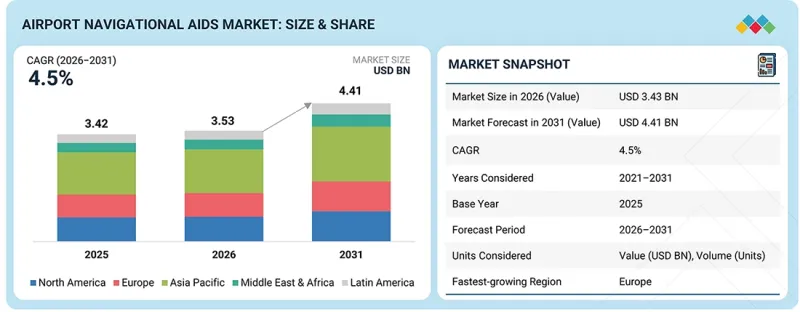
세계의 공항 항행 보조 시설 시장 규모는 2026년에 35억 3,000만 달러로 추정되며, 2026년부터 2031년까지 CAGR 4.5%로 확대되어 2031년에는 44억 1,000만 달러에 달할 것으로 예측됩니다.
공항 인프라 및 항공 교통 관리 시스템에 대한 투자가 증가함에 따라, 시장은 예측 기간 동안 꾸준히 성장할 것으로 전망됩니다. 많은 국가에서 공항 확장 프로젝트가 늘어나고 있으며, 이는 첨단 항법 솔루션에 대한 수요를 뒷받침하고 있습니다. 또한, 기존 공항의 현대화 프로그램도 시장 성장에 기여하고 있습니다.
| 조사 범위 | |
|---|---|
| 조사 대상 기간 | 2020-2031년 |
| 기준 연도 | 2025년 |
| 예측 기간 | 2026-2031년 |
| 단위 | 금액(달러) |
| 부문 | 기술, 도입 형태, 최종사용자, 지역별 |
| 대상 지역 | 북미, 유럽, 아시아태평양, 기타 지역 |
시장의 주요 동향 중 하나는 항공기 안전성을 높이기 위해 노후화된 항행 보조 장비를 새로운 시스템으로 교체하는 추세입니다. 공항에서는 시야 불량이나 악천후 시의 운용 성능 향상을 위한 노력이 진행되고 있습니다. 또한, 항공 당국도 증가하는 항공 교통량을 보다 수월하게 관리할 수 있도록 하는 기술에 투자하고 있습니다.
"최종사용자별로는 버티포트 및 AAM 착륙 시설 부문이 예측 기간 동안 가장 높은 연평균 성장률(CAGR)을 기록할 것으로 전망됩니다."
이 부문은 첨단 항공 모빌리티(AAM) 인프라에 대한 투자 확대와 도시 항공 운송 네트워크 구축에 힘입어 성장세를 보이고 있습니다. eVTOL 항공기의 도입 확대에 따라, 버티포트 시설 내 전용 비행·착륙 시스템에 대한 수요가 발생하고 있습니다. 정부, 공항 운영사, 모빌리티 제공업체 역시 미래 항공 모빌리티 운항을 지원하기 위해 차세대 항공 인프라에 대한 투자를 추진하고 있습니다.
"거리 측정 장치(DME) 유형별로는, ILS/VOR 연계형 DME 부문이 예측 기간 동안 가장 높은 연평균 성장률(CAGR)을 기록할 것으로 전망됩니다."
이 부문은 항공기의 위치 측정 및 접근 유도 정확도 향상을 목적으로 공항에서 항행 지원 인프라를 업데이트함에 따라 도입이 확대되고 있습니다. DME는 ILS 및 초단파(VHF) 전방향 무선비콘(VOR) 시스템과 연동하여 보다 정확한 항법을 제공합니다. 공항 현대화 프로그램의 확대와 더불어, 신뢰성 높은 항행 솔루션에 대한 수요가 증가하고 있는 것이 이 부문의 성장을 뒷받침하고 있습니다.
"아시아태평양이 2025년에 가장 큰 시장 점유율을 차지했습니다."
2025년, 아시아태평양은 공항 항행 지원 시설 시장에서 가장 큰 점유율을 차지했습니다. 이 지역은 대규모 공항 네트워크를 갖추고 있으며, 상업용 항공 시설의 항공 교통량도 많다는 점이 강점으로 꼽힙니다. 공항 운영사는 비행 안전성을 높이기 위해 항행 지원 시스템의 업그레이드를 지속적으로 진행하고 있습니다. 또한, 항공 당국도 공항 인프라 현대화 프로젝트에 투자하고 있습니다. 해당 지역 전체적으로 볼 때, 첨단 항법 지원 기술의 도입률은 여전히 높은 수준을 유지하고 있습니다. 이러한 추세가 견조한 시장 수요 유지에 기여하고 있습니다.
본 보고서에서는 전 세계 공항 항행 보조 시설 시장을 조사하여, 시장 개요, 시장 성장에 영향을 미치는 다양한 요인에 대한 분석, 기술 및 특허 동향, 법규제 환경, 사례 연구, 시장 규모 추정 및 전망, 각종 분류·지역/주요 국가별 상세 분석, 경쟁 현황, 주요 기업 개요 등을 정리하고 있습니다.
자주 묻는 질문
목차
제1장 소개
제2장 주요 요약
제3장 주요 인사이트
제4장 시장 개요
제5장 업계 동향
제6장 규제 상황과 지속가능성에 대한 대처
제7장 고객 상황과 구매 행동
제8장 공항 항행 보조 시설 시장 : 기술별
제9장 공항 항행 보조 시설 시장 : 도입 형태별
제10장 공항 항행 보조 시설 시장 : 최종사용자별
제11장 공항 항행 보조 시설 시장 : 지역별
제12장 경쟁 구도
제13장 기업 개요
제14장 조사 방법
제15장 부록
KSM 26.07.20The global airport navigational aids market is estimated at USD 3.53 billion in 2026 and is projected to reach USD 4.41 billion by 2031 at a CAGR of 4.5% from 2026 to 2031. The market is expected to grow steadily during the forecast period due to rising investments in airport infrastructure plus air traffic management systems. Airport expansion projects are increasing across many countries, which is supporting demand for advanced navigation solutions. Modernization programs at existing airports are also contributing to market growth.
| Scope of the Report | |
|---|---|
| Years Considered for the Study | 2020-2031 |
| Base Year | 2025 |
| Forecast Period | 2026-2031 |
| Units Considered | Value (USD Billion) |
| Segments | By Technology, Deployment, End User and Region |
| Regions covered | North America, Europe, APAC, RoW |
One of the major trends in the market is replacing aging navigation equipment with newer systems to improve aircraft safety. Airports are making efforts to improve performance in low-visibility and adverse weather conditions. Aviation authorities are also investing in technologies that facilitate the management of increasing air traffic volumes.
"By end user, the vertiports & AAM landing facilities segment is projected to grow at the highest CAGR [SC1.1]during the forecast period."
The segment is gaining momentum due to increasing investments in advanced air mobility (AAM) infrastructure and the development of urban air transportation networks. Growing deployment of eVTOL aircraft is creating demand for dedicated navigation and landing systems at vertiport facilities. Governments, airport operators, and mobility providers are also investing in next-generation aviation infrastructure to support future air mobility operations.
"By distance measuring equipment (DME), the ILS/VOR associated DME segment is projected to grow [SC2.1]at the highest CAGR during the forecast period."
The segment is witnessing higher adoption as airports upgrade navigation infrastructure to improve aircraft positioning and approach guidance. DME works with ILS plus very high frequency (VHF) omnidirectional range (VOR) systems to provide more accurate navigation. Growing airport modernization programs, along with the need for reliable navigation solutions, are supporting the growth of this segment.
"The Asia Pacific region captured the largest market share in 2025."[SC3.1]
The Asia Pacific region held the largest share of the airport navigational aids market in 2025. The region benefits from a large airport network and high aircraft traffic across commercial aviation facilities. Airport operators continue upgrading navigation systems to improve flight safety. Aviation authorities are also investing in airport infrastructure modernization projects. Adoption of advanced navigational aid technologies remains high across the region. These developments are helping maintain strong market demand.
The breakdown of profiles for primary participants in the airport navigational aids market is provided below:
- By Company Type: Tier 1 - 35%, Tier 2 - 45%, and Tier 3 - 20%
- By Designation: C Level - 35%, Director Level - 25%, and Others - 40%
- By Region: North America - 25%, Europe - 15%, Asia Pacific - 45%, Middle East - 10%, and Rest of the World (RoW) - 5%
Research Coverage:
This market study examines the airport navigational aids market across various segments and subsegments. It aims to estimate the market's size and growth potential in different regions. The study also provides a detailed competitive analysis of key market players, including their company profiles, product offerings, recent developments, and strategic market initiatives.
Reasons to buy this report:
The report will assist market leaders and new entrants with estimates of the revenue figures for the overall airport navigational aids market. It will also enable stakeholders to understand the competitive landscape better and gain insights to position their businesses more effectively and develop appropriate go-to-market strategies. Additionally, the report will help stakeholders understand the market dynamics and provide information on key market drivers, restraints, challenges, and opportunities.
The report provides insights into the following pointers:
- Market Drivers (increase in low-visibility operations as a quantified demand mechanism for airport navigation aids), restraints (limited capital availability and infrastructure funding constraints at regional airports hampering the growth of airport navigational aids), opportunities (expansion of GNSS-based navigation systems leading to opportunities for growth), challenges (cybersecurity escalation in airport navigational aids and navigation systems)
- Market Penetration: Comprehensive information on the airport navigational aids market offered by the top players in the market
- Product Development/Innovation: Detailed insights into upcoming technologies, research & development activities, and product launches in the airport navigational aids market
- Market Development: Comprehensive information about lucrative markets across varied regions
- Market Diversification: Exhaustive information about new products, untapped geographies, recent developments, and investments in the airport navigational aids market
- Competitive Assessment: In-depth assessment of market share, growth strategies, products, and manufacturing capabilities of leading players in the airport navigational aids market
TABLE OF CONTENTS
1 INTRODUCTION
- 1.1 STUDY OBJECTIVES
- 1.2 MARKET DEFINITION
- 1.3 STUDY SCOPE
- 1.3.1 MARKET SEGMENTATION AND REGIONS COVERED
- 1.3.2 INCLUSIONS AND EXCLUSIONS
- 1.3.3 YEARS CONSIDERED
- 1.4 CURRENCY CONSIDERED
- 1.5 STAKEHOLDERS
- 1.6 SUMMARY OF CHANGES
2 EXECUTIVE SUMMARY
- 2.1 KEY INSIGHTS AND MARKET HIGHLIGHTS
- 2.2 KEY MARKET PARTICIPANTS: MAPPING OF STRATEGIC DEVELOPMENTS
- 2.3 DISRUPTIVE TRENDS SHAPING MARKET
- 2.4 HIGH GROWTH SEGMENTS
- 2.5 REGIONAL SNAPSHOT: MARKET SIZE, GROWTH RATE, AND FORECAST
3 PREMIUM INSIGHTS
- 3.1 ATTRACTIVE OPPORTUNITIES FOR PLAYERS IN AIRPORT NAVIGATIONAL AIDS MARKET
- 3.2 AIRPORT NAVIGATIONAL AIDS MARKET, BY DISTANCE MEASURING EQUIPMENT (DME)
- 3.3 AIRPORT NAVIGATIONAL AIDS MARKET, BY VISUAL LANDING AIDS (VLA)
- 3.4 AIRPORT NAVIGATIONAL AIDS MARKET, BY END USER
- 3.5 AIRPORT NAVIGATIONAL AIDS MARKET, BY TECHNOLOGY
4 MARKET OVERVIEW
- 4.1 INTRODUCTION
- 4.2 MARKET DYNAMICS
- 4.2.1 DRIVERS
- 4.2.1.1 Aviation regulatory compliance requirements driving modernization of airport navigational aid infrastructure
- 4.2.1.2 Growth in international air connectivity leading to growing adoption of advanced airport NAVAIDs
- 4.2.2 RESTRAINTS
- 4.2.2.1 Limited capital availability and infrastructure funding constraints at regional airports
- 4.2.2.2 Lengthy regulatory approval processes
- 4.2.2.3 Space and infrastructure constraints limiting deployment of airport NAVAIDs
- 4.2.3 OPPORTUNITIES
- 4.2.3.1 Expansion of GNSS-based navigation systems
- 4.2.3.2 Emerging airport projects driving NAVAIDS procurement and integration
- 4.2.4 CHALLENGES
- 4.2.4.1 Interoperability challenges in legacy-satellite NAVAID integration
- 4.2.4.2 Cybersecurity escalation in airport NAVAIDs and navigation systems
- 4.2.4.3 Navigation precision challenges in congested airspace
- 4.2.1 DRIVERS
- 4.3 UNMET NEEDS AND WHITE SPACE
- 4.3.1 FRAGMENTED TRANSITION BETWEEN LEGACY AND SATELLITE-BASED NAVIGATION INFRASTRUCTURE
- 4.3.2 LIMITED CYBER-RESILIENT DATA EXCHANGE AND NAVIGATION ASSURANCE CAPABILITIES
- 4.3.3 ABSENCE OF STANDARDIZED NAVIGATIONAL AID INTEGRATION FOR REGIONAL AND SECONDARY AIRPORTS
- 4.4 INTERCONNECTED MARKETS AND CROSS-SECTOR OPPORTUNITIES
- 4.4.1 INTEGRATION WITH SMART AIRPORT AND AIR TRAFFIC MANAGEMENT SYSTEMS
- 4.4.2 CROSS-SECTOR OPPORTUNITIES WITH SURVEILLANCE AND SATELLITE NAVIGATION
- 4.5 STRATEGIC MOVES BY TIER 1/2/3 PLAYERS
5 INDUSTRY TRENDS
- 5.1 INTRODUCTION
- 5.2 MACROECONOMIC OUTLOOK
- 5.2.1 INTRODUCTION
- 5.2.2 GDP TRENDS AND FORECAST
- 5.2.3 TRENDS IN GLOBAL AVIATION INDUSTRY
- 5.2.4 TRENDS IN GLOBAL AIRPORT NAVIGATIONAL AIDS INDUSTRY
- 5.3 VALUE CHAIN ANALYSIS
- 5.3.1 R&D ENGINEERS AND TECHNOLOGY DEVELOPERS (UP TO 30%)
- 5.3.2 COMPONENT AND SUBSYSTEM SUPPLIERS (30-40%)
- 5.3.3 NAVIGATION SYSTEM MANUFACTURERS AND OEMS (40-50%)
- 5.3.4 SYSTEM INTEGRATORS, INSTALLATION, AND COMMISSIONING PROVIDERS (50-80%)
- 5.3.5 AIRPORT OPERATORS, ANSPS, AND AFTERMARKET SERVICE PROVIDERS (80-100%)
- 5.4 ECOSYSTEM ANALYSIS
- 5.4.1 MANUFACTURERS
- 5.4.2 SOLUTION AND SERVICE PROVIDERS
- 5.4.3 END USERS
- 5.5 INVESTMENT AND FUNDING SCENARIO
- 5.6 PRICING ANALYSIS
- 5.6.1 INDICATIVE PRICING ANALYSIS, BY TECHNOLOGY (2025)
- 5.6.2 INDICATIVE PRICING ANALYSIS, BY INSTRUMENT LANDING SYSTEMS (ILS), 2025
- 5.6.3 INDICATIVE PRICING BY DISTANCE MEASURING EQUIPMENT (DME), 2025
- 5.6.4 INDICATIVE PRICING BY DISTANCE MEASURING EQUIPMENT (DME), 2025
- 5.6.5 INDICATIVE PRICING BY VHF OMNIDIRECTIONAL RANGE (VOR), 2025
- 5.6.6 INDICATIVE PRICING BY VISUAL LANDING AIDS (VLA), 2025
- 5.7 TRADE ANALYSIS
- 5.7.1 IMPORT SCENARIO (HS CODE 852691)
- 5.7.2 EXPORT SCENARIO (HS CODE 852691)
- 5.8 KEY CONFERENCES AND EVENTS
- 5.9 TRENDS AND DISRUPTIONS IMPACTING CUSTOMER BUSINESS
- 5.10 CASE STUDY ANALYSIS
- 5.10.1 THALES: ILS MODERNIZATION FOR IMPROVED APPROACH SAFETY
- 5.10.2 INDRA: DVOR/DME MODERNIZATION FOR AIRSPACE EFFICIENCY
- 5.10.3 ADB SAFEGATE: REMOTE MONITORING AND PREDICTIVE MAINTENANCE OF NAVIGATIONAL AIDS
- 5.10.4 NORMARC: ILS DEPLOYMENT FOR REGIONAL AIRPORT MODERNIZATION
- 5.11 IMPACT OF 2025 US TARIFFS
- 5.11.1 INTRODUCTION
- 5.11.2 KEY TARIFF RATES
- 5.11.3 PRICE IMPACT ANALYSIS
- 5.11.4 IMPACT ON COUNTRY/REGION
- 5.11.4.1 US
- 5.11.4.2 Europe
- 5.11.4.3 Asia Pacific
- 5.11.5 IMPACT ON DIFFERENT APPLICATIONS
- 5.11.5.1 Commercial airports
- 5.11.5.2 Military airfield and defense aviation facilities
6 REGULATORY LANDSCAPE AND SUSTAINABILITY INITIATIVES
- 6.1 REGIONAL REGULATIONS AND COMPLIANCE
- 6.1.1 REGULATORY BODIES, GOVERNMENT AGENCIES, AND OTHER ORGANIZATIONS
- 6.1.2 INDUSTRY STANDARDS
- 6.2 SUSTAINABILITY INITIATIVES
- 6.2.1 ECO-APPLICATIONS
- 6.3 SUSTAINABILITY IMPACT AND REGULATORY POLICY INITIATIVES
- 6.3.1 SUSTAINABILITY IMPACT ON AIRPORT NAVIGATIONAL AIDS MARKET
- 6.3.2 REGULATORY POLICIES DRIVING AIRPORT NAVIGATIONAL AIDS DEPLOYMENT
- 6.4 CERTIFICATIONS, LABELING, AND ECO-STANDARDS
7 CUSTOMER LANDSCAPE AND BUYING BEHAVIOR
- 7.1 DECISION-MAKING PROCESS
- 7.2 BUYER STAKEHOLDERS AND BUYING EVALUATION CRITERIA
- 7.2.1 KEY STAKEHOLDERS IN BUYING PROCESS
- 7.2.2 BUYING CRITERIA
- 7.3 ADOPTION BARRIERS AND INTERNAL CHALLENGES
- 7.4 UNMET NEEDS FROM VARIOUS END USES
- 7.4.1 NEED FOR ADVANCED OPERATIONAL EFFICIENCY AND SAFETY OPTIMIZATION
- 7.4.2 NEED FOR INTEROPERABLE AND MODERNIZED AIRSPACE INFRASTRUCTURE
- 7.4.3 NEED FOR SCALABLE DIGITAL AND CYBER-RESILIENT NAVIGATION SYSTEMS
8 AIRPORT NAVIGATIONAL AIDS MARKET, BY TECHNOLOGY (MARKET SIZE & FORECAST TO 2031 - USD MILLION)
- 8.1 INTRODUCTION
- 8.2 INSTRUMENT LANDING SYSTEMS (ILS)
- 8.2.1 INCREASING DEMAND FOR SAFE AIRCRAFT OPERATIONS UNDER LOW-VISIBILITY CONDITIONS TO DRIVE GROWTH
- 8.2.2 USE CASE: ILS FOR PRECISION AIRCRAFT APPROACH AND LANDING
- 8.2.3 CATEGORY I
- 8.2.4 CATEGORY II
- 8.2.5 CATEGORY III
- 8.3 DISTANCE MEASURING EQUIPMENT (DME)
- 8.3.1 INCREASING DEMAND FOR ACCURATE AIRCRAFT POSITIONING AND RESILIENT NAVIGATION INFRASTRUCTURE TO DRIVE GROWTH
- 8.3.2 NORMARC DME BY INDRA FOR PERFORMANCE-BASED NAVIGATION OPERATIONS
- 8.3.3 STANDALONE DME
- 8.3.4 ILS/VOR ASSOCIATED DME
- 8.4 VHF OMNIDIRECTIONAL RANGE (VOR)
- 8.4.1 USE CASE: DVOR 2000 BY THALES FOR AIR ROUTE AND TERMINAL NAVIGATION
- 8.4.2 CONVENTIONAL VOR
- 8.4.3 DOPPLER VOR (DVOR)
- 8.5 NON-DIRECTIONAL BEACONS (NDBS)
- 8.5.1 INCREASING NEED FOR BACKUP NAVIGATION SYSTEMS AND COST-EFFECTIVE AIRPORT NAVIGATION INFRASTRUCTURE TO DRIVE GROWTH
- 8.5.2 USE CASE: NDB NAVIGATION SOLUTION BY INDRA FOR REGIONAL AIRPORT OPERATIONS
- 8.6 GROUND-BASED AUGMENTATION SYSTEMS (GBAS) / GBAS LANDING SYSTEMS (GLS)
- 8.6.1 INCREASING DEMAND FOR SATELLITE-BASED PRECISION APPROACH CAPABILITIES TO DRIVE GROWTH
- 8.6.2 USE CASE: SMARTPATH GBAS BY HONEYWELL FOR MULTI-RUNWAY PRECISION LANDING OPERATIONS
- 8.7 VISUAL LANDING AIDS (VLA)
- 8.7.1 INCREASING EMPHASIS ON RUNWAY SAFETY AND PILOT SITUATIONAL AWARENESS TO DRIVE GROWTH
- 8.7.2 USE CASE: SAFELED PAPI SYSTEM BY ADB SAFEGATE FOR PRECISION VISUAL APPROACH GUIDANCE
- 8.7.3 APPROACH LIGHTING SYSTEMS (ALS)
- 8.7.4 VISUAL APPROACH SLOPE INDICATOR (VASI) SYSTEMS
- 8.7.5 RUNWAY GUIDANCE & IDENTIFICATION LIGHTS
- 8.7.6 AERODROME BEACONS & VISUAL NAVIGATION MARKERS
- 8.7.7 HELIPORT & VERTIPORT VISUAL LANDING AIDS
- 8.8 TACTICAL AIR NAVIGATION (TACAN) SYSTEMS
- 8.8.1 INCREASING REQUIREMENT FOR RELIABLE MILITARY NAVIGATION AND TACTICAL AIR OPERATIONS TO DRIVE GROWTH
- 8.8.2 USE CASE: TACAN 2110 BY THALES FOR MILITARY AIRBASE NAVIGATION OPERATIONS
- 8.9 OTHERS
- 8.9.1 USE CASE: MICROWAVE LANDING SYSTEM (MLS) BY THALES FOR FLEXIBLE PRECISION APPROACH OPERATIONS
9 AIRPORT NAVIGATIONAL AIDS MARKET, BY DEPLOYMENT (MARKET SIZE & FORECAST TO 2031-USD MILLION)
- 9.1 INTRODUCTION
- 9.2 NEW INSTALLATION
- 9.2.1 GROWING AIRPORT INFRASTRUCTURE EXPANSION AND GREENFIELD AIRPORT DEVELOPMENT TO DRIVE GROWTH
- 9.2.2 USE CASE: INDRA NAVIGATION SYSTEMS DEPLOYMENT FOR GREENFIELD AIRPORT DEVELOPMENT
- 9.3 REPLACEMENT, UPGRADE & MODERNIZATION
- 9.3.1 AGING NAVIGATION INFRASTRUCTURE AND AIRPORT DIGITALIZATION INITIATIVES TO DRIVE GROWTH
- 9.3.2 USE CASE: THALES ILS MODERNIZATION PROGRAM
10 AIRPORT NAVIGATIONAL AIDS MARKET, BY END USER (MARKET SIZE & FORECAST TO 2031-USD MILLION)
- 10.1 INTRODUCTION
- 10.2 COMMERCIAL SERVICE AIRPORTS
- 10.2.1 GROWING PASSENGER TRAFFIC AND AIRPORT MODERNIZATION INVESTMENTS TO DRIVE GROWTH
- 10.2.2 USE CASE: THALES ILS AT MAJOR INTERNATIONAL AIRPORTS
- 10.3 MILITARY AIRBASES & DEFENSE AIRPORTS
- 10.3.1 DEFENSE MODERNIZATION PROGRAMS AND INCREASING DEMAND FOR RESILIENT NAVIGATION INFRASTRUCTURE TO DRIVE GROWTH
- 10.3.2 USE CASE: TACAN 2110 BY THALES FOR MILITARY AIRBASE OPERATIONS
- 10.4 GENERAL AVIATION AIRPORTS & AERODROMES
- 10.4.1 GROWING GENERAL AVIATION ACTIVITY AND REGIONAL AIR CONNECTIVITY INVESTMENTS TO DRIVE GROWTH
- 10.4.2 USE CASE: DVOR 2000 BY THALES FOR REGIONAL AIRPORT NAVIGATION
- 10.5 HELIPORTS & HELIPADS
- 10.5.1 GROWING DEMAND FOR EMERGENCY RESPONSE, OFFSHORE OPERATIONS, AND URBAN HELICOPTER SERVICES TO DRIVE GROWTH
- 10.5.2 USE CASE: HELIPORT LIGHTING SYSTEM BY TKH AIRPORT SOLUTIONS FOR HOSPITAL EMERGENCY OPERATIONS
- 10.6 VERTIPORTS & ADVANCED AIR MOBILITY (AAM) LANDING FACILITIES
- 10.6.1 RAPID DEVELOPMENT OF URBAN AIR MOBILITY ECOSYSTEMS TO DRIVE GROWTH
- 10.6.2 USE CASE: VERTIPORT NAVIGATION INFRASTRUCTURE BY SKYPORTS INFRASTRUCTURE
11 AIRPORT NAVIGATIONAL AIDS MARKET, BY REGION (MARKET SIZE & FORECAST TO 2031 - USD MILLION)
- 11.1 INTRODUCTION
- 11.2 NORTH AMERICA
- 11.2.1 US
- 11.2.1.1 Overview
- 11.2.1.2 Growing need for replacement of aging airport infrastructure to drive market
- 11.2.1.3 Use case: Honeywell's SmartPath GBAS-enabled airport navigation system at Newark Liberty International Airport (2025)
- 11.2.2 CANADA
- 11.2.2.1 Overview
- 11.2.2.2 Harsh weather and low-visibility operations to drive demand
- 11.2.2.3 Use case: Deployment of GNSS-based LPV approaches enabled by wide area augmentation system (WAAS)
- 11.2.1 US
- 11.3 EUROPE
- 11.3.1 UK
- 11.3.1.1 Overview
- 11.3.1.2 Public funding for regional airports to drive market
- 11.3.1.3 Use Case: Deployment of UK SBAS developed by Viasat at Cranfield Airport for GNSS-based approach procedures
- 11.3.2 GERMANY
- 11.3.2.1 Overview
- 11.3.2.2 Shift from conventional ground-based navigation infrastructure toward satellite-enabled systems to drive market
- 11.3.2.3 Use case: Implementation of ground-based augmentation system (G-BAS) by Indra for airport navigational aids at Frankfurt Airport, Germany
- 11.3.3 FRANCE
- 11.3.3.1 Overview
- 11.3.3.2 Growing compliance with European safety mandates to drive market
- 11.3.3.3 Use case: Deployment of EGNOS by Thales for airport navigational aids in France
- 11.3.4 SWEDEN
- 11.3.4.1 Overview
- 11.3.4.2 Increasing airport infrastructure modernization and air traffic recovery to drive market
- 11.3.4.3 Use case: Advanced Surface Movement Guidance and Control System (A-SMGCS) by Saab
- 11.3.5 ITALY
- 11.3.5.1 Overview
- 11.3.5.2 Growth in air cargo and e-commerce to drive investment in advanced navigation technologies
- 11.3.5.3 Use case: Modernization of airport navigation infrastructure in Italy through Thales-ENAV integration
- 11.3.6 SPAIN
- 11.3.6.1 Overview
- 11.3.6.2 Rising airport capacity expansion and modernization programs to drive market
- 11.3.6.3 Use case: ILS by Indra
- 11.3.7 REST OF EUROPE
- 11.3.7.1 Overview
- 11.3.7.2 Use case: GBAS and ILS modernization at regional airports in Nordic-Baltic Europe by Thales
- 11.3.1 UK
- 11.4 ASIA PACIFIC
- 11.4.1 CHINA
- 11.4.1.1 Overview
- 11.4.1.2 Domestic GNSS integration to drive modernization of airport navigational aids infrastructure
- 11.4.1.3 Use case: Upgrade of DVOR/DME and ILS at Hanzhong Chenggu Airport
- 11.4.2 INDIA
- 11.4.2.1 Overview
- 11.4.2.2 Expansion of airport capacity, construction of new terminals and runways, and development of greenfield airports to drive market
- 11.4.2.3 Use case: Deployment of ILS and DVOR systems provided by Indra for all-weather operations at Indian airports
- 11.4.3 JAPAN
- 11.4.3.1 Overview
- 11.4.3.2 Modernization efforts aligned with broader objective of improving operational resilience to drive market
- 11.4.3.3 Use case: Implementation of advanced ILS provided by Thales to support precision approaches in high-traffic Japanese airports
- 11.4.4 SOUTH KOREA
- 11.4.4.1 Overview
- 11.4.4.2 Low-visibility operational requirements to drive demand
- 11.4.4.3 Use case: Deployment of integrated instrument landing systems provided by Indra at Incheon International Airport, South Korea
- 11.4.5 AUSTRALIA
- 11.4.5.1 Overview
- 11.4.5.2 Shift to satellite-based navigation systems to drive demand
- 11.4.5.3 Use case: Deployment of ILS and NDB Systems provided by Indra across Australian airfields
- 11.4.6 REST OF ASIA PACIFIC
- 11.4.6.1 Overview
- 11.4.6.2 Use case: Deployment of scalable ILS provided by Thales and Indra for airport modernization in Southeast Asia
- 11.4.1 CHINA
- 11.5 MIDDLE EAST & AFRICA
- 11.5.1 UAE
- 11.5.1.1 Overview
- 11.5.1.2 Air traffic expansion to increase demand for airport navigational aids
- 11.5.1.3 Use case: Precision landing system upgrades at UAE's international airports supported by Indra
- 11.5.2 SAUDI ARABIA
- 11.5.2.1 Overview
- 11.5.2.2 Technological upgrades and modernization of airports to increase demand
- 11.5.2.3 Use case: Deployment of time based and instrument landing navigation systems provided by Thales in Saudi airports
- 11.5.3 SOUTH AFRICA
- 11.5.3.1 Overview
- 11.5.3.2 Air traffic growth and airport modernization to drive demand
- 11.5.3.3 Use case: PBN deployment to improve airport operations in South Africa
- 11.5.4 REST OF MIDDLE EAST & AFRICA
- 11.5.4.1 Overview
- 11.5.4.2 Use case: GNSS-based PBN deployment across Middle East and African airports
- 11.5.1 UAE
- 11.6 LATIN AMERICA
- 11.6.1 BRAZIL
- 11.6.1.1 Overview
- 11.6.1.2 Government initiatives to improve regional connectivity and expanding airport infrastructure to drive market
- 11.6.1.3 Use case: Deployment of ILS provided by Thales in Brazilian airports
- 11.6.2 MEXICO
- 11.6.2.1 Overview
- 11.6.2.2 FAA Category 1 restoration to accelerate investment in airport navigation infrastructure
- 11.6.2.3 Use case: Drone-based navigation aid verification for Mexican airports delivered by Colibrex (LS Telecom)
- 11.6.3 ARGENTINA
- 11.6.3.1 Overview
- 11.6.3.2 Airport modernization programs to drive demand for advanced navigation systems
- 11.6.3.3 Use case: GNSS-based navigation implementation for enhanced flight operations at Argentine airports
- 11.6.4 REST OF LATIN AMERICA
- 11.6.4.1 Overview
- 11.6.4.2 Use case: Airport navigational aid modernization in Chile by Indra
- 11.6.1 BRAZIL
12 COMPETITIVE LANDSCAPE
- 12.1 INTRODUCTION
- 12.2 KEY PLAYER STRATEGIES/RIGHT TO WIN, 2021-2026
- 12.3 REVENUE ANALYSIS, 2021-2025
- 12.4 MARKET SHARE ANALYSIS, 2025
- 12.5 BRAND/PRODUCT COMPARISON
- 12.6 COMPANY VALUATION AND FINANCIAL METRICS
- 12.7 COMPANY EVALUATION MATRIX: KEY PLAYERS, 2025
- 12.7.1 STARS
- 12.7.2 EMERGING LEADERS
- 12.7.3 PERVASIVE PLAYERS
- 12.7.4 PARTICIPANTS
- 12.7.5 COMPANY FOOTPRINT, KEY PLAYERS, 2025
- 12.7.5.1 Company footprint
- 12.7.5.2 Region footprint
- 12.7.5.3 Deployment footprint
- 12.8 COMPANY EVALUATION MATRIX: STARTUPS/SMES, 2025
- 12.8.1 PROGRESSIVE COMPANIES
- 12.8.2 RESPONSIVE COMPANIES
- 12.8.3 DYNAMIC COMPANIES
- 12.8.4 STARTING BLOCKS
- 12.8.5 COMPETITIVE BENCHMARKING: STARTUPS/SMES, 2025
- 12.8.5.1 List of startups/SMEs
- 12.8.5.2 Competitive benchmarking of startups/SMEs
- 12.9 COMPETITIVE SCENARIO
- 12.9.1 PRODUCT LAUNCHES/DEVELOPMENTS
- 12.9.2 DEALS
- 12.9.3 OTHER DEVELOPMENTS
13 COMPANY PROFILES
- 13.1 KEY PLAYERS
- 13.1.1 THALES
- 13.1.1.1 Business overview
- 13.1.1.2 Products/ Solutions/ Services offered
- 13.1.1.3 Recent developments
- 13.1.1.3.1 Deals
- 13.1.1.3.2 Other developments
- 13.1.1.4 MnM view
- 13.1.1.4.1 Right to win
- 13.1.1.4.2 Strategic choices
- 13.1.1.4.3 Weaknesses and competitive threats
- 13.1.2 INDRA
- 13.1.2.1 Business overview
- 13.1.2.2 Products/ Solutions/ Services offered
- 13.1.2.3 Recent developments
- 13.1.2.3.1 Product announcements
- 13.1.2.3.2 Deals
- 13.1.2.3.3 Other developments
- 13.1.2.3.4 Expansions
- 13.1.2.4 MnM view
- 13.1.2.4.1 Right to win
- 13.1.2.4.2 Strategic choices
- 13.1.2.4.3 Weaknesses and competitive threats
- 13.1.3 HONEYWELL INTERNATIONAL INC.
- 13.1.3.1 Business overview
- 13.1.3.2 Products/ Solutions/ Services offered
- 13.1.3.3 Recent developments
- 13.1.3.3.1 Product announcements
- 13.1.3.3.2 Deals
- 13.1.3.4 MnM view
- 13.1.3.4.1 Right to win
- 13.1.3.4.2 Strategic choices
- 13.1.3.4.3 Weaknesses and competitive threats
- 13.1.4 LEONARDO S.P.A
- 13.1.4.1 Business overview
- 13.1.4.2 Products/ Solutions/ Services offered
- 13.1.4.3 Recent developments
- 13.1.4.3.1 Deals
- 13.1.4.3.2 Other developments
- 13.1.4.4 MnM view
- 13.1.4.4.1 Right to win
- 13.1.4.4.2 Strategic choices
- 13.1.4.4.3 Weaknesses and competitive threats
- 13.1.5 SAAB AB
- 13.1.5.1 Business overview
- 13.1.5.2 Products/ Solutions/ Services offered
- 13.1.5.3 Recent developments
- 13.1.5.3.1 Deals
- 13.1.5.4 MnM view
- 13.1.5.4.1 Right to win
- 13.1.5.4.2 Strategic choices
- 13.1.5.4.3 Weaknesses and competitive threats
- 13.1.6 RADIOLA
- 13.1.6.1 Business overview
- 13.1.6.2 Products/ Solutions/ Services offered
- 13.1.6.3 Recent developments
- 13.1.6.3.1 Other developments
- 13.1.7 NAUTEL
- 13.1.7.1 Business overview
- 13.1.7.2 Products/ Solutions/ Services offered
- 13.1.8 IACIT
- 13.1.8.1 Business overview
- 13.1.8.2 Products/ Solutions/ Services offered
- 13.1.9 BECKER AVIONICS EAST EUROPE S.R.O
- 13.1.9.1 Business overview
- 13.1.9.2 Products/ Solutions/ Services offered
- 13.1.9.3 Recent developments
- 13.1.9.3.1 Product enhancements
- 13.1.9.3.2 Other developments
- 13.1.10 AVINEERING
- 13.1.10.1 Business overview
- 13.1.10.2 Products/ Solutions/ Services offered
- 13.1.10.3 Recent developments
- 13.1.10.3.1 Product announcements
- 13.1.10.3.2 Deals
- 13.1.10.3.3 Other developments
- 13.1.11 BHARAT ELECTRONICS LIMITED
- 13.1.11.1 Business overview
- 13.1.11.2 Products/ Solutions/ Services offered
- 13.1.12 NEC CORPORATION
- 13.1.12.1 Business overview
- 13.1.12.2 Products/ Solutions/ Services offered
- 13.1.12.3 Recent developments
- 13.1.12.3.1 Product announcements
- 13.1.13 SYSTEMS INTERFACE LIMITED
- 13.1.13.1 Business overview
- 13.1.13.2 Products/ Solutions/ Services offered
- 13.1.13.3 Recent developments
- 13.1.13.3.1 Deals
- 13.1.13.3.2 Other developments
- 13.1.14 APPROACH NAVIGATION SYSTEMS INC.
- 13.1.14.1 Business overview
- 13.1.14.2 Products/ Solutions/ Services offered
- 13.1.14.3 Recent developments
- 13.1.14.3.1 Product announcements
- 13.1.15 RTX
- 13.1.15.1 Business overview
- 13.1.15.2 Products/ Solutions/ Services offered
- 13.1.15.3 Recent developments
- 13.1.15.3.1 Other developments
- 13.1.16 INTELCAN TECHNOSYSTEMS INC.
- 13.1.16.1 Business overview
- 13.1.16.2 Products/ Solutions/ Services offered
- 13.1.16.3 Recent developments
- 13.1.16.3.1 Product approvals/announcements
- 13.1.16.3.2 Deals
- 13.1.16.3.3 Other developments
- 13.1.17 GECI GROUP
- 13.1.17.1 Business overview
- 13.1.17.2 Products/ Solutions/ Services offered
- 13.1.17.3 Recent developments
- 13.1.17.3.1 Other developments
- 13.1.18 ASELSAN A.S.
- 13.1.18.1 Business overview
- 13.1.18.2 Products/ Solutions/ Services offered
- 13.1.19 MOPIENS, INC.
- 13.1.19.1 Business overview
- 13.1.19.2 Products/ Solutions/ Services offered
- 13.1.20 ADVANCED NAVIGATION AND POSITIONING CORPORATION
- 13.1.20.1 Business overview
- 13.1.20.2 Products/ Solutions/ Services offered
- 13.1.20.3 Recent developments
- 13.1.20.3.1 Deals
- 13.1.20.3.2 Other developments
- 13.1.21 ADB SAFEGATE
- 13.1.21.1 Business overview
- 13.1.21.2 Products/ Solutions/ Services offered
- 13.1.21.3 Recent developments
- 13.1.21.3.1 Product announcements/launches
- 13.1.21.3.2 Deals
- 13.1.21.3.3 Other developments
- 13.1.22 ERA A.S.
- 13.1.22.1 Business overview
- 13.1.22.2 Products/ Solutions/ Services offered
- 13.1.22.3 Recent developments
- 13.1.22.3.1 Other developments
- 13.1.23 L3HARRIS TECHNOLOGIES, INC.
- 13.1.23.1 Business overview
- 13.1.23.2 Products/ Solutions/ Services offered
- 13.1.23.3 Recent developments
- 13.1.23.3.1 Other developments
- 13.1.24 TIANJIN 764 COMMUNICATION AND NAVIGATION TECHNOLOGY CO. LTD.
- 13.1.24.1 Business overview
- 13.1.24.2 Products/ Solutions/ Services offered
- 13.1.25 RHODE & SHWARZ
- 13.1.25.1 Business overview
- 13.1.25.2 Products/ Solutions/ Services offered
- 13.1.1 THALES
- 13.2 OTHER PLAYERS
- 13.2.1 S4GA
- 13.2.2 ARC
- 13.2.3 SIGNALIGHT
- 13.2.4 SEALITE PTY LTD.
- 13.2.5 AVIMAR APS
- 13.2.6 MA ENGINEERING CO. LTD.
- 13.2.7 SEA AND AIR TECHNOLOGY, S.L.
- 13.2.8 FLIGHT LIGHT INC.
- 13.2.9 APS AVIATION
- 13.2.10 Q AVIATION B.V.
14 RESEARCH METHODOLOGY
- 14.1 RESEARCH DATA
- 14.1.1 SECONDARY DATA
- 14.1.1.1 Key data from secondary sources
- 14.1.2 PRIMARY DATA
- 14.1.2.1 Primary interview participants
- 14.1.2.2 Key data from primary sources
- 14.1.2.3 Breakdown of primary interviews
- 14.1.1 SECONDARY DATA
- 14.2 MARKET SIZE ESTIMATION
- 14.2.1 BOTTOM-UP APPROACH
- 14.2.2 TOP-DOWN APPROACH
- 14.3 BASE NUMBER CALCULATION
- 14.4 DATA TRIANGULATION
- 14.5 FACTOR ANALYSIS
- 14.5.1 DEMAND-SIDE ANALYSIS
- 14.5.2 SUPPLY-SIDE ANALYSIS
- 14.6 RESEARCH ASSUMPTIONS
- 14.7 RESEARCH LIMITATIONS
- 14.8 RISK ASSESSMENT
15 APPENDIX
- 15.1 DISCUSSION GUIDE
- 15.2 ANNEXURE
- 15.3 KNOWLEDGESTORE: MARKETSANDMARKETS' SUBSCRIPTION PORTAL
- 15.4 CUSTOMIZATION OPTIONS
- 15.5 RELATED REPORTS
- 15.6 AUTHOR DETAILS