
|
시장보고서
상품코드
2094052
유착 방지제 시장 : 제품별, 제형별, 용도별, 최종사용자별, 지역별 - 세계 예측(-2031년)Adhesion Barrier Market by Product, Type (Film, Gel, Liquid), Application (Abdominal, Orthopedic, Cardiovascular, Gynecological Surgery), End User (Hospitals & Clinics) - Global Forecast to 2031 |
||||||

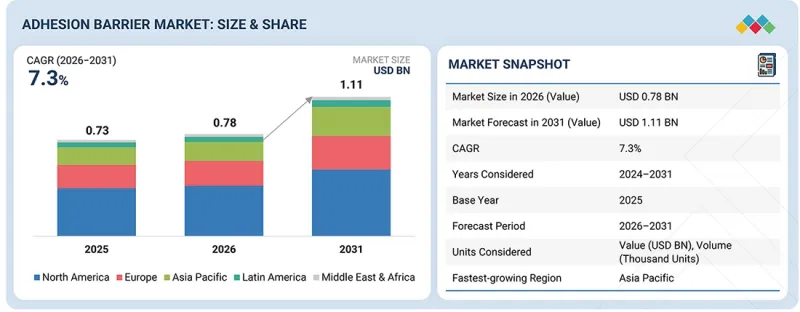
세계의 유착 방지제 시장 규모는 2026년 7억 8,000만 달러에서 2031년까지 11억 1,000만 달러에 달할 것으로 예측되며, 예측 기간 동안 CAGR은 7.3%를 기록할 전망입니다.
| 조사 범위 | |
|---|---|
| 조사 대상 기간 | 2026-2031년 |
| 기준 연도 | 2025년 |
| 예측 기간 | 2026-2031년 |
| 산정 단위 | 금액(10억 달러) |
| 부문 | 제품별, 제형별, 용도별, 최종사용자별, 지역별 |
| 대상 지역 | 북미, 유럽, 아시아태평양, 라틴아메리카, 중동 및 아프리카 |
고령 인구 증가에 따라 외과 수술 건수가 크게 늘어나고 있으며, 이로 인해 현대 외과 의료 분야에서 유착 방지제에 대한 수요가 뒷받침되고 있습니다. 나이가 들면서 심혈관질환, 정형외과 질환, 소화기 계통의 합병증, 부인과 질환 등의 만성 질환에 걸릴 위험이 높아지며, 이들 중 상당수는 외과적 치료가 필요합니다. 또한, 고령 환자는 조직의 치유 속도가 느리고 조직의 탄력성이 떨어지며 염증 반응이 심해지기 때문에 수술 후 합병증 발생 위험이 높으며, 이것이 수술 후 유착 형성의 한 원인이 될 가능성이 있습니다. 이러한 상황에서 유착 방지제는 수술 후 유착을 완화하고, 수술 결과를 개선하며, 재수술의 필요성을 최소화하는 데 중요한 역할을 하고 있습니다.
전 세계적으로 고령화가 진행됨에 따라, 복잡한 외과 수술 건수가 증가함에 따라 유착 방지제에 대한 수요도 증가할 것으로 예상됩니다. 그러나 고성능 유착 방지제 제품은 가격이 비싸다는 점에 더해, 의료 자원이 제한된 환경에서는 해당 제품에 대한 인지도나 입수 가능성이 낮아 보급이 제한될 가능성이 있습니다.
"제품별로 보면 예측 기간 동안 합성 유착 방지제 시장이 해당 시장 내에서 가장 높은 성장률을 보일 것으로 전망됩니다."
제품별로 보면 유착 방지제 시장은 합성계와 천연계 두 가지로 분류됩니다. 합성계 유착 방지제는 다시 히알루론산, 재생 셀룰로오스, 폴리에틸렌 글리콜 및 기타 합성계 유착 방지제로 분류됩니다. 합성 유착 방지제의 성장률이 높은 이유는 안정적인 제품 품질, 제어된 분해 특성, 생체적합성의 향상, 그리고 필름, 젤, 액체에 쉽게 배합할 수 있다는 점에 기인하는 것으로 보입니다. 또한, 합성 소재는 제조상의 확장성이 뛰어나며, 다양한 외과적 용도에서 목표하는 차단 성능을 발휘하도록 설계할 수 있기 때문에 유착 방지제 시장에서의 채택 확대를 뒷받침하고 있습니다.
"일반·복부 외과 수술은 유착 방지제 시장에서 가장 큰 용도 부문입니다."
2025년, 용도별로 보면 일반·복부 외과 수술이 유착 방지제 시장에서 가장 큰 점유율을 차지했습니다. 이 부문의 점유율이 높은 이유는 일반·복부 외과 수술에서 수술 후 유착 형성 위험이 높다는 점, 복부 외과 수술 건수의 증가, 그리고 이러한 수술에 사용할 수 있는 여러 가지 시판용 유착 방지제가 있다는 점에 기인합니다. 유착은 복부 및 골반 수술, 특히 장 수술, 복막 손상, 또는 재수술이 수반되는 시술에서 흔히 나타납니다. 대장·직장 수술 및 기타 소화기 계통 수술, 탈장 교정술, 그 밖의 개복 또는 복강경 하 복부 수술에서 유착 방지제의 사용이 증가함에 따라, 이 부문의 우위가 더욱 확고해지고 있습니다.
"예측 기간 동안 아시아태평양 시장이 가장 높은 성장률을 보일 것으로 전망된다'
지역별로 보면 유착 방지제 시장은 북미, 유럽, 아시아태평양, 라틴아메리카, 중동 및 아프리카로 분류됩니다. 아시아태평양은 예측 기간 동안 유착 방지제 시장에서 가장 높은 성장률을 기록할 것으로 예상됩니다. 이러한 성장은 주로 중국과 인도 등 신흥 경제국에서의 의료 인프라 개선, 의료비 증가, 가처분 소득 향상, 그리고 첨단 외과 의료에 대한 접근성 확대에 힘입어 이루어지고 있습니다. 수술 건수의 증가, 만성 질환 유병률의 상승, 그리고 첨단 외과용 제품의 도입 확대가 해당 지역의 유착 방지제 수요를 더욱 부추기고 있습니다.
또한, 병원 및 수술 센터의 현대화, 의료 시설의 급속한 확대, 그리고 수술 후 유착이 초래하는 임상적·경제적 부담에 대한 인식 제고 역시 시장 성장에 기여하고 있습니다. 첨단 의료 기술의 도입 확대와 더불어 의료 제공자의 구매력 향상까지 더해지면서, 아시아태평양의 일반·복부 외과, 산부인과, 정형외과, 심혈관 외과 및 기타 외과 분야에서 유착 방지 제품의 사용이 가속화될 것으로 예상됩니다.
유착 방지제 시장에서 사업을 전개하는 주요 기업은 Johnson & Johnson(미국), Baxter(미국), Medtronic(아일랜드), Integra LifeSciences Corporation(미국), Anika Therapeutics, Inc.(미국), Terumo Corporation(일본), FzioMed, Inc.(미국), MAST Biosurgery(스위스), BIOSCOMPASS, Inc.(미국), W. L. Gore & Associates, Inc.(미국), AlloSource(미국), CG Bio Inc.(한국), PlantTec Medical GmbH(독일), Hangzhou Singclean Medical Products(중국), Gunze Limited(일본), Samyang Biopharm Corporation(한국), BioRegen Biomedical(Changzhou)(중국), SciVision Biotech Inc.(대만), Kyeron(네덜란드), Betatech Medical(튀르키예), Dongsung(한국), Womed(프랑스), Proview-MBD Biotech(대만), Semical(튀르키예), Alafair Biosciences(미국)입니다.
조사 범위:
본 시장 조사는 다양한 부문에 걸친 접착 방지재 시장을 대상으로 합니다. 본 조사는 제품, 제형, 용도, 최종사용자 및 지역별로 각 부문의 시장 규모와 성장 잠재력을 추정하는 것을 목적으로 합니다. 또한, 시장 내 주요 기업에 대한 상세한 경쟁 분석 외에도 각 기업 개요, 제품 및 사업 내용에 관한 주요 관찰 사항, 최근 동향, 그리고 주요 시장 전략에 대해서도 다루고 있습니다.
이 보고서를 구매해야 하는 이유
본 보고서는 해당 시장의 선도 기업 및 신규 진입 기업을 대상으로, 접착 방지재 시장 전체 및 각 하위 부문의 매출액에 관한 가장 정확한 추정치를 제공합니다. 본 보고서는 이해관계자들이 경쟁 구도를 이해하고, 자사의 비즈니스를 더 유리한 위치로 이끌며, 적절한 시장 진입 전략을 수립하는 데 필요한 인사이트를 얻는 데 도움이 됩니다. 또한, 본 보고서는 이해관계자들이 시장 동향을 파악하고, 주요 시장 촉진요인, 억제요인, 과제 및 기회에 관한 정보를 얻는 데 도움이 됩니다.
본 보고서에서는 다음 사항에 대한 인사이트를 제공합니다:
- 유착 방지제 시장의 성장에 영향을 미치는 주요 촉진요인(고령 인구 증가, 수술 건수 및 스포츠 관련 부상 건수 증가, 유착의 의학적 영향에 대한 인식 제고), 제약요인(외과의사별 유착 방지제 사용에 대한 소극적 태도, 제품 리콜), 기회(미개척 신흥 시장), 그리고 과제(기술 혁신을 제한하는 엄격한 규제)에 대한 분석
- 시장 침투도 : 전 세계 접착 방지제 시장에서 주요 기업들이 제공하는 제품 포트폴리오에 대한 종합적인 정보입니다. 본 보고서에서는 제품 유형, 제형, 용도 및 지역별로 이 시장을 분석하고 있습니다.
- 제품 기능 강화 및 혁신 : 세계 유착 방지제 시장의 향후 동향 및 신규 서비스 출시에 대한 심층적인 인사이트
- 시장 개발 : 제품 유형, 제형, 용도, 지역별로 살펴본 수익성이 높은 신흥 시장에 대한 종합적인 정보
- 시장의 다양화 : 전 세계 접착 방지제 시장의 신제품·신서비스, 급성장 중인 지역, 최근 동향 및 투자에 관한 종합적인 정보
- 경쟁사 분석 : 세계 접착 방지제 시장의 주요 기업별 시장 점유율, 성장 전략, 제품 및 서비스 제공 내용, 그리고 역량에 대한 상세한 평가
자주 묻는 질문
목차
제1장 소개
제2장 주요 요약
제3장 주요 인사이트
제4장 시장 개요
제5장 업계 동향
제6장 기술 진보, AI에 의한 영향, 특허, 그리고 혁신
제7장 치료와 규제 상황
제8장 고객 상황과 구매 행동
제9장 유착 방지제 시장(제품별)
제10장 유착 방지제 시장(제형별)
제11장 유착 방지제 시장(용도별)
제12장 유착 방지제 시장(최종사용자별)
제13장 유착 방지제 시장(지역별)
제14장 경쟁 구도
제15장 기업 개요
제16장 조사 방법
제17장 부록
KSM 26.07.28The global adhesion barrier market size is projected to reach USD 1.11 billion by 2031 from USD 0.78 billion in 2026, at a CAGR of 7.3% during the forecast period.
| Scope of the Report | |
|---|---|
| Years Considered for the Study | 2026-2031 |
| Base Year | 2025 |
| Forecast Period | 2026-2031 |
| Units Considered | Value (USD billion) |
| Segments | By product, formulation, application, end user, and region |
| Regions covered | North America, Europe, the Asia Pacific, Latin America, the Middle East, and Africa |
The increasing geriatric population is driving a significant rise in surgical procedures, thereby supporting the demand for adhesion barriers in modern surgical care. As individuals age, they become more prone to chronic conditions such as cardiovascular diseases, orthopedic disorders, gastrointestinal complications, and gynecological conditions, many of which require surgical intervention. Elderly patients are also at a higher risk of post-surgical complications due to slower tissue healing, reduced tissue elasticity, and increased inflammatory response, which may contribute to adhesion formation after surgery. In this context, adhesion barriers play an important role in reducing post-operative adhesions, improving surgical outcomes, and minimizing the need for repeat surgeries.
As the global aging population continues to expand, the demand for adhesion barriers is expected to increase in parallel with the growing volume of complex surgical procedures. However, the high cost of advanced adhesion barrier products and limited awareness of or access to them in low-resource healthcare settings may restrict their widespread adoption.
"The synthetic adhesion barrier market is projected to witness the highest growth in the market, by product, during the forecast period."
By product, the adhesion barriers market is segmented into synthetic and natural barriers. Synthetic adhesion barriers are further classified into hyaluronic acid, regenerated cellulose, polyethylene glycol, and other synthetic adhesion barriers. The higher growth of synthetic adhesion barriers can be attributed to their consistent product quality, controlled degradation profile, improved biocompatibility, and ease of formulation into films, gels, and liquids. In addition, synthetic materials offer greater manufacturing scalability and can be engineered to deliver targeted barrier performance across multiple surgical applications, thereby supporting their growing adoption in the adhesion barriers market.
"General/abdominal surgeries are the largest application segment in the adhesion barrier market."
In 2025, based on application, general/abdominal surgeries held the largest share of the adhesion barriers market. The large share of this segment can be attributed to the higher risk of post-surgical adhesion formation in general/abdominal procedures, the growing volume of abdominal surgeries, and the availability of several commercialized adhesion barrier products for these procedures. Adhesions are commonly associated with abdominal and pelvic surgeries, particularly in procedures involving bowel handling, peritoneal trauma, or repeat surgical intervention. The increasing use of adhesion barriers in colorectal and other gastrointestinal surgeries, hernia repair, and other open or laparoscopic abdominal surgeries further supports the dominance of this segment.
"Asia Pacific market to witness the highest growth during the forecast period"
By region, the adhesion barriers market is segmented into North America, Europe, Asia Pacific, Latin America, the Middle East, and Africa. The Asia Pacific region is expected to witness the highest growth in the adhesion barriers market during the forecast period. This growth is primarily driven by improvements in healthcare infrastructure, rising healthcare expenditure, increasing disposable incomes, and expanding access to advanced surgical care in emerging economies such as China and India. The rising volume of surgical procedures, the increasing prevalence of chronic diseases, and the growing adoption of advanced surgical products are further driving demand for adhesion barriers in the region.
In addition, the modernization of hospitals and surgical centers, the rapid expansion of healthcare facilities, and increasing awareness regarding the clinical and economic burden of post-surgical adhesions are contributing to market growth. The growing adoption of advanced medical technologies, along with improving purchasing capacity among healthcare providers, is expected to accelerate the use of adhesion barrier products across general/abdominal, gynecological, orthopedic, cardiovascular, and other surgical applications in the Asia Pacific.
The break-up of the profile of primary participants in the adhesion barrier market:
- By Company Type: Tier 1 - 40%, Tier 2 - 30%, and Tier 3 - 30%
- By Designation: C-level - 27%, D-level - 18%, and Others - 55%
- By Region: North America - 51%, Europe - 21%, Asia Pacific - 18%, Latin America - 6%, and Middle East & Africa- 4%
The prominent players operating in the adhesion barriers market are Johnson & Johnson (US), Baxter (US), Medtronic (Ireland), Integra LifeSciences Corporation (US), Anika Therapeutics, Inc. (US), Terumo Corporation (Japan), FzioMed, Inc. (US), MAST Biosurgery (Switzerland), BIOSCOMPASS, Inc. (US), W. L. Gore & Associates, Inc. (US), AlloSource (US), CG Bio Inc. (South Korea), PlantTec Medical GmbH (Germany), Hangzhou Singclean Medical Products Co., Ltd. (China), Gunze Limited (Japan), Samyang Biopharm Corporation (South Korea), BioRegen Biomedical (Changzhou) Co., Ltd. (China), SciVision Biotech Inc. (Taiwan), Kyeron (Netherlands), Betatech Medical (Turkey), Dongsung (South Korea), Womed (France), Proview-MBD Biotech (Taiwan), Semical (Turkey), and Alafair Biosciences (US).
Research Coverage:
The market study covers the adhesion barrier market across various segments. It aims at estimating the market size and the growth potential of this market across different segments by product, by formulation, by application, by end user, and by region. The study also includes an in-depth competitive analysis of the key players in the market, along with their company profiles, key observations related to their products and business offerings, recent developments, and key market strategies.
Reasons to Buy the Report
The report will help the market leaders/new entrants in this market with information on the closest approximations of the revenue numbers for the overall adhesion barrier market and the subsegments. This report will help stakeholders understand the competitive landscape and gain insights to better position their businesses and plan suitable go-to-market strategies. The report also helps stakeholders understand the pulse of the market and provides them with information on key market drivers, restraints, challenges, and opportunities.
This report provides insights into the following pointers:
- Analysis of key drivers (rising geriatric population, increase in the volume of surgeries and sports-related injuries, increasing awareness about the medical implications of adhesion), restraints (reluctance of surgeons to use adhesion barriers, product recalls), opportunities (untapped emerging markets), and challenges (stringent regulations resulting in limited technological innovations) influencing the growth of the adhesion barrier market
- Market Penetration: Comprehensive information on product portfolios offered by the top players in the global adhesion barrier market. The report analyzes this market by product type, formulation, application, and region.
- Product Enhancement/Innovation: Detailed insights on upcoming trends and service launches in the global adhesion barrier market
- Market Development: Comprehensive information on the lucrative emerging markets by type of product, formulation, application, and region
- Market Diversification: Exhaustive information about new products and services, growing geographies, recent developments, and investments in the global adhesion barrier market
- Competitive Assessment: In-depth assessment of market shares, growth strategies, product and service offerings, and capabilities of leading players in the global adhesion barrier market
TABLE OF CONTENTS
1 INTRODUCTION
- 1.1 STUDY OBJECTIVES
- 1.2 MARKET DEFINITION
- 1.2.1 PRODUCT
- 1.2.2 FORMULATION
- 1.3 MARKET SCOPE
- 1.3.1 INCLUSIONS AND EXCLUSIONS
- 1.3.2 MARKETS COVERED
- 1.3.3 YEARS CONSIDERED
- 1.4 CURRENCY
- 1.5 STAKEHOLDERS
- 1.6 SUMMARY OF CHANGES
2 EXECUTIVE SUMMARY
- 2.1 KEY INSIGHTS & MARKET HIGHLIGHTS
- 2.2 KEY MARKET PARTICIPANTS: INSIGHTS & DEVELOPMENTS
- 2.3 DISRUPTIVE TRENDS SHAPING MARKET GROWTH
- 2.4 HIGH-GROWTH SEGMENTS & EMERGING FRONTIERS
- 2.5 SNAPSHOT: GLOBAL MARKET SIZE, GROWTH RATE, AND FORECAST
3 PREMIUM INSIGHTS
- 3.1 ATTRACTIVE OPPORTUNITIES FOR PLAYERS IN ADHESION BARRIER MARKET
- 3.2 ADHESION BARRIER MARKET, BY REGION, 2026 VS. 2031
- 3.3 ASIA PACIFIC ADHESION BARRIER MARKET, BY FORMULATION AND COUNTRY, 2025
- 3.4 ADHESION BARRIER MARKET, BY COUNTRY
- 3.5 ADHESION BARRIER MARKET: DEVELOPING VS. DEVELOPED MARKETS
4 MARKET OVERVIEW
- 4.1 INTRODUCTION
- 4.2 MARKET DYNAMICS
- 4.2.1 DRIVERS
- 4.2.1.1 Rapid growth in geriatric population globally
- 4.2.1.2 Increase in volume of surgeries
- 4.2.1.3 Increasing awareness about medical implications of adhesions
- 4.2.2 RESTRAINTS
- 4.2.2.1 Reluctance of surgeons to use adhesion barriers
- 4.2.3 OPPORTUNITIES
- 4.2.3.1 Untapped markets in emerging economies
- 4.2.3.2 Growing number of hospitals
- 4.2.4 CHALLENGES
- 4.2.4.1 Stringent regulations and limited technological innovations
- 4.2.1 DRIVERS
- 4.3 UNMET NEEDS AND WHITE SPACES
- 4.3.1 UNMET NEEDS IN ADHESION BARRIER MARKET
- 4.3.2 WHITE SPACE OPPORTUNITIES
- 4.4 INTERCONNECTED MARKETS AND CROSS-SECTOR OPPORTUNITIES
- 4.4.1 INTERCONNECTED MARKET
- 4.4.2 CROSS-SECTOR OPPORTUNITIES
- 4.5 STRATEGIC MOVES BY TIER-1/2/3 PLAYERS
5 INDUSTRY TRENDS
- 5.1 PORTER'S FIVE FORCES ANALYSIS
- 5.1.1 THREAT OF NEW ENTRANTS
- 5.1.2 INTENSITY OF COMPETITIVE RIVALRY
- 5.1.3 BARGAINING POWER OF BUYERS
- 5.1.4 BARGAINING POWER OF SUPPLIERS
- 5.1.5 THREAT OF SUBSTITUTES
- 5.2 MACROECONOMICS OUTLOOK
- 5.2.1 INTRODUCTION
- 5.2.2 GDP TRENDS AND FORECAST
- 5.2.3 TRENDS IN BIOSURGERY INDUSTRY
- 5.3 SUPPLY CHAIN ANALYSIS
- 5.4 VALUE CHAIN ANALYSIS
- 5.5 ECOSYSTEM ANALYSIS
- 5.6 PRICING ANALYSIS
- 5.6.1 AVERAGE SELLING PRICE OF ADHESION BARRIER, BY PRODUCT
- 5.6.2 AVERAGE SELLING PRICE TREND OF ADHESION BARRIER, BY REGION, 2023-2025
- 5.7 TRADE ANALYSIS
- 5.7.1 IMPORT DATA FOR ADHESION BARRIER (HS CODE: 300610)
- 5.7.2 EXPORT DATA FOR ADHESION BARRIER (HS CODE: 300610)
- 5.8 KEY CONFERENCES & EVENTS, 2026-2027
- 5.9 TRENDS/DISRUPTIONS IMPACTING CUSTOMER BUSINESS
- 5.10 CASE STUDY ANALYSIS
- 5.10.1 CASE STUDY 1: WORLD LAPAROSCOPY HOSPITAL DEMONSTRATES CLINICAL ADOPTION OF INTERCEED FOR POSTOPERATIVE ADHESION PREVENTION IN LAPAROSCOPIC SURGERY
- 5.10.2 CASE STUDY 2: BUDDHIST TZU CHI GENERAL HOSPITAL ACHIEVES HIGH SEPRAFILM PLACEMENT SUCCESS USING A MODIFIED LAPAROSCOPIC APPLICATION TECHNIQUE
- 5.10.3 CASE STUDY 3: FUKUSHIMA MEDICAL UNIVERSITY DEMONSTRATES SAFE AND RELIABLE LAPAROSCOPIC APPLICATION OF SEPRAFILM USING A REDUCER SLEEVE TECHNIQUE
- 5.11 IMPACT OF 2025 US TARIFFS ON ADHESION BARRIER MARKET
- 5.11.1 INTRODUCTION
- 5.11.2 KEY TARIFF RATES
- 5.11.3 PRICE IMPACT ANALYSIS
- 5.11.4 IMPACT ON REGION
- 5.11.4.1 US
- 5.11.4.2 Europe
- 5.11.4.3 Asia Pacific
- 5.11.5 IMPACT ON END-USE INDUSTRIES
6 TECHNOLOGICAL ADVANCEMENTS, AI-DRIVEN IMPACT, PATENTS, AND INNOVATIONS
- 6.1 KEY EMERGING TECHNOLOGIES
- 6.2 COMPLEMENTARY TECHNOLOGIES
- 6.2.1 HYDROGEL BIOMATERIALS
- 6.3 TECHNOLOGY/PRODUCT ROADMAP
- 6.3.1 SHORT-TERM (2025-2027) | FOUNDATION & EARLY COMMERCIALIZATION
- 6.3.2 MID-TERM (2027-2030) | EXPANSION & STANDARDIZATION
- 6.3.3 LONG-TERM (2030-2035+) | MASS COMMERCIALIZATION & DISRUPTION
- 6.4 PATENT ANALYSIS
- 6.4.1 PATENT PUBLICATION TRENDS FOR ADHESION BARRIER MARKET
- 6.4.2 TOP APPLICANTS (COMPANIES) OF ADHESION BARRIER PATENTS
- 6.4.3 JURISDICTION ANALYSIS: TOP APPLICANTS (COUNTRIES) FOR PATENTS IN ADHESION BARRIER MARKET
- 6.4.4 LIST OF MAJOR PATENTS
- 6.5 IMPACT OF AI/GEN AI ON ADHESION BARRIER MARKET
- 6.5.1 TOP USE CASES AND MARKET POTENTIAL
- 6.5.2 TOP CASE STUDIES OF AI IMPLEMENTATION IN ADHESION BARRIER MARKET
- 6.5.3 INTERCONNECTED ADJACENT ECOSYSTEM AND IMPACT ON MARKET PLAYERS
- 6.5.4 CLIENTS' READINESS TO ADOPT GENERATIVE AI IN ADHESION BARRIER MARKET
- 6.6 SUCCESS STORIES AND REAL-WORLD APPLICATIONS
- 6.6.1 BAXTER: SEPRAFILM - EVIDENCE-BACKED ADHESION REDUCTION IN ABDOMINAL & PELVIC SURGERY
- 6.6.2 JOHNSON & JOHNSON MEDTECH/ETHICON: GYNECARE INTERCEED - STANDARDIZED ADHESION PREVENTION IN GYNECOLOGIC SURGERY
- 6.6.3 ANIKA THERAPEUTICS/HYALOBARRIER: HYALURONIC ACID GEL FOR LAPAROSCOPY, LAPAROTOMY & HYSTEROSCOPY
7 TREATMENT AND REGULATORY LANDSCAPE
- 7.1 REGIONAL REGULATIONS AND COMPLIANCE
- 7.1.1 REGULATORY BODIES, GOVERNMENT AGENCIES, AND OTHER ORGANIZATIONS
- 7.1.2 INDUSTRY STANDARDS
- 7.1.2.1 North America
- 7.1.2.1.1 US
- 7.1.2.1.2 Canada
- 7.1.2.2 Europe
- 7.1.2.3 Asia Pacific
- 7.1.2.3.1 China
- 7.1.2.3.2 Japan
- 7.1.2.3.3 India
- 7.1.2.4 Latin America
- 7.1.2.4.1 Brazil
- 7.1.2.4.2 Mexico
- 7.1.2.5 Middle East
- 7.1.2.6 Africa
- 7.1.2.1 North America
- 7.2 CERTIFICATIONS, LABELLING, AND ECO-STANDARDS
- 7.2.1 CERTIFICATIONS, LABELLING, AND ECO-STANDARDS IN ADHESION BARRIER MARKET
8 CUSTOMER LANDSCAPE & BUYER BEHAVIOR
- 8.1 DECISION-MAKING PROCESS
- 8.2 BUYER STAKEHOLDERS AND BUYING EVALUATION CRITERIA
- 8.2.1 KEY STAKEHOLDERS IN BUYING PROCESS
- 8.2.2 KEY BUYING CRITERIA
- 8.3 ADOPTION BARRIERS & INTERNAL CHALLENGES
- 8.4 UNMET NEEDS IN END USERS
- 8.5 MARKET PROFITABILITY
- 8.5.1 REVENUE POTENTIAL
- 8.5.2 COST DYNAMICS
- 8.5.3 MARGIN OPPORTUNITIES IN KEY APPLICATIONS
9 ADHESION BARRIER MARKET, BY PRODUCT
- 9.1 INTRODUCTION
- 9.2 SYNTHETIC ADHESION BARRIERS
- 9.2.1 HYALURONIC ACID
- 9.2.1.1 Greater biocompatibility and higher bioresorbability to drive segment
- 9.2.2 REGENERATED CELLULOSE
- 9.2.2.1 Non-reactive and bacteriostatic nature of regenerated cellulose to drive use in gynecological surgeries
- 9.2.3 POLYETHYLENE GLYCOL
- 9.2.3.1 Ability to decrease post-surgical adhesions after abdominal and peritoneal surgeries to drive segment
- 9.2.4 OTHER SYNTHETIC ADHESION BARRIERS
- 9.2.1 HYALURONIC ACID
- 9.3 NATURAL ADHESION BARRIERS
- 9.3.1 TIME-CONSUMING AND COMPLEX APPLICATIONS DURING SURGERIES TO LIMIT MARKET
10 ADHESION BARRIER MARKET, BY FORMULATION
- 10.1 INTRODUCTION
- 10.2 FILM FORMULATIONS
- 10.2.1 FILM FORMULATIONS DOMINATED ADHESION BARRIER MARKET IN 2025
- 10.3 GEL FORMULATIONS
- 10.3.1 HIGHER PREFERENCE FOR GEL-BASED FORMULATIONS OVER FILM-BASED BARRIERS TO DRIVE MARKET
- 10.4 LIQUID FORMULATIONS
- 10.4.1 LIQUID FORMULATIONS TO BE WIDELY USED IN GYNECOLOGICAL, PELVIC, AND ABDOMINAL SURGERIES
11 ADHESION BARRIER MARKET, BY APPLICATION
- 11.1 INTRODUCTION
- 11.2 GYNECOLOGICAL SURGERIES
- 11.2.1 RISING INCIDENCE OF PELVIC AND UTERINE CANCER AND INCREASING NUMBER OF C-SECTIONS TO DRIVE MARKET
- 11.3 GENERAL/ABDOMINAL SURGERIES
- 11.3.1 INCREASING FORMATION OF POST-OPERATIVE ADHESIONS AND RISING COMPLICATIONS AMONG PATIENTS TO DRIVE MARKET
- 11.4 CARDIOVASCULAR SURGERIES
- 11.4.1 HIGH NUMBER OF CONGENITAL HEART DISEASE PATIENTS TO DRIVE MARKET
- 11.5 ORTHOPEDIC SURGERIES
- 11.5.1 GROWING VOLUME OF ORTHOPEDIC PROCEDURES TO DRIVE MARKET
- 11.6 NEUROLOGICAL SURGERIES
- 11.6.1 GROWING CONCERNS ABOUT PHYSICAL PAIN AND IMPAIRMENT AFTER NEUROLOGICAL SURGERIES TO DRIVE MARKET
- 11.7 RECONSTRUCTIVE SURGERIES
- 11.7.1 HIGHER INSURANCE COVERAGE FOR COSMETIC SURGERIES TO DRIVE MARKET
- 11.8 UROLOGICAL SURGERIES
- 11.8.1 GROWING INCIDENCE OF POST-OPERATIVE ADHESION FORMATION TO DRIVE MARKET
- 11.9 OTHER SURGERIES
12 ADHESION BARRIER MARKET, BY END USER
- 12.1 INTRODUCTION
- 12.2 HOSPITALS AND CLINICS
- 12.2.1 INCREASING INVESTMENT IN HOSPITALS TO DRIVE MARKET
- 12.3 AMBULATORY SURGICAL CENTERS
- 12.3.1 INCREASING NUMBER OF OUTPATIENT VISITS AND FAVORABLE REIMBURSEMENT POLICIES TO DRIVE MARKET
- 12.4 OTHER END USERS
13 ADHESION BARRIER MARKET, BY REGION
- 13.1 INTRODUCTION
- 13.2 NORTH AMERICA
- 13.2.1 MACROECONOMIC OUTLOOK FOR NORTH AMERICA
- 13.2.2 US
- 13.2.2.1 US dominated North American adhesion barrier market in 2025
- 13.2.3 CANADA
- 13.2.3.1 Increasing number of C-section surgeries to drive market
- 13.3 EUROPE
- 13.3.1 MACROECONOMIC OUTLOOK FOR EUROPE
- 13.3.2 GERMANY
- 13.3.2.1 Growth in healthcare spending to drive market
- 13.3.3 FRANCE
- 13.3.3.1 Rising number of advanced orthopedic surgeries to drive market
- 13.3.4 UK
- 13.3.4.1 Rising number of cardiovascular, gynecological, and orthopedic surgeries to drive market
- 13.3.5 ITALY
- 13.3.5.1 Rising geriatric population and increasing prevalence of chronic diseases to drive market
- 13.3.6 SPAIN
- 13.3.6.1 High cost of surgical procedures to limit market
- 13.3.7 REST OF EUROPE
- 13.4 ASIA PACIFIC
- 13.4.1 MACROECONOMIC OUTLOOK FOR ASIA PACIFIC
- 13.4.2 JAPAN
- 13.4.2.1 Rising geriatric population and increasing number of surgical procedures performed to drive market
- 13.4.3 CHINA
- 13.4.3.1 Growing number of hospitals and healthcare policy reforms to drive growth
- 13.4.4 INDIA
- 13.4.4.1 Rising focus of multinational companies on Indian market and improving urban healthcare infrastructure to drive market
- 13.4.5 AUSTRALIA
- 13.4.5.1 Growing government awareness campaigns and rising funding and grants for medical research to drive market
- 13.4.6 SOUTH KOREA
- 13.4.6.1 Growing geriatric population to drive market
- 13.4.7 REST OF ASIA PACIFIC
- 13.5 LATIN AMERICA
- 13.5.1 MACROECONOMIC OUTLOOK FOR LATIN AMERICA
- 13.5.2 BRAZIL
- 13.5.2.1 Well-established healthcare system to drive sustained growth in market
- 13.5.3 MEXICO
- 13.5.3.1 Rising chronic diseases and well-organized healthcare system to drive market
- 13.5.4 REST OF LATIN AMERICA
- 13.6 MIDDLE EAST & AFRICA
- 13.6.1 STRENGTHENING OF HEALTHCARE INFRASTRUCTURE TO SUPPORT MARKET GROWTH
- 13.6.2 MACROECONOMIC OUTLOOK FOR MIDDLE EAST & AFRICA
- 13.6.3 GCC COUNTRIES
- 13.6.4 REST OF MIDDLE EAST & AFRICA
14 COMPETITIVE LANDSCAPE
- 14.1 INTRODUCTION
- 14.2 KEY PLAYER STRATEGY/RIGHT TO WIN
- 14.2.1 OVERVIEW OF STRATEGIES ADOPTED BY KEY PLAYERS IN ADHESION BARRIER MARKET
- 14.3 REVENUE ANALYSIS, 2021-2025
- 14.4 MARKET SHARE ANALYSIS, 2025
- 14.5 COMPANY EVALUATION MATRIX: KEY PLAYERS, 2025
- 14.5.1 STARS
- 14.5.2 EMERGING LEADERS
- 14.5.3 PERVASIVE PLAYERS
- 14.5.4 PARTICIPANTS
- 14.5.5 COMPANY FOOTPRINT: KEY PLAYERS, 2025
- 14.5.5.1 Company footprint
- 14.5.5.2 Region footprint
- 14.5.5.3 Product footprint
- 14.5.5.4 Application footprint
- 14.5.5.5 Formulation footprint
- 14.6 COMPANY EVALUATION MATRIX: STARTUPS/SMES, 2025
- 14.6.1 PROGRESSIVE COMPANIES
- 14.6.2 RESPONSIVE COMPANIES
- 14.6.3 DYNAMIC COMPANIES
- 14.6.4 STARTING BLOCKS
- 14.6.5 COMPETITIVE BENCHMARKING: STARTUPS/SMES, 2025
- 14.7 BRAND/PRODUCT COMPARISON
- 14.8 COMPANY VALUATION AND FINANCIAL METRICS
- 14.8.1 FINANCIAL METRICS
- 14.8.2 COMPANY VALUATION
- 14.9 COMPETITIVE SCENARIO
- 14.9.1 PRODUCT LAUNCHES AND APPROVALS
- 14.9.2 DEALS
- 14.9.3 EXPANSIONS
- 14.9.4 OTHER DEVELOPMENTS
15 COMPANY PROFILES
- 15.1 KEY PLAYERS
- 15.1.1 BAXTER
- 15.1.1.1 Business overview
- 15.1.1.2 Products offered
- 15.1.1.3 Recent developments
- 15.1.1.3.1 Other developments
- 15.1.1.4 MnM view
- 15.1.1.4.1 Key strengths
- 15.1.1.4.2 Strategic choices
- 15.1.1.4.3 Weaknesses and competitive threats
- 15.1.2 JOHNSON & JOHNSON
- 15.1.2.1 Business overview
- 15.1.2.2 Products offered
- 15.1.2.3 Recent developments
- 15.1.2.3.1 DEALS
- 15.1.2.3.2 Other developments
- 15.1.2.4 MnM view
- 15.1.2.4.1 Key strengths
- 15.1.2.4.2 Strategic choices
- 15.1.2.4.3 Weaknesses and competitive threats
- 15.1.3 INTEGRA LIFESCIENCES CORPORATION
- 15.1.3.1 Business overview
- 15.1.3.2 Products offered
- 15.1.3.3 Recent developments
- 15.1.3.3.1 Other developments
- 15.1.3.4 MnM view
- 15.1.3.4.1 Key strengths
- 15.1.3.4.2 Strategic choices
- 15.1.3.4.3 Weaknesses and competitive threats
- 15.1.4 TERUMO CORPORATION
- 15.1.4.1 Business overview
- 15.1.4.2 Products offered
- 15.1.4.3 Recent developments
- 15.1.4.3.1 Deals
- 15.1.4.3.2 Expansions
- 15.1.4.3.3 Other developments
- 15.1.4.4 MnM view
- 15.1.4.4.1 Key strengths
- 15.1.4.4.2 Strategic choices
- 15.1.4.4.3 Weaknesses and competitive threats
- 15.1.5 FZIOMED, INC.
- 15.1.5.1 Business overview
- 15.1.5.2 Products offered
- 15.1.5.3 Recent developments
- 15.1.5.3.1 Product launches and approvals
- 15.1.5.4 MnM view
- 15.1.5.4.1 Key strengths
- 15.1.5.4.2 Strategic choices
- 15.1.5.4.3 Weaknesses and competitive threats
- 15.1.6 ANIKA THERAPEUTICS INC.
- 15.1.6.1 Business overview
- 15.1.6.2 Products offered
- 15.1.6.3 Recent developments
- 15.1.6.3.1 Other developments
- 15.1.7 MAST BIOSURGERY
- 15.1.7.1 Business overview
- 15.1.7.2 Products offered
- 15.1.8 BETATECH MEDICAL
- 15.1.8.1 Business overview
- 15.1.8.2 Products offered
- 15.1.9 DONGSUNG
- 15.1.9.1 Business overview
- 15.1.10 PRODUCTS OFFERED
- 15.1.11 BIOSCOMPASS, INC.
- 15.1.11.1 Business overview
- 15.1.11.2 Products offered
- 15.1.12 W.L. GORE & ASSOCIATES, INC.
- 15.1.12.1 Business overview
- 15.1.12.2 Products offered
- 15.1.13 ALLOSOURCE
- 15.1.13.1 Business overview
- 15.1.13.2 Products offered
- 15.1.14 HANGZHOU SINGCLEAN MEDICAL PRODUCTS CO., LTD
- 15.1.14.1 Business overview
- 15.1.14.2 Products offered
- 15.1.15 BIOREGEN BIOMEDICAL (CHANGZHOU) CO., LTD.
- 15.1.15.1 Business overview
- 15.1.15.2 Products offered
- 15.1.16 DALIM TISSEN CO., LTD.
- 15.1.16.1 Business overview
- 15.1.16.2 Products offered
- 15.1.1 BAXTER
- 15.2 OTHER PLAYERS
- 15.2.1 CG BIO INC.
- 15.2.2 PLANTTEC MEDICAL GMBH
- 15.2.3 GUNZE LIMITED
- 15.2.4 SAMYANG BIOPHARM CORPORATION
- 15.2.5 WOMED
- 15.2.6 PROVIEW-MBD BIOTECH CO., LTD
- 15.2.7 SEMICAL
- 15.2.8 ALAFAIR BIOSCIENCES
- 15.2.9 SCIVISION BIOTECH INC.
- 15.2.10 KYERON
16 RESEARCH METHODOLOGY
- 16.1 RESEARCH DATA
- 16.1.1 SECONDARY DATA
- 16.1.1.1 Key data from secondary sources
- 16.1.2 PRIMARY DATA
- 16.1.2.1 Key data from primary sources
- 16.1.2.2 Key industry insights
- 16.1.1 SECONDARY DATA
- 16.2 MARKET SIZE ESTIMATION
- 16.2.1 BOTTOM-UP APPROACH
- 16.2.2 TOP-DOWN APPROACH
- 16.2.3 BASE NUMBER ESTIMATION
- 16.2.3.1 Supply-side Analysis (Revenue Share Analysis)
- 16.2.3.2 Company Presentations and Primary Interviews
- 16.2.3.3 Demand-side Analysis
- 16.3 MARKET FORECAST APPROACH
- 16.4 MARKET BREAKDOWN AND DATA TRIANGULATION
- 16.5 MARKET SHARE ESTIMATION
- 16.6 STUDY ASSUMPTIONS
- 16.7 FACTOR ANALYSIS
- 16.8 RESEARCH LIMITATIONS
- 16.8.1 SCOPE-RELATED LIMITATIONS
- 16.8.2 METHODOLOGY-RELATED LIMITATIONS
- 16.9 RISK ASSESSMENT
17 APPENDIX
- 17.1 DISCUSSION GUIDE
- 17.2 KNOWLEDGESTORE: MARKETSANDMARKETS' SUBSCRIPTION PORTAL
- 17.3 CUSTOMIZATION OPTIONS
- 17.4 RELATED REPORTS
- 17.5 AUTHOR DETAILS


