
|
시장보고서
상품코드
2132778
펩티드 합성 시장 예측(-2031년) : 기기(합성기, 정제, 동결건조기, 분석기), 시약(아미노산, 수지), 방법(화학 합성, 생물학적 합성), 서비스(커스텀 합성, 수식), 용도, 최종사용자별Peptide Synthesis Market by Instruments (Synthesizers, Purification, Lyophilizers, Analytical), Reagents (Amino Acids, Resins), Technique (Chemical, Biological), Services (Custom Synthesis, Modification), Application, End User - Global Forecast to 2031 |
||||||

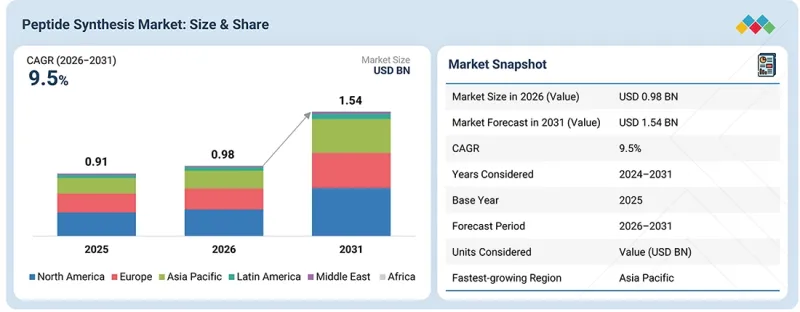
세계의 펩티드 합성 시장 규모는 2026년 9억 8,000만 달러에서 2031년에는 15억 4,000만 달러에 달할 것으로 추정되고 있으며, 2026-2031년까지 CAGR은 9.5%에 달할 전망입니다.
이 시장은 펩티드 기반 치료제 파이프라인의 확대, GLP-1 및 기타 대사계 펩티드에 대한 수요 증가, 종양, 진단, 연구 분야에서의 합성 펩티드 용도 확대를 원동력으로 삼아 예측 기간 중 꾸준히 성장할 것으로 전망됩니다. 또한 자동 고상 펩티드 합성, 고처리량 플랫폼, 특수 변형 화학, 펩티드 정제 및 분석 기술의 발전도 이러한 성장을 지원하고 있습니다.
| 조사 범위 | |
|---|---|
| 조사 대상 기간 | 2026-2031년 |
| 기준연도 | 2025년 |
| 예측 기간 | 2026-2031년 |
| 단위 | 금액(달러) |
| 부문 | 제공, 제품 유형, 기술, 서비스 유형, 용도, 제품 최종사용자, 서비스 최종사용자 |
| 대상 지역 | 북미, 유럽, 아시아태평양, 라틴아메리카, 중동, 아프리카 |
그러나 재료 및 용매 소비량이 많고, 장쇄의 복잡한 배열 합성이 어렵다는 점, 정제상 과제, 전문적인 기술 지식을 갖춘 인력이 필요하다는 점 등이 시장 전체의 추가적인 성장을 저해할 것으로 예상됩니다.
"서비스 유형별로는 2025년에 맞춤형 펩티드 합성 서비스가 가장 큰 점유율을 차지했다"
2025년에는 표준 펩티드, 고순도 펩티드, 변형 펩티드, 장쇄 펩티드, 복잡한 펩티드의 합성 수요를 외부에 위탁하는 추세가 확대된 것을 배경으로, 맞춤형 펩티드 합성 서비스가 최대 시장 점유율을 차지했습니다. 이러한 서비스는 신약 개발, 치료제 개발, 진단 연구, 항체 제조, 학술연구 등 다양한 워크플로우에서 널리 활용되고 있습니다. 또한 짧은 납기, 맞춤형 순도 수준, 난해한 서열에 대한 대응, 특수한 펩티드 형태에 대한 수요 확대도 시장을 지원하고 있습니다. 제약 및 생명공학 기업, CRO 및 CDMO, 학술·연구 기관에서의 폭넓은 적용 가능성이 이 부문의 세계적 선도적 지위를 지속적으로 지원하고 있습니다.
"기술별로는 화학 합성이 2025년에 가장 큰 점유율을 차지했다"
기술별로는 연구용 및 치료용 펩티드 제조에 고상 펩티드 합성(SPPS)이 널리 사용되고 있으므로 화학 합성이 2025년에 가장 큰 시장 점유율을 차지했습니다. SPPS는 확립된 Fmoc 및 Boc 기반 화학 반응, 자동화와의 높은 친화성, 서열 설계의 유연성 외에도 합성기, 수지, 보호 아미노산, 커플링 시약으로 구성된 광범위한 생태계를 제공합니다. 또한 액상 합성, 하이브리드법, 화학적 라이게이션법은 특정 단편이나 복잡한 서열에서 SPPS를 보완하는 역할을 하고 있습니다. 화학 합성 워크플로우의 성숙도와 제약, 생명공학, CRO, 학술연구소에서의 광범위한 활용이 이 부문의 선도적 지위를 지속적으로 지원하고 있습니다.
"아시아태평양은 2026-2031년까지 가장 높은 연평균 성장률(CAGR)을 기록할 것으로 전망"
아시아태평양은 제약·바이오기술 분야의 연구개발 확대, 펩티드 의약품 개발의 진전, 맞춤형 펩티드 합성의 외부 위탁 증가, 연구 인프라 개선을 배경으로 예측 기간 중 가장 높은 연평균 성장률(CAGR)을 기록하며 성장할 것으로 추정됩니다. 또한 자동 펩티드 합성기 및 첨단 정제·분석 플랫폼의 도입 확대, 중국, 인도, 일본, 한국, 호주에서의 펩티드 치료제 수요 증가도 성장을 지원하고 있습니다. 지역에 기반을 둔 공급업체와 지속적으로 확대되고 있는 글로벌 생명과학 사업의 성장 또한 아시아태평양 전체의 펩티드 합성 역량 강화로 이어지고 있습니다.
이 보고서에서는 전 세계 펩티드 합성 시장을 조사하여, 시장 개요, 시장 성장에 영향을 미치는 각종 요인에 대한 분석, 기술 및 특허 동향, 법적 규제 환경, 사례 연구, 시장 규모 추이 및 전망, 각종 분류·지역/주요 국가별 상세 분석, 경쟁 현황, 주요 기업 개요 등을 종합적으로 다루고 있습니다.
자주 묻는 질문
목차
제1장 서론
제2장 개요
제3장 주요 인사이트
제4장 시장 개요
제5장 업계 동향
제6장 기술의 진보, AI의 영향, 특허, 혁신
제7장 지속가능성과 규제 상황
제8장 고객 상황과 구매 행동
제9장 펩티드 합성 시장 : 제공별
제10장 펩티드 합성 제품 시장 : 제품 유형별
제11장 펩티드 합성 제품 시장 : 기술별
제12장 펩티드 합성 제품 시장 : 최종사용자별
제13장 펩티드 합성 서비스 시장 : 서비스 유형별
제14장 펩티드 합성 서비스 시장 : 최종사용자별
제15장 펩티드 합성 시장 : 용도별
제16장 펩티드 합성 시장 : 지역별
제17장 경쟁 구도
제18장 기업 개요
제19장 조사 방법
제20장 부록
KSA 26.10.01The global peptide synthesis market is estimated to reach USD 1.54 billion by 2031 from USD 0.98 billion in 2026, at a CAGR of 9.5% from 2026 to 2031. The market is projected to grow steadily over the forecast period, driven by the expanding pipeline of peptide-based therapeutics, rising demand for GLP-1 and other metabolic peptides, and broader use of synthetic peptides in oncology, diagnostics, and research. Growth is further supported by advances in automated solid-phase peptide synthesis, high-throughput platforms, specialized modification chemistries, and peptide purification and analytical technologies.
| Scope of the Report | |
|---|---|
| Years Considered for the Study | 2026-2031 |
| Base Year | 2025 |
| Forecast Period | 2026-2031 |
| Units Considered | Value (USD billion) |
| Segments | Offering, Product Type, Technique, Service Type, Application, Product End User, and Service End User |
| Regions covered | North America, Europe, Asia Pacific, Latin America, the Middle East, and Africa |
However, high material and solvent consumption, synthesis complexity for long and difficult sequences, purification challenges, and the need for specialized technical expertise are expected to restrain broader market growth.
"The custom peptide synthesis services segment accounted for the largest share, by service type, in 2025."
Based on service type, the peptide synthesis services market is segmented into custom peptide synthesis services, peptide engineering & modification services, peptide purification services, peptide analytical & characterization services, and peptide library preparation/synthesis services. In 2025, custom peptide synthesis services accounted for the largest market share, driven by growing outsourcing of standard, high-purity, modified, long, and complex peptide requirements. These services are widely used across drug discovery, therapeutic development, diagnostic research, antibody generation, and academic research workflows. Demand is further supported by increasing requirements for rapid turnaround, customized purity levels, difficult sequences, and specialized peptide formats. Their broad applicability across pharmaceutical & biotechnology companies, CROs & CDMOs, and academic & research institutes continues to support the segment's leading position globally.
"Chemical synthesis segment accounted for the largest share of the peptide synthesis products market, by technique, in 2025."
Based on technique, the peptide synthesis products market is segmented into chemical synthesis and biological synthesis. Chemical synthesis accounted for the largest market share in 2025, due to the widespread use of solid-phase peptide synthesis (SPPS) for research and therapeutic peptide production. SPPS offers established Fmoc- and Boc-based chemistries, compatibility with automation, sequence flexibility, and a broad ecosystem of synthesizers, resins, protected amino acids, and coupling reagents. Liquid-phase synthesis, hybrid approaches, and chemical ligation methods complement SPPS for selected fragments and complex sequences. The maturity of chemical synthesis workflows and their extensive use across pharmaceutical, biotechnology, CRO, and academic laboratories continue to support the segment's leading position.
"Asia Pacific is expected to register the highest CAGR in the peptide synthesis market from 2026 to 2031."
The peptide synthesis market, by region, is segmented into North America, Europe, Asia Pacific, Latin America, the Middle East, and Africa. Asia Pacific is estimated to grow at the highest CAGR during the forecast period, driven by expanding pharmaceutical and biotechnology R&D, growing peptide drug development, rising outsourcing of custom peptide synthesis, and improvements in research infrastructure. Growth is further supported by increasing adoption of automated peptide synthesizers, advanced purification and analytical platforms, and expanding demand for peptide therapeutics across China, India, Japan, South Korea, and Australia. Established regional suppliers and expanding global life-science operations continue to strengthen peptide synthesis capabilities across the region.
The primary interviews conducted for this report can be categorized as follows:
- By Respondent: Supply Side (80%) and Demand Side (20%)
- By Designation: Managers (45%), CXOs & Directors (30%), and Executives (25%)
- By Region: North America (40%), Europe (25%), Asia Pacific (25%), Latin America (5%), and the Middle East & Africa (5%)
Merck KGaA (Germany), Thermo Fisher Scientific Inc. (US), Agilent Technologies, Inc. (US), GenScript Biotech Corporation (China), Kaneka Corporation (Japan), Biotage AB (Sweden), Sartorius AG (Germany), Bachem Holding AG (Switzerland), CEM Corporation (US), Bio-Synthesis, Inc. (US), Biosynth (Switzerland), CSBio (US), GL Biochem (Shanghai) Ltd. (China), Mesa Laboratories, Inc. (US), Danaher Corporation (US), Chem-Impex International, Inc. (US), Advanced ChemTech (ACT) (US), Mimotopes Pty Ltd (Australia), Iris Biotech GmbH (Germany), AAPPTec, LLC (US), Enamine Ltd. (Ukraine), Intavis Peptide Services (Germany), JPT Peptide Technologies GmbH (Germany), Innovagen AB (Sweden), Peptide Protein Research Ltd. (UK), LifeTein LLC (US), Creative Peptides (US), Genemed Synthesis, Inc. (US), ChinaPeptides Co., Ltd. (China), and Beijing Scilight Biotechnology Co., Ltd. (China) are some of the key companies offering peptide synthesis products and services.
Research Coverage
This research report categorizes the peptide synthesis market by offering (products, services), product type (instruments, reagents & consumables), technique (chemical synthesis, biological synthesis), service type (custom peptide synthesis services, peptide engineering & modification services, peptide purification services, peptide analytical & characterization services, peptide library preparation/synthesis services), application (therapeutic applications, diagnostics applications, research applications), product end user (pharmaceutical & biotechnology companies, CROs & CDMOs, academic & research institutes, medical device companies, clinical & diagnostic laboratories), service end user (pharmaceutical & biotechnology companies, CROs & CDMOs, academic & research institutes, medical device companies, clinical & diagnostic laboratories), and region (North America, Europe, Asia Pacific, Latin America, Middle East, and Africa).
The scope of the report provides detailed information on major factors such as drivers, challenges, opportunities, and restraints that influence the growth of the peptide synthesis market. A comprehensive analysis of key industry players has been conducted to provide insights into their business overviews, product & services portfolios, and key strategies, including collaborations, partnerships, expansions, agreements, acquisitions, and recent developments in the peptide synthesis market.
Key Benefits of Buying the Report
This report offers a comprehensive overview of the peptide synthesis market. It aims to assess the market size and future growth opportunities across various segments. The report also features an in-depth competitive analysis of the major market players, including their company profiles, recent developments, and key market strategies:
The report provides insights on the following pointers:
- Analysis of key drivers (surging demand for GLP-1 and other high-volume peptide therapeutics, rising complexity of peptide modalities requiring advanced synthesis and purification, expanding peptide drug pipelines and clinical development activity), restraints (high material consumption and waste generation in large-scale peptide synthesis, high cost and supply sensitivity of GMP-grade synthesis inputs), opportunities (rapid expansion of global GMP peptide manufacturing capacity, shift toward continuous-flow, hybrid, and solvent-efficient peptide synthesis technologies), and challenges (maintaining yield, purity, and batch consistency for complex peptides at scale) influencing the growth of the market.
- Product Development/Innovation: Detailed insights on newly launched products & services of the peptide synthesis market.
- Market Development: Comprehensive information about lucrative markets - the report analyses the market across varied regions.
- Market Diversification: Exhaustive information about new products, untapped geographies, recent developments, and investments in the peptide synthesis market.
- Competitive Assessment: In-depth assessment of market shares, growth strategies, and product offerings of leading players such as Merck KGaA (Germany), Thermo Fisher Scientific Inc. (US), Agilent Technologies, Inc. (US), GenScript Biotech Corporation (China), Kaneka Corporation (Japan), Biotage AB (Sweden), Sartorius AG (Germany), Bachem Holding AG (Switzerland), CEM Corporation (US), Bio-Synthesis, Inc. (US), Biosynth (Switzerland), CSBio (US), GL Biochem (Shanghai) Ltd. (China), Mesa Laboratories, Inc. (US), Danaher Corporation (US), Chem-Impex International, Inc. (US), Advanced ChemTech (ACT) (US), Mimotopes Pty Ltd (Australia), Iris Biotech GmbH (Germany), AAPPTec, LLC (US), Enamine Ltd. (Ukraine), Intavis Peptide Services (Germany), JPT Peptide Technologies GmbH (Germany), Innovagen AB (Sweden), Peptide Protein Research Ltd. (UK), LifeTein LLC (US), Creative Peptides (US), Genemed Synthesis, Inc. (US), ChinaPeptides Co., Ltd. (China), and Beijing Scilight Biotechnology Co., Ltd. (China).
The report also helps stakeholders understand trends in the peptide synthesis market and provides information on key drivers, restraints, challenges, and opportunities. A detailed analysis of the key industry players has been conducted to offer insights into their strategies, product & services launches, acquisitions, partnerships, collaborations, recent activities, investments, funding, brand/product/service comparisons, vendor evaluations, and financial metrics of the peptide synthesis sector.
TABLE OF CONTENTS
1 INTRODUCTION
- 1.1 STUDY OBJECTIVES
- 1.2 MARKET DEFINITION
- 1.3 STUDY SCOPE
- 1.3.1 MARKET SEGMENTATION & REGIONAL SCOPE
- 1.3.2 INCLUSIONS & EXCLUSIONS
- 1.3.3 YEARS CONSIDERED
- 1.3.4 CURRENCY CONSIDERED
- 1.4 STAKEHOLDERS
- 1.5 SUMMARY OF CHANGES
2 EXECUTIVE SUMMARY
- 2.1 MARKET HIGHLIGHTS & KEY INSIGHTS
- 2.2 KEY MARKET PARTICIPANTS: MAPPING OF STRATEGIC DEVELOPMENTS
- 2.3 DISRUPTIVE TRENDS IN PEPTIDE SYNTHESIS MARKET
- 2.4 HIGH-GROWTH SEGMENTS
- 2.5 REGIONAL SNAPSHOT: MARKET SIZE, GROWTH RATE, AND FORECAST
3 PREMIUM INSIGHTS
- 3.1 PEPTIDE SYNTHESIS MARKET OVERVIEW
- 3.2 NORTH AMERICA: PEPTIDE SYNTHESIS MARKET, BY OFFERING
- 3.3 PEPTIDE SYNTHESIS MARKET: GEOGRAPHIC GROWTH OPPORTUNITIES
- 3.4 PEPTIDE SYNTHESIS MARKET SHARE, BY APPLICATION, 2026 VS. 2031 (%)
4 MARKET OVERVIEW
- 4.1 INTRODUCTION
- 4.2 MARKET DYNAMICS
- 4.2.1 DRIVERS
- 4.2.1.1 Surging demand for GLP-1 and other high-volume peptide therapeutics
- 4.2.1.2 Rising complexity of peptide modalities requiring advanced synthesis and purification
- 4.2.1.3 Expanding peptide drug pipelines and clinical development activity
- 4.2.2 RESTRAINTS
- 4.2.2.1 High material consumption and waste generation in large-scale solid-phase peptide synthesis
- 4.2.2.2 High cost and supply sensitivity of GMP-grade synthesis inputs
- 4.2.3 OPPORTUNITIES
- 4.2.3.1 Rapid expansion of global GMP peptide manufacturing capacity
- 4.2.3.2 Shift toward continuous-flow, hybrid, and solvent-efficient peptide synthesis technologies
- 4.2.4 CHALLENGES
- 4.2.4.1 Maintaining yield, purity, and batch consistency for complex peptides at scale
- 4.2.1 DRIVERS
- 4.3 UNMET NEEDS & WHITE SPACES
- 4.4 INTERCONNECTED MARKETS & CROSS-SECTOR OPPORTUNITIES
- 4.5 STRATEGIC MOVES BY TIER-1/2/3 PLAYERS
5 INDUSTRY TRENDS
- 5.1 PORTER'S FIVE FORCES ANALYSIS
- 5.1.1 THREAT OF NEW ENTRANTS
- 5.1.2 THREAT OF SUBSTITUTES
- 5.1.3 BARGAINING POWER OF BUYERS
- 5.1.4 BARGAINING POWER OF SUPPLIERS
- 5.1.5 INTENSITY OF COMPETITIVE RIVALRY
- 5.2 MACROECONOMIC OUTLOOK
- 5.2.1 INTRODUCTION
- 5.2.2 GDP TRENDS & FORECAST
- 5.2.3 TRENDS IN GLOBAL PEPTIDE SYNTHESIS MARKET
- 5.3 VALUE CHAIN ANALYSIS
- 5.4 ECOSYSTEM ANALYSIS
- 5.5 PRICING ANALYSIS
- 5.5.1 AVERAGE SELLING PRICE TREND OF KEY PLAYERS, BY PRODUCT
- 5.5.2 AVERAGE SELLING PRICE TREND OF PRODUCTS, BY REGION
- 5.6 TRADE ANALYSIS
- 5.6.1 IMPORT SCENARIO (HS CODE 902720)
- 5.6.2 EXPORT SCENARIO (HS CODE 902720)
- 5.6.3 IMPORT SCENARIO (HS CODE 841933)
- 5.6.4 EXPORT SCENARIO (HS CODE 841933)
- 5.7 KEY CONFERENCES & EVENTS, 2026-2027
- 5.8 TRENDS/DISRUPTIONS IMPACTING CUSTOMERS' BUSINESSES
- 5.9 INVESTMENT & FUNDING ACTIVITY
- 5.10 IMPACT OF 2025 US TARIFFS ON PEPTIDE SYNTHESIS MARKET
- 5.10.1 INTRODUCTION
- 5.10.2 PRICE IMPACT ANALYSIS
- 5.10.3 IMPACT ON COUNTRY/REGION
- 5.10.3.1 North America
- 5.10.3.2 Europe
- 5.10.3.3 Asia Pacific
- 5.10.4 IMPACT ON END-USE INDUSTRIES
- 5.10.4.1 Pharmaceutical & biotechnology companies
- 5.10.4.2 CROs & CDMOs
- 5.10.4.3 Academic & research institutes, diagnostic labs, and other end users
6 TECHNOLOGICAL ADVANCEMENTS, AI-DRIVEN IMPACT, PATENTS, AND INNOVATIONS
- 6.1 TECHNOLOGY ANALYSIS
- 6.1.1 KEY EMERGING TECHNOLOGIES
- 6.1.1.1 Solid-phase peptide synthesis (SPPS)
- 6.1.1.2 Liquid-phase peptide synthesis (LPPS)
- 6.1.1.3 Enzymatic peptide synthesis
- 6.1.1.4 Recombinant peptide synthesis
- 6.1.1.5 Continuous-flow peptide synthesis
- 6.1.2 COMPLEMENTARY TECHNOLOGIES
- 6.1.2.1 Analytical characterization & quality-control technologies
- 6.1.2.2 Purification & downstream processing technologies
- 6.1.2.3 Peptide ligation technologies
- 6.1.3 ADJACENT TECHNOLOGIES
- 6.1.3.1 Protein design & engineering
- 6.1.3.2 Synthetic biology/genetic-code engineering
- 6.1.1 KEY EMERGING TECHNOLOGIES
- 6.2 TECHNOLOGY/PRODUCT ROADMAP
- 6.3 PATENT ANALYSIS
- 6.3.1 TOP APPLICANTS/OWNERS (COMPANIES) FOR PEPTIDE SYNTHESIS PATENTS
- 6.4 FUTURE APPLICATIONS
- 6.5 IMPACT OF AI/GEN AI ON PEPTIDE SYNTHESIS MARKET
- 6.5.1 BEST PRACTICES IN PEPTIDE SYNTHESIS WORKFLOW
- 6.5.2 CASE STUDIES OF AI IMPLEMENTATION IN PEPTIDE SYNTHESIS MARKET
- 6.5.3 INTERCONNECTED ADJACENT ECOSYSTEMS & IMPACT ON MARKET PLAYERS
- 6.5.4 CLIENTS' READINESS TO ADOPT GENERATIVE AI IN PEPTIDE SYNTHESIS MARKET
7 SUSTAINABILITY & REGULATORY LANDSCAPE
- 7.1 REGIONAL REGULATIONS & COMPLIANCE
- 7.1.1 REGULATORY BODIES, GOVERNMENT AGENCIES, AND OTHER ORGANIZATIONS
- 7.1.2 REGULATORY FRAMEWORK
- 7.1.3 INDUSTRY STANDARDS
- 7.2 SUSTAINABILITY INITIATIVES
- 7.3 SUSTAINABILITY IMPACT & REGULATORY POLICY INITIATIVES
- 7.4 CERTIFICATIONS, LABELING, AND ECO-STANDARDS
8 CUSTOMER LANDSCAPE & BUYER BEHAVIOR
- 8.1 DECISION-MAKING PROCESS
- 8.2 BUYER STAKEHOLDERS & BUYING EVALUATION CRITERIA
- 8.2.1 KEY STAKEHOLDERS IN BUYING PROCESS
- 8.2.2 KEY BUYING CRITERIA, BY END USER
- 8.3 ADOPTION BARRIERS & INTERNAL CHALLENGES
- 8.4 UNMET NEEDS FROM END USERS
- 8.5 MARKET PROFITABILITY
9 PEPTIDE SYNTHESIS MARKET, BY OFFERING
- 9.1 INTRODUCTION
- 9.2 PRODUCTS
- 9.2.1 IN-HOUSE WORKFLOW CONTROL AND RECURRING PEPTIDE-SPECIFIC DEMAND TO DRIVE MARKET GROWTH
- 9.3 SERVICES
- 9.3.1 GROWING OUTSOURCING OF COMPLEX AND VARIABLE-VOLUME PEPTIDE PROJECTS TO SUPPORT MARKET GROWTH
10 PEPTIDE SYNTHESIS PRODUCTS MARKET, BY PRODUCT TYPE
- 10.1 INTRODUCTION
- 10.2 REAGENTS & CONSUMABLES
- 10.2.1 REAGENTS
- 10.2.1.1 Amino acid building blocks
- 10.2.1.1.1 Expanding use of protected and non-natural residues to drive demand for amino acid building blocks
- 10.2.1.2 Resins
- 10.2.1.2.1 Broader linker chemistry and high-throughput SPPS formats to support steady resin demand
- 10.2.1.3 Coupling reagents
- 10.2.1.3.1 Need for faster activation and lower side-reaction risk to sustain demand for advanced coupling chemistry
- 10.2.1.4 Peptide modification reagents
- 10.2.1.4.1 Half-life extension, targeting, and conjugation strategies to make modification reagents fastest-growing reagent category
- 10.2.1.5 Labeling reagents
- 10.2.1.5.1 Rising use of labeled peptides in imaging, diagnostics, binding studies, and assay development to expand demand
- 10.2.1.6 Protection & deprotection reagents
- 10.2.1.6.1 Orthogonal protecting strategies and pressure to reduce hazardous chemistry to shape product selection
- 10.2.1.7 Cleavage reagents
- 10.2.1.7.1 Continued SPPS use and demand for cleaner cleavage profiles to support recurring cleavage-chemistry purchases
- 10.2.1.8 Other reagents
- 10.2.1.1 Amino acid building blocks
- 10.2.2 CONSUMABLES
- 10.2.2.1 Higher synthesis throughput and purification workload to support steady recurring consumables demand
- 10.2.1 REAGENTS
- 10.3 INSTRUMENTS
- 10.3.1 PEPTIDE SYNTHESIZERS
- 10.3.1.1 Peptide synthesizers, by type
- 10.3.1.1.1 Automated peptide synthesizers
- 10.3.1.1.2 Manual peptide synthesizers
- 10.3.1.2 Peptide synthesizers, by technology
- 10.3.1.2.1 Conventional-batch peptide synthesizers
- 10.3.1.2.2 Microwave-assisted peptide synthesizers
- 10.3.1.2.3 Hybrid peptide synthesizers
- 10.3.1.2.4 Other peptide synthesizers
- 10.3.1.1 Peptide synthesizers, by type
- 10.3.2 PURIFICATION SYSTEMS
- 10.3.2.1 Higher crude-peptide complexity and throughput bottlenecks to increase demand for scalable purification platforms
- 10.3.3 ANALYTICAL & QUALITY CONTROL INSTRUMENTS
- 10.3.3.1 Impurity profiling, identity confirmation, and tighter peptide quality requirements to sustain analytical platform investment
- 10.3.4 LYOPHILIZATION EQUIPMENT
- 10.3.4.1 Need for stable dry peptide formats and scale-appropriate freeze-drying capacity to support demand
- 10.3.5 OTHER INSTRUMENTS
- 10.3.1 PEPTIDE SYNTHESIZERS
11 PEPTIDE SYNTHESIS PRODUCTS MARKET, BY TECHNIQUE
- 11.1 INTRODUCTION
- 11.2 CHEMICAL SYNTHESIS
- 11.2.1 SOLID-PHASE PEPTIDE SYNTHESIS (SPPS)
- 11.2.1.1 Automation, rapid iterative chemistry, and commercial-scale familiarity to sustain SPPS as largest chemical synthesis method
- 11.2.2 LIQUID-PHASE PEPTIDE SYNTHESIS (LPPS)
- 11.2.2.1 Solvent-efficiency improvements and large-scale economics to make LPPS fastest-growing chemical synthesis method
- 11.2.3 OTHER CHEMICAL METHODS
- 11.2.1 SOLID-PHASE PEPTIDE SYNTHESIS (SPPS)
- 11.3 BIOLOGICAL SYNTHESIS
- 11.3.1 RECOMBINANT PEPTIDE PRODUCTION
- 11.3.1.1 Scalable microbial expression and established biologics infrastructure to keep recombinant production dominant within biological synthesis
- 11.3.2 ENZYMATIC PEPTIDE SYNTHESIS
- 11.3.2.1 High selectivity and lower-solvent ligation to position enzymatic synthesis as fastest-growing biological method
- 11.3.1 RECOMBINANT PEPTIDE PRODUCTION
12 PEPTIDE SYNTHESIS PRODUCTS MARKET, BY END USER
- 12.1 INTRODUCTION
- 12.2 PHARMACEUTICAL & BIOTECHNOLOGY COMPANIES
- 12.2.1 EXPANDING PEPTIDE PIPELINES AND IN-HOUSE MANUFACTURING CAPABILITIES TO DRIVE MARKET GROWTH
- 12.3 CROS & CDMOS
- 12.3.1 RAPID OUTSOURCING AND CAPACITY EXPANSION TO MAKE CROS & CDMOS FASTEST-GROWING PRODUCT END-USER CATEGORY
- 12.4 ACADEMIC & RESEARCH INSTITUTES
- 12.4.1 DISCOVERY-LED PEPTIDE LIBRARIES AND GREATER ACCESS TO AUTOMATED BENCHTOP SYSTEMS TO SUSTAIN RESEARCH INSTITUTE DEMAND
- 12.5 MEDICAL DEVICE COMPANIES
- 12.5.1 PEPTIDE-FUNCTIONALIZED BIOSENSORS AND SURFACE-ENGINEERED DEVICES TO BROADEN SPECIALIZED DEMAND FOR MODIFIED SYNTHESIS PRODUCTS
- 12.6 CLINICAL & DIAGNOSTIC LABORATORIES
- 12.6.1 HIGHER ASSAY SPECIFICITY AND STANDARDIZED PEPTIDE REAGENTS TO SUPPORT ADOPTION IN CLINICAL AND DIAGNOSTIC LABORATORIES
13 PEPTIDE SYNTHESIS SERVICES MARKET, BY SERVICE TYPE
- 13.1 INTRODUCTION
- 13.2 CUSTOM PEPTIDE SYNTHESIS SERVICES
- 13.2.1 FLEXIBLE SEQUENCE, PURITY, AND QUANTITY REQUIREMENTS TO KEEP CUSTOM PEPTIDE SYNTHESIS SERVICES LARGEST SERVICE CATEGORY
- 13.3 PEPTIDE ENGINEERING & MODIFICATION SERVICES
- 13.3.1 GROWING NEED FOR HALF-LIFE EXTENSION, TARGETING, AND CONJUGATION TO MAKE ENGINEERING & MODIFICATION SERVICES FASTEST-GROWING CATEGORY
- 13.4 PEPTIDE PURIFICATION SERVICES
- 13.4.1 MORE DIFFICULT PEPTIDE SEQUENCES AND TIGHTER PURITY SPECIFICATIONS TO SUSTAIN DEMAND FOR OUTSOURCED PURIFICATION
- 13.5 PEPTIDE ANALYTICAL & CHARACTERIZATION SERVICES
- 13.5.1 RISING MOLECULAR COMPLEXITY AND QUALITY EXPECTATIONS TO EXPAND PEPTIDE ANALYTICAL & CHARACTERIZATION OUTSOURCING
- 13.6 PEPTIDE LIBRARY PREPARATION/SYNTHESIS SERVICES
- 13.6.1 HIGH-THROUGHPUT SCREENING AND IMMUNE-MONITORING WORKFLOWS TO INCREASE ADOPTION OF PEPTIDE LIBRARY SERVICES
14 PEPTIDE SYNTHESIS SERVICES MARKET, BY END USER
- 14.1 INTRODUCTION
- 14.2 PHARMACEUTICAL & BIOTECHNOLOGY COMPANIES
- 14.2.1 BROAD OUTSOURCING ACROSS DISCOVERY AND DEVELOPMENT TO BOOST MARKET GROWTH
- 14.3 CROS & CDMOS
- 14.3.1 EXTERNAL CAPACITY, SPECIALIZED CHEMISTRY, AND NETWORK FLEXIBILITY TO MAKE CROS & CDMOS FASTEST-GROWING SERVICE END-USER CATEGORY
- 14.4 ACADEMIC & RESEARCH INSTITUTES
- 14.4.1 FLEXIBLE PROJECT-SCALE OUTSOURCING AND SPECIALIZED PEPTIDE FORMATS TO SUSTAIN DEMAND FROM ACADEMIC & RESEARCH INSTITUTES
- 14.5 MEDICAL DEVICE COMPANIES
- 14.5.1 PEPTIDE-FUNCTIONALIZED DEVICES AND BIOSENSORS TO INCREASE DEMAND FOR SPECIALIZED SYNTHESIS, MODIFICATION, AND CONJUGATION SERVICES
- 14.6 CLINICAL & DIAGNOSTIC LABORATORIES
- 14.6.1 ASSAY STANDARDIZATION AND CLINICAL-GRADE QUALITY REQUIREMENTS TO SUPPORT OUTSOURCED PEPTIDE SERVICES FOR DIAGNOSTIC LABORATORIES
15 PEPTIDE SYNTHESIS MARKET, BY APPLICATION
- 15.1 INTRODUCTION
- 15.2 THERAPEUTIC APPLICATIONS
- 15.2.1 THERAPEUTIC APPLICATIONS, BY DISEASE INDICATION
- 15.2.1.1 Diabetes
- 15.2.1.1.1 Large established peptide classes and sustained need for high-purity analogs drive growth
- 15.2.1.2 Obesity
- 15.2.1.2.1 Late-stage dual- and triple-agonist pipelines and rapid commercial scale-up to make obesity fastest-growing therapeutic indication
- 15.2.1.3 Cancer
- 15.2.1.3.1 Targeted delivery, neoantigen programs, and radioligand development to deepen peptide-synthesis requirements in oncology
- 15.2.1.4 Autoimmune disease
- 15.2.1.4.1 Targeted oral peptides and antigen-specific immunomodulation to broaden peptide use in chronic autoimmune disorders
- 15.2.1.5 Other therapeutic indications
- 15.2.1.1 Diabetes
- 15.2.2 THERAPEUTIC APPLICATIONS, BY MOLECULE
- 15.2.2.1 Metabolic & hormonal peptides
- 15.2.2.1.1 High-volume incretin, insulin, and hormone-peptide demand to drive market growth
- 15.2.2.2 Peptide inhibitors
- 15.2.2.2.1 Improved oral delivery, structural constraint, and access to difficult protein interfaces to expand peptide inhibitor development
- 15.2.2.3 Peptide-drug conjugates (PDCs)
- 15.2.2.3.1 Targeted payload delivery and radioconjugate pipelines to make PDCs fastest-growing therapeutic molecule category
- 15.2.2.4 Peptide-based vaccines
- 15.2.2.4.1 Neoepitope discovery, immune monitoring, and personalized vaccine strategies to support high-diversity peptide synthesis demand
- 15.2.2.5 Other therapeutic modalities
- 15.2.2.1 Metabolic & hormonal peptides
- 15.2.1 THERAPEUTIC APPLICATIONS, BY DISEASE INDICATION
- 15.3 RESEARCH APPLICATIONS
- 15.3.1 HIGH-THROUGHPUT DISCOVERY, BIOMARKER STUDIES, AND RECURRING CUSTOM-PEPTIDE USE TO SUSTAIN BROAD RESEARCH DEMAND BASE
- 15.4 DIAGNOSTIC APPLICATIONS
- 15.4.1 PEPTIDE-BASED ASSAY REAGENTS, IMAGING LIGANDS, AND COMPANION-DIAGNOSTIC DEVELOPMENT TO EXPAND SPECIALIZED DIAGNOSTIC DEMAND
16 PEPTIDE SYNTHESIS MARKET, BY REGION
- 16.1 INTRODUCTION
- 16.2 NORTH AMERICA
- 16.2.1 US
- 16.2.1.1 Dense peptide pipelines and domestic capacity to sustain market growth
- 16.2.2 CANADA
- 16.2.2.1 Biopharma manufacturing investment and research demand to support steady expansion
- 16.2.1 US
- 16.3 EUROPE
- 16.3.1 GERMANY
- 16.3.1.1 Integrated peptide manufacturing and strong chemical supply chains to support demand
- 16.3.2 UK
- 16.3.2.1 Research intensity and diagnostic peptide capability to support specialized demand
- 16.3.3 FRANCE
- 16.3.3.1 Expanding SPPS capacity to strengthen commercial peptide supply base
- 16.3.4 ITALY
- 16.3.4.1 Injectable manufacturing integration to support peptide development-to-product workflows
- 16.3.5 SPAIN
- 16.3.5.1 Research and specialty-pharma activity to sustain demand for imported synthesis solutions
- 16.3.6 REST OF EUROPE
- 16.3.1 GERMANY
- 16.4 ASIA PACIFIC
- 16.4.1 CHINA
- 16.4.1.1 Large-scale TIDES capacity and domestic supplier depth to accelerate market expansion
- 16.4.2 JAPAN
- 16.4.2.1 Advanced drug discovery and specialty peptide innovation to sustain high-value demand
- 16.4.3 INDIA
- 16.4.3.1 Cost-efficient CRDMO expansion and new peptide capacity to accelerate market growth
- 16.4.4 SOUTH KOREA
- 16.4.4.1 Biotech investment and long-acting peptide development to expand specialized demand
- 16.4.5 AUSTRALIA
- 16.4.5.1 Research-intensive institutions and biotech pipelines to sustain high-value peptide demand
- 16.4.6 REST OF ASIA PACIFIC
- 16.4.1 CHINA
- 16.5 LATIN AMERICA
- 16.5.1 BRAZIL
- 16.5.1.1 Large research base and metabolic-disease focus to make Brazil core Latin American market
- 16.5.2 MEXICO
- 16.5.2.1 US-linked manufacturing and clinical research to support peptide synthesis demand
- 16.5.3 REST OF LATIN AMERICA
- 16.5.1 BRAZIL
- 16.6 MIDDLE EAST
- 16.6.1 GCC COUNTRIES
- 16.6.1.1 Saudi Arabia
- 16.6.1.1.1 Localization initiatives and research funding to support rising peptide workflow adoption
- 16.6.1.2 UAE
- 16.6.1.2.1 Biotech hubs and regional distribution to strengthen access to peptide synthesis solutions
- 16.6.1.3 Rest of GCC Countries
- 16.6.1.1 Saudi Arabia
- 16.6.2 REST OF MIDDLE EAST
- 16.6.1 GCC COUNTRIES
- 16.7 AFRICA
- 16.7.1 RESEARCH-LED DEMAND AND IMPORT DEPENDENCE TO SHAPE MARKET
17 COMPETITIVE LANDSCAPE
- 17.1 OVERVIEW
- 17.2 KEY PLAYER STRATEGY/RIGHT TO WIN
- 17.2.1 OVERVIEW OF STRATEGIES ADOPTED BY PLAYERS IN PEPTIDE SYNTHESIS MARKET
- 17.3 REVENUE ANALYSIS, 2021-2025
- 17.4 MARKET SHARE ANALYSIS, 2025
- 17.5 COMPANY EVALUATION QUADRANT: KEY PLAYERS, 2025
- 17.5.1 STARS
- 17.5.2 EMERGING LEADERS
- 17.5.3 PERVASIVE PLAYERS
- 17.5.4 PARTICIPANTS
- 17.5.5 COMPANY FOOTPRINT: KEY PLAYERS, 2025
- 17.5.5.1 Company footprint
- 17.5.5.2 Region footprint
- 17.5.5.3 Offering footprint
- 17.5.5.4 Product type footprint
- 17.5.5.5 Application footprint
- 17.6 COMPANY EVALUATION MATRIX: STARTUPS/SMES, 2025
- 17.6.1 PROGRESSIVE COMPANIES
- 17.6.2 RESPONSIVE COMPANIES
- 17.6.3 DYNAMIC COMPANIES
- 17.6.4 STARTING BLOCKS
- 17.6.5 COMPETITIVE BENCHMARKING: STARTUPS/SMES, 2025
- 17.6.5.1 Detailed list of key startups/SMEs
- 17.6.5.2 Competitive benchmarking of key startups/SMEs
- 17.7 COMPANY VALUATION & FINANCIAL METRICS
- 17.7.1 FINANCIAL METRICS
- 17.7.2 COMPANY VALUATION
- 17.8 PRODUCT/SERVICE COMPARISON
- 17.9 COMPETITIVE SCENARIO
- 17.9.1 PRODUCT LAUNCHES
- 17.9.2 DEALS
- 17.9.3 EXPANSIONS
18 COMPANY PROFILES
- 18.1 KEY PLAYERS
- 18.1.1 THERMO FISHER SCIENTIFIC INC.
- 18.1.1.1 Business overview
- 18.1.1.2 Products & services offered
- 18.1.1.3 Recent developments
- 18.1.1.3.1 Product launches
- 18.1.1.3.2 Deals
- 18.1.1.3.3 Expansions
- 18.1.1.4 MnM view
- 18.1.1.4.1 Right to win
- 18.1.1.4.2 Strategic choices
- 18.1.1.4.3 Weaknesses & competitive threats
- 18.1.2 MERCK KGAA
- 18.1.2.1 Business overview
- 18.1.2.2 Products & services offered
- 18.1.2.3 Recent developments
- 18.1.2.3.1 Deals
- 18.1.2.3.2 Expansions
- 18.1.2.4 MnM view
- 18.1.2.4.1 Right to win
- 18.1.2.4.2 Strategic choices
- 18.1.2.4.3 Weaknesses & competitive threats
- 18.1.3 AGILENT TECHNOLOGIES, INC.
- 18.1.3.1 Business overview
- 18.1.3.2 Products & services offered
- 18.1.3.3 Recent developments
- 18.1.3.3.1 Product launches
- 18.1.3.4 MnM view
- 18.1.3.4.1 Right to win
- 18.1.3.4.2 Strategic choices
- 18.1.3.4.3 Weaknesses and competitive threats
- 18.1.4 GENSCRIPT BIOTECH CORPORATION
- 18.1.4.1 Business overview
- 18.1.4.2 Products & services offered
- 18.1.4.3 Recent developments
- 18.1.4.3.1 Expansions
- 18.1.4.4 MnM view
- 18.1.4.4.1 Right to win
- 18.1.4.4.2 Strategic choices
- 18.1.4.4.3 Weaknesses & competitive threats
- 18.1.5 KANEKA CORPORATION
- 18.1.5.1 Business overview
- 18.1.5.2 Products & services offered
- 18.1.5.3 Recent developments
- 18.1.5.3.1 Expansions
- 18.1.5.4 MnM view
- 18.1.5.4.1 Right to win
- 18.1.5.4.2 Strategic choices
- 18.1.5.4.3 Weaknesses & competitive threats
- 18.1.6 SARTORIUS AG
- 18.1.6.1 Business overview
- 18.1.6.2 Products & services offered
- 18.1.6.3 Recent developments
- 18.1.6.3.1 Expansions
- 18.1.7 BACHEM HOLDING AG
- 18.1.7.1 Business overview
- 18.1.7.2 Products & services offered
- 18.1.7.3 Recent developments
- 18.1.7.3.1 Deals
- 18.1.7.3.2 Expansions
- 18.1.8 BIOTAGE AB
- 18.1.8.1 Business overview
- 18.1.8.2 Products & services offered
- 18.1.8.3 Recent developments
- 18.1.8.3.1 Product launches
- 18.1.8.3.2 Deals
- 18.1.9 CEM CORPORATION
- 18.1.9.1 Business overview
- 18.1.9.2 Products & services offered
- 18.1.9.3 Recent developments
- 18.1.9.3.1 Product launches
- 18.1.10 BIO-SYNTHESIS, INC.
- 18.1.10.1 Business overview
- 18.1.10.2 Products & services offered
- 18.1.11 BIOSYNTH
- 18.1.11.1 Business overview
- 18.1.11.2 Products & services offered
- 18.1.11.3 Recent developments
- 18.1.11.3.1 Deals
- 18.1.11.3.2 Expansions
- 18.1.12 CSBIO
- 18.1.12.1 Business overview
- 18.1.12.2 Products & services offered
- 18.1.13 GL BIOCHEM (SHANGHAI) LTD.
- 18.1.13.1 Business overview
- 18.1.13.2 Products & services offered
- 18.1.14 MESA LABORATORIES, INC.
- 18.1.14.1 Business overview
- 18.1.14.2 Products & services offered
- 18.1.14.3 Recent developments
- 18.1.14.3.1 Product & service launches
- 18.1.14.3.2 Deals
- 18.1.15 DANAHER CORPORATION
- 18.1.15.1 Business overview
- 18.1.15.2 Products & services offered
- 18.1.15.3 Recent developments
- 18.1.15.3.1 Product launches
- 18.1.1 THERMO FISHER SCIENTIFIC INC.
- 18.2 OTHER PLAYERS
- 18.2.1 CHEM-IMPEX INTERNATIONAL, INC.
- 18.2.2 ADVANCED CHEMTECH
- 18.2.3 MIMOTOPES PTY LTD.
- 18.2.4 IRIS BIOTECH GMBH
- 18.2.5 AAPPTEC, LLC
- 18.2.6 ENAMINE LTD.
- 18.2.7 INTAVIS PEPTIDE SERVICES GMBH
- 18.2.8 JPT PEPTIDE TECHNOLOGIES GMBH
- 18.2.9 INNOVAGEN AB
- 18.2.10 PEPTIDE PROTEIN RESEARCH LTD.
- 18.2.11 LIFETEIN LLC
- 18.2.12 CREATIVE PEPTIDES
- 18.2.13 GENEMED SYNTHESIS, INC.
- 18.2.14 CHINAPEPTIDES CO., LTD.
- 18.2.15 BEIJING SCILIGHT BIOTECHNOLOGY LTD. CO.
19 RESEARCH METHODOLOGY
- 19.1 RESEARCH DATA
- 19.1.1 SECONDARY DATA
- 19.1.1.1 Key secondary sources
- 19.1.1.2 Key data from secondary research
- 19.1.2 PRIMARY DATA
- 19.1.2.1 Key primary participants
- 19.1.2.2 Breakdown of primary interviews
- 19.1.2.3 Key data from primary sources
- 19.1.1 SECONDARY DATA
- 19.2 MARKET SIZE ESTIMATION
- 19.2.1 GLOBAL PEPTIDE SYNTHESIS MARKET ESTIMATION, 2025
- 19.2.1.1 Approach 1: Company revenue analysis-based estimation (bottom-up)
- 19.2.1.2 Approach 2: Primary research
- 19.2.1.2.1 Key industry insights
- 19.2.1.3 Approach 3: MnM repository analysis
- 19.2.2 SEGMENTAL MARKET SIZE ESTIMATION, 2025
- 19.2.1 GLOBAL PEPTIDE SYNTHESIS MARKET ESTIMATION, 2025
- 19.3 MARKET GROWTH RATE PROJECTIONS
- 19.4 DATA TRIANGULATION
- 19.5 RESEARCH ASSUMPTIONS
- 19.6 RESEARCH LIMITATIONS & RISK ASSESSMENT
20 APPENDIX
- 20.1 DISCUSSION GUIDE
- 20.2 KNOWLEDGESTORE: MARKETSANDMARKETS' SUBSCRIPTION PORTAL
- 20.3 CUSTOMIZATION OPTIONS
- 20.4 RELATED REPORTS
- 20.5 AUTHOR DETAILS


