

|
시장보고서
상품코드
2118172
펩타이드 합성 시약 시장 : 시장 점유율 분석, 업계 동향 및 통계, 성장 예측(2026-2031년)Peptide Synthesis Reagents - Market Share Analysis, Industry Trends & Statistics, Growth Forecasts (2026 - 2031) |
||||||
 Mordor Intelligence
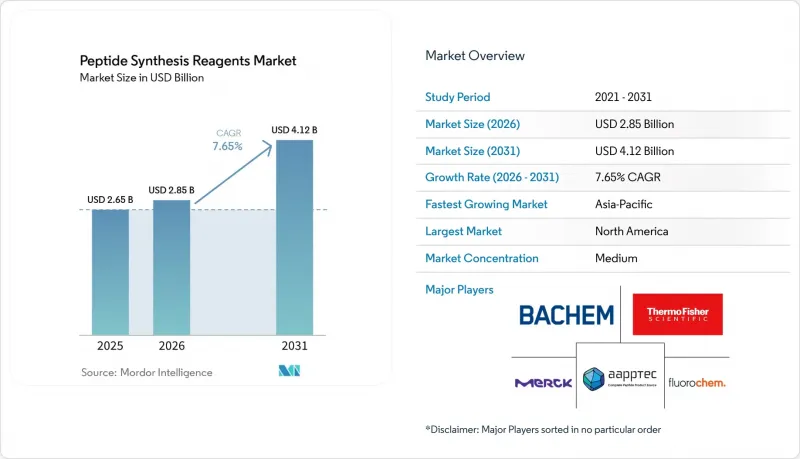
Mordor Intelligence에 의하면, 펩타이드 합성 시약 시장 규모는 2025년 26억 5,000만 달러로 평가되었고, 2026년에는 28억 5,000만 달러로 추정되고, 2026-2031년 CAGR 7.65%로 성장을 지속할 전망이며, 2031년까지 41억 2,000만 달러에 이를 것으로 예측됩니다.
본 보고서는 제품 유형별(보호 아미노산, 커플링 시약 등), 합성 방법별(고체상 펩타이드 합성(SPPS) 등), 용도별(치료용 펩타이드 제조, 진단용 펩타이드 등), 지역별(아시아태평양, 북미, 유럽, 기타 지역)로 분류되어 있습니다. 시장 전망은 금액(달러) 기준으로 제시되어 있습니다.
세계의 펩타이드 합성 시약 시장 동향 및 인사이트
펩타이드 치료제의 급속한 성장
펩타이드 의약품은 전체 분자에서 차지하는 비중은 여전히 작지만, 현재 전 세계 제약 업계에서 중요한 수익원이 되고 있습니다. 이 때문에 펩타이드 합성 시약 시장은 후기 단계의 치료제 개발 진행 상황과 밀접하게 연결되어 있습니다. 2025년에는 150종 이상의 펩타이드 후보 물질이 처음으로 임상시험 단계에 진입하여, 신약 발견, 개발 및 규모 확대 활동에 걸친 미래 시약 소비의 폭넓은 기반을 뒷받침하고 있습니다. 대사계 및 심혈관계 분야의 대규모 프로그램이 상업 생산 단계에 가까워짐에 따라, 각 합성 단계에서 보호기가 부착된 잔기나 커플링제를 반복적으로 사용해야 하므로 펩타이드 합성 시약 시장 수요는 급격히 증가합니다. 또한, 경구용 펩타이드 분야의 발전에 따라 필요한 원료의 구성도 변화하고 있습니다. 개발자들은 복잡한 생체 이용률 전략을 뒷받침하기 위해 더 높은 순도의 구성 요소와 더 엄격한 공정 관리를 필요로 하기 때문입니다. 이 때문에 펩타이드 합성 시약 시장은 단순히 분자 수뿐만 아니라 파이프라인의 질과 제조 준비 상황에 대해 더 민감하게 반응하고 있습니다.
위탁 개발·제조 기관(CDMO) 서비스의 확대
펩타이드 합성 시약 시장은 각 제조업체가 지역을 넘어 합성 거점을 확대하고 공정 역량을 확충해 나가는 가운데, 펩타이드 CDMO의 새로운 성장 국면에 힘입어 성장하고 있습니다. Bachem사는 2026년에 부벤도르프의 ‘Building K’ 가동을 본격화할 예정이며, 이를 통해 최첨단 API(유효 성분)의 대규모 생산 능력이 강화되어 펩타이드 원료에 대한 장기적인 구매 수요가 뒷받침될 것입니다. 2026년 5월 CordenPharma가 AmbioPharm 인수를 합의함에 따라 미국과 중국에 제조 거점이 추가되어 펩타이드 공급의 지역적 분포가 변화함과 동시에, 더욱 광범위한 세계 생산 네트워크가 강화될 것입니다. 파마블록의 저장성 내 첫 GMP 준수 파일럿 규모 펩타이드 공장이 2026년 6월에 가동을 시작했습니다. 이 공장은 액상 합성, 연속 흐름 합성, 효소 보조 합성 기능을 갖추고 있어 상업 개발에 사용되는 시약의 선택 폭을 넓히고 있습니다. 그 결과, 펩타이드 합성 시약 시장은 등급 선정, 문서화 요건 및 선호되는 화학 플랫폼에 영향을 미칠 수 있는 소수의 주요 구매자들에 의해 점점 더 형성되고 있습니다.
고품질 합성 시약의 높은 비용
펩타이드 합성 시약 시장은 의약품 등급의 보호 아미노산과 특수 커플링제가 저등급 대체품보다 여전히 비싸기 때문에 뿌리 깊은 비용 장벽에 직면해 있습니다. 이러한 부담의 대부분은 정제 과정에서 비롯되며, 펩타이드 제조업체의 보고에 따르면 정제 비용은 총 제조 비용의 50%에서 60%를 차지할 수 있고, 기존의 C18 법을 사용할 경우 정제된 유효 성분(API) 1Kg당 상당한 양의 용매를 소비할 가능성이 있습니다. 제조업체가 저사양 원료를 선택하면 이러한 비용 압박은 더욱 심해집니다. 결합이 불완전해지거나 라세미화가 진행되어 추가 정제 공정이 필요할 수 있기 때문입니다. 이러한 영향은 펩타이드가 길거나, 변형되었거나, 또는 고리형 펩타이드인 경우에 특히 두드러집니다. 이러한 경우 시약 사용량이 늘어날 뿐만 아니라, 합성 오류를 수정하는 데 드는 비용도 높아집니다. 그 결과, 시장 성장은 고객 그룹에 따라 편차가 나타나며, 소규모 제조업체나 예산이 제한된 연구소는 대규모 상업용 펩타이드 제조업체보다 총비용 압박에 더 취약한 상황에 놓이게 됩니다.
부문 분석
2025년, 보호 아미노산은 펩타이드 합성 시약 시장 점유율의 33.47%를 차지했으며, 이는 고상 및 액상 합성 경로 모두에서 널리 사용되고 있음을 반영합니다. 모든 펩타이드 개발 프로그램에서 보호 잔기의 반복적인 도입이 필수적이며, 대규모 글루카곤 유사 펩타이드-1(GLP-1) 개발 프로그램의 경우 긴 서열과 높은 생산량으로 인해 그 필요성이 더욱 증가함에 따라, 보호 아미노산에 대한 수요는 계속해서 높은 수준을 유지하고 있습니다. 커플링 시약은 2031년까지 연평균 성장률(CAGR) 8.41%를 나타낼 것으로 예측되며, 펩타이드 합성 시약 시장에서 가장 빠르게 성장하는 제품 카테고리가 될 전망입니다. 2025년 연구에 따르면, 친환경 2성분 용매와 함께 사용되는 커플링 시약 TBEC는 기존의 디메틸포름아미드(DMF) 기반 방법과 동등한 릴라글루티드 합성 수율을 달성하여 차세대 시약 시스템에 대한 상업적 관심을 뒷받침하고 있습니다.
펩타이드 합성 수지는 고상 펩타이드 합성(SPPS)에 필요한 고상 지지체를 제공하며, SPPS가 상업 생산의 주류를 이루는 한 그 중요성을 유지할 것이기 때문에 여전히 3위 제품 카테고리를 차지하고 있습니다. 실리카계 비팽윤성 수지 시스템은 용매 사용량을 줄이고, 펩타이드 합성 시약 업계 일부에서 채택되고 있는 플로우 기반 처리 플랫폼과의 친화성이 높아 관심이 높아지고 있습니다. 보호 시약 및 합성 첨가제는 수량 기준으로는 비교적 작은 카테고리이지만, 안전성, 안정성 및 확립된 규제 승인이 중요한 분야에서 더 큰 가치 잠재력을 지니고 있습니다. 용매 및 보조 시약의 경우, 각 제조업체가 DMF 대체품을 평가하고 있어 단기적인 압박에 직면해 있습니다. 후지필름 와코는 더 높은 순도 보증과 공급 신뢰성을 요구하는 고객을 지원하기 위해 2025년에 GMP 준수 ‘CertiPro’ 제품 라인을 확충했습니다.
지역별 분석
2025년, 북미는 펩타이드 합성 시약 시장 점유율의 39.82%를 차지했으며, 지역별로는 가장 큰 기여도를 보였습니다. 이 지역은 미국에 제약 회사, 생명공학 기업 및 대규모 펩타이드 위탁 개발·제조 기관(CDMO)이 밀집해 있다는 이점이 있습니다. 이러한 집적 덕분에 펩타이드 합성 시약 시장에서 GMP 등급의 아미노산 유도체, 커플링제, 수지 및 문서화가 완료된 특수 원료에 대한 안정적인 수요가 뒷받침되고 있습니다. 상업적 투자도 활발하며, 2026년에 바켐(Bakem)사가 지속적인 사업 확장을 진행하고 있는 것은 북미가 기존 개발 기반에 더해 펩타이드 제조 역량을 계속해서 유치하고 있음을 보여줍니다. 캐나다는 확립된 생명과학 산업이 집중된 주를 중심으로 한 학술 연구 활동 및 수탁 개발 업무를 통해, 점유율은 작지만 성장을 이어가고 있습니다.
아시아태평양은 2031년까지 연평균 성장률(CAGR) 9.03%로 확대될 것으로 예측되며, 펩타이드 합성 시약 시장에서 가장 빠르게 성장하는 지역이 될 전망입니다. 중국은 광범위한 시약 제조거점을 통해 이러한 성장 속도를 뒷받침하고 있습니다. GL Biochem사는 전 세계 5곳에 제조 거점을 운영하며, 10,000종 이상의 펩타이드 시약 및 빌딩 블록을 상품화하고 있습니다. 또한, 이 지역은 PharmaBlock사의 저장성 GMP 공장이 보여주듯이, 액상 합성, 연속 흐름 합성 및 효소 보조 합성 능력을 추가하는 등 펩타이드 제조 설비의 확충을 통해 혜택을 받고 있습니다. 일본은 특수 시약에 대한 깊은 전문성을 무기로 독자적인 입지를 유지하고 있으며, 크래프턴 바이오테크놀러지와 후지필름 와코가 2026년에 체결한 새로운 포스포라미다이트 시약에 관한 합의는 인접한 고순도 합성 분야에서 일본의 중요성을 부각시키고 있습니다. 또한, 인도와 한국도 고객이 펩타이드 합성 시약 시장에서 비용 경쟁력이 있고 기술적으로 우수한 생산 옵션을 추구하는 가운데 그 위상을 높이고 있습니다.
유럽은 독일, 영국, 프랑스의 제약 클러스터에 힘입어 펩타이드 합성 시약 시장에서 확고한 지역 거점으로서의 지위를 유지하고 있습니다. 코덴파마(Cordenpharma)의 무텐츠 공장 프로젝트는 현재 주기에서 중요한 지역 인프라 구축 노력의 일환이며, 유럽이 미래의 펩타이드 생산 능력을 위해 지속적으로 투자하고 있음을 보여줍니다. 독일의 특수 화학제품 생태계는 아미노산 유도체, 시약 키트, 연구용 재료를 공급함으로써 지역 수요를 뒷받침하고 있습니다. 세계 기타 지역은 여전히 규모가 작고 발전 초기 단계에 있지만, 수요는 학술 연구 및 기초 의약품 제조에 집중되어 있습니다. 다만, 중동 일부 지역의 의료 분야 투자가 GMP 준수 공급을 위한 새로운 기회를 창출하기 시작하고 있습니다.
기타 혜택 :
- 엑셀 형식 시장 예측(ME) 시트
- 3개월간의 애널리스트 지원
자주 묻는 질문
목차
제1장 서론
제2장 조사 방법
제3장 주요 요약
제4장 시장 구도
제5장 시장 규모 및 성장 예측
제6장 경쟁 구도
제7장 시장 기회 및 향후 전망
AJY 26.09.03According to Mordor Intelligence, the peptide synthesis reagents market size is expected to grow from USD 2.65 billion in 2025 to USD 2.85 billion in 2026 and is forecast to reach USD 4.12 billion by 2031 at 7.65% CAGR over 2026-2031.
This report is Segmented by Product Type (Protected Amino Acids, Coupling Reagents, and More), Synthesis Method (Solid-Phase Peptide Synthesis (SPPS) and More), Application (Therapeutic Peptide Manufacturing, Diagnostic Peptides, and More), and Geography (Asia-Pacific, North America, Europe, and Rest of the World). The Market Forecasts are Provided in Terms of Value (USD).
Global Peptide Synthesis Reagents Market Trends and Insights
Rapid Growth of Peptide Therapeutics
Peptide drugs now represent a meaningful revenue stream in global pharmaceuticals, although they remain a smaller share of total molecules. This keeps the peptide synthesis reagents market closely tied to late-stage therapeutic progress. More than 150 peptide candidates entered clinical trials for the first time in 2025, supporting a broad base of future reagent consumption across discovery, development, and scale-up activities. Demand in the peptide synthesis reagents market rises sharply as high-volume metabolic or cardiovascular programs move closer to commercial production, as they consume repeated equivalents of protected residues and coupling agents at each synthesis step. Progress in oral peptides also changes the mix of required inputs, since developers need cleaner building blocks and tighter process control to support complex bioavailability strategies. This makes the peptide synthesis reagents market more sensitive to pipeline quality and manufacturing readiness than to molecule count alone.
Expansion of Contract Development and Manufacturing Organization (CDMO) Services
The peptide synthesis reagents market is being supported by a new phase of peptide CDMO expansion, as manufacturers expand their synthesis footprints and broaden their process capabilities across regions. Bachem is ramping up Building K in Bubendorf in 2026, which strengthens large-scale production capacity for modern APIs and reinforces long-duration purchasing demand for peptide inputs. CordenPharma's agreement to acquire AmbioPharm in May 2026 adds manufacturing sites in the United States and China, shifting the geography of peptide supply and strengthening a broader global production network. PharmaBlock's first GMP pilot-scale peptide plant in Zhejiang became operational in June 2026, with liquid-phase, continuous-flow, and enzyme-assisted capabilities that broaden the reagent basket used in commercial development. As a result, the peptide synthesis reagents market is increasingly shaped by a smaller number of large buyers that can influence grade selection, documentation needs, and preferred chemistry platforms.
High Cost of Premium Synthesis Reagents
The peptide synthesis reagents market faces a persistent cost barrier, as pharmaceutical-grade protected amino acids and specialty coupling agents remain more expensive than lower-grade alternatives. Purification accounts for a significant portion of this burden, with peptide manufacturers reporting that it can account for 50% to 60% of total manufacturing costs and that conventional C18 methods can consume substantial solvent volumes per kilogram of purified Active Pharmaceutical Ingredient (API). This cost pressure intensifies when manufacturers select lower-specification inputs, as incomplete coupling and higher racemization can increase the need for additional purification cycles. The impact is more pronounced for long, modified, or cyclic peptides, where reagent loads are heavier and each synthesis error is more costly to correct. As a result, market growth is uneven across customer groups, with smaller manufacturers and budget-constrained laboratories more exposed to total cost pressure than large commercial peptide producers.
Other drivers and restraints analyzed in the detailed report include:
- Rising Pharmaceutical Research and Development (R&D) Expenditure
- Technological Advancements in Peptide Synthesis
- Regulatory and Quality Compliance Challenges
For complete list of drivers and restraints, kindly check the Table Of Contents.
Segment Analysis
Protected amino acids held 33.47% of the peptide synthesis reagents market share in 2025, reflecting their universal use across both solid-phase and liquid-phase synthesis routes. Their demand remains high because every peptide program relies on repeated incorporation of protected residues, and large glucagon-like peptide-1 (GLP-1) programs multiply that requirement across long sequences and high production volumes. Coupling reagents are projected to grow at an 8.41% CAGR through 2031, making them the fastest-growing product category in the peptide synthesis reagents market. A 2025 study showed that the coupling reagent TBEC, used with green binary solvents, delivered liraglutide synthesis yields comparable to those of conventional dimethylformamide (DMF)-based methods, supporting commercial interest in next-generation reagent systems.
Peptide synthesis resins remained the third-largest product category, as they provide the solid support needed for solid-phase peptide synthesis (SPPS) and continue to be relevant as long as SPPS dominates commercial production. Interest is rising in silica-based non-swelling resin systems, as they reduce solvent requirements and align more closely with flow-based processing platforms used in parts of the peptide synthesis reagents industry. Protecting reagents and synthesis additives represent a smaller category by volume, but offer greater value potential where safety, stability, and established regulatory acceptance are important. Solvents and auxiliary reagents face near-term pressure as manufacturers evaluate DMF alternatives. FUJIFILM Wako expanded its CertiPro GMP-compliant line in 2025 to support customers requiring stronger purity assurance and supply reliability.
Complete Report Scope:
- By Product Type
- Protected Amino Acids
- Coupling Reagents
- Peptide Synthesis Resins
- Protecting Reagents
- Peptide Synthesis Additives
- Solvents and Auxiliary Reagents
- By Synthesis Method
- Solid-Phase Peptide Synthesis (SPPS)
- Liquid-Phase Peptide Synthesis (LPPS)
- Hybrid Peptide Synthesis
- By Application
- Therapeutic Peptide Manufacturing
- Pharmaceutical API Synthesis
- Drug Discovery and Development
- Academic and Research
- Diagnostic Peptides
- Vaccine Development
- Cosmetic Peptides
- Other Applications
- By Geography
- Asia-Pacific
- China
- India
- Japan
- South Korea
- Rest of Asia-Pacific
- North America
- United States
- Canada
- Europe
- Germany
- United Kingdom
- France
- Italy
- Russia
- Rest of Europe
- Rest of the World
- South America
- Middle-East and Africa
- Asia-Pacific
Geography Analysis
North America held 39.82% of the peptide synthesis reagents market share in 2025, making it the largest regional contributor. The region benefits from a dense concentration of pharmaceutical companies, biotechnology firms, and large peptide Contract Development and Manufacturing Organizations (CDMOs) across the United States. This concentration supports steady demand for GMP-grade amino acid derivatives, coupling systems, resins, and documentation-ready specialty inputs in the peptide synthesis reagents market. Commercial investment remains active, and Bachem's ongoing expansion in 2026 indicates that North America continues to attract peptide manufacturing capacity alongside its existing development base. Canada contributes a smaller but growing share through academic research activity and contract development work centered in established life sciences provinces.
Asia-Pacific is forecast to expand at a 9.03% CAGR through 2031, making it the fastest-growing region in the peptide synthesis reagents market. China supports this pace through its broad reagent manufacturing base; GL Biochem operates 5 global manufacturing sites and has commercialized more than 10,000 peptide reagents and building blocks. The region is also benefiting from a broader peptide manufacturing build-out, as demonstrated by PharmaBlock's Zhejiang GMP plant, which adds liquid-phase, continuous-flow, and enzyme-assisted synthesis capabilities. Japan maintains a distinct position through its depth in specialty reagents, and a 2026 agreement between Crafton Biotechnology and FUJIFILM Wako on a novel phosphoramidite reagent highlights its relevance in adjacent high-purity synthesis fields. India and South Korea are also improving their standing as customers seek cost-competitive, technically capable production options within the peptide synthesis reagents market.
Europe remains an established regional base in the peptide synthesis reagents market, supported by pharmaceutical clusters in Germany, the United Kingdom, and France. CordenPharma's Muttenz facility project represents a significant regional infrastructure commitment in the current cycle, indicating that Europe continues to invest in future peptide capacity. Germany's specialty chemistry ecosystem supports regional demand by supplying amino acid derivatives, reagent kits, and research-use materials. The Rest of the World remains smaller and earlier in development, with demand concentrated in academic research and basic pharmaceutical manufacturing, although healthcare investment in parts of the Middle East is beginning to create new opportunities for GMP-oriented supply.
- AAPPTec
- AnaSpec, Inc.
- Bachem Inc.
- Biosolve Chimie
- BLD Pharmatech Ltd.
- Canpeptide Inc.
- Carl Roth GmbH + Co. KG
- Chem-Impex International
- CordenPharma International
- CS Bio Co.
- Enamine Ltd.
- Fluorochem Limited
- FUJIFILM Wako Pure Chemical Corporation
- GL Biochem (Shanghai) Ltd.
- IRIS Biotech GmbH
- Luxembourg Bio Technologies Ltd.
- Merck KGaA
- Suzhou Highfine Biotech Co., Ltd.
- Thermo Fisher Scientific Inc.
- Tokyo Chemical Industry Co., Ltd.
Additional Benefits:
- The market estimate (ME) sheet in Excel format
- 3 months of analyst support
TABLE OF CONTENTS
1 Introduction
- 1.1 Study Assumptions and Market Definition
- 1.2 Scope of the Study
2 Research Methodology
3 Executive Summary
4 Market Landscape
- 4.1 Market Overview
- 4.2 Market Drivers
- 4.2.1 Rapid Growth of Peptide Therapeutics and GLP-1 Drug Development
- 4.2.2 Increasing Adoption of Solid-Phase Peptide Synthesis (SPPS)
- 4.2.3 Rising Pharmaceutical and Biotechnology R and D Investments
- 4.2.4 Expansion of CDMO Services for Peptide Manufacturing
- 4.2.5 Technological Advancements in Automated Peptide Synthesizers
- 4.3 Market Restraints
- 4.3.1 High Cost of Premium Peptide Synthesis Reagents
- 4.3.2 Complex Multi-Step Peptide Manufacturing Processes
- 4.3.3 Regulatory and Quality Compliance Requirements
- 4.4 Value and Supply Chain Analysis
- 4.5 Porter's Five Forces Analysis
- 4.5.1 Threat of New Entrants
- 4.5.2 Bargaining Power of Suppliers
- 4.5.3 Bargaining Power of Buyers
- 4.5.4 Threat of Substitutes
- 4.5.5 Competitive Rivalry
5 Market Size and Growth Forecasts (Value)
- 5.1 By Product Type
- 5.1.1 Protected Amino Acids
- 5.1.2 Coupling Reagents
- 5.1.3 Peptide Synthesis Resins
- 5.1.4 Protecting Reagents
- 5.1.5 Peptide Synthesis Additives
- 5.1.6 Solvents and Auxiliary Reagents
- 5.2 By Synthesis Method
- 5.2.1 Solid-Phase Peptide Synthesis (SPPS)
- 5.2.2 Liquid-Phase Peptide Synthesis (LPPS)
- 5.2.3 Hybrid Peptide Synthesis
- 5.3 By Application
- 5.3.1 Therapeutic Peptide Manufacturing
- 5.3.2 Pharmaceutical API Synthesis
- 5.3.3 Drug Discovery and Development
- 5.3.4 Academic and Research
- 5.3.5 Diagnostic Peptides
- 5.3.6 Vaccine Development
- 5.3.7 Cosmetic Peptides
- 5.3.8 Other Applications
- 5.4 By Geography
- 5.4.1 Asia-Pacific
- 5.4.1.1 China
- 5.4.1.2 India
- 5.4.1.3 Japan
- 5.4.1.4 South Korea
- 5.4.1.5 Rest of Asia-Pacific
- 5.4.2 North America
- 5.4.2.1 United States
- 5.4.2.2 Canada
- 5.4.3 Europe
- 5.4.3.1 Germany
- 5.4.3.2 United Kingdom
- 5.4.3.3 France
- 5.4.3.4 Italy
- 5.4.3.5 Russia
- 5.4.3.6 Rest of Europe
- 5.4.4 Rest of the World
- 5.4.4.1 South America
- 5.4.4.2 Middle-East and Africa
- 5.4.1 Asia-Pacific
6 Competitive Landscape
- 6.1 Market Concentration
- 6.2 Strategic Moves
- 6.3 Market Share (%)/Ranking Analysis
- 6.4 Company Profiles (includes Global Overview, Market Overview, Core Segments, Financials as available, Strategic Information, Products and Services, and Recent Developments)
- 6.4.1 AAPPTec
- 6.4.2 AnaSpec, Inc.
- 6.4.3 Bachem Inc.
- 6.4.4 Biosolve Chimie
- 6.4.5 BLD Pharmatech Ltd.
- 6.4.6 Canpeptide Inc.
- 6.4.7 Carl Roth GmbH + Co. KG
- 6.4.8 Chem-Impex International
- 6.4.9 CordenPharma International
- 6.4.10 CS Bio Co.
- 6.4.11 Enamine Ltd.
- 6.4.12 Fluorochem Limited
- 6.4.13 FUJIFILM Wako Pure Chemical Corporation
- 6.4.14 GL Biochem (Shanghai) Ltd.
- 6.4.15 IRIS Biotech GmbH
- 6.4.16 Luxembourg Bio Technologies Ltd.
- 6.4.17 Merck KGaA
- 6.4.18 Suzhou Highfine Biotech Co., Ltd.
- 6.4.19 Thermo Fisher Scientific Inc.
- 6.4.20 Tokyo Chemical Industry Co., Ltd.
7 Market Opportunities and Future Outlook
- 7.1 White-Space and Unmet-Need Assessment


