

|
시장보고서
상품코드
2146282
변압기유 시장 예측(-2031년) : 오일 유형별(광물, 실리콘, 바이오 기반), 용도별, 최종사용자별, 지역별Transformer Oil Market by Oil Type [Mineral (Naphthenic, Paraffinic), Silicone, Bio-based], Application (Transformer, Switchgear, Reactor), End User (Transmission & Distribution, Power Generation, Railways & Metros), Region - Global Forecast to 2031 |
||||||

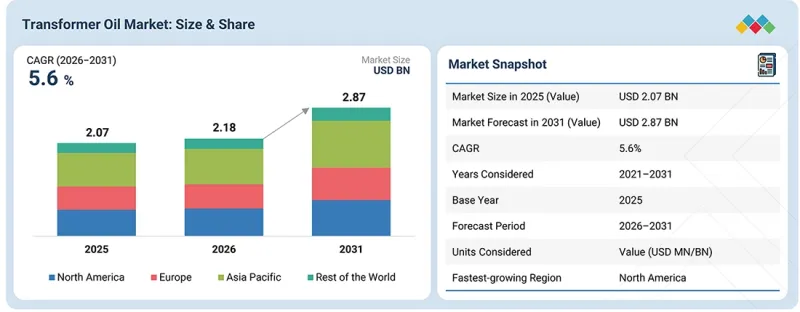
세계의 변압기유 시장은 2026년 21억 8,000만 달러에서 2031년까지 28억 7,000만 달러로, CAGR 5.6%로 확대할 것으로 예측됩니다.
이 시장의 성장은 송전 및 배전 네트워크에 대한 투자 증가, 발전 용량 확대, 그리고 재생 가능 에너지 및 산업 인프라와 관련된 변압기에 대한 수요 증가에 힘입고 있습니다.
| 조사 범위 | |
|---|---|
| 조사 대상 기간 | 2022-2031년 |
| 기준 연도 | 2025년 |
| 예측 기간 | 2026-2031년 |
| 산정 단위 | 금액(백만/십억 달러) |
| 부문 | 유형별, 용도별, 최종사용자별, 지역별 |
| 대상 지역 | 북미, 유럽, 아시아태평양, 기타 지역 |
전력 회사와 변압기 제조업체들도 송전망의 신뢰성을 높이고 증가하는 전력 부하에 대응하기 위해 대용량 및 고효율 변압기에 대한 투자를 추진하고 있습니다. 이와 동시에 변압기의 가동 조건이 더욱 까다로워지고 환경 및 안전 요건이 발전함에 따라 특수 절연유에 대한 수요도 증가하고 있습니다.
고전압 송전 인프라, 철도 전철화, 지하철망 및 송전망 확장에 대한 투자 확대는 변압기유 공급업체에게 더 많은 비즈니스 기회를 창출하고 있습니다. 선진국 시장 전반에 걸친 노후화된 변압기의 교체 및 개보수 또한 변압기유에 대한 지속적인 수요를 더욱 부추기고 있습니다. 동시에, 화재 안전성 및 환경 성능에 대한 관심이 높아짐에 따라 특히 도시 지역의 변전소, 재생 가능 에너지 시설 및 환경을 고려해야 하는 장소에서 바이오 기반 및 에스테르 기반 변압기유의 채택이 촉진되고 있습니다.
변압기 설계 및 절연유 분야의 기술 개발 또한 경쟁 구도를 변화시키고 있습니다. 각 제조사는 끊임없이 변화하는 고객 요구 사항을 충족하기 위해 절연 내력, 열 성능, 산화 안정성, 화재 안전성 및 생분해성 향상에 주력하고 있습니다. 고성능 바이오 기반 및 합성 절연유의 개발과 더불어, 변압기 모니터링 및 자산 관리 기술의 발전으로 전력 사업자는 변압기의 신뢰성과 가동 수명을 향상시킬 수 있게 되었습니다. 전력망이 더욱 복잡해지고 전력 인프라가 확대됨에 따라 변압기유은 신뢰성이 높고 견고한 전력 시스템에서 필수적인 구성 요소로 계속 남아 있을 것으로 예상됩니다.
"오일 유형별로는 광물유가 예측 기간 중 주도적인 위치를 유지할 것으로 전망됩니다."
예측 기간 중, 오일 유형별로는 광물유가 변압기유 시장에서 가장 큰 점유율을 차지할 것으로 예상됩니다. 발전용 및 배전용 변압기에서의 확고한 사용 실적, 비용 경쟁력, 입증된 절연 성능, 그리고 광범위한 입수 가능성 덕분에 광물유는 방대한 설치 기반에서 선호되는 절연유로 자리 잡고 있습니다. 전력 회사와 변압기 제조업체는 기존 변압기 설계 및 유지보수 관행과의 호환성 때문에 나프텐계 및 파라핀계 광물유를 널리 사용하고 있습니다. 변압기의 지속적인 설치, 노후화된 설비의 교체, 그리고 송전망의 확장으로 인해 광물유계 변압기유에 대한 수요는 지속될 것으로 예상됩니다. 특히 화재 안전성이나 환경 성능이 우선시되는 분야에서는 바이오 기반이나 에스테르계 절연유의 도입이 진행되고 있지만, 광물유의 방대한 도입 실적과 경제적 우위 덕분에 그 주도적인 지위는 유지될 것으로 전망됩니다.
"최종사용자별로는 예측 기간 중 변압기 분야에서 강력한 성장이 예상됩니다."
발전, 송전, 배전 인프라에 대한 투자 확대를 배경으로, 변압기는 예측 기간 중 가장 빠르게 성장하는 용도 부문이 될 것으로 전망됩니다. 전력 소비량 증가와 발전 용량 확대로 인해 선진국 및 신흥 시장을 불문하고 추가적인 전력 변압기 및 배전 변압기에 대한 수요가 높아지고 있습니다. 재생 가능 에너지 도입 확대에 따라 발전 설비를 송전·배전 네트워크로 연결하는 데 필요한 변압기 수요가 더욱 증가하고 있습니다. 또한 노후화된 변압기의 교체 및 고압 송전 시스템의 확장이 변압기유 공급업체에게 비즈니스 기회를 창출하고 있습니다. 이러한 동향에 따라 신규 변압기 설치뿐만 아니라 유지보수, 개보수, 교체 작업에 사용되는 절연유 수요도 증가할 것으로 예상됩니다.
주요 조사 대상의 내역:
중요한 정성적·정량적 정보를 수집·검증하고, 향후 시장 전망을 평가하기 위해 주요 업계 관계자, 전문가 외에도 주요 시장 참여 기업의 경영진 및 이사 등을 대상으로 상세한 인터뷰를 시행했습니다. 주요인터뷰 대상은 다음과 같습니다. :
기업 유형별: Tier 1(65%), Tier 2(24%), Tier 3(11%)
직책별: C레벨 임원(30%), 이사(25%), 기타(45%)
지역별: 북미(25%), 유럽(30%), 아시아태평양(35%), 기타 지역(10%)
변압기유 시장은 주로 유서 깊은 기술 기업과 제조업체들이 주도하고 있습니다. 이 보고서에 소개된 주요 기업 개요에는 Nynas AB(스웨덴), APAR Industries(인도), Calumet Specialty Products Partners, L.P.(미국), Cargill, Incorporated(미국), Phillips 66 Company(미국), Dow(미국), Repsol(스페인), Chevron Corporation(미국), Gandhar Oil Refinery(India) Limited(인도), PetroChina Company Limited(중국), Sasol(남아프리카공화국), Exxon Mobil Corporation(미국), Shell(영국) 등이 있습니다. 이들 기업의 강력한 제조 거점, 기술적 리더십, 그리고 지역내 생산 능력 확대를 위한 지속적인 투자가 경쟁 구도를 계속해서 형성하고 있습니다.
조사 범위:
이 보고서에서는 오일 유형별 [광물유(나프텐계 및 파라핀계), 바이오 기반 오일, 실리콘 오일], 용도(변압기, 리액터, 개폐기),최종사용자(송전·배전, 철도·지하철, 발전, 기타 최종사용자) 및 지역(북미, 유럽, 아시아태평양, 기타 지역)별로 변압기유 시장에 대한 포괄적인 정의, 설명 및 예측을 제공합니다. 또한 시장 촉진요인 및 과제에 대한 정성적 및 정량적 분석도 제시하고 있습니다. 아울러 본 조사에서는 시장 규모 추정 및 예측, 기술 동향, 제품 개발, 경쟁 구도 평가, 생태계 분석, 상업적 활용 사례, 기업 벤치마킹 및 최근 동향에 대해서도 다루고 있으며, 전 세계 변압기유 시장에 대한 포괄적인 관점을 제공합니다.
이 보고서를 구매할 때의 주요 이점
이 보고서는 변압기 제조업체, 변압기유 공급업체, 공공사업체, 발전 회사, 철도 사업자, 정책 입안자, 투자자 및 기타 업계 이해관계자들이 끊임없이 변화하는 변압기유 시장을 이해하는 데 도움이 됩니다. 주요 부문 및 지역에 걸친 신뢰할 수 있는 시장 예측 외에도, 제품 채택 현황, 기술 개발, 경쟁 포지셔닝 및 향후 성장 기회에 대한 인사이트를 제공합니다. 이 보고서는 상세한 시장 정보와 전략적 분석을 통해 이해관계자들이 정보에 기반한 비즈니스 의사결정을 내릴 수 있도록 지원합니다.
- 주요 시장 역학 동향 분석: 송전 및 배전 네트워크 확장, 전력 수요 증가, 변압기 교체 및 개보수, 재생 가능 에너지 통합, 철도 전철화 등 주요 촉진요인을 포괄하고 있습니다. 또한 기유 가격 변동, 특수 유체 및 바이오 기반 유체의 비용 상승, 엄격한 성능 요건과 같은 제약 요인도 다루고 있습니다. 기회로는 에스테르계 변압기유의 채택, 송전망 현대화, 재생 가능 에너지 인프라, 고전압 송전 프로젝트 등이 있습니다. 또한 과제로는 환경 규제, 공급망에 대한 의존도, 대체 절연 기술과의 경쟁 등이 있습니다.
- 기술 및 제품 혁신: 절연 내력, 열 성능, 산화 안정성, 화재 안전성 및 생분해성을 향상시키도록 설계된 고성능 광물유, 천연 및 합성 에스테르계 유체, 실리콘계 변압기유, 그리고 친환경 절연 유체의 발전에 대해 검토하고 있습니다.
- 시장 발전: 송전망 확장, 재생 가능 에너지 발전, 고전압 송전 프로젝트, 변압기 교체 프로그램, 그리고 철도 및 지하철 전철화에 대한 투자 확대가 전력 인프라 및 전기 기기 전반에 걸쳐 변압기유에 대한 새로운 수요를 창출하고 있다는 점을 강조합니다.
- 시장의 다각화: 기존의 전력 변압기에 그치지 않고, 개폐기, 리액터, 견인용 변압기, 재생 가능 에너지 설비, 기타 특수 전기 기기 등으로의 변압기유 용도 확대를 평가하며, 변압기유 제조사 및 공급업체에게 새로운 수익 기회가 창출되고 있음을 보여줍니다.
- 경쟁 상황 평가: Nynas AB(스웨덴), APAR Industries(인도), Calumet Specialty Products Partners, L.P.(미국), Cargill, Incorporated(미국), Phillips 66 Company(미국), Dow(미국), Repsol(스페인), Chevron Corporation(미국), Gandhar Oil Refinery(India) Limited(인도), PetroChina Company Limited(중국), Sasol(남아프리카공화국), Exxon Mobil Corporation(미국), Shell(영국)과 같은 주요 기업에 대해 제품 포트폴리오, 전략적 구상, 기술력 및 경쟁적 위치를 포괄하는 상세한 분석을 제공합니다.
자주 묻는 질문
목차
제1장 서론
제2장 요약
제3장 주요 인사이트
- 변압기유 시장에서 사업자에게 매력적인 비즈니스 기회
- 변압기유 시장: 오일 유형별·지역별
- 변압기유 시장: 오일 유형별
- 용도별 변압기유 시장
- 변압기유 시장: 최종사용자별
- 지역별 변압기유 시장
제4장 시장 개요
- 시장 역학
- 촉진요인
- 억제요인
- 기회
- 과제
- 상호 연관된 시장 및 부문 간 기회
- 부문 간 기회
- 시장 지도
제5장 업계 동향
- Porter's Five Forces 분석
- 신규 진입자의 위협
- 공급업체의 협상력
- 구매자의 협상력
- 대체품의 위협
- 경쟁 기업 간의 적대적 관계
- 밸류체인 분석
- 원자재 공급업체
- 변압기용 오일 생산자
- 장비 제조업체
- 판매 대리점
- 최종사용자
- 가격 분석
- 오일 유형별 평균 판매 가격 분석
- 고객의 사업에 영향을 미치는 동향 및 혼란
- 사례 분석
- 타타 파워는 공간 및 안전에 대한 우려를 해소하고, 비용과 환경에 미치는 영향을 줄이기 위해 뭄바이에 배전용 변압기를 설치했습니다
- 재생 가능 에너지의 발전 및 청정 에너지로의 전환이 변압기유 시장에 미치는 영향
- 전기자동차(EV)의 보급 및 전기자동차 인프라 구축이 변압기유 시장에 미치는 영향
- 기술 분석
- 규제
제6장 변압기유 시장: 오일 유형별
- 광물유
- 바이오 기반 오일
- 실리콘 오일
제7장 변압기유 시장: 최종사용자별
- 송전·배전 사업자
- 철도·지하철
- 발전 사업자
- 기타
제8장 변압기유 시장: 용도별
- 변압기
- 리액터
- 개폐기
제9장 변압기유 시장: 지역별
- 아시아태평양
- 오일 유형별
- 용도별
- 최종사용자별
- 국가별
- 북미
- 오일 유형별
- 용도별
- 최종사용자별
- 국가별
- 유럽
- 오일 유형별
- 광물유 - 하위 오일 유형별
- 광물유 - 억제 유형별
- 용도별
- 최종사용자별
- 국가별
- 영국
- 전력망 투자 확대와 재생 가능 에너지 통합이 시장 성장을 촉진
- 석유 유형별
- 광물유 - 하위 오일 유형별
- 용도별
- 최종사용자별
- 독일
- 에너지 전환과 재생 가능 에너지 도입이 시장 성장을 가속화할 것
- 오일 유형별
- 광물유 - 하위 오일 유형별
- 용도별
- 최종사용자별
- 러시아
- 시장 성장을 지원하는 송전망 현대화 및 변압기 용량 확대
- 오일 유형별
- 광물유 - 오일 유형별
- 용도별
- 최종사용자별
- 프랑스
- 시장 성장을 가속화하는 송전망 강화 및 전기화
- 석유 유형별
- 광물유 - 오일 유형별
- 용도별
- 최종사용자별
- 기타 유럽
- 오일 유형별
- 광물유 - 오일 유형별
- 용도별
- 최종사용자별
- 기타
- 오일 유형별
- 용도별
- 최종사용자별
- 지역별
제10장 경쟁 현황
- 개요
- 주요 진입 기업의 전략/강점, 2023년 1월-2026년 8월
- 수익 분석, 2021-2025년
- 시장 점유율 분석, 2025년
- 브랜드 비교
- NYNAS AB(스웨덴)
- ETROCHINA COMPANY LIMITED(중국)
- APAR INDUSTRIES(인도)
- SHELL(영국)
- ERGON, INC.(미국)
- 기업 평가 매트릭스: 주요 기업, 2025년
- 스타
- 신흥 리더
- 광범위한 참여 기업
- 진입 기업
- 경쟁 시나리오
- 신제품 출시
- 거래
- 사업 확장
제11장 기업 개요
- 주요 기업
- NYNAS AB
- ERGON, INC.
- PETROCHINA COMPANY LIMITED
- APAR INDUSTRIES LIMITED
- SHELL
- CALUMET SPECIALTY PRODUCTS PARTNERS, L.P.
- SINOPEC LUBRICANT COMPANY
- CARGILL, INCORPORATED.
- EXXON MOBIL CORPORATION
- GULF OIL INTERNATIONAL LTD
- PHILLIPS 66 COMPANY
- DOW
- REPSOL
- CHEVRON CORPORATION
- SAVITA
- 기타 주요 기업
- GANDHAR OIL REFINERY(INDIA)LIMITED
- HYDRODEC GROUP PLC
- ENGEN PETROLEUM LIMITED
- LUBRITA
- PETRO-CANADA
제12장 조사 방법론
제13장 부록
KSA 26.10.19The global transformer oil market is projected to grow from USD 2.18 billion in 2026 to USD 2.87 billion by 2031, at a CAGR of 5.6%. Market growth is supported by increasing investment in electricity transmission and distribution networks, expanding power generation capacity, and rising demand for transformers linked to renewable energy and industrial infrastructure.
| Scope of the Report | |
|---|---|
| Years Considered for the Study | 2022-2031 |
| Base Year | 2025 |
| Forecast Period | 2026-2031 |
| Units Considered | Value (USD Million/Billion) |
| Segments | by Type, by Application, End-User, Region |
| Regions covered | North America, Europe, Asia Pacific, Rest of the World |
Utilities and transformer manufacturers are also investing in higher-capacity and more efficient transformers to improve grid reliability and accommodate growing electricity loads. In parallel, demand for specialized insulating fluids is increasing as transformer operating conditions become more demanding and environmental and safety requirements evolve.
Growing investments in high-voltage transmission infrastructure, railway electrification, metro networks, and grid expansion are creating additional opportunities for transformer oil suppliers. The replacement and refurbishment of aging transformers across developed markets are further generating recurring demand for insulating fluids. At the same time, increasing attention to fire safety and environmental performance is supporting the adoption of bio-based and ester-based transformer oils, particularly in urban substations, renewable energy installations, and environmentally sensitive locations.
Technological developments in transformer design and insulating fluids are also transforming the competitive landscape. Manufacturers are focusing on improved dielectric strength, thermal performance, oxidation stability, fire safety, and biodegradability to meet evolving customer requirements. The development of high-performance bio-based and synthetic fluids, together with advancements in transformer monitoring and asset-management technologies, is enabling utilities to improve transformer reliability and operating life. As power networks become more complex and electricity infrastructure expands, transformer oil is expected to remain an essential component of reliable and resilient electrical systems.
"By oil type, mineral oil is expected to maintain its leading position throughout the forecast period."
Mineral oil is expected to account for the largest share of the transformer oil market by oil type throughout the forecast period. Its established use across power and distribution transformers, cost competitiveness, proven dielectric performance, and widespread availability make it the preferred insulating fluid across a large installed base. Utilities and transformer manufacturers widely use naphthenic and paraffinic mineral oils because they are compatible with existing transformer designs and maintenance practices. Continued transformer installations, replacement of aging equipment, and grid expansion are expected to sustain demand for mineral-based transformer oils. Although bio-based and ester fluids are gaining adoption, particularly where fire safety and environmental performance are priorities, the large installed base and economic advantages of mineral oil are expected to preserve its leading position.
"By end user, transformers are expected to witness strong growth during the forecast period."
Transformers are expected to be the fastest-growing application segment during the forecast period, driven by rising investments in power generation, transmission, and distribution infrastructure. Increasing electricity consumption and expanding generation capacity are driving demand for additional power and distribution transformers across developed and emerging markets. The growing deployment of renewable energy is further increasing demand for transformers required to connect generation assets to transmission and distribution networks. In addition, replacing aging transformer fleets and expanding high-voltage transmission systems are creating opportunities for transformer oil suppliers. These trends are expected to increase demand for insulating fluids used during new transformer installations as well as maintenance, refurbishment, and replacement activities.
Breakdown of Primaries:
In-depth interviews with key industry participants, subject-matter experts, C-level executives of key market players, and directors, among others, were conducted to obtain and verify critical qualitative and quantitative information and assess future market prospects. The primary interviews were distributed as follows:
By Company Type: Tier 1 (65%), Tier 2 (24%), and Tier 3 (11%)
By Designation: C-level Executives (30%), Directors (25%), and Others (45%)
By Region: North America (25%), Europe (30%), Asia Pacific (35%), and the Rest of the World (10%)
Well-established technology companies and manufacturers predominantly govern the transformer oil market. Key players profiled in the report include Nynas AB (Sweden), APAR Industries (India), Calumet Specialty Products Partners, L.P. (US), Cargill, Incorporated (US), Phillips 66 Company (US), Dow (US), Repsol (Spain), Chevron Corporation (US), Gandhar Oil Refinery (India) Limited (India), PetroChina Company Limited (China), Sasol (South Africa), Exxon Mobil Corporation (US), and Shell (UK). Their strong manufacturing footprints, technology leadership, and continued investments in regional capacity expansion continue to shape the competitive landscape.
Research Coverage:
The report provides a comprehensive definition, description, and forecast of the transformer oil market by oil type [mineral oil (naphthenic and paraffinic), bio-based oil, and silicone oil], application (transformers, reactors, and switchgears), end user (transmission & distribution, railways & metros, power generation, and other end users), and region (North America, Europe, Asia Pacific, and the Rest of the World). It delivers qualitative and quantitative analysis of market drivers, restraints, opportunities, and challenges. The study also includes market sizing and forecasts, technology trends, product developments, competitive landscape assessment, ecosystem analysis, commercial use cases, company benchmarking, and recent developments to provide a comprehensive view of the global transformer oil market.
Key Benefits of Buying the Report
The report helps transformer manufacturers, transformer oil suppliers, utilities, power generation companies, railway operators, policymakers, investors, and other industry stakeholders understand the evolving transformer oil market. It provides reliable market forecasts across major segments and regions, along with insights into product adoption, technology developments, competitive positioning, and future growth opportunities. The report enables stakeholders to make informed business decisions through detailed market intelligence and strategic analysis.
- Analysis of key market dynamics: Covers major drivers such as expansion of transmission and distribution networks, rising electricity demand, transformer replacement and refurbishment, renewable energy integration, and railway electrification; restraints including volatility in base oil prices, higher cost of specialty and bio-based fluids, and stringent performance requirements; opportunities such as adoption of ester-based transformer oils, grid modernization, renewable energy infrastructure, and high-voltage transmission projects; and challenges including environmental regulations, supply chain dependencies, and competition from alternative insulating technologies.
- Technology and Product Innovation: Examines advancements in high-performance mineral oils, natural and synthetic ester fluids, silicone-based transformer oils, and environmentally preferable insulating fluids designed to improve dielectric strength, thermal performance, oxidation stability, fire safety, and biodegradability.
- Market Development: Highlights how grid expansion, renewable power generation, high-voltage transmission projects, transformer replacement programs, and increasing investments in railway and metro electrification are creating new demand for transformer oils across power infrastructure and electrical equipment applications.
- Market Diversification: Evaluates the expanding use of transformer oils beyond conventional power transformers across switchgear, reactors, traction transformers, renewable energy installations, and other specialized electrical equipment, creating additional revenue opportunities for transformer oil manufacturers and suppliers.
- Competitive Assessment: Provides detailed analysis of leading companies including Nynas AB (Sweden), APAR Industries (India), Calumet Specialty Products Partners, L.P. (US), Cargill, Incorporated (US), Phillips 66 Company (US), Dow (US), Repsol (Spain), Chevron Corporation (US), Gandhar Oil Refinery (India) Limited (India), PetroChina Company Limited (China), Sasol (South Africa), Exxon Mobil Corporation (US), and Shell (UK), covering their product portfolios, strategic initiatives, technological capabilities, and competitive positioning.
TABLE OF CONTENTS
1 INTRODUCTION
- 1.1 STUDY OBJECTIVES
- 1.2 MARKET DEFINITION
- 1.3 STUDY SCOPE.
- 1.3.1 MARKETS COVERED AND REGIONAL SCOPE
- 1.3.2 INCLUSIONS AND EXCLUSIONS
- 1.3.3 YEARS CONSIDERED
- 1.4 CURRENCY CONSIDERED
- 1.5 UNIT CONSIDERED
- 1.6 LIMITATIONS
- 1.7 STAKEHOLDERS
- 1.8 SUMMARY OF CHANGES
2 EXECUTIVE SUMMARY
- 2.1 MARKET HIGHLIGHTS AND KEY INSIGHTS
- 2.2 KEY MARKET PARTICIPANTS: MAPPING OF STRATEGIC DEVELOPMENTS
- 2.3 DISRUPTIVE TRENDS IN TRANSFORMER OIL MARKET
- 2.4 HIGH GROWTH SEGMENTS
- 2.5 REGIONAL SNAPSHOT: MARKET SIZE, GROWTH RATE, AND FORECAST
3 PREMIUM INSIGHTS
- 3.1 ATTRACTIVE OPPORTUNITIES FOR PLAYERS IN TRANSFORMER OIL MARKET
- 3.2 TRANSFORMER OIL MARKET, BY OIL TYPE AND REGION
- 3.3 TRANSFORMER OIL MARKET, BY OIL TYPE
- 3.4 TRANSFORMER OIL MARKET, BY APPLICATION
- 3.5 TRANSFORMER OIL MARKET, BY END USER
- 3.6 TRANSFORMER OIL MARKET, BY REGION
4 MARKET OVERVIEW
- 4.1 INTRODUCTION
- 4.2 MARKET DYNAMICS
- 4.2.1 DRIVERS
- 4.2.1.1 Grid investments to meet increasing power demand
- 4.2.1.2 Requirement for replacement and upgrades of aging grid assets
- 4.2.1.3 Rise in electricity-intensive loads and electrification
- 4.2.2 RESTRAINTS
- 4.2.2.1 Environmental and fire-safety concerns
- 4.2.2.2 Growing dry-type transformer adoption
- 4.2.2.3 Availability of alternative insulating liquids
- 4.2.3 OPPORTUNITIES
- 4.2.3.1 Growing demand for ester-based insulating liquids amid sustainability requirements
- 4.2.3.2 Transformer infrastructure expansion to support cross-border power transmission
- 4.2.3.3 Demand for high-voltage transformers due to HVDC expansion
- 4.2.3.4 Aftermarket opportunities for transformer fleet maintenance and retrofilling
- 4.2.4 CHALLENGES
- 4.2.4.1 Feedstock price volatility pressures transformer oil manufacturers
- 4.2.4.2 Transformer supply constraints
- 4.2.1 DRIVERS
- 4.3 INTERCONNECTED MARKETS AND CROSS-SECTOR OPPORTUNITIES
- 4.3.1 CROSS SECTOR OPPORTUNITIES
- 4.3.2 MARKET MAP
5 INDUSTRY TRENDS
- 5.1 PORTER'S FIVE FORCES ANALYSIS
- 5.1.1 THREAT OF NEW ENTRANTS
- 5.1.2 BARGAINING POWER OF SUPPLIERS
- 5.1.3 BARGAINING POWER OF BUYERS
- 5.1.4 THREAT OF SUBSTITUTES
- 5.1.5 INTENSITY OF COMPETITIVE RIVALRY
- 5.2 VALUE CHAIN ANALYSIS
- 5.2.1 RAW MATERIAL SUPPLIERS
- 5.2.2 TRANSFORMER OIL PRODUCERS
- 5.2.3 EQUIPMENT MANUFACTURERS
- 5.2.4 DISTRIBUTORS
- 5.2.5 END USERS
- 5.3 PRICING ANALYSIS
- 5.3.1 AVERAGE SELLING PRICE ANALYSIS, BY OIL TYPE
- 5.4 TRENDS/DISRUPTIONS IMPACTING CUSTOMER BUSINESS
- 5.5 CASE STUDY ANALYSIS
- 5.5.1 TATA POWER INSTALLS DISTRIBUTION TRANSFORMERS IN MUMBAI TO ADDRESS SPACE- AND SAFETY-RELATED CONCERNS AND REDUCE COST AND ENVIRONMENTAL IMPACT
- 5.6 IMPACT OF DEVELOPMENTS IN RENEWABLE ENERGY & TRANSITION TOWARD CLEAN ENERGY ON TRANSFORMER OIL MARKET
- 5.7 IMPACT OF EV ADOPTION & EV INFRASTRUCTURE DEVELOPMENTS ON TRANSFORMER OIL MARKET
- 5.8 TECHNOLOGY ANALYSIS
- 5.9 REGULATIONS
6 TRANSFORMER OIL MARKET, BY OIL TYPE
- 6.1 INTRODUCTION
- 6.2 MINERAL OIL
- 6.2.1 ESTABLISHED INFRASTRUCTURE AND COST COMPETITIVENESS TO SUSTAIN DEMAND FOR MINERAL TRANSFORMER OIL
- 6.2.2 NAPHTHENIC OIL
- 6.2.2.1 Naphthenic oil, by inhibition type
- 6.2.2.1.1 Inhibited naphthenic oil
- 6.2.2.1.2 Uninhibited naphthenic oil
- 6.2.2.1 Naphthenic oil, by inhibition type
- 6.2.3 PARAFFINIC OIL
- 6.2.3.1 Paraffinic oil, by inhibition type
- 6.2.3.1.1 Inhibited paraffinic oil
- 6.2.3.1.2 Uninhibited paraffinic oil
- 6.2.3.1 Paraffinic oil, by inhibition type
- 6.3 BIO-BASED OIL
- 6.3.1 RISING ENVIRONMENTAL CONCERNS TO DRIVE DEMAND FOR BIO-BASED OIL
- 6.4 SILICONE OIL
- 6.4.1 NON-REACTIVE AND NON-TOXIC PROPERTIES TO FUEL NEED FOR SILICONE TRANSFORMER OIL
7 TRANSFORMER OIL MARKET, BY END USER
- 7.1 INTRODUCTION
- 7.2 TRANSMISSION & DISTRIBUTION UTILITIES
- 7.2.1 RISING FOCUS ON UPGRADING AGING T&D INFRASTRUCTURE TO FUEL MARKET GROWTH
- 7.3 RAILWAYS & METROS
- 7.3.1 GROWING INVESTMENTS IN RAILWAYS & METROS TO PROPEL DEMAND FOR TRANSFORMER OIL
- 7.4 POWER GENERATION UTILITIES
- 7.4.1 INCREASING NEED FOR POWER GENERATION TO DRIVE MARKET
- 7.5 OTHERS
8 TRANSFORMER OIL MARKET, BY APPLICATION
- 8.1 INTRODUCTION
- 8.2 TRANSFORMER
- 8.2.1 INCREASING INVESTMENTS IN T&D SECTOR TO CREATE DEMAND FOR TRANSFORMERS
- 8.2.2 POWER TRANSFORMER
- 8.2.3 DISTRIBUTION TRANSFORMER
- 8.3 REACTOR
- 8.3.1 LONG-TERM INDUSTRIAL GROWTH AND INCREASED DEMAND FOR ENERGY TO BOOST SEGMENTAL GROWTH
- 8.4 SWITCHGEAR
- 8.4.1 INVESTMENTS IN T&D NETWORK EXPANSION TO PROPEL DEMAND FOR OIL-FILLED SWITCHGEAR
9 TRANSFORMER OIL MARKET, BY REGION
- 9.1 INTRODUCTION
- 9.2 ASIA PACIFIC
- 9.2.1 BY OIL TYPE
- 9.2.1.1 Mineral oil - by sub-oil type
- 9.2.1.2 Mineral oil - by inhibition type
- 9.2.1.2.1 Naphthenic mineral oil - by inhibition type
- 9.2.1.2.2 Paraffinic mineral oil - by inhibition type
- 9.2.2 BY APPLICATION
- 9.2.2.1 Transformer - by sub-application
- 9.2.3 BY END USER
- 9.2.4 BY COUNTRY
- 9.2.4.1 China
- 9.2.4.1.1 Increasing investments in T&D sector to favor market growth
- 9.2.4.2 India
- 9.2.4.2.1 Increasing power generation activities to generate demand for transformer oil
- 9.2.4.3 Japan
- 9.2.4.3.1 Renovation of grid infrastructure to drive market
- 9.2.4.4 Australia
- 9.2.4.4.1 Rising energy infrastructure and renewable investments to support transformer oil demand
- 9.2.4.5 South Korea
- 9.2.4.5.1 Government initiatives to boost renewable power generation to facilitate segmental growth
- 9.2.4.6 Rest of Asia Pacific
- 9.2.4.1 China
- 9.2.1 BY OIL TYPE
- 9.3 NORTH AMERICA
- 9.3.1 BY OIL TYPE
- 9.3.1.1 Mineral oil - by sub-oil type
- 9.3.1.2 Mineral oil - by inhibition type
- 9.3.1.2.1 Naphthenic mineral oil - by inhibition type
- 9.3.1.2.2 Paraffinic mineral oil - by inhibition type
- 9.3.2 BY APPLICATION
- 9.3.2.1 Transformer - by sub-application
- 9.3.3 BY END USER
- 9.3.4 BY COUNTRY
- 9.3.4.1 US
- 9.3.4.1.1 Upgrades to existing power infrastructure to drive market
- 9.3.4.2 Canada
- 9.3.4.2.1 Rapid expansion of transmission networks to drive market
- 9.3.4.3 Mexico
- 9.3.4.3.1 Growth of industrial sector and surging energy requirements to boost market
- 9.3.4.1 US
- 9.3.1 BY OIL TYPE
- 9.4 EUROPE
- 9.4.1 BY OIL TYPE
- 9.4.2 MINERAL OIL - BY SUB-OIL TYPE
- 9.4.3 MINERAL OIL - BY INHIBITION TYPE
- 9.4.3.1 Naphthenic mineral oil - by inhibition type
- 9.4.3.2 Paraffinic mineral oil - by inhibition type
- 9.4.4 BY APPLICATION
- 9.4.4.1 By transformer - sub-application
- 9.4.5 BY END USER
- 9.4.6 BY COUNTRY
- 9.5 UK
- 9.5.1 RISING GRID INVESTMENT AND RENEWABLE INTEGRATION TO FOSTER MARKET GROWTH
- 9.5.2 BY OIL TYPE
- 9.5.3 MINERAL OIL - BY SUB-OIL TYPE
- 9.5.4 BY APPLICATION
- 9.5.4.1 By transformer - sub-application
- 9.5.5 BY END USER
- 9.6 GERMANY
- 9.6.1 ENERGY TRANSITION AND RENEWABLE ENERGY ADOPTION TO EXPEDITE MARKET GROWTH
- 9.6.2 BY OIL TYPE
- 9.6.3 MINERAL OIL - BY SUB-OIL TYPE
- 9.6.4 BY APPLICATION
- 9.6.4.1 By transformer - sub-application
- 9.6.5 BY END USER
- 9.7 RUSSIA
- 9.7.1 GRID MODERNIZATION AND TRANSFORMER CAPACITY EXPANSION TO BOLSTER MARKET GROWTH
- 9.7.2 BY OIL TYPE
- 9.7.3 MINERAL OIL - BY SUB-OIL TYPE
- 9.7.4 BY APPLICATION
- 9.7.4.1 By transformer - sub-application
- 9.7.5 BY END USER
- 9.8 FRANCE
- 9.8.1 GRID REINFORCEMENT AND ELECTRIFICATION TO ACCELERATE MARKET GROWTH
- 9.8.2 BY OIL TYPE
- 9.8.3 MINERAL OIL - BY SUB-OIL TYPE
- 9.8.4 BY APPLICATION
- 9.8.4.1 By transformer - sub-application
- 9.8.5 BY END USER
- 9.9 REST OF EUROPE
- 9.9.1 BY OIL TYPE
- 9.9.2 MINERAL OIL - BY SUB-OIL TYPE
- 9.9.3 BY APPLICATION
- 9.9.3.1 By transformer - sub-application
- 9.9.4 BY END USER
- 9.10 ROW
- 9.10.1 BY OIL TYPE
- 9.10.1.1 Mineral oil - by sub-oil type
- 9.10.1.2 Mineral oil - by inhibition type
- 9.10.1.2.1 Naphthenic mineral oil - by inhibition type
- 9.10.1.2.2 Paraffinic mineral oil - by inhibition type
- 9.10.2 BY APPLICATION
- 9.10.2.1 Transformer - by sub-application
- 9.10.3 BY END USER
- 9.10.4 BY REGION
- 9.10.4.1 Middle East
- 9.10.4.1.1 High investments in oil & gas industry and infrastructural developments to augment market growth
- 9.10.4.2 Africa
- 9.10.4.2.1 Strong focus on reducing blackouts and power outages to fuel market growth
- 9.10.4.3 South America
- 9.10.4.3.1 Increasing investments in power generation to bolster market growth
- 9.10.4.1 Middle East
- 9.10.1 BY OIL TYPE
10 COMPETITIVE LANDSCAPE
- 10.1 OVERVIEW
- 10.2 KEY PLAYER COMPETITIVE STRATEGIES/RIGHT TO WIN, JANUARY 2023-AUGUST 2026
- 10.3 REVENUE ANALYSIS, 2021-2025
- 10.4 MARKET SHARE ANALYSIS, 2025
- 10.5 BRAND COMPARISON
- 10.5.1 NYNAS AB (SWEDEN)
- 10.5.2 PETROCHINA COMPANY LIMITED (CHINA)
- 10.5.3 APAR INDUSTRIES (INDIA)
- 10.5.4 SHELL (UK)
- 10.5.5 ERGON, INC. (US)
- 10.6 COMPANY EVALUATION MATRIX: KEY PLAYERS, 2025
- 10.6.1 STARS
- 10.6.2 EMERGING LEADERS
- 10.6.3 PERVASIVE PLAYERS
- 10.6.4 PARTICIPANTS
- 10.7 COMPETITIVE SCENARIOS
- 10.7.1 PRODUCT LAUNCHES
- 10.7.2 DEALS
- 10.7.3 EXPANSIONS
11 COMPANY PROFILES
- 11.1 KEY PLAYERS
- 11.1.1 NYNAS AB
- 11.1.1.1 Business overview
- 11.1.1.2 Products offered
- 11.1.1.3 Recent developments
- 11.1.1.3.1 Product launches
- 11.1.1.3.2 Deals
- 11.1.1.3.3 Other developments
- 11.1.1.4 MnM view
- 11.1.1.4.1 Key strengths/Right to win
- 11.1.1.4.2 Strategic choices
- 11.1.1.4.3 Weaknesses/Competitive threats
- 11.1.2 ERGON, INC.
- 11.1.2.1 Business overview
- 11.1.2.2 Products offered
- 11.1.2.3 Recent developments
- 11.1.2.3.1 Product launches
- 11.1.2.3.2 Deals
- 11.1.2.3.3 Other developments
- 11.1.2.4 MnM view
- 11.1.2.4.1 Key strengths/Right to win
- 11.1.2.4.2 Strategic choices
- 11.1.2.4.3 Weaknesses/Competitive threats
- 11.1.3 PETROCHINA COMPANY LIMITED
- 11.1.3.1 Business overview
- 11.1.3.2 Products offered
- 11.1.3.3 Recent developments
- 11.1.3.3.1 Developments
- 11.1.3.4 MnM view
- 11.1.3.4.1 Key strengths/Right to win
- 11.1.3.4.2 Strategic choices
- 11.1.3.4.3 Weaknesses/Competitive threats
- 11.1.4 APAR INDUSTRIES LIMITED
- 11.1.4.1 Business overview
- 11.1.4.2 Products offered
- 11.1.4.3 Recent developments
- 11.1.4.3.1 Product launches
- 11.1.4.3.2 Expansions
- 11.1.4.3.3 Other developments
- 11.1.4.4 MnM view
- 11.1.4.4.1 Key strengths/Right to win
- 11.1.4.4.2 Strategic choices
- 11.1.4.4.3 Weaknesses/Competitive threats
- 11.1.5 SHELL
- 11.1.5.1 Business overview
- 11.1.5.2 Products offered
- 11.1.5.3 Recent developments
- 11.1.5.3.1 Product launches
- 11.1.5.3.2 Deals
- 11.1.5.3.3 Other developments
- 11.1.5.4 MnM view
- 11.1.5.4.1 Key strengths/Right to win
- 11.1.5.4.2 Strategic choices
- 11.1.5.4.3 Weaknesses/Competitive threats
- 11.1.6 CALUMET SPECIALTY PRODUCTS PARTNERS, L.P.
- 11.1.6.1 Business overview
- 11.1.6.2 Products offered
- 11.1.6.3 Recent developments
- 11.1.6.3.1 Product launches
- 11.1.7 SINOPEC LUBRICANT COMPANY
- 11.1.7.1 Business overview
- 11.1.7.2 Products offered
- 11.1.8 CARGILL, INCORPORATED.
- 11.1.8.1 Business overview
- 11.1.8.2 Products offered
- 11.1.9 EXXON MOBIL CORPORATION
- 11.1.9.1 Business overview
- 11.1.9.2 Products offered
- 11.1.9.3 Recent developments
- 11.1.9.3.1 Product launches
- 11.1.9.3.2 Expansions
- 11.1.10 GULF OIL INTERNATIONAL LTD
- 11.1.10.1 Business overview
- 11.1.10.2 Products offered
- 11.1.10.3 Recent developments
- 11.1.10.3.1 Expansions
- 11.1.11 PHILLIPS 66 COMPANY
- 11.1.11.1 Business overview
- 11.1.11.2 Products offered
- 11.1.12 DOW
- 11.1.12.1 Business overview
- 11.1.12.2 Products offered
- 11.1.13 REPSOL
- 11.1.13.1 Business overview
- 11.1.13.2 Products offered
- 11.1.13.3 Recent developments
- 11.1.13.3.1 Product launches
- 11.1.13.3.2 Deals
- 11.1.13.3.3 Expansions
- 11.1.13.3.4 Other developments
- 11.1.14 CHEVRON CORPORATION
- 11.1.14.1 Business overview
- 11.1.14.2 Products offered
- 11.1.14.3 Recent developments
- 11.1.14.3.1 Deals
- 11.1.14.3.2 Expansions
- 11.1.14.3.3 Other developments
- 11.1.15 SAVITA
- 11.1.15.1 Business overview
- 11.1.15.2 Products offered
- 11.1.1 NYNAS AB
- 11.2 OTHER PLAYERS
- 11.2.1 GANDHAR OIL REFINERY (INDIA) LIMITED
- 11.2.2 HYDRODEC GROUP PLC
- 11.2.3 ENGEN PETROLEUM LIMITED
- 11.2.4 LUBRITA
- 11.2.5 PETRO-CANADA
12 RESEARCH METHODOLOGY
- 12.1 RESEARCH DATA
- 12.2 DATA TRIANGULATION
- 12.2.1 SECONDARY DATA
- 12.2.1.1 Key data from secondary sources
- 12.2.2 PRIMARY DATA
- 12.2.2.1 Key industry insights
- 12.2.2.2 Breakdown of primary interviews
- 12.2.1 SECONDARY DATA
- 12.3 MARKET SIZE ESTIMATION
- 12.3.1 BOTTOM-UP APPROACH
- 12.3.2 TOP-DOWN APPROACH
- 12.3.3 DEMAND-SIDE ANALYSIS
- 12.3.3.1 Demand-side calculations
- 12.3.3.2 Demand-side assumptions
- 12.3.4 SUPPLY-SIDE ANALYSIS
- 12.3.4.1 Supply-side calculations
- 12.3.4.2 Supply-side assumptions
- 12.3.5 FORECAST
13 APPENDIX
- 13.1 INSIGHTS FROM INDUSTRY EXPERTS
- 13.2 DISCUSSION GUIDE
- 13.3 KNOWLEDGESTORE: MARKETSANDMARKETS' SUBSCRIPTION PORTAL
- 13.4 CUSTOMIZATION OPTIONS
- 13.5 RELATED REPORTS
- 13.6 AUTHOR DETAILS


