

|
시장보고서
상품코드
2154198
데이터센터용 열교환기 시장 : 유형, 냉각 기술, 용도, 데이터센터 유형, 지역별 - 세계 예측(-2032년)Data Center Heat Exchangers Market by Type (Air-to-Air, Liquid-to-Liquid, Liquid-to-Air, Refrigerant-Based), Cooling Technology, Application, Data Center Type (Hyperscale, Colocation, Enterprise, Edge & Micro), and Region - Global Forecast to 2032 |
||||||

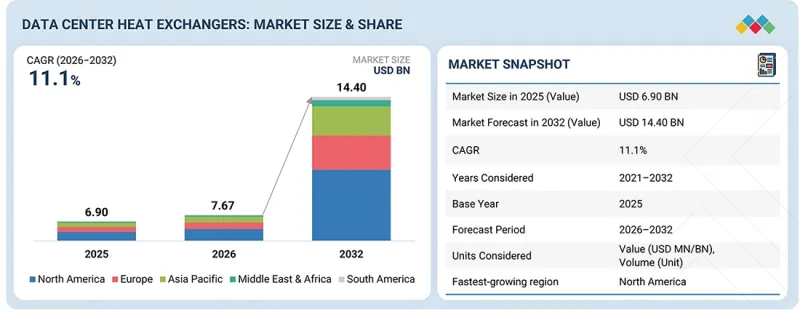
데이터센터용 열교환기 시장은 2026년 76억 7,000만 달러에서 2032년까지 144억 달러로 성장할 것으로 예상되며, 예측 기간 동안 연평균 성장률(CAGR)은 11.1%에 달할 것으로 전망됩니다.
이 시장은 데이터센터 내의 서버, 스토리지 시스템, 네트워크 장비 및 고성능 컴퓨팅 인프라에서 발생하는 열을 전달 및 방출하는 기술과 솔루션으로 구성되어 있습니다.
| 조사 범위 | |
|---|---|
| 조사 대상 기간 | 2021-2032년 |
| 기준 연도 | 2025년 |
| 예측 기간 | 2026-2032년 |
| 산정 단위 | 금액(백만/십억 달러) 및 수량(단위) |
| 부문 | 유형, 냉각 기술, 데이터센터 유형, 용도 및 지역 |
| 대상 지역 | 아시아태평양, 유럽, 북미, 중동 및 아프리카, 남미 |
열교환기는 현대 냉각 아키텍처에서 필수적인 구성요소로, 냉각 루프, 냉수 시스템 및 주변 냉각 환경 간의 효율적인 열 전달을 가능하게 하여 최적의 작동 온도를 유지하고 신뢰성 높은 IT 성능을 보장합니다. 인공지능(AI), 기계 학습, 클라우드 컴퓨팅 및 하이퍼스케일 데이터센터의 확대로 인해 랙의 전력 밀도가 높아지고 열 관리 요구 사항이 증가함에 따라 이 시장은 급속히 성장하고 있습니다.
“유형별로는 예측 기간 동안 데이터센터용 열교환기 시장에서 액체-액체 열교환기 부문이 금액 기준으로 가장 큰 점유율을 차지할 것으로 전망됩니다.”
액체-액체 열교환기 부문은 하이퍼스케일, 인공지능(AI) 및 고성능 컴퓨팅(HPC) 데이터센터에서 액체 냉각 기술의 도입이 가속화되고 있는 것을 배경으로, 예측 기간 동안 데이터센터용 열교환기 시장에서 금액 기준으로 가장 큰 점유율을 차지할 것으로 예상됩니다. 액체-액체 열교환기는 유체의 완전한 분리를 유지하면서 서버 측 냉각 루프에서 시설의 수계로 열을 전달하는 데 있어 매우 중요한 역할을 수행하며, 효율적인 열 관리, 시스템 신뢰성 및 장비 보호를 보장합니다. 데이터센터에서 막대한 열 부하를 발생시키는 고밀도 GPU 클러스터 및 AI 가속기의 도입이 확대됨에 따라, 이러한 열교환기는 냉각 분배 장치(CDU), 다이렉트-투-칩(Direct-to-Chip) 냉각 시스템 및 기타 첨단 액체 냉각 아키텍처의 핵심 구성요소로 자리 잡고 있습니다.
이 부문이 시장을 선도하고 있는 배경에는 기존 냉각 방식에 비해 뛰어난 열전달 효율, 확장성 및 운영 성능을 실현할 수 있는 능력이 있습니다. 액체-액체 열교환기를 통해 데이터센터 운영자는 증가하는 랙 전력 밀도를 관리하고, 냉각 효율을 향상시키며, 전반적인 에너지 소비를 줄일 수 있게 되어 차세대 컴퓨팅 환경에서 필수적인 요소로 자리 잡고 있습니다. 또한, 지속가능성과 에너지 최적화에 대한 관심이 높아짐에 따라 온수 냉각 및 열 회수 애플리케이션에 대한 수요가 확대되고 있으며, 액체-액체 열교환기는 열 에너지의 효율적인 전달과 재이용에 중요한 역할을 하고 있습니다. 하이퍼스케일 시설, AI 팩토리, 코로케이션 센터 및 엔터프라이즈 데이터센터에서의 이러한 열교환기의 광범위한 도입에 더해, 액체 냉각 인프라에 대한 투자 증가가 맞물리면서 예측 기간 동안 견실한 수익 창출이 지속될 것으로 보이며, 액체-액체 열교환기 부문이 데이터센터용 열교환기 시장에서 가장 큰 기여를 하는 부문이 될 것으로 전망됩니다.
“냉각 기술별로 보면 예측 기간 동안 데이터센터용 열교환기 시장에서 다이렉트 투 칩(D2C) 냉각이 가장 빠르게 성장하는 부문이 될 것입니다.”
다이렉트 투 칩(D2C) 냉각 부문은 현대 데이터센터에서 전례 없는 열 밀도를 발생시키는 인공지능(AI), 기계 학습, 그리고 고성능 컴퓨팅(HPC)의 워크로드가 급속히 증가하고 있는 것을 배경으로, 예측 기간 동안 데이터센터용 열교환기 시장에서 가장 빠르게 성장하는 부문이 될 것으로 예상됩니다. 다이렉트 투 칩(D2C) 냉각 기술은 액체 냉각식 콜드 플레이트를 사용하여 CPU, GPU, AI 가속기 등의 고전력 구성요소에서 직접 열을 제거하는 것으로, 기존의 공랭식 시스템에 비해 열 관리 효율을 대폭 향상시킵니다. 첨단 AI 도입 환경에서 랙의 전력 밀도가 100kW를 넘어 200kW에 가까워짐에 따라, D2C 냉각은 최적의 작동 온도를 유지하고 신뢰성 높은 시스템 성능을 보장하기 위한 최적의 솔루션으로 자리 잡고 있습니다.
이 부문의 성장은 액체 냉각 인프라 도입 확대와 밀접한 관련이 있으며, 그중에서도 열교환기는 서버의 냉각 루프에서 시설의 냉각 시스템으로 열을 전달하는 데 있어 매우 중요한 역할을 수행합니다. 냉각 분배 장치(CDU)에 통합된 액체 대 액체 열교환기는 효율적인 열 방출과 D2C 냉각 아키텍처의 지속적인 작동을 지원하는 데 필수적입니다. 또한 이 기술은 냉각 효율 향상, 에너지 소비량 절감, 전력 사용 효율(PUE) 저하, 더 높은 랙 밀도 지원 등 큰 이점을 제공하여, 하이퍼스케일 사업자, 클라우드 서비스 제공업체, 코로케이션 시설 및 엔터프라이즈 데이터센터에 매우 매력적인 선택지가 되고 있습니다.
“용도별로 보면 예측 기간 동안 데이터센터용 열교환기 시장에서 서버 및 IT 하드웨어 냉각 부문이 가장 빠르게 성장할 것으로 전망됩니다.”
서버 및 IT 하드웨어 냉각 부문은 인공지능(AI), 기계 학습, 클라우드 컴퓨팅, 고성능 컴퓨팅(HPC) 워크로드로 인한 계산 수요 증가에 힘입어, 예측 기간 동안 데이터센터용 열교환기 시장에서 가장 빠르게 성장할 애플리케이션 부문이 될 것으로 예상됩니다. 고성능 CPU, GPU, AI 가속기를 탑재한 최신 서버는 기존 IT 장비에 비해 훨씬 더 많은 열을 발생시키기 때문에 첨단 열 관리 솔루션에 대한 수요가 높아지고 있습니다. 열교환기는 서버 및 기타 IT 하드웨어에서 열을 효율적으로 제거함으로써 최적의 작동 온도를 유지하는 데 중요한 역할을 하며, 이를 통해 신뢰할 수 있는 성능을 보장하고, 열 스로틀링을 방지하며, 장비의 수명을 연장할 수 있습니다.
다이렉트 투 칩(Direct-to-Chip) 및 침지 냉각을 포함한 액체 냉각 기술의 급속한 보급으로 인해, 서버 및 하드웨어 냉각 용도의 열교환기 수요는 더욱 가속화되고 있습니다. 이러한 냉각 아키텍처는 액체 대 액체 및 기타 첨단 열교환 시스템을 활용하여, 기존의 공랭식 방식보다 고밀도 컴퓨팅 장비에서 열을 더 효과적으로 방출합니다. 데이터센터 사업자들이 AI 클러스터를 지속적으로 도입하고 랙의 전력 밀도를 높여감에 따라, 효율적인 서버 냉각 솔루션의 중요성은 점점 더 커지고 있습니다.
“예측 기간 동안 북미의 데이터센터용 열교환기 시장은 금액 기준으로 최대 규모를 기록할 것으로 전망됩니다.”
예측 기간 동안 북미는 하이퍼스케일 데이터센터 도입, 인공지능(AI) 인프라에 대한 투자, 그리고 첨단 액체 냉각 기술의 채택에서 주도적인 역할을 하고 있다는 점을 배경으로, 전 세계 데이터센터용 열교환기 시장에서 금액 기준으로 최대 점유율을 차지할 것으로 예상됩니다. 미국은 클라우드 컴퓨팅 및 디지털 인프라의 세계적 허브 역할을 하고 있으며, 주요 기술 기업과 클라우드 서비스 제공업체가 운영하는 수많은 하이퍼스케일 시설을 보유하고 있습니다. AI 훈련 클러스터, 생성형 AI 워크로드 및 고성능 컴퓨팅(HPC) 환경의 급속한 확장으로 인해 열 관리 요구 사항이 크게 증가하고 있으며, 액체 냉각 아키텍처를 지원하는 고부가가치 열교환기 솔루션에 대한 강력한 수요가 발생하고 있습니다.
이 지역의 경쟁력은 다이렉트 투 칩(Direct-to-Chip) 냉각, 침지 냉각, 냉각 분배 장치(CDU) 기반 시스템 등 첨단 냉각 기술의 조기 도입을 통해 더욱 뒷받침되고 있습니다. 이러한 기술들은 모두 액체-액체 열교환기 및 기타 고성능 열교환기에 크게 의존하고 있습니다. 랙의 전력 밀도가 지속적으로 증가함에 따라, 북미 전역의 데이터센터 운영 사업자들은 운영 신뢰성을 유지하고, 냉각 효율을 최적화하며, 에너지 소비를 줄이기 위해 첨단 열 관리 인프라에 대한 투자를 추진하고 있습니다. 이러한 투자는 고품질 열교환기 기술에 대한 지출 증가를 주도하고 있으며, 해당 지역의 시장 가치에서 선도적인 위치를 차지하는 데 기여하고 있습니다.
본 보고서에 포함된 주요 참여 기업 현황:
- 기업 유형별 : Tier 1 - 45%, Tier 2 - 22%, Tier 3 - 33%
- 직책별 : C레벨 임원 - 50%, 이사 - 10%, 기타 - 40%
- 지역별 : 북미 - 17%, 아시아태평양 - 17%, 유럽 - 33%, 중동 및 아프리카 - 25%, 남미 - 8%
데이터센터용 열교환기 시장의 주요 기업들은 시장에서 중요한 역할을 수행하고 있습니다. 각 기업은 시장 점유율과 수익을 확대하기 위해 제휴, 합작 투자, 사업 확장 등 다양한 전략을 채택하고 있습니다.
조사 범위:
본 보고서에서는 부문을 정의하고, 유형, 냉각 기술, 데이터센터 종류, 용도 및 지역별로 데이터센터용 열교환기 시장의 규모를 예측하고 있습니다. 주요 기업 개요를 작성하여 해당 기업의 시장 점유율과 핵심 경쟁력을 종합적으로 분석하고 있습니다. 또한, 시장에서 이들 기업의 사업 확장, 제휴, 인수합병(M&A) 등 경쟁 동향을 추적·분석하고 있습니다.
본 보고서를 구매해야 하는 이유:
본 보고서는 데이터센터용 열교환기 시장 및 각 부문의 매출에 대해 가장 정확한 추정치를 제공함으로써, 시장을 선도하는 기업과 신규 진입 기업을 지원하는 데 기여할 것으로 기대됩니다. 또한, 이해관계자들이 시장의 경쟁 구도를 더 깊이 이해하고, 사업 입지를 강화하기 위한 귀중한 인사이트를 얻어 효과적인 시장 진입 전략을 수립하는 데에도 도움이 될 것으로 기대됩니다. 더불어, 이해관계자들이 시장 동향을 파악할 수 있도록 돕는 동시에 주요 시장 촉진요인, 억제요인, 과제 및 기회에 대한 정보를 제공합니다.
본 보고서에서는 다음 사항에 대한 인사이트를 제공합니다:
- 성장 촉진요인(AI 및 고성능 컴퓨팅의 급속한 성장, 액체 냉각 도입 가속화, 하이퍼스케일 및 코로케이션 데이터센터의 확대), 제약요인(높은 초기 설비 투자 비용, 복잡한 개조 요건), 기회(AI에 최적화된 데이터센터, 열 회수·재활용 시스템, 첨단 열교환기 기술 개발), 그리고 과제(증가하는 랙의 전력 밀도 관리, 성능과 에너지 소비의 균형 조정)가 데이터센터용 열교환기 시장의 성장에 어떤 영향을 미치고 있는지
- 제품 개발/혁신 : 데이터센터용 열교환기 시장의 향후 기술 동향 및 연구 개발 활동에 대한 상세한 인사이트
- 시장 개발 : 수익성이 높은 시장에 대한 종합적인 정보 - 본 보고서는 다양한 지역에 걸친 데이터센터용 열교환기 시장을 분석합니다
- 시장 다각화 : 신제품, 다양한 유형, 미개척 지역, 최근 동향 및 시장 투자에 관한 종합적인 정보
- 경쟁 분석
자주 묻는 질문
목차
제1장 서론
제2장 요약
제3장 주요 인사이트
- 데이터센터용 열교환기 시장에서 사업자에게 매력적인 기회
- 데이터센터용 열교환기 시장 : 데이터센터 유형별
- 데이터센터용 열교환기 시장 : 냉각 방식별
- 데이터센터용 열교환기 시장 : 유형별
- 데이터센터용 열교환기 시장 : 용도별
- 데이터센터용 열교환기 시장 : 지역별
- 데이터센터용 열교환기 시장 : 국가별
제4장 시장 개요
- 시장 역학
- 성장 촉진요인
- 성장 억제요인
- 기회
- 과제
- 미충족 수요 및 미개척 분야
- 데이터센터용 열교환기 시장의 미충족 수요
- 미개척 시장의 기회
- 상호 연관된 시장 및 부문 간 기회
- 상호 연관된 시장
- 부문 간 기회
- 새로운 비즈니스 모델과 생태계의 변화
- 새로운 비즈니스 모델
- 생태계의 변화
- Tier 1/2/3 기업들의 전략적 움직임
- 주요 동향 및 전략적 초점
제5장 업계 동향
- Porter's Five Forces 분석
- 공급업체의 협상력
- 구매자의 협상력
- 대체품의 위협
- 신규 진입자의 위협
- 경쟁 기업 간의 적대적 관계
- 거시경제 지표
- GDP 동향 및 전망
- 데이터센터 업계
- 제조업
- 세계 하이퍼스케일 및 AI 데이터센터 산업의 동향
- 밸류체인 분석
- 생태계 분석
- 2026-2027년 주요 컨퍼런스 및 행사
- 고객의 비즈니스에 영향을 미치는 동향 및 파괴적 변화
- 투자 및 자금 조달 시나리오
- 사례 연구 분석
- 사례 연구 1 : 로렌스 버클리 국립 연구소(LBNL) - 리어 도어 방식 열교환기를 활용한 데이터센터 랙 냉각
- 사례 연구 2 : 알파 라발(Alfa Laval) - 차이나 모바일(China Mobile) 제남 데이터센터용 판형 열교환기 재설계
- 사례 연구 3 : SWEP - 신화사 데이터센터용 브레이징 판형 열교환기
제6장 주요 신흥 기술
- 주요 기술
- 후면 도어식 공기-액체 열교환기 기술
- 직접 액체 냉각을 위한 액체-액체 열교환
- 다이렉트 투 칩(Direct-to-Chip) 및 콜드 플레이트를 이용한 열전달
- 관련 기술
- 모듈식 및 조립식 액체 냉각 시스템
- 열 회수 및 열 재이용 기술
- 보완 기술
- 냉각수 분배 장치 및 첨단 액체 냉각 제어 시스템
- 특허 분석
- 조사 방법론
- 문서 유형
- 인사이트
- 특허의 법적 현황
- 관할 구역 분석
- 주요 출원인
- 향후 응용
- AI 및 고성능 컴퓨팅(HPC) 데이터센터 : 랙 스케일의 액체 냉각 및 극한의 열 부하를 처리하는 대용량 열교환기
- 하이브리드 및 개조형 데이터센터 : 기존 공랭식 및 냉수 인프라에 액체 냉각을 통합하기 위한 열교환기
- 모듈형 및 엣지 데이터센터 : 신속한 구축 및 확장이 가능한 데이터센터 모듈용, 콤팩트하고 확장성이 뛰어난 열교환기 시스템
- 데이터센터 폐열 재활용 : 데이터센터의 폐열을 지역 난방, 건물, 온실 및 기타 열 활용 용도로 전환하기 위한 열교환기
- AI/생성형 AI가 데이터센터용 열교환기 시장에 미치는 영향
- 주요 사용 사례 및 시장 잠재력
- 모범 사례 : 기업 및 기관의 활용 사례
- 데이터센터용 열교환기 시장의 사례 연구
- 상호 연관된 인접 생태계 및 시장 참여자에 미치는 영향
- 데이터센터용 열교환기 시장에서 생성형 AI 도입에 대한 고객의 준비 현황
제7장 지속가능성과 규제 현황
- 지역별 규제 및 규정 준수
- 규제 기관, 정부 기관 및 기타 조직
- 업계 표준
- 지속가능성을 위한 노력
- 데이터센터용 열교환기 시장의 탄소 영향 및 친환경 적용
- 지속가능성에 미치는 영향 및 규제 정책 노력
- 인증, 표시 및 환경 기준
제8장 고객 동향 및 구매 행동
- 의사결정 과정
- 구매 과정의 주요 이해관계자
- 구매 과정의 주요 이해관계자
- 구매 기준
- 도입 장벽 및 사내 과제
- 각 최종 이용 산업별 미충족 수요
- 시장의 수익성
- 수익 창출 가능성
- 비용 동향
- 주요 용도에서의 이익률 향상 기회
제9장 데이터센터용 열교환기 시장 : 유형별
- 판형 열교환기
- 쉘 앤 튜브식 열교환기
- 핀 부착 코일식 열교환기
- 기타 유형
제10장 데이터센터용 열교환기 시장 : 용도별
- 냉매 분배 장치(CDU)
- 컴퓨터실용 공조기(CRAC)/컴퓨터실용 에어 핸들러(CRAH)
- 드라이 쿨러 및 칠러
- 후면 도어식 열교환기
제11장 데이터센터용 열교환기 시장 : 냉각 방식별
- 공랭식
- 액체 냉각
제12장 데이터센터용 열교환기 시장 : 데이터센터 유형별
- 하이퍼스케일 데이터센터
- 엔터프라이즈 데이터센터
- 코로케이션형 데이터센터
제13장 데이터센터용 열교환기 시장 : 지역별
- 아시아태평양
- 중국
- 인도
- 일본
- 한국
- 기타 아시아태평양
- 북미
- 미국
- 캐나다
- 멕시코
- 유럽
- 독일
- 영국
- 네덜란드
- 프랑스
- 이탈리아
- 기타 유럽
- 중동 및 아프리카
- GCC 국가들
- 남아프리카
- 기타 중동 및 아프리카
- 남미
- 브라질
- 기타 남미
제14장 경쟁 현황
- 주요 진입 기업의 전략/강점
- 2025년 수익 분석
- 2025년 시장 점유율 분석
- 주요 시장 참여 기업 순위 분석
- 2025년 시장 주요 기업의 점유율 분석
- 브랜드 및 제품 비교
- 기업 평가 및 재무 지표
- 기업 평가 매트릭스 : 주요 기업, 2025년
- 스타 기업
- 신흥 리더
- 광범위한 영향력을 가진 기업
- 진출 기업
- 기업의 사업 전개 : 주요 기업, 2025년
- 기업 평가 매트릭스 : 스타트업/중소기업, 2025년
- 선도적인 기업
- 대응력이 뛰어난 기업
- 역동적인 기업
- 출발점
- 경쟁사 벤치마킹 : 스타트업/중소기업, 2025년
- 경쟁 시나리오
- 제품 출시
- 거래
제15장 기업 개요
- 주요 기업
- ALFA LAVAL
- KELVION HOLDING GMBH
- SWEP INTERNATIONAL AB
- DANFOSS
- XYLEM
- API HEAT TRANSFER
- CHART INDUSTRIES
- TRANTER INC.
- AIREDALE INTERNATIONAL AIR CONDITIONING LTD.(MODINE)
- HEXNOVAS HEAT EXCHANGER TECHNOLOGY CO., LTD.
- EATON
- KAORI HEAT TREATMENT CO., LTD.
- JOHNSON CONTROLS
- LUVE
- VESFIL
- WIELAND ONDA SRL
- BARRIQUAND HEAT EXCHANGERS
- EVAPCO, INC.
- NEXSON GROUP
- FUNKE WARMEAUSTAUSCHER APPARATEBAU GMBH
- THERMOKEY S.P.A.
- SPX COOLING TECH, LLC
- KRN HEAT EXCHANGER &REFRIGERATION LTD.
- STEFANI SPA
- ZHEJIANG SANHUA COMMERCIAL REFRIGERATION CO., LTD.
- 기타 주요 기업
- TRIANON ECHANGEUR
- HFM
제16장 조사 방법론
제17장 부록
KSM 26.10.29The data center heat exchangers market is projected to grow from USD 7.67 billion in 2026 to USD 14.40 billion by 2032, at a CAGR of 11.1% over the forecast period. The market comprises technologies and solutions that transfer and dissipate heat generated by servers, storage systems, networking equipment, and high-performance computing infrastructure within data centers.
| Scope of the Report | |
|---|---|
| Years Considered for the Study | 2021-2032 |
| Base Year | 2025 |
| Forecast Period | 2026-2032 |
| Units Considered | Value (USD Million/Billion) and Volume (Unit) |
| Segments | Type, Cooling Technology, Data Center Type, Application, and Region |
| Regions covered | Asia Pacific, Europe, North America, the Middle East & Africa, and South America |
Heat exchangers are a critical component of modern cooling architectures, enabling efficient heat transfer between coolant loops, chilled water systems, and ambient cooling environments, thereby maintaining optimal operating temperatures and ensuring reliable IT performance. The market is growing rapidly due to the expansion of artificial intelligence (AI), machine learning, cloud computing, and hyperscale data centers, which are driving higher rack power densities and increasing thermal management requirements.
"By type, the liquid-to-liquid heat exchangers segment will be the largest in value within the data center heat exchangers market during the forecast period."
The liquid-to-liquid heat exchangers segment is expected to account for the largest share of the data center heat exchangers market by value during the forecast period, driven by the accelerating adoption of liquid cooling technologies in hyperscale, artificial intelligence (AI), and high-performance computing (HPC) data centers. Liquid-to-liquid heat exchangers play a pivotal role in transferring heat from server-side coolant loops to facility water systems while maintaining complete fluid separation, ensuring efficient thermal management, system reliability, and equipment protection. As data centers increasingly deploy high-density GPU clusters and AI accelerators that generate substantial thermal loads, these heat exchangers have become a core component of cooling distribution units (CDUs), direct-to-chip cooling systems, and other advanced liquid cooling architectures.
The segment's value leadership is supported by its ability to deliver superior heat transfer efficiency, scalability, and operational performance compared with conventional cooling approaches. Liquid-to-liquid heat exchangers enable data center operators to manage rising rack power densities, improve cooling effectiveness, and reduce overall energy consumption, making them essential for next-generation computing environments. Additionally, the growing focus on sustainability and energy optimization is driving demand for warm-water cooling and heat recovery applications, where liquid-to-liquid heat exchangers play a critical role in efficient thermal energy transfer and reuse. Their widespread deployment across hyperscale facilities, AI factories, colocation centers, and enterprise data centers, combined with increasing investments in liquid cooling infrastructure, is expected to sustain strong revenue generation and position the liquid-to-liquid heat exchangers segment as the largest contributor to the data center heat exchangers market throughout the forecast period.
"By cooling technology, the direct-to-chip cooling will be the fastest-growing segment of the data center heat exchangers market during the forecast period."
The direct-to-chip (D2C) cooling segment is expected to be the fastest-growing segment of the data center heat exchangers market over the forecast period, driven by the rapid rise of artificial intelligence (AI), machine learning, and high-performance computing (HPC) workloads that generate unprecedented heat densities in modern data centers. Direct-to-chip cooling technology removes heat directly from high-power components, such as CPUs, GPUs, and AI accelerators, using liquid-cooled cold plates, significantly improving thermal management efficiency compared with conventional air-cooling systems. As rack power densities continue to rise beyond 100 kW and approach 200 kW or more in advanced AI deployments, D2C cooling is becoming the preferred solution for maintaining optimal operating temperatures and ensuring reliable system performance.
The growth of this segment is closely tied to the growing deployment of liquid-cooling infrastructure, where heat exchangers play a critical role in transferring heat from server coolant loops to facility cooling systems. Liquid-to-liquid heat exchangers integrated into cooling distribution units (CDUs) are essential for efficient heat rejection and for supporting the continuous operation of D2C cooling architectures. The technology also offers substantial benefits, including improved cooling efficiency, reduced energy consumption, lower Power Usage Effectiveness (PUE), and support for higher rack density, making it highly attractive for hyperscale operators, cloud service providers, colocation facilities, and enterprise data centers.
"By application, the server & IT hardware cooling segment will be the fastest in the data center heat exchangers market during the forecast period."
The server & IT hardware cooling segment is expected to be the fastest-growing application segment of the data center heat exchangers market over the forecast period, driven by rising computational demands from artificial intelligence (AI), machine learning, cloud computing, and high-performance computing (HPC) workloads. Modern servers with high-performance CPUs, GPUs, and AI accelerators generate significantly more heat than traditional IT equipment, creating a growing need for advanced thermal management solutions. Heat exchangers play a critical role in maintaining optimal operating temperatures by efficiently removing heat from servers and other IT hardware, thereby ensuring reliable performance, preventing thermal throttling, and extending equipment lifespan.
The rapid adoption of liquid cooling technologies, including direct-to-chip and immersion cooling, is further accelerating demand for heat exchangers in server and hardware cooling applications. These cooling architectures rely on liquid-to-liquid and other advanced heat exchanger systems to dissipate heat from high-density computing equipment more effectively than conventional air-cooling methods. As data center operators continue to deploy AI clusters and increase rack power densities, the importance of efficient server cooling solutions is becoming increasingly critical.
"The data center heat exchangers market in North America will be the largest, in terms of value, during the forecast period."
North America is expected to account for the largest share of the global data center heat exchangers market by value during the forecast period, driven by the region's leadership in hyperscale data center deployments, artificial intelligence (AI) infrastructure investments, and adoption of advanced liquid cooling. The United States serves as a global hub for cloud computing and digital infrastructure, hosting numerous hyperscale facilities operated by major technology companies and cloud service providers. The rapid expansion of AI training clusters, generative AI workloads, and high-performance computing (HPC) environments is significantly increasing thermal management requirements, creating strong demand for high-value heat exchanger solutions that support liquid cooling architectures.
The region's dominance is further supported by early adoption of advanced cooling technologies, including direct-to-chip cooling, immersion cooling, and cooling distribution unit (CDU)-based systems, all of which rely heavily on liquid-to-liquid and other high-performance heat exchangers. As rack power densities continue to rise, data center operators across North America are investing in sophisticated thermal management infrastructure to maintain operational reliability, optimize cooling efficiency, and reduce energy consumption. These investments are driving increased spending on premium heat exchanger technologies, contributing to the region's leadership in market value.
Profile break-up of primary participants for the report:
- By Company Type: Tier 1 - 45%, Tier 2 - 22%, and Tier 3 - 33%
- By Designation: C-Level Executives- 50%, Directors- 10%, and Others - 40%
- By Region: North America - 17%, Asia Pacific - 17%, Europe - 33%, Middle East & Africa - 25%, and South America - 8%
Leading players in the data center heat exchangers market include Vertiv Holdings Corp. (US), Schneider Electric (France), Alfa Laval (Sweden), Rittal GmbH & Co. KG (Germany), STULZ GmbH (Germany), Airedale International Air Conditioning Ltd. (UK), CoollT Systems Inc. (Canada), Munters Group AB (Sweden), Modine Manufacturing Company (US), Danfoss A/S (Denmark), Kelvion Holding GmbH (Germany), Nortek Air Solutions LLC (US), Eaton Corporation plc (Ireland), Johnson Controls International plc (Ireland), Huawei Technologies Co., Ltd. (China), Vikrant Heat Exchangers Pvt. Ltd. (India), thermowave (Germany), and others. These key players are significant contributors to the data center heat exchangers market. They have adopted various strategies, including agreements, joint ventures, and expansions, to increase their market share and revenue.
Research Coverage:
The report defines segments and projects the size of the data center heat exchangers market by type, cooling technology, data center type, application, and region. It strategically profiles key players and comprehensively analyzes their market share and core competencies. It also tracks and analyzes competitive developments, such as expansions, partnerships, and acquisitions undertaken by these players in the market.
Reasons to Buy the Report:
The report is expected to help market leaders and new entrants by providing the closest approximations of revenue figures for the data center heat exchangers market and its segments. It is also expected to help stakeholders gain a deeper understanding of the market's competitive landscape, acquire valuable insights to enhance their business positions, and develop effective go-to-market strategies. It also enables stakeholders to understand the market's pulse and provides information on key market drivers, restraints, challenges, and opportunities.
The report provides insights into the following pointers:
- Analysis of drivers (rapid growth of AI and high-performance computing, accelerating adoption of liquid cooling, expansion of hyperscale and colocation data centers), restraints (high initial capital investment, complex retrofit requirements), opportunities (AI-optimized data centers, heat recovery and reuse systems, development of advanced heat exchanger technologies), and challenges (managing increasing rack power densities, balancing performance and energy consumption) are influencing the growth of the data center heat exchangers market
- Product Development/Innovation: Detailed insights into upcoming technologies, research & development activities in the data center heat exchangers market
- Market Development: Comprehensive information about lucrative markets - the report analyzes the data center heat exchangers market across varied regions
- Market Diversification: Exhaustive information about new products, various types, untapped geographies, recent developments, and investments in the market
- Competitive Assessment: In-depth assessment of market share, growth strategies, and product offerings of leading players such as Vertiv Holdings Corp. (US), Schneider Electric (France), Alfa Laval (Sweden), Rittal GmbH & Co. KG (Germany), STULZ GmbH (Germany), Airedale International Air Conditioning Ltd. (UK), CoollT Systems Inc. (Canada), Munters Group AB (Sweden), Modine Manufacturing Company (US), Danfoss A/S (Denmark), Kelvion Holding GmbH (Germany), Nortek Air Solutions LLC (US), Eaton Corporation plc (Ireland), Johnson Controls International plc (Ireland), Huawei Technologies Co., Ltd. (China), Vikrant Heat Exchangers Pvt. Ltd. (India), thermowave (Germany), and others are the key players in data center heat exchangers market
TABLE OF CONTENTS
1 INTRODUCTION
- 1.1 STUDY OBJECTIVES
- 1.2 MARKET DEFINITION
- 1.3 STUDY SCOPE
- 1.3.1 MARKET SEGMENTATION AND REGIONAL SCOPE
- 1.3.2 INCLUSIONS AND EXCLUSIONS
- 1.3.3 YEARS CONSIDERED
- 1.4 CURRENCY CONSIDERED
- 1.5 LIMITATIONS
- 1.6 STAKEHOLDERS
2 EXECUTIVE SUMMARY
- 2.1 KEY INSIGHTS AND MARKET HIGHLIGHTS
- 2.2 KEY MARKET PARTICIPANTS: SHARE INSIGHTS AND STRATEGIC DEVELOPMENTS
- 2.3 DISRUPTIVE TRENDS IN DATA CENTER HEAT EXCHANGERS MARKET
- 2.4 HIGH-GROWTH SEGMENTS
- 2.5 REGIONAL SNAPSHOT: MARKET SIZE, GROWTH RATE, AND FORECAST
3 PREMIUM INSIGHTS
- 3.1 ATTRACTIVE OPPORTUNITIES FOR PLAYERS IN DATA CENTER HEAT EXCHANGERS MARKET
- 3.2 DATA CENTER HEAT EXCHANGERS MARKET, BY DATA CENTER TYPE
- 3.3 DATA CENTER HEAT EXCHANGERS MARKET, BY COOLING TYPE
- 3.4 DATA CENTER HEAT EXCHANGERS MARKET, BY TYPE
- 3.5 DATA CENTER HEAT EXCHANGERS MARKET, BY APPLICATION
- 3.6 DATA CENTER HEAT EXCHANGERS MARKET, BY REGION
- 3.7 DATA CENTER HEAT EXCHANGERS MARKET, BY COUNTRY
4 MARKET OVERVIEW
- 4.1 INTRODUCTION
- 4.2 MARKET DYNAMICS
- 4.2.1 DRIVERS
- 4.2.1.1 Rapid expansion of data center capacity
- 4.2.1.2 Increasing AI/HPC rack power density and shift toward liquid cooling
- 4.2.1.3 Increasing retrofit and modernization of existing data centers for higher-density computing
- 4.2.2 RESTRAINTS
- 4.2.2.1 High initial capital investment
- 4.2.2.2 Complex retrofit requirements
- 4.2.3 OPPORTUNITIES
- 4.2.3.1 Growing deployment of AI-optimized data centers
- 4.2.3.2 Increasing adoption of data center heat recovery and reuse systems
- 4.2.4 CHALLENGES
- 4.2.4.1 Managing increasing thermal loads from higher rack power densities
- 4.2.4.2 Balancing heat transfer performance and energy consumption
- 4.2.1 DRIVERS
- 4.3 UNMET NEEDS AND WHITE SPACES
- 4.3.1 UNMET NEEDS IN DATA CENTER HEAT EXCHANGERS MARKET
- 4.3.2 WHITE SPACE OPPORTUNITIES
- 4.4 INTERCONNECTED MARKETS AND CROSS-SECTOR OPPORTUNITIES
- 4.4.1 INTERCONNECTED MARKETS
- 4.4.2 CROSS SECTOR OPPORTUNITIES
- 4.5 EMERGING BUSINESS MODELS AND ECOSYSTEM SHIFTS
- 4.5.1 EMERGING BUSINESS MODELS
- 4.5.2 ECOSYSTEM SHIFTS
- 4.6 STRATEGIC MOVES BY TIER 1/2/3 PLAYERS
- 4.6.1 KEY MOVES AND STRATEGIC FOCUS
5 INDUSTRY TRENDS
- 5.1 PORTER'S FIVE FORCES ANALYSIS
- 5.1.1 BARGAINING POWER OF SUPPLIERS
- 5.1.2 BARGAINING POWER OF BUYERS
- 5.1.3 THREAT OF SUBSTITUTES
- 5.1.4 THREAT OF NEW ENTRANTS
- 5.1.5 INTENSITY OF COMPETITIVE RIVALRY
- 5.2 MACROECONOMIC INDICATORS
- 5.2.1 INTRODUCTION
- 5.2.2 GDP TRENDS AND FORECAST
- 5.2.3 DATA CENTER INDUSTRY
- 5.2.4 MANUFACTURING INDUSTRY
- 5.2.5 TRENDS IN GLOBAL HYPERSCALE AND AI DATA CENTER INDUSTRY
- 5.3 VALUE CHAIN ANALYSIS
- 5.4 ECOSYSTEM ANALYSIS
- 5.5 KEY CONFERENCES & EVENTS IN 2026 - 2027
- 5.6 TRENDS/DISRUPTIONS IMPACTING CUSTOMERS' BUSINESSES
- 5.7 INVESTMENT AND FUNDING SCENARIO
- 5.8 CASE STUDY ANALYSIS
- 5.8.1 CASE STUDY 1: LAWRENCE BERKELEY NATIONAL LABORATORY (LBNL) - REAR-DOOR HEAT EXCHANGER DATA CENTER RACK COOLING
- 5.8.2 CASE STUDY 2: ALFA LAVAL - PLATE HEAT EXCHANGER REDESIGN FOR CHINA MOBILE JINAN DATA CENTER
- 5.8.3 CASE STUDY 3: SWEP - BRAZED PLATE HEAT EXCHANGERS FOR XINHUA NEWS AGENCY DATA CENTER
6 KEY EMERGING TECHNOLOGIES
- 6.1 KEY TECHNOLOGIES
- 6.1.1 REAR-DOOR AIR-TO-LIQUID HEAT EXCHANGER TECHNOLOGY
- 6.1.2 LIQUID-TO-LIQUID HEAT EXCHANGE FOR DIRECT LIQUID COOLING
- 6.1.3 DIRECT-TO-CHIP AND COLD-PLATE HEAT TRANSFER
- 6.2 ADJACENT TECHNOLOGIES
- 6.2.1 MODULAR AND PREFABRICATED LIQUID COOLING SYSTEMS
- 6.2.2 HEAT RECOVERY AND HEAT REUSE TECHNOLOGIES
- 6.3 COMPLEMENTARY TECHNOLOGIES
- 6.3.1 COOLANT DISTRIBUTION UNITS AND ADVANCED LIQUID COOLING CONTROLS
- 6.4 PATENT ANALYSIS
- 6.4.1 INTRODUCTION
- 6.4.2 METHODOLOGY
- 6.4.3 DOCUMENT TYPE
- 6.4.4 INSIGHTS
- 6.4.5 LEGAL STATUS OF PATENTS
- 6.4.6 JURISDICTION ANALYSIS
- 6.4.7 TOP APPLICANTS
- 6.4.7.1 List of major patents
- 6.5 FUTURE APPLICATIONS
- 6.5.1 AI AND HIGH-PERFORMANCE COMPUTING DATA CENTERS: HIGH-CAPACITY HEAT EXCHANGERS FOR RACK-SCALE LIQUID COOLING AND EXTREME THERMAL LOADS
- 6.5.2 HYBRID AND RETROFIT DATA CENTERS: HEAT EXCHANGERS FOR INTEGRATING LIQUID COOLING WITH EXISTING AIR-COOLED AND CHILLED WATER INFRASTRUCTURE
- 6.5.3 MODULAR AND EDGE DATA CENTERS: COMPACT AND SCALABLE HEAT EXCHANGER SYSTEMS FOR RAPIDLY DEPLOYED AND EXPANDABLE DATA CENTER MODULES
- 6.5.4 DATA CENTER WASTE HEAT REUSE: HEAT EXCHANGERS FOR TRANSFERRING DATA CENTER WASTE HEAT TO DISTRICT HEATING, BUILDINGS, GREENHOUSES, AND OTHER THERMAL APPLICATIONS
- 6.6 IMPACT OF AI/GEN AI ON DATA CENTER HEAT EXCHANGERS MARKET
- 6.6.1 INTRODUCTION
- 6.6.2 TOP USE CASES AND MARKET POTENTIAL
- 6.6.3 BEST PRACTICES: COMPANIES/INSTITUTIONS USE CASES
- 6.6.4 CASE STUDIES OF DATA CENTER HEAT EXCHANGERS MARKET
- 6.6.5 INTERCONNECTED ADJACENT ECOSYSTEM AND IMPACT ON MARKET PLAYERS
- 6.6.6 CLIENTS' READINESS TO ADOPT GENERATIVE AI IN DATA CENTER HEAT EXCHANGERS MARKET
- 6.6.6.1 Alfa laval: ai-enabled digital services for heat exchanger maintenance
- 6.6.6.2 Tranter: hybrid-AI digital twins for heat exchanger optimization
7 SUSTAINABILITY AND REGULATORY LANDSCAPE
- 7.1 REGIONAL REGULATIONS AND COMPLIANCE
- 7.1.1 REGULATORY BODIES, GOVERNMENT AGENCIES, AND OTHER ORGANIZATIONS
- 7.1.2 INDUSTRY STANDARDS
- 7.2 SUSTAINABILITY INITIATIVES
- 7.2.1 CARBON IMPACT AND ECO APPLICATIONS OF DATA CENTER HEAT EXCHANGERS MARKET
- 7.3 SUSTAINABILITY IMPACT AND REGULATORY POLICY INITIATIVES
- 7.4 CERTIFICATIONS, LABELING AND ECO STANDARDS
8 CUSTOMER LANDSCAPE & BUYER BEHAVIOUR
- 8.1 DECISION-MAKING PROCESS
- 8.2 KEY STAKEHOLDERS IN BUYING PROCESS
- 8.2.1 KEY STAKEHOLDERS IN BUYING PROCESS
- 8.2.2 BUYING CRITERIA
- 8.3 ADOPTION BARRIERS & INTERNAL CHALLENGES
- 8.4 UNMET NEEDS IN VARIOUS END-USE INDUSTRIES
- 8.5 MARKET PROFITABILITY
- 8.5.1 REVENUE POTENTIAL
- 8.5.2 COST DYNAMICS
- 8.5.3 MARGIN OPPORTUNITIES IN KEY APPLICATIONS
9 DATA CENTER HEAT EXCHANGERS MARKET, BY TYPE
- 9.1 INTRODUCTION
- 9.2 PLATE HEAT EXCHANGERS
- 9.3 SHELL & TUBE HEAT EXCHANGERS
- 9.4 FINNED COIL HEAT EXCHANGERS
- 9.5 OTHER TYPES
10 DATA CENTER HEAT EXCHANGERS MARKET, BY APPLICATION
- 10.1 INTRODUCTION
- 10.2 COOLANT DISTRIBUTION UNITS (CDU)
- 10.2.1 INCREASING LIQUID COOLING DEPLOYMENT FUELING DEMAND FOR HIGH-EFFICIENCY HEAT EXCHANGERS IN CDUS
- 10.3 COMPUTER ROOM AIR CONDITIONERS (CRAC)/COMPUTER ROOM AIR HANDLERS (CRAH)
- 10.3.1 INCREASING DEMAND FOR PRECISION COOLING SUPPORTING HEAT EXCHANGER DEPLOYMENT IN CRAC AND CRAH UNITS
- 10.4 DRY COOLERS & CHILLERS
- 10.4.1 EXPANDING FREE-COOLING DEPLOYMENT AND CHILLED-WATER INFRASTRUCTURE FUELING DEMAND
- 10.5 REAR DOOR HEAT EXCHANGERS
- 10.5.1 RISING RACK-LEVEL COOLING REQUIREMENTS INCREASING ADOPTION
11 DATA CENTER HEAT EXCHANGERS MARKET, BY COOLING TYPE
- 11.1 INTRODUCTION
- 11.2 AIR COOLING
- 11.2.1 AIR-BASED COOLING INFRASTRUCTURE WITNESSING CONTINUED DEMAND
- 11.3 LIQUID COOLING
- 11.3.1 RISING HIGH-DENSITY COMPUTING AND DIRECT-TO-CHIP DEPLOYMENT ACCELERATING DEMAND
12 DATA CENTER HEAT EXCHANGERS MARKET, BY DATA CENTER TYPE
- 12.1 INTRODUCTION
- 12.2 HYPERSCALE DATA CENTERS
- 12.2.1 RISING AI WORKLOADS AND RACK DENSITIES TO ACCELERATE HEAT EXCHANGER DEPLOYMENT
- 12.3 ENTERPRISE DATA CENTERS
- 12.3.1 INCREASING COMPUTE REQUIREMENTS AND INFRASTRUCTURE MODERNIZATION FUELING ADOPTION
- 12.4 COLOCATION DATA CENTERS
- 12.4.1 RISING HIGH-DENSITY WORKLOADS AND FLEXIBLE COOLING REQUIREMENTS TO FUEL DEMAND
13 DATA CENTER HEAT EXCHANGERS MARKET, BY REGION
- 13.1 INTRODUCTION
- 13.2 ASIA PACIFIC
- 13.2.1 CHINA
- 13.2.1.1 Digital infrastructure expansion to support demand for data center heat exchangers
- 13.2.2 INDIA
- 13.2.2.1 Increasing internet users to drive rapid adoption
- 13.2.3 JAPAN
- 13.2.3.1 AI infrastructure expansion and energy efficiency to fuel demand
- 13.2.4 SOUTH KOREA
- 13.2.4.1 AI data center expansion and infrastructure development to support market growth
- 13.2.5 REST OF ASIA PACIFIC
- 13.2.5.1 Data center infrastructure expansion to support heat exchanger demand
- 13.2.1 CHINA
- 13.3 NORTH AMERICA
- 13.3.1 US
- 13.3.1.1 Increasing computing density and cooling requirements to drive adoption
- 13.3.2 CANADA
- 13.3.2.1 Growth of sovereign AI compute infrastructure to strengthen market expansion
- 13.3.3 MEXICO
- 13.3.3.1 Large-scale data center investments and rising cooling requirements to drive demand
- 13.3.1 US
- 13.4 EUROPE
- 13.4.1 GERMANY
- 13.4.1.1 Rapid expansion of data center capacity and increasing thermal loads to drive heat exchanger demand
- 13.4.2 UK
- 13.4.2.1 AI infrastructure expansion and rising data center capacity to support market growth
- 13.4.3 NETHERLANDS
- 13.4.3.1 Growing data center footprint and rising computing demand to support adoption
- 13.4.4 FRANCE
- 13.4.4.1 AI infrastructure development and data center expansion to fuel demand
- 13.4.5 ITALY
- 13.4.5.1 Rising colocation demand and data center investment to support market expansion
- 13.4.6 REST OF EUROPE
- 13.4.1 GERMANY
- 13.5 MIDDLE EAST & AFRICA
- 13.5.1 GCC COUNTRIES
- 13.5.1.1 UAE
- 13.5.1.1.1 Large-scale data center investments to support heat exchanger demand
- 13.5.1.2 Saudi Arabia
- 13.5.1.2.1 Rapid data center capacity expansion and AI infrastructure development to drive demand
- 13.5.1.3 Rest of GCC countries
- 13.5.1.1 UAE
- 13.5.2 SOUTH AFRICA
- 13.5.2.1 Expansion of data center infrastructure to support market growth
- 13.5.3 REST OF MIDDLE EAST & AFRICA
- 13.5.1 GCC COUNTRIES
- 13.6 SOUTH AMERICA
- 13.6.1 BRAZIL
- 13.6.1.1 Rapid data center expansion to support heat exchanger demand
- 13.6.2 REST OF SOUTH AMERICA
- 13.6.1 BRAZIL
14 COMPETITIVE LANDSCAPE
- 14.1 INTRODUCTION
- 14.2 KEY PLAYERS' STRATEGIES/RIGHT TO WIN
- 14.3 REVENUE ANALYSIS, 2025
- 14.4 MARKET SHARE ANALYSIS, 2025
- 14.4.1 RANKING ANALYSIS OF KEY MARKET PLAYERS
- 14.4.2 MARKET PLAYERS' SHARE ANALYSIS, 2025
- 14.5 BRAND/PRODUCT COMPARISON
- 14.6 COMPANY VALUATION AND FINANCIAL METRICS
- 14.7 COMPANY EVALUATION MATRIX: KEY PLAYERS, 2025
- 14.7.1 STARS
- 14.7.2 EMERGING LEADERS
- 14.7.3 PERVASIVE PLAYERS
- 14.7.4 PARTICIPANTS
- 14.7.5 COMPANY FOOTPRINT: KEY PLAYERS, 2025
- 14.7.5.1 Company footprint
- 14.7.5.2 Region footprint
- 14.7.5.3 Application footprint
- 14.7.5.4 Cooling type footprint
- 14.7.5.5 Data center type footprint
- 14.8 COMPANY EVALUATION MATRIX: STARTUPS/SMES, 2025
- 14.8.1 PROGRESSIVE COMPANIES
- 14.8.2 RESPONSIVE COMPANIES
- 14.8.3 DYNAMIC COMPANIES
- 14.8.4 STARTING BLOCKS
- 14.8.5 COMPETITIVE BENCHMARKING: STARTUPS/SMES, 2025
- 14.8.5.1 Detailed list of key startups/SMEs
- 14.8.5.2 Competitive benchmarking of key startups/SMEs
- 14.9 COMPETITIVE SCENARIO
- 14.9.1 PRODUCT LAUNCHES
- 14.9.2 DEALS
15 COMPANY PROFILE
- 15.1 KEY PLAYERS
- 15.1.1 ALFA LAVAL
- 15.1.1.1 Business overview
- 15.1.1.2 Products/Solutions/Services offered
- 15.1.1.3 MnM view
- 15.1.1.3.1 Key strengths
- 15.1.1.3.2 Strategic choices
- 15.1.1.3.3 Weaknesses and competitive threats
- 15.1.2 KELVION HOLDING GMBH
- 15.1.2.1 Business overview
- 15.1.2.2 Products/Solutions/Services offered
- 15.1.2.3 Recent developments
- 15.1.2.3.1 Product launches
- 15.1.2.3.2 Deals
- 15.1.2.4 MnM view
- 15.1.2.4.1 Key strengths
- 15.1.2.4.2 Strategic choices
- 15.1.2.4.3 Weaknesses and competitive threats
- 15.1.3 SWEP INTERNATIONAL AB
- 15.1.3.1 Business overview
- 15.1.3.2 Products/Solutions/Services offered
- 15.1.3.3 Recent developments
- 15.1.3.3.1 Product launches
- 15.1.3.3.2 Deals
- 15.1.3.4 MnM view
- 15.1.3.4.1 Key strengths
- 15.1.3.4.2 Strategic choices
- 15.1.3.4.3 Weaknesses and competitive threats
- 15.1.4 DANFOSS
- 15.1.4.1 Business overview
- 15.1.4.2 Products/Solutions/Services offered
- 15.1.4.3 MnM view
- 15.1.4.3.1 Key strengths
- 15.1.4.3.2 Strategic choices
- 15.1.4.3.3 Weaknesses and competitive threats
- 15.1.5 XYLEM
- 15.1.5.1 Business overview
- 15.1.5.2 Products/Solutions/Services offered
- 15.1.5.3 MnM view
- 15.1.5.3.1 Key strengths
- 15.1.5.3.2 Strategic choices
- 15.1.5.3.3 Weaknesses and competitive threats
- 15.1.6 API HEAT TRANSFER
- 15.1.6.1 Business overview
- 15.1.6.2 Products/Solutions/Services offered
- 15.1.7 CHART INDUSTRIES
- 15.1.7.1 Business overview
- 15.1.7.2 Products/Solutions/Services offered
- 15.1.7.3 Recent developments
- 15.1.7.3.1 Product launches
- 15.1.8 TRANTER INC.
- 15.1.8.1 Business overview
- 15.1.8.2 Products/Solutions/Services offered
- 15.1.9 AIREDALE INTERNATIONAL AIR CONDITIONING LTD. (MODINE)
- 15.1.9.1 Business overview
- 15.1.9.2 Products/Solutions/Services offered
- 15.1.10 HEXNOVAS HEAT EXCHANGER TECHNOLOGY CO., LTD.
- 15.1.10.1 Business overview
- 15.1.10.2 Products/Solutions/Services offered
- 15.1.11 EATON
- 15.1.11.1 Business overview
- 15.1.11.2 Products/Solutions/Services offered
- 15.1.11.3 Recent developments
- 15.1.11.3.1 Deals
- 15.1.12 KAORI HEAT TREATMENT CO., LTD.
- 15.1.12.1 Business overview
- 15.1.12.2 Products/Solutions/Services offered
- 15.1.13 JOHNSON CONTROLS
- 15.1.13.1 Business overview
- 15.1.13.2 Products/Solutions/Services offered
- 15.1.13.3 Recent developments
- 15.1.13.3.1 Deals
- 15.1.14 LUVE
- 15.1.14.1 Business overview
- 15.1.14.2 Products/Solutions/Services offered
- 15.1.15 VESFIL
- 15.1.15.1 Business overview
- 15.1.15.2 Products/Solutions/Services offered
- 15.1.16 WIELAND ONDA SRL
- 15.1.16.1 Business overview
- 15.1.16.2 Products/Solutions/Services offered
- 15.1.16.3 Recent developments
- 15.1.16.3.1 Deals
- 15.1.17 BARRIQUAND HEAT EXCHANGERS
- 15.1.17.1 Business overview
- 15.1.17.2 Products/Solutions/Services offered
- 15.1.18 EVAPCO, INC.
- 15.1.18.1 Business overview
- 15.1.18.2 Products/Solutions/Services offered
- 15.1.18.3 Recent developments
- 15.1.18.3.1 Product launches
- 15.1.19 NEXSON GROUP
- 15.1.19.1 Business overview
- 15.1.19.2 Products/Solutions/Services offered
- 15.1.19.3 Recent developments
- 15.1.19.3.1 Deals
- 15.1.20 FUNKE WARMEAUSTAUSCHER APPARATEBAU GMBH
- 15.1.20.1 Business overview
- 15.1.20.2 Products/Solutions/Services offered
- 15.1.21 THERMOKEY S.P.A.
- 15.1.21.1 Business overview
- 15.1.21.2 Products/Solutions/Services offered
- 15.1.21.3 Recent developments
- 15.1.21.3.1 Deals
- 15.1.22 SPX COOLING TECH, LLC
- 15.1.22.1 Business overview
- 15.1.22.2 Products/Solutions/Services offered
- 15.1.23 KRN HEAT EXCHANGER & REFRIGERATION LTD.
- 15.1.23.1 Business overview
- 15.1.23.2 Products/Solutions/Services offered
- 15.1.24 STEFANI SPA
- 15.1.24.1 Business overview
- 15.1.24.2 Products/Solutions/Services offered
- 15.1.25 ZHEJIANG SANHUA COMMERCIAL REFRIGERATION CO., LTD.
- 15.1.25.1 Business overview
- 15.1.25.2 Products/Solutions/Services offered
- 15.1.1 ALFA LAVAL
- 15.2 OTHER PLAYERS
- 15.2.1 TRIANON ECHANGEUR
- 15.2.2 HFM
16 RESEARCH METHODOLOGY
- 16.1 RESEARCH DATA
- 16.1.1 SECONDARY DATA
- 16.1.1.1 List of key secondary sources
- 16.1.1.2 Key data from secondary sources
- 16.1.2 PRIMARY DATA
- 16.1.2.1 Key data from primary sources
- 16.1.2.2 Key industry insights
- 16.1.2.3 List of primary participants
- 16.1.2.4 Breakdown of primary interviews
- 16.1.1 SECONDARY DATA
- 16.2 MARKET SIZE ESTIMATION
- 16.2.1 BOTTOM-UP APPROACH
- 16.2.2 TOP-DOWN APPROACH
- 16.3 MARKET FORECAST APPROACH
- 16.3.1 DEMAND-SIDE ANALYSIS
- 16.3.2 SUPPLY-SIDE ANALYSIS
- 16.3.3 CALCULATIONS FOR SUPPLY-SIDE ANALYSIS
- 16.4 GROWTH FORECAST
- 16.5 DATA TRIANGULATION
- 16.6 RESEARCH ASSUMPTIONS
- 16.7 RESEARCH LIMITATIONS
- 16.8 RISK ASSESSMENT
- 16.9 FACTOR ANALYSIS
17 APPENDIX
- 17.1 DISCUSSION GUIDE
- 17.2 KNOWLEDGESTORE: MARKETSANDMARKETS' SUBSCRIPTION PORTAL
- 17.3 CUSTOMIZATION OPTIONS
- 17.4 RELATED REPORTS
- 17.5 AUTHOR DETAILS


