

|
시장보고서
상품코드
2158070
배터리 열관리 시스템 시장 예측(-2033년) : 기술, 컴포넌트, 배터리, 추진, 배터리 용량, 제공, 차종, 지역별Battery Thermal Management System Market by Technology (Active, Passive Hybrid), Component (Thermal Sensors, Cooling Plates), Battery (LFP, NMC, NCA, LMFP, SSB), Propulsion, Battery Capacity, Offering, Vehicle Type, Region - Forecast to 2033 |
||||||

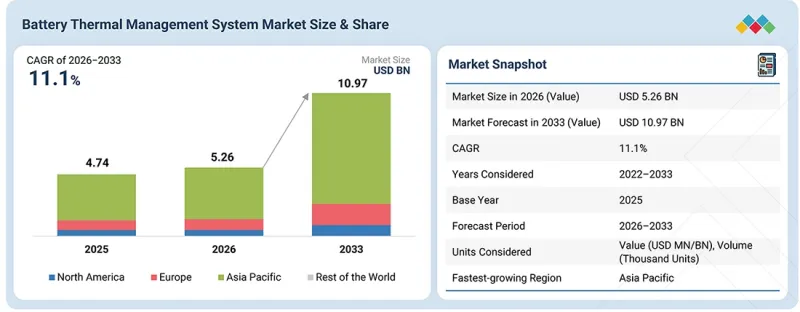
전 세계 배터리 열 관리 시스템(BTMS) 시장 규모는 2026년 52억 6,000만 달러에서 2033년까지 109억 7,000만 달러로 연평균 성장률(CAGR) 11.1%를 기록하며 확대될 것으로 전망됩니다.
테슬라의 ‘Model 3’나 BMW의 ‘iX’와 같은 OEM 업체들이 통합형 열 관리 및 배터리 프리컨디셔닝을 활용하여 다양한 주행 상황, 급속 충전, 주변 환경 조건 하에서 배터리 온도를 관리하고 있는 만큼, BTMS 시장은 시스템의 고도화된 지능화와 배터리 작동 조건에 대한 제어 능력 향상으로 전환되고 있습니다. 이에 따라 배터리의 부하, 온도, 충전 상태 및 차량의 작동 조건에 따라 냉각·가열을 동적으로 조정하는 BTMS 솔루션에 대한 수요가 발생하고 있습니다.
| 조사 범위 | |
|---|---|
| 조사 대상 기간 | 2026-2033년 |
| 기준 연도 | 2025 |
| 예측 기간 | 2026-2033년 |
| 대상 단위 | 10억 달러 |
| 부문 | 배터리 열 관리 시스템 시장: 기술, 구성 부품, 배터리, 추진 방식, 배터리 용량, 제공 형태, 차종, 지역별 - 2033년까지의 세계 전망 |
| 대상 지역 | 아시아태평양, 유럽, 북미, 기타 지역 |
또한 AI를 활용한 시뮬레이션, 셀 수준의 냉각, 예측형 열 제어에 대한 관심도 높아지고 있습니다. 이는 배터리 데이터를 활용하여 온도 변화를 예측하고, 성능이나 안전성의 한계에 도달하기 전에 열 제어를 최적화하는 것입니다. 지능적이고 예측형인 열 제어 전략의 도입은 BTMS 시장의 성장을 지원할 것으로 예상됩니다.
예측 기간 중 LFP가 가장 빠르게 성장하는 부문이 될 것으로 예상됩니다.
LFP 화학계 배터리는 긴 사이클 수명과 열적 안정성 덕분에 상용차 분야에서 그 중요성이 커지고 있습니다. 각 BTMS 공급업체들은 더 대형의 상용차용 배터리 팩과 더 높은 충전 전력을 지원하는 열 관리 솔루션을 개발하고 있습니다. 예를 들어 2025년 5월 EVE Energy는 급속 충전시 온도 제어를 개선하기 위해 상부 및 하부 액체 냉각 기능을 갖춘 상용차용 448 kWh LFP 배터리를 발표했습니다. 상용차 OEM 및 공급업체들도 모듈식 냉각 아키텍처를 갖춘 대용량 LFP 팩으로의 전환을 추진하고 있습니다. 예를 들어 BorgWarner사는 버스, 트럭 및 기타 상용차를 위해 능동형 액체 냉각 및 멀티팩 제어 기능을 갖춘 확장 가능한 여러 LFP 팩 구성을 제공하고 있습니다. 배터리 용량과 충전 전력이 향상됨에 따라 BTMS에는 반복되는 충전 사이클 동안 지속적인 열 제거 및 온도 제어가 요구되며, 이는 상용차에 액체 냉각식 리튬이온 배터리 시스템의 채택을 지원하고 있습니다.
승용차는 예측 기간 중 BTMS 시장에서 높은 성장세를 보일 것으로 전망됩니다.
승용차는 BTMS 시장에서 큰 점유율을 차지할 것으로 예상되며, 팩 크기를 대폭 늘리지 않으면서 배터리 모듈 및 셀 수준에서 냉각을 통합한 컴팩트한 열 설계가 채택되고 있습니다. 예를 들어 현대자동차는 ‘투손 PHEV’에서 전용 13.8 kW 냉각 덕트를 사용하여 배터리 온도를 제어하고 있는 반면, 기아 ‘소렌토 PHEV’에서는 시트 아래에 냉각 덕트를 배치한 13.8 kWh 배터리 팩을 채택하여 컴팩트한 열 시스템 패키징을 실현하고 있습니다. 또한 현대모비스는 모듈 및 셀 수준의 냉각 기술을 도입했습니다. 승용차의 향후 BTMS 개발에서는 충전 상태 및 주행 조건과 연동된 배터리 프리컨디셔닝에 더욱 중점을 둘 것으로 예상되며, 이에 따라 보다 정밀한 배터리 온도 제어를 위한 통합형 히터, 칠러, 센서의 사용이 증가할 것으로 전망됩니다. 컴팩트한 열 설계, 배터리 프리컨디셔닝, 그리고 충전 상태와 연동된 온도 제어 기술이 승용차용 배터리 열 관리 시스템 시장의 성장을 주도하고 있습니다.
아시아태평양에서 중국의 BTMS 시장은 상당한 성장이 예상됩니다.
중국에서는 중국계 배터리 제조사의 강력한 입지와 고성능 BEV용 배터리를 위한 통합형 열 관리에 대한 집중에 힘입어, 아시아태평양의 배터리 열 관리 시스템 시장에서 현저한 성장이 예상됩니다. 중국에서는 특히 LFP 기반 EV 배터리 팩의 경우, 액체 냉각이 여전히 주류 BTMS 아키텍처로 자리 잡고 있지만, OEM 및 배터리 공급업체들은 대용량 팩, 급속 충전, 셀 수준의 온도 제어, 그리고 고부하 용도를 위한 침지 냉각으로 전환하고 있습니다. 중국의 각 공급업체들은 열 관리를 배터리 팩 설계, 온도 모니터링 및 충전 성능과 통합하고 있습니다. 예를 들어 CATL은 ‘Qilin’ 배터리 팩과 셀 수준의 모니터링을 수행하는 통합 열 관리 시스템 ‘Smart Management Technology’를 제공하여, 배터리 관리의 일환으로 배터리의 온도와 작동 상태를 모니터링할 수 있게 되었습니다. 이러한 변화로 인해 중국의 배터리 공급업체들은 BTMS를 독립적인 냉각 시스템으로 취급하기보다는 통합된 온도 모니터링 및 제어를 통해 자사의 배터리 플랫폼을 차별화할 기회를 얻고 있습니다. 또한 NMC 기반 BEV 전반에 걸쳐 급속 충전, 배터리 수명 관리 및 안전 기능을 지원하는 데 있으며, 온도 센서의 역할도 확대되고 있습니다. 따라서 온도 센서와 배터리 관리·열 제어 시스템의 통합을 통해 보다 정밀한 온도 모니터링이 가능해지고, 열 제어 성능이 개선됨에 따라 중국내 첨단 배터리 열 관리 시스템에 대한 수요가 증가할 것으로 예상됩니다.
BTMS 시장에서 사업을 운영하는 주요 조직의 CXO, 마케팅 이사, 기타 혁신·기술 관리자 및 임원을 대상으로 상세한 인터뷰를 시행했습니다. 참가자 구성은 다음과 같습니다. :
- 기업 유형별: OEM-25%, Tier 1-65%, Tier 2 및 3-10%,
- 직책별: CXO-30%, 매니저-50%, 임원-20%
- 지역별: 북미-22%, 유럽-32%, 아시아태평양-33%, 기타 지역-12%
조사 범위:
본 조사는 배터리 열 관리 시스템 시장을 다양한 부문에 걸쳐 포괄적으로 다루고 있습니다. 배터리 유형, 배터리 용량, 차종, 추진 방식, 기술, 제공 및 지역과 같은 서로 다른 부문별로 시장 규모 및 추정치와 향후 성장 가능성을 추정하는 것을 목적으로 합니다. 또한 주요 시장 참여자에 대한 상세한 경쟁 분석, 각 기업의 프로필, 제품 및 사업 제공에 관한 주요 관찰 사항, 최근 동향, 그리고 인수 사례에 대해서도 다루고 있습니다.
본 조사 보고서에서는 배터리 열 관리 시스템(BTMS) 시장을 배터리 유형, 기술, 추진 방식, 제공 형태, 배터리 용량, 구성 부품 및 지역(아시아태평양, 유럽, 북미, 기타 지역)별로 분류하고 있습니다. 이 보고서의 범위에는 BTMS 시장의 성장에 영향을 미치는 주요 요인(촉진요인, 제약 요인, 과제, 기회 등)에 대한 상세한 정보가 포함되어 있습니다. 주요 업계 참여자에 대한 상세한 분석을 통해 각 기업의 사업 개요, 솔루션, 서비스, 주요 전략, 계약, 파트너십, 합의 사항, 신제품·서비스 출시, 합병·인수, 그리고 BTMS 시장과 관련된 최근 동향에 대한 인사이트를 제공합니다. 또한 이 보고서에서는 BTMS 시장 생태계내 중소기업(SME) 및 스타트업의 경쟁 분석에 대해서도 다루고 있습니다.
이 보고서를 구매해야 하는 이유:
이 보고서는 배터리 열 관리 시스템 시장 전체 및 각 하위 부문의 매출에 대한 가장 정확한 추정치를 제공함으로써, 이 시장의 시장 선도 기업과 신규 진입 기업을 지원합니다. 이 보고서는 이해관계자가 경쟁 구도를 이해하고, 자사의 비즈니스를 더 나은 위치로 이끌며, 적절한 시장 진입 전략을 수립하기 위한 추가적인 인사이트를 얻는 데 도움이 됩니다. 또한 이 보고서는 이해관계자가 시장 동향을 파악하고, 주요 시장 촉진요인, 억제요인, 과제 및 기회에 대한 정보를 얻는 데 도움이 됩니다.
이 보고서는 다음 사항에 대한 인사이트를 제공합니다. :
- 주요 촉진요인(배터리 전력 밀도 향상으로 인한 셀 수준의 온도 제어 강화, 그리고 급속 충전 성능 향상으로 인해 BTMS가 충전의 핵심 요소로 자리 잡은 점) 및 제약 요인(셀에서 팩으로의 열 불균일성으로 인한 고출력 및 급속 충전 능력의 제한, BTMS의 성능, 패키징, 에너지 간의 상충 관계가 시스템 최적화를 제한하고 있음), 기회(통합형 열 관리 플랫폼을 통한 BTMS 공급업체의 가치 창출 확대, 상용 EV 배터리에 대한 침지 냉각 방식의 도입, 그리고 급속 충전과 배터리 수명 최적화를 가능하게 하는 예측 열 인텔리전스), 그리고 과제(고출력 및 급속 충전 조건 하에서 셀 수준의 열 균일성 유지, 효율을 저하시키지 않으면서 첨단 BTMS를 차량의 열 관리 및 제어 아키텍처에 통합하는 것) 등, 배터리 열 관리 시스템 시장의 성장에 영향을 미치는 요인들에 대해 분석하고 있습니다
- 제품 개발/혁신: BTMS 시장의 향후 기술, 연구개발 활동 및 제품·서비스 출시에 대한 상세 인사이트
- 시장 개발: 수익성이 높은 시장에 대한 포괄적인 정보(이 보고서에서는 다양한 지역에 걸친 BTMS 시장을 분석하고 있습니다)
- 시장 다각화: BTMS 시장의 신제품 및 서비스, 미개발 지역, 최근 동향, 투자에 관한 포괄적인 정보
- 경쟁 분석: 주요 기업의 시장 점유율, 성장 전략 및 서비스 제공에 대한 상세한 평가
자주 묻는 질문
목차
제1장 서론
제2장 요약
제3장 주요 인사이트
- 배터리 열 관리 시스템 시장에서 사업자에게 매력적인 기회
- 배터리 열 관리 시스템 시장: 추진 요인별
- 배터리 열 관리 시스템 시장: 차종별
- 배터리 열 관리 시스템 시장: 배터리 유형별
- 배터리 열 관리 시스템 시장: 기술별
- 배터리 열 관리 시스템 시장: 배터리 용량별
- 배터리 열 관리 시스템 시장: 구성 요소별
- 배터리 열 관리 시스템 시장: 제공 방식별
- 배터리 열 관리 시스템 시장: 지역별
제4장 시장 개요
- 시장 역학
- 촉진요인
- 억제요인
- 기회
- 과제
- 미충족 수요 및 미개발 분야
- 초고속 충전 및 반복적인 충전 사이클에서의 열 성능 격차
- 고에너지 밀도 및 새로운 배터리 팩 아키텍처의 열 관리
- 사용 빈도가 높은 상용 전기자동차용 열 관리 솔루션의 부족
- 전략적 전망 및 성장 기회
- 상호 연관된 시장 및 부문 간 기회
- OEM 및 Tier 1, Tier 2/3 기업의 전략적 움직임
제5장 업계 동향
- 거시경제 지표
- GDP 동향 및 전망
- 세계 열관리 배터리 산업의 동향
- 전 세계 전기자동차용 배터리 산업의 동향
- 가격 분석
- 주요 기업이 제공하는 배터리 열 관리 시스템의 평균 판매 가격 동향(추진 방식별)
- 구동 방식별 배터리 열 관리 시스템의 평균 판매 가격 동향
- 차종 및 지역별 배터리 열 관리 시스템의 평균 판매 가격 동향
- 생태계 분석
- BTMS에 대한 OEM의 요구 사항
- 온도 균일성 및 열유속 관리
- 급속 충전시 열 관리
- 차량 통합형 열 관리
- 밸류체인 분석
- 사례 분석
- 공랭식에서 수랭식까지: 첨단 배터리 열 관리
- EV 배터리 팩용 열전파 차단막
- 전기버스용 배터리 통합형 양면 액체 냉각 시스템
- EV 배터리 팩용 첨단 셀 간 열 차단층
- 침지 냉각 배터리 기술을 통한 전기자동차 성능 향상
- 투자 및 자금 조달 시나리오
- 무역 데이터(HS 코드 903289)
- 수입 무역 데이터(HS 코드 903289)
- 수출 무역 데이터(HS 코드 903289)
- 2026-2027년 주요 회의 및 행사
- 고객의 비즈니스에 영향을 미치는 동향 및 변화
- 배터리, 파워트레인 및 실내 열 관리 시스템의 OEM 통합에 관한 분석
- OEM과 전기자동차용 배터리 및 파워트레인의 열 통합
- OEM, 전기자동차 배터리 및 실내 열 관리 시스템의 통합
- OEM과 BTMS 플랫폼 전략
- OEM과 1차 공급업체 간의 기술 및 조달 전략
- 배터리 열 관리 시스템의 부품 리스트
- 열전달 재료 및 단열재
- 냉매 회로의 하드웨어
- 냉매 회로의 인터페이스
- 온도 센서
- 냉각수 회로
- BTMS 컨트롤러 및 배선
- 밸브/팽창 밸브
- 배터리 히터
- 펌프/팬
- 배터리 쿨러
- 냉각 플레이트
- 배터리 아키텍처에 따른 BTMS의 진화
- 모듈형 배터리
- 셀-투-팩(CTP)
- 구조형 배터리
- 셀-투-바디(CTB)
- 셀-투-섀시
- 일체형 배터리 섀시
제6장 기술의 진보, AI의 영향, 특허, 혁신 및 미래의 응용
- 특허 분석
- 기술 분석
- 주요 기술
- 보완 기술
- 인접 기술
- 제품·기술 로드맵
- BTMS 아키텍처의 진화
- 열 관리 기술 로드맵
- EU·인도 FTA의 영향 분석
- EU 관세
- 인도로의 수입
- 인도 수출
- 2026년 이스라엘-이란 분쟁이 배터리 열 관리 시스템 시장에 미치는 영향
- 원자재 및 부품 가격 변동
- 공급망 및 물류 차질
- 제품 개발 및 차량 프로그램 지연
- 지역별 영향
- AI가 배터리 열 관리 시스템 시장에 미치는 영향
- 주요 사용 사례 및 시장 잠재력
- 배터리 열 관리 시스템 시장에서 제조사/OEM이 채택하고 있는 베스트 프랙티스
- 배터리 열 관리 시스템 시장에서의 AI 도입에 관한 사례 연구
- 상호 연계된 생태계와 시장 참여자에 미치는 영향
- 배터리 열 관리 시스템 시장에서 AI 통합 도입에 대한 고객의 준비 현황
제7장 규제 현황 및 지속가능성 동향
- 규제 분석
- 주요 규제
- 규제기관, 정부 기관 및 기타 조직
- 지속가능성 관련 활동
- 중국: 배터리 순환 경제 및 수명 주기 관리에 관한 노력
- 유럽: 배터리의 탄소발자국 및 순환 경제에 관한 노력
- 미국: 국내 배터리 순환 경제 및 자원 안보 관련 노력
- 일본: 첨단 배터리 기술 및 에너지 효율화에 관한 노력
- 한국: 폐배터리 순환 경제 관련 활동
- UAE: 전기 모빌리티 및 저배출 교통에 관한 노력
- 인도: 국내 배터리 제조 및 배터리 순환 경제 관련 노력
- 독일: 순환 경제 및 자원 효율화에 관한 노력
- 규제 정책이 지속가능성 노력에 미치는 영향
제8장 고객 동향 및 구매 행동
- 의사결정 과정
- 구매자의 이해관계자와 구매 평가 기준
- 구매 과정에서 주요 이해관계자
- 주요 구매 기준
- 도입 장벽 및 사내 과제
- 시장의 수익성
- 수익 창출 가능성
- 비용 동향
- 용도별 이익률 기회
제9장 배터리 열 관리 시스템 시장: 기술별
- 능동형 시스템
- 하이브리드 시스템
- 패시브 시스템
- 주요 인사이트
제10장 배터리 열 관리 시스템 시장: 배터리 유형별
- 리튬이온
- 전고체
- 주요 인사이트
제11장 배터리 열 관리 시스템 시장: 차종별
- 승용차
- 상용차
- 주요 인사이트
제12장 배터리 열 관리 시스템 시장: 배터리 용량별
- 50 KWH 미만
- 50-100KWh
- 100-200KWh
- 200-500KWh
- 500 KWH 초과
- 주요 인사이트
제13장 배터리 열 관리 시스템 시장: 제공 유형별
- 배터리 탑재형 BTMS
- 배터리 미장착형 BTMS
- 주요 인사이트
제14장 배터리 열 관리 시스템 시장: 추진 요인별
- 배터리식 전기자동차(BEV)
- 플러그인 하이브리드 전기자동차(PHEV)
- 연료전지 전기자동차(FCEV)
- 주요 인사이트
제15장 배터리 열 관리 시스템 시장: 구성 요소별
- 온도 센서
- 냉각판
- 히트파이프
- 펌프/팬
- 배터리 쿨러
- 열교환기/라디에이터
- 밸브/팽창 밸브
- 냉매 회로용 하드웨어
- 냉각수 회로
- 배터리 히터
- BTMS 컨트롤러 및 배선
- 열전도재(TIM) 및 단열재
- 주요 인사이트
제16장 배터리 열 관리 시스템 시장: 지역별
- 아시아태평양
- 중국
- 인도
- 일본
- 한국
- 기타 아시아태평양
- 유럽
- 프랑스
- 독일
- 노르웨이
- 영국
- 스웨덴
- 네덜란드
- 기타 유럽
- 북미
- 미국
- 캐나다
- 기타 지역(ROW)
- 아랍에미리트
- 이집트
- 남아프리카
제17장 경쟁 현황
- 주요 참여 기업의 전략/강점, 2024년 1월-2026년 9월
- 수익 분석, 2021-2025년
- 시장 점유율 분석, 2025년
- 기업 평가 매트릭스: 주요 기업, 2025년
- 스타 기업
- 신흥 리더
- 광범위한 업체
- 진입 기업
- 기업 사업 전개: 주요 기업, 2025년
- 기업 평가 매트릭스: 스타트업/중소기업, 2025년
- 선도적인 기업
- 대응력이 뛰어난 기업
- 역동적인 기업
- 출발점
- 경쟁사 벤치마킹: 스타트업/중소기업, 2025년
- 기업 가치 평가 및 재무 지표
- 브랜드·제품 비교
- 경쟁 시나리오
- 제품 출시 및 개발 동향
- 거래
- 사업 확장
- 기타 동향
제18장 기업 개요
- 주요 기업
- ROBERT BOSCH GMBH
- GENTHERM
- VALEO
- AUMOVIO
- DENSO CORPORATION
- MAHLE GMBH
- BORGWARNER INC.
- DANA LIMITED
- GRAYSON THERMAL SYSTEMS
- WEBASTO GROUP
- LG CHEM
- HANON SYSTEMS(HANKOOK &COMPANY GROUP)
- 기타 주요 기업
- VOSS
- MARELLI HOLDINGS CO., LTD.
- LEM INTERNATIONAL SA
- ORION BMS
- RENESAS ELECTRONICS CORPORATION
- 3M
- INFINEON TECHNOLOGIES AG
- PANASONIC HOLDINGS CORPORATION
- STMICROELECTRONICS
- POLYMER SCIENCE, INC.
- CARRAR
- ZHENGZHOU KELIN MOTOR VEHICLE AIR CONDITIONING CO., LTD.
- CALOGY SOLUTIONS
- ZF FRIEDRICHSHAFEN AG
제19장 조사 방법론
제20장 부록
KSA 26.11.03The global battery thermal management system (BTMS) market size is projected to grow from USD 5.26 billion in 2026 to USD 10.97 billion by 2033 at a CAGR of 11.1%. The BTMS market is shifting toward higher system intelligence and greater control over battery operating conditions, as OEMs such as Tesla with the Model 3 and BMW with the iX use integrated thermal management and battery preconditioning to manage battery temperature across varying driving, fast charging, and ambient conditions. This is creating demand for BTMS solutions that dynamically adjust cooling and heating based on battery load, temperature, charging state, and vehicle operating conditions.
| Scope of the Report | |
|---|---|
| Years Considered for the Study | 2026-2033 |
| Base Year | 2025 |
| Forecast Period | 2026-2033 |
| Units Considered | USD billion |
| Segments | Battery Thermal Management System Market, by Technology, Component, Battery, propulsion, battery capacity, Offering, Vehicle Type and region - Global Forecast to 2033 |
| Regions covered | Asia Pacific, Europe, North America, Rest of the World |
The focus is also shifting toward AI-based simulation, cell-level cooling, and predictive thermal control, where battery data is used to anticipate temperature changes and optimize thermal intervention before performance or safety limits are reached. The adoption of intelligent and predictive thermal control strategies is expected to support growth in the BTMS market.
LFP is expected to be the fastest-growing segment during the forecast period.
LFP chemistry is gaining importance in commercial vehicles due to its long cycle life and thermal stability. BTMS providers are developing thermal management solutions for larger commercial vehicle battery packs and higher charging power. For instance, in May 2025, EVE Energy has also introduced 448 kWh LFP batteries for commercial vehicles with top and bottom liquid cooling to improve temperature control during fast charging. Commercial vehicle OEMs and suppliers are also moving toward larger LFP packs with modular cooling architectures; for instance, BorgWarner offers multiple scalable LFP pack configurations with active liquid cooling and multi pack control for buses, trucks, and other commercial vehicles. As battery capacity and charging power increase, BTMS requires continuous heat removal and temperature control during repeated charging cycles, supporting the use of liquid-cooled lithium-ion battery systems in commercial vehicles.
Passenger vehicles are poised to show high growth in the BTMS market during the forecast period.
Passenger vehicles are expected to hold a significant share of the BTMS market, compact thermal architectures that integrate cooling at the battery module and cell level without significantly increasing pack size. For instance, Hyundai uses a dedicated 13.8 kW cooling duct to regulate battery temperature in the Tucson PHEV, while the Kia Sorento PHEV uses a 13.8 kWh battery pack with a cooling duct positioned below the seats, supporting compact thermal system packaging. Additionally, Hyundai Mobis has launched module- and cell-level cooling. Future BTMS development in passenger vehicles is expected to focus more on battery preconditioning linked to charging and driving conditions, which is expected to increase the use of integrated heaters, chillers, and sensors for more precise battery temperature control. Compact thermal architectures, battery preconditioning, and charging-linked temperature control are driving growth in the passenger vehicle battery thermal management system market.
China is expected to show substantial growth in the Asia Pacific region for the BTMS market
China is expected to register substantial growth in the Asia Pacific battery thermal management system market, supported by the strong presence of Chinese battery manufacturers and their focus on integrated thermal management for high-performance BEV batteries. In China, liquid cooling remains the dominant BTMS architecture, particularly for LFP-based EV battery packs, while OEMs and battery suppliers are moving toward higher-capacity packs, faster charging, cell-level temperature control, and immersion cooling for high-load applications. Chinese suppliers are integrating thermal management with battery pack design, temperature monitoring, and charging performance. For instance, CATL provides the Qilin battery pack and Smart Management Technology, an integrated thermal management system for cell-level monitoring, enabling battery temperature and operating conditions to be monitored as part of battery management. This shift is creating opportunities for Chinese battery providers to differentiate their battery platforms through integrated thermal monitoring and control, rather than treating BTMS as a standalone cooling system. It also increases the role of thermal sensors in supporting faster charging, battery life management, and safety functions across NMC based BEVs. The integration of thermal sensors with battery management and thermal control systems is therefore expected to support more precise temperature monitoring, improve thermal control, and increase demand for advanced battery thermal management systems in China.
In-depth interviews were conducted with CXOs, marketing directors, other innovation and technology managers, and executives from various key organizations operating in the BTMS market. The breakdown of the participants is as follows:
- By Company Type: OEMs - 25%, Tier 1 - 65% and Tier 2 & 3 - 10%,
- By Designation: CXO - 30%, Managers - 50%, and Executives - 20%
- By Region: North America - 22%, Europe - 32%, Asia Pacific - 33%, and Rest of the World -12%
The BTMS market comprises major manufacturers such as Robert Bosch (Germany), Gentherm (US), Valeo (France), AUMOVIO (Germany), and Denso (Japan).
Research Coverage:
The study covers the battery thermal management system market across various segments. It aims at estimating the market size and future growth potential of this market across different segments such as battery type, battery capacity, vehicle type, propulsion, technology, offering, and Region. The study also includes an in-depth competitive analysis of key market players, their company profiles, key observations related to product and business offerings, recent developments, and acquisitions.
This research report categorizes the battery thermal management system market by battery type, technology, propulsion, offering, battery capacity, component, and region (Asia Pacific, Europe, North America, and Rest of the World). The report's scope covers detailed information regarding the major factors, such as drivers, restraints, challenges, and opportunities, influencing the growth of the BTMS market. A detailed analysis of the key industry players provides insights into their business overview, solutions, and services; key strategies; contracts, partnerships, agreements, new product & service launches, mergers and acquisitions, and recent developments associated with the BTMS market. Competitive analysis of SMEs/startups in the BTMS market ecosystem is covered in this report.
Reasons to buy this report:
The report will help the market leaders/new entrants in this market with information on the closest approximations of the revenue numbers for the overall battery thermal management system market and the subsegments. This report will help stakeholders understand the competitive landscape and gain more insights to position their businesses better and to plan suitable go-to-market strategies. The report will also help stakeholders understand the market pulse and provide information on key market drivers, restraints, challenges, and opportunities.
The report provides insights on the following pointers:
- Analysis of key drivers (higher battery power density driving tighter cell level temperature control, and fast charging performance making BTMS a core charging enabler), restraints (cell to pack thermal non-uniformity limiting high power and fast charging capability, BTMS performance, packaging, and energy trade off limiting system optimization), opportunities (integrated thermal management platforms expanding BTMS supplier value capture, immersion cooling adoption for commercial EV batteries, and predictive thermal intelligence enabling fast charging and battery life optimization), and challenges (maintaining cell level thermal uniformity under high power and fast charging conditions, integrating advanced BTMS with vehicle thermal and control architectures without compromising efficiency) influencing the growth of the battery thermal management system market
- Product Development/Innovation: Detailed insights into upcoming technologies, research & development activities, and product & service launches in the BTMS market
- Market Development: Comprehensive information about lucrative markets (the report analyzes the BTMS market across varied regions)
- Market Diversification: Exhaustive information about new products & services, untapped geographies, recent developments, and investments in the BTMS market
- Competitive Assessment: In-depth assessment of market shares, growth strategies, and service offerings of leading players like Robert Bosch (Germany), Gentherm (US), Valeo (France), AUMOVIO (Germany), and Denso (Japan) in the BTMS market
TABLE OF CONTENTS
1 INTRODUCTION
- 1.1 STUDY OBJECTIVES
- 1.2 MARKET DEFINITION
- 1.2.1 INCLUSIONS AND EXCLUSIONS
- 1.3 STUDY SCOPE
- 1.3.1 CURRENCY CONSIDERED
- 1.3.2 UNITS CONSIDERED
- 1.4 STAKEHOLDERS
- 1.5 SUMMARY OF CHANGES
2 EXECUTIVE SUMMARY
- 2.1 KEY INSIGHTS AND MARKET HIGHLIGHTS
- 2.2 KEY MARKET PARTICIPANTS: INSIGHTS AND STRATEGIC DEVELOPMENTS
- 2.3 DISRUPTIVE TRENDS SHAPING BATTERY THERMAL MANAGEMENT SYSTEM MARKET
- 2.4 HIGH-GROWTH SEGMENTS & EMERGING FRONTIERS
- 2.5 SNAPSHOT: GLOBAL MARKET SIZE, GROWTH RATE, AND FORECAST
3 PREMIUM INSIGHTS
- 3.1 ATTRACTIVE OPPORTUNITIES FOR PLAYERS IN BATTERY THERMAL MANAGEMENT SYSTEM MARKET
- 3.2 BATTERY THERMAL MANAGEMENT SYSTEM MARKET, BY PROPULSION
- 3.3 BATTERY THERMAL MANAGEMENT SYSTEM MARKET, BY VEHICLE TYPE
- 3.4 BATTERY THERMAL MANAGEMENT SYSTEM MARKET, BY BATTERY TYPE
- 3.5 BATTERY THERMAL MANAGEMENT SYSTEM MARKET, BY TECHNOLOGY
- 3.6 BATTERY THERMAL MANAGEMENT SYSTEM MARKET, BY BATTERY CAPACITY
- 3.7 BATTERY THERMAL MANAGEMENT SYSTEM MARKET, BY COMPONENT
- 3.8 BATTERY THERMAL MANAGEMENT SYSTEM MARKET, BY OFFERING
- 3.9 BATTERY THERMAL MANAGEMENT SYSTEM MARKET, BY REGION
4 MARKET OVERVIEW
- 4.1 INTRODUCTION
- 4.2 MARKET DYNAMICS
- 4.2.1 DRIVERS
- 4.2.1.1 Higher battery power density driving tighter cell-level temperature control
- 4.2.1.2 Fast charging performance making BTMS core charging-enabler
- 4.2.2 RESTRAINTS
- 4.2.2.1 Cell-to-pack thermal non-uniformity limiting high-power and fast-charging capability
- 4.2.2.2 BTMS performance, packaging and energy trade-off limiting system optimization
- 4.2.3 OPPORTUNITIES
- 4.2.3.1 Integrated thermal management platforms expanding BTMS supplier value capture
- 4.2.3.2 Immersion cooling adoption for commercial EV batteries
- 4.2.3.3 Predictive thermal intelligence enabling fast charging and battery life optimization
- 4.2.4 CHALLENGES
- 4.2.4.1 Maintaining cell-level thermal uniformity under high-power and fast-charging conditions
- 4.2.1 DRIVERS
- 4.3 UNMET NEEDS AND WHITE SPACES
- 4.3.1 THERMAL PERFORMANCE GAP DURING ULTRA FAST CHARGING AND REPEATED CHARGING CYCLES
- 4.3.2 THERMAL MANAGEMENT OF HIGH-ENERGY-DENSITY AND NEW BATTERY PACK ARCHITECTURES
- 4.3.3 LIMITED THERMAL SOLUTIONS FOR HIGH-UTILIZATION COMMERCIAL ELECTRIC VEHICLES
- 4.4 STRATEGIC OUTLOOK AND GROWTH OPPORTUNITIES
- 4.4.1 INTERCONNECTED MARKETS AND CROSS-SECTOR OPPORTUNITIES
- 4.4.1.1 Interconnected markets
- 4.4.1.2 Cross-sector opportunities
- 4.4.2 STRATEGIC MOVES BY OEMS AND TIER 1 & TIER 2/3 PLAYERS
- 4.4.1 INTERCONNECTED MARKETS AND CROSS-SECTOR OPPORTUNITIES
5 INDUSTRY TRENDS
- 5.1 MACROECONOMIC INDICATORS
- 5.1.1 INTRODUCTION
- 5.1.2 GDP TRENDS AND FORECAST
- 5.1.3 TRENDS IN GLOBAL THERMAL BATTERY MANAGEMENT INDUSTRY
- 5.1.4 TRENDS IN GLOBAL ELECTRIC VEHICLE BATTERY INDUSTRY
- 5.2 PRICING ANALYSIS
- 5.2.1 AVERAGE SELLING PRICE TREND OF BATTERY THERMAL MANAGEMENT SYSTEMS OFFERED BY KEY PLAYERS, BY PROPULSION
- 5.2.2 AVERAGE SELLING PRICE TREND OF BATTERY THERMAL MANAGEMENT SYSTEMS, BY PROPULSION
- 5.2.3 AVERAGE SELLING PRICE TREND OF BATTERY THERMAL MANAGEMENT SYSTEMS, BY VEHICLE TYPE AND REGION
- 5.3 ECOSYSTEM ANALYSIS
- 5.4 OEM REQUIREMENTS FOR BTMS
- 5.4.1 THERMAL UNIFORMITY & HEAT-FLUX MANAGEMENT
- 5.4.2 FAST CHARGING THERMAL MANAGEMENT
- 5.4.3 INTEGRATED VEHICLE THERMAL MANAGEMENT
- 5.5 VALUE CHAIN ANALYSIS
- 5.6 CASE STUDY ANALYSIS
- 5.6.1 ADVANCED BATTERY THERMAL MANAGEMENT FROM AIR COOLING TO IMMERSION COOLING
- 5.6.2 THERMAL PROPAGATION BARRIER FOR EV BATTERY PACKS
- 5.6.3 INTEGRATED DUAL-SIDED LIQUID COOLING SYSTEM FOR ELECTRIC BUS BATTERIES
- 5.6.4 ADVANCED THERMAL CELL BARRIER FOR EV BATTERY PACKS
- 5.6.5 ENHANCEMENT OF EV PERFORMANCE WITH IMMERSION COOLING BATTERY TECHNOLOGY
- 5.7 INVESTMENT AND FUNDING SCENARIO
- 5.8 TRADE DATA (HS CODE 903289)
- 5.8.1 IMPORT TRADE DATA (HS CODE 903289)
- 5.8.2 EXPORT TRADE DATA (HS CODE 903289)
- 5.9 KEY CONFERENCES AND EVENTS, 2026-2027
- 5.10 TRENDS AND DISRUPTIONS IMPACTING CUSTOMER BUSINESS
- 5.11 OEM INTEGRATION OF BATTERY, POWERTRAIN, AND CABIN THERMAL SYSTEMS ANALYSIS
- 5.11.1 OEM X EV BATTERY AND POWERTRAIN THERMAL INTEGRATION
- 5.11.2 OEM, EV BATTERY, AND CABIN THERMAL INTEGRATION
- 5.11.3 OEM X BTMS PLATFORM STRATEGY
- 5.11.4 OEM X TIER 1 TECHNOLOGY & SOURCING STRATEGY
- 5.12 BILL OF MATERIALS OF BATTERY THERMAL MANAGEMENT SYSTEMS
- 5.12.1 THERMAL INTERFACE MATERIALS & INSULATION
- 5.12.2 REFRIGERANT CIRCUIT HARDWARE
- 5.12.3 REFRIGERANT CIRCUIT INTERFACE
- 5.12.4 THERMAL SENSORS
- 5.12.5 COOLANT CIRCUITS
- 5.12.6 BTMS CONTROLLERS & WIRING
- 5.12.7 VALVES/EXPANSION VALVES
- 5.12.8 BATTERY HEATERS
- 5.12.9 PUMPS/FANS
- 5.12.10 BATTERY CHILLERS
- 5.12.11 COOLING PLATES
- 5.13 BTMS EVOLUTION BY BATTERY ARCHITECTURE
- 5.13.1 MODULE BATTERY
- 5.13.2 CELL-TO-PACK (CTP)
- 5.13.3 STRUCTURAL BATTERY
- 5.13.4 CELL-TO-BODY (CTB)
- 5.13.5 CELL-TO-CHASSIS
- 5.13.6 INTEGRATED BATTERY CHASSIS
6 TECHNOLOGICAL ADVANCEMENTS, AI-DRIVEN IMPACT, PATENTS, INNOVATIONS, AND FUTURE APPLICATIONS
- 6.1 PATENT ANALYSIS
- 6.2 TECHNOLOGY ANALYSIS
- 6.2.1 KEY TECHNOLOGIES
- 6.2.1.1 Immersion cooling
- 6.2.1.2 Advanced liquid cooling and cooling plates
- 6.2.1.3 Refrigerant-based cooling systems
- 6.2.2 COMPLEMENTARY TECHNOLOGIES
- 6.2.2.1 Advancements in thermal sensors
- 6.2.2.2 Phase change materials
- 6.2.2.3 AI-based predictive thermal control
- 6.2.3 ADJACENT TECHNOLOGIES
- 6.2.3.1 FAST CHARGING THERMAL CONDITIONING
- 6.2.3.2 HIGH VOLTAGE E COMPRESSORS AND THERMAL ACTUATORS
- 6.2.3.3 INTEGRATED HEAT PUMP AND VEHICLE THERMAL MANAGEMENT
- 6.2.1 KEY TECHNOLOGIES
- 6.3 PRODUCT/TECHNOLOGY ROADMAP
- 6.3.1 BTMS ARCHITECTURE EVOLUTION
- 6.3.1.1 Standalone battery cooling
- 6.3.1.2 Integrated battery/powertrain
- 6.3.1.3 Integrated vehicle thermal management
- 6.3.1.4 Predictive and adaptive vehicle thermal architecture
- 6.3.2 THERMAL MANAGEMENT TECHNOLOGY ROADMAP
- 6.3.2.1 Air cooling
- 6.3.2.2 Indirect liquid
- 6.3.2.3 Advanced cold plates
- 6.3.2.4 PCM/Hybrid cooling
- 6.3.2.5 Immersion/Two-phase cooling
- 6.3.1 BTMS ARCHITECTURE EVOLUTION
- 6.4 EU-INDIA FTA IMPACT ANALYSIS
- 6.4.1 EU TARIFFS
- 6.4.2 IMPORT TO INDIA
- 6.4.3 EXPORT FROM INDIA
- 6.5 IMPACT OF 2026 ISRAEL-IRAN CONFLICT ON BATTERY THERMAL MANAGEMENT SYSTEM MARKET
- 6.5.1 RAW MATERIAL AND COMPONENT PRICE VOLATILITY
- 6.5.2 SUPPLY CHAIN AND LOGISTICS DISRUPTIONS
- 6.5.3 PRODUCT DEVELOPMENT AND VEHICLE PROGRAM DELAYS
- 6.5.4 REGIONAL EFFECTS
- 6.6 IMPACT OF AI ON BATTERY THERMAL MANAGEMENT SYSTEM MARKET
- 6.6.1 TOP USE CASES AND MARKET POTENTIAL
- 6.6.2 BEST PRACTICES FOLLOWED BY MANUFACTURERS/OEMS IN BATTERY THERMAL MANAGEMENT SYSTEM MARKET
- 6.6.3 CASE STUDIES RELATED TO IMPLEMENTATION OF AI IN BATTERY THERMAL MANAGEMENT SYSTEM MARKET
- 6.6.4 INTERCONNECTED ECOSYSTEM AND IMPACT ON MARKET PLAYERS
- 6.6.5 CLIENTS' READINESS TO ADOPT AI INTEGRATION IN BATTERY THERMAL MANAGEMENT SYSTEM MARKET
7 REGULATORY AND SUSTAINABILITY LANDSCAPE
- 7.1 REGULATORY ANALYSIS
- 7.1.1 KEY REGULATIONS
- 7.1.1.1 European Union (EU)
- 7.1.1.2 India
- 7.1.1.3 China
- 7.1.1.4 Canada
- 7.1.1.5 US
- 7.1.2 REGULATORY BODIES, GOVERNMENT AGENCIES, AND OTHER ORGANIZATIONS
- 7.1.1 KEY REGULATIONS
- 7.2 SUSTAINABILITY INITIATIVES
- 7.2.1 CHINA: BATTERY CIRCULARITY AND LIFECYCLE MANAGEMENT INITIATIVES
- 7.2.2 EUROPE: BATTERY CARBON FOOTPRINT AND CIRCULAR ECONOMY INITIATIVES
- 7.2.3 US: DOMESTIC BATTERY CIRCULARITY AND RESOURCE SECURITY INITIATIVES
- 7.2.4 JAPAN: ADVANCED BATTERY TECHNOLOGY AND ENERGY EFFICIENCY INITIATIVES
- 7.2.5 SOUTH KOREA: USED BATTERY CIRCULAR ECONOMY INITIATIVES
- 7.2.6 UAE: ELECTRIC MOBILITY AND LOW EMISSION TRANSPORT INITIATIVES
- 7.2.7 INDIA: DOMESTIC BATTERY MANUFACTURING AND BATTERY CIRCULARITY INITIATIVES
- 7.2.8 GERMANY: CIRCULAR ECONOMY AND RESOURCE EFFICIENCY INITIATIVES
- 7.3 IMPACT OF REGULATORY POLICIES ON SUSTAINABILITY INITIATIVES
8 CUSTOMER LANDSCAPE & BUYER BEHAVIOR
- 8.1 DECISION-MAKING PROCESS
- 8.2 BUYER STAKEHOLDERS AND BUYING EVALUATION CRITERIA
- 8.2.1 KEY STAKEHOLDERS IN BUYING PROCESS
- 8.2.2 KEY BUYING CRITERIA
- 8.3 ADOPTION BARRIERS & INTERNAL CHALLENGES
- 8.3.1 MARKET PROFITABILITY
- 8.3.2 REVENUE POTENTIAL
- 8.3.3 COST DYNAMICS
- 8.4 MARGIN OPPORTUNITIES, BY APPLICATION
9 BATTERY THERMAL MANAGEMENT SYSTEM MARKET, BY TECHNOLOGY
- 9.1 INTRODUCTION
- 9.2 ACTIVE SYSTEMS
- 9.2.1 INCREASING DEMAND FOR HIGHER HEAT-REJECTION CAPACITY IN HIGH-DENSITY BATTERY PACKS TO DRIVE MARKET
- 9.2.2 AIR COOLING
- 9.2.3 LIQUID COOLING
- 9.2.4 THERMOELECTRIC COOLING
- 9.3 HYBRID SYSTEMS
- 9.3.1 COMBINING ACTIVE COOLING WITH THERMAL BUFFERING TO SUPPORT FAST CHARGING TO DRIVE MARKET
- 9.3.2 HEAT PIPE + AIR/LIQUID
- 9.3.3 PCM + AIR/LIQUID
- 9.3.4 PCM + HEAT PIPE
- 9.3.5 LIQUID + AIR
- 9.4 PASSIVE SYSTEMS
- 9.4.1 PHASE CHANGE MATERIAL (PCM)
- 9.4.2 HEAT PIPES
- 9.5 KEY PRIMARY INSIGHTS
10 BATTERY THERMAL MANAGEMENT SYSTEM MARKET, BY BATTERY TYPE
- 10.1 INTRODUCTION
- 10.2 LITHIUM-ION
- 10.2.1 LITHIUM IRON PHOSPHATE (LFP)
- 10.2.1.1 Cost-driven EV adoption in high-volume platforms to drive growth
- 10.2.2 LITHIUM NICKEL MANGANESE COBALT OXIDE (NMC)
- 10.2.2.1 High energy density requirements to drive growth
- 10.2.3 LITHIUM IRON MANGANESE PHOSPHATE (LFMP)
- 10.2.3.1 Upgraded thermal management and Higher-energy LFP architectures to drive growth
- 10.2.4 LITHIUM NICKEL COBALT ALUMINUM OXIDE (NCA)
- 10.2.4.1 High precision cooling demand to drive growth
- 10.2.1 LITHIUM IRON PHOSPHATE (LFP)
- 10.3 SOLID-STATE
- 10.3.1 TRANSITION TOWARD HIGHER ENERGY DENSITY TO DRIVE MARKET
- 10.4 KEY PRIMARY INSIGHTS
11 BATTERY THERMAL MANAGEMENT SYSTEM MARKET, BY VEHICLE TYPE
- 11.1 INTRODUCTION
- 11.2 PASSENGER VEHICLE
- 11.2.1 INCREASING FAST-CHARGING CAPABILITY AND HIGH-VOLTAGE EV ADOPTION TO DRIVE MARKET
- 11.3 COMMERCIAL VEHICLE
- 11.3.1 RISING ELECTRIFICATION OF HIGH-UTILIZATION FLEETS AND HEAVY-DUTY VEHICLES TO DRIVE GROWTH
- 11.4 KEY PRIMARY INSIGHTS
12 BATTERY THERMAL MANAGEMENT SYSTEM MARKET, BY BATTERY CAPACITY
- 12.1 INTRODUCTION
- 12.2 <50 KWH
- 12.2.1 INCREASING DEMAND FOR COMPACT AND COST-OPTIMIZED THERMAL ARCHITECTURES TO DRIVE GROWTH
- 12.3 50-100 KWH
- 12.3.1 EXPANDING FAST-CHARGING REQUIREMENTS IN MAINSTREAM EV PLATFORMS TO DRIVE MARKET
- 12.4 100-200 KWH
- 12.4.1 GROWING TREND OF LARGER-CAPACITY BATTERIES TO DRIVE GROWTH
- 12.5 200-500 KWH
- 12.5.1 INCREASING DEMAND FOR FASTER ACCELERATION AND GREATER POWER OUTPUT TO DRIVE GROWTH
- 12.6 >500 KWH
- 12.6.1 EXPANSION OF LONG-RANGE AND HEAVY-DUTY PLATFORMS TO DRIVE MARKET
- 12.7 KEY PRIMARY INSIGHTS
13 BATTERY THERMAL MANAGEMENT SYSTEM MARKET, BY OFFERING
- 13.1 INTRODUCTION
- 13.2 BTMS WITH BATTERY
- 13.2.1 INCREASING INTEGRATION OF THERMAL ARCHITECTURE INTO BATTERY-PACK DESIGN TO DRIVE MARKET
- 13.3 BTMS WITHOUT BATTERY
- 13.3.1 GROWING OEM PREFERENCE FOR MODULAR THERMAL-SYSTEM INTEGRATION TO DRIVE MARKET
- 13.4 KEY PRIMARY INSIGHTS
14 BATTERY THERMAL MANAGEMENT SYSTEM MARKET, BY PROPULSION
- 14.1 INTRODUCTION
- 14.2 BATTERY ELECTRIC VEHICLE (BEV)
- 14.2.1 INCREASING ULTRA-FAST CHARGING AND BATTERY PERFORMANCE REQUIREMENTS TO DRIVE MARKET
- 14.3 PLUG-IN HYBRID ELECTRIC VEHICLE (PHEV)
- 14.3.1 RISING BATTERY CAPACITY AND DUAL-POWERTRAIN THERMAL INTEGRATION TO DRIVE MARKET
- 14.4 FUEL CELL ELECTRIC VEHICLE (FCEV)
- 14.5 KEY PRIMARY INSIGHTS
15 BATTERY THERMAL MANAGEMENT SYSTEM MARKET, BY COMPONENT
- 15.1 INTRODUCTION
- 15.2 THERMAL SENSORS
- 15.2.1 INCREASING REQUIREMENT FOR CELL-LEVEL TEMPERATURE MONITORING TO DRIVE DEMAND
- 15.3 COOLING PLATES
- 15.3.1 RISING FAST-CHARGING AND BATTERY ENERGY DENSITY REQUIREMENTS TO DRIVE DEMAND
- 15.4 HEAT PIPES
- 15.4.1 EXPANDING USE OF PASSIVE HEAT TRANSFER FOR TEMPERATURE UNIFORMITY TO DRIVE DEMAND
- 15.5 PUMPS/FANS
- 15.5.1 INCREASING DEMAND FOR CONTROLLED COOLANT CIRCULATION TO DRIVE MARKET
- 15.6 BATTERY CHILLERS
- 15.6.1 INTEGRATION OF BATTERY COOLING WITH VEHICLE REFRIGERATION SYSTEMS TO DRIVE GROWTH
- 15.7 HEAT EXCHANGERS/RADIATORS
- 15.7.1 GROWING NEED FOR EFFICIENT HEAT REJECTION TO DRIVE MARKET
- 15.8 VALVES/EXPANSION VALVES
- 15.8.1 INCREASING PRECISION FLOW CONTROL TO DRIVE GROWTH
- 15.9 REFRIGERANT CIRCUIT HARDWARE
- 15.9.1 EXPANSION OF ACTIVE REFRIGERATION FOR HIGH-LOAD BATTERY CONDITIONING TO DRIVE MARKET
- 15.10 COOLANT CIRCUITS
- 15.10.1 INCREASING ADOPTION OF MULTI-LOOP LIQUID COOLING ARCHITECTURES TO DRIVE MARKET
- 15.11 BATTERY HEATERS
- 15.11.1 GROWING IMPORTANCE OF LOW-TEMPERATURE BATTERY CONDITIONING TO DRIVE DEMAND
- 15.12 BTMS CONTROLLERS & WIRING
- 15.12.1 TRANSITION TOWARD SOFTWARE-DEFINED THERMAL CONTROL TO DRIVE MARKET
- 15.13 THERMAL INTERFACE MATERIAL (TIM) & INSULATION
- 15.13.1 INCREASING THERMAL DENSITY REQUIREMENTS TO DRIVE MARKET
- 15.14 KEY PRIMARY INSIGHTS
16 BATTERY THERMAL MANAGEMENT SYSTEM MARKET, BY REGION
- 16.1 INTRODUCTION
- 16.2 ASIA PACIFIC
- 16.2.1 CHINA
- 16.2.1.1 Increasing demand for EVs and advanced thermal management solutions to drive market
- 16.2.2 INDIA
- 16.2.2.1 EV incentives and battery manufacturing programs to drive market
- 16.2.3 JAPAN
- 16.2.3.1 Growing focus on domestic EV battery manufacturing to drive market
- 16.2.4 SOUTH KOREA
- 16.2.4.1 Growing emphasis on greenhouse gas emission reduction to drive market
- 16.2.5 REST OF ASIA PACIFIC
- 16.2.1 CHINA
- 16.3 EUROPE
- 16.3.1 FRANCE
- 16.3.1.1 Expansion of advanced battery cooling technologies to drive market
- 16.3.2 GERMANY
- 16.3.2.1 Expansion of integrated EV thermal management solutions to drive market
- 16.3.3 NORWAY
- 16.3.3.1 Expansion of domestic battery manufacturing to support advanced BTMS development
- 16.3.4 UK
- 16.3.4.1 Integration of battery thermal management components to drive market
- 16.3.5 SWEDEN
- 16.3.5.1 Expansion of commercial electric vehicle fleets to drive market
- 16.3.6 NETHERLANDS
- 16.3.6.1 Need for advanced thermal management in electric trucks to drive market
- 16.3.7 REST OF EUROPE
- 16.3.1 FRANCE
- 16.4 NORTH AMERICA
- 16.4.1 US
- 16.4.1.1 Expansion of battery thermal management capabilities to drive market
- 16.4.2 CANADA
- 16.4.2.1 Development of advanced battery thermal management technologies to drive market
- 16.4.1 US
- 16.5 REST OF THE WORLD (ROW)
- 16.5.1 UAE
- 16.5.1.1 Advanced battery cooling for high ambient conditions to drive market
- 16.5.2 EGYPT
- 16.5.2.1 Localization of EV and battery manufacturing to drive market
- 16.5.3 SOUTH AFRICA
- 16.5.3.1 Growing local battery manufacturing for electric mobility to drive market
- 16.5.1 UAE
17 COMPETITIVE LANDSCAPE
- 17.1 INTRODUCTION
- 17.2 KEY PLAYER STRATEGIES/RIGHT TO WIN, JANUARY 2024-SEPTEMBER 2026
- 17.3 REVENUE ANALYSIS, 2021-2025
- 17.4 MARKET SHARE ANALYSIS, 2025
- 17.5 COMPANY EVALUATION MATRIX: KEY PLAYERS, 2025
- 17.5.1 STARS
- 17.5.2 EMERGING LEADERS
- 17.5.3 PERVASIVE PLAYERS
- 17.5.4 PARTICIPANTS
- 17.5.5 COMPANY FOOTPRINT: KEY PLAYERS, 2025
- 17.5.5.1 Company footprint
- 17.5.5.2 Region footprint
- 17.5.5.3 Technology footprint
- 17.5.5.4 Battery type footprint
- 17.5.5.5 Vehicle type footprint
- 17.5.5.6 Propulsion footprint
- 17.6 COMPANY EVALUATION MATRIX: STARTUPS/SMES, 2025
- 17.6.1 PROGRESSIVE COMPANIES
- 17.6.2 RESPONSIVE COMPANIES
- 17.6.3 DYNAMIC COMPANIES
- 17.6.4 STARTING BLOCKS
- 17.6.5 COMPETITIVE BENCHMARKING: STARTUPS/SMES, 2025
- 17.7 COMPANY VALUATION AND FINANCIAL METRICS
- 17.8 BRAND/PRODUCT COMPARISON
- 17.9 COMPETITIVE SCENARIO
- 17.9.1 PRODUCT LAUNCHES AND DEVELOPMENTS
- 17.9.2 DEALS
- 17.9.3 EXPANSIONS
- 17.9.4 OTHER DEVELOPMENTS
18 COMPANY PROFILES
- 18.1 KEY PLAYERS
- 18.1.1 ROBERT BOSCH GMBH
- 18.1.1.1 Business overview
- 18.1.1.2 Products/Solutions/Services offered
- 18.1.1.3 Recent developments
- 18.1.1.3.1 Deals
- 18.1.1.3.2 Other developments
- 18.1.1.4 MnM view
- 18.1.1.4.1 Right to win
- 18.1.1.4.2 Strategic choices
- 18.1.1.4.3 Weaknesses and competitive threats
- 18.1.2 GENTHERM
- 18.1.2.1 Business overview
- 18.1.2.2 Products/Solutions/Services offered
- 18.1.2.3 Recent developments
- 18.1.2.3.1 Deals
- 18.1.2.4 MnM view
- 18.1.2.4.1 Right to win
- 18.1.2.4.2 Strategic choices
- 18.1.2.4.3 Weaknesses and competitive threats
- 18.1.3 VALEO
- 18.1.3.1 Business overview
- 18.1.3.2 Products/Solutions/Services offered
- 18.1.3.3 Recent developments
- 18.1.3.3.1 Product launches and developments
- 18.1.3.3.2 Deals
- 18.1.3.3.3 Expansions
- 18.1.3.3.4 Other developments
- 18.1.3.4 MnM view
- 18.1.3.4.1 Right to win
- 18.1.3.4.2 Strategic choices
- 18.1.3.4.3 Weaknesses and competitive threats
- 18.1.4 AUMOVIO
- 18.1.4.1 Business overview
- 18.1.4.2 Products/Solutions/Services offered
- 18.1.4.3 Recent developments
- 18.1.4.3.1 Other developments
- 18.1.4.4 MnM view
- 18.1.4.4.1 Right to win
- 18.1.4.4.2 Strategic choices
- 18.1.4.4.3 Weaknesses and competitive threats
- 18.1.5 DENSO CORPORATION
- 18.1.5.1 Business overview
- 18.1.5.2 Products/Solutions/Services offered
- 18.1.5.3 Recent developments
- 18.1.5.3.1 Product developments
- 18.1.5.3.2 Deals
- 18.1.5.3.3 Other developments
- 18.1.5.4 MnM view
- 18.1.5.4.1 Right to win
- 18.1.5.4.2 Strategic choices
- 18.1.5.4.3 Weaknesses and competitive threats
- 18.1.6 MAHLE GMBH
- 18.1.6.1 Business overview
- 18.1.6.2 Products/Solutions/Services offered
- 18.1.6.3 Recent developments
- 18.1.6.3.1 Product launches
- 18.1.6.3.2 Deals
- 18.1.6.3.3 Expansions
- 18.1.6.3.4 Other developments
- 18.1.7 BORGWARNER INC.
- 18.1.7.1 Business overview
- 18.1.7.2 Products/Solutions/Services offered
- 18.1.7.3 Recent developments
- 18.1.7.3.1 Product launches and developments
- 18.1.7.3.2 Deals
- 18.1.7.3.3 Expansions
- 18.1.7.3.4 Other developments
- 18.1.8 DANA LIMITED
- 18.1.8.1 Business overview
- 18.1.8.2 Products/Solutions/Services offered
- 18.1.8.3 Recent developments
- 18.1.8.3.1 Expansions
- 18.1.8.3.2 Other developments
- 18.1.9 GRAYSON THERMAL SYSTEMS
- 18.1.9.1 Business overview
- 18.1.9.2 Products/Solutions/Services offered
- 18.1.9.3 Recent developments
- 18.1.9.3.1 Product launches
- 18.1.9.3.2 Expansions
- 18.1.10 WEBASTO GROUP
- 18.1.10.1 Business overview
- 18.1.10.2 Products/Solutions/Services offered
- 18.1.10.3 Recent developments
- 18.1.10.3.1 Product launches
- 18.1.10.3.2 Other developments
- 18.1.11 LG CHEM
- 18.1.11.1 Business overview
- 18.1.11.2 Products/Solutions/Services offered
- 18.1.11.3 Recent developments
- 18.1.11.3.1 Product developments
- 18.1.11.3.2 Deals
- 18.1.11.3.3 Other developments
- 18.1.12 HANON SYSTEMS (HANKOOK & COMPANY GROUP)
- 18.1.12.1 Business overview
- 18.1.12.2 Products/Solutions/Services offered
- 18.1.12.3 Recent developments
- 18.1.12.3.1 Expansions
- 18.1.12.3.2 Other developments
- 18.1.1 ROBERT BOSCH GMBH
- 18.2 OTHER PLAYERS
- 18.2.1 VOSS
- 18.2.2 MARELLI HOLDINGS CO., LTD.
- 18.2.3 LEM INTERNATIONAL SA
- 18.2.4 ORION BMS
- 18.2.5 RENESAS ELECTRONICS CORPORATION
- 18.2.6 3M
- 18.2.7 INFINEON TECHNOLOGIES AG
- 18.2.8 PANASONIC HOLDINGS CORPORATION
- 18.2.9 STMICROELECTRONICS
- 18.2.10 POLYMER SCIENCE, INC.
- 18.2.11 CARRAR
- 18.2.12 ZHENGZHOU KELIN MOTOR VEHICLE AIR CONDITIONING CO., LTD.
- 18.2.13 CALOGY SOLUTIONS
- 18.2.14 ZF FRIEDRICHSHAFEN AG
19 RESEARCH METHODOLOGY
- 19.1 RESEARCH DATA
- 19.1.1 SECONDARY DATA
- 19.1.1.1 List of secondary sources
- 19.1.1.2 Key data from secondary sources
- 19.1.2 PRIMARY DATA
- 19.1.2.1 Objectives of primary research
- 19.1.2.2 Primary interviews: demand and supply sides
- 19.1.2.3 Breakdown of primary interviews
- 19.1.2.4 List of primary participants
- 19.1.1 SECONDARY DATA
- 19.2 MARKET SIZE ESTIMATION
- 19.2.1 BOTTOM-UP APPROACH
- 19.2.2 TOP-DOWN APPROACH
- 19.3 DATA TRIANGULATION
- 19.4 FACTOR ANALYSIS
- 19.4.1 DEMAND- AND SUPPLY-SIDE FACTOR ANALYSIS
- 19.4.2 REGIONAL ECONOMY IMPACT ANALYSIS
- 19.5 RESEARCH ASSUMPTIONS
- 19.6 RESEARCH LIMITATIONS
- 19.7 RISK ANALYSIS
20 APPENDIX
- 20.1 DISCUSSION GUIDE
- 20.2 KNOWLEDGESTORE: MARKETSANDMARKETS' SUBSCRIPTION PORTAL
- 20.3 CUSTOMIZATION OPTIONS
- 20.3.1 BATTERY THERMAL MANAGEMENT SYSTEM MARKET, BY VEHICLE TYPE, AT COUNTRY LEVEL (FOR COUNTRIES NOT COVERED IN REPORT)
- 20.3.2 BATTERY THERMAL MANAGEMENT SYSTEM MARKET, BY TECHNOLOGY, AT COUNTRY LEVEL (FOR COUNTRIES COVERED IN REPORT)
- 20.3.3 BATTERY THERMAL MANAGEMENT SYSTEM MARKET, BY COMPONENT, AT COUNTRY LEVEL (FOR COUNTRIES COVERED IN REPORT)
- 20.3.4 COMPANY INFORMATION: PROFILING OF ADDITIONAL MARKET PLAYERS (UP TO 5)
- 20.4 RELATED REPORTS
- 20.5 AUTHOR DETAILS


