

|
시장보고서
상품코드
2154745
배터리 열 관리 재료 : 시장 점유율 분석, 업계 동향과 통계, 성장 예측(2026-2031년)Battery Thermal Management Materials - Market Share Analysis, Industry Trends & Statistics, Growth Forecasts (2026 - 2031) |
||||||
 Mordor Intelligence
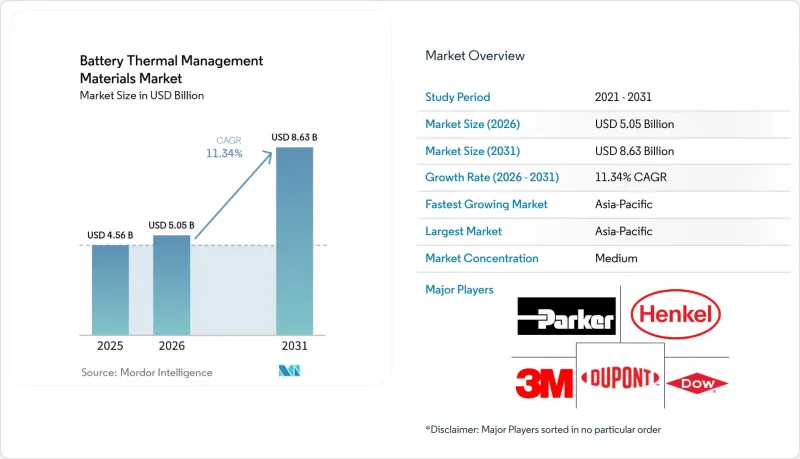
에 따르면 배터리 열 관리 재료 시장 규모는 2025년에 45억 6,000만 달러로 평가되며, 2026년 50억 5,000만 달러에서 2031년까지 86억 3,000만 달러에 달할 것으로 예측되며, 예측 기간(2026-2031년) 동안 CAGR은 11.34%가 될 전망입니다.
전 세계 배터리 열 관리 소재 시장의 동향 및 인사이트
전기자동차 생산 대수 및 배터리 생산능력 증가
전기자동차 생산은 배터리 열관리 소재 시장의 수요를 견인하는 주요 요인입니다. 이는 각 배터리 팩에서 셀, 모듈, 팩의 각 접합부에 소재가 필요하기 때문입니다. 배터리 설치량은 2024년 901.4 GWh에서 2025년에는 1,187 GWh에 달할 것으로 예상되며, 이에 따라 갭 필러, 포팅 컴파운드, 열전도성 접착제 및 보호 배리어에 대한 수요가 증가하고 있습니다. 2025년에도 중국은 전기자동차의 주요 생산 및 판매 거점으로 남아, 자재 조달, 설계 결정 및 공급업체 인증에 영향을 미치고 있습니다. 중국의 기가팩토리 과잉 생산능력은 소재 가격에 압박을 가할 가능성이 있지만, 배터리 생산능력의 추가 확장은 배터리 열 관리 소재 시장의 수요를 계속해서 뒷받침하고 있습니다. 북미 및 유럽의 자동차 제조업체(OEM)는 배터리 조립의 현지화를 추진하고 있으며, 이는 해당 지역에서 인증된 생산능력과 기술 지원을 갖춘 공급업체에 대한 수요를 창출하고 있습니다. 아시아에 애플리케이션 연구소나 인증 데이터를 보유한 기업은 고객이 아시아의 배터리 팩 설계를 다른 지역의 시설에 적용할 수 있도록 지원할 수 있습니다.
배터리 에너지 밀도 향상 및 급속 충전 요구 사항
에너지 밀도 향상과 급속 충전의 확산으로 인해 배터리 팩 내 발열량이 증가하고 있으며, 더 높은 열전도율, 더 얇은 본딩 라인, 그리고 신뢰성 높은 온도 사이클 성능을 갖춘 소재가 요구되고 있습니다. 셀-투-팩(Cell-to-Pack) 설계는 셀 간 간격을 줄이고 모듈 하우징에 의한 열 완충 효과를 제거함으로써 체적 에너지 밀도를 향상시킵니다. 800V 차량 플랫폼으로의 전환에 따라 15분 이내에 완료되는 초고속 충전 시 온도 구배가 증가합니다. 파라핀을 함침시킨 나노 다공성 구리 집전체에 대한 연구에서는 인산철리튬(LFP) 및 니켈-망간-코발트(NMC) 파우치 셀에서 자가 조절형 과열 보호 기능이 입증되었습니다. 이 조사는 열 제어 방식이 팩 수준의 갭 필러에서 셀 수준의 보호로 전환되고 있음을 보여줍니다. 배터리 열 관리 소재 시장에서 구조적 접착과 열전도 기능을 겸비한 이중 기능 제품은 열 제어 성능을 저하시키지 않으면서 층 수와 조립 공정을 줄일 수 있습니다.
첨단 열 관리 소재의 높은 비용과 기술적 복잡성
첨단 열 관리 소재는 대개 기존의 실리콘 패드보다 비용이 높고, 특수한 가공이 필요한 경우가 있어 가격에 민감한 배터리 프로그램에서의 채택을 제한하고 있습니다. 에어로겔 복합재, 고열전도성 갭 필러 및 마이크로캡슐화된 상변화 물질은 제조 및 적용 요건이 더 높은 재료 시스템과 생산 방법에 의존합니다. 첨단 갭 필러는 높은 열전도성을 실현하기 위해 질화 붕소, 질화 알루미늄, 실리콘 카바이드 등의 열전도성 필러가 필요합니다. 셀에서 팩으로의 조립 공정에서, 열전도성 구조용 접착제는 단순한 패드 삽입보다 정밀한 도포 장비와 더 엄격한 공정 관리가 필요합니다. 중국의 자동차 제조업체들은 열 성능 요건이 허용하는 경우, 실리콘계 갭 필러 대신 폴리우레탄 소재를 선택하기도 합니다. 이러한 요인들로 인해 배터리 열 관리 소재 시장 내에는 비용과 성능에 따른 계층이 형성되어, 고성능 배합 소재의 채택에 영향을 미치고 있습니다.
부문 분석
2025년에는 열 인터페이스 재료가 매출의 37.45%를 차지하며, 배터리 열 관리 재료 시장에서 가장 큰 재료 카테고리가 되었습니다. 이러한 소재는 수랭식 배터리 팩의 셀과 냉각판의 접촉점에 채택되고 있습니다. 이들은 요철이 있는 표면 사이에서도 열을 전달하는 동시에, 냉각 효율을 저하시킬 수 있는 공기 틈새를 방지합니다. 열전도성 접착제는 한 번의 도포로 구조적 접착과 열전달을 동시에 실현하고, 패드 삽입에 필요한 조립 공정을 생략할 수 있기 때문에 셀-투-팩 시스템에서 특정 갭 필러를 대체하는 추세가 강해지고 있습니다. 2026년 5월, 헨켈은 열전도율 1.7 W/m*K, 토출 속도 40 cm3/s를 초과하는 실리콘 프리 2액형 열 간극 충전재 ‘Bergquist TGF 2030APS’를 발표했습니다. 또한 이 회사는 셀-투-팩 설계를 위해 열전도율 2 W/m*K의 폴리우레탄계 열전도성 접착제 ‘Loctite TLB 9270APS’도 발표했습니다.
갭 필러와 열전도 패드는 팩의 재가공이나 비파괴적인 셀 접근이 중요한 용도에서 여전히 중요한 역할을 하고 있습니다. 한편, 포팅 및 밀봉 제품은 기계적 손상이나 화학제품 침입으로부터의 보호가 분해보다 우선시되는 고정형 에너지 저장 용도에서 채택이 확대되고 있습니다. 상변화 물질(PCM)은 능동적인 펌프 시스템 없이도 잠열을 흡수·방출하기 때문에 2031년까지 연평균 성장률(CAGR) 12.56%로 성장할 것으로 예측됩니다. 수동형 배터리 열 관리에 관한 조사에 따르면, 팽창 흑연을 포함한 복합 상변화 물질(PCM) 코팅은 표준 주행 사이클에서 두께 3mm일 때 셀의 평균 최고 온도 상승을 7°C 낮췄습니다. 배터리 열 관리 소재 업계에서는 열전도율, 도포 속도, 경화 특성, 재작업 요건 및 수동적 안전 성능이 균형을 이룬 제품이 요구되고 있습니다. 이러한 요건으로 인해 폭넓은 제품 포트폴리오 구축과 개발 초기 단계에서 배터리 팩 설계자와의 긴밀한 협력이 촉진되고 있습니다.
지역별 분석
아시아태평양은 2025년 배터리 열 관리 소재 시장의 45.13%를 차지할 것으로 예상되며, 2031년까지 연평균 성장률(CAGR) 12.62%로 성장할 것으로 전망됩니다. 이 지역에서는 배터리 생산, 전기자동차(EV) 조립, 셀 연구 및 에너지 저장 시스템 도입이 유기적으로 연계되어 소재 수요를 창출하고, 폭넓은 자격을 갖춘 제조업체 기반을 뒷받침하고 있습니다. 2025년 기준, 중국은 전 세계 소형 전기자동차 판매 대수의 62%, 전 세계 전기자동차 생산 대수의 71%를 차지하고 있습니다. 이러한 규모가 전기자동차, 고정형 에너지 저장, 산업용 분야에서 열 인터페이스 소재, 상변화 제품, 방화 등급 제품에 대한 수요를 견인하고 있습니다. 2026년 7월 신차 형식 인증에 시행된 중국의 GB 38031-2025 규격에 따르면, 열 폭주가 발생한 후 2시간 동안 배터리가 화재나 폭발을 방지해야 할 의무가 부과됩니다.
한국은 배터리 소재 생태계와 국내 열 관리 제품 전문 기업을 통해 더욱 탄탄한 지역적 수요 기반을 제공하고 있습니다. 바커 케미 AG는 일본 츠쿠바와 한국 진천에서 특수 실리콘 생산을 확대하고 있으며, 이를 통해 현지에서 생산된 열 인터페이스 소재 등급과 더 짧은 공급 경로를 통해 아시아 자동차 업계 고객들에게 서비스를 제공할 수 있게 되었습니다. 인도는 신흥 수요 거점으로 부상하고 있으며, 이 나라의 전동 이륜차 및 삼륜차 차량군에는 안전 요건을 충족하는 배터리 열 관리 솔루션이 요구되고 있습니다. 국내 배터리 조립 능력의 확대는 수입 배터리 팩 이외의 수요도 창출하고 있습니다. 아시아태평양의 셀 제조업체들은 많은 유럽 및 미국 시장보다 더 신속하게 ‘셀-투-팩(cell-to-pack)’ 및 ‘셀-투-섀시(cell-to-chassis)’ 아키텍처를 채택하고 있으며, 이로 인해 소재 인증 기간이 단축되고, 해당 지역에 애플리케이션 연구소를 갖춘 공급업체들이 지원을 받고 있습니다.
북미와 유럽은 매출 규모 측면에서 그 다음으로 큰 지역 블록을 차지하고 있지만, 수요를 견인하는 요인은 서로 다릅니다. 유럽의 신차 판매에서 배터리식 전기자동차가 차지하는 비중은 2024년 14%에서 2025년 18%로 증가했습니다. EU 배터리 규정 2023/1542에 따라 안전성, 분해 및 폐배터리 처리를 지원하는 소재에 대한 수요가 증가하고 있습니다. 북미에서는 그리드 규모의 에너지 저장용 컨테이너에 관한 ANSI/CAN/UL 9540A 및 ANSI/CAN/UL 1487의 요구 사항이 수요를 뒷받침하고 있습니다. 남미, 중동 및 아프리카는 여전히 소규모 시장이지만, 수요는 브라질, 아르헨티나, 사우디아라비아, 남아프리카공화국에 집중되어 있으며, 이 지역들의 에너지 저장 및 전기화 프로젝트는 전 세계 공급업체들에게 사업 다각화의 기회를 제공하고 있습니다.
기타 혜택:
- 엑셀 형식의 시장 예측(ME) 시트
- 3개월간의 애널리스트 지원
자주 묻는 질문
목차
제1장 소개
- 조사 가정과 시장 정의
- 조사 범위
제2장 조사 방법
제3장 주요 요약
제4장 시장 구도
- 시장 개요
- 시장 성장 촉진요인
- 시장 성장 억제요인
- 밸류체인 분석
- Porter's Five Forces 분석
제5장 시장 규모와 성장 예측
- 소재 유형별
- 용도별
- 지역별
- 아시아태평양
- 중국
- 인도
- 일본
- 한국
- 기타 아시아태평양 국가
- 북미
- 미국
- 캐나다
- 멕시코
- 유럽
- 독일
- 영국
- 프랑스
- 이탈리아
- 러시아
- 기타 유럽 국가
- 남미
- 브라질
- 아르헨티나
- 기타 남미 국가
- 중동 및 아프리카
- 사우디아라비아
- 남아프리카공화국
- 기타 중동 및 아프리카 국가
- 아시아태평양
제6장 경쟁 구도
- 시장 집중도
- 전략적 동향
- 시장 점유율·순위 분석
- 기업 개요
- 3M
- Asahi Kasei Corporation
- Aspen Aerogels, Inc.
- Dow
- DuPont
- Elkem ASA
- GrafTech International
- H.B. Fuller Company
- Henkel AG & Co. KGaA
- Momentive
- PARKER HANNIFIN CORP
- Saint-Gobain
- Shin-Etsu Chemical Co., Ltd.
- Sika AG
- Wacker Chemie AG
제7장 시장 기회와 향후 전망
KSM 26.10.29According to Mordor Intelligence, the battery thermal management materials market size was valued at USD 4.56 billion in 2025 and is estimated to grow from USD 5.05 billion in 2026 to reach USD 8.63 billion by 2031, at a CAGR of 11.34% during the forecast period (2026-2031).
Global Battery Thermal Management Materials Market Trends and Insights
Rising Electric Vehicle Production and Battery Manufacturing Capacity
Electric vehicle production is a key driver of demand in the battery thermal management materials market, as each battery pack requires materials at the cell, module, and pack interfaces. Battery installations reached 1,187 GWh in 2025, up from 901.4 GWh in 2024, increasing demand for gap fillers, potting compounds, thermal adhesives, and protective barriers. China remained the main production and sales hub for electric vehicles in 2025, influencing material procurement, design decisions, and supplier qualification. Excess gigafactory capacity in China may pressure material prices; however, additional battery capacity continues to support demand in the battery thermal management materials market. North American and European original equipment manufacturers (OEMs) are localizing battery assembly, creating demand for suppliers with qualified regional production capabilities and technical support. Companies with application laboratories and qualification data in Asia can support customers adapting Asian battery pack designs for facilities in other regions.
Higher Battery Energy Density and Faster Charging Requirements
Higher energy density and faster charging increase heat generation within battery packs, requiring materials with higher thermal conductivity, thinner bondlines, and reliable temperature-cycling performance. Cell-to-pack designs increase volumetric energy density by reducing cell-to-cell spacing and eliminating the heat-buffering effect of module housings. The transition to 800 V vehicle platforms increases thermal gradients during ultra-fast charging events that can last less than 15 minutes. Research on paraffin-impregnated nanoporous copper current collectors demonstrated self-regulated overheating protection in lithium iron phosphate (LFP) and nickel manganese cobalt (NMC) pouch cells. This research indicates a shift in thermal control from pack-level gap fillers toward cell-level protection. In the battery thermal management materials market, dual-function products that combine structural bonding and heat transfer can reduce the number of layers and assembly steps without compromising thermal control.
High Cost and Technical Complexity of Advanced Thermal Materials
Advanced thermal materials often cost more than conventional silicone pads and may require specialized processing, limiting adoption in price-sensitive battery programs. Aerogel composites, high-conductivity gap fillers, and micro-encapsulated phase change materials rely on material systems and production methods with higher manufacturing and application requirements. Advanced gap fillers require thermally conductive fillers, such as boron nitride, aluminum nitride, and silicon carbide, to achieve high thermal conductivity. In cell-to-pack assembly, thermally conductive structural adhesives require precise dispensing equipment and tighter process controls than simpler pad insertion. Vehicle manufacturers in China may select polyurethane materials instead of silicone-based gap fillers when thermal performance requirements permit. These factors create cost and performance tiers within the battery thermal management materials market and affect the adoption of higher-performance formulations.
Other drivers and restraints analyzed in the detailed report include:
- Thermal-Runaway Prevention and Battery-Safety Requirements
- Growth of Energy Storage Systems and Renewable-Power Integration
- Qualification Cycles and Diverse OEM Battery-Pack Requirements
For complete list of drivers and restraints, kindly check the Table Of Contents.
Segment Analysis
Thermal interface materials accounted for 37.45% of revenue in 2025, making them the largest material category in the battery thermal management materials market. These materials are deployed at cell-to-cooling-plate contact points in liquid-cooled battery packs. They transfer heat across uneven surfaces while preventing air gaps that can reduce cooling efficiency. Thermally conductive adhesives are increasingly replacing certain gap fillers in cell-to-pack systems because they provide structural bonding and heat transfer in a single dispensed layer, eliminating the assembly stage required for pad insertion. In May 2026, Henkel introduced Bergquist TGF 2030APS, a silicone-free, two-component thermal gap filler with thermal conductivity of 1.7 W/m*K and dispensing rates above 40 cm3/s. The company also introduced Loctite TLB 9270APS, a polyurethane thermally conductive adhesive with thermal conductivity of 2 W/m*K for cell-to-pack designs.
Gap fillers and thermal pads remain relevant in applications where pack rework and non-destructive cell access are important. Meanwhile, potting and encapsulation products are gaining adoption in stationary energy storage applications, where protection from mechanical damage and chemical ingress can take priority over disassembly. Phase change materials are forecast to grow at a CAGR of 12.56% through 2031 because they absorb and release latent heat without requiring active pumping systems. According to research on passive battery thermal management, composite phase change material (PCM) coatings containing expanded graphite reduced average peak cell temperature increases by 7°C at a thickness of 3 mm during standard drive cycles. The battery thermal management materials industry requires products that balance thermal conductivity, dispensing speed, curing behavior, rework requirements, and passive safety performance. This requirement supports broad product portfolios and closer collaboration with battery pack designers during early-stage development.
Complete Report Scope:
- By Material Type
- Thermal Interface Materials
- Gap Fillers and Thermal Pads
- Phase Change Materials
- Thermal Conductive Adhesives
- Potting and Encapsulation Materials
- Thermal Insulation and Fire-Protection Materials
- Others
- By Application
- Electric Vehicles
- Energy Storage Systems
- Consumer Electronics
- Industrial Equipment
- Others
- By Geography
- Asia-Pacific
- China
- India
- Japan
- South Korea
- Rest of Asia-Pacific
- North America
- United States
- Canada
- Mexico
- Europe
- Germany
- United Kingdom
- France
- Italy
- Russia
- Rest of Europe
- South America
- Brazil
- Argentina
- Rest of South America
- Middle East and Africa
- Saudi Arabia
- South Africa
- Rest of Middle East and Africa
- Asia-Pacific
Geography Analysis
Asia-Pacific holds 45.13% of the battery thermal management materials market in 2025 and is forecast to grow at a CAGR of 12.62% through 2031. The region combines battery production, electric vehicle (EV) assembly, cell research, and energy storage deployment, generating material demand and supporting a broad base of qualified manufacturers. China accounts for 62% of global light-duty EV sales and 71% of global EV production in 2025. This scale drives demand for thermal interface materials, phase-change products, and fire-protection grades across EV, stationary storage, and industrial applications. China's GB 38031-2025, which took effect in July 2026 for new vehicle declarations, requires batteries to prevent fire and explosion for two hours after thermal runaway begins.
South Korea provides an additional regional demand base through its battery materials ecosystem and domestic thermal management product specialists. Wacker Chemie AG has expanded specialty silicone production in Tsukuba, Japan, and Jincheon, South Korea, enabling the company to serve Asian automotive customers with locally produced thermal interface material grades and shorter supply routes. India is an emerging demand center, as its electric two- and three-wheeler fleets require battery thermal management solutions that meet safety requirements. Expanding domestic battery assembly capacity also creates demand beyond imported battery packs. Asia-Pacific cell manufacturers are adopting cell-to-pack and cell-to-chassis architectures more rapidly than many Western markets, shortening material qualification timelines and supporting suppliers with established regional application laboratories.
North America and Europe represent the next-largest geographic revenue blocks, although their demand drivers differ. Europe's battery-electric vehicle share of new car sales reached 18% in 2025, up from 14% in 2024. The EU Battery Regulation 2023/1542 increases demand for materials that support safety, disassembly, and end-of-life battery handling. In North America, ANSI/CAN/UL 9540A and ANSI/CAN/UL 1487 requirements for grid-scale energy storage containment support demand. South America, the Middle East, and Africa remain smaller markets, with demand concentrated in Brazil, Argentina, Saudi Arabia, and South Africa, where energy storage and electrification projects provide diversification opportunities for global suppliers.
- 3M
- Asahi Kasei Corporation
- Aspen Aerogels, Inc.
- Dow
- DuPont
- Elkem ASA
- GrafTech International
- H.B. Fuller Company
- Henkel AG & Co. KGaA
- Momentive
- PARKER HANNIFIN CORP
- Saint-Gobain
- Shin-Etsu Chemical Co., Ltd.
- Sika AG
- Wacker Chemie AG
Additional Benefits:
- The market estimate (ME) sheet in Excel format
- 3 months of analyst support
TABLE OF CONTENTS
1 Introduction
- 1.1 Study Assumptions and Market Definition
- 1.2 Scope of the Study
2 Research Methodology
3 Executive Summary
4 Market Landscape
- 4.1 Market Overview
- 4.2 Market Drivers
- 4.2.1 Rising Electric Vehicle Production and Battery Manufacturing Capacity
- 4.2.2 Higher Battery Energy Density and Faster Charging Requirements
- 4.2.3 Thermal-Runaway Prevention and Battery-Safety Requirements
- 4.2.4 Growth of Energy Storage Systems and Renewable-Power Integration
- 4.2.5 Cell-to-Pack and Cell-to-Chassis Architectures Increasing Material Intensity
- 4.3 Market Restraints
- 4.3.1 High Cost and Technical Complexity of Advanced Thermal Materials
- 4.3.2 Qualification Cycles and Diverse OEM Battery-Pack Requirements
- 4.3.3 Recyclability Challenges for Cured TIMs, Encapsulants, and Adhesive-Bonded Packs
- 4.4 Value Chain Analysis
- 4.5 Porter's Five Forces Analysis
- 4.5.1 Threat of New Entrants
- 4.5.2 Bargaining Power of Suppliers
- 4.5.3 Bargaining Power of Buyers
- 4.5.4 Threat of Substitutes
- 4.5.5 Competitive Rivalry
5 Market Size and Growth Forecasts (Value)
- 5.1 By Material Type
- 5.1.1 Thermal Interface Materials
- 5.1.2 Gap Fillers and Thermal Pads
- 5.1.3 Phase Change Materials
- 5.1.4 Thermal Conductive Adhesives
- 5.1.5 Potting and Encapsulation Materials
- 5.1.6 Thermal Insulation and Fire-Protection Materials
- 5.1.7 Others
- 5.2 By Application
- 5.2.1 Electric Vehicles
- 5.2.2 Energy Storage Systems
- 5.2.3 Consumer Electronics
- 5.2.4 Industrial Equipment
- 5.2.5 Others
- 5.3 By Geography
- 5.3.1 Asia-Pacific
- 5.3.1.1 China
- 5.3.1.2 India
- 5.3.1.3 Japan
- 5.3.1.4 South Korea
- 5.3.1.5 Rest of Asia-Pacific
- 5.3.2 North America
- 5.3.2.1 United States
- 5.3.2.2 Canada
- 5.3.2.3 Mexico
- 5.3.3 Europe
- 5.3.3.1 Germany
- 5.3.3.2 United Kingdom
- 5.3.3.3 France
- 5.3.3.4 Italy
- 5.3.3.5 Russia
- 5.3.3.6 Rest of Europe
- 5.3.4 South America
- 5.3.4.1 Brazil
- 5.3.4.2 Argentina
- 5.3.4.3 Rest of South America
- 5.3.5 Middle East and Africa
- 5.3.5.1 Saudi Arabia
- 5.3.5.2 South Africa
- 5.3.5.3 Rest of Middle East and Africa
- 5.3.1 Asia-Pacific
6 Competitive Landscape
- 6.1 Market Concentration
- 6.2 Strategic Moves
- 6.3 Market Share (%)/Ranking Analysis
- 6.4 Company Profiles (includes Global Overview, Market Overview, Core Segments, Financials as available, Strategic Information, Products and Services, and Recent Developments)
- 6.4.1 3M
- 6.4.2 Asahi Kasei Corporation
- 6.4.3 Aspen Aerogels, Inc.
- 6.4.4 Dow
- 6.4.5 DuPont
- 6.4.6 Elkem ASA
- 6.4.7 GrafTech International
- 6.4.8 H.B. Fuller Company
- 6.4.9 Henkel AG & Co. KGaA
- 6.4.10 Momentive
- 6.4.11 PARKER HANNIFIN CORP
- 6.4.12 Saint-Gobain
- 6.4.13 Shin-Etsu Chemical Co., Ltd.
- 6.4.14 Sika AG
- 6.4.15 Wacker Chemie AG
7 Market Opportunities and Future Outlook
- 7.1 White-Space and Unmet-Need Assessment


