|
시장보고서
상품코드
1907333
퍼스널케어 포장 시장 : 시장 점유율 분석, 업계 동향 및 통계, 성장 예측(2026-2031년)Personal Care Packaging - Market Share Analysis, Industry Trends & Statistics, Growth Forecasts (2026 - 2031) |
||||||
 Mordor Intelligence
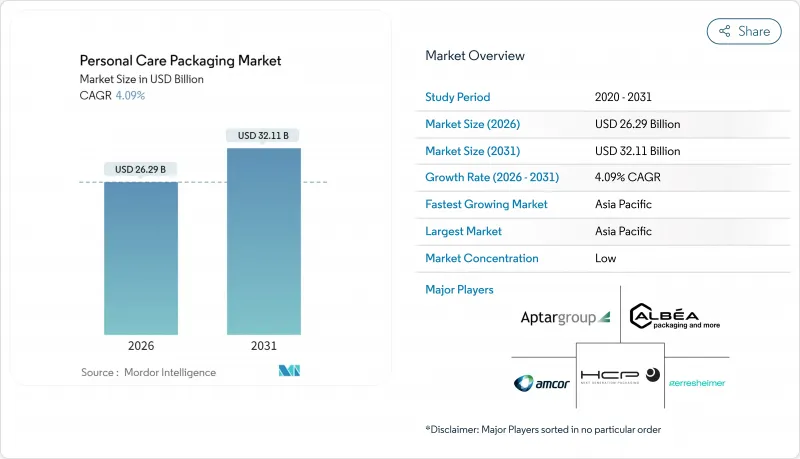
퍼스널케어 포장 시장은 2025년 252억 6,000만 달러로 평가되었고, 2026년에는 262억 9,000만 달러로 성장할 전망이며, 2026-2031년 CAGR 4.09%로 성장을 지속하여, 2031년까지 321억 1,000만 달러에 달할 것으로 예측됩니다.
지속적인 성장은 신흥국의 프리미엄화, 최소 30% 포스트 소비자 재생재(PCR) 함량의 의무화, 높은 보호 성능을 갖춘 선적 준비 포장을 필요로 하는 옴니채널 대응 모델과 관련이 있습니다. PCR PET, 바이오베이스 폴리머 및 해양 플라스틱 원료를 중심으로 한 소재 혁신은 규제 위험을 줄이고 제품 차별화를 촉진합니다. 에지 AI 충전 라인은 SKU 생산 비용을 줄이고 가정용 리필 디스펜서는 소비자의 편의성을 높이고 재료 사용을 줄입니다. 이러한 요인들이 함께 북미와 유럽에서 수지 가격의 변동과 일회용 규제에 대한 퍼스널케어 포장 시장의 내성을 강화하고 있습니다.
세계의 퍼스널케어 포장 시장 동향 및 인사이트
신흥 시장에서 미용 SKU의 고급화
프리미엄화는 금속조 마무리, 엠보싱 가공, 복수 부품 구성이라고 하는 수법에 의해 가치 지향의 소비자에게 배타성을 전해, 로컬 브랜드 및 세계의 브랜드를 동경의 대상으로 승화시킵니다. 디지털 장식 기술은 경제적으로 실현 가능한 소량 생산을 가능하게 하고, 20-40%의 가격 프리미엄을 포함한 한정판의 빈번한 발매를 촉진하고 있습니다. 스킨케어 분야에서의 성공은 헤어케어 및 데오도란트 분야에서도 유사한 전략을 추진하고 패키지의 세련도가 효과와 안전성을 나타내는 소비자의 인식을 강화하고 있습니다.
옴니 채널 대응이 추진하는 보호 기능 및 배송 대응 포장
전자상거래의 가속화로 포장은 단일 소포 배송을 견디면서 매장 품질의 브랜딩을 유지해야 합니다. 일체형 완충재, 변조 방지 캡, 낙하 시험 대응 구조에 의해 2차 포장이 불필요하게 되어, 도입 기업에 따라서는 자재 소비량을 30% 삭감하고 있습니다. 자동화를 통해 소매용과 온라인용 SKU 간의 신속한 라인 전환이 가능하며, 카테고리별 전자상거래 침투율이 연간 25% 이상의 가운데 생산 사이클의 단축을 도모하고 있습니다.
변동하는 폴리올레핀 및 PET 원료 가격
수지 비용은 1년 이내에 40% 이상 변동해 컨버터의 이익률을 압박, 동적인 가격 설정과 헤징 프로그램의 도입을 촉구하고 있습니다. 공급 제한에 따라 재생 수지 가격은 더욱 크게 변동하고 수익성을 지키기 위해 수직 통합형 조달과 장기 계약이 추진되고 있습니다.
부문 분석
플라스틱은 비용 효율성 및 적응성이 높은 장벽 성능을 배경으로 2025년 시점에서 퍼스널케어 포장 시장의 58.22%를 차지했습니다. 부문 내에서 폴리에틸렌과 폴리프로필렌은 생산량을 견인하는 반면, PET는 일회용 규제의 영향을 받아 뒤쳐졌습니다. 바이오 베이스 수지 및 PCR 수지는 2031년까지 연평균 복합 성장률(CAGR) 4.22%를 유지할 전망이며, 규제가 퍼스널케어 포장 시장 규모에 미치는 영향을 완화합니다. 유리는 고급 향수를 위한 고급 제품으로서의 지위를 유지했으며, 금속 에어로졸은 헤어 스프레이 및 데오도란트 분야에서 틈새 시장을 견지했습니다. 종이판은 방습성이 중요하지 않은 2차 포장으로 수요를 확대하고 있습니다.
첨단 재활용 기술과 상용화제 화학에 대한 지속적인 투자로 컨버터는 투명성과 보존 기간을 손상시키지 않고 PCR 기준을 충족할 수 있게 되었습니다. 브랜드 각사는 사용후의 리사이클성을 극대화하기 위해, 무색 마스터 배치나 첨가제 프리의 배합을 실험하고 있습니다. 이러한 진전은 정책 압력이 높아지는 가운데 플라스틱이 최전선에 머물러 혁신이 퍼스널케어 포장 시장을 안정화시키고 있는 것으로 나타났습니다.
2025년 시점에서 경질 용기는 퍼스널케어 포장 시장 규모의 80.96%를 차지하였고, 내구성과 브랜드 가치에 대한 소비자의 인식을 배경으로, CAGR 5.51%로 확대가 전망됩니다. 에어리스 항아리, 유리 스포이드, 스프레이 액추에이터가 있는 PET 병은 고급 스킨 케어 및 헤어 케어 제품의 포지셔닝에 적합합니다. 플렉서블 파우치는 여행 크기와 리필 포드에 침투하고 있지만, 브랜드 소유자는 여전히 매장에서의 존재감과 가치감의 관점에서 단단한 1차 용기에 의존하고 있습니다.
경량화 및 모듈식 조립에 의해 강성을 유지하면서 재료 사용량을 삭감하고 있습니다. 하이브리드 솔루션은 경질 외피와 유연한 리필 용기를 결합하여 사용자의 친숙한 사용감과 지속가능성 향상을 양립시킵니다. NFC 인증 기능을 갖춘 스마트 클로저의 업계 도입으로 경질 포장은 디지털 소비자 참여 전략에서도 중요한 역할을 계속하고 있습니다.
지역별 분석
아시아태평양은 2025년에 퍼스널케어 포장 시장 점유율의 41.62%를 차지하였고, 가처분 소득 증가, 도시로의 인구 이동, 남성용 그루밍 시장의 활성화를 배경으로, 2031년까지 연평균 복합 성장률(CAGR) 5.18%로 확대가 전망됩니다. 중국은 통합 공급망과 급성장하는 전자상거래를 배경으로 수량 기준의 주도적 지위를 유지하고 있으며, 인도에서는 현대적인 유통 형태가 증가함에 따라 급속한 수량 성장을 기록하고 있습니다. 일본과 한국은 제품과의 상호작용 및 진정성 검증을 위한 NFC 태그와 감열 잉크를 통합하는 등 세계의 스마트 포장 동향을 견인하고 있습니다.
북미에서는 스킨 케어 및 헤어 케어 분야의 프리미엄 지향과 브랜드 충성도로 퍼스널케어 포장 시장이 계속 대규모로 유지되고 있습니다. 재활용 플라스틱(PCR) 함량에 대한 규제 강화로 컨버터 기업은 기계적 및 화학적 재활용의 확대를 촉구하고 있으며, 이 지역이 혁신의 실험장으로서의 역할을 확고하게 하고 있습니다. 미국에서는 변조 방지 및 아이 안전 포장 수요가 견인역이 되는 한편, 캐나다에서는 같은 경향에 더해, 2언어 표시에의 중점이 추가되고 있습니다. 멕시코는 무역 협정과 원재료 공급원에 대한 근접성을 활용하여 수출용 생산에 있어서 비용 효율적인 거점을 제공합니다.
유럽의 동향은 엄격한 폐기물 감소 의무에 의해 형성됩니다. 독일과 프랑스에서는 양판점에서 리필 스테이션의 시험 도입이 진행되어 재사용 가능한 포장의 보급을 가속시키고 있습니다. 영국은 브렉짓 후 복잡한 통관 절차에 대응하면서도 고급 향수용 유리 용기의 고부가가치 틈새 생산을 유지하고 있습니다. 남유럽은 프리미엄 경질 용기의 디자인 유산을 활용하고 북유럽 시장에서는 순환성 지표를 충족하기 위해 카톤 기반의 2차 포장을 추진하고 있습니다.
기타 혜택 :
- 엑셀 형식 시장 예측(ME) 시트
- 애널리스트에 의한 3개월간의 지원
자주 묻는 질문
목차
제1장 서론
- 조사의 전제조건 및 시장 정의
- 조사 범위
제2장 조사 방법
제3장 주요 요약
제4장 시장 상황
- 시장 개요
- 시장 성장 촉진요인
- 신흥 시장에서의 미용 SKU의 프리미엄화
- 옴니 채널 대응이 추진하는 보호 포장 및 출하 대응 포장
- 지속가능성 규칙 : 30% 이상의 재활용 플라스틱(PCR) 함유 의무화
- 가정용 리필식 디스펜서의 급속한 보급
- 엣지 AI 탑재 충전 라인에 의한 SKU 비용 절감
- 동남아시아에서 남성용 미용 시장의 급성장
- 시장 성장 억제요인
- 변동하는 폴리올레핀 및 PET 원료 가격
- EU 전역 및 미국 일부 주에서 일회용 플라스틱 제품 금지
- 알루미늄 및 유리에서 공급망의 병목
- 고형 유형의 화장실 제품 대두에 의한 1차 포장 대체
- 업계 밸류체인 분석
- 규제 상황
- 기술 전망
- Porter's Five Forces 분석
- 신규 참가업체의 위협
- 구매자의 협상력
- 공급기업의 협상력
- 대체품의 위협
- 경쟁 기업 간 경쟁 관계
- 거시경제 요인이 시장에 미치는 영향
제5장 시장 규모 및 성장 예측
- 재료 유형별
- 플라스틱
- 폴리에틸렌
- 폴리프로필렌
- PET 및 PVC
- 폴리스티렌
- 바이오 베이스 플라스틱
- 기타 플라스틱 재료 유형
- 유리
- 금속
- 종이 및 판지
- 플라스틱
- 포장 형태별
- 연질
- 경질
- 제품 유형별
- 병 및 항아리
- 튜브 및 스틱
- 펌프 및 디스펜서
- 파우치 및 파우치
- 뚜껑 및 마개
- 기타 제품 유형
- 용도별
- 스킨 케어
- 헤어 케어
- 오랄 케어
- 메이크업 제품
- 데오도란트 및 향수
- 아기 케어
- 기타 용도
- 지역별
- 북미
- 미국
- 캐나다
- 멕시코
- 남미
- 브라질
- 아르헨티나
- 기타 남미
- 유럽
- 독일
- 프랑스
- 영국
- 이탈리아
- 스페인
- 기타 유럽
- 아시아태평양
- 중국
- 일본
- 인도
- 한국
- ASEAN 국가
- 호주 및 뉴질랜드
- 기타 아시아태평양
- 중동 및 아프리카
- 중동
- 사우디아라비아
- 아랍에미리트(UAE)
- 튀르키예
- 기타 중동
- 아프리카
- 남아프리카
- 나이지리아
- 이집트
- 기타 아프리카
- 중동
- 북미
제6장 경쟁 구도
- 시장 집중도
- 전략적 동향
- 시장 점유율 분석
- 기업 프로파일
- Albea SA
- HCP Packaging Group
- Gerresheimer AG
- Amcor plc
- AptarGroup, Inc.
- Cosmopak USA LLC
- Quadpack Industries, SA
- Libo Cosmetics Co., Ltd.
- Mpack Poland sp. z oo
- POLITECH SP. Z OO
- Rieke Corporation(TriMas Corporation)
- Berlin Packaging LLC
- MKTG INDUSTRY SRL
- Silgan Holdings, Inc.
- Stoelzle Oberglas GmbH
- EPL Limited
- Verescence Inc.
- Apackaging Group LLC
- Heinz-Glass GmbH & Ko. KGaA
- Roetell Group
- Vitro SAB De CV
- Vidraria Anchieta Ltda.
- Lumson SpA
제7장 시장 기회 및 장래 전망
AJY 26.01.22The personal care packaging market is expected to grow from USD 25.26 billion in 2025 to USD 26.29 billion in 2026 and is forecast to reach USD 32.11 billion by 2031 at 4.09% CAGR over 2026-2031.
Sustained growth is linked to premiumization in emerging economies, the enforcement of a minimum 30% post-consumer recycled (PCR) content, and omni-channel fulfilment models that require ship-ready packs with high protective performance. Material innovation centered on PCR PET, bio-based polymers, and ocean-plastic feedstock mitigates regulatory risk and fuels product differentiation. Edge-AI filling lines are cutting SKU production costs, while refill-at-home dispensing formats broaden consumer convenience and lower material intensity. Together, these factors strengthen the personal care packaging market's resilience against volatile resin prices and single-use restrictions in North America and Europe.
Global Personal Care Packaging Market Trends and Insights
Premiumization of Beauty SKUs in Emerging Markets
Premiumization elevates local and global brands to aspirational status through metallic finishes, embossed textures, and multi-component assemblies that convey exclusivity to value-oriented consumers. Digital embellishment enables economically viable short runs, encouraging frequent limited-edition launches that command 20-40% price premiums. Success in skin care drives similar strategies in hair care and deodorants, reinforcing consumer perception that package sophistication signals efficacy and safety.
Omni-Channel Fulfillment Driving Protective and Ship-Ready Packs
E-commerce acceleration compels packages to survive single-parcel distribution while projecting shelf-quality branding. Integrated cushioning, tamper-evident closures, and drop-test-rated structures remove secondary boxes and trim material consumption by 30% for some adopters. Automation supports rapid line changeovers between retail and online SKUs, tightening production cycles as category e-commerce penetration exceeds 25% annually.
Volatile Polyolefin and PET Feed-Stock Prices
Resin costs swing more than 40% within a year, compressing converter margins and prompting dynamic pricing and hedging programs. Recycled resin prices fluctuate even more due to limited supply, driving vertically integrated sourcing and long-term contracts to shield profitability.
Other drivers and restraints analyzed in the detailed report include:
- Sustainability Rules Mandating More than 30% PCR Content
- Rapid Adoption of Refill-At-Home Dispensing Formats
- Supply-Chain Chokepoints in Aluminium and Glass
For complete list of drivers and restraints, kindly check the Table Of Contents.
Segment Analysis
Plastic held 58.22% of the personal care packaging market share in 2025, supported by cost efficiency and adaptable barrier performance. Within the segment, polyethylene and polypropylene led volumes, while PET trailed under scrutiny from single-use restrictions. Bio-based and PCR resins underpin a 4.22% CAGR to 2031, cushioning regulatory impacts on the personal care packaging market size. Glass retained its luxury positioning for prestige fragrances, whereas metal aerosols sustained their niche in hair sprays and deodorants. Paperboard gains traction in secondary packs where moisture barriers are non-critical.
Continued investment in advanced recycling and compatibilizer chemistry allows converters to meet PCR thresholds without sacrificing clarity or shelf life. Brands experiment with colorless masterbatches and additive-free formulations to maximize end-of-life recyclability. These developments keep plastic at the forefront even as policy pressure intensifies, demonstrating how innovation stabilizes the personal care packaging market.
Rigid formats represented 80.96% of the personal care packaging market size in 2025 and are forecast to expand at a 5.51% CAGR, driven by consumer perception of durability and brand prestige. Airless jars, glass droppers, and PET bottles with spray actuators satisfy premium skin and hair care positioning. Flexible pouches penetrate travel sizes and refill pods, but brand owners still rely on rigid primary containers for shelf presence and perceived value.
Light-weighting and modular assemblies help offset material intensity while preserving rigidity. Hybrid solutions pair rigid outer shells with flexible refills, merging user familiarity with sustainability gains. Industry adoption of smart closures capable of NFC authentication keeps rigid packaging relevant in digital consumer engagement strategies.
The Personal Care Packaging Market Report is Segmented by Material Type (Plastic, Glass, Metal, and Paper and Paperboard), Packaging Format (Flexible and Rigid), Product Type (Bottles and Jars, Tubes and Sticks, Pumps and Dispensers, Pouches and Sachets, and More), Application (Skin Care, Hair Care, Oral Care, Make-Up Products, and More), and Geography. The Market Forecasts are Provided in Terms of Value (USD).
Geography Analysis
Asia-Pacific controlled 41.62% of the personal care packaging market share in 2025 and will expand at a 5.18% CAGR to 2031, lifted by rising disposable incomes, urban migration, and vibrant male grooming uptake. China sustains volume leadership on the back of integrated supply chains and surging e-commerce, while India registers rapid unit growth as modern trade formats multiply. Japan and South Korea steer global smart-packaging trends, embedding NFC tags and heat-sensitive inks for product interaction and authenticity verification.
North America maintains a sizeable personal care packaging market due to premiumization and brand loyalty in skin and hair care. Regulatory emphasis on PCR content pushes converters to scale mechanical and chemical recycling, cementing the region's role as an innovation testbed. The United States drives demand for tamper-resistant, child-safe packs, whereas Canada mirrors these tendencies with an additional focus on bilingual labeling. Mexico offers cost-effective production hubs for export-oriented runs, benefiting from trade agreements and proximity to raw material suppliers.
Europe's profile is shaped by stringent waste-reduction mandates. Germany and France pilot refill stations in mass retail, accelerating uptake of reusable packs. The United Kingdom navigates post-Brexit customs complexities yet retains high-value niche production in luxury fragrance glass. Southern Europe leverages design heritage in premium rigid formats, while Northern European markets advance carton-based secondary packs to satisfy circularity metrics.
- Albea S.A.
- HCP Packaging Group
- Gerresheimer AG
- Amcor plc
- AptarGroup, Inc.
- Cosmopak USA LLC
- Quadpack Industries, S.A.
- Libo Cosmetics Co., Ltd.
- Mpack Poland sp. z o.o.
- POLITECH SP. Z O.O.
- Rieke Corporation (TriMas Corporation)
- Berlin Packaging LLC
- MKTG INDUSTRY SRL
- Silgan Holdings, Inc.
- Stoelzle Oberglas GmbH
- EPL Limited
- Verescence Inc.
- Apackaging Group LLC
- Heinz-Glass GmbH & Ko. KGaA
- Roetell Group
- Vitro SAB De CV
- Vidraria Anchieta Ltda.
- Lumson S.p.A
Additional Benefits:
- The market estimate (ME) sheet in Excel format
- 3 months of analyst support
TABLE OF CONTENTS
1 INTRODUCTION
- 1.1 Study Assumptions and Market Definition
- 1.2 Scope of the Study
2 RESEARCH METHODOLOGY
3 EXECUTIVE SUMMARY
4 MARKET LANDSCAPE
- 4.1 Market Overview
- 4.2 Market Drivers
- 4.2.1 Premiumization of Beauty SKUs in Emerging Markets
- 4.2.2 Omni-Channel Fulfilment Driving Protective and Ship-Ready Packs
- 4.2.3 Sustainability Rules Mandating more than 30 % PCR Content
- 4.2.4 Rapid Adoption of Refill-At-Home Dispensing Formats
- 4.2.5 Edge-Ai Enabled Filling Lines Cutting SKU Cost
- 4.2.6 Explosive Growth of Male Grooming in Southeast Asia
- 4.3 Market Restraints
- 4.3.1 Volatile Polyolefin and PET Feed-Stock Prices
- 4.3.2 Single-Use-Plastics Bans Across the EU and Select US States
- 4.3.3 Supply-Chain Chokepoints in Aluminium and Glass
- 4.3.4 Rise of Solid-Format Toiletries Replacing Primary Packs
- 4.4 Industry Value Chain Analysis
- 4.5 Regulatory Landscape
- 4.6 Technological Outlook
- 4.7 Porter's Five Forces Analysis
- 4.7.1 Threat of New Entrants
- 4.7.2 Bargaining Power of Buyers
- 4.7.3 Bargaining Power of Suppliers
- 4.7.4 Threat of Substitute Products
- 4.7.5 Intensity of Competitive Rivalry
- 4.8 Impact of Macroeconomic Factors on the Market
5 MARKET SIZE AND GROWTH FORECASTS (VALUE)
- 5.1 By Material Type
- 5.1.1 Plastic
- 5.1.1.1 Polyethylene
- 5.1.1.2 Polypropylene
- 5.1.1.3 PET and PVC
- 5.1.1.4 Polystyrene
- 5.1.1.5 Bio-Based Plastics
- 5.1.1.6 Other Plastic Material Types
- 5.1.2 Glass
- 5.1.3 Metal
- 5.1.4 Paper and Paperboard
- 5.1.1 Plastic
- 5.2 By Packaging Format
- 5.2.1 Flexible
- 5.2.2 Rigid
- 5.3 By Product Type
- 5.3.1 Bottles and Jars
- 5.3.2 Tubes and Sticks
- 5.3.3 Pumps and Dispensers
- 5.3.4 Pouches and Sachets
- 5.3.5 Caps and Closures
- 5.3.6 Other Product Types
- 5.4 By Application
- 5.4.1 Skin Care
- 5.4.2 Hair Care
- 5.4.3 Oral Care
- 5.4.4 Make-Up Products
- 5.4.5 Deodorants and Fragrances
- 5.4.6 Baby Care
- 5.4.7 Other Applications
- 5.5 By Geography
- 5.5.1 North America
- 5.5.1.1 United States
- 5.5.1.2 Canada
- 5.5.1.3 Mexico
- 5.5.2 South America
- 5.5.2.1 Brazil
- 5.5.2.2 Argentina
- 5.5.2.3 Rest of South America
- 5.5.3 Europe
- 5.5.3.1 Germany
- 5.5.3.2 France
- 5.5.3.3 United Kingdom
- 5.5.3.4 Italy
- 5.5.3.5 Spain
- 5.5.3.6 Rest of Europe
- 5.5.4 Asia-Pacific
- 5.5.4.1 China
- 5.5.4.2 Japan
- 5.5.4.3 India
- 5.5.4.4 South Korea
- 5.5.4.5 ASEAN Countries
- 5.5.4.6 Australia and New Zealand
- 5.5.4.7 Rest of Asia-Pacific
- 5.5.5 Middle East and Africa
- 5.5.5.1 Middle East
- 5.5.5.1.1 Saudi Arabia
- 5.5.5.1.2 United Arab Emirates
- 5.5.5.1.3 Turkey
- 5.5.5.1.4 Rest of Middle East
- 5.5.5.2 Africa
- 5.5.5.2.1 South Africa
- 5.5.5.2.2 Nigeria
- 5.5.5.2.3 Egypt
- 5.5.5.2.4 Rest of Africa
- 5.5.5.1 Middle East
- 5.5.1 North America
6 COMPETITIVE LANDSCAPE
- 6.1 Market Concentration
- 6.2 Strategic Moves
- 6.3 Market Share Analysis
- 6.4 Company Profiles (includes Global level Overview, Market level overview, Core Segments, Financials as available, Strategic Information, Market Rank/Share for key companies, Products and Services, and Recent Developments)
- 6.4.1 Albea S.A.
- 6.4.2 HCP Packaging Group
- 6.4.3 Gerresheimer AG
- 6.4.4 Amcor plc
- 6.4.5 AptarGroup, Inc.
- 6.4.6 Cosmopak USA LLC
- 6.4.7 Quadpack Industries, S.A.
- 6.4.8 Libo Cosmetics Co., Ltd.
- 6.4.9 Mpack Poland sp. z o.o.
- 6.4.10 POLITECH SP. Z O.O.
- 6.4.11 Rieke Corporation (TriMas Corporation)
- 6.4.12 Berlin Packaging LLC
- 6.4.13 MKTG INDUSTRY SRL
- 6.4.14 Silgan Holdings, Inc.
- 6.4.15 Stoelzle Oberglas GmbH
- 6.4.16 EPL Limited
- 6.4.17 Verescence Inc.
- 6.4.18 Apackaging Group LLC
- 6.4.19 Heinz-Glass GmbH & Ko. KGaA
- 6.4.20 Roetell Group
- 6.4.21 Vitro SAB De CV
- 6.4.22 Vidraria Anchieta Ltda.
- 6.4.23 Lumson S.p.A
7 MARKET OPPORTUNITIES AND FUTURE OUTLOOK
- 7.1 White-space and Unmet-Need Assessment