|
시장보고서
상품코드
2035089
연속 혈당 모니터링(CGM) 시장 : 점유율 분석, 산업 동향 및 통계 데이터, 성장 예측(2026-2031년)Continuous Glucose Monitoring (CGM) - Market Share Analysis, Industry Trends & Statistics, Growth Forecasts (2026 - 2031) |
||||||
 Mordor Intelligence
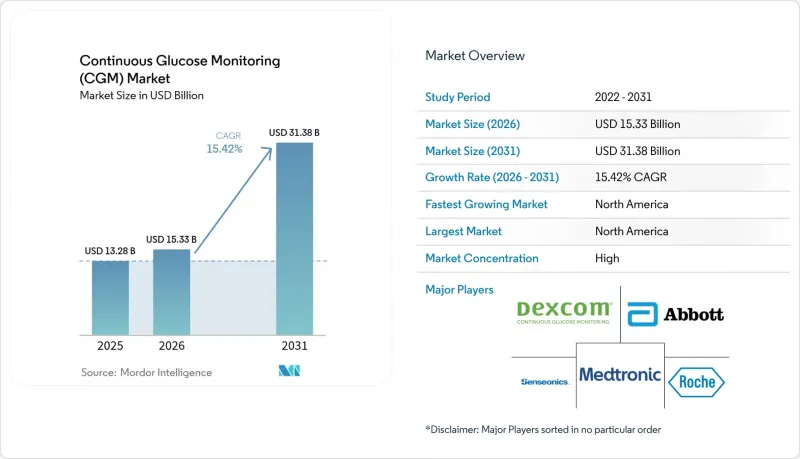
연속 혈당 모니터링 시장 규모는 2025년에 132억 8,000만 달러로 평가되었고 2026년 153억 3,000만 달러에서 2031년까지 313억 8,000만 달러에 이를 것으로 예측되며, 예측 기간(2026-2031년) CAGR은 15.42%를 나타낼 전망입니다.
이러한 견조한 성장은 센서의 소형화, 보험 환급 지원, 그리고 소비자의 웰빙과 의료적 필요의 융합에 기인합니다. 매출은 북미가 1위를 차지하고 있지만, 스마트폰 보급률과 당뇨병 유병률이 겹치는 아시아태평양이 가장 빠른 보급을 보이고 있습니다. 현재 진행 중인 장치와 소프트웨어의 융합은 지속적인 수익원을 창출하고 있으며, 기존 기업들이 하드웨어와 분석 서비스 구독을 결합하여 판매하도록 유도하고 있습니다. 한편, 이식형 및 비침습적 프로토타입은 연속 혈당 모니터링 시장이 예방 및 웰빙 지향적 이용 사례로 확대될 것이라는 기대감을 높이고 있습니다.
세계 연속 혈당 모니터링(CGM) 시장 동향 및 인사이트
당뇨병 유병률 증가와 조기 진단
발병률의 가속화는 구조적 수요를 뒷받침하고 있습니다. 2형 당뇨병이 96%를 차지하며, 아시아태평양에서는 발병 연령이 젊어지는 추세를 보이고 있기 때문입니다. IDF는 현재 이 지역에서는 발병 연령의 중앙값이 45세 미만이며, 수십년동안 모니터링이 이루어지고 있다고 지적했습니다. 인공지능을 활용한 스크리닝의 고도화로 위험군을 조기에 파악하여 예방적 센서 활용을 촉진하고 있습니다. 메디케어의 2024년 정책으로 저혈당 발작이 있는 2형 당뇨병 환자들에게 접근성이 개방되어 보험 가입자가 즉시 증가했습니다. 이미 CAGR 18.41%로 확대되고 있는 소아 분야에서의 도입도 이러한 흐름에 편승하고 있습니다. 학부모들이 학교나 스포츠 환경에서의 안전 대책으로 연속 모니터링을 중요시하고 있기 때문입니다.
원격 모니터링 및 원격 의료 통합의 급속한 확산
실시간 데이터 스트림을 통해 임상의는 추가 인력 배치 없이도 더 많은 환자를 관리할 수 있으며, 미국의 CPT 코드에 기반한 상환 시스템은 원격 환자 모니터링 키트를 도입하는 의료 서비스 제공업체에게 보상을 제공하는 구조로 되어 있습니다. 미국 및 유럽 각지의 지방에 거주하는 환자들은 장시간 이동하지 않고도 전문의의 감독을 받을 수 있게 되어 치료 순응도와 혈당 조절이 향상되고 있습니다. 스마트폰 전용 앱은 전용 수신기 비용을 절감하고, 젊은 층과 기술에 정통한 사용자들의 장벽을 없애고 있습니다.
지불자와 환자의 높은 장비 및 소모품 비용
10-14일마다 교체해야 하는 센서는 미국 메디케어 수급자에게 자부담까지 포함하면월100-200달러의 비용이 발생해 고정 수입에 부담을 주고 있습니다. 중저소득 국가에서는 보조금이 없는 소매가격이 평균월소득을 상회하고 있습니다. 구독 모델은 초기 비용을 절감할 수 있지만, 여전히 많은 사람들이 감당할 수 없는 가격입니다. 혁신적인 종량제 및 성과연동형 계약은 이러한 경제적 장벽을 완화할 수 있는 잠재력을 가지고 있지만, 아직 널리 도입되지는 않은 상태입니다.
부문 분석
2025년에는 센서가 매출의 84.35%를 차지하고 CAGR 17.10%로 견인해 필수적인 생리적 터치포인트로서의 역할을 반영했습니다. 지속적인 소재 혁신으로 주류 일회용 제품의 착용 기간은 10 일에서 14 일로 연장되고, 이식형 제품은 1 년에 1 회 교체 주기를 실현할 것으로 예측됩니다. 수명 연장은 총소유비용(LOC)을 직접적으로 낮추기 때문에 센서 분야의 연속 혈당 모니터링 시장 규모가 매출 확대의 주요 원동력이 되고 있습니다. 반면, 송신기 하드웨어의 CAGR은 5.98%에 불과했습니다. 이는 Bluetooth Low Energy 모듈과 스마트폰에 직접 연결되는 아키텍처로 인해 이 계층이 상품화되고 있기 때문입니다. 플랫폼 공급업체들은 현재 센서 하우징과 스마트폰 앱에 송신기 기능을 통합하고 있으며, 이는 단가 수익률에 압박을 가하는 한편, 설정 간소화를 통해 소비자를 끌어들이고 있습니다.
2세대 센서 기술은 효소 안정화 및 고분자 필름을 활용하여 드리프트를 억제하고, 보다 적극적인 인슐린 투여 알고리즘과 자동 인슐린 투여 시스템의 통합을 가능하게 합니다. Glucotrack과 Senseonics의 임베디드 솔루션은 얇고 유지보수가 적은 장치로의 전환을 상징하며, 지금까지 충분히 다루어지지 않았던 직업과 스포츠 분야를 개척할 수 있는 가능성을 가지고 있습니다. 센서가 반 임베디드 디바이스로 진화하면서 소프트웨어 분석과 클라우드 구독의 매출 비중이 증가하고, 가치 창출의 축이 하드웨어에서 장기적인 데이터 서비스로 이동하고 있습니다.
지역별 분석
북미는 잘 구축된 보험 제도와 높은 기기 활용 능력에 힘입어 2025년 50.55%의 점유율을 유지했습니다. 이 지역에서는 2031년까지 연평균 복합 성장률(CAGR) 15.05%로 78억 7,000만 달러의 매출 증가가 예상됩니다. 2024년 4월 메디케어(Medicare) 정책으로 저혈당 기록이 있는 2형 당뇨병 환자까지 적용 대상이 확대되면서 잠재적 성인층이 확보되어 지속적인 판매량 증가를 기대할 수 있게 되었습니다. 캐나다의 단일 지불자 제도는 처방약 목록을 전국적으로 통일하고 주 간 격차를 해소하고 있습니다. 한편, 멕시코의 사회보장 개혁으로 인해 도시지역에서 의료기기에 대한 의료비 상환 범위가 확대되고 있습니다.
현재 18.85%의 점유율을 차지하고 있는 아시아태평양은 15.78%의 가장 높은 CAGR을 기록하고 있습니다. 중국 국가 보험 의약품 목록에서 2025년부터 센서의 시범 채택이 시작되고, 국내 제조업체들은 2급 도시 수요를 충족시키기 위해 생산 규모를 확대되고 있습니다. 인도에서는 높은 스마트폰 보급률과 종량제 보험 앱이 결합되어 가정 내 도입 장벽이 낮습니다. 일본과 한국에서는 대형 가전업체들이 다기능 웨어러블 기기에 혈당 측정 모듈을 내장하고 있어 1인당 보급률이 높은 수준을 유지하고 있으며, 이러한 추세는 동남아시아에도 파급될 가능성이 있습니다.
유럽에서는 보편적 의료보험과 조달 일원화에 힘입어 한 자릿수 중반의 성장이 예상됩니다. 독일에서는 CGM이 1형 당뇨병 환자의 표준 치료법으로 권장되고 있으며, 영국 NHS 장기 계획에서는 공장 보정된 모델로 하드웨어 업데이트에 대한 보조금을 지급하고 있습니다. 동유럽 시장은 미개척 분야로 부상하고 있으며, 체코와 폴란드는 2025년 시범사업에 대한 자금 지원을 시작하여 EU 구조기금을 활용하여 당뇨병 치료의 현대화를 추진하고 있습니다.
기타 특전:
- 엑셀 형식 시장 예측(ME) 시트
- 3개월간 애널리스트 지원
자주 묻는 질문
목차
제1장 서론
제2장 분석 방법
제3장 주요 요약
제4장 시장 구도
제5장 시장 규모와 성장 예측
제6장 경쟁 구도
제7장 시장 기회와 향후 전망
JHS 26.05.20The continuous glucose monitoring market size was valued at USD 13.28 billion in 2025 and estimated to grow from USD 15.33 billion in 2026 to reach USD 31.38 billion by 2031, at a CAGR of 15.42% during the forecast period (2026-2031).
Robust growth stems from sensor miniaturization, supportive reimbursement, and the blending of consumer wellness with medical necessity. North America leads revenue generation, but Asia Pacific records the fastest uptake as smartphone penetration and diabetes prevalence converge. Ongoing device-software convergence creates recurring revenue streams that entice incumbents to bundle hardware with analytics subscriptions. Meanwhile, implantable and non-invasive prototypes foster expectations that the continuous glucose monitoring market will broaden into preventive and wellness-oriented use cases.
Global Continuous Glucose Monitoring (CGM) Market Trends and Insights
Rising Prevalence of Diabetes and Earlier Diagnosis
Accelerating incidence underpins structural demand because type 2 accounts for 96% of cases and is trending younger in Asia Pacific, where the median onset now falls below 45 years, creating decades-long monitoring horizons, IDF. Enhanced screening powered by artificial intelligence identifies at-risk cohorts earlier, prompting preventive sensor use. Medicare's 2024 policy opened access for type 2 patients with hypoglycemic episodes, instantly raising the insured base. Pediatric adoption, already growing at 18.41% CAGR, rides this wave as caregivers view continuous tracking as a safety net for school and sports environments.
Rapid Uptake of Remote Monitoring and Tele-Health Integration
Real-time data streams allow clinicians to manage more people without extra staff, and U.S. CPT-code reimbursements reward providers who deploy remote patient-monitoring kits. Rural patients in the United States and across Europe gain specialist oversight without long drives, improving adherence and glycemic control. Smartphone-native apps cut dedicated receiver costs, lifting barriers for younger, tech-savvy users.
High Device and Consumable Costs for Payers and Patients
Sensors that require replacement every 10-14 days cost USD 100-200 per month for U.S. Medicare beneficiaries after coinsurance, straining fixed incomes. In low- and middle-income countries, unsubsidized retail prices exceed average monthly wages. Although subscription models lower entry costs, they remain out of reach for many. Innovative pay-per-use or outcomes-based contracts could mitigate financial hurdles, yet broad implementation is still nascent.
Other drivers and restraints analyzed in the detailed report include:
- Sensor Miniaturization and Accuracy Breakthroughs
- Favorable Reimbursement Expansion in OECD & China
- GLP-1 Weight-Loss Drugs Reducing Glucose Testing Frequency
For complete list of drivers and restraints, kindly check the Table Of Contents.
Segment Analysis
Sensors delivered 84.35% revenue in 2025, underpinning a 17.10% CAGR that reflects their role as the indispensable physiological touchpoint. Continuous material innovation increased wear life from 10 to 14 days on mainstream disposables, while implantable variants promise annual exchange intervals. Extended longevity directly lowers lifetime ownership costs, making the continuous glucose monitoring market size for sensors the primary engine of topline expansion. Transmitter hardware, by contrast, booked just a 5.98% CAGR as Bluetooth Low Energy modules and direct-to-phone architecture commoditize that layer. Platform vendors now bundle transmitter functions into sensor housings or smartphone apps, pressuring unit margins but captivating consumers through simplified setups.
Second-generation sensor chemistry leverages enzyme stabilization and polymer membranes to curtail drift, enabling more aggressive insulin dosing algorithms and automated insulin delivery integration. Implantable solutions from Glucotrack and Senseonics highlight a migration toward low-profile, maintenance-light devices that could open occupational and athletic niches previously underserved. As sensors evolve into semi-implantable assets, software analytics and cloud subscriptions accrue increasing wallet share, pivoting value creation away from hardware toward longitudinal data services.
The Continuous Glucose Monitoring (CGM) Market Report is Segmented by Component (Sensors, Transmitters, Receivers), End User (Hospitals/Clinics, Home/Personal), Demography (Adult, Paediatric), and Geography (North America, Europe, Asia-Pacific, Middle East and Africa, South America). The Market Forecasts are Provided in Terms of Value (USD).
Geography Analysis
North America retained 50.55% share in 2025, supported by entrenched insurance frameworks and high device literacy. The region is forecast to add USD 7.87 billion in incremental sales at a 15.05% CAGR to 2031. Medicare's April 2024 policy expanded eligibility to type 2 diabetics with documented hypoglycemia, unlocking a latent adult cohort and ensuring sustained unit growth. Canada's single-payer system aligns formularies nationally, smoothing provincial disparities, while Mexico's social-security reforms broaden device reimbursement in urban centers.
Asia Pacific, now at 18.85% share, records the steepest CAGR of 15.78%. China's National Reimbursement Drug List began piloting sensor inclusion in 2025, and domestic manufacturers are scaling to meet tier-2 city demand. India's high smartphone penetration, coupled with pay-as-you-go insurance apps, lowers household entry barriers. Japan and South Korea maintain high per-capita uptake because consumer-electronics majors embed glucose modules into multipurpose wearables, a trend likely to ripple across Southeast Asia.
Europe offers mid-single-digit growth underpinned by universal coverage and coordinated procurement. Germany champions CGM as the standard of care for type 1 patients, while the United Kingdom's NHS Long-Term Plan subsidizes hardware upgrades to factory-calibrated models. Eastern European markets emerge as white space; Czechia and Poland introduced pilot funding in 2025, leveraging EU structural funds to modernize diabetes care.
- Abbott Laboratories
- Medtronic
- Dexcom
- Senseonics
- Roche
- A. Menarini Diagnostics S.r.l.
- I-Sens
- Medtrum Technologies Inc.
- Nemaura Medical Inc.
- Zhejiang POCTech Co.,Ltd.
- MicroTech Medical
Additional Benefits:
- The market estimate (ME) sheet in Excel format
- 3 months of analyst support
TABLE OF CONTENTS
1 Introduction
- 1.1 Study Assumptions and Market Definition
- 1.2 Scope of the Study
2 Research Methodology
3 Executive Summary
4 Market Landscape
- 4.1 Market Overview
- 4.2 Market Drivers
- 4.2.1 Rising Prevalence of Diabetes and Earlier Diagnosis
- 4.2.2 Rapid Uptake of Remote Monitoring and Tele-Health Integration
- 4.2.3 Sensor Miniaturization and Accuracy Breakthroughs
- 4.2.4 Favorable Reimbursement Expansion in OECD & China
- 4.2.5 Consumer-Wellness Expansion Beyond Diagnosed Diabetes
- 4.2.6 Subscription Pricing Lowering LMIC Entry Barriers
- 4.3 Market Restraints
- 4.3.1 High Device and Consumable Costs for Payers And Patients
- 4.3.2 Calibration / Data-Overload Usability Concerns
- 4.3.3 GLP-1 Weight-Loss Drugs Reducing Glucose Testing Frequency
- 4.3.4 Cyber-Security and Data-Privacy Vulnerabilities
- 4.4 Supply-Chain Analysis
- 4.5 Regulatory Landscape
- 4.6 Technological Outlook
- 4.7 Porter's Five Forces
- 4.7.1 Threat of New Entrants
- 4.7.2 Bargaining Power of Buyers
- 4.7.3 Bargaining Power of Suppliers
- 4.7.4 Threat of Substitutes
- 4.7.5 Intensity of Competitive Rivalry
- 4.8 Disease-Prevalence Indicators
- 4.8.1 Type-1 Diabetes Population
- 4.8.2 Type-2 Diabetes Population
5 Market Size & Growth Forecasts (Value)
- 5.1 By Component
- 5.1.1 Sensors
- 5.1.2 Transmitters
- 5.1.3 Receivers
- 5.2 By End User
- 5.2.1 Hospitals / Clinics
- 5.2.2 Home / Personal
- 5.3 By Demography
- 5.3.1 Adult
- 5.3.2 Paediatric
- 5.4 By Geography
- 5.4.1 North America
- 5.4.1.1 United States
- 5.4.1.2 Canada
- 5.4.1.3 Mexico
- 5.4.2 Europe
- 5.4.2.1 Germany
- 5.4.2.2 United Kingdom
- 5.4.2.3 France
- 5.4.2.4 Italy
- 5.4.2.5 Spain
- 5.4.2.6 Russia
- 5.4.2.7 Rest of Europe
- 5.4.3 Asia-Pacific
- 5.4.3.1 Japan
- 5.4.3.2 South Korea
- 5.4.3.3 China
- 5.4.3.4 India
- 5.4.3.5 Australia
- 5.4.3.6 Vietnam
- 5.4.3.7 Malaysia
- 5.4.3.8 Indonesia
- 5.4.3.9 Philippines
- 5.4.3.10 Thailand
- 5.4.3.11 Rest of Asia-Pacific
- 5.4.4 Middle East and Africa
- 5.4.4.1 Saudi Arabia
- 5.4.4.2 Iran
- 5.4.4.3 Egypt
- 5.4.4.4 Oman
- 5.4.4.5 South Africa
- 5.4.4.6 Rest of Middle East and Africa
- 5.4.5 South America
- 5.4.5.1 Brazil
- 5.4.5.2 Argentina
- 5.4.5.3 Rest of South America
- 5.4.1 North America
6 Competitive Landscape
- 6.1 Market Concentration
- 6.2 Market Share Analysis
- 6.3 Company Profiles (includes Global level Overview, Market level overview, Core Segments, Financials as available, Strategic Information, Market Rank/Share for key companies, Products & Services, and Recent Developments)
- 6.3.1 Abbott Laboratories
- 6.3.2 Medtronic plc
- 6.3.3 Dexcom Inc.
- 6.3.4 Senseonics Holdings Inc.
- 6.3.5 F. Hoffmann-La Roche Ltd
- 6.3.6 A. Menarini Diagnostics S.r.l.
- 6.3.7 i-SENS, Inc.
- 6.3.8 Medtrum Technologies Inc.
- 6.3.9 Nemaura Medical Inc.
- 6.3.10 Zhejiang POCTech Co.,Ltd.
- 6.3.11 MicroTech Medical
7 Market Opportunities & Future Outlook
- 7.1 White-space & Unmet-need Assessment